Showing posts with label Arctic security. Show all posts

Wednesday, August 19, 2026

Exercise Northern Viking Marks 75 Years of Defense Cooperation

U.S. service members arrived in Keflavik, Iceland, yesterday, joining forces with the Icelandic Coast Guard and other NATO allies for the U.S. 6th Fleet's Exercise Northern Viking 2026.
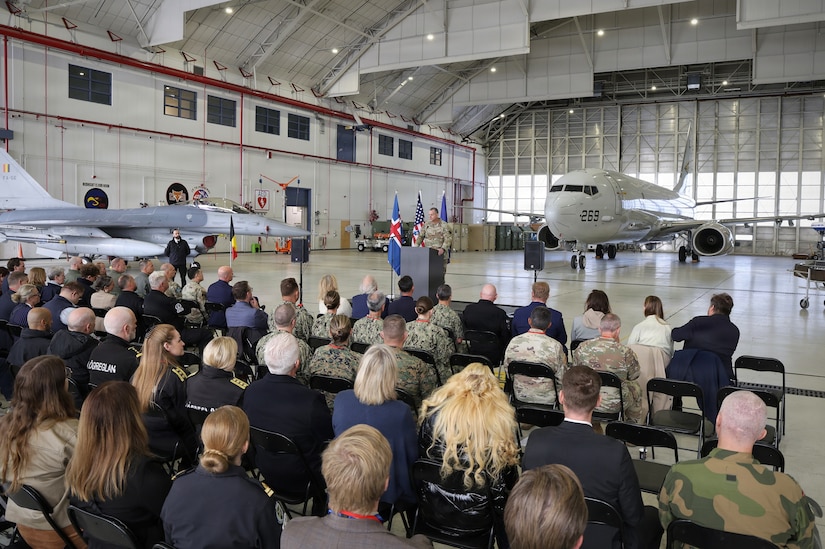
A man in a camouflage military uniform speaks to dozens of people in similar attire and business attire seated in an aircraft hangar; there are two military aircraft in the background.

Participating nations include Belgium, Denmark, France, Iceland, Norway, Poland and the U.S., alongside specialized assets and personnel assigned to the Allied Maritime Command and NATO Joint Force Command Norfolk.

"Our defense cooperation with the United States has thrived for 75 years because it has never stood still; it has developed to meet [the] evolving challenges of our time," said Þorgerður Katrín Gunnarsdóttir, Iceland's minister for foreign affairs, during the exercise's opening ceremony. "The best way to celebrate this anniversary is not merely by commemorating our partnership, but by actually practicing it — together and alongside our allies. Northern Viking is precisely that, a demonstration that the commitments we have made to one another are dynamic, practical and built on trust, underpinned by shared interests."

This year's iteration of the biennial exercise marks the 75th anniversary of the 1951 bilateral defense agreement between Iceland and the U.S. Running from Aug. 22 to Sept. 3, Northern Viking will challenge joint and coalition forces with a series of highly realistic training scenarios.

Key training opportunities will focus on antisubmarine warfare, mine countermeasures, expeditionary construction, search and rescue, humanitarian medical response and disaster response.
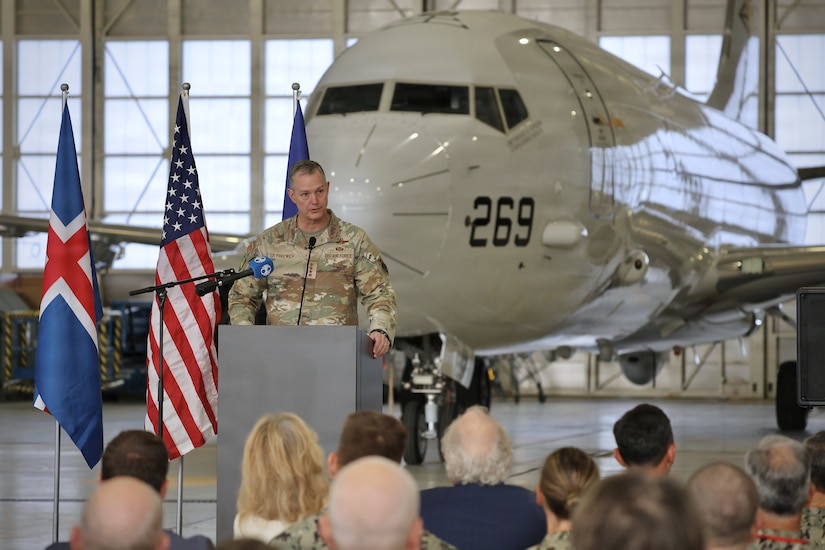
A man in a camouflage military uniform speaks to dozens of people in similar attire and business attire seated in an aircraft hangar; the American, Iceland and NATO flags are displayed behind him, and a large military aircraft is in the background.
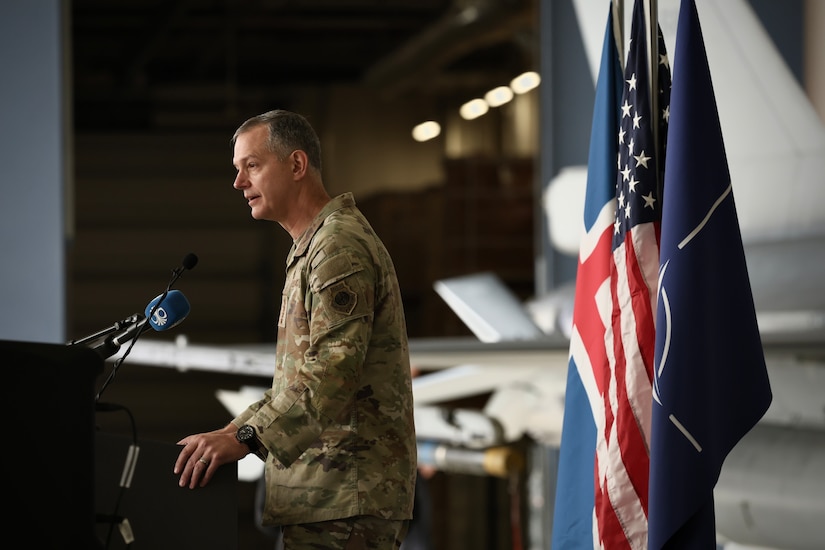
A man in a camouflage uniform speaks into a microphone while standing behind a lectern; the American, Iceland and NATO flags are displayed behind him.
"Seventy-five years of bilateral defense cooperation is a testament to the unbreakable bond between the United States and Iceland," said U.S. Navy Vice Adm. J. T. Anderson, U.S. 6th Fleet commander. "Northern Viking 2026 is a demonstration of our commitment to the collective defense of the North Atlantic. Together with our allies, we continue to create an environment that allows interoperability among NATO maritime forces so that European allies can take over primary responsibility for deterrence and defense in the European theater."

Exercise Northern Viking 2026 is designed to strengthen interoperability and force readiness between the U.S., Iceland and other allied nations. The exercise enables critical multidomain command and control of joint and coalition forces defending Iceland and safeguarding the sea lines of communication within the waterways between Greenland, Iceland and the United Kingdom.

As a vital global shipping corridor, keeping this area secure is an imperative for transatlantic trade, commerce and security between North America and Europe.

"Together, we're honing our warfighting skills and ensuring our ability to secure this critical region and to project decisive combat power wherever and whenever necessary," said Air Force Gen Alexus G. Grynkewich, NATO supreme allied commander Europe and commander of U.S. European Command. "Throughout this exercise, and others, we will leverage the power of data in [artificial intelligence] enabled decision support tools, will integrate data streams in real time and ensure our command and control structures can make decisions at the speed of future conflict."

The 1951 defense agreement was the foundation of a unique security framework designating the U.S. as responsible for Iceland's defense in the absence of its own standing military. This treaty established a highly specialized and enduring defense presence in the region.

Over the last 75 years, this partnership has adapted from Cold War deterrence to modern multidomain defense operations, ensuring that the transatlantic bridge remains open and secure.

Monday, September 22, 2025

Hegseth Hosts Canadian Counterpart at Pentagon for Bilateral Discussion

 Sept. 22, 2025 | By C. Todd Lopez, Pentagon News

Secretary of War Pete Hegseth today hosted the Canadian Minister of National Defense David McGuinty for a bilateral discussion at the Pentagon. 

Canada is one of the United States' closest defense partners as both nations share responsibility for defense of North America through the North American Aerospace Defense Command. 

"Our great nations have served together in many wars. ... And today our warfighters continue that, serving together through joint exercises, defending the homeland and really the only binational command of its kind, which is NORAD," Hegseth said. 

The secretary said the work at North American Aerospace Defense Command is important for the defense of North America, but also that there's much that can be done between the U.S. and Canada to modernize its operations. 

"The threats to North America require a strong U.S.-Canada defense relationship — there's no doubt," Hegseth said. "And I know Canada has committed at the [NATO] summit to increasing defense spending to 5% of [gross domestic product] by 2035, which is incredible to see. A very strong step." 

The Canadian Prime Minister Mark Carney announced in June an additional $9.3 billion in defense investments, McGuinty said. These investments bring Canada's commitment to defense to 2% of its GDP "a full five years ahead of schedule." 

McGuinty said the increase in spending is not just about budgets. 

"It's a game changer," he said. "These investments are building combat-ready forces, recruiting and retaining the best, modernizing critical infrastructure on 33 bases, upgrading our cyber [and] our digital defense, [and] sharpening our ability to fight shoulder-to-shoulder with folks like you." 

Canada, like the U.S., is also working to strengthen its defense industrial base, McGuinty said. 

"We're launching a major defense industrial strategy for the country; cutting through red tape to deliver faster, improving resilience, securing access to vital resources, like critical minerals — turns out, we have lots of those," he said. "These hard power capabilities are going to ensure we're ready to strike back and defend whenever and wherever we need." 

While Canada is stepping up its defense involvement in both the Euro-Atlantic and Indo-Pacific regions, McGuinty said homeland defense in North America, in partnership with the U.S., remains the top priority. 

"Defending North America remains our top priority," McGuinty said. "That starts in the Arctic — our shared front line. Canada is locked in to protect the north, its people, its environment and its strategic advantage. It's where our sovereignty, our national security and our partnership with the U.S. comes together strongest. So, from NORAD modernization to Arctic surveillance and infrastructure, we're taking major and fast, bold, decisive action to shore up our collective defense."