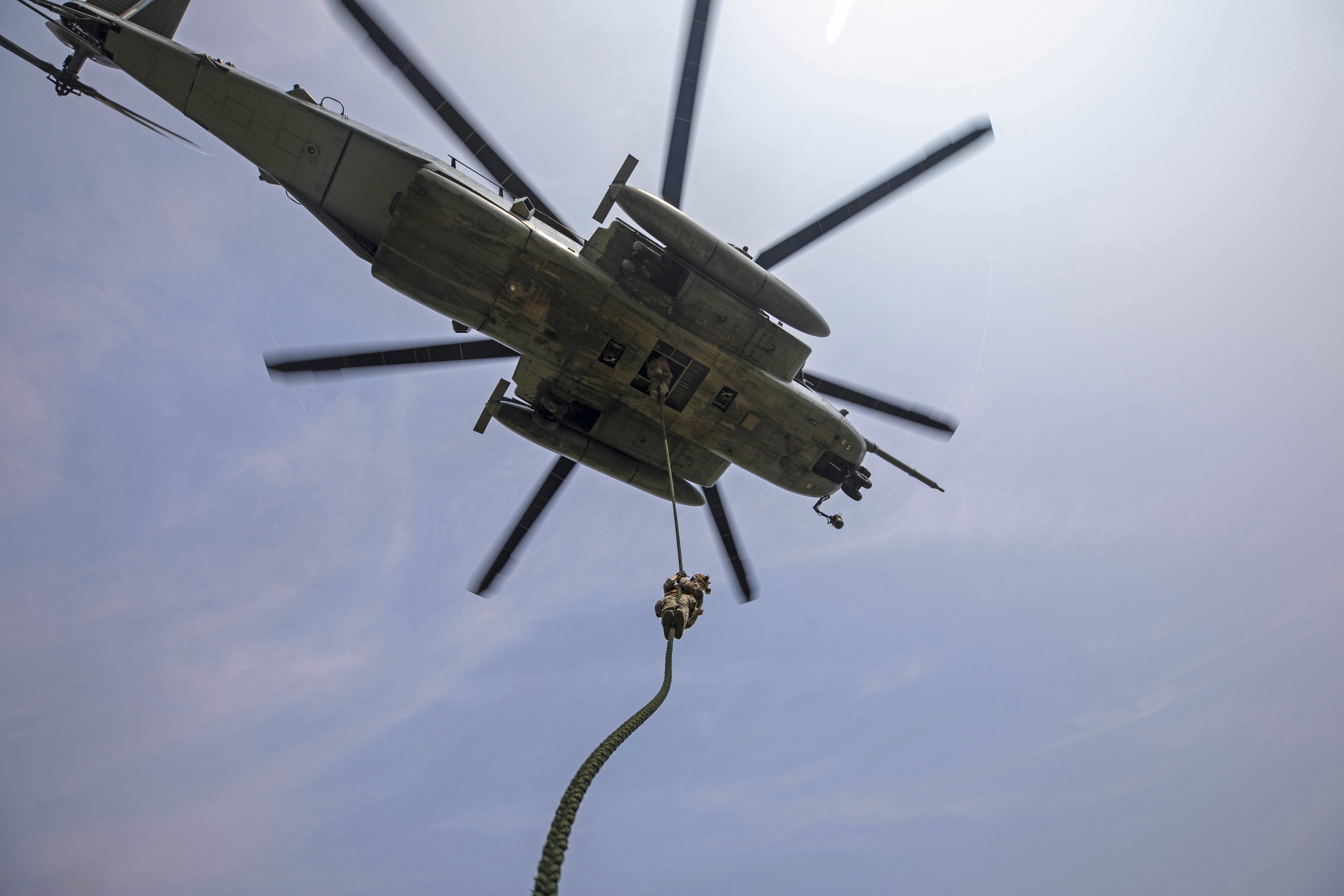
Marine Corps Cpl. Derian Webber fast ropes from a CH-53E Super Stallion during a course at Marine Corps Base Camp Lejeune, N.C., July 22, 2021.
Providing up-to-date information, news and original content on American Military issues.
Marine Corps Cpl. Derian Webber fast ropes from a CH-53E Super Stallion during a course at Marine Corps Base Camp Lejeune, N.C., July 22, 2021.
July 27, 2021 | BY David Vergun , DOD News
Army Gen. James H. Dickinson said today that the role of the Space Force is to organize, man, train and equip space forces, while Spacecom employs those forces in operations.
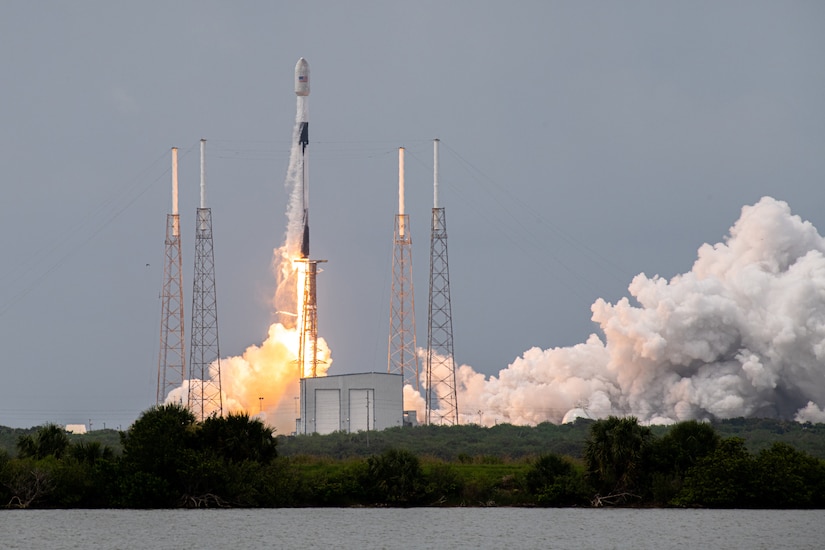
Both Spacecom and the Space Force were created because of the threat from adversaries in the space domain and the need to protect and defend space assets from those adversaries, he said.
Dickinson noted that the mission of Spacecom is to deter a war beginning or extending into space, and, should deterrence fail, Spacecom is prepared to fight and win with the help of the other combatant commands, allies and partners.
"Our adversaries have militarized space. And in response, we have established the structures necessary to protect and defend our assets against those capabilities," he said.
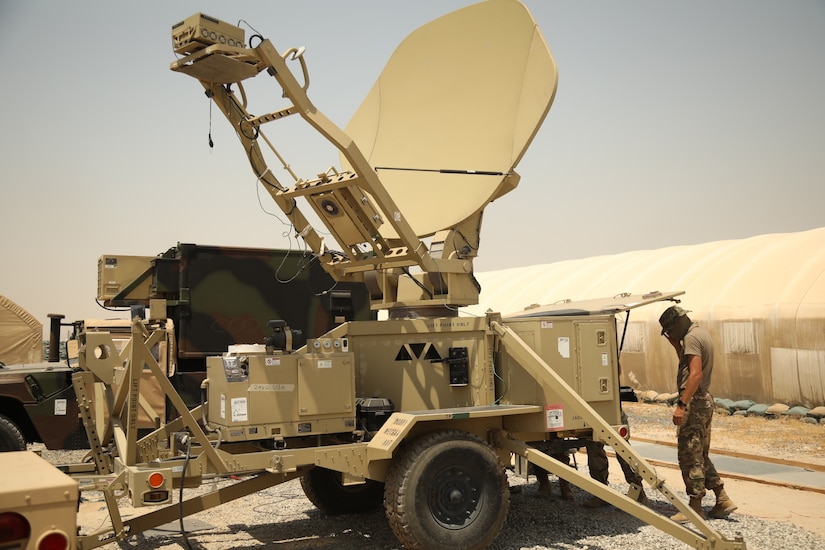
"Many Americans still don't quite grasp how important our assets in space really are and don't understand how their daily lives are tied to assets in space. Space-based capabilities enable virtually every element of our national power, including diplomacy, economics, finance and information," he said.
Space is vast and complex, Dickinson said. Spacecom's area of responsibility extends about 100 kilometers above the Earth and extends into infinity.
"[Spacecom] simply can't go it alone. We are closely aligned and in sync with all the 11 other combatant commands," he said, noting that U.S. Cyber Command, in particular, plays a critical part in space capability, along with the National Reconnaissance Office.
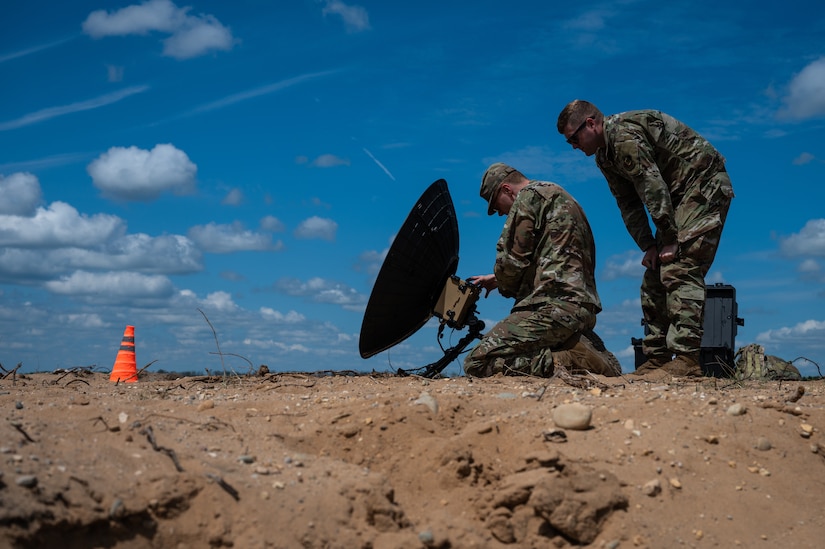
Spacecom is also partnered with industry, he said. The Commercial Integration Cell has been stood up now for quite some time at Vandenberg Air Force Base, California. "We have an incredible number of commercial partners who are willing and able and want to be part of the team.
"So, this is a very exciting time in terms of both our work within the whole of government, as well as those with our commercial partners," he said.
As for the Spacecom workforce, Dickinson said it is looking not only for the best and brightest in the science, technology, engineering and math fields, but also lawyers, planners and other non-STEM personnel who can contribute to the mission.
"Those skills sets together in the combatant command is what really makes us powerful and able to go quickly and to be agile enough in this changing environment that we're seeing in the space domain," he said.
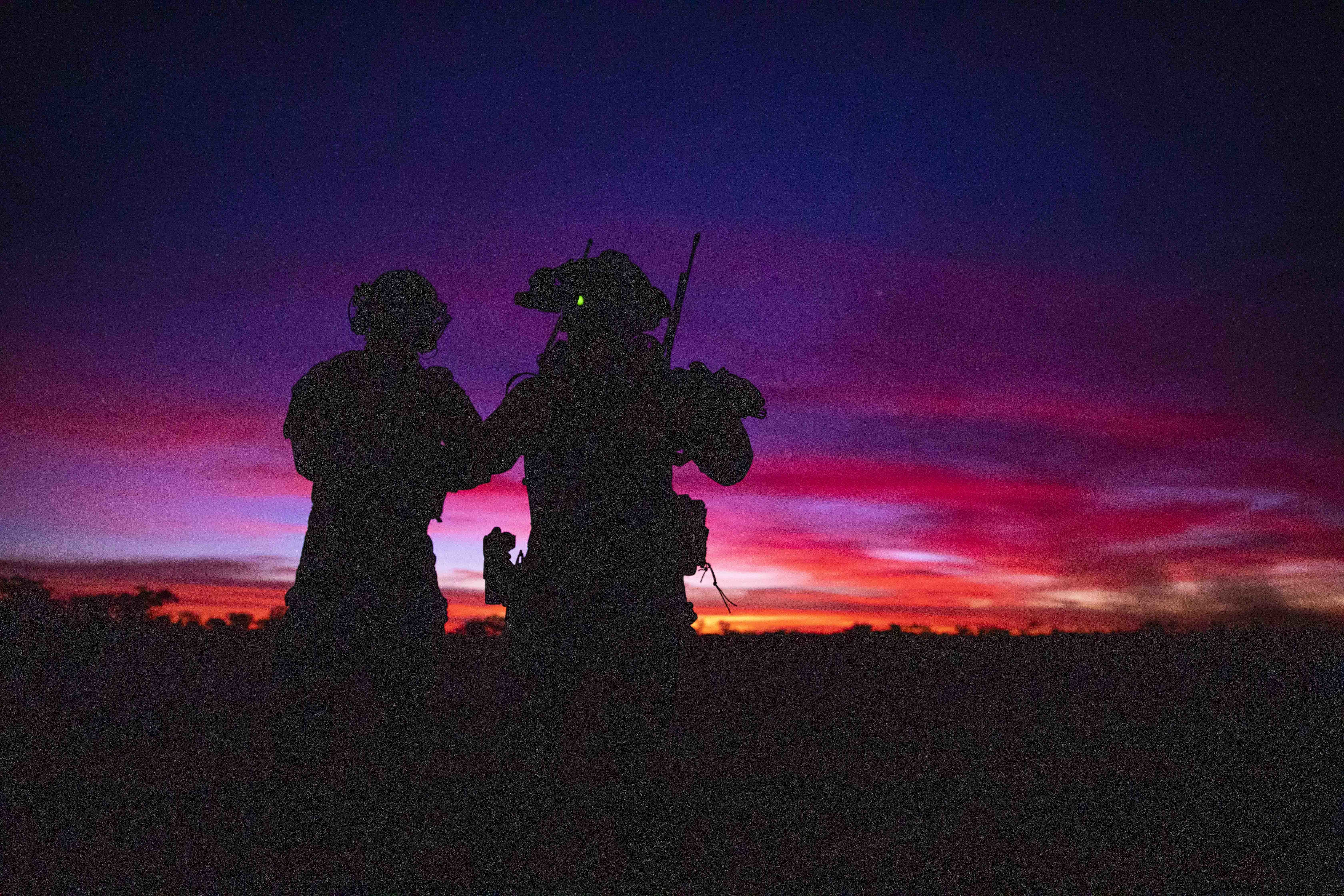
Airmen provide aircraft security during Talisman Saber at Royal Australian Air Force Base Tindal, Australia, July 18, 2021. The exercise is designed to strengthen capabilities to respond to security concerns in the Indo-Pacific region.
July 27, 2021 | BY C. Todd Lopez , DOD News
The Defense Department today revealed the prisoner of war/missing in action commemorative poster which, leading up to POW/MIA Recognition Day in September, will highlight ongoing efforts made by the department to provide the fullest possible accounting of the soldiers, sailors, Marines and airmen still missing from past conflicts.
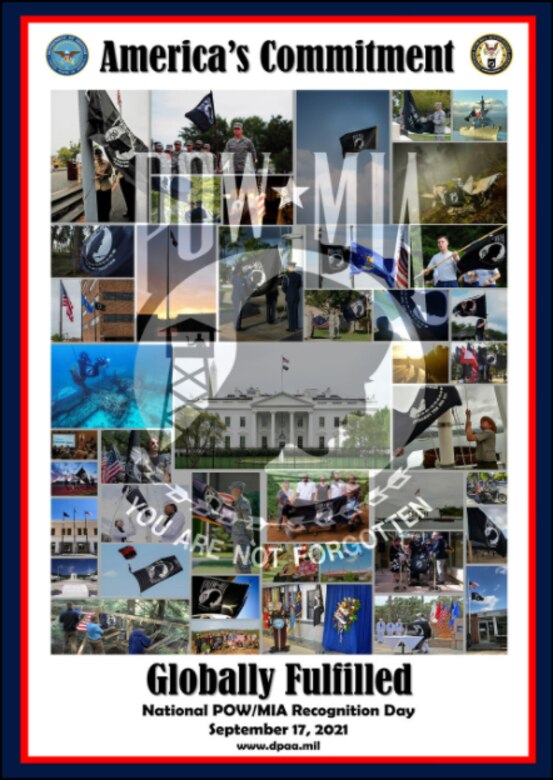
Each year, the department creates a poster in advance of POW/MIA Recognition Day, which will be commemorated on Sept. 17.
Deputy Defense Secretary Kathleen H. Hicks explained that since the Revolutionary War, more than a half-million U.S. service members have, at one point in time, been held as prisoners of war.
Today, nearly 82,000 service members remain unaccounted for, from conflicts dating back to World War II, she said. More than 72,000 of those were lost during World War II, nearly 8,000 from the Korean War, and around 1,600 remain unaccounted for from the Vietnam War.
The department remains committed to bringing all of them home, she said.
July 27, 2021 | BY Terri Moon Cronk , DOD News
Patricia Montes Barron discussed "Food Security in the Military: What We Know and Why It Matters," at CSIS today. The U.S. Department of Agriculture defines food insecurity as a lack of consistent access to enough food for an active, healthy life. Those serving on active duty, in the military reserves or in the National Guard experienced food insecurity at double the national average in recent months, according to nationwide surveys. And anecdotal evidence points to heightened rates of food insecurity among U.S. veterans during the COVID-19 pandemic, reports show.

Barron said her office has been hard at work since April to develop a plan for the Defense Department that everybody can wrap their arms around. "We've also started to work with the USDA, and we've just gotten approval to work with the Census Bureau on a military family focus panel," she added.
Food insecurity is one of Secretary of Defense Lloyd J. Austin's III high priorities, she said. "He wants to make sure we're addressing this and getting to it as quickly as we can … [via] Congressional interest, as well as discussions with [the White House's initiative] Joining Forces," she noted.
"We are gathering data and analyzing relevant statistics, which are going to help us better scope the problem," Barron said. "And while my office is taking the lead, we can't do this alone. We need all of DOD and other federal agencies to work together with us."
Trained members of the Military Family Life Counselor Program will help with assessment tools to assist MC&FP in determining if people counselors deal with need nutritional support, she said, adding that the DOD Federal Financial Readiness Office is also developing an assessment tool and will work closely with MC&FP to make sure families know what financial resources are available.
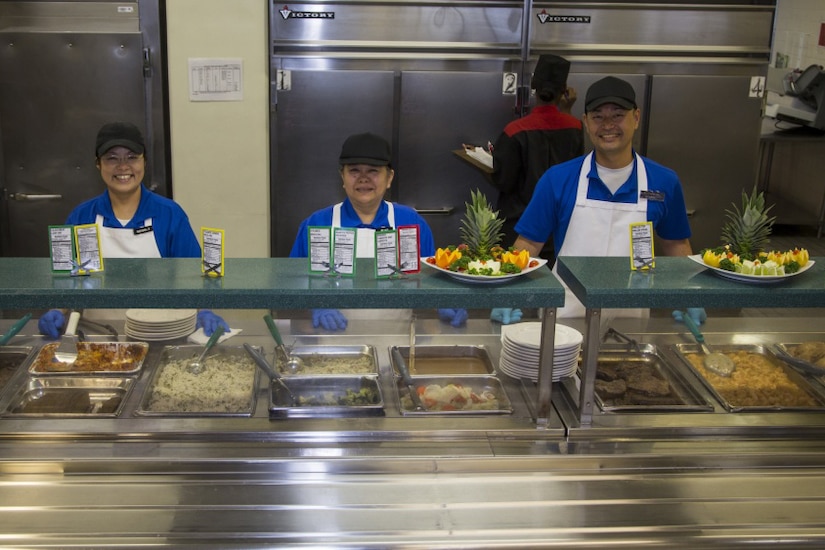
Barron said proper nutrition is vital for readiness and national security . "[If] you are not getting nutritious food, you're not feeding your body and you're not feeding your mind to do the very best that you can do," she said.
"[We're] asking our service members and their families to basically go where they need to go live, give up jobs for spouses," Barron said. "[And] we ask an awful lot of our families, and especially our children who have to move from place to place. Shouldn't we provide them with the very best care that we can? A military family should not have any challenges with food. …We have a plethora of resources; we just need to make sure that our families are aware of them and can take advantage of them."
She said food insecurity is an individual experience, but it's also a family, community and national experience, too. "And if you're not at your best, if you're worried that your family isn't getting enough to eat or if you're worried your family isn't getting the right types of things to eat, that can really impact the overall presence of service members trying to do their jobs and their missions."

Air Force Staff Sgt. Jacob Lara, left, and Senior Airman Matthew Arellano carry a canoe while competing in the Chaos Challenge 2021 at Joint Base Elmendorf-Richardson, Alaska, July 15, 2021. The winner of the multiday event will go on to compete in the 2021 Lightning Challenge to determine the Air Force's best two-person tactical air control party team.
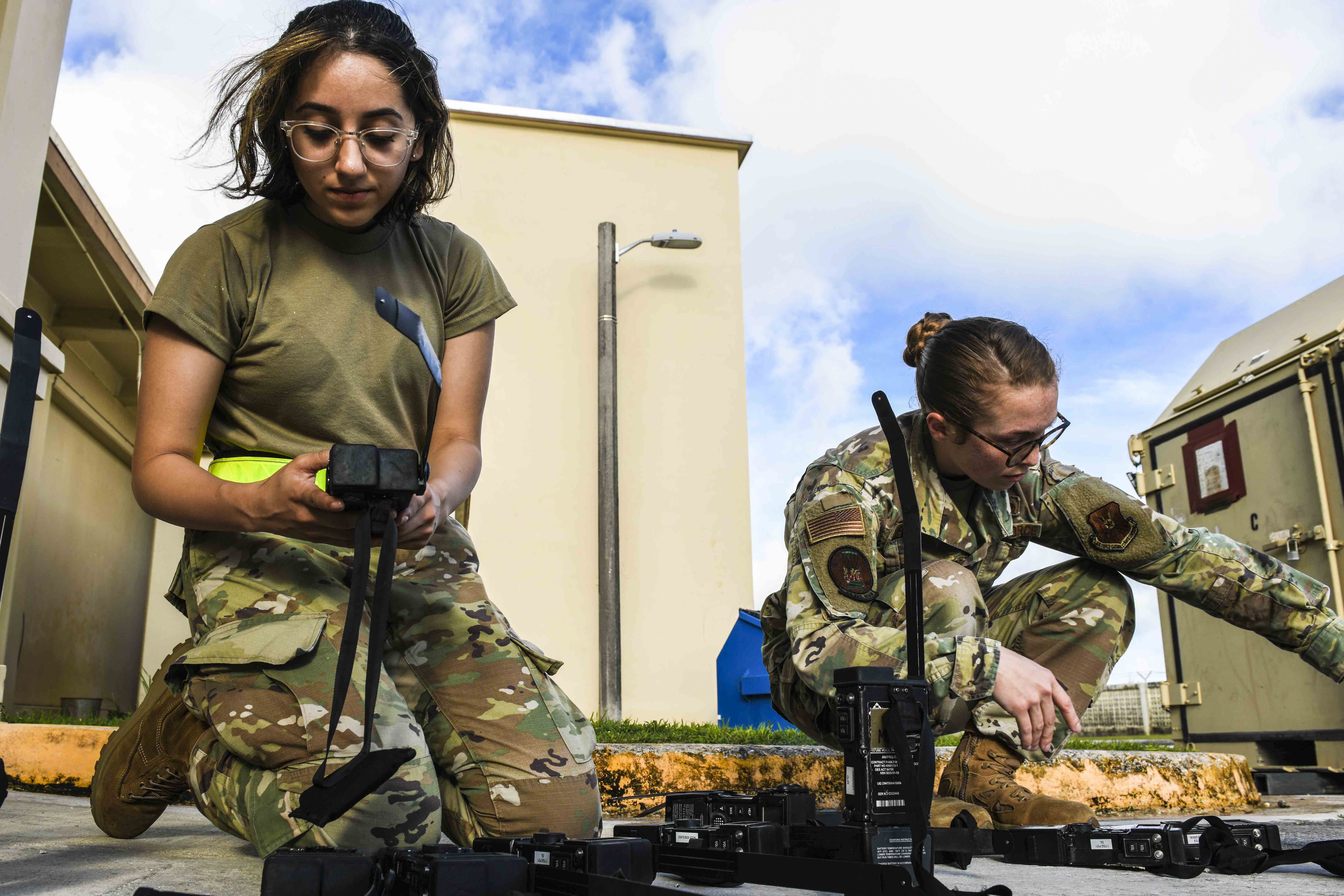
Air Force Staff Sgt. Hannah Pieper and Airman 1st Class Sandra Felix test equipment at Andersen Air Force Base, Guam, July 26, 2021.

The USS America conducts a replenishment with the Australian frigate HMAS Ballarat during Talisman Saber in the Coral Sea, July 27, 2021. The exercise is designed to strengthen capabilities to respond to security concerns in the Indo-Pacific region.
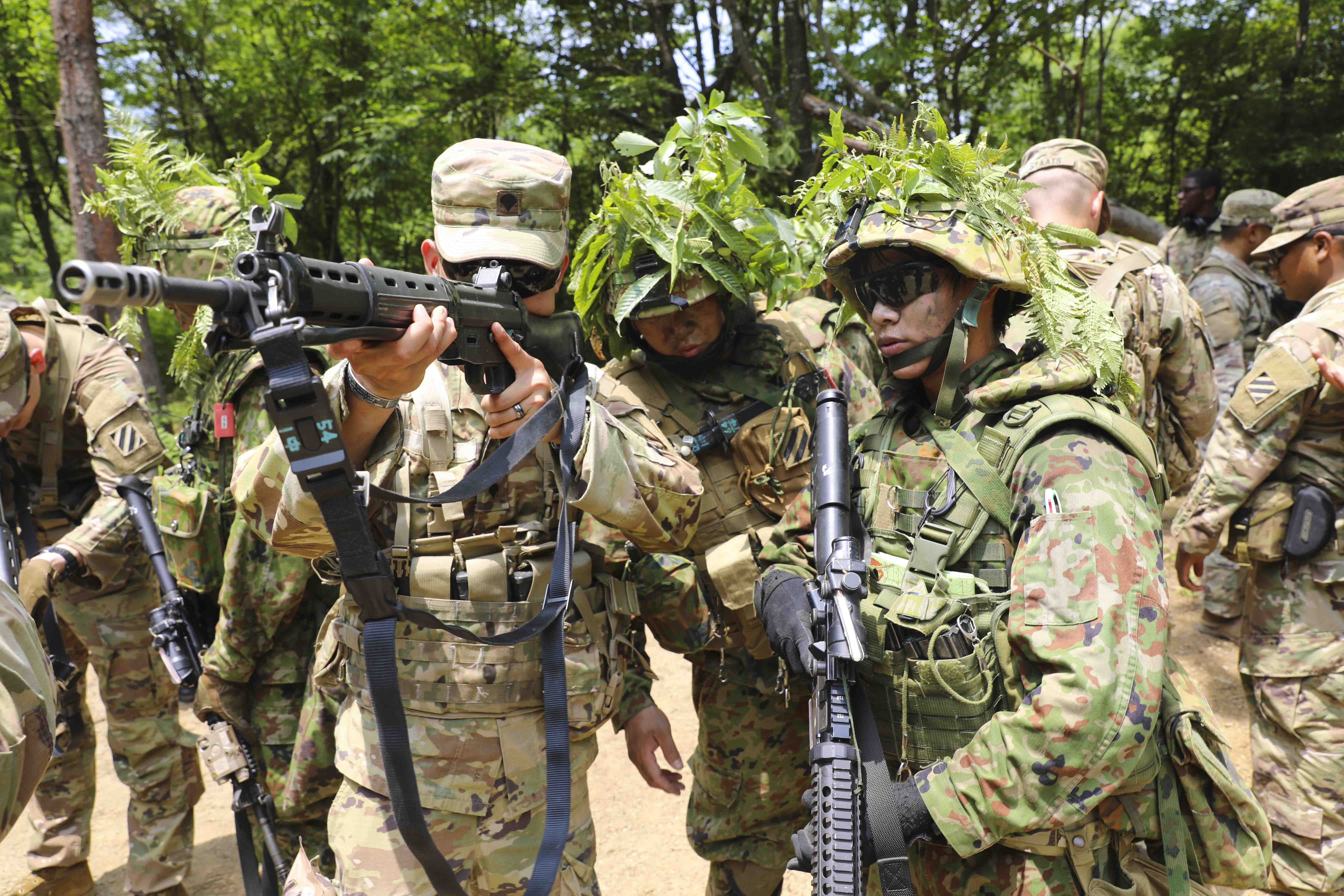
Army Spc. Vuongkhang Luong participates in Orient Shield at Aibano Training Area, Japan, June 24, 2021. The bilateral exercise enhances long-range interception capabilities.

Army Lt. Col. Delubio Rezende, 412th Theater Engineer Command medical advisory officer and medical liaison, gets his nose swabbed for a COVID-19 test as part of pre-mission preparation for exercise Dalan ba Dame 2021 on Andersen Air Force Base in Yigo, Guam, July 16, 2021.
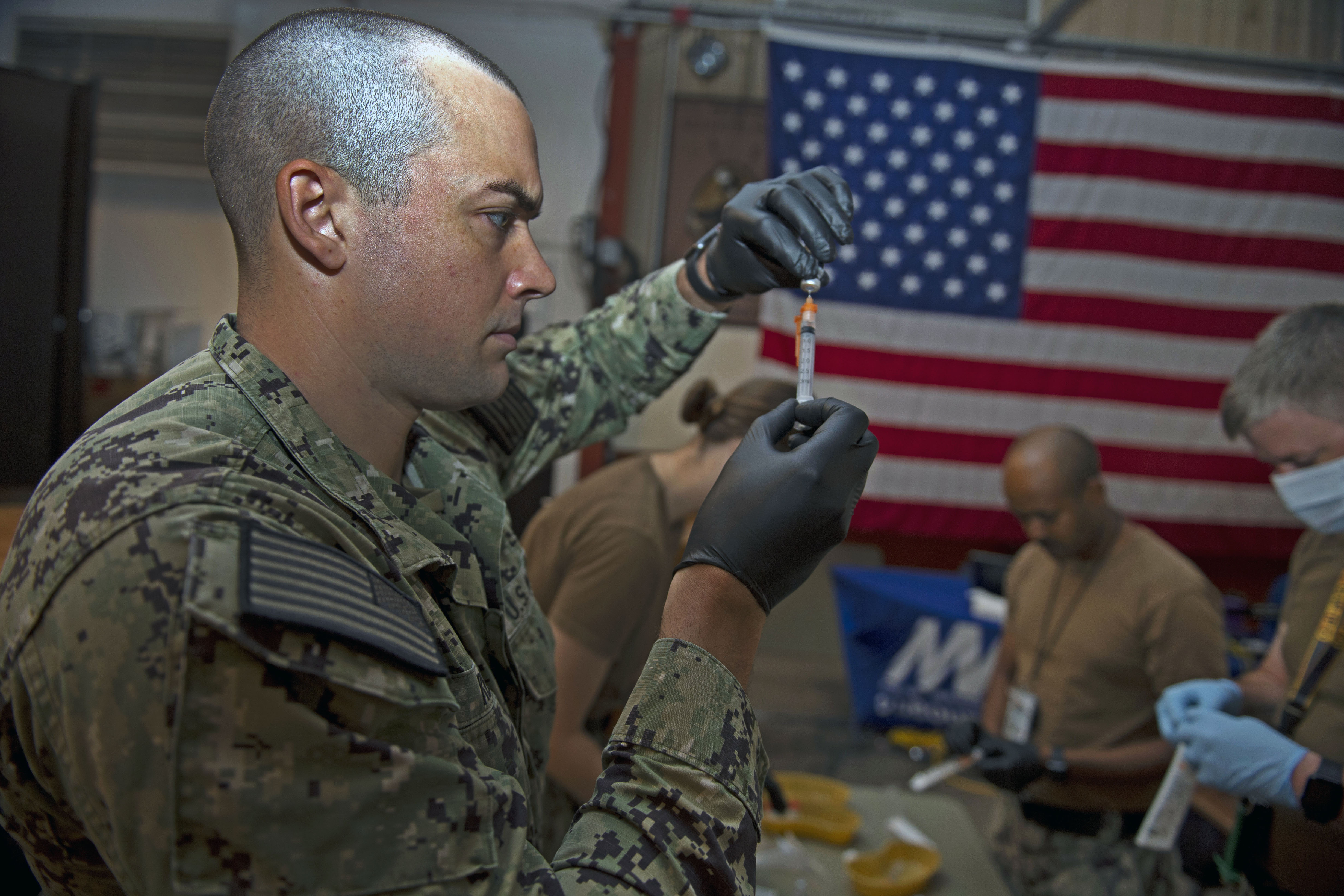
Navy Petty Officer 3rd Class Bryan Reed, assigned to Michaud Expeditionary Medical Facility, prepares supplies for COVID-19 vaccines being administered at Camp Lemonnier, Djibouti, July 8, 2021. Camp Lemonnier is an operational installation that enables U.S., allied and partner nation forces to be where they're needed to ensure security in Europe, Africa and Southwest Asia.

Service members help present the American flag during Military Monday, a community event, at Frontier Park in Cheyenne, Wyo., July 26, 2021.

An airman assembles the framing for structure during a joint training exercise at Gowen Field, Boise, Idaho, June 10, 2021.
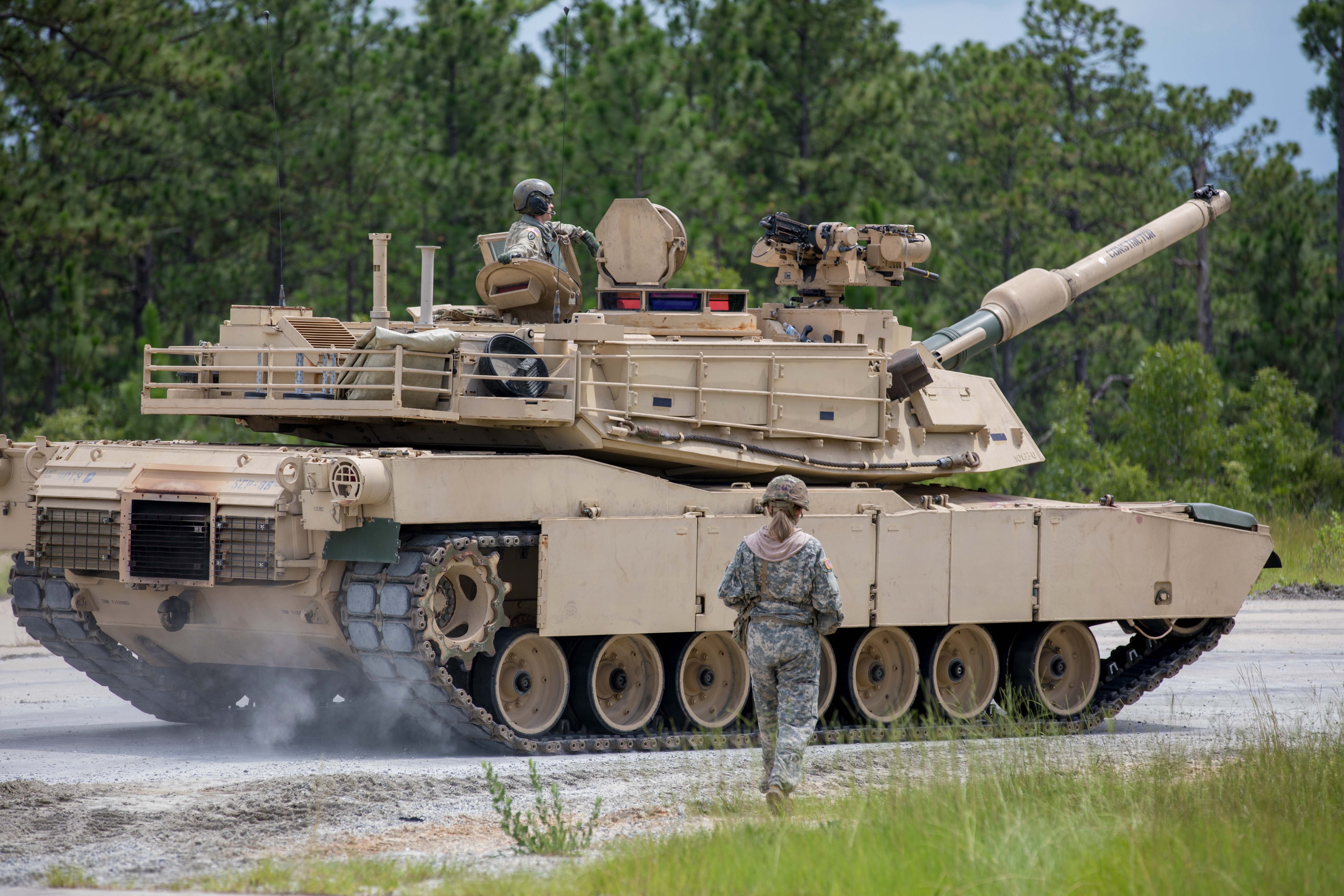
A soldier provides ground guidance for an M1A2 SEP V2 Abrams Tank at Ware Range, Fort Benning, Ga., July 20, 2021.
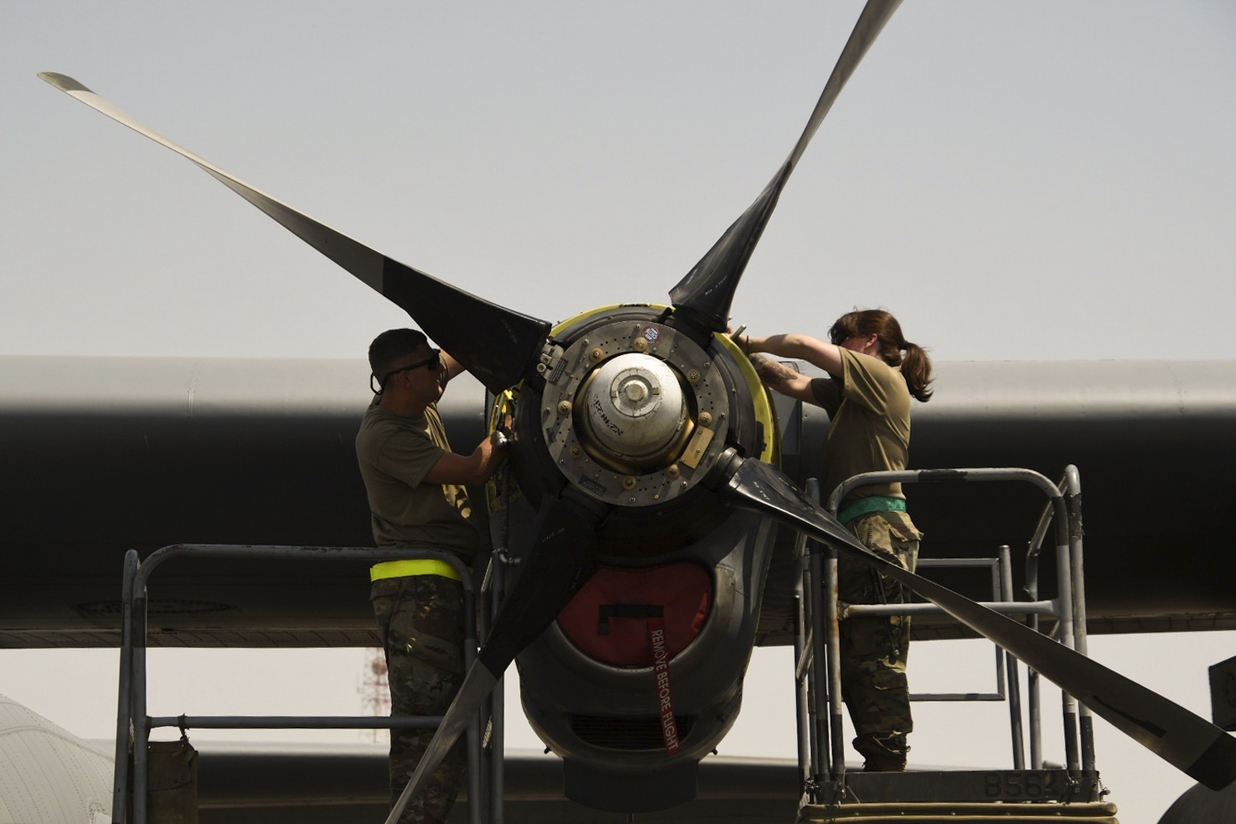
Air Force Tech. Sgt. Jonathan Hall and Staff Sgt. Cecilia Nguyen change a propeller on a C-130J Super Hercules at Ali Al Salem Air Base, Kuwait, July 11, 2021.

A Marine observes a beam hooked to a CH-53E Super Stallion during helicopter support team training at Camp Lejeune, N.C., July 22, 2021.

Air Force Staff Sgt. Troy Gonzalez Mazzone and Senior Airman Drew Bowers participate in building-clearance training in Savannah, Ga., July 22, 2021.

Marines prepare for a boat assault force training exercise aboard the USS New Orleans during exercise Talisman Saber in the Coral Sea, July 20, 2021. The large-scale bilateral exercise between Australia and the United States involves more than 17,000 participants from seven nations.

A Marine jumps into a pool during a swim qualification at Marine Corps Base Camp Pendleton, Calif., July 7, 2021. Marines are required to requalify annually to ensure mission readiness, comfortability in the water and quick response time.



 Posts
Posts

