Army General Daniel R. Hokanson, Chief, National Guard Bureau
STAFF: Ladies and gentlemen, thank you for joining us
today to talk about the National Guard. General Daniel Hokanson, the
chief of the National Guard Bureau, is here to discuss the new mission,
vision and priorities he has set for over 450,000 soldiers and airmen of
the National Guard. He will make an opening statement, and then I will
call on you from here in the room, as well as from the call-in roster,
and alternate between the two. You'll be able to ask one question, and
then I will call on the next reporter so we can get through as many as
possible.
With that, I'd like to introduce to you General Daniel Hokanson.
Sir, over to you.
GENERAL DANIEL R. HOKANSON: Thank you, Tracy.
Good afternoon, ladies and gentlemen, and thank you for the
opportunity to provide an update on our National Guard. Let me start
with a single number: 12 million, 12 million people. That represents
moms, dads, grandparents, neighbors and friends who have received their
COVID-19 vaccination from either National Guard soldiers or National
Guard airmen. Although it is a significant number, it is just one number
in the many missions we do every single day.
Another number is 21 million. That's the number of personnel days for
all missions the National Guard performed in 2020. Whatever the mission
-- combat deployments, COVID, wildfires, civil disturbances or severe
storms, the National Guard answered every call in 2020 and 2021, as we
have for the past 384 years.
As a combat reserve of the Army and the Air Force, we are manned,
trained and equipped to fight our nation's wars. But in times of
emergency, our people, training and equipment help us respond to our
communities.
Last June, more National Guard troops were mobilized than at any time
since World War II. Nearly 120,000 soldiers and airmen were mobilized
supporting combatant commanders overseas or in domestic operations here
at home, and despite the COVID environment, we continued our military
training and met every overseas deployment.
In January, in response to the attack on the Capitol, we mobilized
and deployed over 26,000 National Guardsmen to D.C. within two weeks.
Using organic National Guard air support and logistics, soldiers and
airmen from every single state and territory arrived to help secure our
59th presidential inauguration. "Always ready, always there" is more
than our motto; It's our promise.
This past year was an extraordinary one for the National Guard, and
in the interest of time, I'd like to highlight just one weekend: Labor
Day of '19 -- of 2020. That weekend, more than 64,000 National Guardsmen
were on duty around the world. Roughly 20,000 were deployed across 34
nations in support of our combatant commanders. During the same weekend,
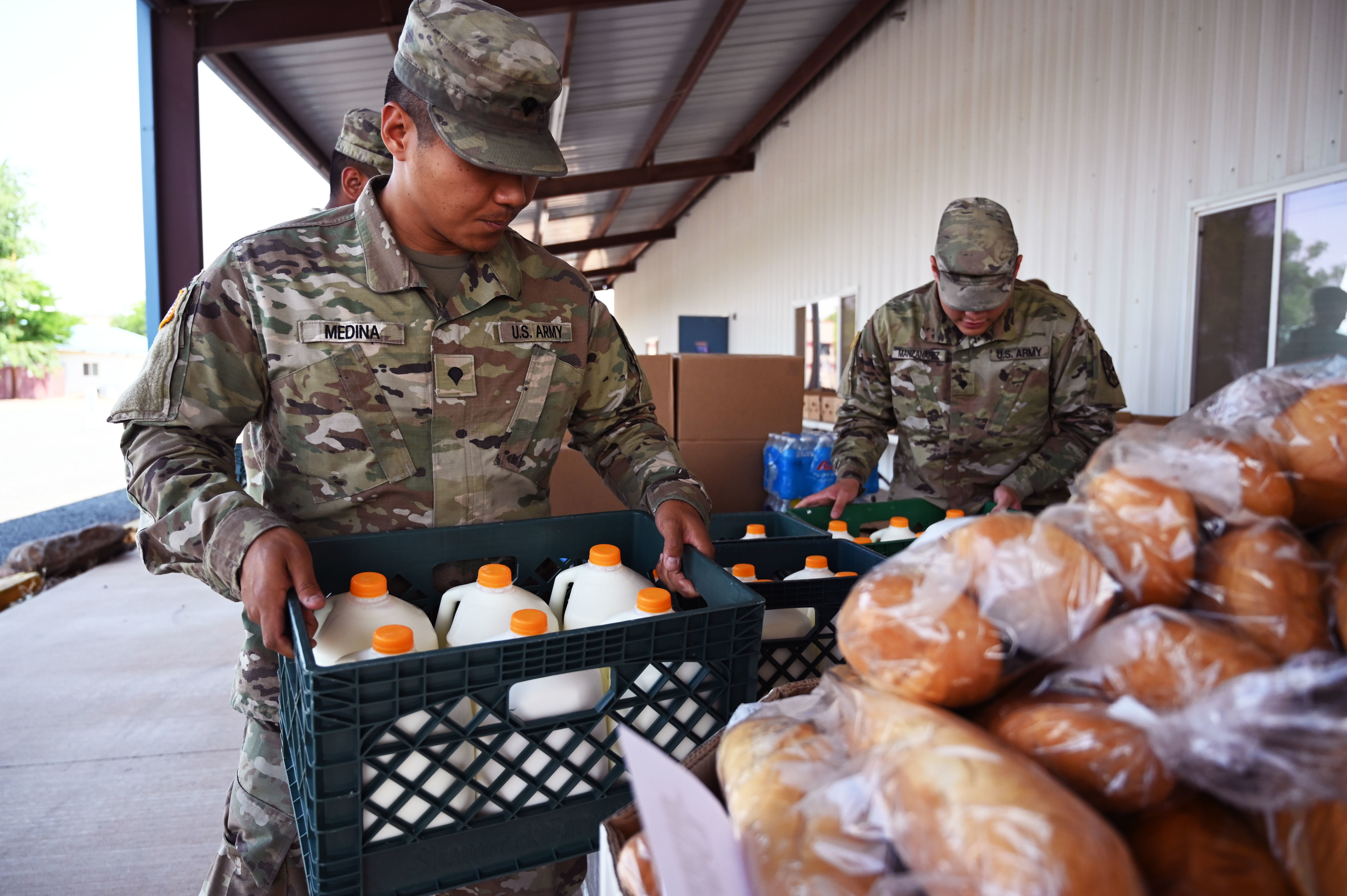
more than 18,000 were helping their communities fight COVID-19, from
manning testing sites, to supporting long-term care facilities, to
working in food banks. More than 3,500 were helping their communities
recover from Hurricane Laura in Texas and Louisiana. More than 2,600
were on our Southwest border, providing aviation and operational support
to the Customs and Border Patrol. More than 1,500 were protecting the
rights of peaceful protesters and safeguarding communities against
violence in Georgia, Texas, Kentucky and Wisconsin. More than 1,100 were
guarding America's skies, from pilots and maintainers manning the
Aerospace Control Alert Mission at fighter and tanker bases across the
country, to the five 24/7 command-and-control sites in the Continental
United States, Alaska and Hawaii. More than 90 were operating our
nation's ground-based missile defense sites in California and Alaska.
That same week in Alaska, a team of Guardian Angel airmen were awarded
the Wilderness Rescue of the Year by the American Red Cross of Alaska
for rescuing two hikers, one who had fallen more than 100 feet off a
cliff.
And still, in the same weekend, specially-modified C-130s from the
California and Nevada Air National Guard, along with helicopters and
unmanned aircraft from multiple states were fighting record wildfires.
This included the dramatic rescue of 240 people trapped by wildfires in
the Sierra National Forest by the California National Guard. This daring
night rescue in heavy smoke was possible because our crews were
equipped with modernized helicopters and the latest-generation night
vision goggles. For their heroism and extraordinary achievement, the air
crews were awarded the Distinguished Flying Cross.
This one weekend tells a story of many weekends for the National
Guard. Our country and our communities needed us, so the men and women
of the National Guard left their families and their civilian jobs and
proudly served as soldiers and airmen. Their selfless service is both
important and inspiring.
In addition to our deployments overseas and operations here at home,
we have also been busy enhancing international partnerships throughout
the globe through our State Partnership Program. Over the last 27 years,
the Department of Defense has formed state partnerships between 82
countries and our 54 states, territories and the District of Columbia.
Through these partnerships, long-term, mutually-beneficial relationships
are formed that further combatant command and U.S. Chief of Mission
goals.
I recently returned from a trip to Africa, where I witnessed the
signing ceremony of our newest partnership between Egypt and the state
of Texas, as well as observed the Utah and Morocco state partnership
program in action during Exercise African Lion 2021.
It is no surprise the National Guard was ready for the challenges we
faced in 2020, and continue to face in 2021. The significant investment
America has made over the last 20 years has transformed our organization
from a Cold War strategic reserve to today's operational reserve, and
clearly highlights the capability, capacity and readiness we bring to
the Joint Force when the National Guard is resourced and modernized.
One out of every five men and women who wear our nation's uniform is a
member of the National Guard, and that's one of the reasons I support
premium-free health care for our service members. Whether they are
serving our nation overseas or their communities here at home, it is
important they have access to medical care so we can keep our promise to
remain always ready, always there.
With that, I welcome your questions.
STAFF: Thank you, General Hokanson.
We'd like to start with A.P. on the phones -- Lita Baldor, please.
Q: Hi, General. Thanks for doing this.
Can you give us a little bit of specifics on the funding that is owed
the National Guard? In several hearings this week, we have heard about
how desperately the Guard across the country needs to be reimbursed for
the funding. What will happen specifically in some of the states in
July, August, if they do not get this reimbursement?
Thank you.
GEN. HOKANSON: And, Lita, thank you.
So if you look at the Operational Capital Response, and the number of
troops we had in the duration, it cost about $521 million. And what we
were able to do is use our funding for operations and maintenance as
well as some of our pay accounts to basically front-load that money so
that we could pay our soldiers and airmen while they were here in the
nation's capitol.
However, that funding is very significant -- that's a significant
amount to any organization, especially the National Guard. And so, for
us to able to meet our training, and operations, and maintenance
requirements for the rest of the year, we will need to be reimbursed
that funding. And I know you asked what the potential ramifications
might be.
So if we don't get that funding fairly soon we'll have to look at not
only August but also September, the last two months in the fiscal year
of either curtailing completely or drastically reducing our National
Guard drill weekends, and annual training as well as our operational
maintenance. So it will have a very significant impact on National Guard
readiness if we're not able to resolve that in a timely manner.
STAFF: Yes Ma’am.
Q: So last year the Guard was -- the operational tempo was so high
essentially, that some of your TAGs started openly pleading for an
increase in end strength in order to meet so many of those missions. And
of course the president's budget now requests dropping 500 soldiers and
airmen from the National Guard. How are you guys going to be able to
make ends meet with fewer people? Are you going to advocate to change
that number, or advocate not to be called on so much -- basically, in
order to balance that.
GEN. HOKANSON: Well, thank you.
So we work very closely with our adjutants general and look at the
OPTEMPO within the state. Because what we're really trying to balance is
for our Guardsmen, their civilian career, their military career and
their family, and try and find the really -- for lack of a better term,
the rheostat, where we can allow them to maintain that and continue to
serve in the National Guard.
And so we look back at 2020, some states had a significant increase
in the amount of OPTEMPO that they had previously had, and so they've
asked for additional force structure. Those decisions are made at the
Secretary of the Army and Secretary of the Air Force level. And of
course like all organizations, we would like to grow if possible.
When you look at that within each state, however, we work with the
states to make sure that they have the personnel. And if it exceeds our
capability we have emergency management assistance compacts where they
can reach out to other states to draw those resources in -- very similar
to what we do during hurricanes.
In the case of one of the Gulf States where they're hit and it
exceeds their capability, we meet every year beforehand to identify
those forces that could come and meet those requirements. So until that
time we'll continue to use the emergency compacts we have between the
states, but we're always ready to grow if the service secretaries agree
to it.
STAFF: All right, on the phone, Steve Beynon, military.com.
Q: General, appreciate you taking the time out today to do this. I've
been talking to a lot of Guardsmen across a lot of different states.
They're just not getting access to gear to train for the ACFT.
It seems like the gear was sent to the states, it's locked up at some
battalion headquarters, inaccessible to a lot of armories at the
moment. And these Guardsmen, they're having to go to crossfit gyms or
find their own equipment, they're not getting reimbursed or anything
from the Guard. Is there any plans to get more gear to armories, or help
soldiers pay for finances related to their health and fitness?
GEN. HOKANSON: So, Steve, when we look at the new Army Combat Fitness
Test, we're fortunate to be able to field all of 100 percent of our
equipment to all the National Guard units. Now that it's in the system,
the units can now additionally order other sets of equipment or augment
what they currently have.
And with any new test, what we're trying to do is really determine
the best way to do this, and I've -- I've seen various states come at it
from different directions, and within the Army National Guard, we're
trying to share those best practices, number one, to make sure that our
soldiers have the -- the ability to train for the test, and then when we
do conduct the test, that it goes as smooth as possible and we can get
everybody through in a -- in a timely manner.
There's been a lot of great innovative approaches. I know there's
some apps out there that you can download to give you events to train
every day to get ready for that. I was fortunate our entire staff took
it a couple of weeks ago and it's a -- it's significantly different from
the other one but I would tell you each and every one of us actually
felt like it was a -- a very good challenge and it was a very -- a very
good test.
But as we go forward, we need everybody to have that test by August
31st so we can actually get more data on what the actual scoring is and
the capabilities of each and every one of our soldiers and also to
identify those events that they need to practice on.
And so when we look at this, we're watching it very closely, staying
in communication with the states to make sure that we can make it
possible for everybody to have the equipment when they need it and so
they can train and be successful in that test.
STAFF: Thank you. Here in the room? Yes. Sir
Q: Abraham Mahshie. Washington Examiner. Thank you, General.
Sir, there's been a high demand on the Guard in the last year. You
described a range that's happening in one -- just one weekend. There's
been a lot of reports lately that this is going to be the new normal. I
wondered if you -- if you can reflect on can Guard members -- current
Guard members, future Guard members expect that this is the kind of
demands that will be placed on them?
And then also, sir, would you comment on your vision for how Space
Guardians would be used? What type of civilian jobs would you be
recruiting for, would you benefit from?
GEN. HOKANSON: Yeah, thank you, Abraham.
So when we look at the -- the demands on the National Guard -- and, I
mean, last year was a great example. Not only did we have the COVID-19
pandemic, we had a historic hurricane season and also a historic fire
season.
One thing that we have done is we've become a lot better at how we do
this, and I'll use fires as an example. So previously, prior to a
hurricane season, we would all meet, identify the states most likely to
suffer from a hurricane, identify their shortages.
So this year is the first time we've actually done the same thing
with wildfires. And in March, we had a meeting with the national
interagency fire committees to really look at -- at what capabilities
may be deployed and what capabilities are going to be here at home, and
then identify those shortages so we can train those units so that
they're ready to fill in and -- and help with wired -- wildfires in the
-- in a time that they need them there. So that's one thing.
When we look at the future, however, we -- we're not really sure what
it's going to look like, but what we have to do is be prepared to meet
whatever that demand signal is. And so what we try and tell our folks is
hey, you know, we go back to our motto -- Always Ready, Always There.
We don't know what -- what we're going to be asked to do but we've got
to be ready to do that.
And when we look at the OPTEMPO of the past year -- and I'll use the
Capitol response as an example -- I spent a lot of evenings out there
with our soldiers and airmen talking to them. And universally, they --
they said "hey, this is what we signed up to do." For many of them, it
was their first trip to the nation's Capitol but they felt very proud
that -- to do their part.
Now, over time, we'll see. We keep in very close touch with each of
the states to help, you know, once again find that balance between
civilian career, military career and family so that we can sustain that.
One indication we used is our recruiting and retention.
And, you know, having previously served as a Director of the Army
Guard, you know, a lot of times, the end of the fiscal year is the end
of September and we would meet our -- our recruiting goal in late
September. But with respect to the Army National Guard, we met our
recruiting goal in May of this year, which is historically early, which
shows that a lot of our Guardsmen have re-enlisted -- re-enlisted or
decided to stay within the organization, and also our recruiting's been
up, as well, and we're very close tracking on the -- on the Air National
Guard, as well. So I would say based on the ability for us to recruit
and retain, that's a good indicator that -- that folks are aware of
that.
Now, with respect to the -- the potential Space National Guard, folks
may not realize but the National Guard has actually been conducting
space missions for over 25 years. We have over 1,000 space professionals
in the National Guard and we really look forward to them transitioning
from the Air National Guard to hopefully a -- a Space National Guard in
the near future.
And with mission sets like that, many of them are already -- work in
the civilian industry, and that's one of the great benefits of the
National Guard, is we leverage not only their military training but many
of them bring their civilian skill sets to work, which makes our
organizations even better and vice versa. A lot of the leadership skills
and training that they receive in the military help benefit their
employers and their companies. So for us, it's a -- it's a win on both
accounts.
Q: Do you have any specifics on civilian areas or more of a -- more broadly, like, what the vision might be for changes?
GEN. HOKANSON: Yes. So with respect to changes, any growth or changes
in mission sets will be directed by the -- the Secretary of the Air
Force, as the Secretary for the Space Force. Under our current mission
sets, we plan to -- to basically continue those until some time in the
future, but in many cases, you'll see that they're located near
businesses or areas that have really compatible civilian jobs, as well,
and that's one advantage our Guardsmen -- they -- they -- they're
Guardsmen for a reason, because they want to have that -- the civilian
career and their military career.
Q: Okay, thank you, sir.
GEN. HOKANSON: Thank you.
STAFF: On the phone -- Alex Horton, Washington Post?
Q: Hey, thanks for doing this. So my question starts 50,000 years ago
-- or 57,000 years ago, when Minot won the oldest living human -- that
is important to -- to understand the links between humans and
Neanderthals -- died somewhere in a cave in what we now call Israel.
That number is important because that's how many years was spent by
Guardsmen on duty in 2020 -- 50,000 years -- 57,000 years worth of -- of
time.
When -- when I asked you about this in March, about the burn rate and
assessments on what that has done for the force, what is needed to
refit and assess what kind of wear and tear this put on, you know,
people's careers, equipment, you know, their civilian side of the house,
you didn't indicate there was any kind of assessment or -- or learning
opportunity there.
I'm curious if the answer's different now, a few months later? You
had mentioned that -- just now that recruiting and retention is a good
sign that people are emboldened by the mission. We're also coming in --
out of one of the worst economies since 1929. So perhaps that is also
playing a role in -- in people re-enlisting.
So I'm curious to -- to hear, you know, once you're kind of climbing
out of this -- this unprecedented year of the Guard, what is your deeper
look at the costs bared by your people and what you intend to do as you
look to -- to fulfill a -- a -- a deeper mission set in the future?
GEN. HOKANSON: So, Alex, thanks for that question.
And when we look broadly across the organization -- of course, you
mentioned recruiting and retention. That's one of the key indicators.
But for us also, it's -- it's really looking at a lot of the -- every
time I visit a state, I -- I usually meet with the senior leaders to
have a conversation about them and what they have learned throughout
their career, and then I also meet with the recruiters to hear what
they're hearing from the young men and women that are coming into the
organization. So it -- it kind of gives me a -- a broad picture of what
the system has produced and what the system is bringing in and the
motivations behind that.
And one interesting thing that we see is when we look at folks, why
they come in, number one, it's a sense to serve. Many come in for
educational benefits and for the training. And what we're also finding
is some -- what we would traditionally consider older adults in their
late 20s, early 30s that are now coming into the National Guard because
they want to make a difference. And so we've noticed that the
demographic has shifted slightly, but not significantly. But for us, we
need to make sure that we -- we very much stay in tune with that.
And the other thing is going back -- and you highlighted a couple of
things when you look at the economy over the past year as well -- is
making sure that we're well-connected with our states to understand
those environments where the economy may be really starting to pick up
again, and allow the Guardsmen that need to get back to their -- to
their civilian careers, and sometimes those civilian careers will ask
more of them than they had in the past as they -- they get up and --
they get up to speed again.
So we have to really work very closely with the adjutants general so
that we can meet their requirements and do everything we can to reduce
the burden on our Guardsmen to do those mission sets that are critical
to our nation and/or our community, but then, and sometimes get away
from some of those mission sets so that we reduce the burden on our
personnel, and it's -- it's an ongoing thing that we really have to
monitor very closely every single day. And really, it goes down to our
leaders at the lowest level having that level of communication with our
Guardsmen so they understand, you know, the pressures that they feel
between their civilian career, their military career and their family.
And one thing otherwise that I -- I mentioned early in my opening
statements is -- is the -- how much I support, really, TRICARE Reserve
Select for all of our servicemembers. And this is one of those things
that we did learn over the past year, is when you go from a -- a
civilian career and you get on orders for more than 31 days, you go to
TRICARE healthcare. But then, in many cases, you may have to switch
providers. And if we had TRICARE Reserve Select for all of our
servicemembers all the time, they'd be able to maintain that continuity
of care, and also, the employers and the families would know that if
they're injured either on or off duty, that they're going to be taken
care of so they can return to duty, return to work and also, be there to
help provide for their families.
STAFF: In the room? Luis?
Q: Hi, Sir. Luis Martinez with ABC News.
If I could ask you two questions about, first, about January 6th and
the reaction to that. You mentioned the $521 million gap right now. Have
you received assurances from members of the Hill that you will be
receiving that compensation either this fiscal year, or if not, in the
-- in the next fiscal year? And what is the difference if you get it
now, as opposed to getting it next? And then I have a -- a different
question.
GEN. HOKANSON: So we were working very closely with our congressional
representatives, and I know, as the Department of Defense is, as well.
And it's critical for us to get it this year because of the funding will
be required for us to complete not only our drills, but all operations
and training we have scheduled in this fiscal year.
Q: And then the response -- five months long, I think it was. A lot
of coordination. I think this is probably the largest collective
National Guard response that we've seen in the continental United States
when you have literally all of the states contributing. What were some
of the lessons learned in -- from that response in how you prepare for
something like that in the future? And also, how do you -- how do you
bridge this disconnect that there seems to be between the popular
perception of what -- of how the National Guard can be used as a quick
response force versus, you know, how it actually operates and that --
how the interpretation is that, yes, the response here was actually
quick but very different.
GEN. HOKANSON: Luis, thank you. So if you go back to the -- to the
initial response itself and the things that we learned, what we found is
the -- the investment that our nation has made, really, since 9/11 in
the National Guard in terms are manning, training and equipping, it has
produced a force that can literally do just about anything we're asked
to do. And our ability to move 26,000 Guardsmen from, really, every
single state, territory, to include Alaska and Guam, came here, as well.
Our capability there is number one, because we had Air National Guard
organic assets to help move. But also, our personnel are used to -- to
mobilize and deploying, and also, the support we got across the 54 as
result of January 6th. Every single state, as I mentioned, all three
territories and D.C. provided personnel to meet every single requirement
that we were given.
So that's one thing that we learned -- the investment that our nation
has made really made that possible, and the training and -- and
professionalism of our force.
When you look at the -- the responsiveness of the National Guard --
and what we try and tell folks is, you know, our motto is "Always Ready,
Always There.” But the majority of our personnel have civilian jobs,
and so for them to leave their civilian job and return to their armory,
get their equipment, get a briefing and sometimes last-minute training
on what specifically they'll be asked to do -- we really look at that as
a 24-hour timeframe. We're not a SWAT team. We're not law enforcement.
We're soldiers and airmen trained -- manned, trained and equipped to
fight our nation's wars. But the leadership and the training that we
get, also, as I mentioned earlier, allow us to do just about anything
our communities ask. But we can't get into the -- the perception that
we're immediate response because we're just not resourced to do that,
and so we really rely, obviously, on -- on local law enforcement, and if
it exceeds their capability, in a timely manner, normally 24 hours, is
when we can start marshaling our organization to help support.
Q: OK, just to follow up -- did it make sense to establish national response forces that could tighten up that timeframe?
GEN. HOKANSON: So when I look at that, Luis, many of these, I think,
are actually a law enforcement mission set, and therefore, I think it's
most appropriate to have law enforcement do that. When you look
specifically at the National Guard, our full-time forces are really
there to -- to really train and administer our organizations so they're
ready to do their war-fighting mission. They're not specifically
designed for anything like that. Thank you.
STAFF: All right. Any last questions? Thank you very much. Have a
great afternoon, and thank you to everybody on the phone, as well. Have a
good day.
Q: Thanks.










 Posts
Posts

