Wednesday, November 11, 2020

The GiveBack Project: Giving Back in Times of Need

 Nov. 11, 2020 | BY Navy Petty Officer 1st Class Benjamin Lewis

Everyone is aware of the ups and downs this pandemic has brought from lockdown to regaining some freedoms to more restrictions being placed again. Despite all the uncertainties, one thing remains constant — the importance of community. No one can deny that the local community has been impacted by COVID-19. Though the Navy is a guest in Spain, this country has become home, and many have chosen to help the local communities in Rota and El Puerto de Santa Maria during this time of need. 
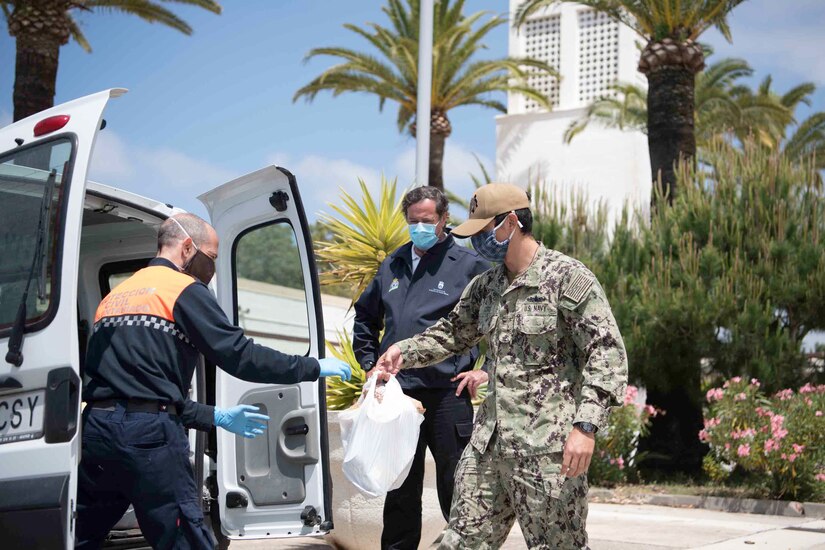
A sailor passes donations to a Spanish official.

Navy Lt. Cmdr. Christon Duhon and Navy Seaman Manuel Soto, both assigned to U.S. Naval Hospital Rota, along with Navy Chaplain (Cmdr.) Samuel Ravelo, former Naval Station Rota command chaplain, came up with the GiveBack project and brought it to life with the help of Boy Scouts of America Troop 73. The project started in April and has seen people come and go. Now, the team includes Navy Petty Officer 2nd Class Josh Espinoza, Navy Chaplain (Lt.) Nathan Rice, and Navy Petty Officer 1st Class Harvy Natac. 

The GiveBack project name represents the welcoming, helpful and supportive community of Rota and El Puerto de Santa Maria and is a way for the base community to give back to the local community during this difficult time. The project was developed with the goal of aiding as many as possible within the local communities. 

"Initially when the project began, Soto and I were concerned how we would meet all the logistical challenges and if we would find enough volunteers to help support a project such as this," Duhon said. "We've been fortunate to find base-wide contributions and support from the multiple departments and tenant commands which include the base chapel, PAO [public affairs officer], Spanish protocol, hospital, housing, Boy Scouts, DoDEA [Department of Defense Education Activity], NAVSUP [Naval Supply Systems Command, NEX [Navy Exchange] and the Seabees. Due to continued interest in helping others and new volunteers taking an interest, we hope to continue this program as long as it's helping others." 

The GiveBack project continues to offer two ways for the community to donate. First, the organizers have set up donation boxes for food or non-perishable items at the base chapel, housing office, and the Boy Scouts Hut in the base housing area. To date, the community has filled 20 tri-wall boxes with donations.
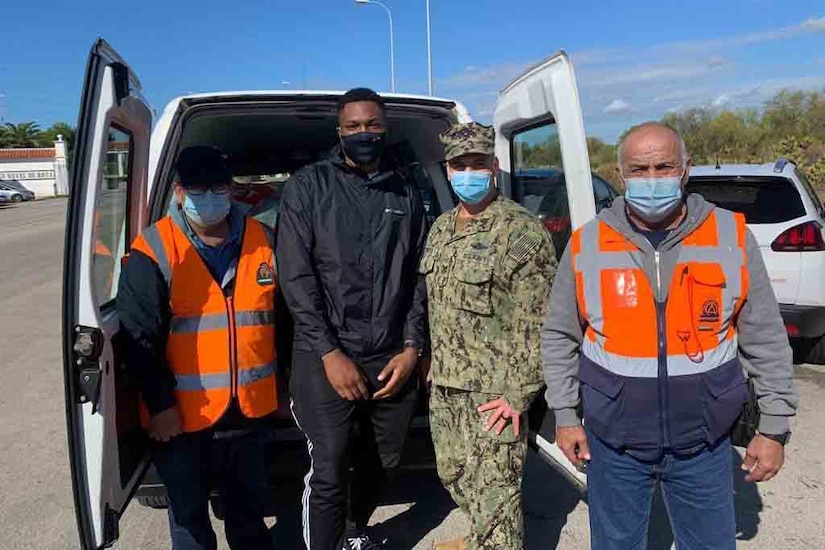
U.S. and Spanish workers pose in front of a van full of donations.

"While this project helps fill that void and lift the spirits for all those who volunteer, our hope is that we can take advantage of the recent PCS [permanent change of station] season as families are unpacking and possibly looking to donate," Duhon said.

Alternatively, the project established an online donation fund where 100% of the money donated will be used to purchase food items from off-base grocery stores. So far, the community has given $1625.26 toward groceries.

Chaplain Ravelo said he originally came to Rota with the idea of making a difference on base and in the community.

"I learned from the time of my arrival here that everything happens around the cathedral in the different cities in Spain, so my prayer has been that our chapel would be like a cathedral for our community," Ravelo said.

The GiveBack organizers are coordinating with the NAVSTA Rota Spanish liaison office, which is in contact with city hall officials from both El Puerto and Rota, in order to organize the pickup or delivery of the donations from the installation for coordinated distribution within their cities.
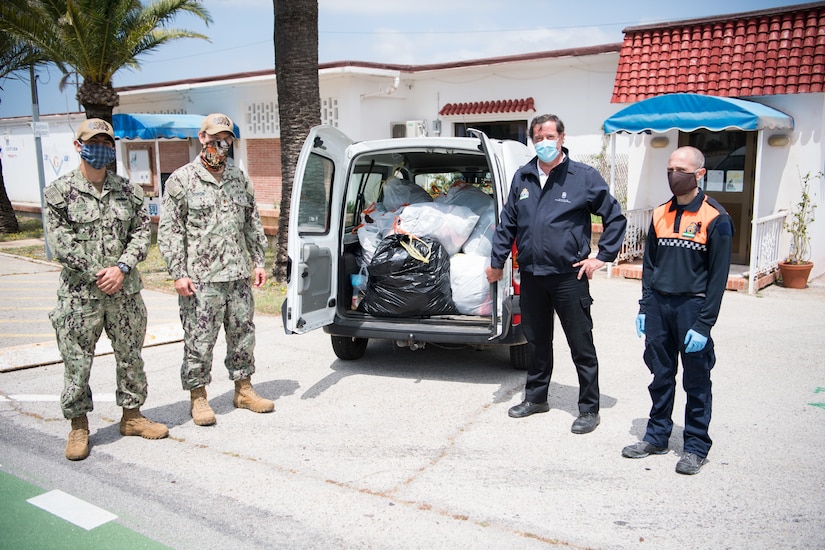
Sailors and local Spanish officials pose in front of donations.

"As mayor of El Puerto de Santa Maria and on behalf of all the people of Puerto that I represent, I want to thank you for your constant generosity with El Puerto which is always important in these times that we are going through and takes on even more value," said German Beardo, mayor of El Puerto de Santa Maria. "Thank you from the bottom of my heart for your donations that help many vulnerable families who need our solidarity and collaboration to move forward. Together we are able to go further to leave no one behind."

Duhon added that the project helps demonstrate to the local community that the U.S. stands by its neighbors and is here to help support our friends in these turbulent times.

"We're not only partners during the operational exercises, we're committed to supporting them when they're not able to make ends meet. By collecting donations or gathering clothing items, this project does just that," Duhon said. "As many people are currently following the state of alarm by their government, they've sacrificed their sources of income to help keep the community healthy, including the naval Base. The GiveBack project is a way to say thank you to them for what they're sacrificing as well as our community's way of demonstrating our support."

Giving food, water or even clothing doesn’t just supply a family with basic necessities, it gives families relief while showing that people do care. Both Americans and Spanish are in this together. The impact of the GiveBack project continues to emphasize and strengthen the bond between our two communities.

Parallel Production


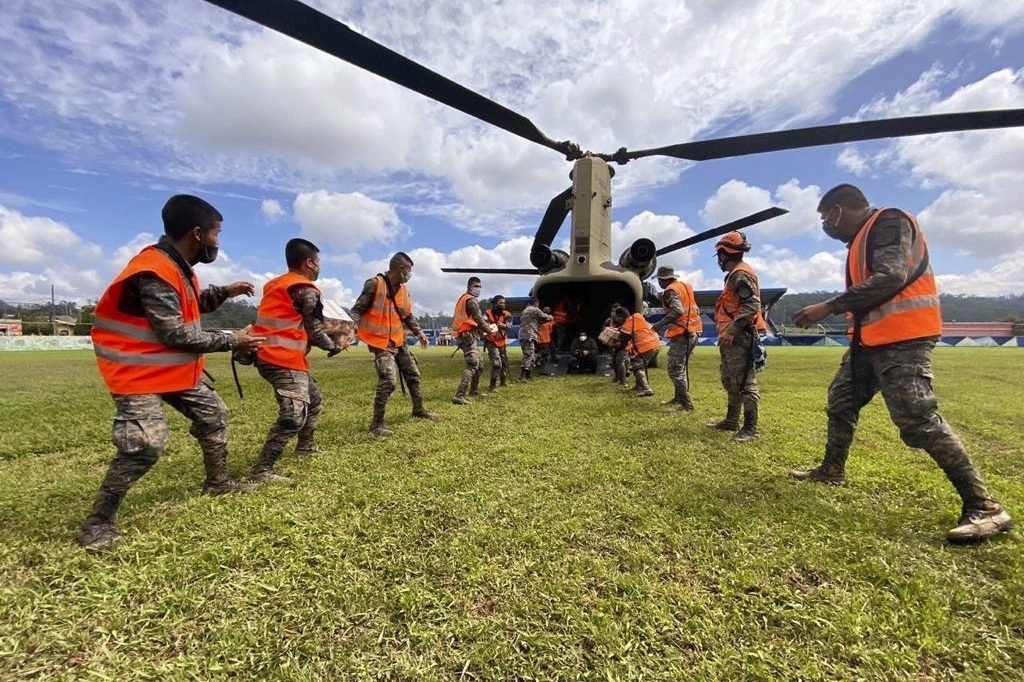
U.S. soldiers and Guatemalan forces unload emergency supplies from an Army CH-47 Chinook in Alta Verapaz, Guatemala, Nov. 8 2020, to assist victims of tropical depression Eta.

Ceremony Salute


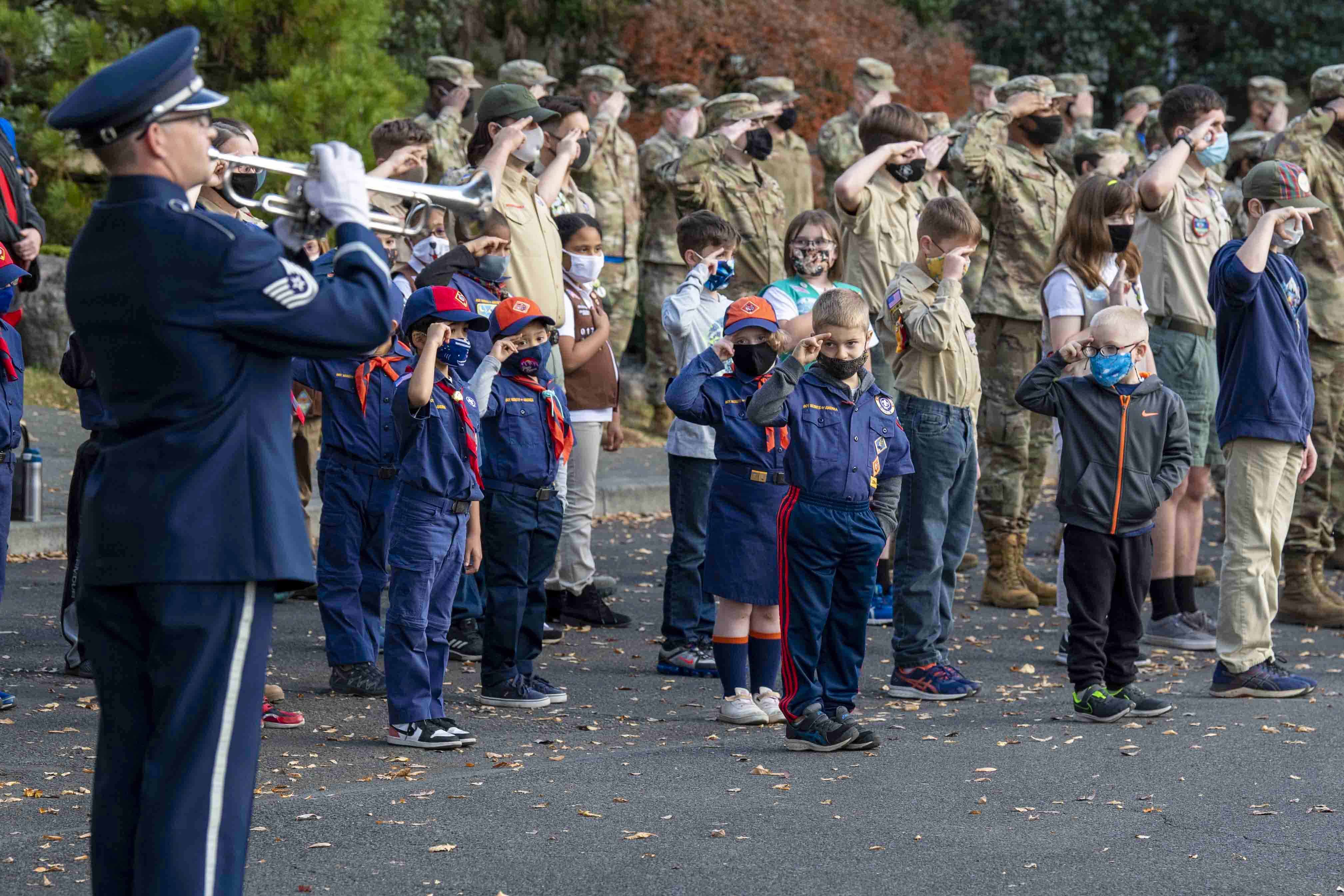
Children from various scouting organizations salute a member of the U.S. Air Force Band of the Pacific-Asia during a Veterans Day ceremony at Yokota Air Base, Japan, Nov. 10, 2020.

Tuesday, November 10, 2020

COVID-19 Forces DOD to Adapt, Innovate

Nov. 10, 2020 | BY Jim Garamone , DOD News

The Defense Department moved quickly in response to the coronavirus pandemic and is already planning on the follow-on computing/data needs, said John Sherman, the DOD's principal deputy chief information officer.

Sherman virtually spoke to the FedScoop Red Hat Government Symposium today. 

He gave a bit of background on the DOD's response to the coronavirus and charted the path forward with digital modernization implementation. "Our focus is on activities to empower our workforce during this critical time and to posture the department for future mission success," he said.

COVID-19 challenged the DOD to act and innovate quickly. "Like many crises before, COVID has forced innovation and new ways of thinking that might not have otherwise been brought to bear, at least not so quickly," he said.

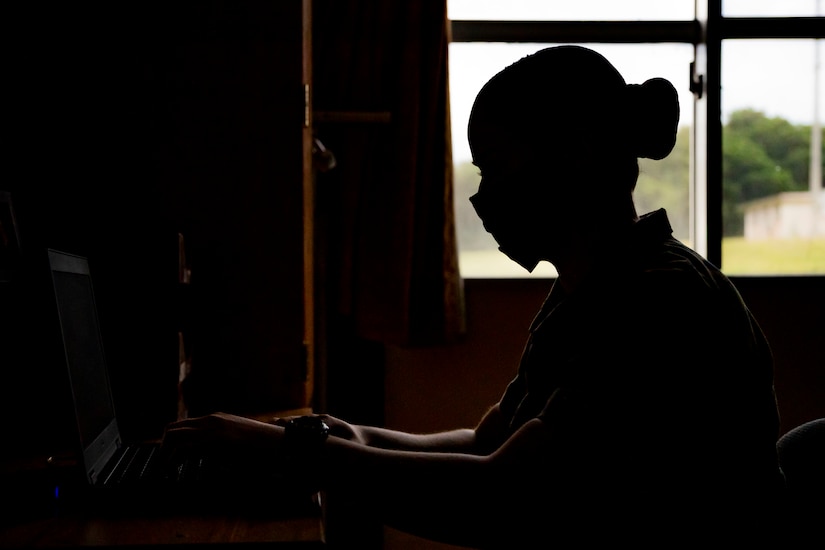
A Marine teleworks from her laptop while sitting at her desk.

Stay-at-home orders and social distancing forced the department to adapt in many areas like flexible collaboration capabilities, more robust networks and implementation of new principles like zero trust. The DOD had to enable new ways to work outside the office. 

And it did. "The speed of innovation also demonstrates what the department can do when pressed," Sherman said. The speed of innovation was built on the three directives to the department: protect the workforce, continue the mission, and support the whole-of-government response. Digital solutions were key to enabling all of these.

All parts of the department collaborated, and Sherman particularly praised the work of the Cloud Computing Program Office, the Defense Information Systems Agency, U.S. Cyber Command, the Joint Staff and the military departments. These organizations responded by deploying the commercial virtual remote capability based on Microsoft Teams. Made available in mere weeks, CVR is now used by over a third of the department, with over a million active users, the deputy said.

"CVR has enabled telework by providing a capability to hold group calls, form virtual teams and host video conferences," he said. "All of this involved DOD users being able to communicate with others, not on the Department of Defense Information Network and, crucially, with government-furnished equipment or their own devices."

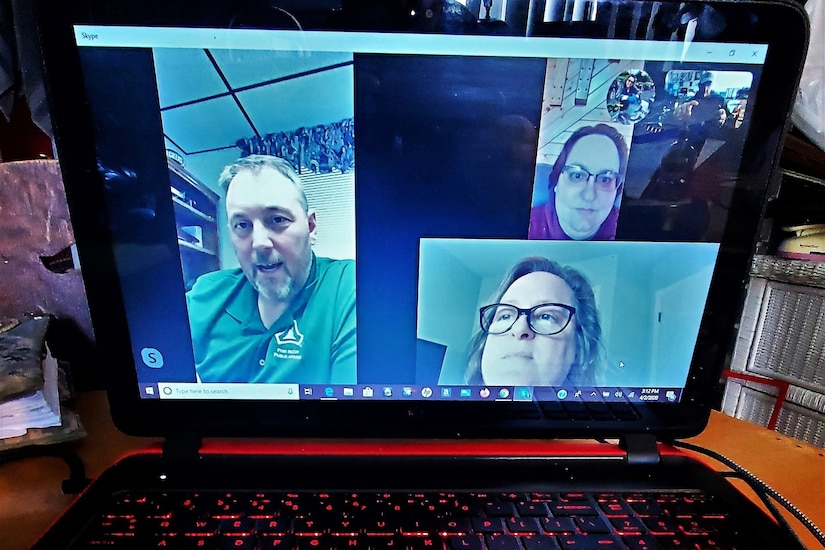
A screenshot shows the faces of people on a teleconference.

This provided flexibility for DOD personnel who are working from home, but also for those supporting crisis operations, such as National Guard members deployed around the nation to support COVID response activities, he said.

CVR has been extended through June 2021. "However, CVR does not currently operate at the level we need over the long term to ensure proper safeguarding of our sensitive information," he said. "We've always known we need to transition to a capability at a higher security level."

Through this process, cybersecurity was not ignored and DISA, U.S. Cyber Command and the National Security Agency combined to mitigate risks and deal quickly with threats. "Ensuring our workforce is aware of these threats and being able to respond quickly when problems do occur have been critical to staying in front of these types of incidents," he said.

Still, the commercial virtual remote was never intended as a "forever" solution and the department is working to define what the enduring capability will be. "We want a solution with more robust security hosted on a government enclave cloud environment," Sherman said. "We also want the functionalities of CVR, such as bring-your-own-approved device, and an ability to communicate with users not on the (DOD network) and with users operating in the current environment."

Sherman stressed the part the zero trust will play in the department's digital modernization implementation.

"I've heard much about zero trust from a conceptual perspective, and I've always appreciated what it really means — namely not just trying to stop threats at the perimeter, as has been the default for so long," he said. "Rather, we should use more holistic access standards and verify identity and other aspects at every point in the process."

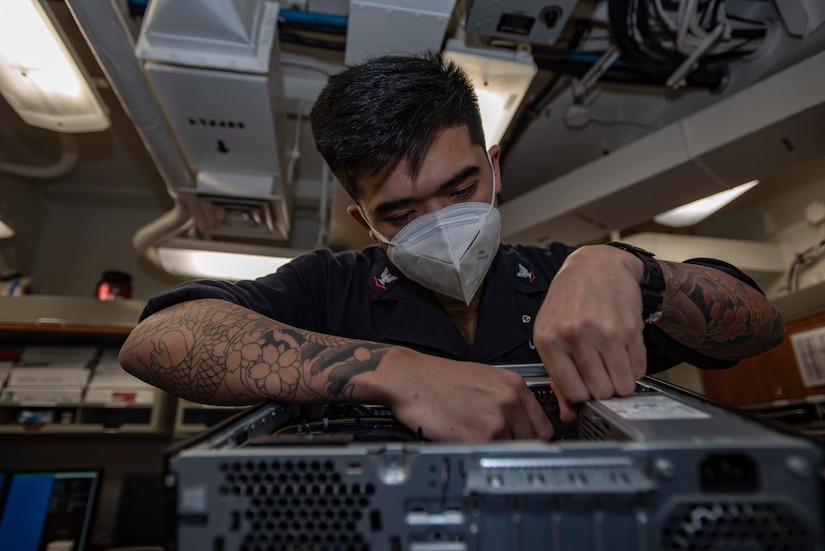
A sailor does maintenance work on a computer.

Implementing zero trust concepts is foundational to enabling the DOD "to craft an up-to-date, effective solution that entails CVR-like capabilities," Sherman said.

This is not easy and there has been constructive dialogue among the various agencies. Sherman said this is a good thing to happen. "Innovation isn't born out of groupthink," he said. 

The pandemic forced the department to confront these challenges. "This crisis has forced us to think differently, and at an accelerated pace, in a way that is certainly going to put us into a more capable and advanced position than we were a year ago," he said.

General Officer Assignments

 Nov. 10, 2020


The secretary of the Air Force announces the following general officer assignments:

Brig. Gen. Stephen G. Purdy will be assigned as commander, 45th Space Wing; and director, Eastern Range, U.S. Space Force, Patrick Air Force Base, Florida.  Purdy is currently serving as director, plans, programs, and financial management, Headquarters U.S. Space Force, Peterson Air Force Base, Colorado.

Brig. Gen. Douglas A. Schiess will be assigned as director, space and cyber operations, Space Operations Command, U.S. Space Force, Peterson Air Force Base, Colorado.  Schiess is currently serving as commander, 45th Space Wing; and director, Eastern Range, U.S. Space Force, Patrick Air Force Base, Florida.

Taking the Oath


Navy Lt. Ian Smith administers the oath of enlistment to Navy Petty Officer 2nd Class Marty Chum during an in-flight reenlistment ceremony aboard a C-12 Huron aircraft assigned to Naval Air Facility Atsugi, Japan, Oct. 27, 2020. NAF Atsugi is currently taking safety precautions against COVID-19 in order to safeguard its service members and families on base.

Elbow Bump


American Legion State Commander Ron Larose and Northern Area Commander Tom Scanlon present service star flags to airmen with the 158th Fighter Wing, Vermont Air National Guard, during a ceremony at Vermont Air National Guard Base, South Burlington, Vt., Nov. 8, 2020. COVID-19 precautions were in place so family and friends could attend.

Preflight Posture


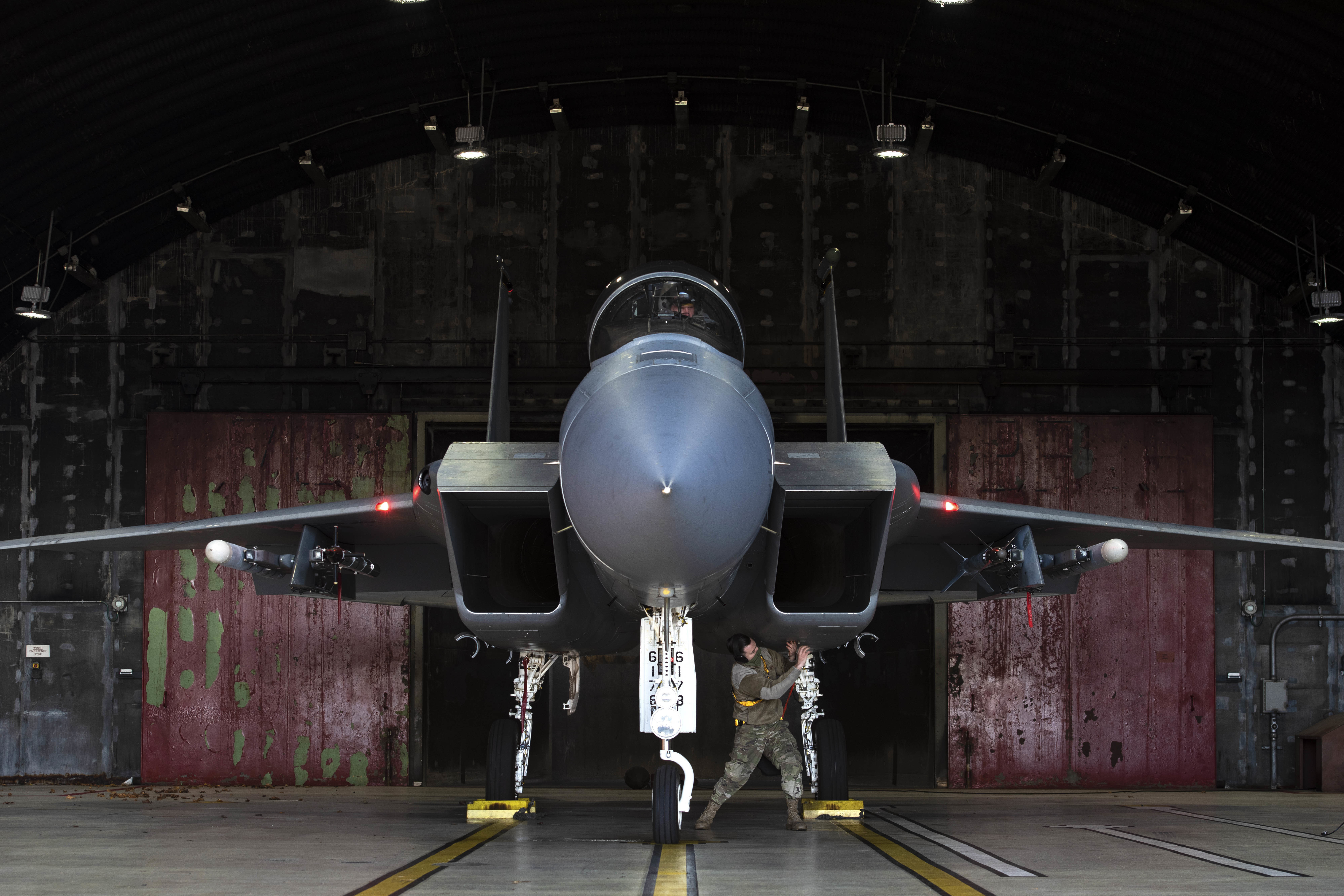
Air Force Senior Airman Dylan Tyler performs preflight checks on an F-15C Eagle while supporting Exercise Crimson Warrior at Royal Air Force Lakenheath, England, Nov. 4, 2020. The exercise is designed to strengthen NATO interoperability and test high-end capabilities in a contested, degraded and operationally limited environment.

DOD Statement on Personnel Changes at the Pentagon

 Nov. 10, 2020


As announced yesterday, November 9, President Trump has designated the National Counter Terrorism Center Director, Chris Miller, as the Acting Secretary of Defense.  Mr. Miller took over those functions and responsibilities mid-day yesterday.  Deputy Secretary of Defense David Norquist remains in his position and continues to execute his responsibilities. 

Today, Acting Under Secretary of Defense for Policy Dr. James Anderson, Under Secretary of Defense for Intelligence and Security Mr. Joseph Kernan and Chief of Staff to the Secretary of Defense, Jen Stewart submitted letters of resignation. 

Dr. Anderson submitted his letter of resignation to the President this morning, effective today.  The Acting Secretary of Defense has delegated the responsibilities of the Under Secretary of Defense for Policy to Mr. Anthony Tata.  As such, Mr. Tata is the Senior Official Performing the Duties of the Under Secretary of Defense for Policy.  He previously was the Senior Official Performing the Duties of the Deputy Under Secretary of Defense for Policy.  Dr. Thomas Williams will now perform the duties of the Deputy Under Secretary of Defense for Policy.

As planned for several months, Under Secretary Kernan submitted his letter of resignation, effective today.  Current Acting Assistant Secretary of Defense for Special Operation and Low-Intensity Conflict Ezra Cohen-Watnick will be the new Acting Under Secretary of Defense for Intelligence and Security.  Mr. Ralph Cacci will continue to perform the duties of the Deputy Under Secretary of Defense for Intelligence and Security.

Also today, Ms. Stewart submitted her resignation from the position of Chief of Staff, effective today.  Mr. Kash Patel, currently on the National Security Council staff, has been named by Acting Secretary Miller as his Chief of Staff.

Acting Secretary of Defense Miller issued the following statement on these personnel changes:  “I want to thank Dr. Anderson, Admiral Kernan and Jen Stewart for their service to the nation and the Department.  Over their careers each has contributed greatly to the national defense and the future of the Department of Defense. We wish them the best in their next endeavors.

Rules Describe Permitted, Prohibited Post-Election Activities

 Nov. 10, 2020

The 2020 election cycle is almost over. However, the rules that limit the political activities of federal government employees and service members still apply.

Those rules — the Hatch Act and Defense Department policy for civilians and DOD Directive 1344.10 for service members — describe what types of partisan activities are prohibited or permitted during various periods of the election cycle.

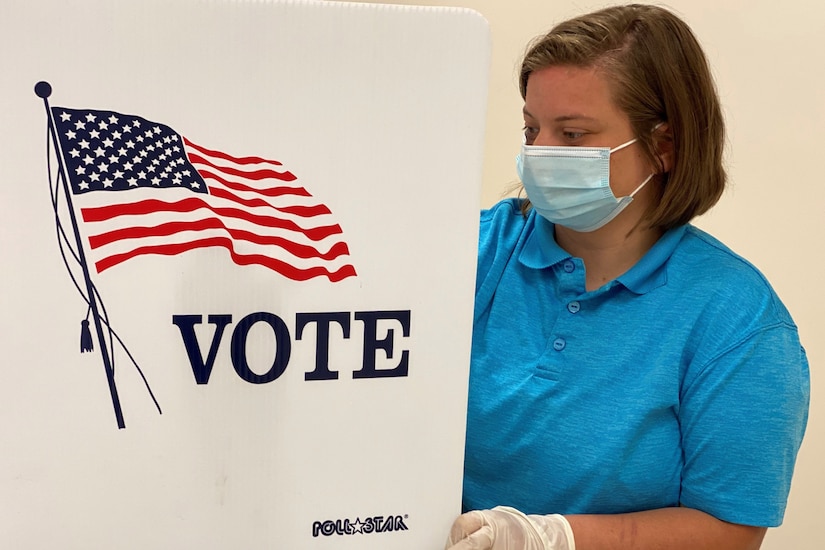
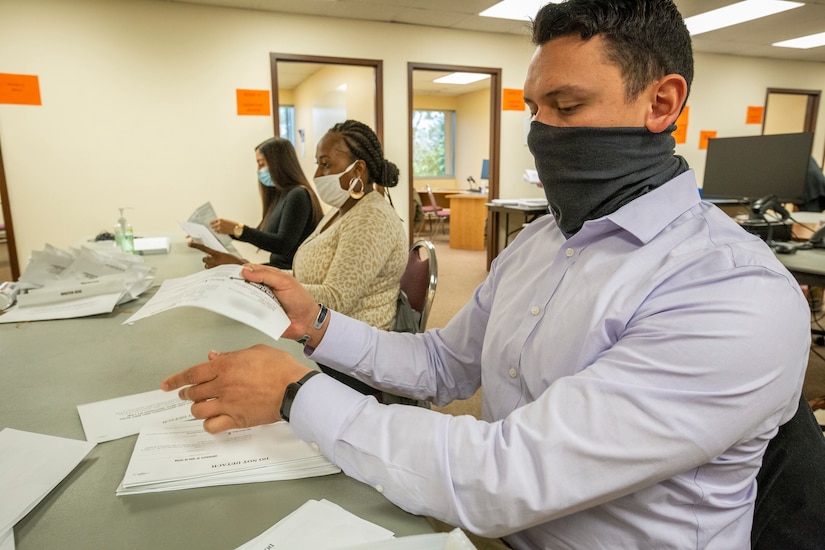
A woman sanitizes a voting station.

Prohibited Activities

While some DOD civilian employees may engage in certain political activities, the Hatch Act and DOD policy prohibit civilian employees from engaging in activity that shows support for or opposition to political parties or partisan political groups while on duty, in a government room or building, wearing an official uniform or insignia, or using a government vehicle.

These prohibitions do not change after Election Day. Specifically, civilian employees are always prohibited from engaging in political activity — defined as an activity directed toward the success or failure of a political party, partisan political group, or candidate for partisan political office — while on duty and while in a federal building.

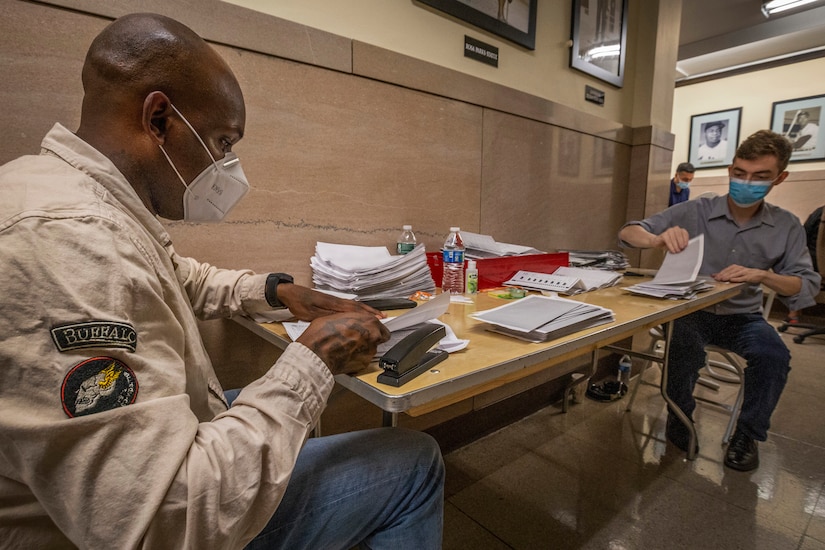
Soldiers sort ballots.
Airmen process ballots.

For example, displaying a sign or other item showing support for the Democratic or Republican parties is always prohibited, but a similar item supporting a nonpartisan movement, such as "save the whales," is permitted.  

Much like civilian employees of the DOD, service members should also avoid partisan political activities before, during and after election day. 

Permitted Activities

After Election Day, with a few exceptions such as runoff elections, the Hatch Act does not prohibit civilian employees from wearing or displaying a former candidate's campaign items while they are on duty, as long as the individual is no longer actively seeking partisan political office.

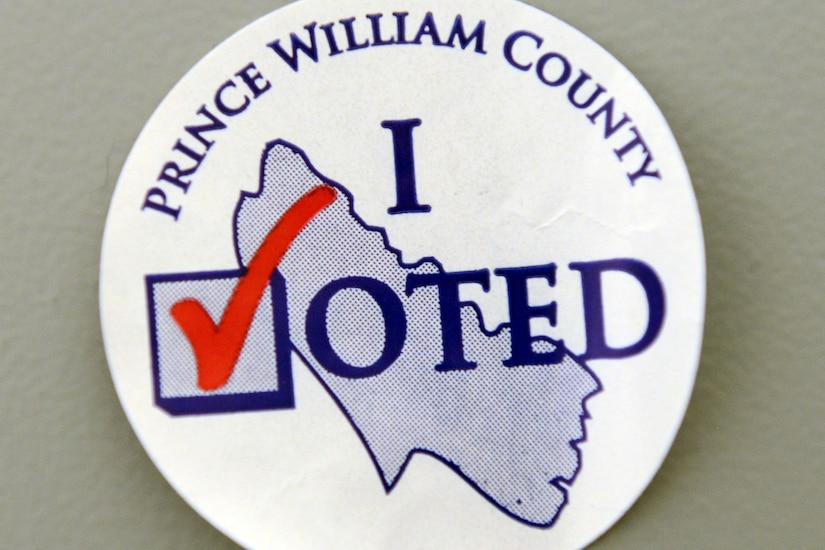
Voting Sticker.

For example, display of a campaign sign reading "Gore-Lieberman" or "Bush-Cheney" would be permitted at any time because their presidential candidacies have ended. But display of a sign reading "Trump-Pence" or "Biden-Harris" would not be permitted until the results of the current election have been certified.

DOD personnel must remain apolitical while performing official duties. Overall, any activity that may be reasonably viewed as directly or indirectly associating the DOD with partisan political activities should be avoided.

Blue Hue


Navy Lt. Yuma Kuwata monitors surface contacts aboard the USS John S. McCain in the Indian Ocean, Nov. 4, 2020, during Malabar, an India-led multinational exercise.

Keen Reach


Air Force Staff Sgt. Vincenzo Gallegos retrieves a parachute line during Keen Sword at the Ojojihara Training Area, Japan, Oct. 30, 2020. The exercise allows U.S. and Japanese troops to sharpen combat readiness and enhance long-range interception capabilities.

Sports Heroes Who Served: Brooklyn Dodgers Great Also Served in the Navy

 Nov. 10, 2020 | BY David Vergun , DOD News

Sports Heroes Who Served is a series that highlights the accomplishments of athletes who served in the U.S. military.

Harold Henry "Pee Wee" Reese, born July 23, 1918 at Ekron, Kentucky, was nicknamed Pee Wee because as a kid growing up, he earned the runner-up spot in a "Louisville Courier-Journal" newspaper-sponsored pee-wee marbles competition.

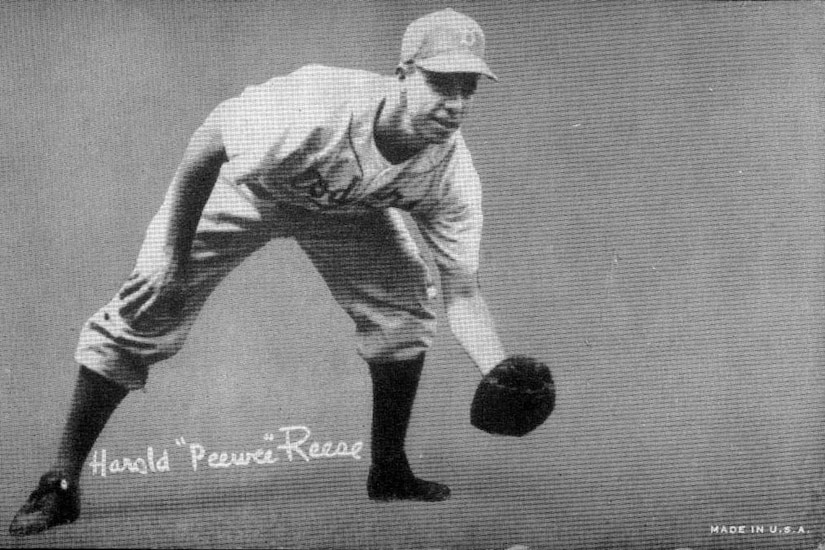
Baseball player holding a bat appears on a trading card.

Although his nickname wasn't related to his stature, he was somewhat short, at 5 feet, 9 inches, a height that prevented him from earning a spot on the duPont Manual High School baseball team in Louisville, Kentucky.

Thinking that he didn't have a career in baseball, he worked as a cable splicer for the Louisville telephone company. For recreation, he played amateur baseball for the Louisville Colonels, a local church team. That's how he acquired his second nickname, "the little colonel."

A Boston Red Socks scout noticed Reese's performance, picked him up, but then traded him to the Brooklyn Dodgers on July 18, 1939. The trade is considered the best ever made in baseball, for a receiving team, in this case the Dodgers.

Baseball player holds catchers mitt.

Reese's game debut with the Dodgers was April 23, 1940. He played until 1942. In 1943, he enlisted in the Navy.

In 1943, Reese was stationed at Norfolk Naval Air Station, Virginia, where he regularly played baseball. In 1944, he was sent to Hawaii and played for the Aiea Hospital team.

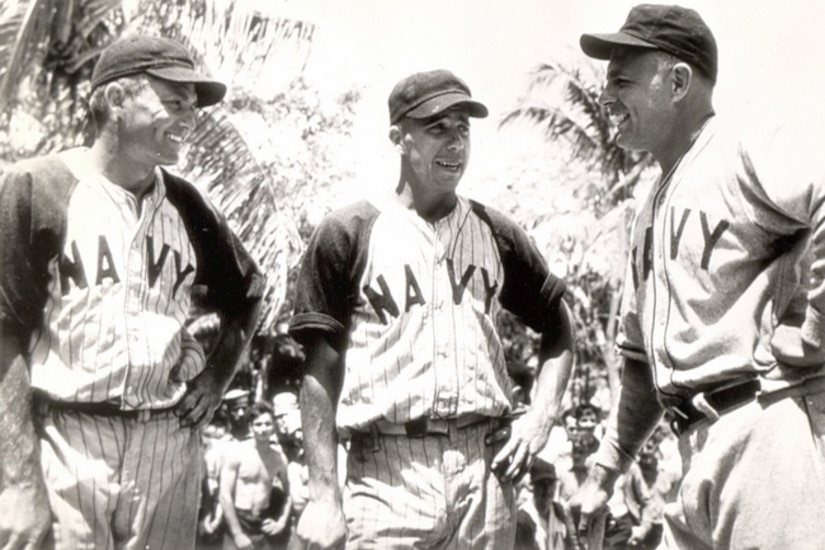
Then, he joined the Third Fleet team for the Navy's Pacific tour and was then assigned to Guam where he was shortstop and assistant coach for the 3rd Marine Division baseball team.

In 1946, following his honorable discharge from the Navy, Reese returned to the Dodgers, where he played until 1958. In his final baseball year of 1958, the Brooklyn Dodgers became the Los Angeles Dodgers.

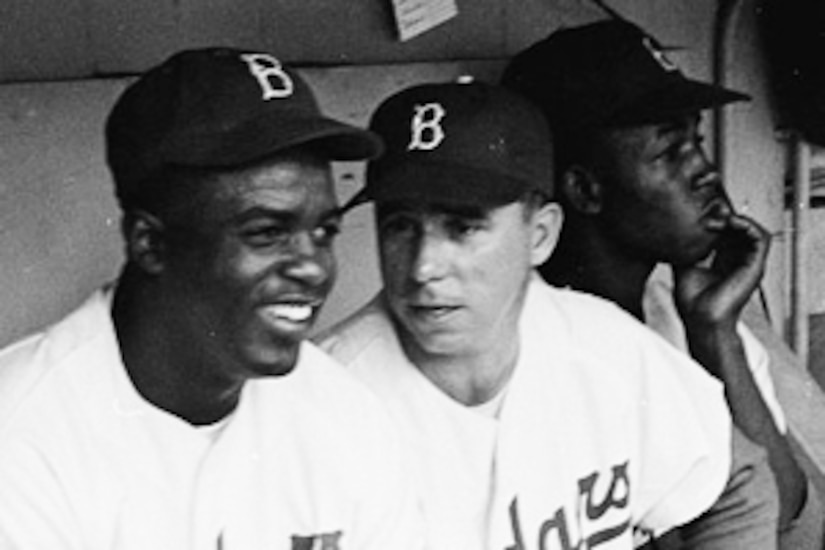
Baseball players chat.

As the team's shortstop, Reese led the National League in walks, 104 in 1947; runs 132 in 1949; and stolen bases, 30 in 1952. Defensively, he led the league four times in putouts, twice in double plays and once each in fielding percentage and assists.

His other statistics: batting average, .269; hits, 2,170; home runs, 126; runs batted in, 885. Reese was a 10-time All Star in 1942 and 1946 to 1954; and, he was a member of the World Series champion team in 1955 as a player and 1959, as team coach.

Although Reese is considered one of baseball's greats, he's probably more well known for his personal friendship of teammate Jackie Robinson.

In 2005, New York City Mayor Michael Bloomberg helped unveil a monument in Brooklyn, depicting Hall of Famers Reese and Robinson with Reese's arm around Robinson.

Baseball players chat.

It was designed to commemorate a moment that was said to have occurred in Cincinnati, Ohio, on May 13, 1947, during Robinson's inaugural season, which saw him break the color barrier to become the first African-American major leaguer.

Eye witnesses said Robinson was booed by Cincinnati fans because of his race. In a show of support, Reese temporarily left his position at shortstop and walked over to Robinson at first base and put his arm around the rookie, silencing the crowd.

In the 1960s, Reese became a baseball game announcer for CBS and then NBC.

In 1984, he was inducted into the National Baseball Hall of Fame and Museum.

Reese died on Aug. 14, 1999 at his Louisville home.

Ramstein Postal Operations Make Mail Move

 Nov. 10, 2020 | BY Air Force Senior Airman Noah Coger , 86th Airlift Wing

It's no secret that the holidays at Ramstein Air Base bring increased traffic to postal operations. Family members in the U.S. are sending packages to loved ones, active-duty members are ordering presents and taking advantage of Black Friday deals, and many are sending holiday greetings. Every year, the 786th Force Support Squadron postal clerks meet this surge head-on and do their best to ensure everyone gets their mail in time.

The onset of COVID-19 has presented a unique set of circumstances for the post office this year. They have been in "holiday mode" since mid-April, with no signs of slowing down as they enter the holiday season.

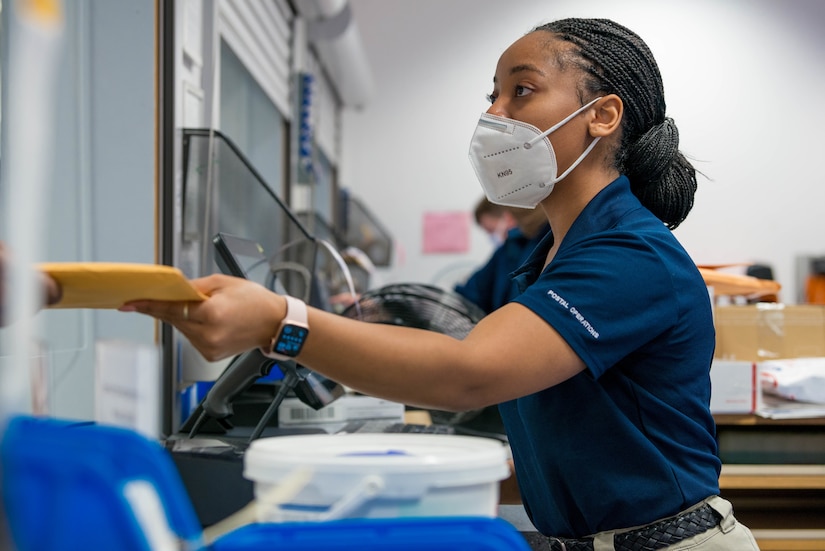
An airman receives mail.

"During the height of COVID-19 over the past year, the Northside Post Office saw a 61% increase for incoming packages," said Air Force Tech. Sgt. Darren Hinds-Webster, 786th FSS official mail manager. "Between mid-April and May, we saw the Postal Service Center deliver more than 90,000 packages."

Germany's lockdown measures earlier in the year saw many nonessential businesses close. This was done to help prevent the spread of COVID-19 but had an inverse effect on mail flow as more people turned to online shopping. Those same measures required squadrons on Ramstein to find ways to operate with minimal manning.

During those two months, packages delivered to the Northside Post Office amounted to approximately the same number as last year's holiday season. The post office not only had to navigate mitigating factors to prevent the spread of COVID-19 but also had to operate with limited manning while meeting the demands of increased operations.

As postmaster, I feel that I work with 52 of the greatest professionals."
Air Force Master Sgt. Dandre Broderick

"We understand the magnitude of our current climate," Hinds-Webster said. "We understand that our customers rely on various essentials: voting ballots, credit cards and other personal communication. For that reason, telework is not an option for us."

Despite the COVID-19 challenges, the post office remains dedicated to ensure timely processing of packages, incoming and outgoing. 

"As a postmaster, I enjoy serving our customers by delivering packages that are important to them," said Air Force Master Sgt. Dandre Broderick, 786th FSS postmaster. "You never know what might be in that letter or parcel that can make someone's day."

To achieve this objective, the post office has four main sections split among 52 airmen servicing more than 7,000 active mailboxes. They're all working toward one goal: customer satisfaction.

The postal service center consists of two smaller sections: receipt and dispatch, which is responsible for the receiving and delivery of all incoming personal mail; and directory service, which locates and re-routes first class mail with incorrect information that cannot be delivered as addressed. 

The customer service team fields all service related issues that include in-and-out processing of P.O. boxes, package inquiries, and forwarding or holding of mail for members that are deployed or doing temporary duty travel. In addition, they also handle the general directory program, which allows service members deployed to Ramstein to receive mail.

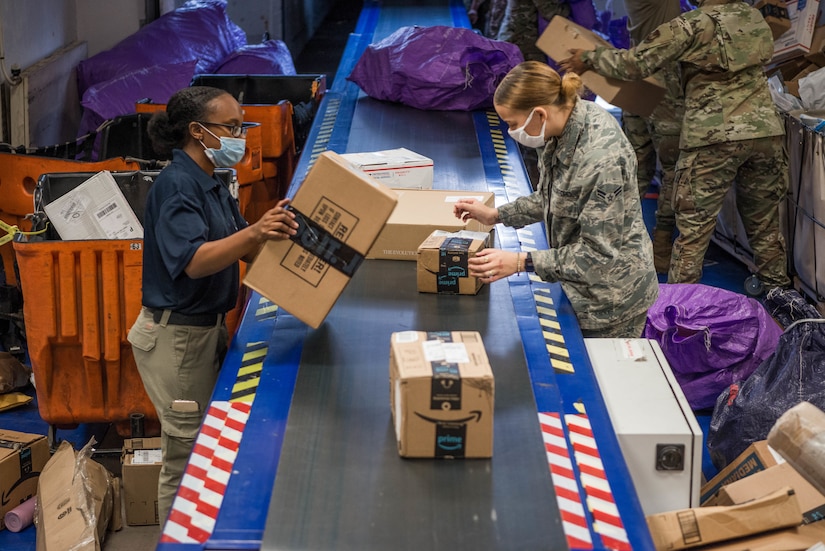
Female military members wearing masks process packages.

The official mail center operates the registered mail cage, which processes the most secure form of mail. 

"Our main customers at the official mail center include the Air Force Office of Special Investigations, medical logistics and personal registered packages," Hinds-Webster said. "A lot of units use registered mail to send sensitive information because it is the best, most secure way to send mail. It's guaranteed to have a hand-to-hand transaction and signature for that transaction every step of the way."

Official mail also services 127 units on Ramstein. Their mobile distribution vehicles run three routes to hand-deliver to 85 of those units Monday through Friday.

The last section, finance and package shipping, helps customers fill out customs forms, send voting ballots and ship packages to more than 420 locations stateside and overseas. 

With all of the sections that the North Side Post Office maintains and tasks the sections are responsible for, it's the airmen that are the core of its operations.

"During the wake of COVID-19, they were dedicated to the mission," Broderick said. "Keeping safety first, some volunteered to work on their days off and weekends just to ensure we did not get too far behind. You cannot beat that dedication. As postmaster, I feel that I work with 52 of the greatest professionals."

Monday, November 09, 2020

Department of Defense Launches New ‘My Military OneSource’ Mobile Application

 Nov. 9, 2020


The Department of Defense launched a new mobile app that quickly connects service members, their families, and survivors to resources and support to help them rejuvenate, be well, and thrive. The My Military OneSource mobile app is now available for free download on Google Play and Apple’s App Store.

The My Military OneSource mobile app provides a customized way for users to experience one of the military’s flagship support programs – Military OneSource. The app offers a fast, 24/7 gateway to personalized military benefits, access to experts, guides for the military, and much more. Unique features include:

  • A personalized experience based on a user’s profile
  • MilLife Guides – a curated library of “must-know” information about military life, spanning topics from PCS to finances, from relationships to recreation
  • Benefits Finder – an easy way to get top-line information about the benefits available to service members and their families
  • Advanced search functionality to ease navigation, and the
  • Ability to immediately connect with live support.

“We are excited to offer an innovative, personalized approach to receiving support, resources, and expertise through the My Military OneSource mobile app, in the same way our folks are used to receiving other information in their lives” said Matthew P. Donovan, Under Secretary of Defense for Personnel and Readiness. “The Department of Defense is committed to providing valuable support to help our military service members and families thrive, and this mobile app was developed with their needs in mind.” 

To ensure the My Military OneSource mobile app continues to meet the needs of the military community, we will evaluate user feedback to help inform ongoing updates and enhancements, as well as new features.

Part of the Department of Defense, Military Community and Family Policy offers a suite of programs, tools, and services – including My Military OneSource and MilitaryOneSource.mil – that connects the military community to resources they can use every day, from relocation planning and tax services to confidential non-medical counseling and spouse employment. These initiatives contribute to force readiness and quality of life by providing policies and programs that advance the well-being of service members, their families, survivors, and other eligible members of the military community.

Military OneSource is a DOD-funded program that is both a call center and a website providing comprehensive information, resources, and assistance on every aspect of military life. Service members and the families of active duty, National Guard, and reserve (regardless of activation status), Coast Guard members when activated for the Navy, DOD expeditionary civilians, and survivors are eligible for Military OneSource services, which are available worldwide 24 hours a day, seven days a week, at no cost to the user.

Army HH-60 Black Hawk helicopter crew members escort rescued U.S citizens


Army HH-60 Black Hawk helicopter crew members escort rescued U.S citizens at San Pedro Sula, Honduras, Nov. 7, 2020, in the aftermath of Hurricane Eta. The soldiers are assigned to Joint Task Force-Bravo, which is trained and prepared to support disaster assistance efforts within Central America.

Cali Cover


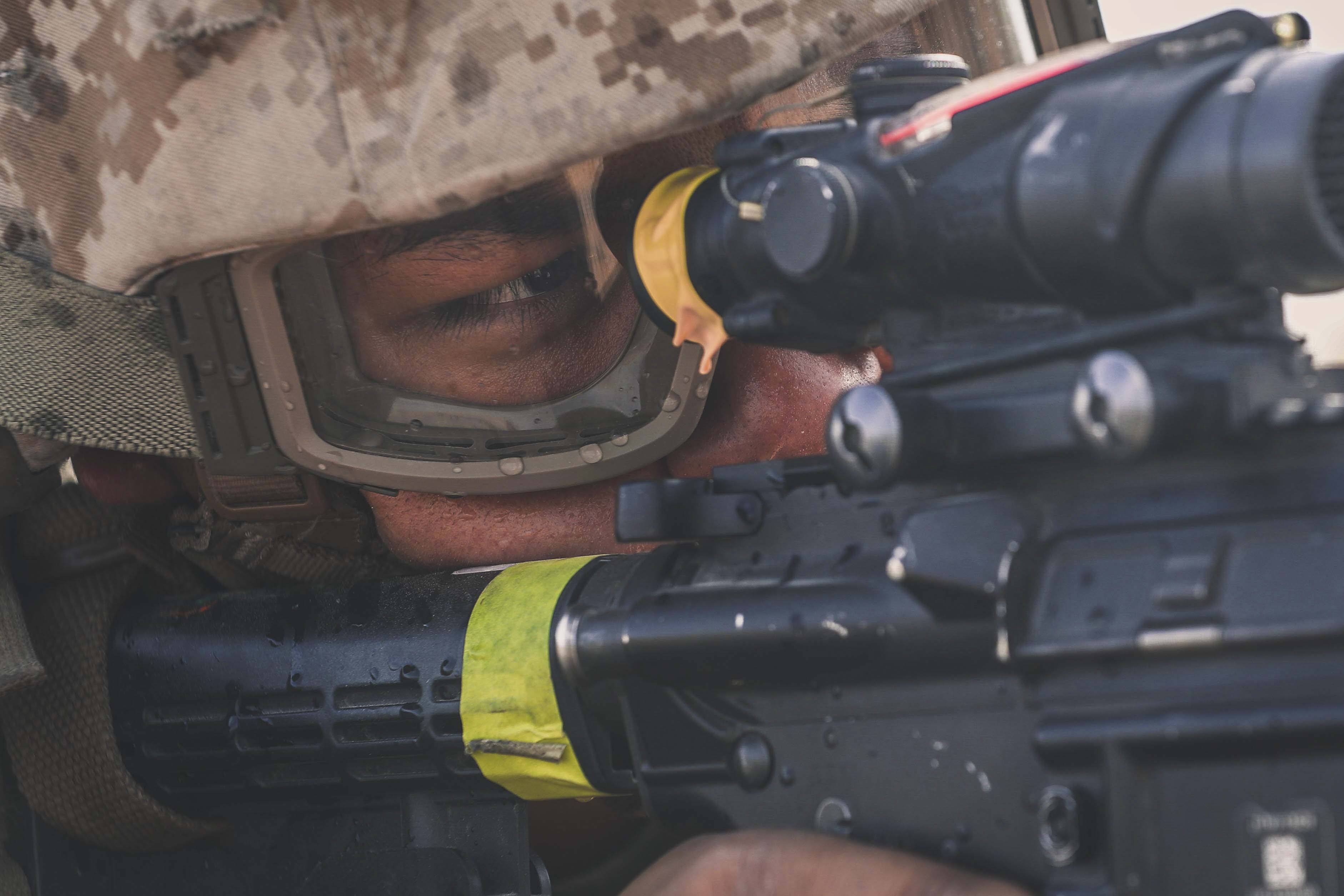
Marine Corps Cpl. Sathya Breckinridge provides cover during an integrated training exercise at Marine Corps Air Ground Combat Center Twentynine Palms, Calif., Oct. 5, 2020.

Supply Support


Navy Seaman Brian Chan moves a box of supplies aboard the USS Gerald R. Ford in the Atlantic Ocean, Nov. 2, 2020.

Malabar Formation


The USS John S. McCain sails in formation with Indian, Australian and Japanese vessels in the Indian Ocean, Nov. 3, 2020, during Malabar, an India-led multinational exercise.

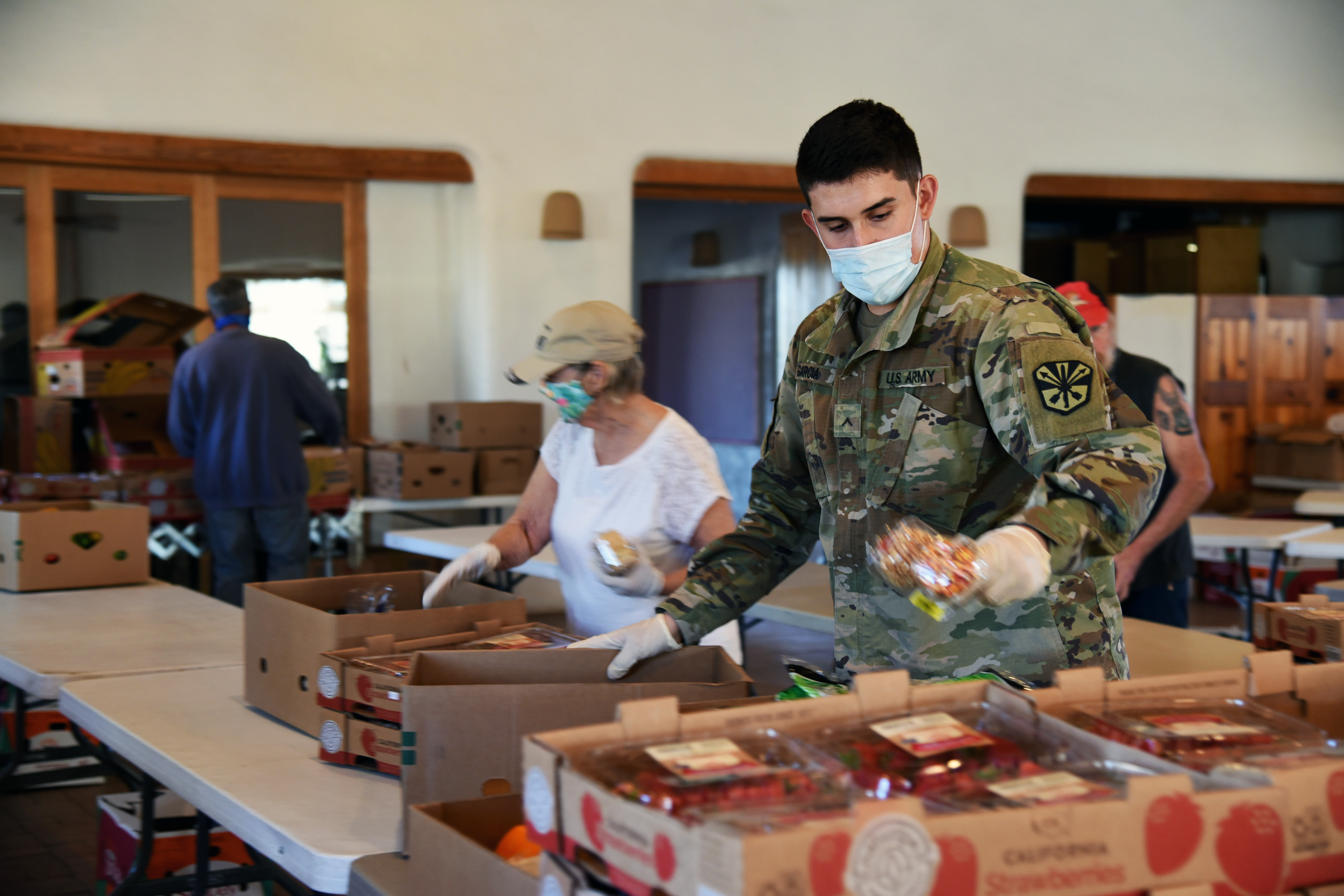
Food Bank


Arizona National Guard service members prepare boxes of groceries for delivery to area residents at a food bank in Three Points, Ariz., Nov. 5, 2020. The Arizona National Guard has activated more than 800 Arizona citizen soldiers and airmen to support the community during this emergency response.