Nov. 3, 2020
|
BY Scott A. Thornbloom, Naval Service Training Command Public Affairs
Navy Junior ROTC and Navy National Defense Cadet Corps units are
facing a "new normal" as they return to school this fall. More than
80,000 cadets and more than 1,000 Naval Science Instructors have had to
adapt to the new challenges in a continuing coronavirus environment.
Many of the more than 600 units across the country and in Guam,
Japan, Spain and Italy are back to school in one form or another. Some
are in socially distanced classrooms or attending via video
teleconference applications.
"There are 1,250 Navy Junior ROTC instructors across the globe who
are working tirelessly to deliver our citizenship development program to
students," said Tim Daseler, Naval Service Training Command deputy
commander for NJROTC/NNDCC operations.
"In these extraordinary times, these seasoned leaders are working
tirelessly to deliver the program to students in new and innovative
ways, and are also assisting and providing bold leadership to
principals, counselors and other teachers with the myriad of issues each
school faces."
I am very proud of our cadets' commitment and perseverance with
adapting to and operating in this new learning environment."
Retired Navy Cmdr. Rick Hamblet
The Navy Junior ROTC and NNDCC are part of the Navy's citizenship
program. They are overseen and supported by NSTC, headquartered at Naval
Station Great Lakes, Illinois. The program seeks to instill in
participating high school students the values of citizenship, service to
the United States, personal responsibility and a sense of
accomplishment. Navy Junior ROTC and NNDCC strive to build a strong
foundation of citizenship within America's future leaders.
The Navy Junior ROTC/NNDCC program is divided into 11 areas. Each
area averages between more than 40 to more than 60 high school units.
Each unit consists of students, known as cadets, ranging from freshmen
to seniors. They are taught the naval science curriculum by a retired U.
S. Navy, Marine Corps or Coast Guard officer and retired enlisted
service members.
"I am very proud of our cadets' commitment and perseverance with
adapting to and operating in this new learning environment. They have
remained strong and demonstrated positive attitudes. We're taking great
pride working together as a team," said retired U. S. Navy Cmdr. Rick
Hamblet, the senior naval science instructor at Vista Ridge High School
in Cedar Park, Texas.
"Not competing in live drill competitions has been hard for the
cadets to accept, but we are placing our focus on the things we can do,
not the things we can't do." said retired U. S. Navy Cmdr. Tim Craddock,
SNSI at Washington High School, Indiana.
Retired U.S. Marine Corps Lt. Col. Carl Lewandowski said Papillion La
Vista High School, Nebraska. is "business as usual" for most of their
daily Navy Junior ROTC activities and events.
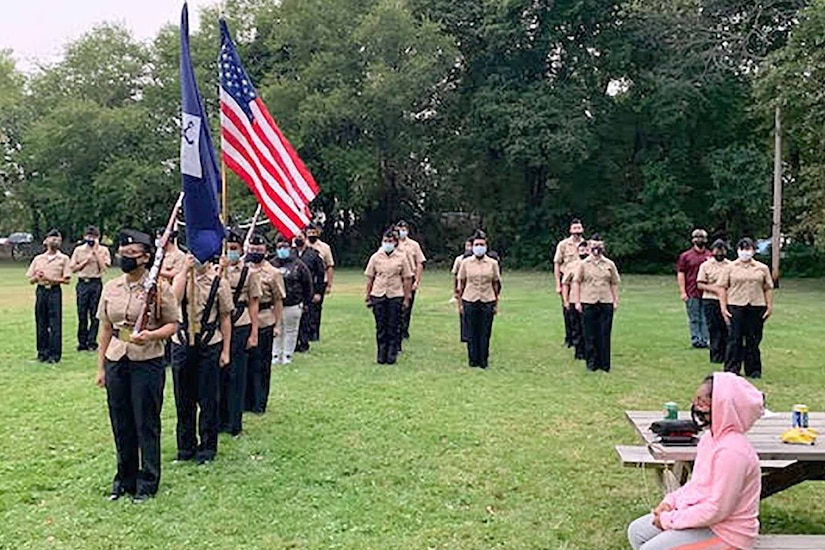
"Uniforms have been issued. We conduct weekly [socially-distant]
personnel inspections and hold student-led drill classes [wearing masks]
weekly. Our color guards have presented the nation's colors at our home
football games. Athletic events have been modified to maximize student
safe distances by substituting planks for sit-ups and other creative
activities. Many of these accomplishments are possible by following the
3W policy: wear a mask, watch your distance and wash your hands.
Finally, we are able to compete against other schools by participating
in postal [air rifle] competitions. Postals were 'remote' before remote
was trending!" he said.
The Navy Junior ROTC program was established in 1964. The program is
conducted at accredited secondary schools throughout the nation, and
taught by instructors who are retired Navy, Marine Corps, and Coast
Guard officers and enlisted personnel. The Navy Junior ROTC accredited
curriculum emphasizes citizenship and leadership development, as well as
America's maritime heritage, the significance of sea power, and naval
topics such as the fundamentals of naval operations, seamanship,
navigation and meteorology.
In a non-COVID-19 year, classroom instruction is augmented throughout
the year by extra-curricular activities of community service, academic,
athletic, drill, and orienteering competitions, field meets, flights,
visits to naval installations or other activities, marksmanship sports
training, and physical fitness training. Electronic classroom equipment,
textbooks, uniforms, educational training aids, travel allowance and a
cost-share of instructors' salaries are provided by the Navy.
These kids were committed to one another and learned to work
together as a team and get out cleaning up the neighborhood."
Retired Navy Lt. Cmdr. Kevin Wilson
In this "new normal" instructors and cadets have to adapt and overcome several challenges.
Retired U. S. Navy Cmdr. Steve Schulte, SNSI for Zion-Benton Township,
Illinois. unit says it has been difficult teaching and motivating
freshmen new to the program through remote learning.
"We are encouraging freshmen to come to school for ‘office hours'
which is allowed by the school. We have been successful in getting about
75 percent of freshmen in to issue uniforms," he said.
But Schulte has also been seeing a few benefits. "It has been a
learning experience for our cadet staff in handling adversity. We have
challenged them to come up with a way to keep our unit functioning as
normal as possible in an abnormal situation. They are working on
preparing for pass-in-reviews without full unit participation in
practice, developing a remote advancement program for junior cadets
among other things," Schulte said.
Recently the Navy Junior ROTC unit at Kecoughtan High School in
Hampton, Virginia., was able to work outside on Oct. 7 as the unit
cleaned up an area of the city.
"We did an Adopt-A-Spot where we cleaned up streets," said Cadet
Julianne Khuu, a senior and the unit's commanding officer, in a video on
the school's News Break YouTube channel. "My favorite part was getting
out and getting the opportunity to be engaged with the community and
allowing myself to be with my cadets cleaning. It was a good experience
to come out and get together and still maintain social distance but
still help out the community."
Retired U. S. Navy Lt. Cmdr. Kevin Wilson, SNSI of the unit said the
Navy and Navy Junior ROTC has three core values — honor, courage and
commitment. "These kids were committed to one another and learned to
work together as a team and get out cleaning up the neighborhood," he
said.












 Posts
Posts

