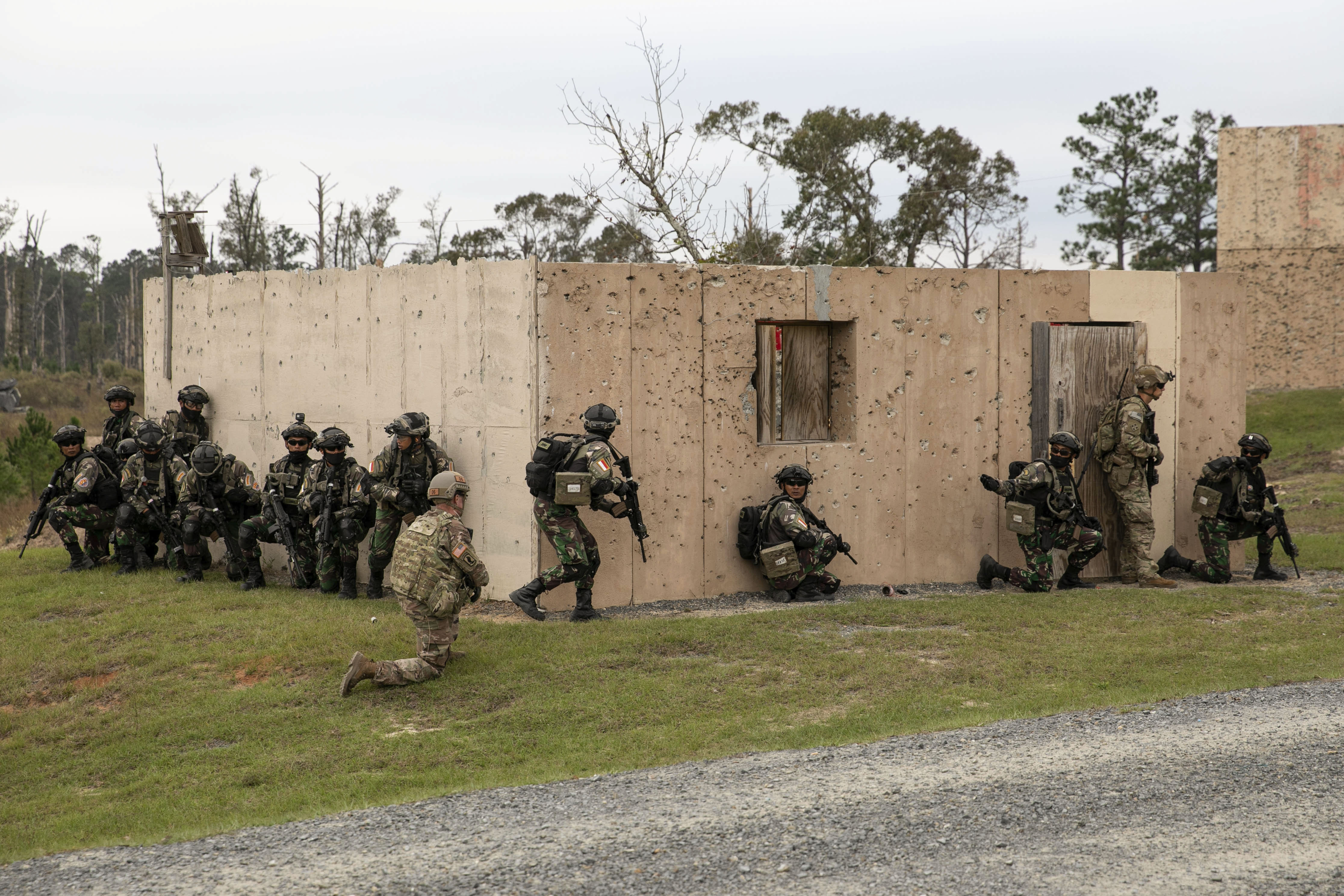
U.S. and Indonesian soldiers conduct a live-fire exercise at Fort Polk, La., Oct. 27, 2020.
U.S. and Indonesian soldiers conduct a live-fire exercise at Fort Polk, La., Oct. 27, 2020.
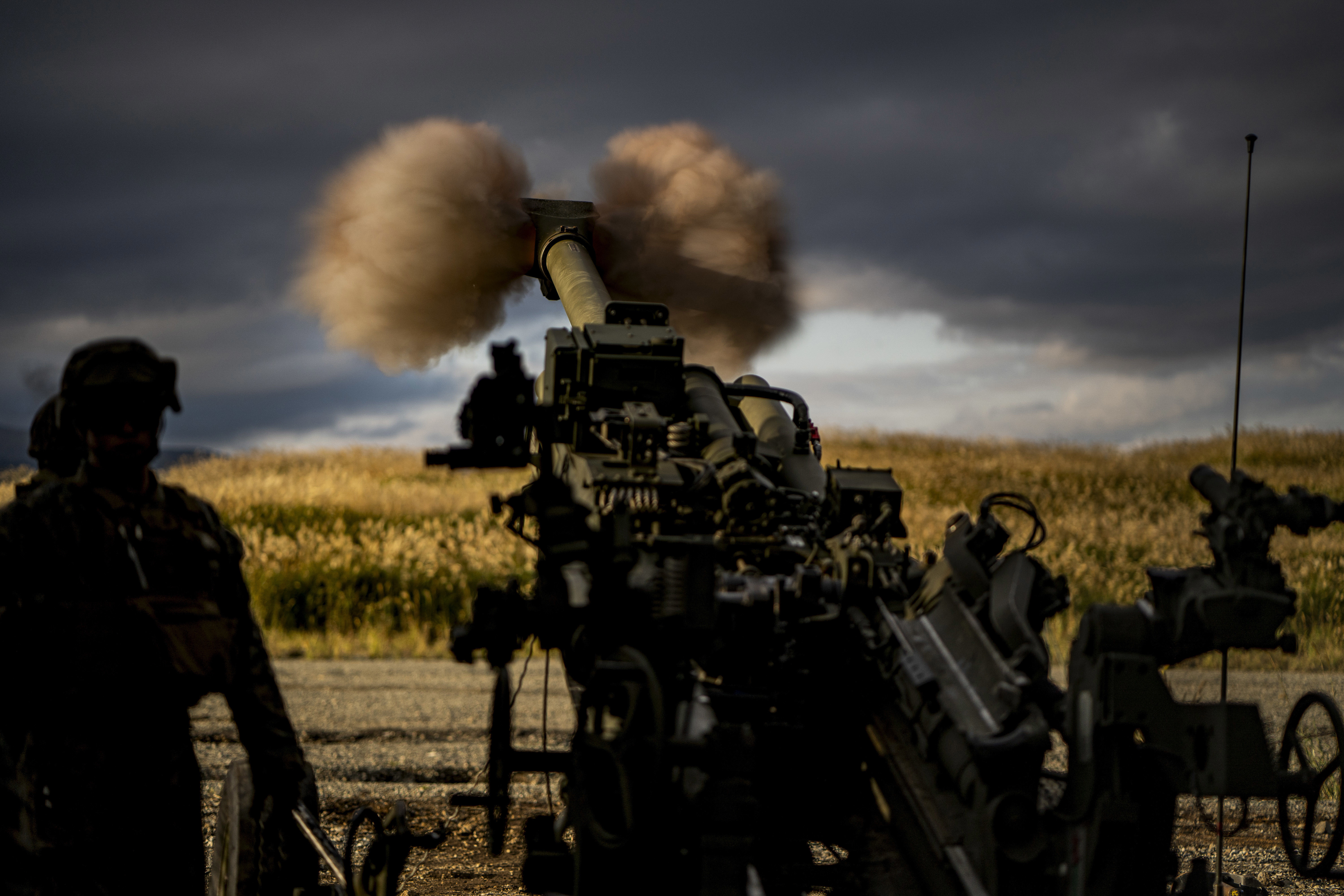
Marines fire an artillery round from an M777 howitzer during training exercises at Camp Fuji, Japan, Oct. 20, 2020.
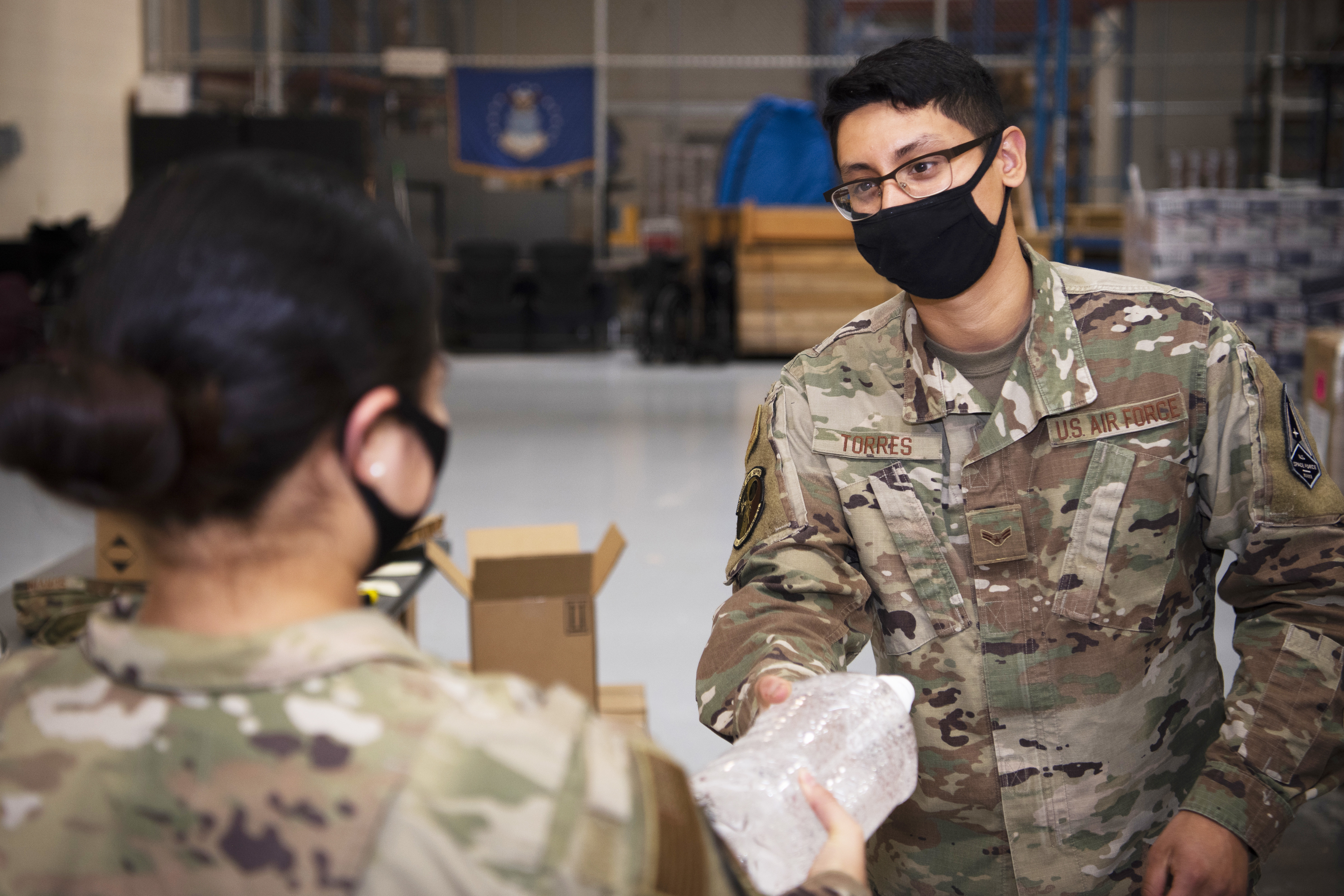
Airman 1st Class Juan Torres, a contract specialist with the 50th Contracting Squadron, gives hand sanitizer to another airman at Schriever Air Force Base, Colo., Oct. 29, 2020. The 50th CONS provided hand sanitizer to 20 units to battle COVID-19.

Air Force Senior Airman Bryce Dupre, assigned to the 60th Aerial Port Squadron, pets a dog at the Yolo County Animal Services Shelter in Woodland, Calif., Oct. 29, 2020. The squadron donated 1,000 unused pillows and blankets to the shelter.

Air Force airmen from the 60th Aerial Port Squadron load pillows and blankets onto a trailer at Travis Air Force Base, Calif., Oct. 29, 2020. The squadron donated 1,000 unused pillows and blankets to the Yolo County Animal Services Shelter in Woodland, Calif.
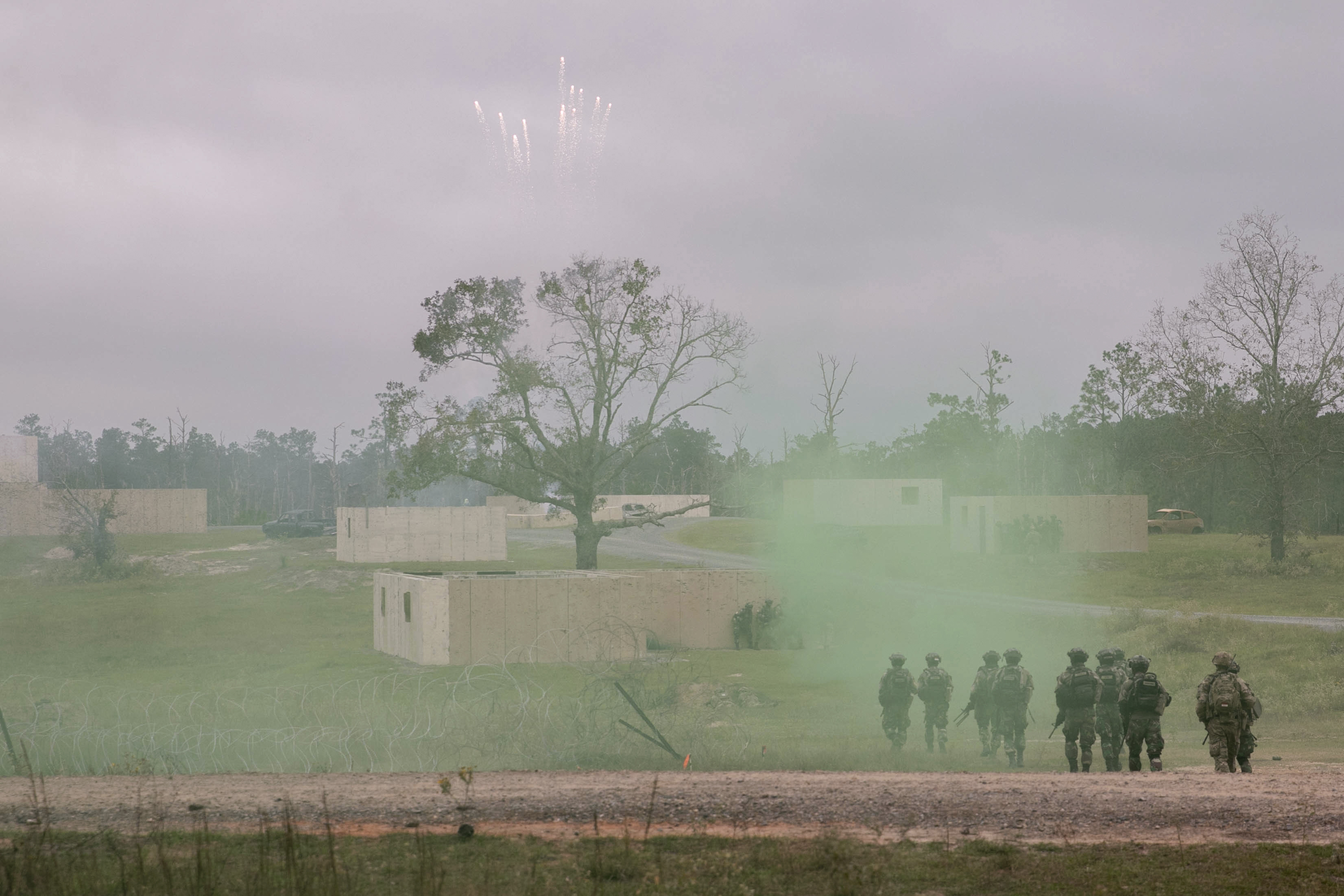
U.S. and Indonesian soldiers conduct a live-fire exercise at Fort Polk, La., Oct. 27, 2020.
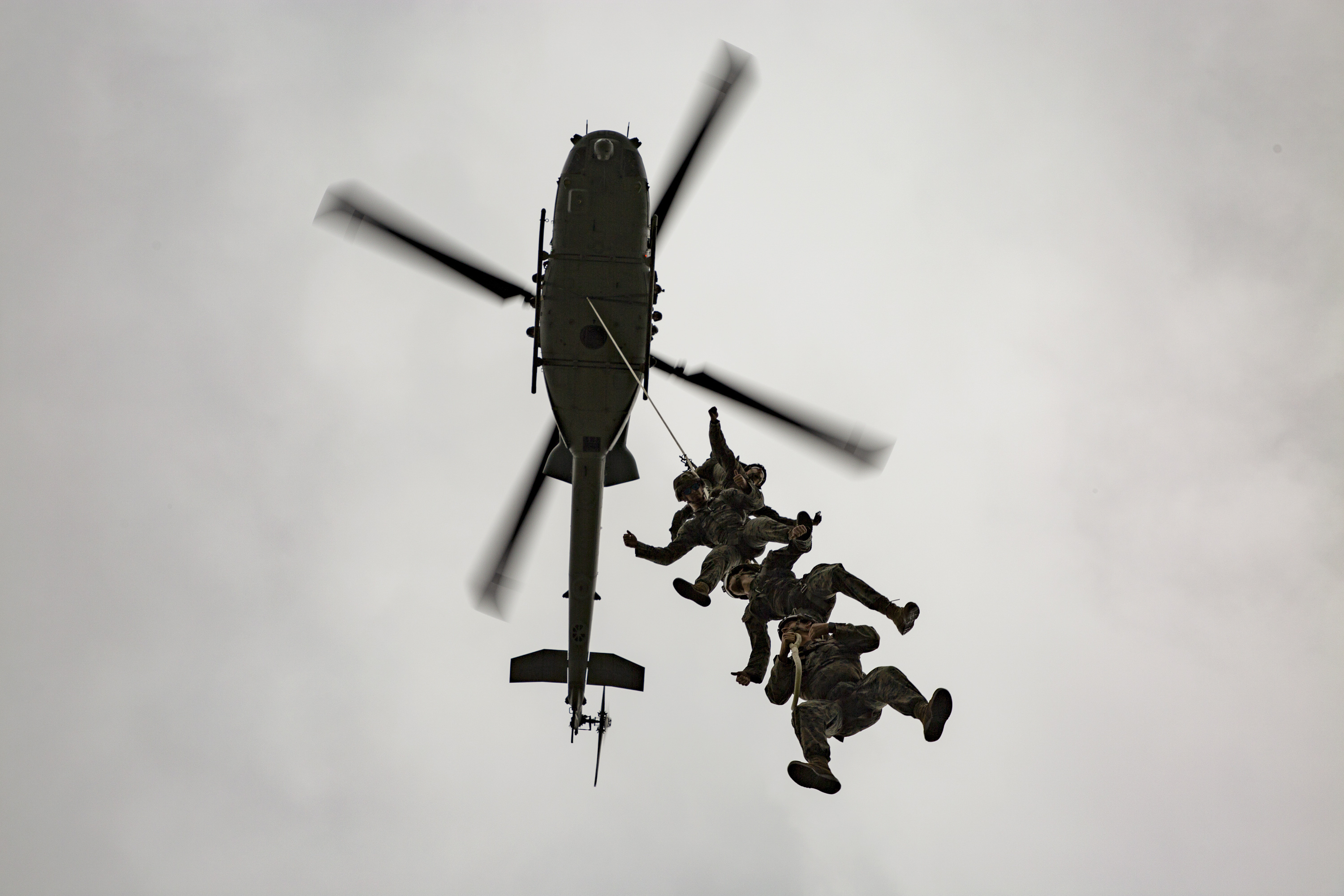
Marines conduct helicopter rappel training at Camp Hansen in Okinawa, Japan, Oct. 23.2020.
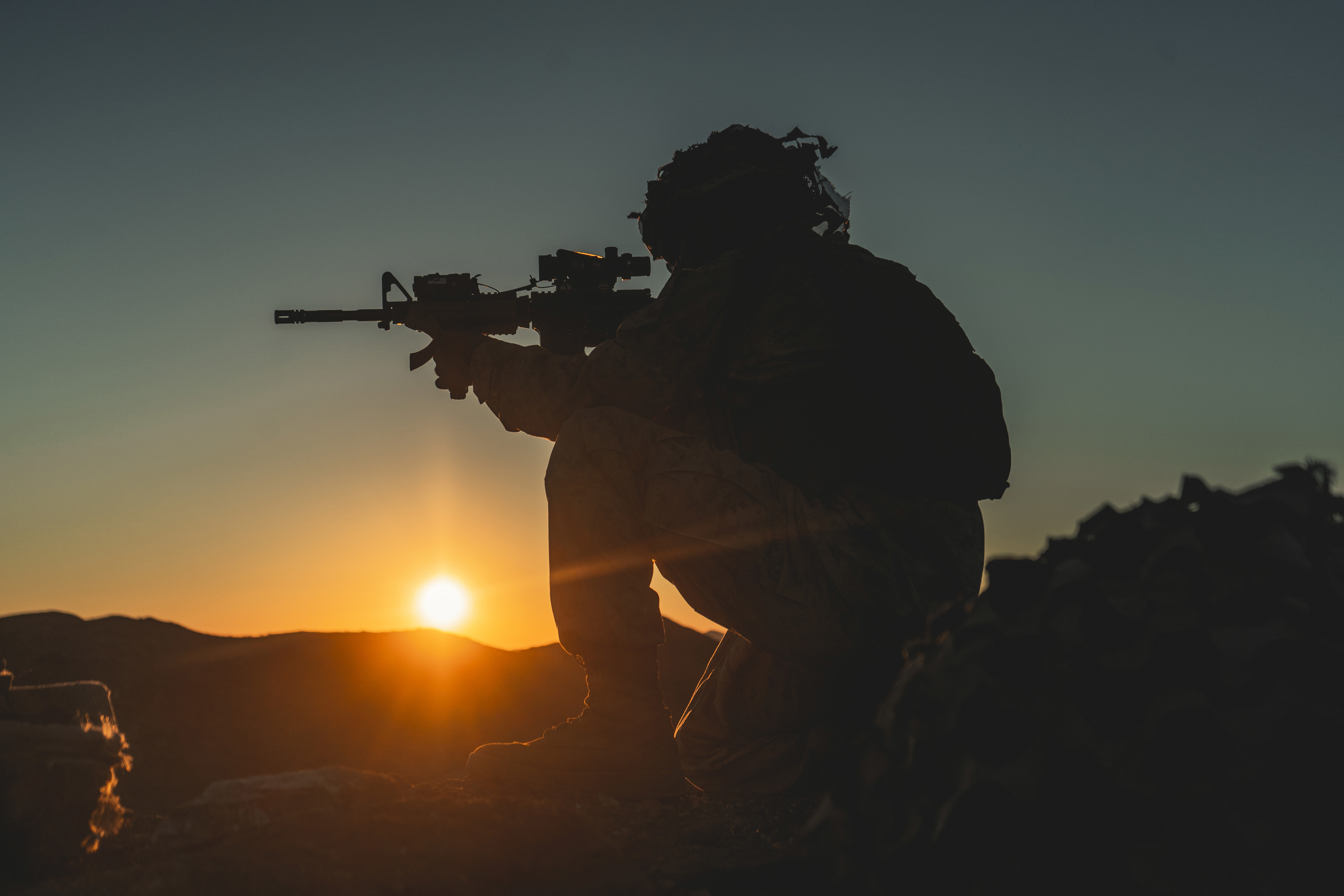
A Marine gets into a defensive position during a training exercise at Marine Corps Air Ground Combat Center Twentynine Palms, Calif., Oct. 28, 2020.
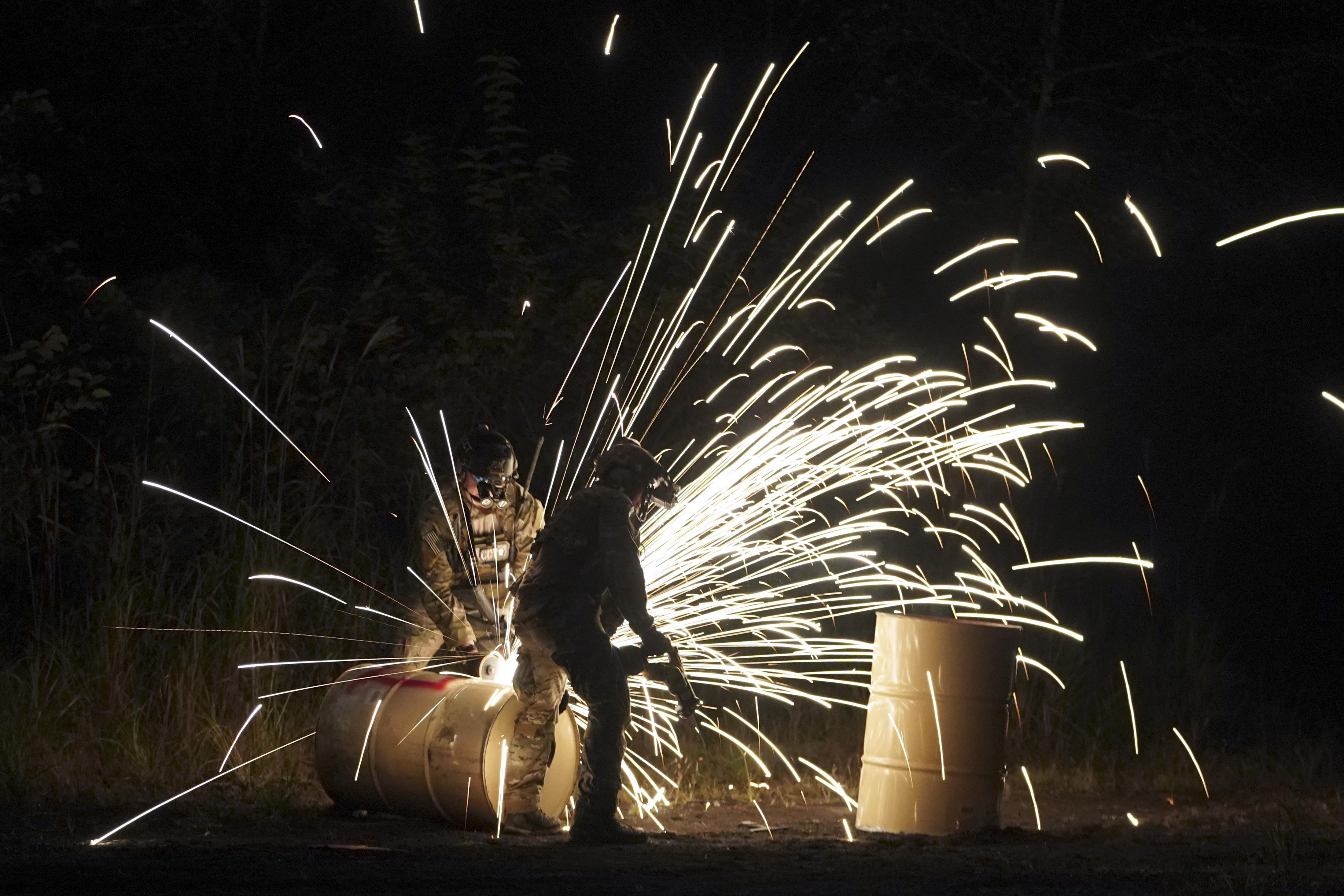
Airmen cut into barrels used as simulated light aircraft while conducting search and rescue training at Camp Fuji, Japan, Oct. 29, 2020. Exercise Keen Sword allows U.S. and Japanese troops to sharpen combat readiness and enhance long-range interception capabilities.
Nov. 2, 2020 | , DOD News
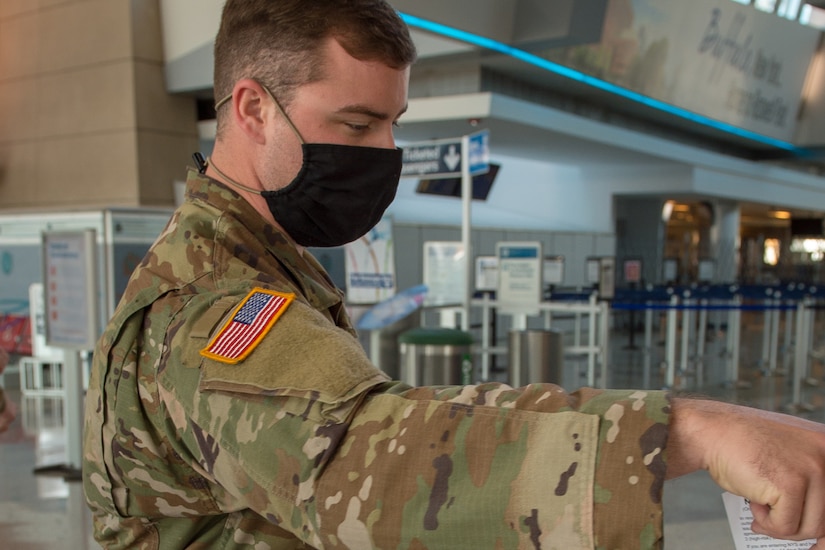
Passengers getting off planes coming from outside New York are now being greeted by New York National Guard soldiers and airmen assisting the state health department in enforcing New York's COVID-19 travel restrictions.
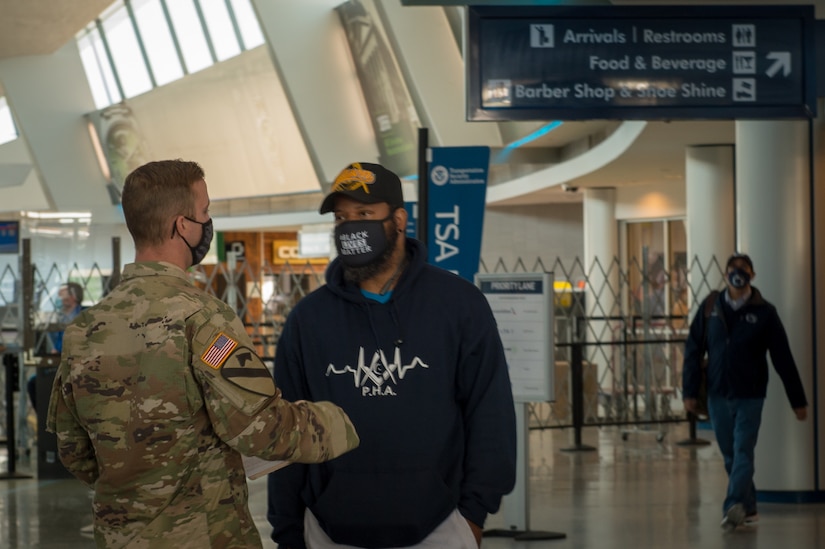
Since Oct. 16, soldiers and airmen at airports across the state have been ensuring that passengers fill out a questionnaire that enables them to comply with an executive order issued by Gov. Andrew M. Cuomo in June. That order mandates that non-essential travelers coming from states with a high level of community spread of COVID-19 must quarantine for 14 days when entering New York.
As of October, all but a few states in the United States are on the list.
"Our responsibility is to assist travelers from any of those states [and] make sure they fill out the questionnaire forms and submit them to the state Department of Health officials located in the airport," Air National Guard Master Sgt. Adam Winters, the noncommissioned officer in charge of the team at the Buffalo Niagara International Airport in Buffalo, New York, explained.
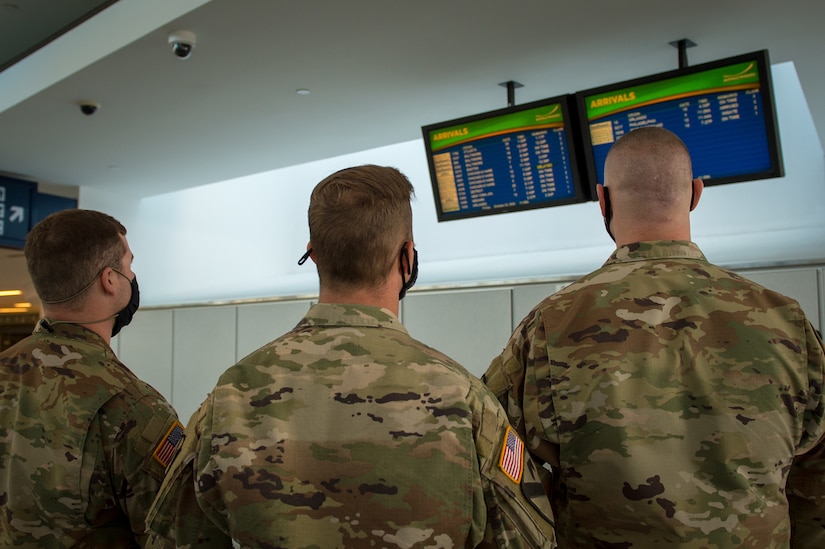
The team at the Buffalo Niagara airport consists of airmen from the 109th Airlift Wing based at Stratton Air National Guard Base in Scotia, New York, and soldiers from the 105th Military Police Company in Buffalo. One hundred Guard Soldiers and Airmen are assigned to the mission at the state's airports which include John F. Kennedy Airport and LaGuardia Airport in New York City, along with the smaller airports in Buffalo, Syracuse, Albany and Rochester.
The soldiers and airmen are there to greet travelers and request proof of completion of the travel advisory health forms, Winters explained. Travelers are asked to prove that they completed an online app on their phones or fill out and submit a form.
"We are not peace officers for this mission and are only trying to enforce the executive order that has been issued by the governor," Winters said. "Guardsmen are taking consideration for each passenger by explaining the executive order and ensuring that this is for the overall safety of all travelers."
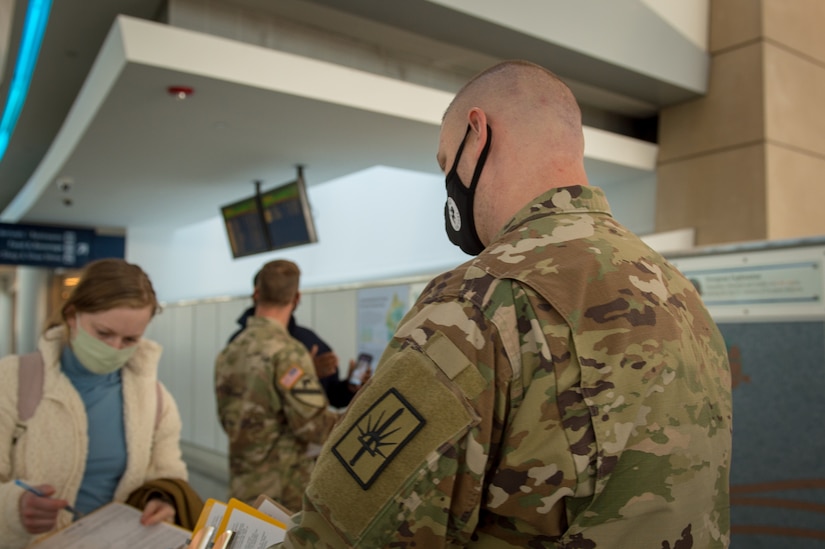
The travel advisory helps track possible positive COVID-19 cases and allows the health department to reach out to anyone who may have been in contact with someone with a positive case. That way, proper measures are taken to preserve the well-being of New York state residents and visitors, according to the New York State Department of Health.
"It's rewarding to help with the pandemic the best we can," Army Spc. Kassandra Bissell said. "We are assisting the Department of Health to keep the public safe."
Refueling airplanes in midair isn't what Tennessee Air National Guard Staff Sgt. Briana Lindquist envisioned her full-time job would be when she was growing up outside of Knoxville, Tennessee. But a random trip to the guard's 134th Air Refueling Wing was all it took for her to be sold on the idea.
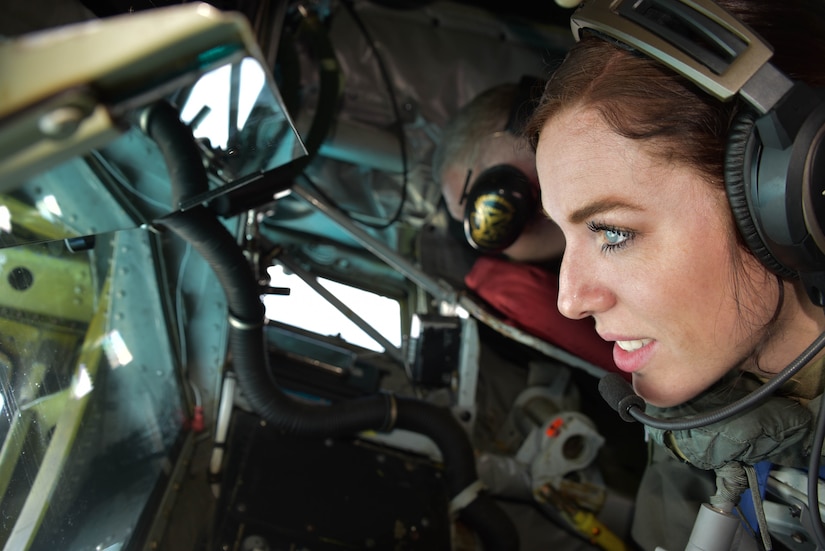
Lindquist, 28, is an in-flight fuel specialist – better known as a boom operator – which means she's in charge of refueling other aircraft while her KC-135 Stratotanker is in flight. It's a serious job that involves a lot of outside factors, and it's one she wouldn't change for the world.
So, what's it like to do this unique job, and how did she get into it? Lindquist answered some of those questions when she recently had a little free time.
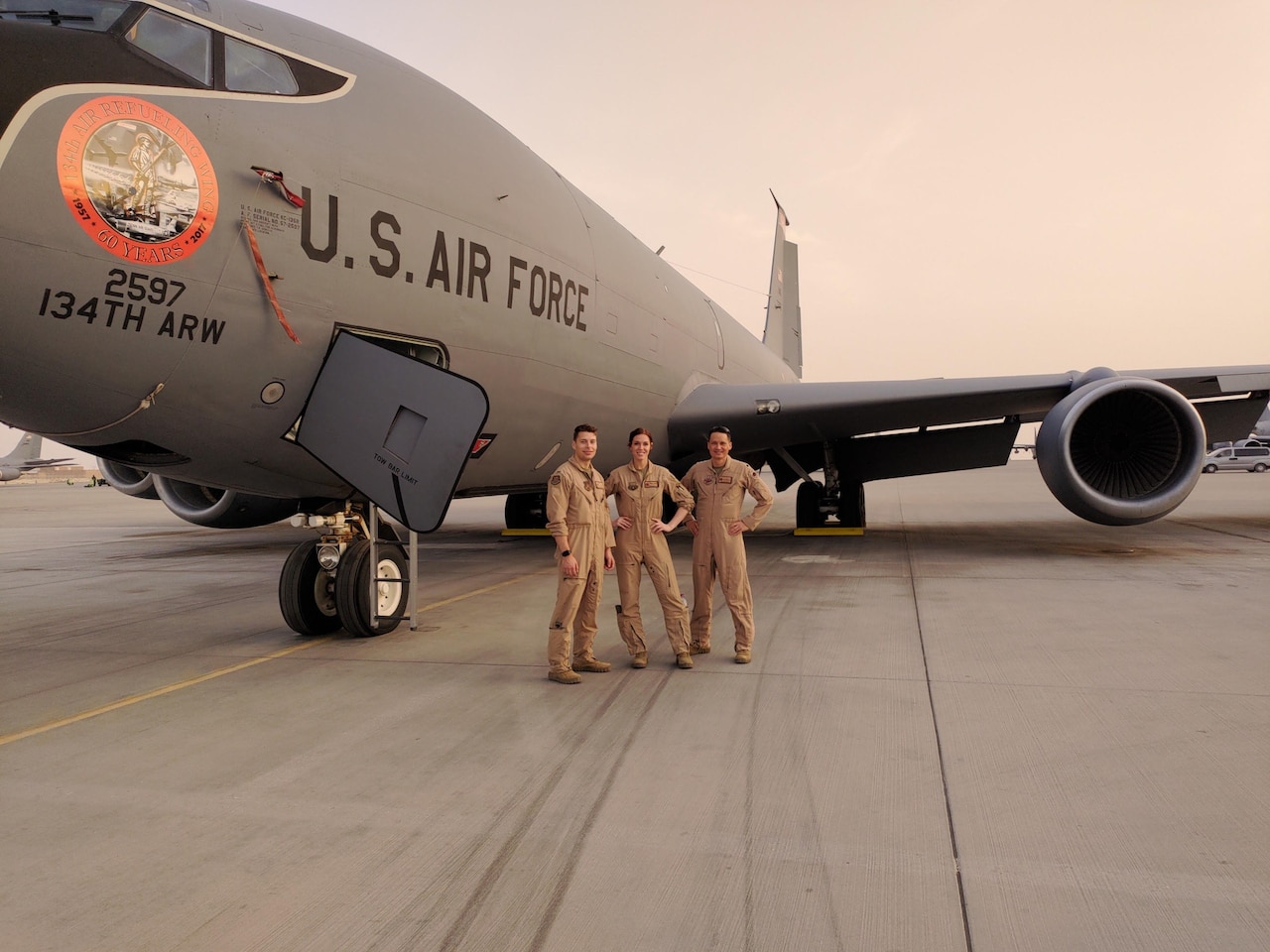
My older sister was my legal guardian when I was in high school, and she was always an inspiration to me. She was also a part of the 134th Air Refueling Wing. One day during my senior year of high school, she drove me out to the base and introduced me to the wing. The rest was history!
With parental or guardian approval. So, my sister — being my legal guardian — was able to authorize my enlistment. I signed in January of 2010, graduated high school in May, and then left for basic training that fall. During the time between enlisting and leaving for training, we have a program that allows us to attend drill in a student status where we will study rank structure, Air Force regulations and even do physical fitness to prepare us for basic training. It's a great opportunity for younger recruits to get familiar with military life before they jump into basic training, and another great advantage of being in the Guard.
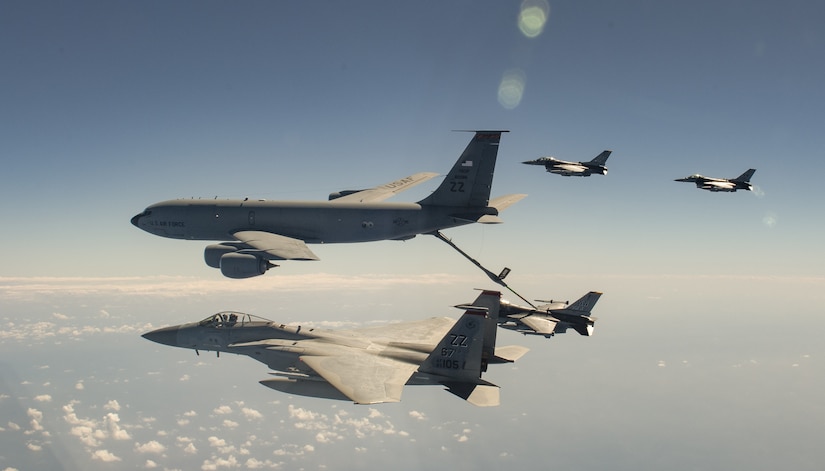
I joined as a KC-135 Stratotanker crew chief, who are in charge of the day-to-day maintenance of the aircraft. I did that for about six years, and it was a great career that allowed me to learn the aircraft inside and out. When the opportunity came up to apply for a boom operator position, I knew it was the next step in my career. I've been a boom operator ever since.
My main responsibility is the refueling of other aircraft in flight! Working from the rear of the tanker, I guide other planes into position to safely transfer fuel from our plane to theirs. It requires a lot of coordination between our pilots and the aircraft we are refueling, and I manually operate the boom into position to forge the connection that allows the fuel to offload.

I'm confident in my ability to do my job, but I still have moments where I'm a bit nervous. Every refueling is different. There are so many factors that can increase the difficulty, like unfamiliar aircraft, poor weather or new pilots who are learning how to refuel. It's my job to make every connection a success — aircraft need fuel to fly — but that can sometimes be stressful. Even so, I wouldn't have it any other way.
Absolutely! In addition to refueling duties, I compute weight and balance for the aircraft, oversee cargo loading and unloading procedures, manage passenger handling and do a host of other smaller tasks.
We perform enough missions that flying with the wing is currently my full-time job.
[Those types of opportunities] are entirely dependent on the career field. There are a lot of ways people can find full-time employment with the Guard, and it creates a ton of great opportunities for members who love what they do. Personally, I feel very fortunate to have full-time employment that I love as a part-time member. It gives me the flexibility to work when and how I want most of the time.
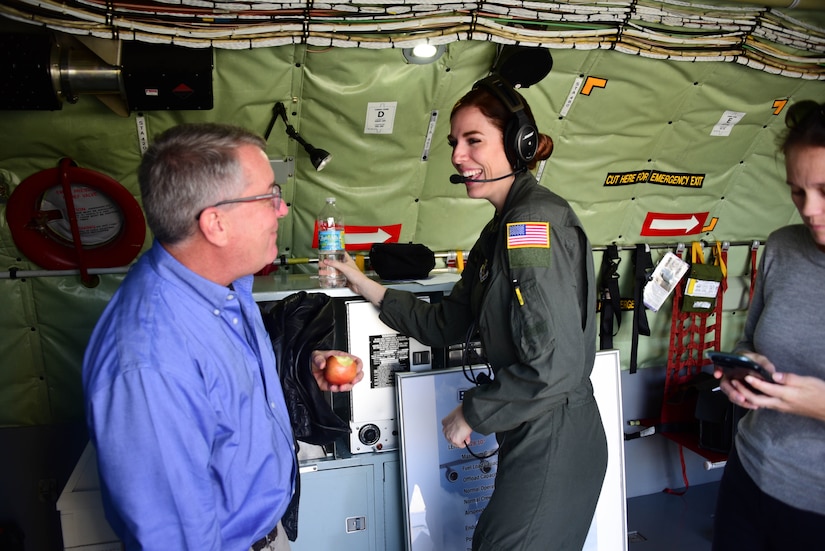
Physically, it's taken me all over the world! Almost 11 years ago, 17-year-old me would never have imagined that signing on the dotted line would bring me to where I am today. It's incredible!
Yes, the Super Bowl was an amazing opportunity! I have also been able to travel to some pretty incredible locations and work with dedicated men and women. I've deployed and flown with multiple NATO countries, flown in joint exercises stateside and abroad, and assisted with recovery efforts from natural disasters here in the U.S.
One was actually here in East Tennessee. A few years ago, there was a fire that devastated the city of Gatlinburg and the Great Smoky Mountain National Park. The overall loss overwhelmed the community, and I was able to help with the aftermath by providing meals, clothing, shelter and other various things to the community.
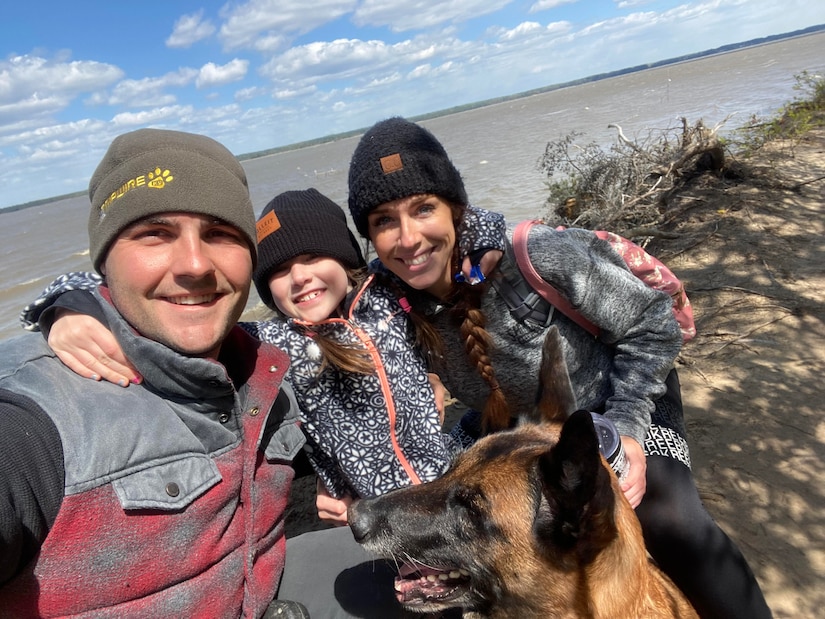
I hope to! The Guard has been my life and family, of sorts, for over a decade. There have been ups and downs like any career, but overall I love what I do and the people I get to work with.
I have a family and a retired military working dog that all keep me pretty busy! We enjoy traveling, and we also love to spend time outdoors when we're home in East Tennessee. It's such a beautiful area with so many opportunities for recreation, like the Great Smoky Mountains. This time of year brings two things that are important to my family — gorgeous mountain hikes and Tennessee football! Go Vols!
Oct. 29, 2020
Secretary of Defense Dr. Mark T. Esper met today in Tel Aviv with Israeli Prime Minister Benjamin Netanyahu. They discussed shared security concerns throughout the region and the need for continued cooperation to advance our mutual interests. Secretary Esper reaffirmed the longstanding and continued U.S. commitment to maintain Israel’s Qualitative Military Edge (QME). Both leaders agreed on the need to continue to strengthen the bilateral security relationship.
Secretary Esper and Prime Minister Netanyahu discussed how the normalization of relations between Israel and the United Arab Emirates and Bahrain under the Abraham Accords represents a historic opportunity to strengthen regional security.
Oct. 30, 2020 | , DOD News
Service members tell Defense Secretary Dr. Mark T. Esper that they do not want the Defense Department to lose focus on the importance of diversity and inclusion in the force.
The secretary met with service members during a visit to Bahrain. Esper has held 24 of these talks all over the world.
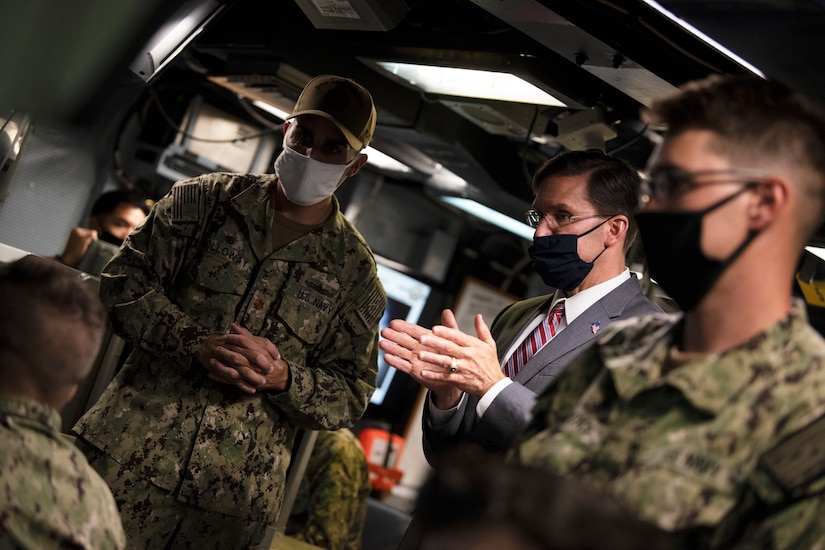
The feedback he is getting is consistent. "One concern that was expressed — and I share the same concern — is that we lose focus," Esper said during a meeting with reporters traveling with him. "The good news is: It's not different [from] my previous 23 sessions. The bad news is: It's not different [from] the previous 23 sessions. In other words, there's a constant concern out there."
The secretary said everywhere he goes, "there's this sense that there is not overt racism in the military, but there is unwitting bias."
Those are the things they are looking for ways to rid the military of, he added. Losing focus worries the secretary as well. He does not want diversity and inclusion to become just another PowerPoint lecture that service members have to endure. "So, that's a problem that I want to make sure we avoid, which is why I set up the three initiatives I did in the summer: short-, medium- and long-term efforts."
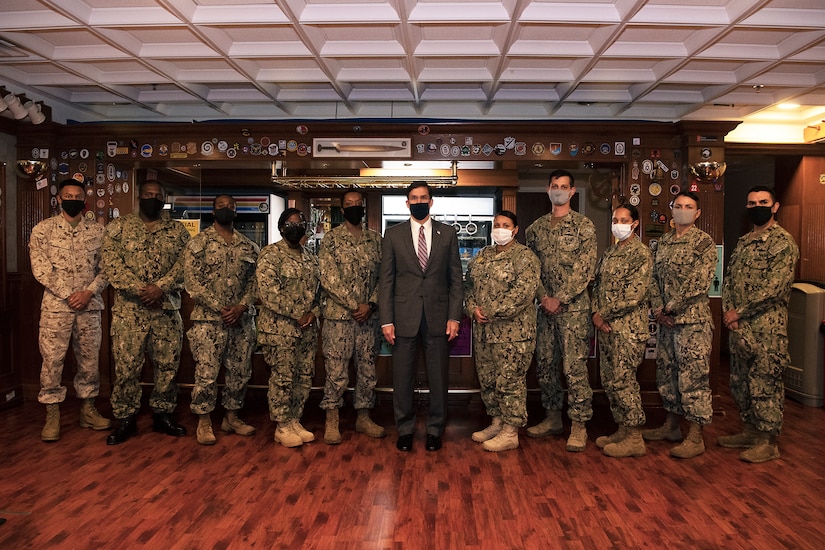
The short-term efforts were immediate things Esper could put in place. "That's done, we've accomplished several things like we took photographs out of promotion boards," he said.
The second part will come from the report of the Defense Board on Diversity and Inclusion that is due out next month.
"Then the long-term, the thing that will sustain the focus will be the Defense Advisory Committee on Diversity and Inclusion in the Services," he said. This will be similar to the Defense Advisory Committee on Women in the Services and should sustain and keep the focus on the diversity and inclusion effort.
Oct. 29, 2020
DEPUTY ASSISTANT SECRETARY OF DEFENSE KIM JOINER: Good afternoon. I'm Kim Joiner, deputy assistant secretary of Defense for Military, Community and Family Policy. To the reporters in the room and those on the phone, thank you for joining us today. We appreciate your participation and hope that we walk you -- you walk away with a better understanding of what our team does every day for our service members, their families and survivors, particularly during this time of COVID-19.
We are the focal point for the coordination of a broad range of quality of life issues within the department. We are home to Military OneSource, the DOD-funded program that provides comprehensive information, resources and confidential support 24/7, 365 on every aspect of military life.
And before I introduce and welcome my three directors today, I'd like to inform you that we continue to closely follow Secretary Esper's three priorities for the COVID-19 response, which are, first, protecting the health and safety of our service members, their families and our civilian workforce; second, maintaining our national security mission capabilities; and, third, supporting the whole-of-nation response to the COVID-19 pandemic.
Additionally, we designated commissaries and other support facilities as mission essential so they could remain open throughout the pandemic. Our military family resources are especially critical during the pandemic. To better serve our service members and their families during this challenging time, military community and family policy significantly enhanced our support efforts in every aspect of our portfolio.
For example, we transitioned more than 1,800 military and family life counselors around the globe from face-to-face non-medical counseling support to telehealth. We launched a section on Military OneSource specifically dedicated to COVID-19 to ensure our military community receives the latest and most accurate information.
And just this month, we launched the My Military OneSource mobile application, which is available for download on smartphones and tablets to provide easier access to information, support and referrals.
Secretary Esper holds an unwavering commitment to caring for our warfighters and their families, as evident in his adding his own fourth line of effort to the National Defense Strategy of taking care of families. This has sent a strong message to the military community and throughout the Department of Defense. We understand how much our people rely on the resources we provide, so this is a no-fail mission for us.
You're going to hear about the spectrum of support we provide. However, in order to really get a true picture of the impact, nothing replaces talking to the service providers who do the work, or the service members and families who access the resources. So if at any point in the future you would like to take a deeper dive into the resources and talk to those providing and receiving that direct service, please let us know, and thank you.
Now, allow me to introduce my three directors. Mr. Marcus Beauregard -- over to you, Marcus.
DIRECTOR MARCUS J. BEAUREGARD: Good afternoon. My name is Marcus Beauregard. I'm the director of the Defense State Liaison Office. Our office of 10 people work with state governments.
Our mission from the very onset has been to essentially eliminate barriers that military families find as a result of unintended consequences of state policy. We also have done some work in terms of basically comporting state policy with federal -- federal law and policy, to ensure that there is no disconnect.
Over the years, we've worked family law; we've worked consumer protection; we've worked child care; K-12 education; higher ed.; EFMP [Exceptional Family Member Program] support through Medicaid waivers; employment security; licensure; voting; National Guard support; veterans' treatment courts; and disposition of human remains.
Right now, we have 10 key issues that we're working that I'll be happy to explain, and go from there. Look forward to your questions.
MS. JOINER: Thank you, Marcus.
Ms. Lee Kelley? Lee, you can take it away.
DIRECTOR LEE KELLEY: Thanks, ma'am.
My name's Lee Kelley. I'm director for military community support programs in the Office of Military Community and Family Policy. My team oversees Military OneSource, the military and family life counseling program, as well as some of DOD's spouse employment programs, like the Spouse Education and Career Opportunities Program, the Military Spouse Employment Partnership and the My Career Advancement Account Scholarship for military spouses.
I wanted to just offer three areas of focus that we have right now during this -- this particular phase of 2020, and the first is a focus on the virtual provision of support. And so we're very lucky in -- within our team to be implementing programs that were already predominantly delivered virtually when in March, we experienced the widespread closures as a result of COVID-19. However, we -- we have added additional virtual capability due to the current needs of our service members and families.
And just as an example, in the spouse-employment space we are particularly increasing our number of virtual engagements. Our Virtual Military Spouse Symposium back in April of 2020 saw nearly 4,000 spouses attend, versus typically what we'd see on an annual basis at -- at that one event would be more like 2,000 spouses.
We also recently held our Virtual Hiring Fair through the Military Spouse Employment Partnership, bringing almost 700 military spouses to visit more than 100 companies who participate in the partnership, who are committed to spouse hiring.
The second area of focus that we have right now is of the virtual delivery of a -- a new initiative developed by the Office of People Analytics called REACH -- Resources Exist, Asking Can Help. It's a -- it's a program, an initiative that's actually focused on dispelling the myths around help-seeking, and -- and COVID-19 has not prevented us from moving that forward. And so we're now focusing more on a virtual delivery with the goal, again, of dispelling the myths of help-seeking, normalizing the experience of help-seeking, removing stigma that might exist for our service members and families.
And the third area of focus, that we're really very excited about, is this fall we've launched a relationship campaign because the top reason that service members and families seek non-medical counseling through the Military and Family Life Counseling Program, as well as through Military OneSource, is for relationship support, and certainly, that need has not gone away during this pandemic. So we've been focused on a public-facing relationship campaign to help pull back the curtain on what relationship support looks like for couples in the military, and we're looking internally at how we provide that relationship support to determine how we can do it in the most effective manner possible. And I really look forward to your questions. Ma'am?
MS. JOINER: Thank you, Lee. And last, but not least, Ms. Carolyn Stevens. Carolyn?
DIRECTOR CAROLYN S. STEVENS: Good afternoon. I'm Carolyn Stevens, the Director of the Office of Military Family Readiness Policy. Our office is divided into three teams: Children, Youth and Families; Family Advocacy Programs; and the Office of Special Needs. I'd like to take a few moments and share some of the initiatives that -- that we have in place that are supporting our families.
So starting first with the Exceptional Family Member Program, we recently launched, with the help of Military OneSource, a web application called “EFMP and Me.” EFMP and Me gives our families, our service providers and our leadership access to a myriad of different topic areas so that individuals can go into the web application and search on very specific information to get questions that -- that might be specific to their individual needs, like preparing for a move; questions about education when you're transitioning to a new location; questions about TRICARE and other medical needs; or just -- just the adjusting to new life situations, if you have a family member enrolled in EFMP.
October is also Domestic Violence Awareness Month, and our Family Advocacy Program, along with the department, is taking the opportunity to reinforce our commitment to keep our military families safe; to support victims of domestic abuse; and ensure that domestic violence is recognized as a crime in those -- in those cases where there's abuse and harassment. We have really focused on what we call a coordinated community response to the work with family advocacy programs, ensuring that we are working with our other entities like law enforcement, investigators, school personnel, personnel in children and youth programs. And the importance of that means that we are taking a very integrated approach in providing supportive services through all of the family advocacy programs.
In particular, we're excited to -- to announce that we have recently launched a training course that involves first responders; again, a very concrete way of ensuring that we take advantage of technology and take advantage of those relationships to work together to support our families.
And then finally, in the area of children, youth and families, we've recently launched an initiative through Military OneSource, again, where we've expanded the availability of childcare for hourly care purposes. We know that not every family needs care on a full-time basis, and through this expanded service with Military OneSource, families can now go into a web application. They can search care providers and find a care provider who can be available to meet those short-term, hourly care needs.
I look forward to your questions. I'll stop there. Thank you.
MS. JOINER: Thank you, Carolyn. OK, let's get started. Abraham Mahshie with the Washington Examiner. Go ahead.
Q: Thank you so much. (inaudible) these important initiatives and topics that you guys have spoken about, and I have a few questions. Lee, I wondered if you could describe a little bit more, specifically, the counseling and the job sort of assistance that you've been providing since COVID hit. Obviously, mental health is a big issue related to the coronavirus lockdowns. I wonder if you could get into more details on that.
And then Carolyn, you spoke about domestic violence awareness this month, and I -- studies show that the more time people spend together, the higher domestic violence is. And so coronavirus lockdowns is putting people together for longer periods of time. I wondered if you're observing that in the military as well, and how you've responded to that. Thank you.
(UNKNOWN): Thank you. Go ahead, Lee.
MS. KELLEY: So I'll start, talking about our counseling programs. Our counseling programs, from the beginning, since they -- they've -- since they started more than a decade ago, have been centralized and standardized through Military OneSource and the Military and Family Life Counseling Program. The biggest difference between the two programs is that Military OneSource is a -- it's entirely, almost entirely virtual. So it's a call center, 1-800-342-9647, 24/7, 365 days a year. And it's often referred to as a one-stop-shop. So any concerns, questions related to military life, whether it's financial counseling, health and wellness coaching, assistance with eldercare, childcare, not -- certainly, non-medical counseling, spouse employment, tax filing -- you name it. Service members and families can reach out to Military OneSource at any time. They can do that via the 1-800 number, or they can do that via live chat through the website.
The Military OneSource Program has always provided non-medical counseling. That non-medical counseling -- and just to -- to kind of step back and define non-medical counseling for a second, because it's not the most intuitive phrase. Non-medical counseling is for all of those issues of -- those stressors related to military life that are under a threshold of a mental health diagnosis -- so relationships, anger, communication, grief, loss. Those are all really appropriate for the solution-focused, non-medical counseling that we provide through Military OneSource.
The Military OneSource non-medical counseling can be provided face-to-face in the community, around where a service member or a family member lives or works; it can be provided via telephone or via video. Separately, the military and family life counseling program, before COVID-19, was provided solely face-to-face. This was face-to-face delivery of non-medical counseling support where service members and families live and work.
So it's a little bit of a nontraditional counseling program, in that you could connect with a counselor while you're fixing an aircraft on a flight line, because that counselor's been embedded in your unit. You could connect with a counselor when you go to pick up your child at the child development center or at the school. So the counselors are located in convenient places for service members and families, so it's always been done face-to-face, around the globe, through the use of more than 2,000 counselors.
What happened during COVID-19 was a demand signal immediately went up from our military communities, service members and families around the globe that said "we don't want a -- yes, we can't have the face-to-face support right now, but we don't want to lose the capability of the counseling support provided through the military and family life counseling program."
So the program quickly transitioned in a matter of days to provide telehealth support. And so that same counselor that you knew from your child's school, you were then able to connect with via video. Military OneSource has been and continues to be used as a central directory for military and family life counselors. So if you say "oh, I -- I know I had one at my unit, but they're not here right now because we're all working from home," you can call Military OneSource and find out the contact information for that counselor so that they can set up a video appointment.
So that's -- that's where we were back in March and where we continue to be, but the military and family life counseling program, it just depends on the location as to whether they're providing face-to-face or telehealth support right now. Completely based on the conditions on the ground and the needs of that location.
I'll move on to the spouse employment piece that you referenced. The spouse employment piece -- so again, the spouse employment program really benefited from already being delivered centrally and in a standardized fashion virtually.
So the spouse education and career opportunities program is implemented through Military OneSource and it provides a dedicated career coaching support to military spouses, and it always has. So it was already virtually delivered, so it was seamless during COVID-19.
What the call center experienced, what the program and the career coaches experienced was not a tremendous spike in spouses calling regarding unemployment, but certainly to include calls related to unemployment; layoffs; how do I balance work and virtual schools for my child; and also for our spouse students, who maybe were attending school in person using the My Career Advancement Account scholarship -- my school's closed, does that mean I'm going to lose my funding? And the short answer is no.
So from the spouse employment perspective, we allocated more effort towards meeting the virtual needs by offering new virtual events. So we offered, just in the last couple of months, career empowerment expos for the Air Force and the Navy that had been previously planned to have been done in person. Those were then done virtually, which actually allowed us to have a wider spectrum of speakers, because there was no travel involved in that.
The third that I just wanted to touch on, that you mentioned, related to COVID-19 specifically -- I mentioned the shift of the military and family life counseling program to telehealth. I'll also say that Military OneSource did need to undergo a shift at the onset of COVID-19 related to support provided to military youth.
Previously, military youth could only obtain non-medical counseling face-to-face through Military OneSource. We heard, again, a demand signal from our military community saying "we need our military youth to be able to access video counseling from their home." And so the program was modified to allow that capability. A parent just needs to come in and give their consent at the start of the video session and then the military youth is able to proceed with a video counseling session.
Q: Great. Do you have any metrics to describe, like, sort of how -- when you talk about demand signals, like, the increased demand for those counseling services or the -- the jobs? Or if you don't have metrics, like, do you have any anecdotes? Like, did -- did this -- did this actually go up, did it go up by a lot?
MS. KELLEY: So with Military OneSource, we've seen a steady increase in utilization, but not necessarily -- it didn't start with COVID-19. We've been seeing, over the last two years, a steady increase in utilization. That steady increase has continued through COVID-19.
What you see in COVID-19 are anecdotes related to the circumstances introduced by the pandemic. So again, I'm not used to having my spouse in the house all day long -- communication challenges related to relationships. You know, from -- from a -- a metric standpoint, you know, just to give you kind of an idea of the amount of relationship support that's provided through the programs, I'm -- I'm going to cite an F.Y.'19 data point, but it hasn't changed tremendously in F.Y. '20.
So F.Y. '19, we saw relationship support make up more than 260,000 sessions within the military and family life counseling program out of a total of 765 sessions. So about 34%. Again, that's the top issue, people seek non-medical counseling through our programs -- is for relationship support, and in F.Y. '19, again it was up -- it ended up being more than 260,000 sessions, and so that -- that has remained the key issue.
It's just that the -- the relationship support that's being asked for now includes the issues that have risen to the surface as a result of COVID-19. In some cases, couples have welcomed the opportunity to work virtually with a military and family life counselor from the comfort of their home, rather than having to coordinate to meet their spouse on base or at another location to have that session.
So for some couples, they've embraced the convenience of -- of telehealth, and for others, it made -- more appreciate the face-to-face support, which we're able to do safely, abiding by CDC -- Centers for Disease Control requirements in areas where that's acceptable and appropriate.
Q: OK, thank you.
MS. JOINER: Carolyn, go ahead.
MS. STEVENS: You ask about the increase -- potential increase in domestic violence, domestic abuse cases. Certainly we -- we see the -- we see the news and we know that in the civilian community, there are increases in the number of reports.
We are not currently seeing that within our military services. In fact, the -- the number of reports now are very similar to the reports a year ago this time. We -- we are concerned that -- and this is an issue that we do need to maintain watch -- I -- I -- I do want to pivot, I think what's important, and it mirrors a lot of what Lee is talking about -- the -- the value and the importance we've placed on the availability of supportive services through virtual methods.
So our family advocacy clinicians have also shifted to that virtual service delivery, our new parent support counselors, the home visitation program shifted as well, victim advocate support, all of that can be provided through -- through virtual means.
So -- so we haven't lost the rhythm of being able to support both victims, provide information to leadership in terms of -- of what are the next steps in cases of allegations of abuse. We didn't lose anything because we just shifted to a virtual means.
Q: In (inaudible) increased sort of calls, or you said no increased reports?
MS. STEVENS: No increased reports. And that's what -- so I'm focused on your question, I'm interpreting your question as -- we do read in the news that there are increased reports, and that's really where we are, are staying connected. That's what -- that's the data that gets reported back to us.
Q: All right, very good, thank you.
MS. JOINER: Thank you, Abraham.
We also have Jennifer-Leigh on the call from Air Force Magazine, on the phone, if you'd like to ask your question?
Q: Well, hello everyone, and thank you so much for taking the time to speak with all of us. I have two quick questions. The first was actually a follow-up on the (inaudible) just received. And this question, again, is for Ms. Stevens.
I was just hoping that you could elaborate on the training programs that involved the domestic violence issues that you said was incorporating first responders. If you could just speak to the nature of what that program is, whether it trains with families, that brings in first responders as speakers or if they're training first responders to be more kind of fluent in what military culture looks like, what military family dynamics look like.
And then my second question is on an unrelated note, and that's for Mr. Beauregard. And that question is, have you seen any progress on the part of states with respect to military staff licensure portability, especially following the Department of the Air Force's assessment of portability in all states where the department has installations? Thank you very much.
MS. STEVENS: So thank you for that question. Regarding the training that I mentioned in my opening remarks, it is focused on technology. Last year, during Domestic Violence Awareness Month, and again this year, our office focused on the fact that abuse can occur through technology, through the phone, through text. That we needed to move away from thinking about this issue as simply a face-to-face issue between an alleged offender and a victim.
And so this training that I mentioned is -- is really focused initially at that law enforcement group as first -- first responders, and bringing them into the conversation about the importance of understanding how technology can be used in cases of domestic violence.
And while -- while we worked with law enforcement to develop this training, it's appropriate for all first responders. Just, again, this is really focused on the technology aspect of this issue.
Thank you. Lee?
MS. JOINER: Marcus.
MS. STEVENS: Marcus, sorry.
MR. BEAUREGARD: Thank you for that question. I'll see if I can repeat it and make sure I got it right. You're asking about whether we saw any improvement in military spouse licensure policy at states; and has there been any impact of the Air Force evaluation system that feeds into the -- their basing model? Is that correct?
Q: Yes, basically I'm just wondering if anything has improved on the licensure portability front, and if the -- I guess if that Department of the Air Force assessment, that kind of graded or have indicators for the relative portability of licenses in various states where the department has bases, if that has had any positive impact.
MR. BEAUREGARD: OK, thank you -- thank you for that.
I'd like to start with just saying that our office has been working military spouse licensure for several years, and over a period of time, we got the states to enact certain legislation around endorsement, temporary licensure, expedited application processes.
In 2017, we found at the -- as a result of a study that was done by the University of Minnesota, that those were not necessarily the most impactful ways to get to the issues that military spouses have with licensure, which are fundamentally about the process and about the amount of effort, time and resources it takes to get to the point of being licensed in a new state.
And so what we did is we went back to the states in 2018. We were aided -- and I wanted to make this point, that the letter that came from the three military department secretaries was sort of the shot across the bow that really got things moving. States once -- where they thought they had taken care of the problem, realized, no, there is more to be done. And so we took advantage of that opportunity to work with states on new best practices that they were developing.
Concurrent with that, at the same time, the Air Force was developing their criteria to evaluate states, and we worked with them, based on the knowledge we had coming from our experiences before 2017 and the result of the University of Minnesota study. And so they started developing that evaluation process and at the same time, the department started working -- as I said, working on this issue as well.
And Secretary Esper, in 2019, said that after he -- he established a fourth line of effort for the National Defense Strategy that included taking care of military families as essential to our national strategy, he also identified military licensure as a key element to that, and requested that we put together a report that would go to all the state governors in the defense -- or the congressional defense committees.
In that, we lined out a way head, three lines of effort. And those three lines of effort developed into also a criteria. So the Air Force had a criteria, we had a criteria. Not necessarily the same, but supportive, definitely supportive of each other. Ours is oriented -- ours -- the OSD criteria, along the three lines of effort, just basically there to provide feedback to the states to let them know how are they doing on those three lines of effort. The Air Force developed a criteria around nine occupations as a test of how well they're doing.
And so we use both of those. And where there are any differences, we've been working very closely together -- the Air Force team and our team -- and approaching states where they have any concern about a difference in that evaluation.
As far as the impact of that evaluation, it has definitely, I think, heightened the awareness of this issue in states where there are Air Force installations. And we are the boots-on-the-ground team that deals with the state legislators. And so we hear from them and ask -- have them respond to us about how can they do better. And so we provide them best practices from other states, which indeed provide the support necessary to improve to answer the needs of the Air Force criteria as well.
Long answer, but hopefully that gave you some context of how we're doing this now. The -- the three lines of effort are included in our 10 key issues for this year and so we're taking them to the states in 2021 to continue our effort. And we're seeing great response.
In 2021, we'll be working on enhancing licensure, state licensure policy. We call it "enhancement" because the states had already done something, but we've come up with a new way of benchmarking them, giving them best practices and giving them a baseline, saying that a military spouses should be able to get a license within 30 days and provide minimal paperwork initially.
They may have to provide additional paperwork to verify their initial application, but they should be able to get some kind of either provisional, temporary or even permanent license based on minimal paperwork up-front.
The second line of effort is to ensure that states are implementing whatever state law they have, and making that law accessible to military spouses. We receive feedback from military spouses that they still don't understand what they need to do; and so we test the -- the states in terms of going to their websites, looking at their application forms, ascertaining whether they have done a good job with implementation and whether they're making it readily accessible to the military spouse.
And finally, we see that interstate compacts for occupational licensure provide a game-change. They basically allow a military spouse to hold the license in one state and then be able to work in all other member states through something called “privilege to practice” without having to re-license in the new state. So we're following through with that as well.
So right now, we have about 20 states that have fulfilled the requirements that we see in terms of that 30-day minimal paperwork requirement. We've got 22 states that we recognize have good policy, good policy to ensure accessibility and have websites that make it -- make it so, make it accessible for military spouses.
And then overall, we've got 39 states that have committed one way or another to interstate compacts; in the criteria that the -- that the OSD has in terms of how well are they doing, we think that states are doing well if they've done at least three compacts -- there's five out there right now that we have been following.
And so we've got 19 states that have done at least three. And as I said, we'll be working with them in 2021 and working hand-in-hand with the Air Force in terms of their criteria reviewing the -- the results of their criteria so that we don't have any disconnects that we have to necessarily discuss with states as a follow-on.
I think that -- that covers it.
(Laughter.)
MS. JOINER: I think you covered that, Marcus, thank you.
Is there anybody else on the phone that would have a question they'd like to ask?
OK.
Q: Hi, this is Caitlin Kenney with Stars and Stripes.
MS. JOINER: Go ahead.
And we'll get back to you, Abraham, just a moment.
Go ahead.
Q: Hi. I don't know if I heard this, but can you say, I guess, what the -- if there's been any increase in, like, more -- like, new, I guess, users for those counseling -- the nonmedical counseling, whether it's service member or spouse or teams? Do you have, like, any actual, like, increasing in numbers and data regarding that, now that it's at least more accessible with virtual? Thanks.
MS. KELLEY: Hi, this is Lee Kelley. I can take that.
(UNKNOWN): Thank you, please.
MS. KELLEY: So we've seen a steady increase in Military OneSource utilization of nonmedical counseling that has continued throughout COVID-19, but did not start at the onset of COVID-19. So it's been a regular, steady increase that did not go away with COVID-19.
The nuance is that the issues -- when we kind of take a pulse of the issues that people are seeking counseling for, COVID-19 may emerge as a stressor amongst those -- those issues that are described when a service member or a family member is seeking support.
You know, for kind of looking at just F.Y. '20, which I know just wrapped up, relational problems remained the top issue for which service members and families sought support for through Military OneSource and the Military and Family Life Counseling Program. It was 56% of all nonmedical counseling sessions for Military OneSource.
And F.Y. '20, I know earlier I cited the F.Y. '19, but the F.Y. '20, it was 38% for relational -- again, relational problems being described as the top reason service members and families were seeking nonmedical counseling.
(UNKNOWN): can you (inaudible) that? Sorry.
MS. KELLEY: Yeah, sure. So earlier, I had mentioned the F.Y. '19. And the F.Y. '19 relational problems accounted for 34% of Military and Family Life Counseling sessions, OK? In F.Y. '19, relational problems indicated were for 57% of total Military OneSource sessions, so two different programs.
Then, switching to F.Y. '20. F.Y. '20, they accounted for 38% of Military and Family Life Counseling programs. In F.Y. '20, they accounted for 56% of Military OneSource sessions.
MS. JOINER: Thank you, Lee, great.
MS. KELLEY: Thank you.
MS. JOINER: Abraham, did you have an additional question?
Q: (inaudible) very similar to the question that was just asked, was trying to get numbers. And it just -- with all -- with the COVID lockdown stress that is permeating all of society and the military, it's hard to believe that it is negligible that the services -- that there's a negligible increase in demands for these services.
MS. KELLEY: The demand has always been in existence. With Military OneSource, we've continued to see a rise in utilization of service members and families accessing the service. That rise did not start with COVID-19.
We think this is a good sign in that service members and their families, when COVID-19 really began to initiate the significant lockdowns starting in March, knew they could rely on Military OneSource as a place to reach out to for support, particularly because that support could be provided virtually; and service members and families, again, for more than a decade, have been used to being able to rely on that service, whether it's picking up the phone, accessing it via live chat.
With military and family life counseling, we have seen sustained utilization through that program but during COVID-19, when we switched to telehealth, there was a -- a -- there was less utilization because the -- the counselor was not right there with you in the room or at the family center or at the school or at the child development center.
So service members and families have to reach out to engage or they may have their command reach out and say "this is that military and family life counselor's contact information," but this speaks to why the military and family life counseling program was a face-to-face program to begin with, because it was intended to really create that ease of access for service members and families.
The telehealth capability has been the -- the capability that we can bring to bear in COVID-19, in areas where face-to-face support isn't available or isn't appropriate at that time, but it doesn't take away -- so -- when -- when we were able to go back to face-to-face support, I think that's what you will see.
You will see military and family life counselors delivering face-to-face support, not maintaining a telehealth presence, because I think the -- the -- the -- what we know through this program is that the face-to-face delivery is important because that counselor's not sitting in an office somewhere. They're actually walking around the unit or walking around the school. And so they're an easy -- easy frame of reference for someone who's seeking help.
You know, the Department of Defense worked with RAND on an evaluation of non-medical counseling and the results were published back in 2017 and they -- they really kind of point to why the program is effective. It -- it's effective because service members and families feel comfortable with the confidentiality provided through the counseling, they feel comfortable with encountering a -- a counselor in normal settings versus having to maybe go to a -- an office to -- to sit down and kind of call -- maybe call attention to themselves. So they're able to really be comfortable with that counseling.
And so the -- just to -- just briefly, the results of that evaluation found that non-medical counseling does reduce problem severity in the short and mid term, and it does reduce interference with daily routines. And so this kind of, again, speaks to why we believe that non-medical counseling is a really important prevention program for our service members and families in maintaining their wellbeing and readiness.
Q: Great. Could you quantify the utilization? Like, how many -- what number of people or families is using it?
MS. KELLEY: For -- for which -- for both programs? Yes, I can. So for --
MS. JOINER: Lee, why don't we try to -- we'll get -- can we get -- get back to you on that, just so we're certain we're -- certain we're -- we're on the numbers?
MS. KELLEY: Sure.
MS. JOINER: OK. One more question -- we have time for one more question. Does anybody on the phone have a question?
All right, well thank you, for everybody joining us today, for the opportunity to be with you. To my directors, thank you so much, excellent job.
And that concludes today's event, so thank you very much.

Betty Dybbro, a Women Airforce Service Pilot, or WASP, visits Joint Base Lewis-McChord, Wash., Oct. 21, 2020. The WASPs were federal civil service pilots who tested and ferried aircraft and trained other pilots during World War II to help offset the lack of male pilots on the home front.
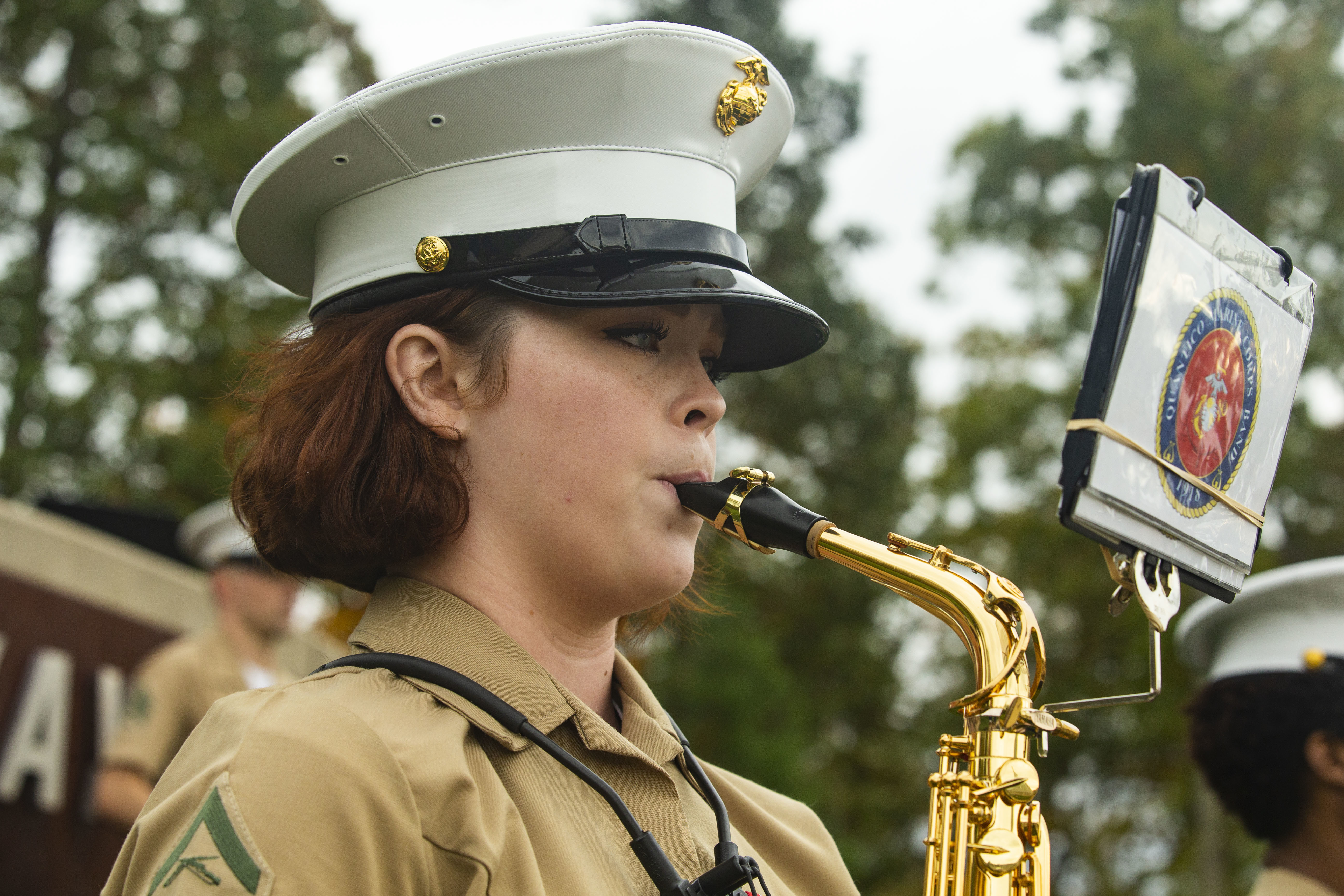
A Marine with the Quantico Marine Corps Band performs at the National Museum of the Marine Corps in Triangle, Va., Oct. 24, 2020.

An Army CH-47 Chinook spins up for an evening training flight just after a storm clears at Katterbach Army Airfield, Germany, Oct. 6, 2020.
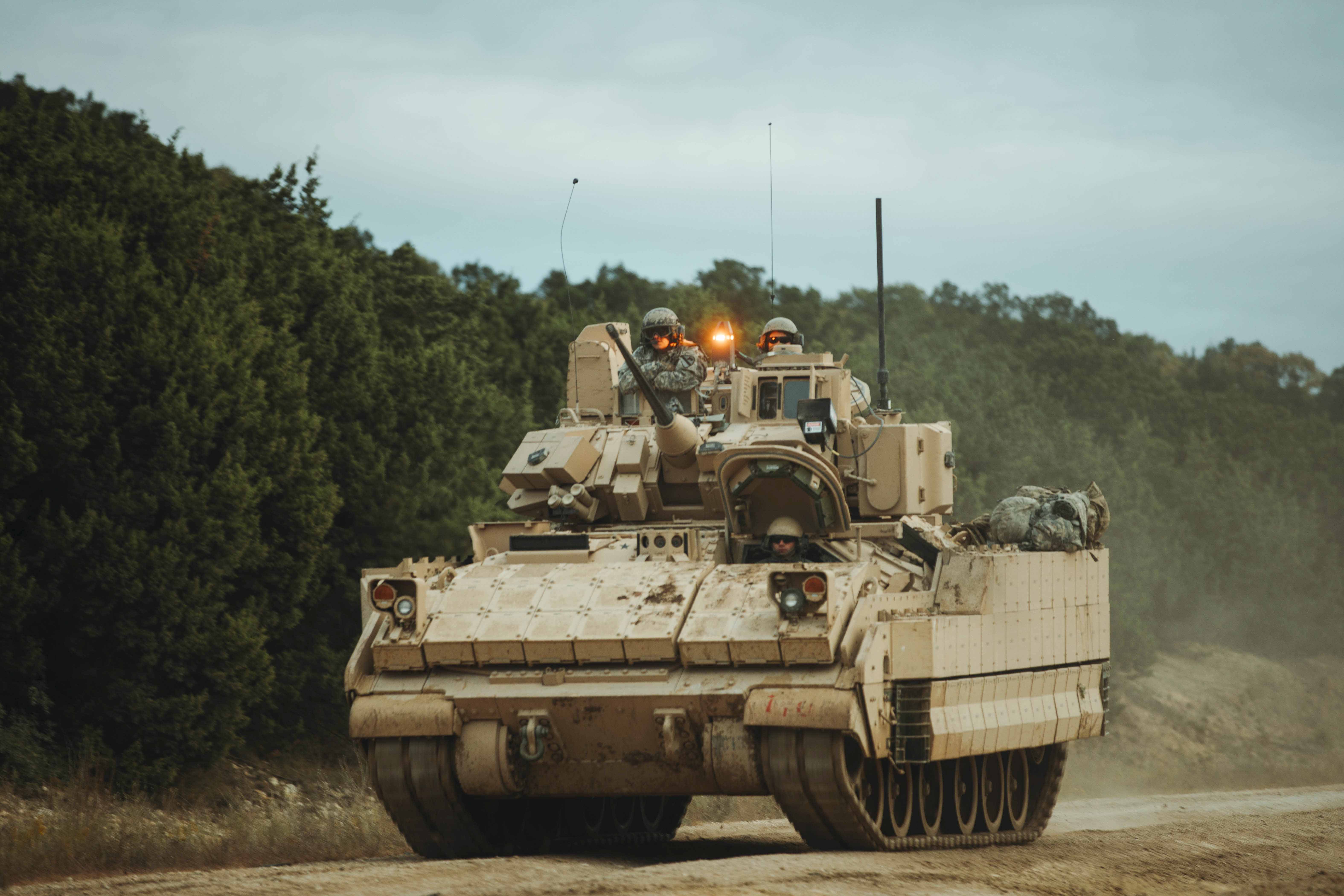
Soldiers field test the newest Bradley Fighting Vehicle in a series of maneuvers and engagements at Fort Hood, Texas, Oct. 24, 2020.

A Navy EA-18G Growler takes off from the flight deck of the USS Ronald Reagan in the Philippine Sea, Oct. 28, 2020, during Keen Sword, an exercise with joint and bilateral partners to enhance long-range interception capabilities.
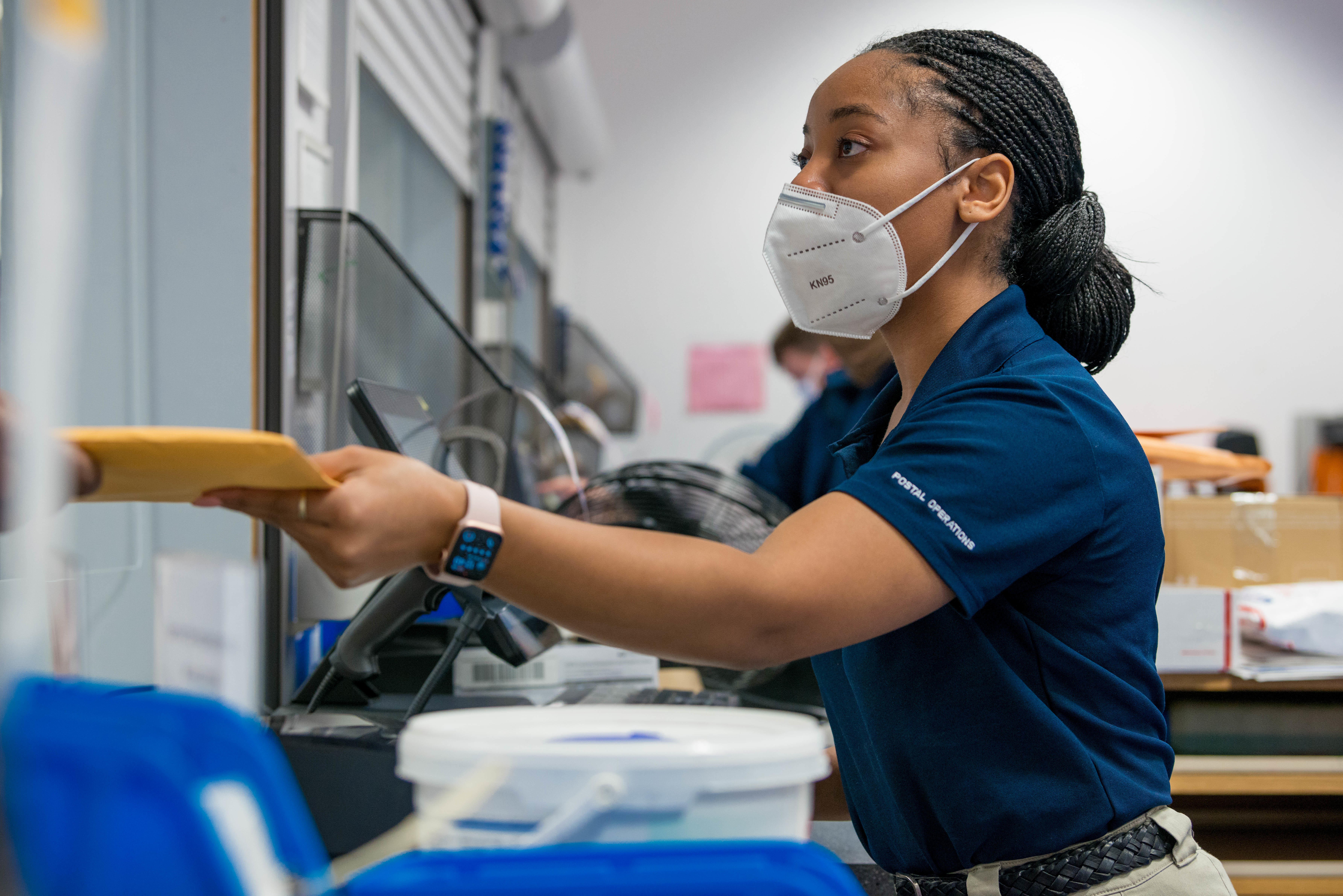
Air Force Airman 1st Class Diamond Durant accepts a parcel from a customer at Ramstein Air Base, Germany, Oct. 28, 2020. Despite COVID-19 challenges, the post office remains dedicated to ensure timely processing of packages, incoming and outgoing.


 Posts
All Comments
Posts
All Comments
Posts
All Comments
Posts
All Comments


