One crucial aspect of the National Defense Strategy
is tending to and encouraging allies and partners, and the Defense
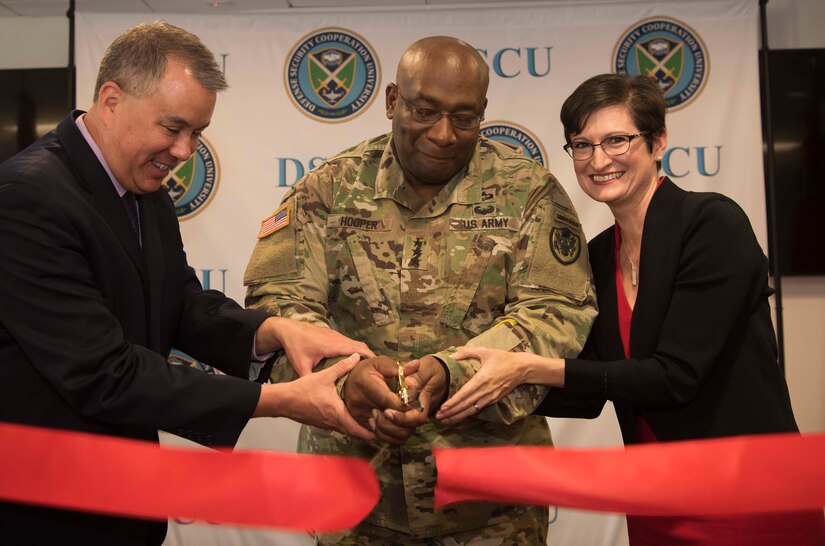
Security Cooperation Agency is at the heart of that process, said Army
Lt. Gen. Charles Hooper, the agency's outgoing director.
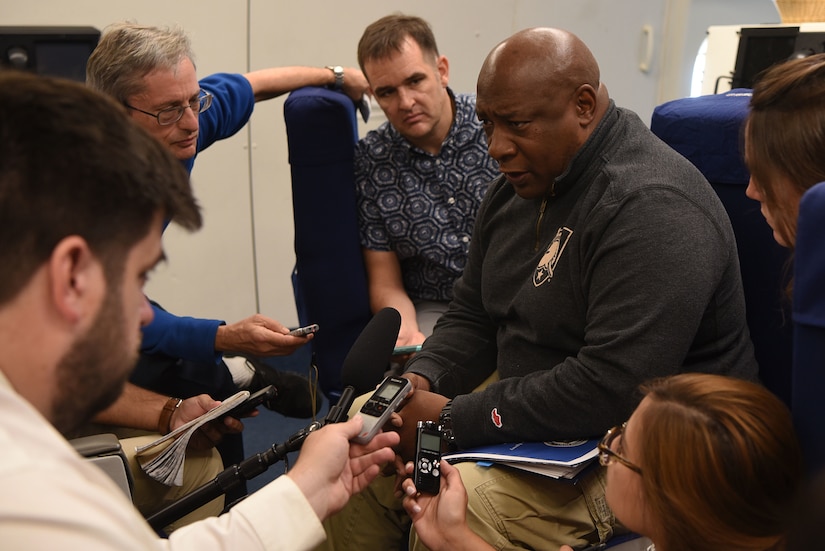
Hooper spoke to retired Army Gen. Carter Ham recently as part of the Association of the U.S. Army's podcast series.
The agency is little known outside Washington, but its effect on
allies, partners and friends around the world is profound. The agency is
the Defense Department entity responsible for all security cooperation,
ranging from training to equipment to professional military education.
Last year, the agency was responsible for more than $55 billion in
sales under a myriad of programs, Hooper said.
Allies and partners using U.S. military equipment makes good sense
from strategic and economic viewpoints, he noted. Common equipment leads
to greater interoperability. The training foreign service members
receive on American equipment also builds close personnel ties. Finally,
the U.S. military sales mean jobs in the United States and keeps the
defense industrial base healthy.
Hooper said that over the past three years, military sales have grown
16 percent. It has accelerated because the U.S. produces the best
military capabilities in the world, he added, and because of
streamlining efforts by the administration and Congress.
The agency reorganized as part of the National Defense Authorization
Act of 2017. Congress wanted to make the agency more efficient and
effective. That legislation also created a civilian career field for
security cooperation and a schoolhouse to train them.
The administration streamlined authorities for conventional arms
transfers. This served to ''compress those timelines between the
identification of a capability necessary for our partners and its
delivery,'' he said.
''The third thing that really helped was the National Defense
Strategy,'' he said, adding that the strategy provided ''clear guidance
to me as to what my mission is, and that is to strengthen alliances and
attract new partners.''
The change in strategy for the United States military to operate
''by, with and through'' local military forces also gave impetus to the
agency. ''I've seen security cooperation become a policy tool of first
resort,'' Hooper said. ''Often in the past, it was kind of an
afterthought — we'd come up with a security policy, … we'd implement
that policy towards a country or an alliance, and then as an
afterthought, we consider military capabilities. But with the second
line of effort in the National Defense Strategy, security cooperation
has become a tool of first resort.''
Another change tied to the National Defense Strategy is great power
competition. China and Russia are U.S. near-peer competitors, and this
forced a different approach at the agency. Hooper had to judge U.S.
strengths and weaknesses against those of China and Russia.
''I came to the conclusion that there is a uniquely American approach
to security cooperation, and that distinguishes us from our strategic
competitors,'' he said. ''Instead of trying to mimic their procedures,
we should leverage our strengths.''
U.S. competitors benefit from an autocratic streamlined arm sales
processes and government-subsidized defense industries, he said. ''I
have to determine how we maintain our competitive edge and continue to
expand our market share when they have systems that allow them to react
quickly, and are reflective, frankly, of their governmental
systems,'' the general said.
''We have a democracy. And as we all know, democracy was designed for
effectiveness, and not efficiency,'' he said. And that carries its own
benefits.
U.S. high-quality, high-technology systems are in demand, and make
American systems competitive. Hooper said he wants the idea of export
for these systems built in from the beginning of research and
development for the systems.
''We have to improve our ability to engineer exportability into the
beginning of our research and development process and not at the
end,'' he said. ''Right now, what we do is design a system for our own
forces, and then we go back and re-engineered for export, we don't have
the time to do that any more.''
Hooper said he also wants to compress decision timelines without
sacrificing due diligence. ''Our system is set up to vet whether or not
we want to share a capability or a system with our partners over a long
period of time, then we finally make a decision and then we export
it,'' he explained. ''We must compress those timelines if we're to
remain competitive, but we understand there's always a cost-benefit
analysis — the benefit of sharing these technologies and systems with
our allies or partners against a potential cost of losing our
technological edge.''
The American way of sharing is also much different from those of the
Russians or Chinese. ''Our approach has always been not only to provide
our partners with the systems themselves, but training, education,
institutional capacity building, helping them to build the institutions
that will help them to maximize the performance envelope with the
equipment,'' Hooper said. ''This commitment is to a long-term
relationship.''
There is value in this approach. He told about visiting Kenya last
year, and seeing the Kenyan air force flying 40 year-old F-5 Tiger jets
built by Northrup. The older jets were landing next to 3-year old
Chinese grounded helicopters. ''Why are our 40-year-old aircraft still
flying, and the 3-year-old Chinese aircraft not? The difference was we
made a commitment to the Kenyan air force to help them to develop a
culture of maintenance excellence that allows them to continue to repair
and maintain their 40-year-old U.S. aircraft,'' he said. ''That's the
distinction that separates us from our strategic competitors.''
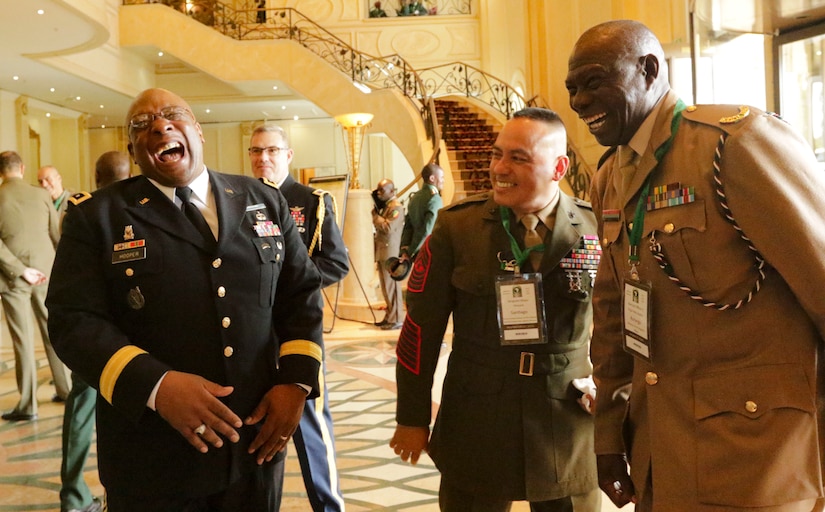
Hooper is the most senior foreign-area officer in the U.S. Army, and
he says that ''dollar for dollar, our international military student
programs are the best investment we can make in security cooperation.''
Whether it is foreign students coming to the United States to learn
to use U.S. military equipment or senior foreign military officers
attending the war college classes, it is a way to build personal
relationships. Hooper spoke of being the defense attache in Cairo during
a difficult time in U.S.-Egyptian relations. Those relations were
smoothed by the fact that many in the Egyptian government had studied at
U.S. military war colleges, and there was a baseline of understanding
among all.
''I was in China for seven years,'' he said. ''Very rarely did they
answer my phone calls, but there was never a time where the Egyptian
senior official did not answer my phone calls.''
U.S. students have an opportunity to forge relationships with the
cream of the international military officers because only the best come
to the United States. ''Those relationships that are forged here, the
way we welcome international students, pays enormous dividends,'' Hooper
said.







 Posts
Posts

