Monday, May 04, 2020

Seabees Build Medical Facility to Support COVID-19 Efforts in Guam


May 4, 2020 | BY Navy Chief Petty Officer Matthew White

Sailors assigned to Task Force 75.5 achieved the engineering initial operating capability of a 150-bed expeditionary medical facility as part of the Defense Department's fight against COVID-19 on Naval Base Guam, April 25.

Reaching engineering initial operating capability means the medical facility is structurally ready to perform its core medical care mission when medical staff arrives. Construction will continue until achieving full operating capability, meaning the facility is fully constructed and able to execute all of its designed tasks.

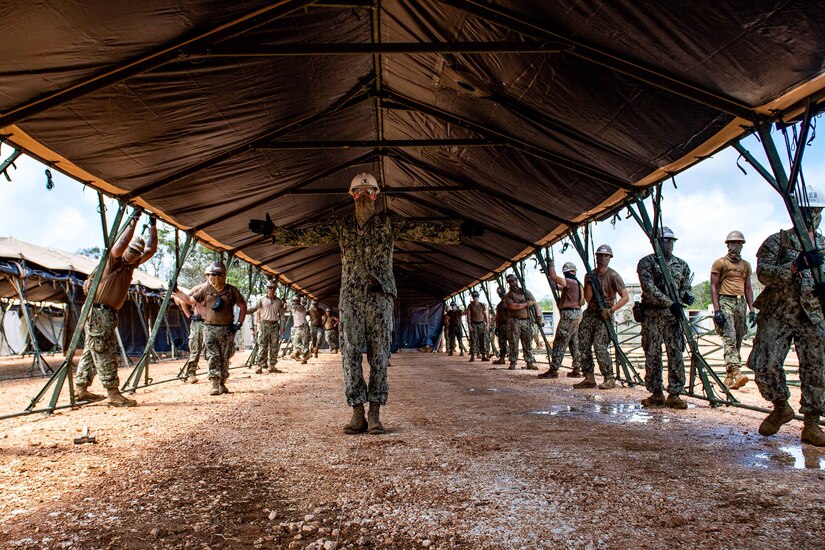
"The Seabees have been working hard through all the adversities we've had out here to get this up and running as soon as possible," said Navy Lt. Matthew Harms, the operations officer for Naval Mobile Construction Battalion 1 Detachment Guam. "[They're] working through the changing weather conditions — it rains two or three times a day and is very hot and humid the rest of the time — on top of learning a brand new tent system that most of our guys haven't seen before. But the team learned quickly, and hasn't let anything get in the way of completing the EMF on time. These guys are awesome."

With more than 130 Seabees working to build the facility, construction began April 11 with the grading and leveling of the five-acre site. Precise leveling and ground compaction is vital due to the sensitive nature of the medical equipment.

"We started by knocking the ground down to a less than 2-percent slope," Harms said, "then built it back up, while compacting the ground to make sure it was flat and stable for the facility."

Following ground preparation, the team began construction of the facility's  infrastructure April 20.

"The combined crew of [NMCB] 1 and [NMCB] 5 started going through and building up the tents into 10 different wings that will make up the medical core," Harms said. "There are also support sites that are being built up for the EMF including fuel and water farms, a troop berthing and hygiene area, and a galley. All of those are part of the expeditionary medical facility and are required to support the approximately 400 medical and support personnel that are coming in."

The Seabees were able to work as a cohesive unit due to the technical guidance provided by sailors on the Expeditionary Medical Facility Assist Team from Navy Expeditionary Medical Support Command and the Naval Expeditionary Medical Training Institute.

"We have a lot of really motivated Seabees, and the team from NEMTI, working for Guam and our brothers and sisters on the USS Theodore Roosevelt," said Navy Petty Officer 1st Class Matthew Petree, a quality control officer assigned to Navy Expeditionary Medical Training Institute. "We build the EMF three or four times a year as training, and we're happy to be able to come to Guam and put our experience to good use."

The facility is a self-contained medical care facility, enabling medical professionals to provide expanded medical capabilities, and will enable forces to be postured to support the region if a Defense Support of Civil Authorities mission is requested.

"It's a Role 3 [medical treatment facility], so you're going to have all the capabilities of a hospital," Petree said. "There are operating rooms, acute care wings, essential sterilization capabilities, a medical lab and a pharmacy. It's really going to be able to do everything you need."

Seabees building the facility are proud to be able to contribute to the Defense Department's COVID-19 response in Guam.

"I think [building the EMF] is amazing," said Navy Petty Officer 3rd Class Mark Austinweldon, a sailor assigned to Naval Construction Battalion 1. "COVID is all around the world, and if this can save anyone's life, I'm excited to be able to help."

Task Group 75.5 is led by the 30th Naval Construction Regiment and is made up of personnel from Naval Construction Battalions 1 and 5, Construction Battalion Maintenance Unit 303, Naval Expeditionary Medical Training Institute and Navy Expeditionary Medical Support Command.

As the command element of Task Group 75.5, the 30th Naval Construction Regiment provides command and control over all Naval Construction Force units in the 7th Fleet area of operations. It enables real-time mobility of engineering units and other assigned forces to provide expeditionary, general and limited combat engineer capabilities in response to major combat operations and contingencies, theater security cooperation plan operations, humanitarian assistance and disaster relief operations and civil-military operations within the Indo-Pacific.

(Navy Chief Petty Officer Matthew White is assigned to Commander Task Force 75.)

Michigan Guardsmen Support COVID-19 Detection Effort


May 4, 2020 | BY AIR FORCE MASTER SGT. DAVID EICHAKER

With some 750 Michigan National Guard soldiers and airmen distributing food, managing supplies and supporting alternate care facilities in the fight against COVID-19, two specially trained guardsmen answered the call from the state's Bureau of Laboratories.

During a typical flu season, the lab tests 1,000 flu specimens, Dr. Diana Riner, a virology and immunology section manager for the Michigan Bureau of Laboratories, said. But ever since the COVID-19 outbreak, that number has significantly increased, she added.

"From the start of February to where we are in April, we have tested more than 10,000 specimens for COVID-19," said Riner, whose lab falls under the state's Department of Health and Human Services. "We went from working five days a week with one shift to seven days a week with two shifts."

To keep up with the influx in testing, a call went out to find professionals with the required certifications, education, training and expertise to work in the highly technical lab. In stepped two Michigan 51st Civil Support Team guardsmen to answer the call.

"It does help offset some of their workload," Army Capt. Nicholas Buck, the medical operations officer and medical section leader for the 51st Civil Support Team, said. "It helps provide them a little bit of relief."

Buck, who earned a bachelor's degree in premedical preparation, with minors in chemistry and military science from Indiana's Ball State University, had what they were looking for.

"Having the CST background and training really was very beneficial," he said. "We train on weapons of mass destruction response, and this really fits well into our response capability."

Testing a specimen for COVID-19 may sound like a simple task, but according to Buck, it isn't.

"One manual extraction of 12 clinical samples can take up to two hours," he said. "After it's extracted, the samples will get moved over to where they can be worked on real-time [polymerase chain reaction]."

"There are certain primers and probes that will match-up the specific RNA code that would be for COVID-19," Buck continued. "If it's amplified through that PCR process, it would be a positive result."

The testing phase can be exhausting, he said.

"Manual extractions are very physically demanding," Buck said. "With repetitive motions for six to eight hours continuously, you can feel the tenseness in your neck and back."

The Guard's assistance is just what the doctor ordered.

"All of our staff is working mandatory overtime right now," Riner said. "We're getting extra specimens processed, because we have that extra set of hands. It's nice to help us split the workload."

Others echoed and reflected on the relationship between the Guard and the lab.

"Evolution of this new relationship between Guard members and MDHHS lab is so unique and unprecedented," Dr. Sandip Shah, the director of the state public health laboratory, Bureau of Laboratories, Michigan Department of Health and Human Services, said. "It is not only admirable and mutually beneficial, but also serves as an example for other state laboratories in the nation when dealing with such a crisis."

The lab work is also beneficial to the guardsmen involved.

"I am very proud to be part of what we are doing," Buck said. "It is an honor to not only provide help to the lab, but realize decisions are being made on our results that positively impact the public."

(Air Force Master Sgt. David Eichaker is assigned to the Michigan Air National Guard.)

Esper Details Defense Readiness in Face of Pandemic


May 4, 2020 | BY Jim Garamone , DOD News

Defense Secretary Dr. Mark T. Esper discussed the immediate operations against COVID-19 and the second order of effects the pandemic will have on the U.S. military during a Brookings Institution webinar.

The secretary gave Brookings senior fellow Michael O'Hanlon an overview of the DOD's actions during the pandemic during today's virtual conversation, saying he is very proud of the role that more than 62,000 service members and Defense Department civilians have played so far.

Esper issued his first guidance on the coronavirus response in January, and he activated the global pandemic plan Feb. 1. "We've remained ahead of the curve at every turn, and I'm very proud of what we've done at this point in time as we start to see some light at the end of the tunnel."

He noted the deployment of the Navy hospital ships USNS Comfort and USNS Mercy to New York and Los Angeles, respectively, and the more than 45,000 National Guardsmen at work in all states, territories and the District of Columbia. "We have thousands of medical professionals, doctors, nurses, respiratory therapists [and] others who are out on the frontlines," he said. He also noted the more than 2,000 Army Corps of Engineers personnel working to expand hospital capacity.

Esper stressed that the U.S. military continues to work with allies and partners around the world.

But there are effects beyond the sickness brought on by the pandemic, and DOD officials are grappling with them, the secretary noted. "We're very cognizant of the impacts that we see on the force and plotting the way ahead," Esper said. "DOD has been very busy using all of our resources and our researchers to work hard on therapeutics and vaccines, … but we're also cognizant about the impacts that this COVID-19 may have on the force."

So far, the pandemic has had a low impact on readiness, Esper said. "But over time, we are anticipating what could be a greater impact … if we don't see a change in the trajectory … of the virus or how we adapt ourselves," he added.

The military has 2 million service members; fewer than 5,000 have been infected and fewer than 100 have been hospitalized. This is a testament to the overall health of the force and to them following CDC guidance, the secretary said. "So, at this point in time, we are in pretty good shape," he said.

From an organization standpoint, the secretary said he is worried about the long-term impacts on recruiting and basic military training.

It carries over to training, the secretary said. Generally, the smaller the unit, the easier it is to preserve the integrity of the unit and training, he explained. Platoons are easier to test and quarantine, if needed, than brigades, destroyers are easier than aircraft carriers, and so on, Esper said.

"As you get higher in terms of the size and scale and scope of the exercise, the more challenging it becomes, and the more risk you absorb, that you may get soldiers, sailors, airmen and Marines infected," he said.