Wednesday, August 29, 2018

Brothers Take Army Officer Candidate School Together


By Bryan Gatchell, Maneuver Center of Excellence, Fort Benning

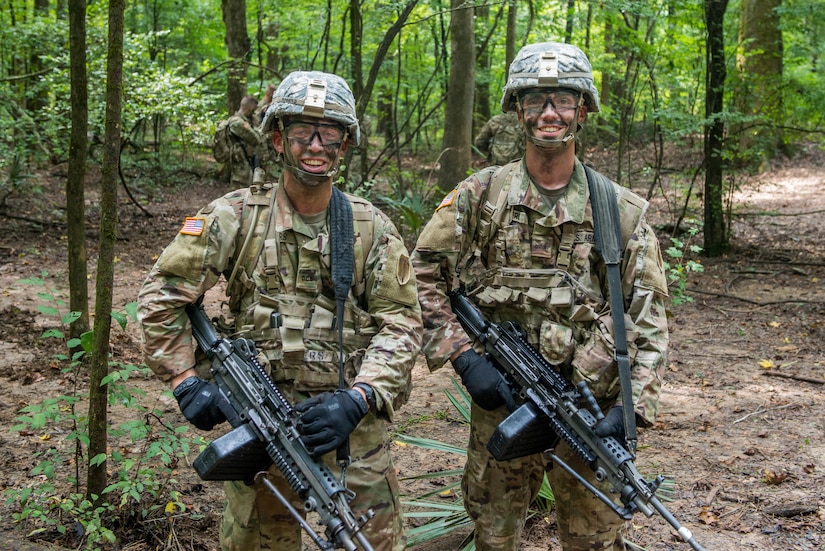
FORT BENNING, Ga. -- Jony and Ben Rogers come from a Pensacola, Florida, family of 13 children. Both brothers joined the Army, and both are now enrolled in the same class and platoon of Officer Candidate School here.

Ben, 30, served in the Army from 2011 to 2015, where he worked in human intelligence. He left the Army and did contracting work in the Washington area and taught English in Iraqi Kurdistan. Then, he returned to the Army to become a commissioned officer.

Jony, 23, went to school from 2013 to 2017 at the University of West Florida in Pensacola. After he graduated he worked as a software engineer and applied to Officer Candidate School.

Waiting for basic training and OCS to line up, his entry into the Army was delayed by six months. Jony had to wait a further six weeks for OCS to have a class size large enough to proceed. Because of this timing, the two brothers happened to be placed in the same class together.

“We didn’t plan it at all,” Jony said. “It just all kind of lined up.”

The two brothers were happy when they found out they would attend the school together.

‘It Was Pretty Cool’

“It was pretty cool,” Ben said. “I knew mom would be happy, because she would only have to go to one graduation.”

“I was initially quite happy with it, coming from basic,” Jony said. “I didn’t know what OCS would hold. I was told a lot of things by a lot of people who had never been to OCS.”

One piece of information Jony considered reliable was that prior-service soldiers were likelier to do better at OCS.

“So knowing that he [Ben] would be there, someone I knew and trusted as far as having that experience and discipline, I knew that would make the course I was going through a lot easier,” Jony said. “I wouldn’t be stumbling around as much.”

“It is nice to put some of my knowledge [to use] to try to help him along, and try to avoid some of the mistakes I made,” Ben said.

Career Choice

Jony and Ben branched infantry, but Ben said he is ultimately hoping for military intelligence with a branch detail to infantry.

“A lot of my [noncommissioned officers] were prior infantry, and you could see the difference,” Ben said. “The infantry and armor branches produce a lot of fantastic leaders. And I want to be a leader -- first and foremost.”

“Of all the people I talked to -- prior enlisted, prior officers -- a lot of them highly recommended going infantry due to the high quality of soldiers that are in there -- a lot more dedicated because you’ve got a lot more on the line,” Jony said. “People that are in the infantry generally tend to be more motivated to be better trained, better disciplined and just tend to have a good experience overall.”

U.S., Romanian Troops Work Together in Survival Training


By Air Force Senior Airman Devin Boyer, 86th Airlift Wing

BOLOVANI, Romania -- Survival, evasion, rescue and escape specialists conducted training here with 37th Airlift Squadron and Romanian air force pilots during Carpathian Summer 2018, a bilateral training exercise designed to enhance interoperability and readiness of forces by conducting combined air operations with the Romanian air force.

The 37th AS is part of the 86th Airlift Wing ’based in Ramstein, Germany.

“Our purpose today is to work interoperable training with the Romanian rescue forces,” said Air Force Senior Master Sgt. Matthew Canoy, U.S. Air Forces in Europe-Air Forces Africa SERE functional manager. “We put survivors on the ground, they communicate with their wingmen, and then they pass the information to the Romanians to get rescued.”

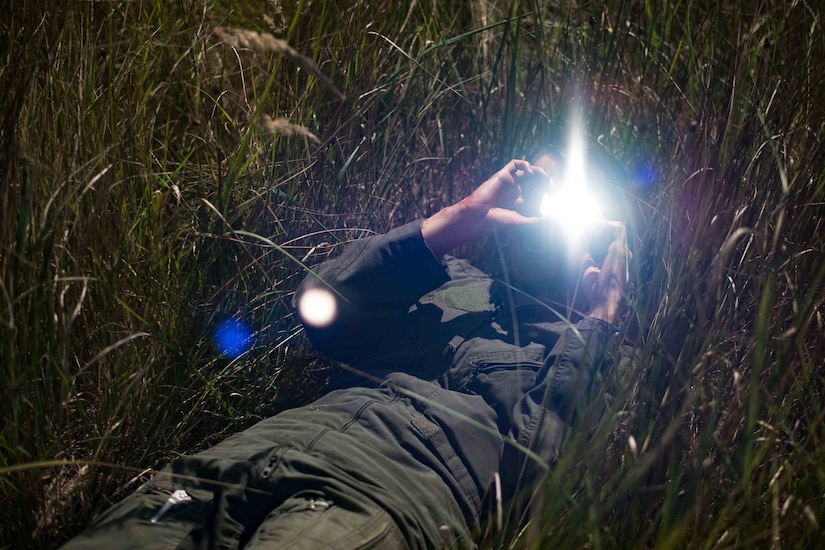
As the pilots rummage through their gear, they pull out a 3-by-5-inch mirror and a radio. As a face-painted pilot dials in a frequency to make communications, another takes the mirror and makes her way out to the field, the only spot within a 2-kilometer radius beaming with sunlight.

Receiving Instructions

The sweat beads up on their faces as they listen to the SERE experts provide instruction.

“When they fly over us, you’re going to want to aim that mirror right at their cockpit,” Canoy said.

In the distance, the faint sound of aircraft faded in and out.

“They’re getting close, but they keep flying away from us,” said one pilot to another.

The pilots then made contact with their wingmen overhead using the radio and gave them a heading.

Roaring engines echoed through the trees as the aircraft approached their location. The C-130J soared over them as they aimed the beam of light reflected off the mirror into their windows, hoping to be spotted. After a few passes, the pilots overhead confirmed visuals with the crew on the ground and gave them a set of coordinates to proceed to next.

Rendezvous Point

After traversing another thicket, the pilots reached a rendezvous point where they called in Romanian helicopter pilots for their rescue.

“The helicopter doesn’t have a visual of their location,” said Air Force Staff Sgt. Christian Martin, 86th Operations Support Squadron SERE specialist. “They know roughly where they’re at and they’re doing a search pattern to identify where our isolated personnel are, but by using vectoring techniques, the aircrew are able to take the sound that they hear from the helicopter, use a heading to get them a visual of the helicopter, and then guide them in using left and right turns.”

Minutes passed, and then a helicopter appeared.

“We have a visual,” relayed the downed pilots to the Romanian helicopters. “Turn 90 degrees to your right.”

Each aircrew member took turns giving the helicopter pilots directions to their location. The choppers then landed, and the crew was saved.

Air Force Capt. Jane Marlow, 37th AS pilot, said the training was incredibly valuable.

“It provided an awesome refresher on survival and evasion, while allowing us to do some things like helicopter vectoring and fixed wing rescue that simply aren’t available at Ramstein,” she said.

Marlow spoke on the importance of the training and how it essential for aircrew members.

“For those of us on the ground, the lessons learned in SERE may be the thing that saves your crew one day, should the worst ever happen,” she said. “For the C-130J’s in the exercise, it gave the crews the opportunity to train as on-scene commanders.”

The multinational rescue training improved cohesion between allied forces, Marlow said.
“Working search and rescue with the Romanians was an incredible opportunity,” she said. “It provided us the opportunity to simulate a realistic multinational rescue operation.”

Face of Defense: Soldier Connects With Vietnam Vet Father Through Shared Service


By Army Maj. Gregory McElwain, 56th Stryker Brigade Combat Team

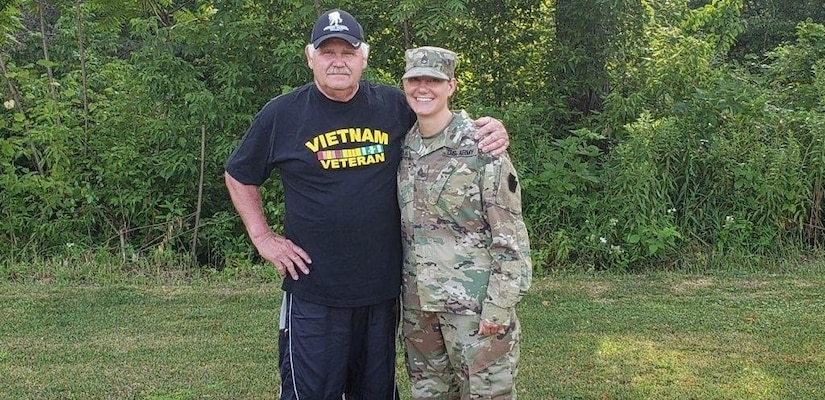
HORSHAM, Pa. -- In 2004, Staff Sgt. Rachel Kovach joined the Pennsylvania Army National Guard. She had many reasons to join, including the call of patriotism and a desire for training, but one of the strongest motivations was her father.

Kovach’s father, John Schilinski, was drafted and sent to Vietnam. He was officially trained as an industrial gas production specialist, but the needs of the Army meant he was placed in an infantry platoon when he arrived in Vietnam.

Schilinski took pride in his role. “I was a squad leader, and I had 17 guys in my squad. I knew every one of them and they knew me. I never had any problems with my guys,” he said.

Long-Lasting Bonds

Kovach, a Slovan, Pennsylvania, native, recalls her father sharing a beer and stories with fellow Vietnam veterans for as far back as she can remember. She saw how the conversation flowed and admired the camaraderie that outlasted both time and distance.

As a child, she recognized the value in the friendship these soldiers shared. “I figured that their connection was veteran-related and I thought that would be my way to connect with my dad.” Kovach said.

Six months ago, Kovach retrained as an infantry soldier and was assigned as the squad leader for 2nd Squad, 2nd Platoon, Alpha Company, 1st Battalion, 112th infantry Regiment.

During training in Fort Pickett, Virginia, she worked to get her squad through the requirements in order to be validated for live-fire exercises at the National Training Center at Fort Irwin, California. Training started out with soldiers working in buddy teams, progressing to team movements, and finally to squad movement techniques. Kovach said she saw great progress.

“We did everything tactically and doctrinally that we were supposed to do. It felt really good to go through the steps and train correctly,” she said.

Building a Team

Although she has seen a lot of tactical growth in her squad, Kovach said she believes the most valuable training was the time she spent building trust with her troops.

“Just spending time with each other on our down time, the chit-chat, the small stuff, allowed me to get to know my guys and build trust. I am not from an infantry background, and they were a little leery having me in charge of them, and I definitely had reservations. But this is the real deal,” she said.

More than 45 years ago, John Schilinski had a similar experience, “Me and my guys grew strong relationships. We were battle buddies. We were a handful of guys that got along good, if I got a package from home we shared everything,” he said.

The bonds that are formed between soldiers are based on trust and a shared struggle. This held true throughout our nation’s conflicts, and is still true today.

“I think Rachel is an outstanding soldier. As a dad, I am damn proud,” Schilinski said.
“Dad is a tough, hard charger,” Kovach said with a laugh. “We talk every day. I am always with my father.”