Thursday, July 26, 2018

U.S., Egypt Commence Exercise Eagle Response 18


EGYPT -- American and Egyptian naval forces began Exercise Eagle Response 18 at the Red Sea Naval Base here, July 24.

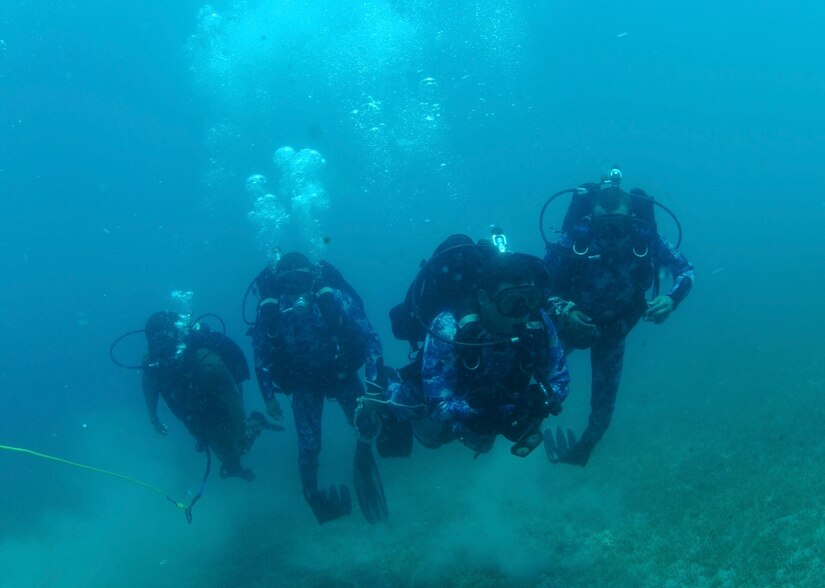
Eagle Response 18 is an explosive ordnance disposal and diving exercise conducted by the U.S., Egypt and other participating nations to enhance interoperability and warfighting readiness, fortify military-to-military relationships and advance operational capabilities of all participating units.

Building Strong Relationships

"We are fortunate to have this opportunity to build strong relationships to strengthen our maritime security capabilities," said Navy Lt. John James, the exercise’s commander. "Training opportunities like these give our sailors the unique chance to learn from different nations and show them what we can do."

The U.S. sailors represent Task Force 52, the U.S. 5th Fleet’s mine warfare task force. The U.S. delegation is part of Task Group 52.3, and includes deployed sailors from Explosive Ordnance Disposal Mobile Unit 6, Mobile Diving and Salvage Unit 2, Company 25 and the Naval Oceanography Mine Warfare Center.

The exercise began with a welcoming brief, classroom trainings and decompression chamber familiarization.

“It was great seeing a variety of nations compare their personal experiences with decompression training from a medical perspective,” said Navy Chief Petty Officer Eli Hernandez, a hospital corpsman who heads the decompression training. “Diving is one of the most hazardous evolutions a human can do, and it’s important we share our experiences and learn from each other to improve safety across the board.”

Exercise Events

Scheduled events include underwater detonation drills, unmanned underwater vehicle operations and antiterrorism/force protection dives.

Eagle Response 18 is part of Eagle Salute 18, a surface exercise that provides opportunities for participating nations to collaborate across a wider range of maritime security operations.
U.S. Naval Forces Central Command, based in Manama, Bahrain, conducts more than 20 bilateral and multilateral exercises with partner nations throughout the region each year. Exercise Eagle Response is one of numerous exercises vital to the U.S. Navy's theater security cooperation efforts in building and enhancing solid regional and international relationships.

Wednesday, July 25, 2018

Army Combat Engineers Conduct Demolition Training at Fort Hood


By Army Maj. Carson Petry, 2nd Brigade Combat Team, 1st Cavalry Division

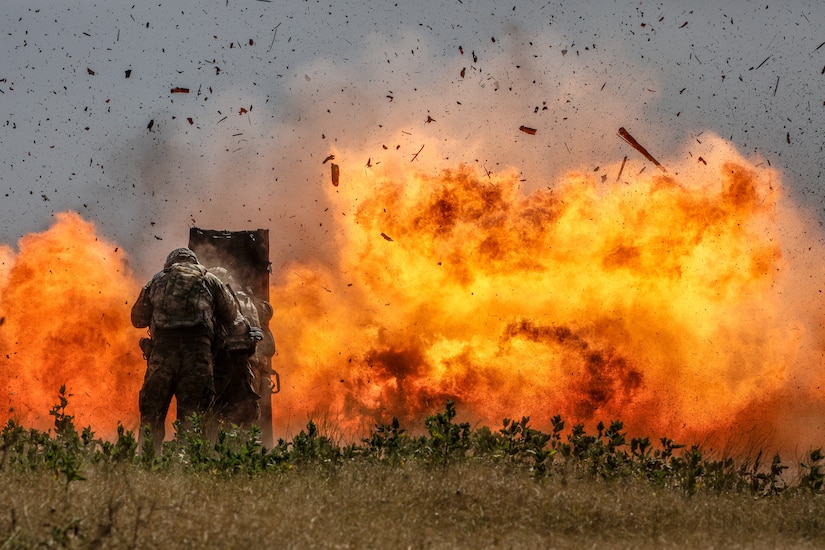
FORT HOOD, Texas -- Army combat engineers produced flaming booms and prodigious smoke plumes during a training exercise at the Curry Demolition Range here.

Soldiers from Alpha Company, 8th Engineer Battalion, 2nd Brigade Combat Team, 1st Cavalry Division conducted demolition training July 14-17.“This week we’ve conducted demolitions and squad movements,” Army Staff Sgt. Charles Marsch, a squad leader with A Company, 8th Brigade Engineer Battalion said during the exercise. “But today is the culmination of a week in the field. The purpose is to get the soldiers familiar with different ways to demo.”

Explosives Experts

Deployed Army combat engineers conduct route clearance operations to uncover improvised explosive devices, and they’re also experts at breaching operations, using high explosives in a variety of means.

Countless hours are spent in the classroom discussing safety and theory, but hands-on training gives combat engineers the confidence and experience required to be effective during combat operations.

The explosive strength of a demolition charge depends on the type of obstacle a combat engineer must breach, Marsch said, noting that breaching a barrier gives maneuver forces the most expedient way to close with and destroy the enemy. Such work, he said, requires technical expertise in handling and creating explosive charges.

The soldiers have trained on the Bangalore torpedo, as well as concrete charges, Marsch said. The Bangalore is torpedo-shaped featuring C4 explosive and detonation cord, he explained.

‘Everything Goes Away’

“You lay that on top of the obstacle, and everything goes away,” Marsch said. “When we come up to an obstacle, the enemy likes to use concertina wire. The Bangalore clears the lane for the tanks. It makes the lanes faster, smoother and safer.”

A concrete charge, he said, is an urban-use demolition charge that blasts through walls. It leaves a hole in the wall, allowing infantry forces a way in.

The combat engineers enjoy demolition training, he said.
“This training means a lot to me,” Army Spc. Hunter Goodall said. Learning how to apply a concrete charge during the exercise made him feel more confident, he added.

Talks Bolster U.S.-Australia Security Relationship, Mattis Says


By Terri Moon Cronk, DoD News, Defense Media Activity

WASHINGTON -- The 28th talks between the United States and Australia were an excellent opportunity to bolster the security relationship and reaffirm the steadfast alliance and close collaboration between the two nations, Defense Secretary James N. Mattis said today.

Mattis and Secretary of State Michael R. Pompeo hosted Australia’s Foreign Affairs Minister Julie Bishop and Defense Minister Marise Payne yesterday and today for the annual Australia-U.S. Ministerial Consultations at Stanford University's Hoover Institution in Palo Alto, California.

During a news conference following the talks, the defense secretary said the two nations in the last year have strengthened their defense cooperation in many tangible ways -- finalizing their respective national security and defense strategies to address shared threats, and increasing their coordination of joint-capabilities development.

“We’ve enhanced our interoperability in our cooperation in the [Indo-Pacific] region through [Rim of the Pacific] and other exercises that’s continuing our 100-year tradition of teamwork -- or ‘mateship’ as our friends from Down Under call it,” Mattis said.

Cyber Memorandum Signed

The defense secretary and Payne signed a memorandum of understanding to enable both countries to do research and development and combine their cyber capabilities.

A Marine Corps rotational force in Darwin, Australia, “will reach the previously agreed-upon number of 2,500 on a timeline determined by our host and partner, Australia,” Mattis noted. “These actions, to borrow a phrase from Minister Payne, demonstrate that the United States and Australia will walk the walk in the Indo-Pacific.”

The two countries share the same strategic goal: to ensure a free, open, inclusive and prosperous Indo-Pacific, where nations large and small are respected and accorded the protection of international law, he said.

“The joint work plan we put forth today helped bring this goal to fruition with concrete steps to help U.S.-Australia cooperation across our governments by further integrating our combined military operations and committing to step up U.S.-Australian cooperation and engagement across the region, including the Pacific islands,” Mattis said.

Keeping Pressure on North Korea

The defense secretary said the four officials also agreed to keep the pressure on the North Korean regime’s denuclearization through the enforcement of the U.N. Security Council’s international sanctions, imposed with the council’s unanimous backing to prevent ship-to-ship transfers of energy supplies.

“We have also partnered on defense innovation,” Mattis said. “There, we will explore all opportunities for deeper defense industry collaboration, now that Australia is included in the U.S. national technology and industrial base.”

Overall, discussions the two nations centered on cooperation on numerous issues that strengthen U.S.-Australian response to various security challenges, he said.

“Australia has been an unwavering friend, standing with us through thick and thin,” Mattis said. “And it was demonstrated by being the first ally on the ground beside us in Afghanistan following the 9/11 attack on America -- an attack that cost 11 Australian citizens their lives during the hit on New York City.”

And the United States does not forget the families of the Australian soldiers who have fallen alongside U.S. service members, he added.

“I’m confident our enduring and unflappable ‘mateship’ will continue to grow and flourish for another 100 years,” Mattis said.