Saturday, July 14, 2018

Army Chooses Austin as Site for Futures Command Headquarters


By David Vergun, Army News Service

WASHINGTON -- Austin, Texas, will be the location for the headquarters of the new U.S. Army Futures Command, Army Secretary Mark T. Esper announced today at a Pentagon news conference.


Army Undersecretary Ryan D. McCarthy then explained the details. He said the process started with 150 metropolitan areas, narrowed down to five. Besides Austin, officials considered Boston; Minneapolis-St. Paul; Raleigh-Durham, North Carolina; and Philadelphia.

McCarthy said he and an advance team visited each of those five cities and met with city leaders, congressional delegations, private-sector entities, and university faculty and staff. All of those, he said, were "tremendously welcoming and accommodating to our team."

He added that the choice was difficult, as all five had great qualities.

The criteria for selection included:

-- Proximity to science, technology, engineering and math workers and industries;

-- Proximity to private-sector innovation;


-- Academic STEM and research and development investment;

-- Quality of life;


-- Availability of cost and time assessment of civic support;


-- Mature entrepreneurial incubator hubs for access to talent, ideas and collaboration;


-- Space and access to top-tier university science and engineering departments for collaboration on experiments, prototype concepts and systems;


-- Expandability of work space for other services and companies to join the effort;


-- Density of industry and academic talent; and

-- Cost of doing business to enable both new startups and to draw established firms.

The undersecretary said the type of urban ecosystem defined by the selection criteria is where innovation, networking and collaboration are happening daily.

"That ecosystem cannot be duplicated from behind the walls of traditional posts and forts," he said, adding that recognition of that concept is a radical change for the Army's culture.

The selection criteria evaluation process included use of an outside firm, validated with the Army's internal studies and analysis, as well as a federally-funded research and development center, he said.

A six-member team is en route to Austin to begin establishing initial operating capability at Army Futures Command, McCarthy said. Within a year, full operating capability will be achieved, he said, with a headquarters staff of about 500.

McCarthy said that doesn't mean all 500 will be working out of a downtown office. He said that as full operating capability is achieved over the coming year, he envisions teams of soldiers and Army civilians working out of technology "incubator hubs" alongside entrepreneurs, scientists and researchers.

A four-star general to head the command has been identified, but the officer’s name has not yet made public, he said.

McCarthy said Army Futures Command will shepherd development of the service's six modernization priorities of improved long-range precision fires, a next-generation combat vehicle, future vertical lift platforms, a mobile and expeditionary Army network, air and missile defense capabilities and soldier lethality.

He added that the eight cross-functional teams responsible now for moving those priorities forward will fall under the command.

Army Col. Patrick Seiber, communications director for Army Futures Command, said over the next year, a number of existing Army organizations are scheduled to transition from other commands to AFC. The Army Research, Development and Engineering Command is one example of an organization that eventually will realign under AFC, he said.

Army Research Laboratories, part of Army Materiel Command, also will realign to AFC, as will the Army Capabilities Integration Center, which now is part of Army Training and Doctrine Command. A number of acquisition and contracting elements that will fall under AFC, but those decisions are still being reviewed, he said.

While some existing Army organizations will be realigned under AFC, Seiber emphasized that those organizations, their employees and their facilities are expected to physically remain where they are now. The changes, he said, are "a delayering or rewiring, so to speak, to streamline functions under one command, to get solutions faster and products out to the soldier faster," he said.

When AFC is stood up within a year, Seiber said, the headquarters will contain up to 100 uniformed soldiers and 400 Army civilians, pending plans moving forward.

Mattis Reaffirms ‘Unbreakable’ Bond, Enduring Commitment to Europe


By Lisa Ferdinando, DoD News, Defense Media Activity

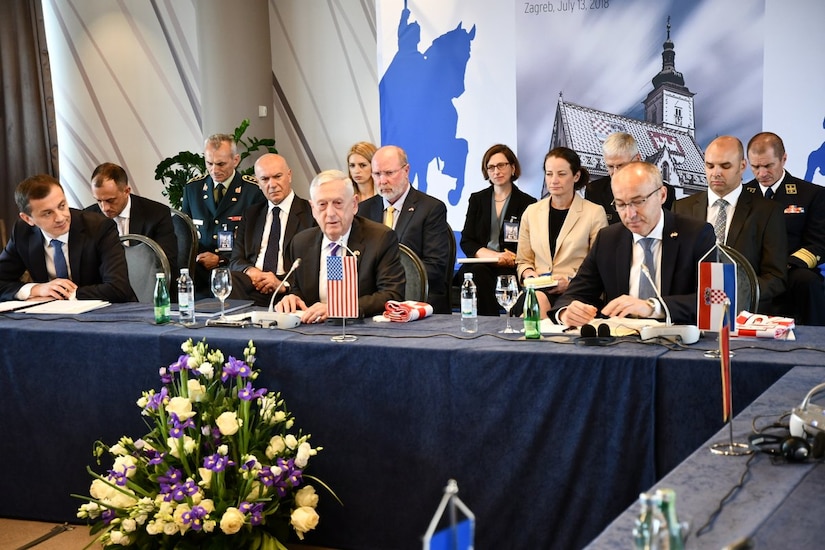
WASHINGTON -- Defense Secretary James N. Mattis reaffirmed the “unbreakable trans-Atlantic bond” between the United States and Europe and underscored the enduring U.S. commitment to peace and prosperity on the continent during the U.S.-Adriatic Charter defense minister’s meeting yesterday in Zagreb, Croatia.

“I’m here today to reinforce America’s commitment to the security and stability of southeast Europe,” Mattis said.

Established in 2003, the U.S.-Adriatic Charter began with the United States, Albania, Croatia and Macedonia as founding members. It expanded to include Bosnia and Herzegovina and Montenegro as members; Kosovo, Serbia and Slovenia are observers.

Mattis said many of those militaries “stand alongside each other shoulder to shoulder” to support critical missions across the globe. Those missions, he said, include NATO‘s regional support; the Resolute Support mission in Afghanistan; operations in Kosovo; the enhanced forward presence in Estonia, Latvia, Lithuania and Poland; and the coalition effort to defeat the Islamic State of Iraq and Syria.

The United States maintains strong state partnership programs with the U.S.-Adriatic Charter members and observers, he added.

Mattis reiterated U.S. support for each nation’s ability to choose its own path on the regional and global stage, whether NATO, the European Union, or both. Further, he reaffirmed U.S. support for NATO’s open-door policy, in which NATO membership is open to any European state in a position to further the principles of the alliance’s founding treaty and contribute to the security of the North Atlantic area.

Enduring Commitment to European Peace, Prosperity

Mattis traveled to Croatia following a NATO summit in Brussels, where the secretary joined President Donald J. Trump to reinforce U.S. priorities, including more equitable burden sharing, strengthening the alliance’s deterrence and defense capabilities, and enhancing NATO’s role in fighting terrorism.

In Zagreb, Mattis said he is reaffirming what Vice President Michael R. Pence said during last year’s U.S.-Adriatic Charter summit: that the regional group is a testament to the U.S. commitment to a Europe that is whole, free and at peace.

“Coming out of our highly successful NATO summit in Brussels, it is clear that the U.S. will continue to strengthen our alliances and partnerships in the region,” the secretary said, noting that fortifying those ties is a priority in the National Defense Strategy.

However, he said there is a keen awareness that “some elsewhere would wish to see us fail in our endeavors here today,” and that “those that seek to divide us for their own reasons will not enjoy our dedication to working together.”

But, America’s commitment to Europe remains steadfast, Mattis said.

“Our meeting today is proof of our enduring shared commitment to this region’s prosperity and security, and the unbreakable trans-Atlantic bond,” he said. “Together, we are building security, shoulder to shoulder through respect, trust and cooperation.”

Mattis traveled on to Oslo, Norway, for talks with Norwegian Defense Minister Frank Bakke-Jensen and Foreign Affairs Minister Ine Eriksen Soreide.

Thursday, July 12, 2018

Face of Defense: Student Flight Leader Affects Hundreds of New Airmen


By Air Force Airman 1st Class Mckenzie Airhart, 194th Wing

CAMP MURRAY, Wash. -- At the Washington Air National Guard’s 194th Wing here, the work of building airmen starts before basic military training, in student flight.

Student flight is where newly enlisted recruits spend drill weekends learning military customs and courtesies, rank structure, and other pertinent information to set them up for success at basic training. The program is led by Air Force Senior Master Sgt. John Austin, the force development superintendent for the 194th Wing and the student flight superintendent assigned to the 194th Force Support Squadron. After the recruiter, Austin is often a new enlistee’s first impression of the Air National Guard.

“To have the opportunity to shape and mold and mentor every new airman coming into the Wing -- that is as powerful as it gets, so there is a lot of pride in that,” Austin said.

Austin has welcomed every new recruit to the wing for the past seven years. He estimates that he has guided 500 airmen through student flight during that time.

Student flight is the best program the Air National Guard has to offer, Austin said. It is also the highlight of his career, he added.

“When you can go home at night and realize the impact you have on the state, on the country, on the Air Force, I mean this wholeheartedly, it is the best job you could ask for in the Air Force,” Austin said.

Prepared Airmen

Student flight alumni have been known to receive honors in training. This is due to recruits being better prepared, said retired 194th Wing Command Chief Master Sgt. Brian Waggoner. The airmen are able to do so well because of the example set by Austin in the program, Waggoner added.

It doesn’t take long to see that Austin exemplifies professionalism, Waggoner said. “I straighten myself before I go into his office,” he said. “He deserves the best leaders that we can be. I don’t want to let him down.”

Austin emphasizes the importance of setting an example. “If you don’t have those standards yourself, how do you pass them along and teach them to anybody else?” asked Austin.

Austin builds trust with new recruits in the program by taking a genuine interest in finding out who they are, said Airman 1st Class Tyree Overall, a packer with the 194th Logistics Readiness Squadron Traffic Management Office. Austin knows how to push people and challenge them to be better, Overall said.

“He commands a presence,” Overall said. “Sgt. Austin just has something about him.”

It’s an impression that sticks with 194th Wing airmen as they move forward in their careers, Waggoner said. “It’s interesting now when you see people pass him in the hallway or see him in the chow hall. That is still the guy they want to impress, they want him to see that they are still sharp,” he said.