By Army Maj. Michael Petersen, Connecticut National Guard
HARTFORD, Conn. -- Army Warrant Officer Roberto Pauleus
spoke two languages, but neither were English.
Like so many immigrants before him, he came to the United
States under the impression that life would be glamorous once he landed on
American soil.
But Pauleus found it to be much harder, realizing the blood,
sweat and tears that would go into making a good life for himself and his
family here in the U.S.
Pauleus grew up in Gonaives, Haiti. He was a teenager in
1990, when the nation’s first popular vote for president took place. Within a
year of Jean-Bertrand Aristide’s election, a military coup saw a nation
repressed and Pauleus wondering what his future would hold.
“It was a like a civil war [in Haiti],” Pauleus recalled.
“People were killing each other. I was still in high school at the time, but
the goal was to join the Haitian Military Academy and to become an orthopedist
after I graduated high school.”
Pauleus was a firsthand witness to the military government’s
brutality. “I was arrested in Gonaives with two other friends while playing at
the national public school one day,” Pauleus said. “We were let go almost right
after because we didn’t do anything wrong, and so well-known neighbor spoke to
that sergeant who agreed to let myself and my friends go. But other people I
know were not so lucky.”
Shifting Goals
When Aristide was reestablished as the nation’s elected
leader in 1994, it was done in no small part to the United States’ involvement,
which included American boots on the ground in Haiti. Pauleus, who was already
planning on joining the military, saw his goal shift.
“The goal was always to become a soldier anyways, but when I
saw the U.S. Army, I changed my mind,” he said. “When U.S. soldiers peacefully
came to Haiti and I saw their professionalism, discipline and teamwork, I knew
this was an organization I wanted to be a part of. They saved lives, they
brought peace to the Haitian people.
“I said to myself, ‘When I come to the U.S., I’m going to
become a U.S. soldier.”
Pauleus didn’t come to America directly out of high school.
He first studied accounting and supplemented his income by teaching French --
one of the two languages he is fluent in, along with Haitian Creole -- and
basic computer skills at Success School at Port-au-Prince, Haiti’s capital
city.
He returned to his hometown and became an accountant for a
conglomerate that owned supermarkets, restaurants and drug stores, but he never
forgot his overall goal.
“I wanted to pay back what I felt I owed to the U.S.
military,” Pauleus said. “How they saved lives, how they helped the people
there. It was my debt to pay back to the country.”
With a college education, a solid work ethic and an
upbringing that toughened him up, he decided in June 2001 to make the move to
the United States.
“My mother, who used to live in Florida, moved to
Connecticut. Here, she and my step-father sponsored me to come in United States
legally,” Pauleus said. “I came with a green card with my three daughters.”
As if being responsible for three children, aged 7, 6, and 5
at the time his family moved to the United States, in a new country wasn’t
enough of a challenge, Pauleus also had to overcome the language barrier.
Starting at the Bottom
“When I first came [to America], I didn’t speak any English,
so all I could really do was wash dishes at a local hotel,” he said. “But I
worked my way up and became a line chef supervisor.
“The biggest misconception is that people don’t have to work
hard in America,” Pauleus said. “I thought I’d be rich in the U.S. The
political turmoil in Haiti was constant … and it made me want to leave Haiti,
despite having a house, a great job, two cars, a motorcycle.”
But he made the leap, and it paid off -- financially and
romantically. Pauleus met his wife, Kristy, who worked in the banquet
department of the hotel. Together they put their family under one roof and they
have raised a total of six children; four girls and two boys.
“She was so patient with me,” he recalled with a laugh. “She
taught me English. I used to carry my French-English dictionary around so I
could find a few words to communicate.”
Pauleus joined the Connecticut Army National Guard’s 1048th
Medium Truck Company in May 2003 as a Motor Transport Operator. He served the
organization full time in a variety of roles in the supply and logistics fields
before deciding to take the plunge and attempt to earn a commission as a
warrant officer.
In 2005, he became a United States citizen, and he began to
forge a promising career.
“Ten years ago, I interviewed for a job as a property book
clerk, and during the interview someone asked me where I saw myself in ten
years,” Pauleus said. “I told them I want to be a property book officer, and
here I am.”
Commissioning
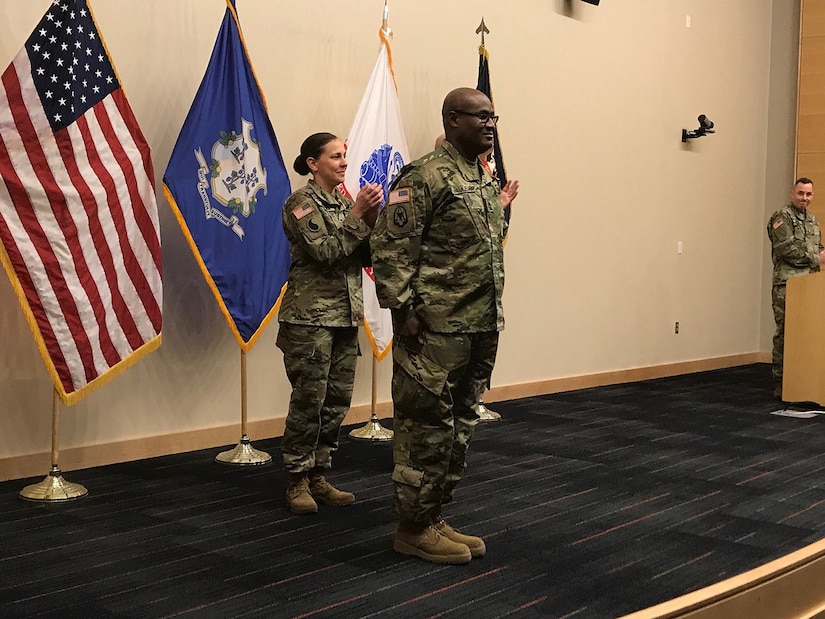
On Nov. 17, 2017, the 43-year old Pauleus officially became
Warrant Officer Pauleus, the property book officer for the 143rd Regional
Support Group in Middletown, Connecticut.
For Pauleus, life in America has been very good, but he
knows he had to work hard for everything he owns.
“People think that all Americans are rich, that you don’t
have to work hard, and that money literally grows on trees,” he said. “I was
disappointed when I realized I would have to start all over again. It was a
struggle, but I made progress, went back to school and got an associate’s
degree in accounting.”
Pauleus also didn’t see a future for his children in Haiti.
Now, he beams with pride when talking about all his children. His two boys are
in college; one daughter recently got married and is working towards her
teaching certification and another just graduated from Western Connecticut
State University. One is getting ready to graduate from Western Connecticut
State University next year, and one followed in her father’s footsteps as a
unit supply specialist in the Army Reserve.
“We’re looking for her to come to the guard when her
contract is over,” Pauleus said with a smile.





 Posts
Posts

