Tuesday, June 26, 2018

West Virginia Soldiers Dive Into FEMA Certification Training


By Army Sgt. Zoe Morris, West Virginia National Guard

KINGWOOD, W.Va. -- Soldiers from the West Virginia Army National Guard and the West Virginia Swift Water Rescue Team attained the necessary training and certification June 10-13 to identify as a Federal Emergency Management Agency Type 1 swift water/flood search and rescue team within the National Incident Management System, the comprehensive, national approach to disaster response.

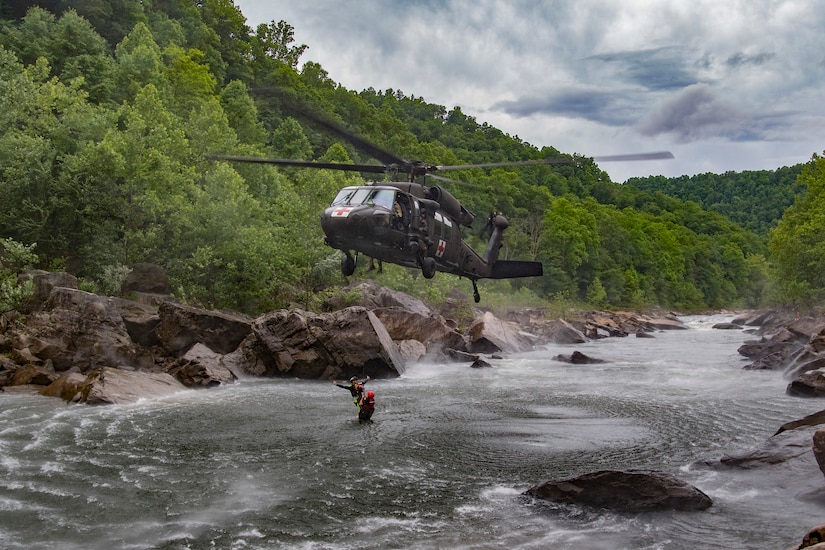
On the Cheat River in Preston County, West Virginia, three soldiers from the Swift Water Rescue Team and 18 soldiers from Company C, 2nd Battalion, 104th General Support Aviation Battalion trained on the helicopter underwater egress trainer and a helicopter search and rescue course that encompassed helicopter hoist, tracking victims dow river with a helicopter and deploying a rescuer from the helicopter. The team included pilots, crew chiefs and rescue swimmers.

In addition to the training on the Cheat River, three Swift Water Rescue Team soldiers assisted Spec Rescue, a national search and rescue training organization, in training FEMA urban search and rescue teams from around the country on the New River outside of Fayetteville, West Virginia, June 20 and 21. The training consisted of a boat operations specialist course that taught students how to navigate a boat flip, how to conduct rescues from a boat and how to tether rescue swimmers from a boat.

Important Training

“This [training] is important to the West Virginia Swift Water Rescue Team, as it shows our certification to operate in these flood disaster environments anywhere within the United States,” said Army Sgt. 1st Class Mark A. Shrewsbury, Joint Interagency Training and Education Center WVSWRT noncommissioned officer in charge. “Being recognized as a FEMA Type 1 swift water rescue team gives us the ability to deploy and be recognized at a national level as capable of performing many technical rescue disciplines that could occur in a flood situation, such as helicopter search and rescue, large animal rescue, technical rope rescue, flat water and swift water rescue, to name a few.”

Jimmy Gianato, director of the West Virginia Division of Homeland Security and Emergency Management, said tying aviation rescue to swift water rescue allows this team to operate in a new environment and capacity for the state.

“Our hope is that we can put teams like this all over the state, so that when something happens we’ve got the capabilities and the response time is diminished,” Gianato said. “It’s tremendous training, and we’ve got some outstanding swift water rescue teams in the state. By taking the National Guard capabilities and adding that with those teams, like we’ve done here, I think it will give us the capability that many other states won’t have.”
In the wake of a very active 2017 hurricane season, said Army Lt. Col. Walter Hatfield, the JITEC commander, there was frustration in not being able to deploy to Texas and Florida, due the few lingering certifications needed. But heading into this hurricane and storm season, he added, he is confident that this team is ready to deploy anywhere in the United States and territories to come to the aid of people in need.

Monday, June 25, 2018

Face of Defense: Soldier Returns Home to Lithuania for Saber Strike Exercise


By Army Sgt. Gregory T. Summers, 22nd Mobile Public Affairs Detachment

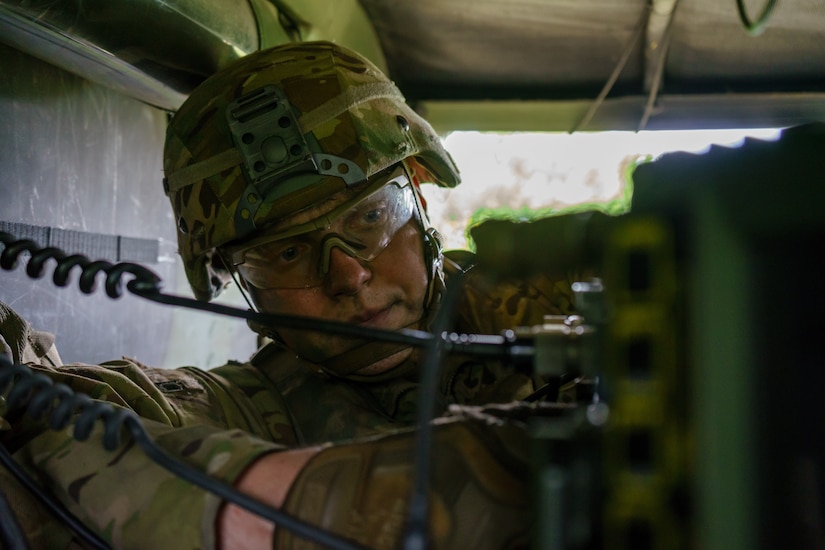
KAZLU RUDA, Lithuania -- Army Spc. Lukas Natkevicius, a cavalry scout and Lithuanian native assigned to Headquarters and Headquarters Troop, 4th Squadron, 2nd Cavalry Regiment based in Vilseck, Germany, returned to his birth country during Exercise Saber Strike 18.

Saber Strike is an annual NATO military training exercise that tests capabilities and enhances relationships among 19 participating countries. This year’s exercise was held June 3-15 at training areas in Estonia, Latvia, Lithuania and Poland.

“It feels good to be back in Lithuania, and this experience has been amazing. I recognize so many places and I feel comfortable here,” Natkevicius said.

Natkevicius was born and raised in Marijampole, a one-hour drive just outside of the training area at Kazlu Ruda.

In 2004, when Natkevicius was 13, his father entered and won the U.S. permanent resident card immigrant diversity program lottery. This program allows those who enter and are selected from qualifying countries to receive a United States permanent resident card.

U.S.-Bound

“At the time, out of three-million people, my dad was extremely lucky,” Natkevicius explained. “We were extremely thankful and excited to be able to go to the United States.”

Natkevicius and his family moved to Florida and eventually relocated to New Jersey.

“Florida was great and I enjoyed surfing, but New Jersey was cold and it wasn’t much fun,” Natkevicius said with a laugh.

He finished high school in New Jersey and upon graduation returned to Florida.

“I enjoyed the area much better and I wanted to make it on my own,” Natkevicius explained. “I intended to go to college as I was saving money while working retail.”

Then, one of Natkevicius’ closest friends who was in the Army, had recommended the military to him.

“She was a mechanic and received her education while serving and now works at Google,” Natkevicius said. “I was interested in that opportunity to better myself and that is what the Army provided.”

Joining the U.S. Army

In January 2015, Natkevicius joined the Army as a cavalry scout and has been serving with the 2nd Cavalry Regiment in Germany for almost two years.

“The Army has helped me with everything I was struggling with and put me back on my feet,” Natkevicius said.

Natkevicius recalled his first visit back to Marijampole once he had the opportunity to take a weekend pass.

“At the time, I hadn’t seen my mom or other family in nearly three years,” Natkevicius said. “I surprised my mom and called as I was driving from Germany to Lithuania to let her know I was coming home and she was so excited. Eventually, so many members of my family had called me once they found out, I had to pull over to talk to all of them.”

With only a 13-hour drive between his home and duty station, Natkevicius goes to Lithuania to see his family every chance he gets.

“Everything has changed for me since I joined the Army,” he said. “It’s been great.”

Natkevicius also serves as his unit’s armorer – he’s responsible for the inventory and maintenance of individual-level weapons systems.

‘I Love Being a Scout’

“I love being a scout and I am enjoying being the armorer so much; I’ve considered re-classing to a small-arms repairer,” Natkevicius said.

Army Capt. Jared Moore, commander of Headquarters and Headquarters Troop, said that it has been a privilege working with Natkevicius.

“He is a very smart, intellectual soldier and having him in our arms room was a great choice for our organization,” Moore said. “Conducting Saber Strike in Lithuania is not only a great opportunity for him, but it’s also a special opportunity for us to share, experience and witness his journey.”

Natkevicius, Moore and other soldiers of HHT are responsible for moving supplies during Saber Strike 18.

Natkevicius is grateful to be back in Lithuania but is focused on the mission.
“I feel the same as everyone else; I do my job and I am happy to do it,” he said. “It’s great to train here and partner with Lithuanian soldiers and help strengthen our countries’ relationships.”

Sunday, June 24, 2018

Secretary General: History, Interests Argue for Solidarity Among North Atlantic Alliance


By Jim Garamone, DoD News, Defense Media Activity

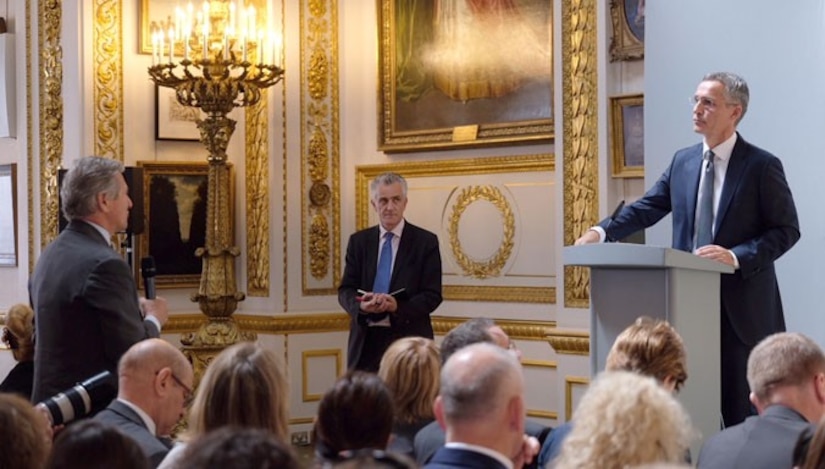
WASHINGTON -- There have been disagreements throughout the history of the North Atlantic Alliance, but the member states have always been able to work together for collective defense, NATO Secretary General Jens Stoltenberg said in London today.

The secretary general previewed the NATO summit in Brussels next month during an address at the Lancaster House. He stressed the necessity of the trans-Atlantic alliance and urged the nations to stand together.

The United States has disagreements with NATO allies on economic aspects such as the Iran deal and climate change. There are disagreements within Europe, too, Stoltenberg said. European allies disagree other over the future of the European Union, what makes up European values, and the growth of populism.

Overcoming Divisions

But NATO must overcome the divisions, the secretary general said, adding that he believes the nations will deal with them as they have throughout to 70 years of peace alliance enabled in Europe.

“Our bond is strong, but today, some are doubting the strength of that bond,” Stoltenberg said. “It is not written in stone that the trans-Atlantic bond will survive forever, but I believe we will preserve it.”

The alliance is not a monolithic entity like the Warsaw Pact once was. It was and is made up of democracies that have had legitimate differences throughout the history of the alliance. “We have overcome disagreements before -- differences of opinion is nothing new,” the secretary general said. “Some of them have been substantial.” Stoltenberg listed the Suez Crisis of 1956, the French withdrawal from NATO’s command structure in 1966 and the Iraq War in 2003.

“We are 29 democracies with different history, geography and culture,” he said. “So of course, sometimes there are disagreements.”

But that has not stopped the most successful alliance in history, he said. “Again and again, we unite around our common goal. We stand together. We protect each other,” he added.

But beyond the disagreements, one aspect stands alone: it is in each country’s strategic interest to maintain the trans-Atlantic alliance, the secretary general said, noting that history is a harsh teacher.

“Two world wars and a Cold War have taught us that Europe and North America are stronger, safer and more prosperous together,” Stoltenberg said. “That is why young American and Canadian soldiers fought on the Western Front in the First World War, and why their sons fought their way across the beaches of Normandy almost 30 years later.”

The United States fought in World War I and then washed its hands of the continent, he pointed out. “That was not a success,” Stoltenberg said. “After World War II, they stayed – in NATO -- and that was a success.”

Stronger and Safer

All Western nations are stronger and safer under the alliance, he said. “It is why hundreds of thousands of European and Canadian troops have served shoulder to shoulder with American troops in Afghanistan, to defeat international terrorism, and with more than a thousand paying the ultimate price,” said he added. “It is – and has always been – in our fundamental interest to stand together. That is as true now as it has been ever before.”

The security environment is more complicated now than it has been in a generation, the secretary general said. International terrorism, missile and nuclear proliferation, cyberattacks and a resurgent Russia, which uses intimidation and force against its neighbors, are just some of the challenges of this new security environment. “It is in our common interest to face them together,” he said.

And alliance nations are facing these common challenges. “There are many different ties that bind Europe and North America together,” he said. “We may have seen the weakening of some of them lately, but our ties on defense have grown stronger. After the Cold War, the U.S. and Canada gradually reduced their military presence in Europe, and European allies cut defense spending.”

But that has changed. U.S. armored forces are back in Europe. The number of American service members on the continent has risen. Since coming to office, the Trump administration has increased funding for the U.S. presence in Europe by 40 percent. Canada has also increased its commitment to the defense of Europe.

“At the same time, Europeans are stepping up too, spending billions more on defense and taking greater responsibility for Euro-Atlantic security alongside their North American allies,” Stoltenberg said. “All allies have stopped the cuts to defense. All allies are increasing their defense spending in real terms.”

European allies and Canada have added an extra $87 billion since 2014, and more are investing 2 percent of gross domestic product – the NATO goal -- on defense. “This has underpinned the biggest increase in our collective defense since the Cold War,” the secretary general said.

And there are concrete capabilities to show for the money, including the deployment of multinational battlegroups to the Baltic countries and Poland. The alliance also has tripled the size of the NATO Response Force and established a task force ready to move in 48 hours, and NATO has joined the global coalition to defeat the Islamic State of Iraq and Syria.

New Capabilities

The alliance will do more, Stoltenberg said, and he expects leaders to approve new capabilities during the Brussels summit. “They will agree to increase the readiness of our forces with 30 mechanized battalions, 30 air squadrons and 30 combat ships ready to use within 30 days or less,” he said. “They will decide on a new NATO command structure with two new commands.”

NATO leaders will make decisions of integrating national cyber capabilities into the alliance’s operations, and will agree a new training mission in Iraq, he said.

Finally, he said, alliance leaders will extend funding for the Afghan forces and deepen cooperation with the European Union.

“All of this shows our determination to provide for our common defense, ready to respond to any attack from any direction,” he said. “We face a difficult security environment, but when NATO is challenged, when others would divide us, weaken us undermine us; we must stay united and rise to the challenge with strength, solidarity and resolve, just as we always have.”