By Army 1st Lt. Nadine Wiley De Moura, 100th Mobile Public
Affairs Detachment
MCALLEN, Texas -- In a small, green-pastured yard enclosed
by barbed wire in Tamaulipas, Mexico, just three hours south of the
Texas-Mexico border, 6-year-old Liliana Chavez marveled at the sight of
cropdusters flying over her home and dreamed that one day she, too, could fly.
Eighteen years later, Army 2nd Lt. Liliana Chavez smiled as
she recalled the memory that propelled her forward.
“I grew up in a rural area where we didn’t have running water
-- we had wells,” Chavez said. “We had outhouses, so no toilets. And, the first
time I saw a shower I was in second or third grade. I grew up in the projects.”
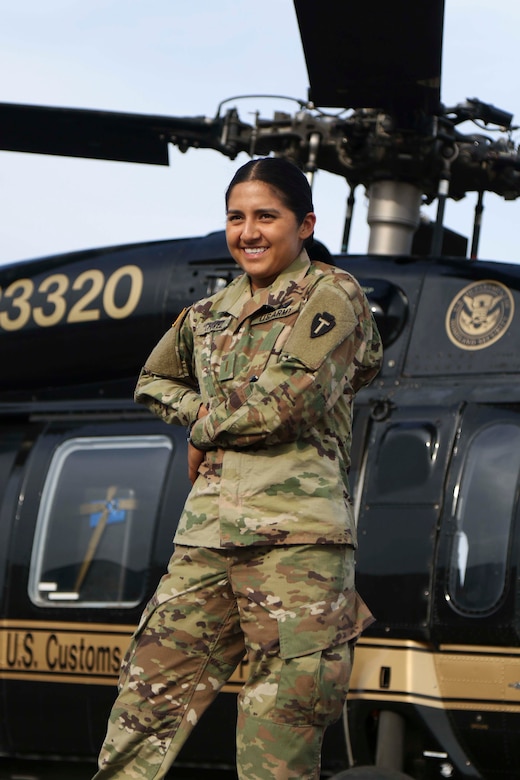
Chavez, 24, is an aeromedical evacuation officer who flies
UH-60 Black Hawk and UH-72A Lakota helicopters for the Texas Army National
Guard‘s 2nd Battalion, 149th Aviation Regiment. She said her accomplishments
are far beyond what her 6-year-old self could have imagined.
Ambition to Fly
“I have been wanting to fly since the first time I saw an airplane,
but I kind of put that dream aside, since I thought it was very competitive,”
Chavez said. “It was like dreaming to be a movie star; you put it aside because
you think it will never happen.”
Despite the obstacles that Chavez and her family endured as
immigrants during their journey, Chavez realized her dreams were more of a
reality than she thought.
“I came here as a permanent resident,” Chavez said. “My dad
worked his butt off to get us all here the correct, legal way, and now I am a
citizen.”
Upon moving, to Pharr, Texas, with her parents, Chavez and
her older sister went to school in the Pharr-San-Juan-Alamo Independent School
District. It was during her high school years that Chavez discovered her love
for a disciplined military structure when she joined the Junior ROTC.
Continuing Education
Chavez graduated fifth in her high school class with an
associate’s degree under her belt, and she landed a two-year Texas Armed
Services scholarship to the University of Texas Pan-American, where she joined
the ROTC program and majored in biology.
“In ROTC, I got the opportunity to go up for the aviation
board,” ’she said. “I put in the packet … and was selected.”
Chavez graduated from flight school and survival, evasion,
resistance and escape training.
SERE is a 21-day training requirement for all pilots and
Special Forces members that tests the limits of the participants’ mental and
physical fortitude to prepare them to evade capture and survive extreme
conditions and unforgiving elements while maintaining the military code of
conduct. Chavez said SERE training was the most challenging experience she has
faced in her life.
During her lowest moment during the training, Chavez
recalled, she started laughing, even though there were tears coming out of her eyes.
Tough Training
“It was tough, but I always had a positive attitude,” she
said. “I tried to sing and make something positive out of a crappy situation.”
Chavez credited her father’s work ethic as the reason she is
so driven to overcome the challenges she faced during SERE training.
“My dad, he is really motivating,” Chavez said. “He works in
construction, in roofing. He would come back home just burned and blistered –
every day, nonstop -- and he never complained.”
Chavez said she admires her father and that he is the force
that continues to keep her on track. “I always stop to sit down and think,
‘Would this make my dad proud?’“ Chavez said.
Silvano Chavez, Liliana’s father, also frequently expresses
his pride for his daughter when talking to his friends.
Father’s Pride
“I tell my friends that Liliana is on another level; she
isn’t just any normal college graduate -- she is way more than that,” Silvano
said. “Liliana serves as an example that if you work hard and persevere you can
get to where you want to be.”
Silvano was one of 14 siblings, and he never had the
opportunity to finish his education or go to college. He started working at age
13 to help provide for his large family. He said he taught his three daughters
that if you want to do better in life, you need to focus and take every
opportunity that you have.
Chavez remembered being one of three women and the only
Hispanic woman in her flight school class.
“There is a challenge in being a Hispanic woman and being a
minority -- that’s two things,” Chavez said. “But now, I think it’s a great
thing because we can actually go all the way to the top.”
Dealing With Discrimination
Chavez said that she overcomes discrimination the same way
that she conquered her challenges during SERE training: with humor.
“I just play along with it. I say, ‘So what?’ Chavez said
with a laugh. “I’ll prove a point. I’m Mexican, I’ll braid my hair. I embrace
every stereotype, and I think that’s the way to do it instead of being
thin-skinned.”
Regardless of all the challenges she has faced, whether it
was getting through college, financial setbacks, discrimination, or SERE,
Chavez said, she never saw failure as an option.
“My main drive was not to disappoint my father,” Chavez
said. “I wanted to finish school and do amazing things for myself and him,
also. I want to eventually pay him back for all he has done for us.”
Chavez, a lean 5 and a half feet tall, walks ruler-straight
and with purpose, radiating positivity, while also having a steadfast command
presence.
Positive Attitude
“The leader I hope to be -- I expect to touch many, many
lives,” Chavez said. “I am already a joyful leader, always looking at the
positive side. I am always smiling, I don’t want to be bitter. If you aren’t
happy and have a moody face, that is contagious.”
When Chavez talks about flying, her face lights up, and her
voice exudes an energetic rhythm.
“I want to fly a fixed-wing [aircraft]. I want to fly it
all,” she said.
“I feel really proud, she loves what she does,” Jessica
Chavez, 27, Liliana’s sister, said. “Every time she talks about it, you can see
a little spark -- the glow in her eyes, the spark in her face.” Her sister
displays strong character everywhere she goes, even in the way she stands,
Jessica added.
Chavez reflected on where she would be in life had her
father not brought her and her family to the United States.
“I would be living a sad life; probably with like, five
kids, not in school, not educated or maybe something even worse -- just the way
stuff is down there,” she said.
With a smirk on his face and standing very straight, Silvano
crossed his arms and shook his head in disagreement with his daughter’s
statement. “If we hadn’t come here, nothing would be different,” Silvano said.
“I would have wanted them to keep up with their education, and if Lily were in
Mexico, she would move somewhere else and still succeed, because that is the
way she is.”
Although she has achieved success, Chavez said she still has
many dreams to fulfill.
More Dreams to Fulfill
“My other plan is to go back to school for earth and coastal
sciences, diving and studying earth forms,” Chavez said. “I want to be an
astronaut too, one day.”
Chavez said working in the community where she was raised is
a reminder of all the people who have shaped her life. “I would never have
thought I would be in this position to make a difference or implant a seed in
their brains so they can actually grow their ideas and be something,” she
added.
Sitting up straight on the end of her office chair, both
hands on her knees, Chavez leaned forward and passionately voiced her message
to other girls who have big “movie-star dreams” like hers.
“I’d tell them don’t limit yourself. The sky is actually not
the limit -- you can be an astronaut if you want to.”





 Posts
Posts

