FORT DRUM, N.Y. -- Providing 10th Combat Aviation Brigade
soldiers assigned here with the most realistic training scenarios required
planners to think outside the box -- and outside of Fort Drum.
That was recently accomplished with Falcon’s Peak, a 10-day
aviation exercise that simulated a rapid readiness deployment of air and ground
troops from Fort Drum to Camp Ethan Allen and Camp Johnson in Vermont.
“Falcon’s Peak was an exercise designed to challenge the
aviation brigade using real-world distances and simulated threats that
replicate the future of warfare, particularly as we see it in multidomain
battle” said Army Col. Clair A. Gill, 10th CAB commander.
Army Maj. Joshua Meyer, 10th CAB operations officer, said
that the idea for Falcon’s Peak was conceived while the brigade was on a
nine-month deployment in Europe last year, where they participated in Saber
Guardian 17 and Falcon’s Talon exercises.
In planning Falcon’s Peak, Meyer said that it would allow
them to exercise all of their key annual training requirements.
Training Requirements
“Expanding the training area and expanding the routes via
air and ground really increased our capabilities,” Meyer said. “It kept us on
our feet the whole time. Just the fact that we had to go through a rapid
emergency deployment readiness exercise, leave Fort Drum in five days -- and
that’s not just packing vehicles and helicopters -- it’s all the briefings and
planning that goes into that, as well.”
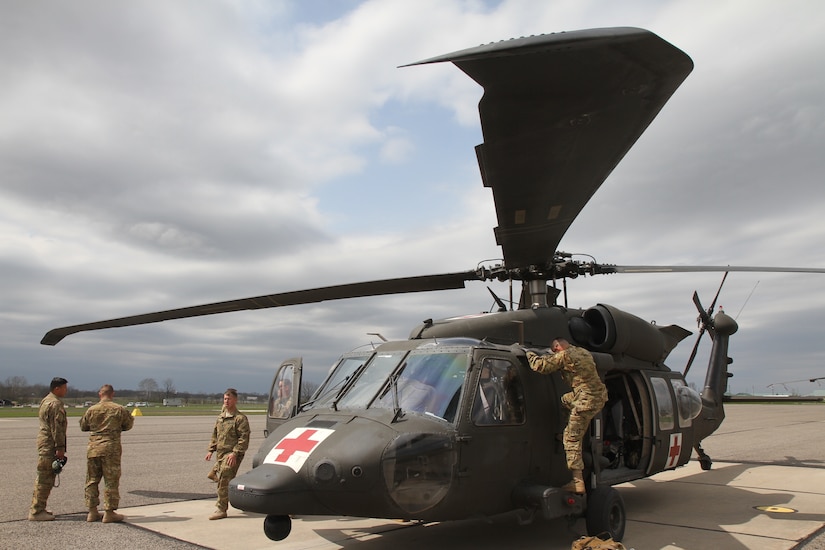
The exercise involved roughly 850 soldiers, 17 AH-64 Apache
and UH-60 Black Hawk helicopters and nearly 250 vehicles. The aviation unit
tested its low-to-the-ground flying, using the terrain in Northern New York and
parts of Vermont to avoid detection and counter simulated air defense artillery
threats.
“What was uniquely different than typical battalion- and
brigade-level training exercises at Fort Drum is that we pushed out into the
surrounding communities to challenge our logistical supply lines and mission
command systems over distances beyond the geographic boundaries of Fort Drum,”
Gill said. “The exercise absolutely challenged those areas we wanted -- and
needed -- to be stressed.”
Soldiers also conducted logistical operations to include
supply movements, water purification and medical evacuations. Army Maj. Derek
Martin, 10th CAB simulations officer and lead exercise designer, said that
training objectives on the ground were just as crucial as those in the air.
“It’s not just a drive. They move in a tactical manner,
seize the ground they’re coming into and quickly establish a defense and
support area where they logistically support the aviation side of this
organization,” he said.
The 277th Aviation Support Battalion completed a convoy
live-fire exercise following an eight-hour convoy from Fort Drum. Army 1st Lt.
Jessica Abbott said the intent was to validate gunnery crews and test their
convoy efficiency.
‘It’s Important to Practice Our Skills’
“It’s important to practice our skills and our gunnery
tables in convoy live-fire exercises because we have to protect our own classes
of supplies as we transport them to these line units on the front line in
supporting them throughout the fight,” she said.
Abbott said that 10th CAB soldiers benefited from training
outside of the familiar ranges at Fort Drum.
“We’re not always going to be right in our backyard and know
what the training area looks like,” she said. “So we have to get there, assess
the area, set up and continue the mission.”
That is what Meyer hoped that every soldier took advantage
of during the training.
“It’s really planning for the unknown,” he said. “Driving on
unknown roads, flying over unknown terrain, not knowing what’s coming next in a
scenario and allowing our planners, our pilots, our soldiers, our drivers --
every soldier and officer in our formation -- to react to the unknown. I really
think that’s what prepares us for the uncertainties of future combat.”
The brigade was permitted to use Moore’s Airport, a
privately owned property in Degrasse, New York, to establish a forward arming
and refueling point. This allowed aircraft to refuel during an air assault
mission. They were also allowed use of Tahawus Mine in Essex County to simulate
a large scale battlefield.
“We sought and gained approval from patriotic community
members who lent us their land on which to train,” Gill said. “We spent weeks
ahead of time briefing community and state officials on the exercise and its
importance to building readiness within the brigade, but also highlighting how
the regional support enables us to demonstrate relevance for the future.”
Harsh Weather Conditions
It wouldn’t be a North Country spring without freezing
temperatures and flurries, and fluctuating weather conditions forced 10th CAB
soldiers to take necessary precautions.
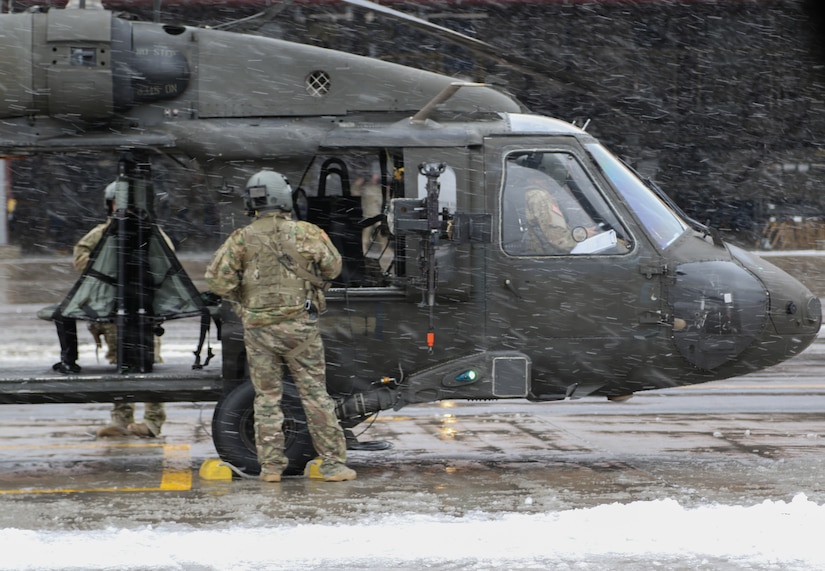
“We had to consider individual soldier safety amid rain,
sleet snow and freezing rain,” Gill said. “We had to reposition aircraft and
equipment to mitigate forecasted high wind warnings, and we had to put our best
crews on mission to fly in adverse, snowy conditions. Our drivers had to think
through operating heavy equipment on trails and roads that weren’t always in
pristine condition.”
He added, “More than anything, exercises like Falcon’s Peak
require leaders at every level to make decisions, sometimes independent of
higher headquarters oversight, to accomplish the mission with only commander’s
intent and the immediate resources at their disposal.”
Martin said that as the temperatures dropped, it was the
junior leaders who rose to the challenge to ensure their soldiers were equipped
properly, training safely and staying combat effective during adverse
conditions.
“We fought against weather -- springtime in the North
Country is always a fun issue -- but it’s part of the exercise,” Martin said.
“You have the enemy situation on the ground, the terrain and the weather. How
to defeat those is always the greatest challenge, and I think this exercise
really got after that.”
Coming Home
The 10th CAB formation took the fight back home April 17,
returning to Fort Drum to face the final objective. Soldiers from 2nd
Battalion, 22nd Infantry Regiment, 1st Brigade Combat Team, served as the
opposition force and the air assault element.
“My job as exercise director was to bring forth an
effective, realistic, tough opposition force, and so I established a very
complex defense here at Fort Drum,” Martin said. “Our aircraft were able to fly
in against it. They attacked, conducted a large air assault in the end which
culminated the exercise and we were very successful tactically.”
Army Chief Warrant Officer 2 Samuel Harvill was one of the
Black Hawk pilots who reached Fort Drum undetected by the OPFOR.
“We never had any indications we were being tracked by the
enemy, and that’s because of our tactics -- how low we were flying and
utilizing the terrain to mask the aircraft from that enemy threat,” he said.
“If they can’t see us, they can’t hit us. It proves that what we are doing is
working, and that if we keep training this way and keep building on these
procedures and techniques that we are learning and developing right now, I
think we will be a very effective force in the future.”
The culminating event was named Operation Po Valley Breakout
in recognition of a historic 10th Mountain Division campaign in Italy during
World War II.
“In fact, Falcon’s Peak took place exactly 73 years to the
day when our forefathers assaulted Hill 909 and 913 during the spring offensive
of 1945 in Italy,” Gill said. “I’m most encouraged by how this formation, the
Falcon Brigade, embodies the spirit and intent of mission command to fight and
win in any environment, anytime.”




 Posts
Posts

