By Army Sgt. 1st Class Gary A. Witte, 642nd Regional Support
Group
FORT VALLEY, Ga., April 10, 2018 — For soldiers in the 421st
Quartermaster Company, “attention to detail” is less a catch phrase than a
lifesaving mission statement.
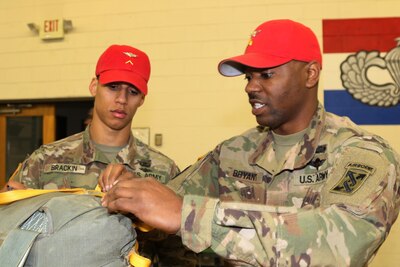
Parachute riggers with the 421st, based at the Army Reserve
Center here, pack hundreds of chutes every month for use by reserve and
active-duty troops across the southern United States. And, there isn’t just one
kind of parachute. There are more than a dozen types, each with a specific
method for packing to ensure they open correctly.
Army 1st Sgt. Richard A. Davis of Musella, the senior
noncommissioned officer for the unit, said one mistake by a parachute rigger
can lead to a fatality or injury.
‘Everything Has to be Precise’
“A lot of things can go wrong,” Davis said. “Everything we
do to pack a parachute has to be done by steps. Everything has to be precise.”
Military jumps typically involve the use of a thick cord --
called a static line -- to pull the chutes open. If the static line is routed
wrong, the parachute won’t open. If the static line is faulty and the problem
isn’t discovered, it can shred and the parachute also won’t open. If the risers
which connect the jumper to the chute are flipped, its canopy might only
partially open -- sending the soldier speeding toward the ground.
Army Master Sgt. Brian W. Steverson of Bonifay, the
operations NCO, said only qualified riggers are allowed to put chutes together,
and they have to remain proficient at their jobs.
“It’s really important to stay current, because every
parachute is a life-support system,” Steverson said.
Heavy Cargo
Cargo loads can be even more complicated. Because of the
weights involved -- up to about 2,000 pounds -- the chute has to be adjusted to
deploy a certain way, otherwise the shock of its opening can tear it. This
would send the heavy payload raining down across the landscape.
“Hopefully, no one is below it,” if that happens, Steverson
said.
To become a qualified parachute rigger, soldiers must go
through airborne orientation, then airborne school, then rigger school, he
said. As part of graduating rigger school, which itself is an 11-week course,
the soldiers pack their own chutes and then jump with them.
“When they come to us, they already have six or seven
jumps,” Steverson said.
Battle assemblies for the company feature all the usual
requirements for an Army Reserve unit, including physical training tests,
equipment accountability and classes. But then, there is the steady drumbeat of
safety checks, packing chutes and preparations for the next unit jump.
Parachute riggers have to maintain their status by jumping
every three months -- at a minimum. If they don’t maintain their jump status,
they aren’t allowed to pack or inspect parachutes, Steverson said.
A handful of riggers remain at the unit on active duty to
continue the packing process throughout the week and also travel with the
chutes when shipped to locations in California, Texas, Florida, South Carolina,
Georgia and Alabama. These parachutes allow members in those airborne units to
maintain their own jump status.
Hundreds of Parachutes
Typically, several hundred parachutes get packed each month.
Properly packing a single parachute can potentially take anywhere from 20
minutes to an hour, depending on how experienced the rigger is. There are 13
rigger checks of each chute -- including inspections prior to its assembly,
before it is packed, while it is packed, after it is packed and a jumpmaster
inspection at the airfield -- before they are authorized to be used in a jump.
Army Sgt. David C. Frady is one of the full-time parachute
riggers. He’s been doing it for eight years and enjoys the complexity because
of the variety of payloads and parachutes they have to manage. There’s a lot of
information to absorb all the time, since both the equipment and missions
change.
But it can get repetitive. And they always stay busy, he
said.
“You pack 15 a day and you do it every single day until you
meet mission requirements,” Frady said. “It just becomes the norm.”
Riggers Take Responsibility
The parachute rigger’s name goes in each chute they pack,
along with the names of its inspectors. Once the parachutes are delivered, a
rigger from the unit stays to monitor and record the jumps.
Davis, who became first sergeant for the unit in 2014, said he
witnessed the resupply of American troops in Afghanistan by air and it
reinforced the importance of their work to him.
“We are enablers,” he said. “Our job enables soldiers to
resupply and continue the fight.”
Accidents remain rare, Davis said. He added that the
parachute riggers with the 421st Quartermaster Company take their mission
personally and have pride in their work.
“It’s still a high-risk thing in which we’re involved, but
we do everything we can to keep it safe,” he said.


 Posts
Posts

