Saturday, March 10, 2018

DoD Works to Incorporate More Gender Perspective in Operations


By Air Force Tech. Sgt. Chuck Broadway DoD News, Defense Media Activity

WASHINGTON, March 8, 2018 — The Defense Department is advancing its efforts to include more women in peacebuilding and conflict resolution processes following the signing of the 2017 Women, Peace and Security Act.

Mark Swayne, acting deputy assistant secretary of defense for stability and humanitarian affairs in the Office of the Assistant Secretary of Defense for Special Operations and Low-Intensity Conflict, said DoD is looking to leverage the unique aspects women bring to the table, not only in peacebuilding and conflict resolution, but also in all facets of military operations.

“When working with partner militaries or civilians, we are trying to include women so they don’t get overlooked,” he said. “Ensuring that our partners include [female perspectives] makes us more effective in our military operations.”

Research on the effectiveness of including women in military peacebuilding and conflict resolution negotiations found that peace agreements between civil society groups are 64 percent more likely to succeed -- and 35 percent more likely to last at least 15 years -- than agreements that overlooked the female perspective.

Setting the Example

According to the Women, Peace and Security Act, Congress found that, around the world, women remain underrepresented in conflict prevention, resolution, and post-conflict peacebuilding efforts. Meaningful participation of women in these operations helps to promote a more inclusive and democratic society, and is critical to the long-term stability of countries and regions, Congress determined.

To promote these findings, DoD is taking the necessary steps to be a global leader by setting a key example for international partners.

“We have a well-integrated military,” Swayne said. “Many of our allies and NATO partners are the same. But we have many military partners around the world where females do not have the same level of representation.”

Swayne added that when DoD representatives send female officers and senior noncommissioned officers to attend meetings with international partners, it conveys a strong message that females take a high priority within the government and the DoD.

Full-Scale Implementation

DoD leaders are working with the National Security Council on an interagency strategy for incorporating and operationalizing the Women, Peace and Security Act. Once that strategy is finalized, a DoD instruction will be created outlining how to implement women, peace, and security measures into all DoD operations. Swayne said he hopes to have the new instruction in place by the end of 2018.

DoD and the Joint Staff recently instituted a Women, Peace and Security Synchronization Group. This group, consisting of representatives from the combatant commands, military services, regional centers and professional military education institutions, as well as DoD and Joint Staff leaders, meets monthly to enable cross-sharing, optimize lessons learned and best practices, and advance future programs throughout the department.

Combatant commands are already successfully implementing Women, Peace and Security Act objectives through their individual theater campaign plans. These efforts aim to educate personnel on how integrating women, peace, and security concepts increases overall mission effectiveness.

“We are weaving Women, Peace and Security into all training activities, and into the fabric of how we institutionalize DoD objectives,” Swayne said. “It’s an opportunity for us to include women, peace, and security scenarios in every activity we are doing [to become] more effective in our military activities.”

Thursday, March 08, 2018

Transcom Stands Ready To Respond, But Future Is Concerning, Commander Says


By Terri Moon Cronk DoD News, Defense Media Activity

WASHINGTON, March 8, 2018 — U.S. Transportation Command stands ready to deliver on behalf of the nation's objectives anywhere at any time, Transcom’s commander told lawmakers on Capitol Hill today during a joint convening of the House Armed Services Committee’s panels on readiness and seapower and projection forces.

Yet, as Air Force Gen. Darren W. McDew noted he has testified before, he remains concerned about the future.

“As we refocus our efforts on great power competition, we're faced with adversaries who want to challenge our democratic values and undermine our security and the existing balance of power,” McDew said. “In this environment, the logistics enterprise must always be ready.”

The resources necessary to transport and sustain America's military must keep pace, he said, and the Defense Department’s ability to deploy a decisive force is foundational to the National Defense Strategy.

“The size and lethality of the force is of little consequence if we can't get it where it needs to go when we want it there,” McDew added.

The 2018 National Defense Authorization Act directed a mobility-requirements study and found the existing inventory of mobility assets is sufficient to support the requirements of combatant commanders, he said.

“This study will [also] consider the current strategic context and use updated assumptions [such as] multidomain contested environments [and] attrition of mobility assets, and the outcomes of the study will provide valuable insight to ensure we are able to respond to tomorrow's needs, as well,” the general added.

Weight Of Nation Needed

“But U.S. Transcom can’t get there alone,” McDew said. “We need the weight of the nation with us and behind us to make sure that our diplomats -- when they go to the negotiating table -- are negotiating from a position of strength.”

The cyber domain is of great concern, he said. “Today our adversaries don't have to stop us with bombs and bullets. All they have to do is slow us down with ones and zeros. That's the challenge, I would say, of our time,” he added.

“We have got to get smarter -- as an industry and as a nation, not only about how we protect ourselves, but how we protect each other,” McDew said. “Cyber defense is more than just security. It's about … mission assurance. It's a national issue. From safeguarding our intellectual property to guaranteeing the integrity of our elections, we've all got to be together,”

And in addition to threats from the cyber domain, challenges in the physical domain also exist, he said.

Personnel Concerns

“For the past three decades, reserve component assets have been used to sustain day-to-day operational requirements, a function for which they weren't properly resourced or structured,” the general said. “Meeting the challenges of the future may require adjustments to the mobilization authorities, or force mix to ensure we have access to vital capacity currently resident in our reserve and guard,” he noted.

Transcom’s ability to move patients from the battlefield is also facing challenges, he said, noting that although the command operates the most robust patient movement system in the world, it lacks sufficient capacity to surge for large-scale conflicts with mass casualties.

“The combination of insufficient personnel, equipment, infrastructure and capacity for patient movement significantly decreases the likelihood we'll see the same high-level survival rates [to which] we've all become accustomed,” McDew testified. “We continue to work with the services, the Joint Staff and the national health enterprise to address these challenges.”

If the United States is able to maintain its go-to-war capacity, “we must ask ourselves as a nation: Who are we and who do we want to be?” he noted. “The U.S. flag fleet has steadily declined since World War II from a little over 1,200 ships to 81 remaining today. That degradation correlates to a decline in qualified merchant mariners. They are the backbone of our industry. If we continue to lose this capacity, I'm concerned what it will mean for how we project our force in the future.”

Dunford Presents Legion of Merit to NATO Military Committee Chairman


By Jim Garamone DoD News, Defense Media Activity

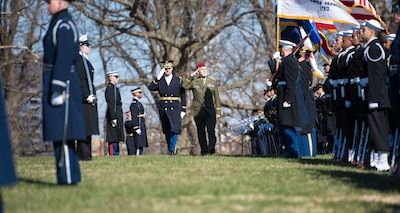
JOINT BASE MYER-HENDERSON HALL, Va., March 8, 2018 — Marine Corps Gen. Joe Dunford, the chairman of the Joint Chiefs of Staff, presented the Legion of Merit to Czech Gen. Petr Pavel, chairman of the NATO Military Committee, during a ceremony here today.

More than 250 service members participated in the ceremony at Whipple Field. The clear, cold day gave great views over Washington and next door Arlington National Cemetery. The Legion of Merit is the highest award American leaders can bestow on foreigners.

Pavel has served as chairman of the Military Committee since June 2015 and his time as chairman coincided with NATO reemphasizing deterrence in the face of a growing Russian threat. The alliance also had troops in contact in Afghanistan and joined the effort to defeat the Islamic State of Iraq and Syria.

Leading Through Challenges

His first mission was to shepherd the decisions made at the 2014 Wales Summit through the Military Committee to ensure the implementation of those decisions was on course. This included the alliance readiness action plan to ensure the allies were prepared for the challenges of collective defense in the 21st century.

Pavel’s time also marked NATO’s growing cooperation with the European Union. Cyber operations, increasing reliance on space assets, discussions about needed military capabilities are just a few of the issues Pavel steered through the committee.

He is the first chairman to come from a nation that was part of the Warsaw Pact. Before serving in Brussels, he was the chief of the general staff of the Czech army.

“General Pavel superbly navigated NATO’s Military Committee, including national military representatives and national chiefs of defense, through the most challenging period in the alliance’s recent history,” the Legion of Merit citation states.

Pavel will relinquish the job of chairman to British Air Marshal Stuart Peach on June 29.