Thursday, February 15, 2018

Aviators Take Joint Training to New Heights


By Air Force Staff Sgt. William Hopper, 122nd Fighter Wing

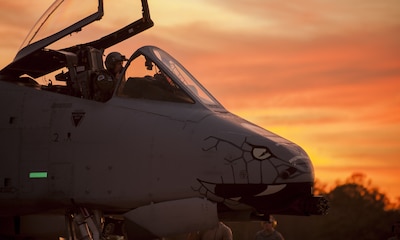
FORT WAYNE, Ind., Feb. 14, 2018 — The Indiana Air National Guard’s 122nd Fighter Wing recently completed Operation Guardian Blitz during a two-week joint training exercise at MacDill Air Force Base, Florida, which included air-to-air refueling, training alongside Navy rotary assets and joint terminal attack controllers.

The team of over 200 airmen and 10 A-10C Thunderbolt II aircraft were able to take advantage of the favorable weather conditions and ability to work with other units at MacDill, and were afforded opportunities to practice close air support, forward air control and combat search and rescue.

Unique Training Opportunity

“My favorite part of training here at MacDill has been the combined force training operations that we don’t have an opportunity to do at home,” said Air Force Lt. Col. Joshua Waggoner, the 122nd Fighter Wing Operation Guardian Blitz detachment commander. “We are here training with our A-10 aircraft, two Navy MH-60S helicopters and refueling tankers overhead. During missions we are on station for over two hours integrating with all these assets while also coordinating with [joint terminal attack controllers] on the ground. The opportunity to work with these other agencies to accomplish missions has been invaluable.”

Operation Guardian Blitz was unique in allowing different branches and squadrons to integrate in a way not typically found during a joint training exercise.

“The ability to have helicopters out of Virginia, tankers out of Niagara, and A-10s out of Fort Wayne, all operating in the same sortie and off the same ramp is something you usually don’t get elsewhere,” Waggoner said. “Even at Snowbird or other trips in the past, we’ve never been collocated with all our other assets. Here at MacDill for Guardian Blitz, we’re all located in the same place and able to interact face-to-face on a daily basis. It’s a luxury you just don’t get anywhere else.”

“We were able to match our objectives with the other unit’s objectives to make it all happen at the same time,” he said. “This is by far the most aggressive training schedule we have set, and it never would have been able to happen at home this time of year due to weather and other circumstances.”

Air Force Refueling

One of the many training opportunities made possible by Guardian Blitz was the refueling mission completed by the Air Force Reserve’s 914th Air Refueling Wing from Niagara Falls, New York.

“The 914th ARW from Niagara is in the process of transitioning from the C-130 [Hercules cargo planes] to KC-135 [Stratotanker refueling] tankers,” Waggoner said. “They were excited to be a part of Guardian Blitz because it gave them the opportunity to get in plenty of refueling sorties with our A-10s while getting training from MacDill instructors. They have completed 41 air-to-air refueling sorties in the last two weeks, which is about what they usually fly in six months.”

“We just made the transition to the KC-135 from the C-130 about six months ago,” said Air Force Lt. Col. Chris Pfeil, a pilot with the 914th Air Refueling Wing. “It’s a little different than what we are used to.”

“Once we get a little more proficient with the KC-135 our unit will become operational,” he said. “More and more, air-to-air refueling is becoming in-demand to carry on the mission of the Air Force.”

Navy Search, Rescue

Also joining the training were two MH-60S Seahawk helicopters operated by the Navy’s Helicopter Sea Combat Squadron 22, from Naval Station Norfolk, Virginia. During missions, the HSC-22 provided recovery assets for the search and rescue training and were also utilized for additional close air support to strike targets on the ground.

“The MH-60S Seahawk is primarily used for search and rescue operations and logistics,” said Navy Petty Officer 2nd Class Nicholas Glass, a door gunner with HSC-22. “I am looking forward to working with other branches of the military during Guardian Blitz to get a better idea of how we can work together to improve mission success.”
“We train to the point that we can execute our mission in any environment,” Waggoner said. “The time we put in training at places like MacDill and back home in Fort Wayne really pays off when it comes time to execute the mission.”

Wednesday, February 14, 2018

Nuclear Posture Review Addresses Reality of Current Threats, DoD Official Says


By Lisa Ferdinando DoD News, Defense Media Activity

WASHINGTON, Feb. 13, 2018 — The recently released Nuclear Posture Review is grounded in a “realistic assessment” of the current security environment, and tailored to deter threats and reassure allies, Deputy Undersecretary of Defense for Policy David J. Trachtenberg said here yesterday.

In a discussion at the Brookings Institution, Trachtenberg outlined the four key goals of the review, which was released Feb. 2: deterring nuclear and nonnuclear attack, assuring allies and partners, achieving U.S. objectives should deterrence fail, and hedging against an uncertain future.

“The 2018 NPR addresses the reality that while the Cold War has been over for decades, a much more challenging nuclear threat environment has developed since the previous 2010 nuclear posture review,” he explained.

The goal of recommendations contained in the 2018 NPR is to “deter war, not to fight one,” Trachtenberg said.

The Defense Department conducted the review along with the departments of State and Energy, in consultation with allies and experts from inside and outside the government, he explained.

The NPR emphasizes that U.S. nuclear policy will continue to contribute to U.S. nuclear nonproliferation goals, he said, adding that those roles are consistent with past priorities of U.S. nuclear policy.

Recognizes Need for Nuclear Triad

“The new NPR recognizes the need for the nuclear triad,” he said, explaining it sustains the previous administration's plan for modernizing the aging U.S. nuclear triad of land-based, sea-based, and air delivery platforms, as well as its supporting nuclear infrastructure and command and control.

Trachtenberg pointed out the 2018 NPR, consistent with the previous NPR, declares that the United States would only consider using nuclear weapons in “extreme circumstances to defend U.S. vital interests.”

He noted that the 2018 NPR recommends two nuclear programs to strengthen U.S. capabilities to deter attacks and assure allies: the modification of a small number of existing submarine-launched ballistic missiles to include a low yield option, and the pursuit of a nuclear sea-launched cruise missile.

“We must recognize that effective deterrence is about tailoring our capabilities to a potential adversary’s calculations regarding the use of nuclear force to ensure that it can never appear to be a useful option,” he said.

The 2018 NPR, he said, is “grounded in a realistic assessment of the contemporary security environment – one that recognizes a return of great power competition and the increasing salience of nuclear weapons in the arsenals and doctrines of potential adversaries.”

Joint Training Develops K-9, Handler Skills


By Army Sgt. 1st Class Wynn A. Hoke, 8th Theater Sustainment Command

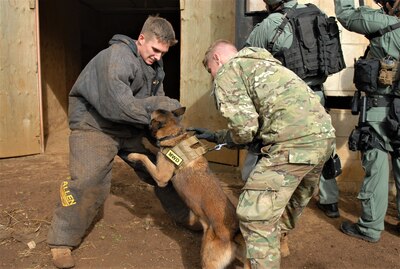
SCHOFIELD BARRACKS, Hawaii, Feb. 14, 2018 — For military working dogs and their handlers it is especially crucial for both to be able to work in any environment, any situation.

The 520th Military Working Dog Detachment seized the opportunity to work on urban combat tactics with the Honolulu Police Department K-9 unit Feb. 8 at the Combined Training Facility urban operations training site here.

“We have been working for a while to get joint training with HPD and their SWAT K-9 group as well as the [Transportation Security Agency] and special response teams,” said Army Staff Sgt. Jeremy D. Coleman, the 520th MWD Detachment kennel master. “Being able to implement our dogs for [special response teams] if the situation arises, having that training prior to execution is essential.”

Incorporating the MWD and handler into a stack formation or SWAT formation when entering a building for search and seizure or apprehension is a tactic new to the detachment. This training will allow the integration of a MWD and handler into Schofield Barracks Police SWAT situations.

“If the dog is never exposed to it, he may or may not freak out or may or may not search,” Coleman said. “The best time to find that out is here during the training rather than down range. Our takeaways are knowing what our dogs’ weakness are when getting in the stack and building on that.”

Becoming a Better Team

Army Sgt. Molly M. Montoya, a military working dog handler with the 520th MWD Detachment, learned firsthand what the Honolulu police could bring to the training.

“HPD is super experienced with implementing a dog team into their stack and all their SWAT teams have dogs,” Montoya said. “They taught the Schofield Barracks SWAT Team and the canine handlers how to incorporate our dogs into their stack so we can become a more efficient team here for Schofield [Barracks] and Fort Shafter.”

The second portion of the training had the HPD handlers and K-9’s honing their explosives search skills within several multistory buildings without combat simulated noises like explosions and small arms fire. Simulated combat noise was added later to continue training tactical explosive detector dogs and their handlers in the types of situations they might find themselves in.

“You come in and whether you run the scenarios really well [or not], there are always something to take from it,” Montoya said. “My dog and I are an experienced canine team but there is always room for improvement.”

Coleman explained that training has to adapt just like the enemy does. To implement this, he tied a dog toy that the handlers are often seen with to a simulated explosive to see if the dog and handler would recognize the threat. In some cases, the dog went straight to the toy, setting off the simulated explosion.
“The takeaway from the tactical downrange side is what the handlers need to focus on, more so than just finding explosives,” Coleman said. “If they are not checking their doorways or constantly watching their dog and where it is at, the dog could set off the device, in which case both dog and hander could perish.”