Friday, January 19, 2018

DoD Issues Guidance for Potential Government Shutdown


By Terri Moon Cronk DoD News, Defense Media Activity

WASHINGTON, Jan. 19, 2018 — The Defense Department has issued guidance to its military and civilian leadership on how to proceed if the federal government should shut down at midnight tonight, according to a memorandum from Deputy Defense Secretary Patrick M. Shanahan.

The deputy secretary said in his memo issued yesterday that the Trump administration does not want the government to shut down.

“The administration is willing to work with the Congress to enact a short-term continuing resolution to fund critical federal government operations and allow Congress the time to complete the full-year 2018 appropriations,” Shanahan said in his memo.

While he and Defense Secretary James N. Mattis hope Congress passes a continuing resolution or an annual appropriations bill for fiscal year 2018 defense activities, he said, “prudent management requires that the department be prepared for the possibility of a lapse in appropriations.”

War Operations to Continue

While the memo contains guidance on essential personnel to continue DoD operations during a potential shutdown, he said, the department will continue to prosecute the war in Afghanistan and operations against al-Qaida and the Islamic State of Iraq and Syria, and will continue to make preparations for deployments into those conflicts.

“The department must, as well, continue many other operations necessary for the safety of human life or the protection of property,” the memo read. “These activities will be ‘excepted’ from the effects of a lapse in appropriations: All other activities would need to be shut down in an orderly and deliberate fashion, including -- with few exceptions -- the cessation of temporary duty travel.”

Military: Normal Duty Status

All active-duty service members will continue in a “normal duty status,” regardless of their affiliation with excepted and unexcepted functions, the memo said.

“Military personnel will not be paid until such time as Congress makes appropriated funds available to compensate them for this period of service,” the memo said. “Civilian employees paid for lapsed appropriations and who are not necessary to carry out or support excepted activities will be furloughed, i.e., placed in a nonwork, nonpay status.”

Shanahan emphasized that no shutdown actions are to be taken until further notice is provided.

“To repeat, the secretary and I hope that Congress will pass a funding bill and the DoD will avoid a shutdown,” Shanahan’s memo read. “This guidance is intended to support prudent planning.”

Maintenance Airmen Pull Duty in Frigid Antarctica


By Susan A Romano, 25th Air Force

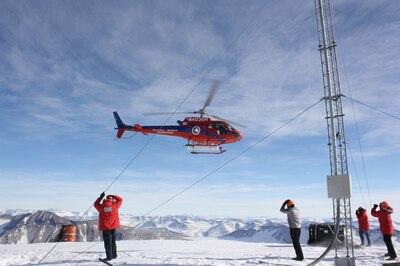
PATRICK AIR FORCE BASE, Fla., Jan. 19, 2018 — With 24 hours of daily sunlight in their favor, a team of seismic technicians traveled to Antarctica at the southernmost point on Earth to conduct annual maintenance of the equipment they use to monitor global nuclear treaties.

Six members of the Air Force Technical Applications Center based here made the trek to Antarctica to troubleshoot and replace seismometers that contribute to the International Monitoring System.

The team also conducted full inventories at the sites and replaced generator starter batteries used to power the stations. The seismic equipment is used to detect activity caused by naturally occurring events such as earthquakes, volcanic eruptions or lightning strikes, as well as man-made events such as mining activity or nuclear explosions.

Air Force Staff Sgt. Jeremy Hannah, a geophysical maintenance supervisor, served as the team lead during the five weeks the team was deployed. Hannah and his fellow seismic maintainers flew from the United States to New Zealand, then on to McMurdo Station in Antarctica, a 14-plus hour trek from one hemisphere to another, including flights aboard an Air Force C-17 and a Bell 212 helicopter.

Logistics, Research Hub

McMurdo Station is the logistics and research hub of the U.S. Antarctic Program and is managed by the National Science Foundation. As part of its global nuclear treaty monitoring mission, AFTAC analyzes seismic data collected from the station and provides it to the U.S. National Data Center.

The Antarctica site, located 1,200 miles north of the South Pole in the McMurdo Dry Valleys near Lake Vanda, supports the International Monitoring System as part of the Comprehensive Test Ban Treaty Organization, and is one of thousands of sensors within AFTAC’s global network, the largest in the Air Force.

A typical duty day for the team consisted of an early rise, breakfast, field work, lunch, preventive maintenance requirements and dinner. Then, a few hours of enjoying the beauty of the landscape. When the team is at the station, they sleep in hardened facilities. In the field, they’re in sleeping bags on the floor of the hybrid power station at Bull Pass or Mount Newall.

Staying properly nourished in sub-zero temperatures is critical to team safety and wellness. When they’re at McMurdo, they enjoy their meals at the station’s cafeteria. When they’re in the field, however, they cook their meals using a camping stove and crockpot. And while most would think the frigid temperatures and austere conditions are the most challenging aspect of their mission, one team member said his biggest hurdle was sunlight.

“Personally for me, having no real track or sense of time was difficult to get used to,” said Air Force Senior Airman Richard Westra, a geophysical maintenance supervisor. “Twenty-four hours of sunlight was a blessing because we could accomplish so much work without worrying about darkness, but it was also somewhat disconcerting not knowing if it was 10 a.m. or 10 p.m.”

Antarctica: ‘Absolutely Breathtaking’

He added, “After a full day of work, though, it’s great to be able to take a hike or walk around to see a place very few people in the world get to experience. Every morning I’d get up and just look outside for several minutes, taking it all in. It’s absolutely breathtaking, and the views blow your mind each day.”

Of the six airmen who made the journey, four had never visited the site before. Travel to AFTAC’s site requires airlift via helicopter, which was one team member’s favorite part of the journey.

“It was so cool to fly over a partially-frozen sea, see penguins and orcas and witness the scenery below in a helicopter, no less,” said Air Force Senior Airman Andrew Pouncy, one of the first-time visitors. “It was an opportunity of a lifetime, and I hope I’ll be able to make the trip again.”

In addition to providing seismic information to senior U.S. decision makers, the data from these sensors also help scientific and academic communities at large.

“We closely coordinate with the NSF and the U.S. Antarctic Program not only when we are deployed to the southern hemisphere, but also when we are back home in Florida,” Hannah said. “This trip, we also worked with the Berg Field Center, the place that outfits both ground and helo teams that work near and around McMurdo. They are an invaluable resource for us.”

The team also serviced AFTAC’s solar generators and wind turbines, better known as hybrid power stations.

“Maintaining our seismic equipment at Vanda is critical to our treaty monitoring mission,” Hannah said. “Because of the weather and rugged terrain, we have a small window of opportunity to perform the necessary troubleshooting to ensure the data is transmitted to the NDC in support of the International Monitoring System as part of the Comprehensive Test Ban Treaty Organization. I’m really proud of the team and what they were able to accomplish on this trip.”
The airmen are now authorized to wear the Antarctica Service Medal on their uniforms.

Thursday, January 18, 2018

Airmen Operate ‘Flying Ambulances’ for Evacuation Missions


By Air Force Master Sgt. Philip Speck 379th Air Expeditionary Wing

AL UDEID AIR BASE, Qatar, Jan. 18, 2018 — The 379th Expeditionary Aeromedical Evacuation Squadron deployed here is one of only two aeromedical evacuation squadrons in the U.S. Central Command area of operations available to remove wounded warriors from the battlefield and ensure they get the medical care they need.

Air Force Lt. Col. Julia Moretti, commander of the 379th EAES, said the unit’s job is to transport wounded warriors from a lower to a higher echelon of care.

“We take them from the battlefield all the way home,” Moretti said.

If military personnel are wounded or become ill on the battlefield, they initially receive first aid care. If lifesaving surgery is needed, the patients are flown to the nearest hospital abroad. That is where the 379th EAES comes in. The unit brings the injured service members here. If they require more intensive care, they will then be transported to Landstuhl Regional Medical Center in Germany. And as a last resort, they will then go back to the United States if they can’t be fully treated overseas.

“The goal is to keep them at the lowest level of care, rehab them and then get them back into the fight quickly as possible,” said Air Force Senior Master Sgt. Matthew Ausfeld, the 379th EAES first sergeant.

Critical Care Air Transport Teams

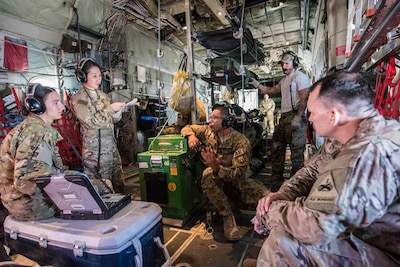
In addition to its aeromedical evacuation teams, the squadron also has critical care air transport teams -- specialized medical teams composed of a doctor, an intensive care nurse and a respiratory therapist.

If patients can be treated and return to work while deployed, they will stay in the theater. But if they have a more severe condition and could not physically manage doing office work as they recover, they will return stateside.

As the war has progressed, the severity, type and numbers of injuries have decreased significantly. In the early 2000s, the teams would care for 20 to 30 patients who would require litter transport. “Now, that is the exception, and we’re glad to see we aren’t having that many now,” Moretti said.

Aeromedical evacuation teams are made up of two nurses and three medical technicians, all considered flight crew. On top of the medical expertise they must know and practice, they also need to know all about the aircraft they are flying on. They have to know how to put together seats, install stanchions to hold patient litters and how the electricity works for their machines aboard the aircraft, among many other details.

AE teams are also required to have the knowledge to perform their duties on a wide variety of Air Force aircraft, such as the KC-135 Stratotanker, C-130 Hercules, C-17 Globemaster III, C-5 Galaxy and C-21.

Total Force Partnership

The AE teams here exemplify total force integration; active duty, Air Force Reserve and Air National Guard members combine to create the medical teams. In fact, only a small percentage of the teams are made up of active duty service members.

“The Guard and Reserve components are a key part in the aeromedical evacuation world,” Moretti said. “Around 88 percent of AE is Guard and Reserve augmenting active duty. It’s a team effort with all the components to transport and care for our wounded warriors.”

Moretti and Ausfeld said the job is rewarding.

“It’s a great feeling helping our wounded warriors,” Moretti said. “Taking care of our own that were injured or became sick while protecting us, it’s a small way to give back. We pamper the patients and give them the best tender loving care we can.”
“I've moved wounded warriors around the world, some with severe battle injuries,” Ausfeld said. “They'll look you in the eyes and thank you for what you're doing for them. It can catch you off guard, and it can be hard to respond to. Because these warriors -- these sons, daughters, mothers, fathers, brothers and sisters -- have sacrificed their body and soul. We're just making sure they get home.”