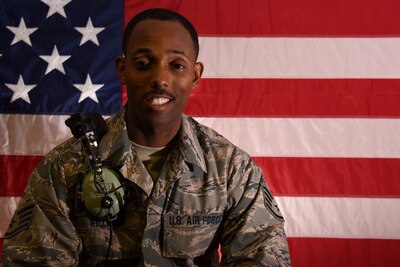
By Air Force Staff Sgt. Ryan A. Conley, 171st Air Refueling
Wing
CORAOPOLIS, Pa., Jan. 17, 2018 — Air Force Staff Sgt.
Sheldon A. Williams Jr., a crew chief and aircraft mechanic with the 171st Air
Refueling Wing’s maintenance group, pursues his lifelong passion for music
while continuing a family legacy of public service.
Williams is also known as “Frisson,” his rap performer name.
Williams said he has worked hard to shape a positive message through his lyrics
while serving in the armed forces and simultaneously striving to become a
full-time firefighter.
Williams decided to join the Air National Guard upon
reaching an impasse after high school.
“I didn’t know exactly what I wanted to do after high school
or what to do in college,” he said. “I definitely didn’t want to waste that
money. I’m mechanical and I like working on cars. Maybe I can tie that into the
military; figure myself out and get some professional skills behind me? I found
out about the benefits. I figured you’re pretty much earning a scholarship for
being out here. So I was like, this is awesome. It’s a great deal.”
Williams decided that becoming a crew chief best suited his
mechanical inclinations.
Crew chiefs perform major inspections and minor maintenance,
he said.
‘I Love My Job’
“If we’re not flying, we’ll do some major maintenance,”
Williams said. “We don’t get in-depth, too much. We diagnose problems and send
it to the specialist shops like hydraulics, electronics and communications. I
love working with tools and I love my job.”
Williams said his father had served in the military and
later worked in civilian law enforcement.
“He’s always tried to better himself,” Williams said of his
father. “He’s a good dad and he was always there for me. He’s out there
hustling and grinding, and I need to do that with my life.”
Seeing the path that his father took was instrumental in
Williams’s choice to start a career as a firefighter for the city of
Pittsburgh.
“I’m still in public service following in my dad’s
footsteps,” he said. “It’s just as dangerous. Firefighters are there to protect
life and property. Be prepared for any situation, save lives and help people.
That’s our job.”
His father was also a pivotal figure that influenced his
musical aspirations, Williams said.
Musical Father
“Musically, he’s a drummer,” Williams said of his father.
“At 4 years old, I’d play the keyboard; he’d be playing drums. We’d be making
music. It would have happened anyway. It’s always been a love of mine. I’ve
been doing it since I was 3, but he definitely influenced me on music.”
Williams got his start on the keyboard and at a young age
was performing in church.
“I did a lot in church,” he said. “There’s a lot of
Christian influence in my music, too. Little hints, but it’s not overwhelming.
I wouldn’t classify myself as a Christian rapper, but that’s a big portion of
my life, so naturally it’s going to be in the music.”
Music is an integral part of Williams’ family life, with his
wife being a musician that he met while attending Pittsburgh’s Creative and
Performing Arts High School.
‘Music is Important to Me’
“Music is important to me,” Williams said. “We live it. Me
and my wife. My kids are even singing now. That’s what we do. We go home, sit
there on the piano and make music.”
Williams is adamant that his lyrics are well-crafted to
relay a clear message
“It’s centered on a message,” he said. “Not just putting
lyrics over tracks, but real music. I’m not just a rapper; I’m a wordsmith.”
Williams said he chose his moniker of “Frisson” from a
word-of-the-day.
“The definition of frisson is actually a sensation of
excitement from things like the arts and music,” Williams said. “It’s real word
derived from French that popped up on my word of the day one day. I’d been
looking for a name forever. I was like, ‘Frisson. Cool.’”
Williams works from his home studio as well as with local
producers.
“The producer can inspire the song,” he said. “I don’t just
take music and try to make a song out of it. I write out things that are hot
topics for me, and he might have something that just works with what I’m
already thinking. Then, it’s just a perfect mash-up.”
Williams said a track featured in his social media
platforms, found by searching Frisson 412 is “Supernova,” a song about stepping
out musically and turning negativity into a positive.
Motivation Music
“With Supernova I merged two thoughts,” he said. “It took me
a long time to decide to do music fully. I’ve been behind the scenes for years,
helping my wife write, helping other producers write for other rappers. It’s
also about deciding to go all out, using your haters to push you forward rather
than hold you back.”
Another featured track on the same album is “Blood, Sweat
and Tears.”
“The album is motivation music,” Williams said. “I
originally wanted to write a song for football, and in doing so found out that
my lyrics were extremely corny. So, I scratched it. I started to write it from
the perspective of someone putting blood, sweat and tears into whatever it is
they’re doing. It turned out awesome. Whatever you’re doing, you can plug
yourself into that song. Honestly, that’s the masterpiece there because there
are so many elements going into the development of that song.”
Williams was asked what motivates him the most.
“In this stage of life everything is my kids,” he said.
“That’s what motivates me. I’ve always had an issue with rap lyrics that
weren’t upstanding influencing children. I want to make music that is okay to
play around kids.”




 Posts
Posts

