Saturday, November 18, 2017

Checkered Flag Training Exercise Hones All-Weather Fighter Operations


By Air Force Airman 1st Class Isaiah Soliz, 325th Fighter Wing

TYNDALL AIR FORCE BASE, Fla., Nov. 16, 2017 — The 366th Fighter Wing “Gunfighters” from Mountain Home Air Force Base, Idaho, deployed to participate in the large-scale aerial exercise Checkered Flag 18-1 and Combat Archer, a Weapons System Evaluation Program here, Nov. 6-17.

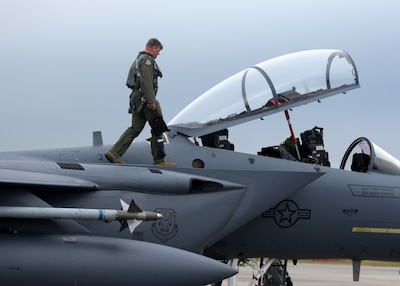
The 366th FW sent approximately 240 operations and maintenance airmen and 14 F-15E Strike Eagle aircraft from the 389th Fighter Squadron to train in real-world simulated scenarios for this two-week long exercise.

One of the mainstays of Mountain Home, the F-15E Strike Eagle, is a distinctive aircraft with dual seats. The aircraft’s design enables the pilot and the weapons systems officer to work collectively to achieve peak proficiency. The all-weather fighter houses avionics and electronics systems that give this aircraft the ability to fight at low altitude any time of the day through various types of weather.

‘Unique Opportunity’

“Checkered Flag is a unique opportunity for us to integrate with many different aircraft, specifically fourth- and fifth-generation aircraft integration,” said Air Force Lt. Col. David Och, 389th Fighter Squadron commander. “We do not get to do this type of training at Mountain Home very often.

“The ability to come here to integrate and mission plan alongside the newest aircraft in our inventory is a unique experience only available at exercises like Red Flag and here at Checkered Flag,” Och added.

According to its factsheet, the 389th FS Thunderbolts are responsible for sustaining combat readiness to conduct a variety of short-notice contingency operations worldwide.

“Exercises like this allow us to practice, make improvements and efficiencies in logistics and manpower toward the deployment aspect of an exercise,” Och said. “In this case, we are only moving assets from Mountain Home to Tyndall. However, if we were to be heading into a real-world deployment, much of the steps and processes would be the same.

Beneficial Exercise

“Our wing must be prepared to deploy combat-ready assets at a moment’s notice so participating in this exercise is extremely beneficial,” he added.

Checkered Flag focuses on the seamless integration of fourth- and fifth-generation aircraft while enabling the participating active duty units to train alongside their Air Force Reserve and Air National Guard colleagues. Checkered Flag and the Weapons Systems Evaluation Program run simultaneously, WESP focuses on the air-to-air training and live fire weapons testing for the participating units.

“This specific exercise allows our Thunderbolts to get back into an air-to-air combat mindset,” Och said. “After returning from a record-setting deployment that was mainly an air-to-ground focus, we will now be able to train and refocus on being ready for any contingencies that may occur at a moment’s notice.”
As the exercises ramp up into full swing, the 389th and its partners will participate in rigorous, high-paced training based on real-world scenarios.

Pentagon Officials Address Korea, ISIS, Budget in News Conference


By Jim Garamone DoD News, Defense Media Activity

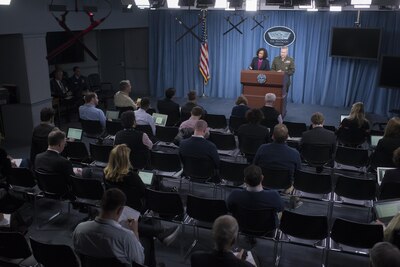
WASHINGTON, Nov. 16, 2017 — It is too soon to tell if there may be an opening for talks with North Korea about denuclearization of the Korean Peninsula, Defense Department officials said today.

At a news conference, chief Pentagon spokesperson Dana W. White said she wouldn't speculate on what North Korea's activities are or are not. The North has tested nuclear weapons and intercontinental ballistic missiles, but has not had a launch since August.

"Our policies remain to have the verifiable, irreversible denuclearization of the Korean Peninsula," she said. "So it's a diplomatic effort. We'll continue to support our diplomats and ensure that they can negotiate from a position of strength."

White said it is perilous to try and predict anything about what North Korea aims to do. "But we're continuing to monitor the situation," she said.

Exercises

Reporters asked about the so-called "freeze-for-freeze' option, meaning if North Korea froze its nuclear and missile development programs, the United States and its allies would freeze military exercises. U.S. and allied military exercises are purely defensive, White said. "Our exercises are long-planned, and our exercises are about reassuring our partners and our alliance allies," she added.

"I would just add that for forward-deployed forces, exercises are a critical component of readiness," said Marine Corps Lt. Gen. Kenneth F. McKenzie, the director of the Joint Staff, who briefed with White. "They do, in fact, assure our partners. They're not necessarily aimed at anyone. But they also, I think, exercise a powerful deterring effect by the fact that they're occurring."

No Deal With ISIS

White and McKenzie struck back at accusations that the United States somehow has a deal with the Islamic State of Iraq and Syria. "We flatly reject those accusations. They're simply not true," McKenzie said. "And in fact, they're not helpful as we pursue what should be a mutual objective of the destruction of ISIS in the Euphrates River Valley. We're conducting one of the most carefully designed air campaigns in the history of modern warfare, and so we flatly reject those assertions."

White also discussed the DoD budget.

"The department has been operating for 1,060 days under a [continuing resolution]," she said. "The current CR will expire on Dec. 8. We need Congress to pass a robust and predictable budget. We need [a fiscal year 2018] appropriations budget before Dec. 8."

White called the process wasteful and inefficient, noting that continuing resolutions delay maintenance, construction starts and launching new programs.

"They increase anxiety in the industrial base, as well as in local communities," she added. "They have a negative impact on the economy, as well as local communities. It's just a waste of money, and we need to be able to plan in advance."

White called on Congress to lift sequestration as it is currently structured.

"As [Defense Secretary Jim Mattis] has said many times, no enemy has done more harm to combat readiness in the field than … sequestration," she said. "If sequestration happens, it'll mean a $52 billion cut to the FY '18 budget. Again, it affects readiness, lethality."

Friday, November 17, 2017

Air National Guard Strikes Hard at ‘Combat Hammer’ Exercise


By Air Force Senior Master Sgt. Robert Shepherd, 132nd Wing, Iowa Air National Guard

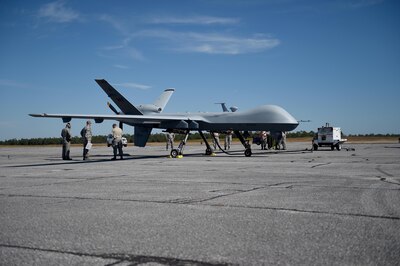
DUKE FIELD, Fla., Nov. 17, 2017 — Airmen with Air National Guard units from Texas, New York, Iowa, Ohio, California, Tennessee, Pennsylvania, Arkansas, and North Dakota supported and piloted MQ-9 Reaper unmanned aerial vehicles during Operation Combat Hammer, the first operational air-to-ground weapons evaluation for the Air National Guard that includes the Reaper.

The Combat Hammer exercise takes place twice each year at Eglin Air Force Base, Florida, and twice annually at Hill Air Force Base, Utah, and is part of the Weapon System Evaluation Program. WSEP has two parts: Combat Hammer evaluates all Air Force air-to-ground weapons, mostly bombs, while Combat Archer evaluates all air-to-air weapons, mostly missiles.

Realistic Training

“WSEP is an opportunity for the Air National Guard to provide our warfighters with ‘as real as it gets’ combat training outside of the combat zone, said Air Force 1st Lt. Josh, WSEP Project Officer for 132nd Wing, Des Moines, Iowa.

The 53rd Weapons Evaluation Group out of Eglin AFB conducted a maritime Weapons System Evaluation Program in the Gulf of Mexico and in Choctawhatchee Bay, Nov. 1-3 and Nov. 6-8. Within the 53rd WEG, the 86th Fighter Weapons Squadron is the lead for Combat Hammer.

"As a whole, Combat Hammer has to do that on a much larger scale since we have three to four units here each WSEP. A lot of hours by a lot of people go into making this happen, and it couldn't be done without a whole team effort," said Air Force Maj. Marcus, the assistant director of operations for WSEP at the 86th FWS, Eglin AFB.

Exercise participants this year included F-22 Raptor aircraft, from the 94th Fighter Squadron at Langley, AFB, Virginia; F-16 Fighting Falcon aircraft, from the 55th Fighter Squadron of Shaw AFB, South Carolina; A-10 Warthog aircraft from the 75th Fighter Squadron of Moody AFB, Georgia; and MQ-9 Reaper UAVs with Air National Guard units from Texas, New York, Iowa, Ohio, California, Tennessee, Pennsylvania, Arkansas, and North Dakota and the 2nd Special Operations Squadron at Hurlburt Field, Florida.

Approximately 30 boats simulated realistic swarm attack formation maneuvers in the Choctawhatchee Bay while military aircraft targeted them from above to practice simulated “kills” and evaluate the precision-guided munitions.

The 96th Range Control Squadron gathered data from the aircraft, weapons, targets, and a multitude of other range sensors. This combined information provides full situational awareness to the WSEP engineers, allowing them to make real-time decisions on the performance of the various weapons systems.

The exercise also marked the first time an MQ-9 Reaper flew across multiple states back to its home unit instead of being shipped back. The 174th Attack Wing in Syracuse, New York, flew its MQ-9 over 1,200 miles from Duke Field, Florida.