By Jim Garamone DoD News, Defense Media Activity
WASHINGTON, Nov. 2, 2017 — The chief of Naval Operations
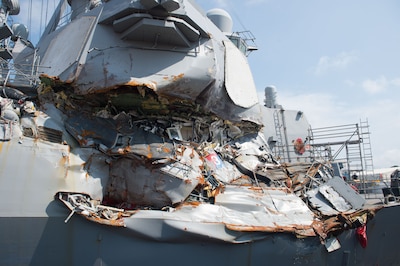
said today that the collisions in the Pacific that killed 10 sailors aboard the
USS Fitzgerald and seven sailors aboard the USS McCain were entirely
preventable, and the service is committed to correcting the actions that led to
the accidents.
Navy Adm. John Richardson told Pentagon reporters that many
aspects combined to cause the accidents, including lack of training, hubris,
sleep deprivation, failures in navigation and failures in leadership.
The guided missile destroyers USS Fitzgerald and USS McCain
sailed when they shouldn’t have, he said, and that decision falls on the
commanders, who are responsible for conducting risk assessments.
The demand for ships, or any military capability, is defined
by the security environment, Richardson said, adding that the Pacific has been
a very demanding environment of late.
The demand of the security environment must match against
the resources that can be applied. “When you have a gap between those two, that’s
risk,” the admiral said. “It's all part of that … day-to-day assessment. Every
commander has to wake up each day at their command level and say, what has
changed in my security environment? What is my new risk posture? And how am I
going to accommodate or mitigate that risk?”
Cultural Change
At some point, commanders cannot mitigate the risk, and they
should say no to the mission, he said, but the present culture is such that
commanders will assess the risk to be acceptable when it is not.
Changing that culture is one goal for the chief -- he wants
commanders to be honest about assessments and the shortfalls they have.
While the changes are in the 7th Fleet area, the Navy is on
all the seas. “A review of your Navy today shows that this morning there are
100 ships and 64,000 sailors and Navy civilians who are deployed,” Richardson
said.
“This includes three carrier strike groups and their
embarked air wings, three amphibious readiness groups, and their embarked
Marine expeditionary units, six ballistic missile defense ships on station, 11
attack submarines, five [ballistic missile submarines],” he said. “The vast
majority of these ships are conducting their missions, some of them extremely
difficult, effectively and professionally, protecting America from attack,
promoting our interests and prosperity, and advocating for the rules that
govern the vast commons from the seafloor, to space, and in cyberspace.”
The Navy and its sailors are busy, and they have been
integral to the wars America has fought since 9/11. “Recent experience has
shown that if we're not careful, we can become overstretched, overextended. And
if we take our eye off the fundamentals, we become vulnerable to mistakes at
all levels of command,” the admiral said.
To address this, the Navy has taken some immediate actions,
including restoring a deliberative scheduling process in the 7th Fleet,
conducting comprehensive ready-for-sea assessments for all Japan-based ships,
establishing a naval service group in the Western Pacific -- an independent
body in Yokosuka, Japan that will keep their eye on readiness generation and
standards for the Pacific Fleet commander -- establishing and using a near-miss
program to understand and disseminate lessons learned, and establishing
policies for surface ships to routinely and actively transmit on their
automatic identification system, Richardson said.
Midterm actions will emphasize training, establishing
comprehensive policies on managing fatigue and accelerating some of the
electronic navigation systems upgrades, he said.
“Long-term actions include improving individual and team training
skills, with an emphasis on basic seamanship, navigation and integrated bridge
equipment; evaluating core officer and enlisted curricula with an emphasis on
fundamentals [and] navigation skills,” the admiral said.
“I have to say that fundamental to all of this is how we
prepare leaders for command,” Richardson said. “We will deeply examine the way
that we prepare officers for increasing leadership challenges, culminating in
assumption of command with the capability and the confidence to form, train and
assess warfighting teams on the bridge, in the combat information center, in
engineering and throughout their command.”




 Posts
Posts

