Tuesday, October 31, 2017

Face of Defense: Airman Counters Life's Jabs


By Air Force Senior Airman Lauren M. Sprunk 23rd Wing

MOODY AIR FORCE BASE, Ga., Oct. 31, 2017 — Life's ups and downs often test people in ways that shake the foundations that give them peace. Air Force Airman 1st Class Isaiah Randall's father was shot, his aunt died and his grandmother was diagnosed with cancer. The rage, devastation and sorrow caused by family turmoil left him reeling. He looked for inner peace in his longtime passion, boxing, but a torn ligament left him staggering.

With nowhere to turn, Randall -- a 23rd Equipment Maintenance Squadron aircraft structural maintenance apprentice here -- came to understand the true concept of resilience, leaning on the support from his family, both by blood and by service, and turning to God to guide him through.

"I kept wondering what I had done to deserve all of this," he said. "Then I remembered a phrase from my childhood: 'God only gives his toughest battles to his strongest soldiers'." Amid the personal turmoil, he added, he learned for the first time that there was more to that phrase and that even the strongest soldiers need somewhere to lean.

The Philadelphia native had always been supportive of his family, carrying them through a world of drugs and violence. Although he may have left home to serve, he said, his role had not changed, and his family fled to him when tragedy struck.

Randall said his father was on the brink of death with seven bullet wounds. His family needed him, as they always had, but he was unsure how to respond. He tried praying, but he was losing faith and feeling like nothing could help him, he said.

Normally, Randall added, he would channel this anger and hopelessness into the boxing ring, a relief he has indulged in since he was 11 years old, and a passion he planned to later turn into a career. But two recent knee surgeries stripped him of this coping mechanism.

More Bad News

As fast as his defense was taken away, he said, life continued to beat him down.

"Just when I thought things couldn't get any worse, several calls from my mother woke me, and I knew right away that something was wrong," said Randall. "When I answered, she was crying hysterically and she said my aunt, my best friend growing up, had died. I lost it."

Without an escape, he said, he found a saving grace where he least expected: in his Air Force family.

"Randall was broken," said Air Force Master Sgt. Justin Archer, Randall's section chief. "When he came in he couldn't talk. He just sat here crying. None of us really knew what to say, so I just hugged him. He needed it. He was at a point where he needed a wingman, someone like a brother or father, to be there for him.

"I think that's when he learned how close-knit not only the Air Force family, but our maintenance family, is," Archer continued. "We have a very demanding job. We work a lot of long hours and we're put under a lot of pressure, but that builds a cohesiveness among all of us. We bicker and fight, but just like family, we will always have each other's back."

For the first time in his life, Randall leaned on others to support the weight that his circumstances were placing on him.

"When I went home, it was tempting for me to fall back into my old ways, but I didn't, and I owe that to my supervision," he said. "Any time my mind wandered and I came close to doing something I would regret, I got a message from one of my supervisors. Even if they just asked how my day was going, it was enough to screw my head on straight. I never would've expected that from them. A year ago, I looked at my leadership as just a lot of stripes on a uniform that gave me instructions every day. But today, they're part of my family, they helped save me."

New Perspective

With this new perspective of his Air Force family, Randall persevered through his aunt's funeral and returned standing strong. But alhough he thought he had been through all he could handle, he said, his battle grew tougher. His grandmother was diagnosed with a severe case of breast cancer and wasn't expected to live long.

"I hit my low and felt like giving up, but I knew no one was going to let me," he said. "I knew I had my family in my corner, and then my mom reminded me of one more support I had begun to lose sight of: God."

Through advice from his family and leadership, coupled with scriptures sent from his mother daily, Randall said, he made a breakthrough and changed his worldview.

"This past year has opened my eyes," he added. "Life is too short to be caught up in nonsense. You have to create a goal for yourself and spend every day working towards that goal until you achieve it. Life is too short to waste."
Living by his own advice, Randall set his eyes on his future. He took everything out of his room and hung a paper with three lines on it: God, family and boxing. He hung the paper above his bed so it would be the first thing he sees every morning, reminding him what it is he's working for.

Monday, October 30, 2017

Dunford Hosts Trilateral Meeting With South Korean, Japanese Military Leaders


CAMP H.M. SMITH, Hawaii, Oct. 30, 2017 — The chairman of the Joint Chiefs of Staff hosted a trilateral conference with South Korean and Japanese military leaders here yesterday.

Marine Corps Gen. Joe Dunford and his counterparts, South Korean Air Force Gen. Jeong Kyeong-doo and Japanese Maritime Self-Defense Force Adm. Katsutoshi Kawano, met at the U.S. Pacific Command headquarters.

The leaders focused on trilateral cooperation in Northeast Asia to respond to increasingly provocative actions from North Korean leader Kim Jong Un. The North Korean leader is persisting in developing nuclear weapons and the missile systems to deliver them. He is continuing this effort in the face of nearly universal condemnation and in defiance of a number of United Nations Security Council resolutions.

This was the fifth trilateral meeting among the leaders since July 2014. The military defense chiefs were joined by Navy Adm. Harry Harris Jr., the Pacom commander; Army Gen. Vincent K. Brooks, the commander of U.S. Forces Korea and the United Nations Command; and Air Force Lt. Gen. Jerry P. Martinez, the commander of U.S. Forces Japan.

Violations of International Norms

The chiefs of defense exchanged views and information on the North Korean violations of international norms. These include testing a nuclear device on Sept. 3 and missile launches that overflew Japan's Hokkaido island in July. The men "agreed to firmly respond to the acts in full coordination with each other," according to a Joint Staff statement describing the meeting.

In addition, the statement said, the three chiefs also discussed multilateral and trilateral initiatives designed to improve interoperability and readiness. Both Japan and South Korea have mutual defense treaties with the United States, and each country has excellent military-to-military relations with the U.S. military, officials added in the statement.

"They agreed to explore their collective capabilities in humanitarian assistance and disaster relief, as well as leveraging their unique competencies in the cyber domain" through the 2016 General Security of Military Information Agreement, the statement said.

'Ironclad Commitment'

The three chiefs called on Kim to stop his provocative behavior, and "walk away from its destructive and reckless path of [weapons of mass destruction] development," the Joint Staff statement said.

For his part, Dunford stressed America's "ironclad" commitment to defend South Korea and Japan, and he reaffirmed the extended deterrence guaranteed by the full spectrum of U.S. military capabilities, including conventional, nuclear and missile defense assets.

The senior leaders vowed to continue to work together on mutual security concerns to enhance peace and stability in the region, the statement said.

Face of Defense: Hurricane Maria Hits Home for Nimitz Sailor


By Navy Petty Officer 2nd Class Elesia K. Patten, Carrier Strike Group 11

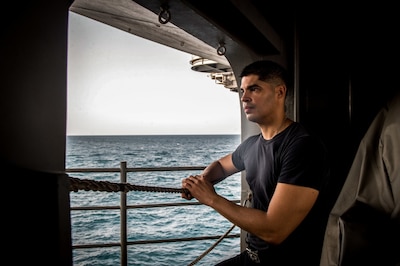
ABOARD USS NIMITZ AT SEA, Oct. 30, 2017 — For many sailors aboard the deployed aircraft carrier USS Nimitz, Hurricane Maria hit close to home. But for one Nimitz sailor, it literally hit home.

Last month, Navy Petty Officer 3rd Class Josue Cordero-Fernandez, an aviation machinist's mate, was working in the jet shop aboard the Navy's oldest active aircraft carrier in the Persian Gulf as Hurricane Maria was gaining momentum, churning in the Atlantic Ocean and barreling toward Puerto Rico.

After hearing that the Category 4 hurricane was projected to hit his homeland, Cordero-Fernandez contacted his family back in Quebradillas -- a small rural town located on the Puerto Rico's northwest shore. Confident that the storm would miss, as many storms had done in the past, his experiences kept him from worrying. But as the storm grew closer to Puerto Rico, he said, his fears grew and he agonized in his rack, unable to sleep for almost a week.

"I lost contact with them the night before it actually hit because communications started going down," he said. "The next day when I started seeing pictures, I felt so useless in that moment because I knew I couldn't do anything. I'm here on deployment."

Unable to Contact Family

Over the next few days, Cordero-Fernandez tried over and over to contact his family, but he was unable to establish communication. He kept his eyes glued to the TV and computer in his shop, taking in reports about conditions in Puerto Rico.

"Seeing so much devastation around the island and not be able to get ahold of them, I was just thinking the worst," he said. "There's no way I can send money, because I don't have their bank information, can't call them, can't do anything."

Cordero-Fernandez said one report told of an emergency evacuation because the Lake Guajataca dam was about to collapse. Lake Guajataca is significant to him, he explained, because it connects three major towns: Isabela, San Sebastian, and Quebradillas.

"That was one of my biggest fears," he said. "They had to evacuate around 70,000 people in case the dam collapsed. Even though my family lives far away from it, if the collapse happened, I knew they would not have water services for months."

Finding a Way to Help

Most services on the hurricane-ravaged island were down immediately following the storm. Unable to physically go to the aid of his family, Cordero-Fernandez said, he wanted to find a way to help. So that's what he did. He got online and began buying essentials such as food and water for his mother, siblings and nephew in Quebradillas.

"My first reaction, my first thought was, 'I have to make sure they have food,'" he said. "Even though I don't know anything about what's happening with my family, I'm just going to start buying food and water and sending it back home."

Communications services were extremely limited, as Hurricane Maria had destroyed Puerto Rico's energy grid, leaving nearly 3.5 million people without power. But some phone and internet companies had service and offered free hotspots to help people reach their loved ones.

Making Contact

After nearly a week of tormenting thoughts, desperately checking Facebook, and frantically calling home, Cordero-Fernandez said, he got good news from his family.

"I finally heard from them through Facebook," he added. "It took me around five days to get ahold of them. It was the greatest feeling ever. I felt relief knowing they were OK, that they didn't suffer any property damage, and they were alive, which was the most important thing."

The island began receiving first aid and support from several organizations shortly after the storm hit, including the Federal Emergency Management Agency and the U.S. military, including the Navy.
"I feel good that the Navy is providing the help we need," Cordero-Fernandez said. "Within the first week, Navy vessels were sent to my island to help out. I think that was a good thing.