by Senior Airman Jake Carter
99th Air Base Wing Public Affairs
2/3/2016 - NELLIS AIR FORCE BASE, Nev. -- When
pilots fly over the massive Nevada Test and Training Range north of Las
Vegas during Red Flag exercises, they always have to be in contact
with one another to make key decisions which will determine who will be
the day's victors and losers.
Teamwork is the key to success when air combat flying squadrons train in
harmony with space and cyberspace units from all around the world to
participate in U.S. Air Force's Red Flag exercises.
For the 606th Air Control Squadron, which operates out of Spangdahlem
Air Base, Germany, they are the commanders of the sky. From ground
equipment to radios and sensors, they have a big role in executing the
mission wherever they may be.
The 606th ACS is a self-contained mobile combat unit with Airmen
covering more than 21 career field specialties who operate and maintain
over $170 million worth of equipment.
The unit provides daily command and control to the 52d Fighter Wing's
two flying squadrons in addition to the occasional control of Airborne
Early Warning Force Command's E-3A from Geilenkirchen North Atlantic
Treaty Organization Air Base, Germany and visiting aircraft from around
the United States Air Force Europe Theater.
During Red Flag 16-1, the 606th ACS training objective is to control the skies over the NTTR.
"The 606th ACS, call sign Galley, provides tactical command and
control," said Lt. Col. Aaron Gibney, 606th ACS commander. "In other
words, we use our sensors and radios to find, communicate and integrate.
We also help solve problems, bring order, and make speedy decisions. We
accomplish this by allocating airspace, finding targets, communicating
the air picture, directing shooters, and integrating capabilities across
multi-domains."
With Red Flag recently integrating all three domains into one exercise,
most of the 606th ACS Airmen are first time participants.
"Red Flag 16-1 is comprised of joint and coalition players and one of
our main objectives during this exercise is to obtain a better
understanding of how to integrate with our partners, especially at the
highest tactical level," Gibney said.
For the 606th operators, Gibney wanted to expose them to Red Flag to
prepare them for situations and scenarios on a larger scale.
"The 606th Air Control Squadron is at Red Flag to provide world-class
tactical command and control in support of all exercise participants.
Red Flag offers the unique opportunity to expose our operators to
situations and scenarios on a larger scale than can be replicated from
our home station," Gibney said. "We have over 30 operators across six
crew positions to include two intelligence Airmen. The majority of our
operators are attending Red Flag for their very first time."
While participating in Red Flag, they will be using the same command and
control system that they would use if they were to deploy.
"(This exercise) is very similar to real world operations and
expectations for our operators," said Maj. Jason Zemler, 606th ACS
director of operations. "Our operators have the unique opportunity at
Red Flag to execute on a system that is the same C2 system they will
deploy or execute on during our next deployment."
When units come to participate in a Red Flag exercise, they can expect
to walk away with the best training possible that will ready them for a
deployment when the time arises.
"While here, Galley operators experience many different pressures that
they are not usually exposed to," Zemler said. "The stressors associated
with detailed mission planning and execution based on realistic threat
systems and scenarios provides a learning opportunity that our operators
cannot typically receive in any other environment. When you apply those
stressors with time and weapons constraints, and repetition over a
three-week period, both the stress and learning is phenomenal."
Wednesday, February 03, 2016
McConnell patrolman wins AF Civilian of the Year award
by Airman Jenna K. Caldwell
22nd Air Refueling Wing Public Affairs
2/2/2016 - MCCONNELL AIR FORCE BASE, Kan. -- A member of the 22nd Security Forces Squadron earned the Air Force Security Forces Civilian of the Year.
Shawn Kennedy, supervisory police officer, received the AMC Outstanding Security Forces Flight-Level Civilian Supervisory Level Award and went on to win Air Force award level recognition as well.
Kennedy has been working with the 22nd SFS for nearly three years and has dedicated his efforts between security operations flight chief, continuation of educational efforts and community renewal projects.
"He quickly gained the trust of team members because he does what he says he will do and treats others the same way he wants to be treated," said Kenneth Chrapkowski, 22nd SFS deputy security officer and Kennedy's supervisor. "This has empowered a great team of defenders to perform at the highest of levels."
Kennedy has had a number of accomplishments as a patrolman. He guided security forces in an attempted suicide to preserve scene integrity that resulted in a saving an Airman's life. He detected illegal base entry and conducted the interview that enabled prosecution, and he expedited and facilitated response to 23 medical emergencies.
"I owe this honor to the flight that I work on and to the people I work with," said Kennedy. "My mentors here have helped me broaden the scope of how I look at things and not to stress so much about the little things."
Kennedy has not only focused his energy on duty as a patrolman but off duty as well as a student, father and volunteer in the community. He has dedicated his time towards advancement and completion of his Bachelors of Science in Criminal Justice degree and homeland security certificates.
He's worked with the local community by teaming up for housing restoration projects, leading food bank programs for youth and committing time to autism awareness groups in support of his son.
22nd Air Refueling Wing Public Affairs
2/2/2016 - MCCONNELL AIR FORCE BASE, Kan. -- A member of the 22nd Security Forces Squadron earned the Air Force Security Forces Civilian of the Year.
Shawn Kennedy, supervisory police officer, received the AMC Outstanding Security Forces Flight-Level Civilian Supervisory Level Award and went on to win Air Force award level recognition as well.
Kennedy has been working with the 22nd SFS for nearly three years and has dedicated his efforts between security operations flight chief, continuation of educational efforts and community renewal projects.
"He quickly gained the trust of team members because he does what he says he will do and treats others the same way he wants to be treated," said Kenneth Chrapkowski, 22nd SFS deputy security officer and Kennedy's supervisor. "This has empowered a great team of defenders to perform at the highest of levels."
Kennedy has had a number of accomplishments as a patrolman. He guided security forces in an attempted suicide to preserve scene integrity that resulted in a saving an Airman's life. He detected illegal base entry and conducted the interview that enabled prosecution, and he expedited and facilitated response to 23 medical emergencies.
"I owe this honor to the flight that I work on and to the people I work with," said Kennedy. "My mentors here have helped me broaden the scope of how I look at things and not to stress so much about the little things."
Kennedy has not only focused his energy on duty as a patrolman but off duty as well as a student, father and volunteer in the community. He has dedicated his time towards advancement and completion of his Bachelors of Science in Criminal Justice degree and homeland security certificates.
He's worked with the local community by teaming up for housing restoration projects, leading food bank programs for youth and committing time to autism awareness groups in support of his son.
Officials Describe Plans to Integrate Women into Combat Roles
By Terri Moon Cronk DoD News, Defense Media Activity
WASHINGTON, February 2, 2016 — Senior Army, Navy and Marine
Corps officials outlined plans to integrate women into combat roles before the
Senate Armed Forces Committee today, and agreed incorporating women into combat
ranks is the right path for the future.
Navy Secretary Ray Mabus, Acting Secretary of the Army
Patrick J. Murphy, Army Chief of Staff Gen. Mark A. Milley and Marine Corps
Commandant Gen. Robert B. Neller updated committee members on the services’
integration efforts.
Marine Corps leadership has “thoughtful and deliberate
plans” to execute the transition effectively, Mabus said, adding the 231 female
Marines who successfully completed the ground combat arms military occupational
specialty training can immediately switch to those previously closed jobs.
The secretary said because the integration process includes
training and education evaluation at every level from recruits to the highest
levels of leadership, implementing that policy was a priority.
And while “suggestions” have been made to lower standards
for female Marines to meet quotas, Mabus emphasized it’s “an unacceptable
notion” for every Marine, especially those women who choose to compete for
those positions.
“It's unacceptable under the law, to me, [and] to every
other senior leader in the Pentagon because it would endanger not only the
safety of Marines, but the safety of our nation,” he said.
“Standards can never be lowered for any group or any job.
Standards will evolve as threats evolve, but they will evolve for everyone
equally,” Mabus said.
The Marine Corps also is ceasing its tradition as the only
service branch that separates men and women in boot camp, he added.
Smaller Army Needs Maximizing
“As our Army gets smaller, our success increasingly depends
upon our ability to maximize the contributions of every volunteer that fills
our ranks,” Murphy said. “A soldier's ability to meet established standards
that contribute to our success will remain our overriding factor moving
forward.”
And to take advantage of America's diverse and deep talents,
the Army began its integration efforts several years ago, leading to three
primary conclusions, he said:
-- Every soldier will have the opportunity to compete for
every position to include infantry, armor and Special Forces;
-- The Army’s high individual standards performance and
professional conduct will continue to be based on requirements of the position
and nothing else; and
-- Enforcing the standards fairly and objectively will
remain the guiding principle for mission success.
Murphy said he’s confident that integrating women into
combat roles, while underpinned by strong leadership, will increase Army
readiness.
“We will continue to monitor and report the lessons we learn
so the Army can collectively integrate the force and share our experiences,” he
said.
Murphy added, “The Army is prepared to act and benefit from
integration -- now.”
No Quotas, No Pressure
Fully integrating women into the Army will “maintain,
sustain or improve” overall readiness, Milley said.
To be successful in this endeavor, he said, the Army must
“maintain and enforce rigorous combat readiness standards, remain a merit-based
results-oriented organization and apply no quotas and no pressure.”
To do so, the Army will put in place a “very deliberate
methodical and transparent process,” Milley said.
Milley called the Army’s methodical approach to
gender-neutral training for all Army officers, noncommissioned officers and
junior enlisted members the leadership’s first principle to ensure success.
“Female cadets and officer candidates who meet the
gender-neutral standard will be given the opportunity to request either
infantry or armor branches” by spring, he said, adding that every active-duty
infantry, armor and field artillery battalion today already has women soldiers.
“It is my professional judgement that some women can perform
every single job in the United States Army to include infantry, armor and
special forces,” Milley said. “Army leaders will continue to assess
[integration] and we will adjust the process [so] our standards in combat
readiness are maintained. You, the committee, have my word on this.”
Corps’ Integration ‘Responsible’
When Defense Secretary Ash Carter on Dec. 3, 2015 opened all
military occupations and positions to women, including combat roles, the
Marines Corps began integrating all qualified Marines into previously closed
MOSs in a well-planned responsible manner” based on Corps’ research, Neller
said in his written statement submitted to the committee.
“We have already awarded additional MOSs to all Marines who
earned it through primary MOS-producing schools,” he said, “and two female
second lieutenants are now undergoing MOS training at the field artillery
officer basic course.”
Marines who were awarded additional MOS qualifications also
can now request formal reclassification for combat arms designation, he said.
“The Marine Corps is a learning organization,” Neller said
in his written statement. “We will evaluate the success of our plan and inform
in-stride adjustments throughout this ongoing process as we recruit, train,
develop, deploy and retain the highest-quality force.”
Team Dover rolls out Unit Marshal Program
by Senior Airman William Johnson
436th Airlift Wing Public Affairs
2/3/2016 - DOVER AIR FORCE BASE, Del. -- As Team Dover continues to deliver airlift cargo to warfighters downrange and humanitarian relief supplies across the world, it has taken additional security measures to ensure the safety of its own Airmen and their families here at home.
With the recent implementation of Eagle Shield, a combined initiative of selective arming programs, the Unit Marshal Program, or UMP, has officially begun at Dover AFB, Delaware. The UMP is a unit commander's program where they select Airmen to carry an M9 pistol during the duty day within their work centers.
"The main purpose of this program is to enable a capable body and put a weapon in the building so that we have an armed individual on the inside in the event something does happen," said Staff Sgt. John Broughal, 436th Security Forces Squadron unit training manager. "The focus of these marshals is to lockdown, secure and save as many lives as possible."
The 436th SFS trained and educated unit commanders about the UMP and what benefits it could provide to their units. Once commanders agreed to participate in the program, they appointed a Marshal Program Monitor. The program monitor is in charge of notifying the base defense operations center of when and where unit marshals will be working within their unit, ensuring they are always accounted for. The program monitor is also in charge of notifying security forces if there are any changes in the Airman's ability to fulfil the obligations of a unit marshal. Then commanders selected mature and capable Airmen for the program. Finally, these selectees were vetted by the 436th SFS to look for any disqualifying factors.
Airmen from the 436th Logistics Readiness Squadron and the 436th Medical Group were selected to participate in the first UMP training course. Training included use of force, weapon fundamentals, defensive shooting, active shooter response and actions on combat.
Once the unit marshals were qualified on the M9, they moved on to advance skills training on how to shoot with an elevated heart rate and a variety of different shooting positions. The unit marshals also conducted live fire training drills with simunition rounds in 'shoot' or 'don't shoot' scenarios and in a variety of active shooter and disgruntled worker exercises.
"The training was outstanding and the instructors did a great job," said Tech. Sgt. Matt Copley, 436th LRS fuels service center NCO in charge and unit marshal. "The classroom portion was great, you can hear it, you can see it and you can shoot your weapon. However, what we realized during the simunitions training is how real it was and the fact that you are actually being fired at. Sometimes the way you thought you were going to react wasn't the way you did once sim-rounds started moving down range."
The training was originally slated for 40 hours, but because a unit marshal's responsibilities are so vital, the training was extended to more than 60 hours.
"It's not because any one of them did something wrong, it's just that we gave them so much information, and we thought it would benefit them exponentially if we gave them three more working days of training," said Staff Sgt. Joshua Botto, 436th SFS trainer. "This ensures that we are arming qualified and knowledgeable people with a firearm."
Lt. Col. Dana Metzger, 436th SFS commander, and other senior security forces personnel observed each unit marshal's final training scenario before they could be certified as meeting the requirements for training. Metzger stressed that even though unit marshals are trained with the use of force and qualified on a M9, they are not trained as law enforcement officers and do not act as first responders, rather they play a defensive role in their work centers.
"We do not want the marshals to run towards danger, however we want them to protect themselves and protect their personnel." said Metzger. "They are not trained to be police officers that are going to go towards and eliminate the threat. However, if the threat presents itself and they can take that individual or threat out, then they are authorized to do so."
Much like security forces defenders, unit marshals will be required to attended quarterly training and stay qualified on the M9. Furthermore, Broughal and other security forces trainers will check in on unit marshals in their work centers at least once a month.
"At any given time, as trainers, we are going to go over to the marshals and do spot checks on them and see how they are functioning within their work centers," said Broughal. "We also want to see if their co-workers know what to do in a lock down or emergency situation."
Unit marshals will be easily identifiable within their units. They are required to wear a bright reflective sash that says, 'Security' while they are armed with their M9 sidearm. However, in the near future they will transition from the sash to arm brassards.
"Whenever they are armed up we want them to be highly visible to their people," said Metzger. "That way if there is an incident, those people know to run to the unit marshal and get behind him or her or get out of the building and listen to what they have instructed them to do."
The 436th SFS also wants the marshals to be highly visible because they are aware as the program rolls out, it might be a shock to some people to see Airmen who are not cops armed with a firearm on base.
"This is a whole different milestone and a new way of thinking, it's going to be a real eye opener," said Broughal. "It will definitely take time for other work centers to get use to and people might not be comfortable with it at first, but once they see the overall big picture and it gets pushed Air Force wide, I think they will become more accepting of the program and even like it."
Even though these Airmen are the first individuals to complete the training course and be certified as unit marshals at Dover AFB, other Air Force bases are already taking notice and asking for assistance with their own UMPs.
"We already have other bases asking for our training plans, lesson plans, after action reports and our lessons learned because they want to implement this program as well," said Metzger. "That's the great part about all of this. We are now helping other bases establish a program that I honestly think will save lives."
436th Airlift Wing Public Affairs
2/3/2016 - DOVER AIR FORCE BASE, Del. -- As Team Dover continues to deliver airlift cargo to warfighters downrange and humanitarian relief supplies across the world, it has taken additional security measures to ensure the safety of its own Airmen and their families here at home.
With the recent implementation of Eagle Shield, a combined initiative of selective arming programs, the Unit Marshal Program, or UMP, has officially begun at Dover AFB, Delaware. The UMP is a unit commander's program where they select Airmen to carry an M9 pistol during the duty day within their work centers.
"The main purpose of this program is to enable a capable body and put a weapon in the building so that we have an armed individual on the inside in the event something does happen," said Staff Sgt. John Broughal, 436th Security Forces Squadron unit training manager. "The focus of these marshals is to lockdown, secure and save as many lives as possible."
The 436th SFS trained and educated unit commanders about the UMP and what benefits it could provide to their units. Once commanders agreed to participate in the program, they appointed a Marshal Program Monitor. The program monitor is in charge of notifying the base defense operations center of when and where unit marshals will be working within their unit, ensuring they are always accounted for. The program monitor is also in charge of notifying security forces if there are any changes in the Airman's ability to fulfil the obligations of a unit marshal. Then commanders selected mature and capable Airmen for the program. Finally, these selectees were vetted by the 436th SFS to look for any disqualifying factors.
Airmen from the 436th Logistics Readiness Squadron and the 436th Medical Group were selected to participate in the first UMP training course. Training included use of force, weapon fundamentals, defensive shooting, active shooter response and actions on combat.
Once the unit marshals were qualified on the M9, they moved on to advance skills training on how to shoot with an elevated heart rate and a variety of different shooting positions. The unit marshals also conducted live fire training drills with simunition rounds in 'shoot' or 'don't shoot' scenarios and in a variety of active shooter and disgruntled worker exercises.
"The training was outstanding and the instructors did a great job," said Tech. Sgt. Matt Copley, 436th LRS fuels service center NCO in charge and unit marshal. "The classroom portion was great, you can hear it, you can see it and you can shoot your weapon. However, what we realized during the simunitions training is how real it was and the fact that you are actually being fired at. Sometimes the way you thought you were going to react wasn't the way you did once sim-rounds started moving down range."
The training was originally slated for 40 hours, but because a unit marshal's responsibilities are so vital, the training was extended to more than 60 hours.
"It's not because any one of them did something wrong, it's just that we gave them so much information, and we thought it would benefit them exponentially if we gave them three more working days of training," said Staff Sgt. Joshua Botto, 436th SFS trainer. "This ensures that we are arming qualified and knowledgeable people with a firearm."
Lt. Col. Dana Metzger, 436th SFS commander, and other senior security forces personnel observed each unit marshal's final training scenario before they could be certified as meeting the requirements for training. Metzger stressed that even though unit marshals are trained with the use of force and qualified on a M9, they are not trained as law enforcement officers and do not act as first responders, rather they play a defensive role in their work centers.
"We do not want the marshals to run towards danger, however we want them to protect themselves and protect their personnel." said Metzger. "They are not trained to be police officers that are going to go towards and eliminate the threat. However, if the threat presents itself and they can take that individual or threat out, then they are authorized to do so."
Much like security forces defenders, unit marshals will be required to attended quarterly training and stay qualified on the M9. Furthermore, Broughal and other security forces trainers will check in on unit marshals in their work centers at least once a month.
"At any given time, as trainers, we are going to go over to the marshals and do spot checks on them and see how they are functioning within their work centers," said Broughal. "We also want to see if their co-workers know what to do in a lock down or emergency situation."
Unit marshals will be easily identifiable within their units. They are required to wear a bright reflective sash that says, 'Security' while they are armed with their M9 sidearm. However, in the near future they will transition from the sash to arm brassards.
"Whenever they are armed up we want them to be highly visible to their people," said Metzger. "That way if there is an incident, those people know to run to the unit marshal and get behind him or her or get out of the building and listen to what they have instructed them to do."
The 436th SFS also wants the marshals to be highly visible because they are aware as the program rolls out, it might be a shock to some people to see Airmen who are not cops armed with a firearm on base.
"This is a whole different milestone and a new way of thinking, it's going to be a real eye opener," said Broughal. "It will definitely take time for other work centers to get use to and people might not be comfortable with it at first, but once they see the overall big picture and it gets pushed Air Force wide, I think they will become more accepting of the program and even like it."
Even though these Airmen are the first individuals to complete the training course and be certified as unit marshals at Dover AFB, other Air Force bases are already taking notice and asking for assistance with their own UMPs.
"We already have other bases asking for our training plans, lesson plans, after action reports and our lessons learned because they want to implement this program as well," said Metzger. "That's the great part about all of this. We are now helping other bases establish a program that I honestly think will save lives."
MQ-1B Predator accident report released
Release Number: 160101
2/3/2016 - Joint Base Langley-Eustis, VA -- An abbreviated accident investigation board found that a remotely piloted MQ-1B Predator that was intentionally crashed into an uninhabited area of the U.S. Central Command area of responsibility on May 27, 2015, suffered an engine failure due to loss of coolant.
At the time of the accident, the aircraft was flying a classified combat support mission in the U.S. CENTCOM AOR.
The board president identified interference as a main factor that contributed to the mishap. According to the investigation report, the crew learned the engine was overheating and began running the associated checklist for addressing the problem. Simultaneously, the pilot in coordination with the mission commander, decided to return the aircraft to base so the checklist was not completed. This interference forestalled the sensor operator from manually turning on the cooling fan as per the checklist instructions.
The aircraft and crew were assigned to the 20th Reconnaissance Squadron, an associate unit at Whiteman Air Force Base, Mo., under the 432nd Wing at Creech AFB, Nev. The total loss to the U.S. Government is estimated at $2.8 million. There were no additional injuries or damages to other government or private property.
2/3/2016 - Joint Base Langley-Eustis, VA -- An abbreviated accident investigation board found that a remotely piloted MQ-1B Predator that was intentionally crashed into an uninhabited area of the U.S. Central Command area of responsibility on May 27, 2015, suffered an engine failure due to loss of coolant.
At the time of the accident, the aircraft was flying a classified combat support mission in the U.S. CENTCOM AOR.
The board president identified interference as a main factor that contributed to the mishap. According to the investigation report, the crew learned the engine was overheating and began running the associated checklist for addressing the problem. Simultaneously, the pilot in coordination with the mission commander, decided to return the aircraft to base so the checklist was not completed. This interference forestalled the sensor operator from manually turning on the cooling fan as per the checklist instructions.
The aircraft and crew were assigned to the 20th Reconnaissance Squadron, an associate unit at Whiteman Air Force Base, Mo., under the 432nd Wing at Creech AFB, Nev. The total loss to the U.S. Government is estimated at $2.8 million. There were no additional injuries or damages to other government or private property.
Tuesday, February 02, 2016
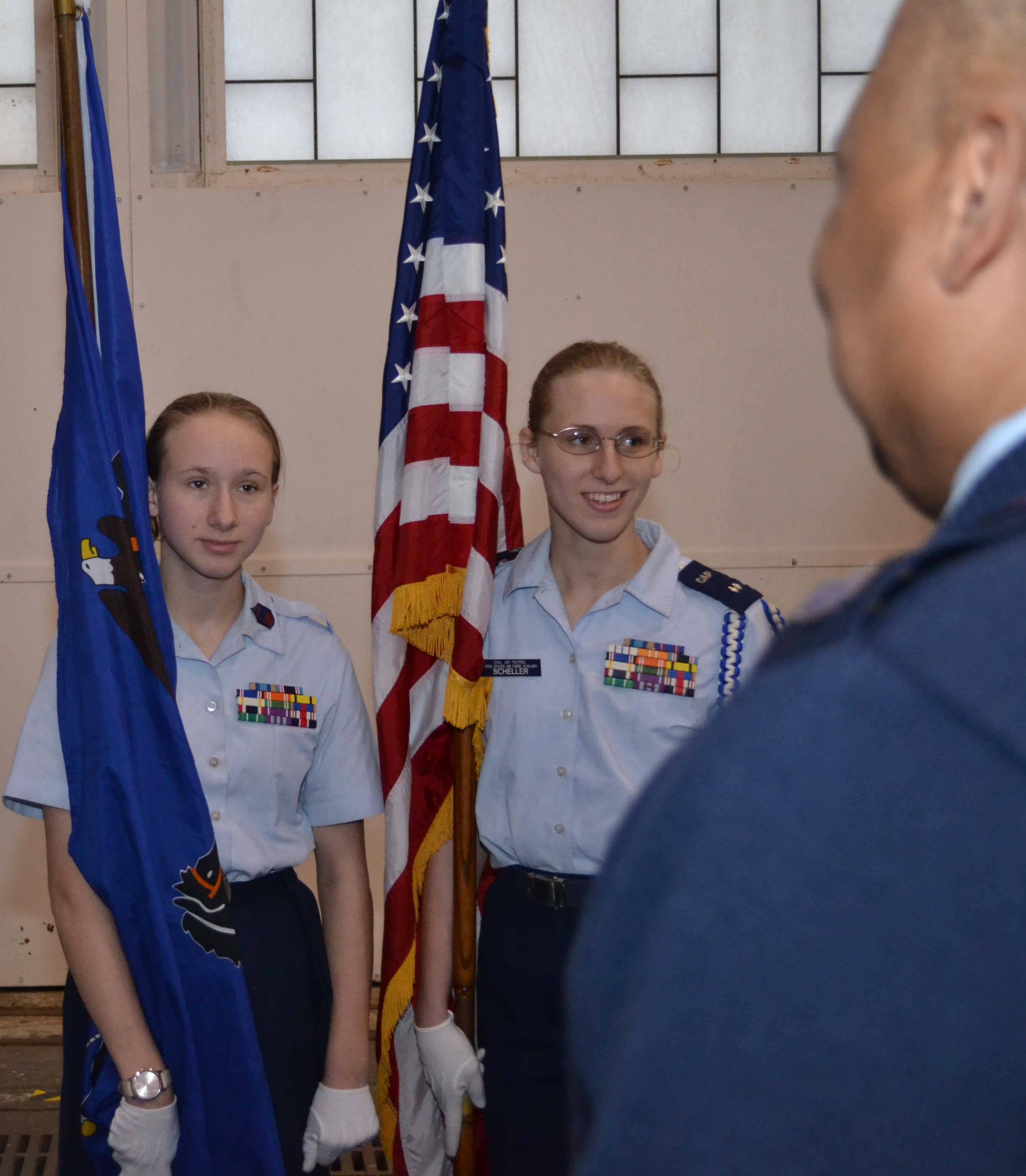
Face of Defense: Airman’s Effort Ensures Continuity for Cadet Honor Guard
By Air Force Tech. Sgt. Andria Allmond, 111th Attack Wing
HORSHAM AIR GUARD STATION, Pa., February 2, 2016 — Michael
Leone, the Aerospace Education Officer for Civil Air Patrol Squadron 801 in
Allentown, Pennsylvania, said he held back tears while writing an email to
thank Air Force Tech. Sgt. Danielle Heidrick.
"I am absolutely speechless," Leone wrote in the
email. "I don't even have the words to express my appreciation."
On Jan. 9, Leone and a handful of cadet CAP honor guard
members visited 111th Attack Wing Honor Guard here to practice and talk to the
Guardsmen. It was during this innocuous event that Leone mentioned troubling
news to Heidrick, one of the wing's honor guard members.
"Mr. Leone told us that their unit was being moved to
another location, and that location wouldn't be ready for at least six months
or more," said Heidrick, who's primary duty is noncommissioned officer in
charge of the 111th Force Support Squadron’s fitness assessment cell. "In
the meantime, the unit would have to disband and find new ones to train with or
not train at all. And I felt that was such a shame for a group of kids who were
so passionate about what they do."
Leone expressed similar sentiments about disassembling his
honor guard.
"This is personal to me," said Leone, a Navy
veteran. "Keeping these kids together is like keeping a family together.
And the thought of sending them to separate units or not training at all is
heartbreaking."
A Unit in Distress
The CAP Squadron 801 Honor Guard practiced on the second
floor of the Liberty Bell Museum located in Zion's United Church of Christ in
Allentown. They also utilized local parking lots and open spaces to accommodate
larger scale drill maneuvers.
Recently, Leone said, they learned their usual space was no
longer available. When they identified an alternate place to practice, he said
they were soon informed that it wouldn't be guaranteed for at least six to
eight months.
"A few months is a long time for an honor guard to not
practice," Leone said. "And that amount of time apart affects morale
[and] esprit de corps. These kids worked too hard for us to stand by and let
their honor guard be taken away from them."
"These cadets are the future of our military and I
don't want us to fail them," he said. "So, I've been desperate to
find someone to help us."
Answering the Call
While revealing the plight of his flight to Heidrick, Leone
didn't realize that he was speaking to someone who would step up and answer his
plea for help.
"My first thought while Mr. Leone was talking was that
we have buildings on this base that are not being actively used," Heidrick
said. "And we're here -- we're here for drill. So, why not open up a
building to them and have them be in this environment with us."
Heidrick explaining that hosting the CAP cadets’ honor guard
would not only give them the space they needed to perform their maneuvers, but
also lend itself to interaction between Air National Guardsmen and the cadets.
She stated that one available building has a classroom attached to provide the
setting for the formal education CAP cadets also receive as part of the
program.
According to Air Force Instruction 10-2701, Organization and
Function of the Civil Air Patrol, the cadet program with the CAP is aimed at
supporting the Air Force -- it states that Air Force installations and units
are authorized to provide support for aerospace education of cadet members. The
instruction also mentions supporting the CAP by introducing American youth to
opportunities and careers in the Air Force.
Backed by the AFI, Heidrick said she also feels that she has
a personal responsibility to assist the cadets.
"It became very apparent to me early on in my
[military] career that what I'm supposed to do here in the Air Force is take
care of people in one way or another," said Heidrick, a mother of four.
"And I've always done that."
In the Works
In the past, Horsham AGS has hosted CAP members, both cadets
and senior leaders, for various training events. Support agreements have been
generated to forge a bond between Air National Guardsmen and the volunteer
auxiliary of the Air Force.
Currently, Heidrick is drafting up a proposal to allow the
CAP Squadron 801 Honor Guard to use the installation during regularly scheduled
drills and work alongside their military counterparts. A cursory query into
this allocation of assets gained enough positive support from 111th ATKW senior
leadership for Heidrick to start the administrative process to make it
official.
Leone expressed elation upon receiving news that Heidrick
was drafting the paperwork to get his cadets what they needed to continue their
mission.
"You have made an old sailor quite happy," Leone
said about Heidrick in an email.
And again his emotion was shared by Heidrick, but on happier
terms this time.
Upon reading his response, Heidrick smiled and stated,
"Doesn't that make [helping someone in need] all worthwhile?"
Subscribe to:
Posts (Atom)