Tuesday, January 12, 2016

Face of Defense: Soldier Aids Sex Assault Prevention Efforts


By Army Master Sgt. Duff E. McFadden Iowa National Guard

JOHNSTON, Iowa, January 12, 2016 — For more than 40 years, the Iowa National Guard and Iowa Law Enforcement Academy have enjoyed a symbiotic relationship within the boundaries of the Camp Dodge Joint Maneuver Training Center here.

For the past two and-a-half years, that relationship has included invaluable training assistance from the Iowa National Guard Sexual Assault Prevention and Response team.

As part of their final grade, ILEA students must conduct a victim interview as part of a sexual assault investigation. Army Sgt. Maggie Passer, a victim advocate coordinator with the Iowa National Guard since 2013, is portraying a sexual assault victim for the Camp Dodge-based police academy.

In this particular scenario, Passer is playing a very calm, very nonchalant, “Sally,” who recounts the events of the previous evening. Sally’s been in a consensual relationship with her boyfriend for many years, but has told him she no longer wants to have sex. Her boyfriend, however, has different ideas and forces her into it.

Working With Local Police

And now, Sally is filing a sexual assault report. She’s confused on how to react, since she knows the relationship is no longer consensual, but she doesn’t necessarily feel it’s rape, either, due to their former relationship.

“I’m being interviewed as a sexual assault victim who is one of several scenario-driven ‘victims,’” said Passer, who’s 34 years old.

“I’m given a scenario by the commandant and the candidates have to ask certain questions and get certain information in order to build a case,” she explained. “They then present their findings to the commandant as if he were their reporting official.”

Passer added, “Each interview can last anywhere from 45 minutes to two hours, depending on whether the interviewer is nervous or scared and dances around the important questions that must be asked in such a scenario.”

Since police officers are often the first persons to arrive following a sexual assault, Passer feels participating in such training can help educate potential officers on how not to “re-victimize” women who have been assaulted.

“I hope, at the end of the day, these officers realize words have meanings and how you present yourself also has an effect,” she said. “Comments such as ‘She asked for it,’ can be very defeating.”

Passer continued, “But if you let them know, ‘I’m very sorry. Let me get you help with medical and safety and we can deal with the police report later,’ that can be a big help to make the victim feel more like a survivor, and less of a victim.”

Passer, who hails from Ankeny, said she gets a lot of “You’re a really good actor” responses from the students, but that’s not why she participates in the quarterly training.

Understanding Sexual Assault Victims

“I want people to look at a victim and realize their interaction with them may make or break whether that victim actually presses charges or not,” she said. “It’s an eye-opening experience for many of these young police officers. They need to realize, ‘Holy cow, I may actually further injure these victims.’”

With a class graduating each quarter and about six interviews per class, Passer has assisted with more than 60 such interviews.

Passer joined the Iowa National Guard in 2001 during her freshman year at the University of Northern Iowa. A history major, she signed on with the 1034th Quartermaster Battalion as a supply logistician.

“I always wanted to fly a helicopter. I watched ‘Courage Under Fire’ as a little girl, with Meg Ryan as a woman helicopter pilot and that’s what I wanted to do. But I was such a chicken to sign on the dotted line,” Passer said.

“My younger brother, who’s three-years younger, joined the Guard with the 1034th Quartermasters at 17 years of age. I figured, if he can do it, so can I. Within six months of my brother, I signed on with the same unit,” she said with a smile.

Service in Afghanistan

Passer served in Afghanistan from 2010-11 with Company A, 334th Brigade Support Battalion, Iowa Army National Guard. She recently re-enlisted for another six years, which will give her more than 20 years of military service.

“I want to continue to do what I’m doing now,” Passer said, “and that’s providing the best advice for my soldiers that I can. At end of the day, I want to ensure they have what they want and need.”

Passer was working supply at the United States Property and Fiscal Office when Army Capt. Joel Sage contacted her about a victim advocacy job opening. He felt she would be a good fit.

“Honestly, there were so many people … who were more senior and more experienced than me,” Passer said. “You can imagine my surprise when I got the position. I jumped up and down.”

Passer carries her passion as a victim advocate coordinator into her job each day.

“Every day is a different challenge,” she said. “We deal not only with the victims themselves, but with perpetrator accountability and leadership as well. We work to educate all soldiers, from the very-senior leaders to the company leaders and staff sergeant team leaders.”

The best part of the job, Passer said, is knowing that any service member going through an atrocity such as sexual assault, has another service member there for them that they can trust.

“One-hundred percent of what they tell me, I believe them,” she said. “Everybody who wears the uniform should share the same goals and Army values. If everyone fervently followed and believed in the Army values we wouldn’t need to have a SHARP team here.”
Passer currently resides in Ankeny, with her husband Jeb, and their two children.

Carter Reaffirms Strategic Relationship in Meeting With Jordan’s King


DoD News, Defense Media Activity

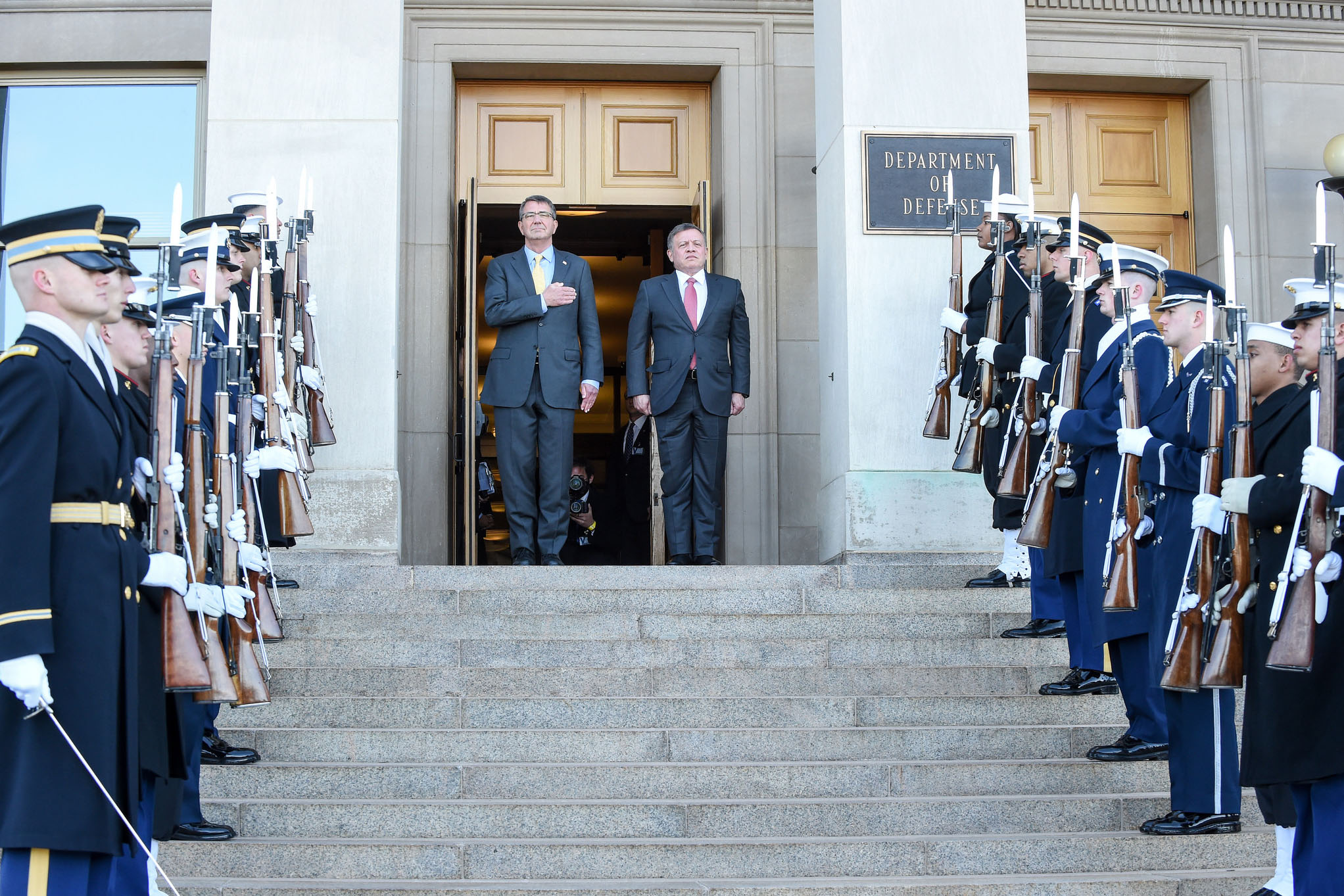
WASHINGTON, January 12, 2016 — Defense Secretary Ash Carter reaffirmed the closeness of the strategic relationship between the United States and Jordan during a meeting with King Abdullah II at the Pentagon yesterday.

In a statement summarizing the meeting, Pentagon Press Secretary Peter Cook said Carter and the Jordanian monarch discussed mutual concerns in the region, including the ongoing crisis in Syria, and that the secretary expressed gratitude for Jordan's continued contributions to regional efforts to counter Islamic State of Iraq and the Levant terrorists.
“They had a good exchange and agreed to continue the close partnership between the United States and Jordan,” Cook added.

Every Airman is mission essential: Aircrew Flight Equipment

by Airman 1st Class Ramon A. Adelan
9th Reconnaissance Wing Public Affairs


1/7/2016 - BEALE AIR FORCE BASE, California  -- As the day begins for training sorties to take off, Airmen are already preparing for the mission. Like clockwork, Airmen are checking and re-checking equipment and supplying pilots with the necessities to fly.

Every Airman plays an essential role in mission success, including those who are behind the scenes. Airmen assigned to the 9th Operational Support Squadron Aircrew Flight Equipment at Beale Air Force Base, California, ensure T-38 Talon pilots are equipped with well-maintained and serviceable flight gear.

"Our goal and mission is to protect and preserve the aircrew's life," said Staff Sgt. Tyler Woodwick, 9th Operations Support Squadron AFE craftsman. "We make sure equipment is working and intact."

A T-38 pilot is equipped with a helmet, G-suit, parachute, and survival kit. The kit includes items such as medical and survival modules, life raft, flares, and food.

"Every item the pilots have are essential, its functionality could mean life or death," said Senior Airman Allison Van Matre 9th OSS AFE journeyman. "We can't let these Airmen or their families down, so we go through pre- and post-flight, daily and weekly inspections of the equipment."

The equipment technicians follow technical orders, produced by the manufacturer and higher headquarters, to conduct inspections. Technical orders explain the required way to inspect or repair a piece of equipment. Depending on the equipment there could be hundreds of tasks per technical order.

"We inspect all surfaces of each piece of gear they have," Woodwick said. "We check every part of the helmets, from the seals to the visor. We make sure there aren't any holes, tears or broken seams in their parachutes and G-suits."

The T-38 is primarily used by the Air Education and Training Command as a training aircraft, but here at Beale it is used as a familiarization aircraft when pilots are not flying the U-2 Dragon Lady.

According to Woodwick, this career field is critical to the lives of the pilots who put their trust in the equipment.

"Our tasks aren't something you can halfway complete; we thoroughly check every piece down to the smallest stitch," Van Matre said. "The pilots rely heavily on us; they put their life in our hands and our equipment."

Monday, January 11, 2016

Face of Defense: Coast Guardsman Continues Mentoring Despite Illness


By Coast Guard Chief Petty Officer Nick Ameen, U.S. Coast Guard District 5 DoD News, Defense Media Activity

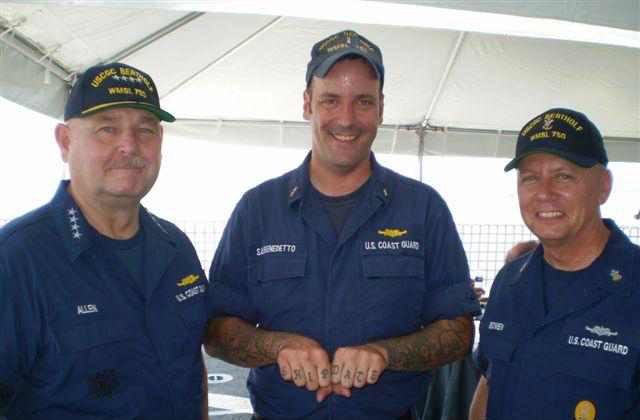
PHILADELPHIA, January 11, 2016 — Coast Guard Chief Warrant Officer Richard Sambenedetto is many things. Known by all as “Mr. Sam,” he’s forever a Coast Guard chief, a cutterman by trade and a chief warrant officer by choice, but above all he lives by his personal motto: “Shipmate for Life.”

“Shipmate for Life,” Sambenedetto explained, is his way of saying, “You need to help a fellow sailor out at sea -- you only have each other.”

Sambenedetto’s presence does not go unnoticed. He is a tall and boisterous man decked out in nautical tattoos that embody the sailor’s spirit. “Shipmate” is spelled out across the fingers of both hands, and even his feet are tattooed -- a rooster on his right and a pig on his left, representing an old nautical belief that tattoos will keep a sailor afloat at sea.

Sambenedetto, the finance and supply division chief for the logistics department at Coast Guard Sector Delaware Bay in Philadelphia, emphasizes the importance of mentoring others.

“Between leadership and mentorship, you use your past experience with current policy to help everyone out,” he said. “No one’s perfect.”

That mentorship extends in every possible direction, from junior enlisted service members to the wardroom and the chiefs’ mess -- of which he is an active member. He’s worked closely with Master Chief Petty Officer Brian Diner, who became Sector Delaware Bay’s chief of the mess in August 2015.

“In the last couple of months, coming into the sector, I’ve really gotten to see Mr. Sam’s involvement in the chiefs’ mess,” Diner said. “He’s helped me get to know who’s who around here, and he brings 25 years of experience. He has a solid history here.”

Diner said Sambenedetto personifies the ideal of a chief warrant officer -- he is involved and always available.

“He doesn’t sugarcoat anything,” Diner said. “It’s nice to have such a straight-shooter chief warrant officer as a member of the chiefs’ mess.”

The Coast Guard may be composed of individuals, but they do not complete the mission individually, Sambenedetto said.

“It’s not just about you -- it’s about others,” he said. “It’s a team. You need active duty, reservists, auxiliarists and civilians. Across all facets of that, everybody helps each other out.”

Embracing Teamwork to Accomplish Missions

Sambenedetto learned about teamwork as he served on multiple Coast Guard cutters for more than 10 years of sea time. His primary duty was as a cook, but among other duties he was also a firearms instructor, firefighting team leader, boarding officer and supply officer.

“Most colleges only take your pay grade into effect -- they don’t necessarily analyze your experience at sea to assign college credits,” he said. “With over 10 years of sea time, I always say, ‘I got a master’s degree from the Atlantic Ocean University!’ You learn a lot out at sea.”

Imagine a small group of people being limited to merely hundreds of feet of walking space while floating at sea. They’re bound to form a fellowship and learn from each other. The numerous cutters on which Sambenedetto served varied in size and crew complement, but the essence of a crew working together to complete the mission was consistent. He likely has enough sea stories to fill volumes.

At Sector Delaware Bay, Sambenedetto’s office is reminiscent of a life at sea. Intricate nautical knot work adorns his workspace. More than a dozen ball caps represent where he’s served. Coast Guard Cmdr. Kurt Richter, chief of logistics at Sector Delaware Bay, said Mr. Sam’s motto of “Shipmate for Life” is a good fit.

“I don’t think I know anyone else who has ‘Shipmate’ tattooed on his knuckles,” Richter said. “He’s constantly looking out for his shipmates. On a daily basis, I see people coming to him for mentoring and counseling.”

‘A New Normal’

Sambenedetto continues to make himself available to his shipmates despite a dramatic turn of events in his personal health.

Diagnosed with myasthenia gravis, a neuromuscular disease that causes muscular weakness and fatigue, he now uses a cane for extra stability, but even that is embellished in nautical knot work reflecting his cutterman pride. Some symptoms of myasthenia gravis include impaired vision, difficulty swallowing and slurred speech.

“My whole career I’ve been helping everybody, and now, ironically, I’ve got a medical condition and now my shipmates are helping me out,” he said. “That’s very humbling. When you put pride aside, to be a leader, you have to take care of others and lead from the front.”

Sambenedetto added, “When junior members are coming up through the ranks during peacetime, you let them lead. But when you’re doing an actual mission, [you] do what you’re trained to do and focus on it. Now with my condition that’s a little harder to do. The simple things aren’t so simple. The normal is now a new normal. I just have to learn how to accept it and move on with it, and it’s through my shipmates I’m getting that done.”

Medical Care, Prognosis

Sambenedetto’s shipmates pitched in to help him in a multitude of ways, but he’s also getting help from a team of medical professionals, including Public Health Service Lt. Cmdr. Jason B. Buenaventura, an osteopath assigned to Coast Guard Training Center Cape May, New Jersey.

“The weakness is worsened by activity and is better with rest,” Buenaventura said. “It is autoimmune, meaning; the body produces antibodies that are attacking the body itself.”

He said myasthenia gravis isn’t contagious or inherited, and the cause is not known. There isn’t a cure for the disease; however, many treatment options are available.

“Mr. Sam is actually the first person I’ve ever met in my nine years of practicing who has myasthenia gravis,” Buenaventura said. “This condition is not very common at all, but every time I interact with him, he seems to be in good spirits.

“I’m sure he’s done his research, and he understands what it means for him long term,” Buenaventura continued. “He was dealt this and he seems to be such a very resilient individual that he’s not going to let it get to him. He’s going to bounce back. I truly believe that once we get the right treatments for him, he’s going to do fine – ‘Shipmate for Life.’”

Sambenedetto received approval to get a service dog, though there is a considerable amount of paperwork involved before he can actually bring the dog home. He said the dog will help tremendously with everyday tasks that have become more and more burdensome to him, and he’s doing everything in his power to move the process along.

Despite his medical condition and a looming medical retirement from the service, Sambenedetto remains involved in mentoring his shipmates. He continues to play a major role in the Chief’s Call to Indoctrination, a two-month process that transitions Coast Guardsmen from junior enlisted to senior enlisted.

When talking about CCTI and its final events -- the Rites of Passage and the Acceptance Dinner -- Sambenedetto said, “This is my Super Bowl!”

As he prepares himself for the next chapter of his life, he said he’ll always stay connected to the chiefs’ mess.
“I’ll handle it one task at a time,” Sambenedetto said. “In a storm, it doesn’t rain forever, but now I have to learn how to dance in the rain.”