Thursday, December 10, 2015

Face of Defense: Flight Medic Departs for Fifth Deployment


By Army Sgt. Neil Gussman, 28th Combat Aviation Brigade DoD News Features, Defense Media Activity

ANNVILLE, Pa., December 10, 2015 — Nearly 100 years ago, young American men were leaving farms across America, joining every branch of the military to fight in World War I. One-third of Americans lived on a farm during the first decades of the 20th century, so nearly every squad of soldiers had farmers in it.

Today, less than two out of every 100 Americans live on a farm, but one of those Americans with a small family farm is headed for his fifth deployment. Pennsylvania Army National Guard Sgt. 1st Class Jeff Kwiecien, a flight medic with nearly 20 years of service, will soon be leaving for Southwest Asia. He is deploying with Detachment 1, Charlie Company, 2nd Battalion, 104th Aviation Regiment, where he will serve as noncommissioned officer in charge of the unit.

On 4.5 acres in central Pennsylvania, Kwiecien and his family raise chickens, ducks and guinea hens. He is considering adding goats and bees to his existing flock of nearly 50 birds, but those plans are on hold until after he returns. Raising poultry for eggs and for the table is one of several hobbies Kwiecien has, including making medical apparel, rock climbing and playing the drums.

Kwiecien joined the Army in 1996, serving on active duty for six years. He joined the Army National Guard in 2003. In 19 years of service he has deployed to Bosnia, Saudi Arabia and twice to Iraq, most recently with the 56th Stryker Brigade in 2009. He has served on active duty with the National Guard since returning from deployment in 2010.

In a phone interview while he was on a weekend pass, Kwiecien talked about his view of life before going on another deployment.

Persistence Pays Off

He said he was a product of “years of failure,” adding, “I am very persistent. I think that persistence has paid off, because after 19 years and many failures I feel like I’ve learned a lot, and like Thomas Edison who figured all the ways not to make a light bulb, I move on and stick with the things that work,” Kwiecien said. “It’s better to try and fail than to never give your dream a shot.”

As an example, he cited his experience with a weekend-long evaluation for an Army National Guard Special Forces unit in Maryland. He said he made it through the first weekend and was told he could come back for the second round of evaluations, but before he could return he was promoted. By taking the promotion, he took himself out of the program. Although he did not make it into the Special Forces, he said he does not regret the attempt.

In his free time, Kwiecien said he likes to find serenity in nature. “My big plan after deployment is to go to Zion National Park in Utah with my family,” he said. “Getting away from civilization and being one with nature. Rock climbing and hiking are things I really look forward to on visits to national parks.”

Philosophies for Life

“You can have the best idea, but execution makes a good idea real,” Kwiecien said. “A good plan put into motion today and refined as needed is better than a great plan that hasn’t been started. Hesitation and indecision kill good plans and good ideas.”

There will always be drama, he said. “It’s nothing new and it’s never going away. I tell my soldiers, ‘Keep your private life private and your professional life professional and I won’t need to be involved in your private life.’”
Kwiecien said the best advice he ever received came from his father. “My dad told me when I was graduating from high school and we were looking at colleges that people should always have a skill in addition to higher education,” he said. So, in addition to growing his farm, Kwiecien plans to start a business making medical clothing for first responders when he returns from his deployment.

Guardsmen are proven in battle, trusted at home

by Col. Pierre B. Oury
USAFE-AFAFRICA Air National Guard Advisor


12/10/2015 - RAMSTEIN AB, Germany -- December 13th marks the 379th birthday of the National Guard.

On this date in 1636, the first militia regiments in North America were organized in Massachusetts. Based upon an order of the Massachusetts Bay Colony's General Court, the colony's militia was organized into three permanent regiments to better defend the colony.

So, what exactly is the National Guard? In a nutshell, it's part of the Army and Air Force reserve component. The guard is composed of military units in each of the 54 states, 3 territories, and the District of Columbia.

What makes the Guard truly different from its reserve and active-duty counterparts is that when not mobilized, the governor in each respective state or territory is the commander-in-chief of the units. The governor, in turn appoints a senior joint military commander called The Adjutant General or TAG. The only exception is in South Carolina where the TAG is an elected position and not appointed by the governor. This command structure allows the Guard to react to national disasters swiftly and precisely.

No other force in the nation is able to rapidly provide military equipment and capabilities during a domestic emergency like the National Guard.  Called to duty by the governor, the National Guard is typically already working with first responders before any federal emergency is declared. National Guard members were called up 286 times by their governors in Fiscal Year 2015 for 53 natural disasters, 27 structural fires, 53 explosive ordinance disposal events and 117 search-and-rescue missions. They also provide support to law enforcement, border security, counterdrug support and protect America's skies by providing fighter and tanker alert response.

The Guard is also a global partner with 70 partnerships around the world through its State Partnership Program that started in 1993. Why? Because the Department of Defense has recognized that pairing a State National Guard to a partner nation provides unparalleled enduring relationships. The US has seen many successes thanks to this program. For example, as a result of Michigan's 22 year partnership with Latvia, USAFE and the Air National Guard executed the first MQ-1 Predator training deployment to the Baltics with great success in September. As a colleague once said, "You can't surge trust."

But the true key to the Guard's success is its people.

Roughly 70% of Guard members are part-time soldiers and airmen and only 30% are fulltime. We are police officers, airline pilots, plumbers and teachers in our communities who make a seamless transition to Soldiers and Airmen when our states, territories or Nation call. It's because of this makeup that I see examples of where innovative civilian skills complement military training in operations both overseas and at home time and time again.

This combination of civilian and military attributes has enabled the National Guard to do three things extraordinarily well: Fighting America's Wars, Protecting the Homeland, and Building Global Partnerships.

So, now that you understand the National Guard take a moment to celebrate the generations of citizen-soldiers who continue to defend community and country.

Tactical Air Control Party: Blending Blue and Green

by Dave Smith
21st Space Wing Public Affairs staff writer


12/9/2015 - FORT CARSON, Colo.  -- The staccato rhythm of automatic weapons fire punctuated by the deep bass thumps and sharp explosions of artillery blasts fill the air. Sudden whooshes signal the launch of shoulder fired surface-to-air missiles, adding to the commotion. The bright ting of bullets ricocheting off armor plating join the other sounds orchestrating a freakish battlefield symphony.

Through it all the Joint Terminal Attack Controller maintains focus. He coordinates artillery to suppress the SAM fire long enough for a circling A-10 Thunderbolt he is directing to strafe an enemy tank, all without hitting any friendly elements. At the precise second the command is given, SAMs are suppressed, enemy tank is neutralized and the A-10 flies off into the distance and a successful mission is completed under the direction of the JTAC.

Even though the previous scenario was a simulation, it's all in a typical days work for members of a 13th Air Support Operations Squadron Tactical Air Control Party, whether training or deployed. The JTAC is one of the positions within the TACP. The Air Force squadron provides tactical command and control of close air support assets to U.S. Army ground commanders of the 4th Infantry Division during combat operations. The squads are normally located on Army posts working through a memorandum of agreement.

"We accomplish the ground commander's intent and keep people safe," said 1st Lt. Marc Buker, 13th ASOS chief of training at Fort Carson, Colorado.

The squadron's mission is straightforward; they are either in battle or preparing for battle. Unlike other Air Force squads the ASOS's do not supply ancillary services to the greater Air Force like security forces does, so when members are not deployed they are training in preparation for deployment.

"Our only mission is war," Buker said. Training for battle functions includes flag exercises at places like the National Training Center, Fort Irwin, Calif., where brigade on brigade - comparable to an Air Force Wing - exercises take place. With no aircraft of its own, 13th ASOS chases aircraft Buker said. What he means is that TACPs frequently travel to where aircraft are participating in training to be able to work on live scenarios with real assets.

The focus on training as frequently as possible includes sending people to various Army schools such as the Ranger, Airborne, Air Assault and Pathfinder schools. Earning badges from these schools helps JTACs understand Army methods better. It also improves credibility with the soldiers with whom they serve, Buker said.

TACP Airmen are both "green" and "blue," having an Air Force chain of command but living and working with the Army for most of their careers. While they dress in Air Force uniforms, their squadron headquarters is more Army-like. Army combat vehicles and equipment are standard parts of the facility.

"This situation creates a unique, joint individual well postured to be a force multiplier for both services. This is demanding on our airman, as an (airman first class) might have dual responsibilities: briefing an Army commander on how best to use (close air support) and then going outside the wire that same day to control the CAS," he said.

Immersed in the Army, Buker admits 13th ASOS members lean a little to the green, or Army, side. But since they come to Peterson AFB for things like medical and financial services it helps keep them blue. The biggest blue influence is working with and communicating with Air Force pilots regularly.

"It keeps us a little blue," Buker said. "We get to be part of both organizations. We get the best of both worlds. Most of us are glad we are in the Air Force."

The 13th ASOS is somewhat spoiled being located so near to Peterson AFB. Many other squadrons are located at Army bases distant from Air Force bases where they go for services. Most of what the 13th ASOS needs is readily available to them at Fort Carson or on Peterson AFB with only a short trip to get what they need.

When the services work together there is a synergy that benefits both. Buker said TACP can't do its job without the Army and the same goes the other way. The mutual support brings together a level of expertise that allows the roughly 140 members of 13th ASOS to coordinate support for a 25,000 person strong Army division.

And it takes more than JTACs to provide the needed level of support. Many people usually associate the ASOS with JTACs because they are the tip of the spear Buker said. For example, the 13 ASOS has the 4th Infantry Division Intelligence Surveillance and Reconnaissance Officer, who is the principal Air Force expert on intelligence to the whole division. Expert radio maintainers are another integral position in the ASOS.

"JTACs use portable communication radios to coordinate and control the airpower we project and without them we are combat ineffective," Buker said. "Here at the 13th ASOS it takes the whole team to accomplish the mission."

Other members of the ASOS team include air liaison officers, radio maintainers, vehicle maintainers, power production, and intelligence personnel.

"Without any member of that team, we falter. When we work together as a resilient and lethal Gunslinger family, we thrive," he said.

The TACP career field is small, elite and in great demand. Because of the value of the TACP, personnel are constantly deployed and not just with 4th Infantry Division. TACP members deploy with Army units all over the world as needed. They may even deploy with special operations groups like Navy SEAL teams if the mission demands their expertise. The high operations tempo means there are many personnel deployed across the globe at any time.

The most important skills needed to be a TACP are intelligence, communication, physical prowess and character. Coordinating multiple fixed-wing and rotary aircraft as well as artillery all while moving, targeting and returning enemy fire requires a high level of intellect. Because the job relies almost entirely on communication the JTAC needs to be able to communicate clearly in the languages of both the Air Force and the Army keeping all involved on the same page. Physical ability is critical because the Airmen of the TACP need to move with their assigned Army units.

"A good measure of a physically fit TACP is the ability to ruck," Buker said. "No TACP can graduate our schoolhouse until they can greatly exceed all Army standards of rucking, running, and calisthenics. We cannot afford to be mentally tired when doing our jobs, so we have to do everything the Army is doing and still be fresher than they are in order to provide terminal attack control and communicate with the aircraft."

Because of the unique nature of the TACP career field, strong character is a prerequisite. Unlike other Airmen, Buker said a TACP is an example of character and professionalism not just to other Airmen, but to the Army. With the great responsibility TACPs are given, much is expected and character cannot be taken lightly.

Through performance in action the TACP has proven its worth time and again. The need to expand the availability of TACPs and JTACs throughout the globe is recognized. Buker said TACP was recently classified as a major weapons system. The classification brings with it more funding allowing for more, and more sophisticated, training.

"The last two conflicts shined the spotlight (on TACP) as a force multiplier," said Buker.

Increased training will only improve what the TACP is able to bring to bear in combat. For example, with increased threat of space warfare and the potential for satellite communications to be disabled, TACPs must be ready to handle a variety of situations and methods of calling in munitions to carry out the mission.

One thing is certain, when experts are needed to drop bombs close to friendly forces, there are none better than U.S. Air Force TACPs to accomplish it while keeping friendly forces in both the air and on the ground safe, Buker said.

SEAC Reflects on Service, Upcoming Transition


By Claudette Roulo DoD News, Defense Media Activity

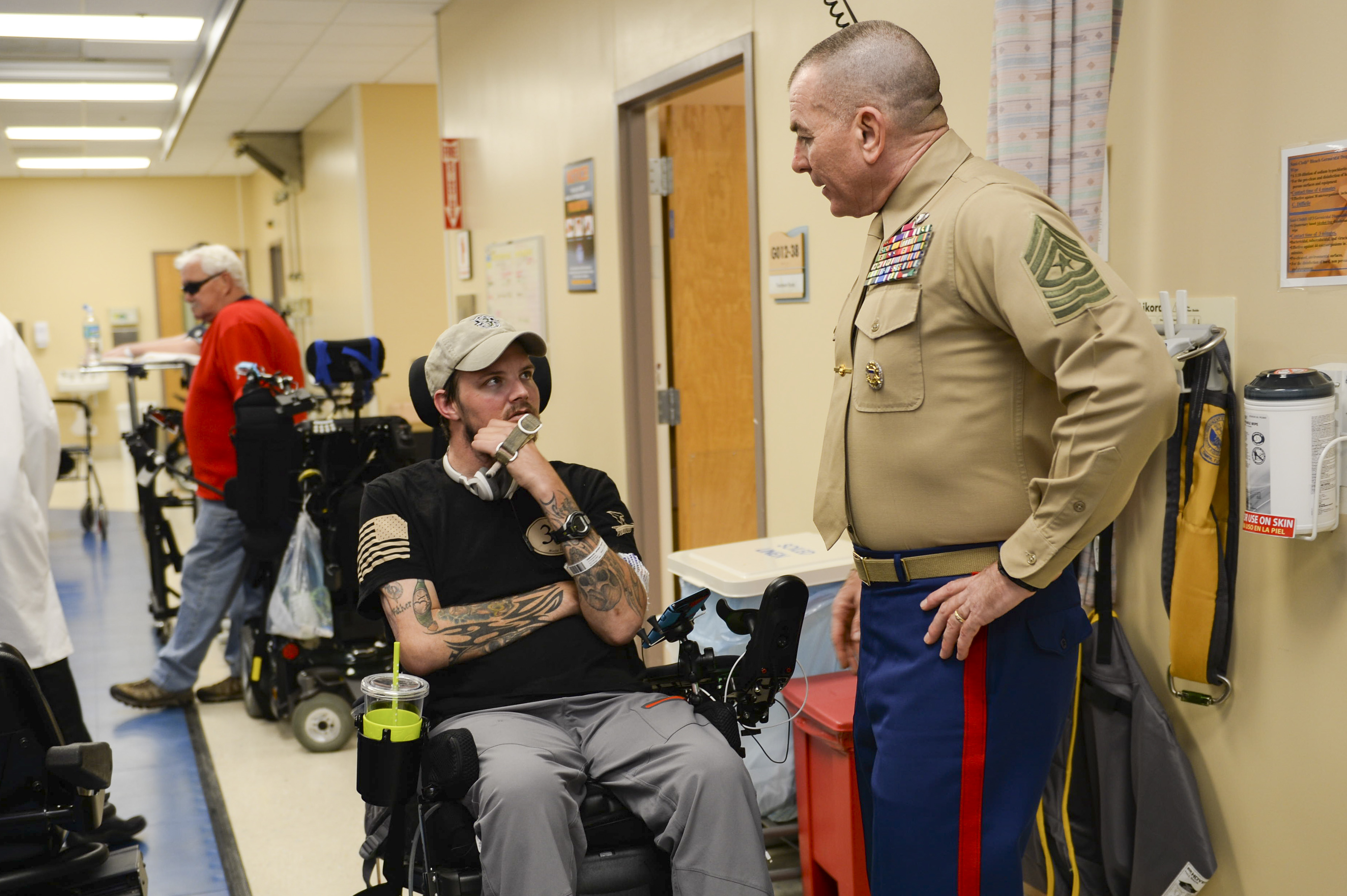
WASHINGTON, December 10, 2015 — Tomorrow, after 36 years as a Marine, Sgt. Maj. Bryan B. Battaglia, the senior enlisted advisor to the chairman of the Joint Chiefs of Staff, will retire and pass his responsibilities to Army Command Sgt. Maj. John Troxell.

Battaglia is just the second enlisted service member to hold the position. Army Command Sgt. Maj. William J. "Joe" Gainey was the first SEAC, from Oct. 1, 2005, until he retired in April 2008. Former chairman Navy Adm. Mike Mullen did not appoint a SEAC during his tenure, but Army Gen. Martin E. Dempsey made it a priority to choose a senior enlisted advisor and Battaglia was sworn in just hours after Dempsey took his own oath as chairman.

Although the position was vacant when he was sworn in, Battaglia said the transition to working on the Joint Staff was made easier by the fact that he was coming from U.S. Joint Forces Command.

“I was already in a position where I was impacting and collaborating with all the combatant commands -- and in some cases, the services too,” he said last week in an interview with DoD News.

And now, Battaglia said, he’s not sure which thing he’s happier about: that the position of SEAC will now have some continuity, or who was chosen to fill it.

He and Troxell “know each other very well,” Battaglia said.

“We've spent some time together; I've visited him on several occasions when he was a unit command sergeant major in various organizations around the globe, so I know how he operates,” Battaglia said.

Troxell “is a very, very intelligent soldier,” Battaglia said. “If he needs to know something, he'll certainly ask. ... He's going to have a great staff -- and that was part of the transition as well, that we kept a staff in place that was already broken in and seasoned, if you will, that he can fall in on and let him make an assessment.”

Battaglia added that he has “every confidence in the world” that Troxell will continue to grow the office of the SEAC and to make a positive impact on policies that affect military personnel, families, programs and initiatives.

“I have left a lot of work for my successor to do and you all will see -- the force will see -- how he will take this office and its efforts and initiatives to a much higher level and degree than I ever could,” he said.

Proud to Serve

Asked about his proudest accomplishments as SEAC, Battaglia said the pride “simply comes in the form of the opportunity to continue to serve. It stops there.”

He went on to thank Dempsey, his staff, and fellow senior enlisted advisors for any success he’s had as SEAC.

The office’s responsibilities grew quickly, Battaglia said, in large part because of the chairman’s insistence that his senior enlisted advisor be an active part of the most difficult discussions facing the DoD -- including those regarding pay and compensation, modernization and the shaping of the armed forces for the decades ahead.

The sergeant major credits Dempsey with ensuring that not only was the SEAC part of those discussions, but that the discussions occurred at all.

"He made a promise, not just to himself, but to the entire force, that there were things that we could probably ... kick down the road for the next chairman, or the next chairman [after that], to handle," Battaglia said, "but [Dempsey said] 'I'm not going to do that, troops. It needs to be handled or it's only going to get worse, and I'm going to handle it now. And if there's someone who needs to take a black eye or a fat lip because of [it], that's going to be me -- I want to do that because we have some challenging times ahead.'"

The sergeant major said he was grateful to be a part of that experience with Dempsey.

Retirement

After tomorrow’s change-of-responsibility ceremony, Battaglia said that he and his wife, Lisa -- herself a Marine veteran -- would prefer that all the attention be focused on the troops.

“We’ll ride off into the sunset as everyone does when they retire, proud not just for our service in the Corps, but proud for the opportunity to serve at this level and make whatever impact that we did,” the sergeant major said.

Battaglia said words can’t express how proud he is of the troops serving today.

“They're ready to go,” he said. “For someone to be sitting on the bench with hand raised saying 'Put me in coach, put me in,' is pretty refreshing. ... Young men and women of America that join our armed forces don't really come in to sit on their hands. They come in to take on some pretty important responsibilities and if there's an opportunity to provide that opportunity to them, then we should take advantage of it.”

Army Sergeant Sentenced to Prison for Conspiracy in Afghanistan Bribery Scheme


An Army sergeant was sentenced to 24 months in prison today for his role in a conspiracy to commit bribery in connection with supply contracts while serving in Afghanistan.

Assistant Attorney General Leslie R. Caldwell of the Justice Department’s Criminal Division, U.S. Attorney John E. Kuhn Jr. of the Western District of Kentucky, Assistant Director in Charge Paul M. Abbate of the FBI’s Washington Field Office, Special Inspector General for Afghanistan Reconstruction (SIGAR) John F. Sopko, Director Frank Robey of the U.S. Army Criminal Investigation Command’s (CID) Major Procurement Fraud Unit, Acting Special Agent in Charge Paul Sternal of the Defense Criminal Investigative Service (DCIS) Mid-Atlantic Field Office and Brigadier General Keith M. Givens, Commander of the Air Force Office of Special Investigations (OSI), made the announcement.

Ramiro Pena Jr., 43, of Fort Campbell, Kentucky, previously pleaded guilty to a one-count information charging him with conspiracy to commit bribery.  In imposing sentence today, Senior U.S. District Judge Thomas B. Russell of the Western District of Kentucky also ordered Pena to forfeit $100,000, a Harley Davidson motorcycle and a Rolex watch.

From January 2008 through September 2009, Pena worked as a U.S. Army sergeant first class at the Humanitarian Assistance (HA) Yard at Bagram Airfield in Afghanistan.  In connection with his guilty plea, Pena admitted that he and his supervisor, Army Master Sergeant Jimmy W. Dennis, were responsible for contracting with local vendors to purchase supplies to support humanitarian relief in Afghanistan, and they awarded approximately 217 such contracts totaling roughly $30,760,255.  In return, Pena and Dennis received money and jewelry from some of the vendors.  Specifically, Pena admitted that he received from the vendors, through Dennis, a Rolex watch and $100,000 in total bribe payments.  

Pena admitted that he sent approximately $22,000 of the cash to his family in Kentucky, spread among numerous greeting cards to avoid drawing attention to the thickness of any particular envelope.  Pena also used the bribe money to pay his family’s personal expenses both in Afghanistan and in the United States to purchase a Harley Davidson motorcycle.  

Dennis also previously pleaded guilty in the Western District of Tennessee to conspiracy to launder bribe payments and was sentenced to 41 months in prison and ordered to forfeit $115,000.

This case was investigated by the SIGAR, FBI’s Washington Field Office, CID, DCIS and OSI.  The case was prosecuted by Trial Attorney Daniel P. Butler of the Criminal Division’s Fraud Section and Assistant U.S. Attorneys Nute A. Bonner and Amy Sullivan of the Western District of Kentucky.