Wednesday, September 16, 2015

Air Force’s top Airman honored by enlisted force


By Tech. Sgt. Torri Hendrix, Secretary of the Air Force Public Affairs Command Information / Published September 16, 2015

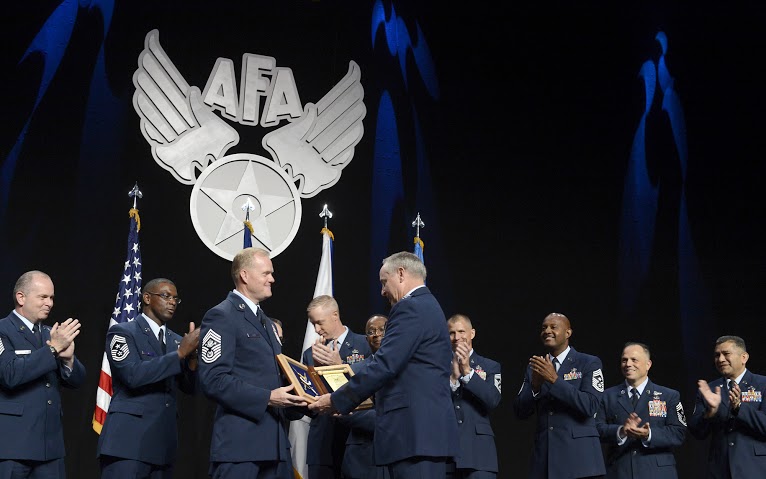
WASHINGTON (AFNS) -- In a historical event, the Air Force’s top enlisted leader honored the service’s top general with an invitation to an Order of the Sword ceremony during the Air Force Association’s Air and Space Conference and Technology Exposition Sept. 16.

Chief Master Sgt. of the Air Force James A. Cody, who is the trusted keeper of the Air Force Master Sword, thanked Air Force Chief of Staff Gen. Mark A. Welsh III for his exceptional service as a leader and for his significant care of the enlisted corps.

“Any organization needs a heartbeat,” Cody said. “There isn’t an Airman out there that cares more about our Airmen, their families and our Air Force.”

According to regulation, The Order of the Sword was established by the Air Force enlisted force to recognize and honor military senior officers with the rank of colonel or above, and civilian equivalents, for conspicuous and significant contributions to the welfare and prestige of the Air Force enlisted force, mission effectiveness and the overall military establishment.

“We have been blessed to be under your leadership, unbelievably so,” Cody told Welsh. “We would not be where we are without you. On behalf of the nearly 400,000 enlisted Airmen, we’d like you to accept this invitation to be the 10th recipient of the Air Force Order of the Sword, the highest level of recognition that can be afforded by the enlisted force.”

The Order of the Sword tradition is rooted in chivalry from the Middle Ages. In 1522, King Gustavus the First of Sweden ordered the noblemen commissioned by him to appoint officers to serve him. The system worked so well it was incorporated into the Swedish Army as a way to establish and maintain a cohesive, disciplined and well-trained force to protect lives and property in the kingdom.

These NCOs would honor their leader and pledge their loyalty by ceremoniously presenting him with a sword. The sword, a symbol of truth, justice and power rightfully used, served as a token for all to see and know that here was a “leader among leaders.” This ceremony became known as the “Royal Order of the Sword.” It was passed through the ages, coming to America about the time of the Revolutionary War.

The practice of awarding a sword lay dormant for many years. The only known instance of its use was in the 1860s when Gen. Robert E. Lee was presented a sword by his command. The “Royal Order of the Sword” ceremony was revised, updated and adopted by the NCOs of the Air Force in 1967.

Welsh, who was surprised by the invitation, was only able to say “thank you” to Cody when he accepted the invitation. After some of the shock wore off, he reflected on how he felt about receiving this honor from the enlisted corps.

“I’m astonished and incredibly proud,” Welsh said. “This is the single greatest honor of my career.”

(Editor’s Note: Historical background information was taken from Air Force Instruction 36-2824 – Order of the Sword Programs.)

Massachusetts Guard Announces State Partnership With Kenya


From a Massachusetts National Guard News Release

HANSCOM AIR FORCE BASE, Mass., September 16, 2015 — The Massachusetts National Guard has been selected as the U.S. partner for the Republic of Kenya as part of the Defense Department’s State Partnership Program.

Through the program, the Massachusetts National Guard will conduct mutually beneficial engagements in support of defense security cooperation goals and work to strengthen its partner nation’s domestic response capabilities, according to a Massachusetts National Guard press release.

“The Massachusetts National Guard, under the leadership of [Air Force] Maj. Gen. L. Scott Rice, [adjutant general], has done a superb job building the State Partnership Program and identifying mutually beneficial opportunities between our commonwealth and the Republic of Kenya,” said Massachusetts Gov. Charlie Baker. “Massachusetts is proud to have an enhanced role in securing our nation’s defense around the world. Our administration looks forward to enhancing this program by developing and strengthening this partnership with the Republic of Kenya.”

The State Partnership Program is administered by the National Guard Bureau, guided by U.S. Department of State foreign policy goals, and supports theater commanders’ security cooperation objectives. The program has been successfully building relationships around the globe for the past 22 years. With the inclusion of the Republic of Kenya, the State Partnership Program will have a total of 70 state partnerships, the release said.

Kenya is Massachusetts’ second state partner. The commonwealth formalized a partnership with Paraguay in 2001. Since its inception, the Massachusetts National Guard has completed more than 100 exchanges with Paraguay, ranging from humanitarian assistance and disaster relief to maintenance, emergency management, engineering, and Army and Air Force aviation, according to the release.

"National Guard states have been building enduring relationships for more than 20 years through the State Partnership Program," said Army Gen. Frank J. Grass, chief of the National Guard Bureau. "This partnership establishes Kenya as the National Guard's 76th partner nation and greatly enhances Combatant Commanders’ global security objectives."

The State Partnership Program helps partner nations build a skilled force capable of helping develop the host nation's defenses and security, disaster response, crisis management and interagency cooperation capabilities, according to the release.

“Our service members will provide mutual benefits to this strategic partnership with the Republic of Kenya,” Rice said. “Our force will use their dynamic civilian and military skill sets and experiences to identify potential problems and offer effective solutions to cooperate with shared initiatives in Kenya. We are excited to exchange ideas and share knowledge to foster an enduring partnership.”

The Massachusetts National Guard’s nomination to partner with Kenya was supported by the Massachusetts governor’s office and several congressional delegates. Additional support came from academia and civic organizations with current Kenyan relationships. The official signing of the Massachusetts National Guard State Partnership will take place in Kenya and be announced soon, according to the release.

The heat is on: Whiteman FSS teams compete in Iron Chef Challenge

by Airman 1st Class Jovan Banks
509th Bomb Wing Public Affairs


9/11/2015 - WHITEMAN AIR FORCE BASE, Mo -- Six Airmen from the 509th Force Support Squadron (FSS) competed in the Global Strike Iron Chef Challenge Sept. 3, 2015, at Whiteman Air Force Base, Missouri.

The Global Strike Challenge is held annually to determine the best bomb and missile teams from all Air Force Global Strike Command (AFGSC) bases, but this year it will also determine who will hold the title of "Iron Chef". In accordance with the theme of the show from which the competition takes its nature, the challengers created dishes with a secret ingredient, unknown until its unveiling during the challenge.

Each team consisted of three members with predetermined roles and one team captain.  During the challenge the teams had an hour to complete a main dish and dessert for five judges.
U.S. Air Force Staff Sgt. Renton Espejo, a shift leader for the 509th Force Support Squadron, was the head chef for the blue team and made tough decisions when the pressure was on in the kitchen.

"The pressure of being in the kitchen with an audience watching every move I made was the most challenging part for me," said Espejo. "Knowing that I had to cook under pressure and be judged while the audience is watching was a bit scary."

Though the blue team was not victorious in the challenge, Espejo feels his team accomplished their goals during the competition.

"I was impressed by the courage both teams showed by being part of the challenge," said Espejo. "I felt like we did what we came for ... to show them that we can cook not only the dining facility food, but also a gourmet dish."

Both teams received great reception from the judges during the tasting portion, but one member of the red team felt as if their win was more of a comeback victory. 

The winning red team prepared fish tacos filled with spicy shrimp rice and a dessert of a chocolate peanut brittle cup with fresh fruit all including the secret ingredient ... yogurt.

"The Challenge felt a little chaotic at first," said Senior Airman Rafael Hirao, a storeroom manager for the 509th Force Support Squadron. "I thought the other team had handled that stressful situation a lot better than we did, they seemed a lot calmer and more composed than we were, but we overcame that adversity."

Whiteman's Iron Chefs are scheduled to go on to Barksdale Air Force Base, Louisiana, to compete at the AFGSC level.

With a victory under their belt and the support of their former opposition, Hirao and his teammates are optimistic.

"Our team will win because we don't like to lose," said Hirao.

Hispanic Heritage Month: Anthropology of coconuts

by Airman 1st Class Rose Gudex
21st Space Wing Public Affairs


9/16/2015 - PETERSON AIR FORCE BASE, Colo.  -- Puerto Rico is a country many Americans only dream of traveling to for a beautiful vacation. For one Peterson Airman, that tropical paradise was reality.

Senior Airman Andrew Rojas-Marquez, 21st Communications Squadron cybersecurity specialist, was born and raised in Puerto Rico and loved every second of it. His Hispanic heritage helped him to become a better son, husband and Airman.

Growing up in a commonwealth of the United States meant he had much of the same lifestyle that Americans know, but naturally with their own cultural spin. Puerto Ricans grow up learning both Spanish and English, celebrate American holidays as well as their own and listen to pop music...in Spanish.

Independence Day, Thanksgiving and Christmas are just some of the American holidays they celebrate, but specific traditions may be different. Thanksgiving isn't a traditional Puerto Rican holiday, but Rojas said they are happy to celebrate it.

The Puerto Rican twist to an American holiday is to roast a pig instead of the traditional American turkey, he said. In addition, the desserts are to die for. The most unique to Puerto Rico is anything with coconut in it.

"It's the best candy you've ever had," Rojas said. "There's nothing like the flavor of real, genuine coconut."

In addition to food, the music is also different. He said there is a lot of merengue and salsa music in Puerto Rico, but there is still pop and hip hop for younger generations, like in America.

Rojas came to the US while in high school briefly, and then went back to Puerto Rico to finish high school and bachelor's degree in anthropology and archeology. The percentage of people with degrees in Puerto Rico is very high, making it very competitive and challenging to get a job after graduating.

"I was like 75 percent of the population in Puerto Rico," he said.
In order to not be just another number competing for those few jobs, Rojas came to the U.S. with his wife in 2011 in search of a career. When his new job was going to be cut, he looked to the military as his top option.

Rojas said his mother was prior enlisted Navy and then an Air Force officer. For him, there was no doubt which military branch he was going to choose.

"The Air Force is great," he said. "Education wise, you can get employment, work experience and at the same time, your education."

The education is really what drew him, so in 2012 at the age of 24, Rojas joined the Air Force. That and the acceptance of individuals coming from different backgrounds influenced his choice.

"It's very open-minded and very professional," he said. "It's based on your qualities as an individual and as a professional."

Being part of the small 13.1 percent of Hispanic Airmen throughout the entire Air Force, Rojas said his heritage helps give him a different perspective, although he does have to translate his thoughts from Spanish to English as he speaks. The culture is very job oriented in Puerto Rico, which helps him be diligent in his career and continuously looking for ways to improve himself.

"I had this idea that if I didn't have a bachelor's degree that I wasn't going to get anywhere," he said. "I'm working on my (master's degree in business administration) with an emphasis in cybersecurity. I'm also working on my Air Force associate degree so I have something technical."

With all the tuition assistance and resources available for Airmen to continue their education, Rojas said furthering his education wasn't ever a question. All the opportunities available are what he tells anyone who is considering the military.

"It's a great experience and they'll get so much out of it," he said. "The best thing is education, professionalism and serving the country as well. In all honesty, it's the best kept secret."

The benefits reaped by signing the dotted line go well beyond the education and advancement options. Rojas said the military gave him structure and yet another thing to be proud of. While his heritage and background is different, he wears the same uniform and fulfills the Air Force core values of excellence, service and integrity every day.

(The is part one of a four part series highlighting Hispanic Airmen for Hispanic Heritage Month)

Take action: September is National Preparedness Month

by Senior Airman Diana M. Cossaboom
20th Fighter Wing Public Affairs


9/15/2015 - JOINT BASE LANGLEY-EUSTIS, Va.  -- September is National Preparedness Month, and Air Combat Command encourages Airmen, civilians and their families to be prepared for emergencies and disasters at all times.

This year's theme is "Don't wait. Communicate. Make your emergency plan today," and each week of the month is dedicated to different focuses that can help keep families and Airmen prepared for crises.

At Shaw Air Force Base, South Carolina, the 20th Civil Engineer Squadron emergency management team is conducting several events to promote preparedness, including providing an information booth and visiting various schools throughout September.

"National Preparedness Month is a month that we look at different natural disasters that can happen in the area and a way to prepare the local personnel on actions to take," said Senior Airman Michaela Baker, 20th Civil Engineer Squadron emergency management journeyman.

There are a number of natural disasters people can experience, including hurricanes, flooding, thunderstorms, tornadoes and extreme heat or extreme cold -- depending on the season.

Some preparedness tips provided by emergency management include:
- Know the hazards that occur in the area.
- Learn the evacuation routes and shelter locations.
- Have an emergency or disaster kit ready and know how to use it.
- Know how to reconnect with people following an emergency.
- Learn emergency skills including how to use a fire extinguisher and first aid.

According to the Federal Emergency Management Agency, in 2014, a total of 84 disasters were declared and 45 of them were declared as a major disaster.

"If you fail to plan, you are planning to fail," said Staff Sgt. Catrina Rouse, 20th CES emergency management craftsman. "Any kind of preparation you can do before something actually happens is always best."

Emergency management suggests the following to be put into an emergency kit:
- Emergency contact numbers
- Medications
- Vet records for pets
- Non-perishable food
- A gallon of water per person, per day
- A couple changes of clothes
- First aid kit
- Flashlight with extra bulbs
- Batteries
- Games to keep children entertained
- Manual can opener

"We suggest packing anything you would need to keep yourself comfortable, but not too much where you can't carry it around," Rouse said.

The command also encourages people to keep their personal contact information up to date to ensure they receive pertinent ACC and base-specific notifications in a timely manner.

Emergencies and disasters can happen at a moment's notice. Staying prepared can not only make things easier and less stressful during traumatic times, but could potentially save lives and keep families together and safe.

Remembering our fallen firefighters

by Tech. Sgt. Robert Barnett
JBER Public Affairs


9/16/2015 - ANCHORAGE, Alaska  -- Parents wake with a start at the sound of their smoke alarm screaming. Their bedroom is as black as night, and their senses are flooded with the thick, gagging smell of smoke. They make their way to the door and are able to feel the heat through it. Not a good sign.

Concerned for their children, the parents open the door anyway. Smoke clouds everything. Somehow a fire started downstairs, and now everyone in the house is facing a potentially deadly situation. How do they get everyone out without catching on fire or suffocating from the smoke?

The sound of breaking glass catches their attention and they turn towards the window. Only when the window is gone do they hear the sirens and see the firefighters making their way in. Their house might be gone, but their lives are spared because a few chose to make the commitment and risk their own lives saving others.

This scenario is an example of what firefighters do. Various films such as 'Ladder 49' and 'Fireproof' also provide examples portraying how firefighters risk, or give, their lives to save others.

These scenarios pale compared to what was required on Sept. 11, 2001. The service sometimes requires the full commitment and ultimate sacrifice, and such sacrifices are remembered during these and similar observances.

They were once again remembered on Sept. 11, 2015, during the Alaska Fallen Firefighters Memorial Ceremony, next to Fire Station One in Anchorage. The event was attended by numerous firefighters and fire departments from across the state, military from Joint Base Elmendorf-Richardson and other bases, and civilians from the community coming to pay their respects and remember.

"It's important that we never forget," said Mark Barker, chairman of the Fallen Firefighter Committee. "This memorial is here for the family members of the fallen, so they know we will never forget their loved ones. It also stands here for the fellow members of the department, signifying that we will also never forget them. It stands here for those who may not know what happened to their loves ones, whose names may be lost to history, or those who now, generations later, are learning about family members who died in the line of duty in Alaska."

During the ceremony, a special guest was introduced.

"Every one of the names on the plaques has a story, but one today is particularly special," Barker said. "Not many people know, but during the early days of World War II, the U.S. Navy built a number of bases across Alaska. One of these Navy bases in Sitka was protected by an Army base called Fort Ray. On the evening of Oct. 12, 1941, a grass fire started on one of those islands [off the coast of Sitka]."

The grass fire started to spread to a dynamite and ammunition shed on one of those causeways on an island, he said. The U.S. Army fire brigade was called and a fire truck with four firefighters responded.

As they pulled up to it, the shed exploded, killing all four firefighters.

"The officer in charge of the fire brigade that evening was a guy named Capt. Francis Allen - That's his plaque on [our] wall," Barker said. "Today, we have his grandson [visiting], a retired fire chief, Jeffrey Allen."

The news of Allen's death found its way to his wife via a telegram, asking what she wanted to do with the body, Jeffrey Allen said.

"After the official report of his death, nothing was done," he said.

Jeffrey Allen had looked into his grandfather's death before, but recently had discovered something new.

He found the Alaska Fallen Firefighter's Memorial online, he explained.

"I was able to confirm that my grandfather and the other three firefighters had been immortalized on the wall here," he said. "I sat there with tears streaming down my cheeks. I could not believe what I was seeing - after all this time, his sacrifice had been recognized. So I'm here to say thank you to my fellow firefighters who have kept that promise that, even after 70 years, we never forget our fallen brothers and sisters."

After the ceremony, many chose to stay and view the plaques on the walls, and the bricks in the ground with names of Alaska's fallen firefighters engraved on them.

"If people cannot depend fully on the fire service, then nothing is sacred," said keynote speaker retired fire chief Dewey Whetsell. "You can still look inside a fire station and note those inside who won't sit by and watch the suffering of others, who won't turn a deaf ear on their needs. You can still find the continual testimony of what's good in man."

CGO staff ride explores the history of airpower at Operation Market Garden

by Capt. Lauren Ott
USAFE-AFAFRICA Public Affairs


9/16/2015 - RAMSTEIN AIR BASE, Germany -- Twenty-five officers traveled together from Ramstein to Arnhem, Netherlands, as part of a staff ride to learn about airpower in Operation Market Garden during WWII.

General Frank Gorenc, U.S. Air Forces in Europe and Air Forces Africa commander, organized the staff ride program to foster the deliberate professional development of USAFE-AFAFRICA Airmen.

This iteration was aimed at company grade officers and offered them an historical perspective and  greater understanding of the history between the United States and its European allies with a special focus on the role that airpower played.

"There is so much military history throughout Europe, which is the foundation for our heritage, that we'd be remiss not to take these opportunities to see these historic locations while we're here," said Col. William Lewis, USAFE-AFAFRICA Chiefs of Staff office.

History often focuses on the ground forces, but frequently omits the role airpower played in shaping history.  These staff rides are designed to show participants how Airmen affected that history.

While soldiers are fighting the battle on the ground, "there's an entire war going on above them, trying to support them not only with [close air support], but to resupply them, to get them medivaced, to provide [intelligence, surveillance & reconnaissance] and command and control.  That's all happening at the same time," said Lewis.

"If nothing else, it teaches our Airmen on this staff ride, it informs them, it makes them proud," said Lewis.

The intent of this program from Gorenc is to inspire a quest for more knowledge in his Airmen.

From Bastogne to Verdun, Market Garden to Schweinfurt, each staff ride has a different lesson to teach about airpower.

"Some are more focused on leadership, some are more focused on innovation, overcoming obstacles, like bad weather and bad targeting data. Some of them are more about overcoming adversity," said Lewis.

This ride's focus, Operation Market Garden, was considered a failure as the largest airborne operation during WWII, yet there is still a lot that can be learned.

Maj. Gen. Timothy Zadalis, USAFE-AFAFRICA vice commander, who served as the ride's senior leader mentor, noted that if you don't study history, you're condemned to make the same mistakes. Despite technological leaps, we still see similar challenges today that were faced during the execution of Operation Market Garden.

This staff ride followed Highway 69, later nicknamed "Hell's Highway" due to the obstacles that were faced along the way, from Eindhoven to Arnhem, Netherlands. The ride stopped at various landing zones, drop zones, and bridges that were central to Operation Market Garden.

In Operation Market Garden, allied troops were to secure a number of bridges over canals and major waterways in a push to get troops across the Rhine, but the operation ultimately failed.

The staff ride participants were placed right in the middle of key locations where the operation occurred nearly 71 years ago.

"When you stand somewhere where an historic event occurred, you bring that event to life more than you ever could get from sitting in a lecture listening to a professor or a historian speak, or even reading in a book.  To physically stand on these grounds, gives learning new meaning and depth," said Zadalis.

But this wasn't just a sight-seeing tour.

The majority of the academics were conducted by Mr. Peter Herrly, a retired Marine colonel, and Dr. Ernest Roth, who holds a doctorate in Combined Bomber Offensive and German Air Defenses. The duo helped paint the picture of what occurred during Operation Market Garden for the staff ride participants.

"It's one thing to read something and see something in black and white, but when you're in a place and you've got someone setting the stage for you of what happened, and you have the additional atmospherics of how the local people feel about it, it becomes a lot more real," said Capt. Raymond Seinkiewicz, staff ride participant.

Sienkiewicz said that not only should Airmen learn from history's mistakes to keep from repeating them, but they must also develop both personally and professionally.

The USAFE-AFAFRICA staff ride program will continue to mold and develop Airmen, with the next ride being scheduled for the end of September to St. Mihiel, France to learn about airpower during WWI.