
Navy Vice Adm. Samuel Paparo, U.S. Naval Forces Central Command commander, fires rounds from an Army M1A2 Abrams while visiting soldiers near Camp Buehring, Kuwait, Feb. 17, 2021.
Navy Vice Adm. Samuel Paparo, U.S. Naval Forces Central Command commander, fires rounds from an Army M1A2 Abrams while visiting soldiers near Camp Buehring, Kuwait, Feb. 17, 2021.
Feb. 17, 2021
PRESS SECRETARY JOHN F. KIRBY: OK, a couple of things here to kick off and then we'll get right at your questions. Let me start by highlighting two phone calls Secretary Austin had with his counterparts in Iraq, following the rocket attacks in Irbil over the weekend. I think you've seen our readouts from these calls, but I would like to reiterate them.
Yesterday morning he spoke with the Iraqi Minister of Defense, Juma Saadoun. In the afternoon, he spoke with the Iraqi Minister of Interior Othman al-Ghanmi. During the calls they all condemned the attacked against U.S. and coalition forces in Iraq and they expressed condolences for the individual killed, for those wounded, the Iraqi people, and of course, all the families that are involved here.
They discussed the importance of a robust and expeditious investigation to hold the perpetrators accountable for the attack. The leaders also reaffirmed our joint commitment to the strategic partnership between the United States and Iraq.
Today as you know was Day One of the NATO Defense Ministerial. Secretary Austin and the other NATO ministers participated in what they call "interventions", two interventions, two events.
The first intervention discussed deterrents and defense, burden-sharing and Secretary General Stoltenberg's NATO 2030 Initiative. The second session discussed Transatlanticism, NATO/E.U. relations, the resilience of the alliance and emerging and disruptive technologies. The secretary reaffirmed the president's message that the United States intends to revitalize our relationship with the alliance and that our commitment to Article 5 remains ironclad.
Secretary Austin emphasized that NATO's most important task is protecting our populations and territories by presenting credible deterrents and a strong military. He also thanked allies for the seventh consecutive year of growth and defense spending and noted the importance of continuing to build on this progress, to achieve the defense investment pledge that all allies made at the 2014 Wales Summit. The Secretary expressed support for the overarching goals of the NATO 2030 Initiative, which are to ensure the alliance remains strong militarily, becomes stronger politically, and takes a more global approach.
Secretary Austin closed his remarks in the second session by discussing the importance of working across the Alliance to improve earlier adoption of emerging and disruptive technologies, as well as the need to protect our supply chains, infrastructure, and technologies for strategic competitors. He also emphasized the department's commitment to working with NATO to ensure democratic nations remain global hubs for innovation. Finally, he thanked our allies for the opportunity to discuss these important issues and he looks forward to tomorrow's session as well, where the allies will be discussing the missions in Afghanistan and Iraq.
On the personnel front – we’ve onboarded now 13 new employees yesterday, bringing our total to 71. Among those joining the team, I think you've seen reports about this, are Bishop Garrison, the Senior Advisor for Human Capital and Diversity, Equity and Inclusion; Joseph Bryan, Special Assistant to the Secretary as the Senior Advisor on Climate; Jesse Salazar, the Deputy Assistant Secretary of Defense for Industrial Policy and Rebecca Zimmerman, Deputy Assistant Secretary of Defense for Afghanistan, Pakistan, and Central Asia.
Finally, I am pleased to let you know that Secretary Austin will be right up here with you tomorrow following his second and final day of the NATO Defense Ministerial. He'll be up here to give you a readout of that and to take your questions. And with that, I'll take your questions.
Let's go to Lita on the phone.
Q: Hi, thanks, John. Today is a hearing on a couple of the generals, Generals Friedrichs and Taliaferro, both talked a little bit about data the Pentagon apparently has regarding the decision by service members to take or not take the vaccines. The Pentagon has repeatedly said that there is no data but today General Friedrichs said not only is there data, but that they also have it by gender, race, and other categories.
I'm wondering if you are able to get us or provide any details on any of that? They talked about the general rate is about two-thirds acceptance but they didn't provide any details on what that involved, what that includes or the timeline. Can you give us any further clarity on those numbers?
MR. KIRBY: My understanding, Lita, is that they were speaking to the same general data set that they have spoken to you before; General Friedrichs has been at this podium himself talking about this, that we in the military basically mirror the acceptance rates of the American society and that's why I think they put it at a broad percentage of about 33 percent, which is again, consistent with what we said before, that we're basically seeing a mirroring of American society. But that it is not, and I believe they went on to say, it is not data that we are specifically tracking right now and as I've said before, what we are doing is keeping track of acceptance rates, those who are agreeing to take the vaccines, but we don't have a system in place across each of the services to specifically track data with respect to those individuals who for whatever reason are declining or deferring the vaccine.
Q: Well just a follow-up. I think I mean acceptance rates, declining rates, whichever one you have is fine, but they did say that they were tracking the rates by race and gender. Do you know what period of time they were talking about in terms of these acceptance rates? Were these recent? Were these you know a few weeks old? Do you have any sense of that?
MR. KIRBY: No I don't and that, as I said, my understanding was that they were again reiterating what they said before, which was that we're mirroring American society. So I don't have that, Lita. I'm happy to pulse the joint staff and see if there's more clarity on that.
But as for acceptance, we've administered 88.2 percent of vaccines on hand as of today. So we've had more than a million doses delivered to the Defense Department, 1,039,665, to be exact, and we've administered 916,575, and we expect by Friday, by the end of the week, to be over the one-million mark. So it's not, I hear the argument that you don't get all the data that you think we should have or want, but this is data that we have put out before, doses delivered and doses administered and of those I can update you, if you want. The initial dose is 644,762; that's the number of people that have had one, and 271,813 individuals in the department have received their second dose.
OK, Jeff Schogol?
Q: Thank you very much. With all due respect, what you just said is extremely hard to believe. They gave, they said they have data. They said they had it by gender. The mirroring society was on claims that older people are more likely to get the vaccine than younger ones. So I ask again, why is the Pentagon hiding the data?
MR. KIRBY: Jeff, nobody's hiding data. I appreciate your frustration. I hear it every time that you ask the question. And I respect it. Nobody's hiding data. There would be no reason for us to hide data when we can certainly tell you exactly how many people are getting the vaccines. If there's something more to what my understanding is of what was testified today, I promise you I will get it to you.
But nobody's trying to hide anything here. It's in our interest to be as open and as transparent as we can and we're trying to do that. People, it's a voluntary vaccine, people decide for themselves if they want it or not and we have to respect that decision-making process, and while I understand that there's for data, I hope you'll understand that our obligation's to make it available to as many members of the military and their families as we can, as possible, we're going through a very phased approach to do that, and we're up here almost every day talking to you about how many people are getting it.
So I'm afraid I take a little issue, Jeff, with your implication that we are somehow trying to obfuscate or to be less than transparent with you. We're doing the best we can with the data that we have and that we know we collect. Tom?
Q: John, to Afghanistan, do we expect the secretary to put a statement out tomorrow on Afghanistan if he talks with the ministers? Secretary Stoltenberg has basically said the Taliban haven't made -- met their commitments so far, they have to do a lot more.
And on Iraq, you say there's going to be an investigation, but do you -- do you believe it's Iranian-backed militia that shot the rockets off, are you just trying to determine which one? Just walk us through that if you could.
MR. KIRBY: So I won't get ahead of the secretary. He's going to come here tomorrow and talk to you about the -- about his discussions with the NATO ministers. Tomorrow's -- tomorrow morning's discussion will include current operations, Afghanistan and Iraq, and I suspect he'll be able to in his own way characterize that conversation, so I won't get ahead of that.
On Iraq as the investigation is just starting and both Iraqi Ministers that the secretary spoke to yesterday said they want to take this seriously, urgently, but seriously, and they put together an inspection regime that is akin to what you would consider an interagency effort, and the secretary pledged our support to that effort in whatever degree they might want.
So I think it's important that we let that investigation go through before we -- before any follow-on decisions are made, and I won't speak to preliminary intelligence estimates here about who might be responsible for this. You can rest assured that we and our Iraqi partners are taking a look at this very, very closely, and clearly we want to have a better understanding of exactly who was responsible.
Q: But the previous attacks, haven't they all been done by Iranian-backed militias?
MR. KIRBY: I can't account for every single one over the last couple of years, but you're right generally speaking, most of the attacks on coalition and U.S. facilities in Iraq have come from these Shia-backed militias, yes.
(UNKNOWN): (inaudible)
MR. KIRBY: OK.
Q: Thank you. Taliban leader -- one of the Taliban leader Mullah (inaudible) send a letter to the United States on expect from the U.S. regular (inaudible) authority to withdraw their soldiers in Afghanistan soon as possible. Do you think that -- what would be U.S. Pentagon reaction to the Taliban request, and also tomorrow’s NATO conference, do you think that NATO make decisions to pulling out their soldiers in Afghanistan?
MR. KIRBY: Well we certainly -- we certainly approve of freedom of speech. I'm not going to prejudge or get ahead of decisions that haven't been made yet with respect to force posture in Afghanistan. I'll say what we've said all along, that we want to see a responsible and sustainable end to this war, that that has to come through political settlement. There's a process to try to achieve that. We are also going through a review of our own of that process of the agreement and associated compliance issues, and when there's more detail to read out to you about that process, we certainly will.
But we are committed to a political settlement, and certainly committed to the original goal for why military operations began in Afghanistan to begin with, which was to make sure that that country can never serve as a launching pad for terrorist attacks again in the future.
Let me go back to the phones here. Sam Legron?
Q: Hi, the carrier presence in the Middle East has been pretty constant but then it's kind of dropped off; now that the Nimitz left, nobody's in the neighborhood. Are you all seeing any connections with dialed back naval presence and then the attack in Irbil, or just general Iran activity in the region? Thank you.
MR. KIRBY: Well again, without prejudging the work that's being done to investigate this attack, I've seen nothing that indicates that the current lack of an aircraft carrier strike group was in any way responsible or led to the rocket attack in Irbil.
But again, there's an investigation going on and we want to support that process. Let's see, I have glasses, I should just use them. Phil Stewart from Reuters?
Q: Thanks. Secretary Austin in his readout of the call with the Interior Minister said he was offering support to the investigation by the Iraqis into the rocket attack. Secretary Blinken said as much as well.
Have the Iraqis taken up the U.S. on that offer, or are they still kind of weighing whether or not they want the U.S. involved in this investigation?
MR. KIRBY: Phil, I'm not aware of any specific requests for support. The offer was made in good faith, and certainly the secretary meant every word of it, but I'm aware at this time here one day later that there's been a specific ask for support with the investigation. Jenny?
Q: Thank you very much, John, this time I will not give you a hard time. Yes.
(CROSSTALK)
MR. KIRBY: It's all right, I look forward to it every time, how's the tie, it was alright today?
Q: Yes, it’s nice.
MR. KIRBY: All right, good.
Q: It was (inaudible)...
MR. KIRBY: I'll make sure I'm in good shape.
Q: (inaudible)
(LAUGHTER)
Q: On the North Korean issues, OK, on the North Korea, the cyber hacking crime, the South Korean National Intelligence Office reported that the North Korean cyber hacking attacked the U.S. Pfizer vaccine laboratories. Do you have any information on this?
MR. KIRBY: Well you know, Jenny, that I am loathe to talk about intelligence matters here from the podium, and I am certainly not going to break that rule today. The only thing I would say -- so I can't confirm these reports, but we're living through a once in a generation global pandemic, and there's no country that's unaffected by it, and what we would like to see is as has been the case almost everywhere around the world, countries are cooperating and being collaborative and sharing information to improve the health -- the public health of their populations, and I think that's -- that kind of cooperation and that kind of openness is what -- is what we would like to see from everybody.
Q: But if that happened that is very serious, then it -- for the United States but anything attacked by DOD's Cyber Command, so what does DOD's Cyber department doing? So why South Korean reporting but you guys aren’t reporting it?
MR. KIRBY: Yes, I appreciate the go-around at it, again, but I'm simply not going to get into intelligence issues and I'm -- and I'm not going to comment on our activities in cyberspace.
Again, I think we want everybody to turn their shoulders to the work of defeating this pandemic around the world.
Yes, Lucas?
Q: Thank you, John. Anne Neuberger said at the White House that the SolarWinds attack was launched from the United States. Is that why it wasn't detected for so long?
MR. KIRBY: I haven't seen that report, Lucas. I couldn't give you an accurate answer on that.
Q: Could you update us on the investigation?
MR. KIRBY: I don't -- I don't have an update on the investigation either. I'm sorry. Yes.
Q: Yes. John, as you know Turkey's currently trying to conduct operations in mountainous areas in North Iraq, and SDF had issued several statements against Turkey's operations on the PKK controlled mountains. And of course extract comparatively with them. Isn't there at least some kind of concern within the department that a group who get U.S. taxpayers' money he has sometimes links and expressed solidarity with a designated terrorist organization?
MR. KIRBY: I think you know that our operations in Iraq and Syria are solely focused on countering the still-lingering threat that ISIS poses to the Iraqi people and the Syrian people, and that as we have long said, one of the best ways to ensure a sustainable defeat of ISIS is to do so through local indigenous forces.
And we are working in Syria with the SDF, and we have -- and we're working with Iraqis in Iraq. And the goal is as it has been to go after ISIS. That's the focus.
Q: But is it justified? Does it justify them to express their solidarity with a terrorist group?
MR. KIRBY: Again, I'm not going to get into individual groups here. We're working with local Syrian democratic forces in Syria to go after ISIS, and that hasn't changed. And if you're asking me if I think the taxpayer's well-served by the coalition efforts to defeat ISIS, I would -- I would say absolutely they are. This is a group that is greatly diminished from what it was the last time I was standing up here at this podium in 2014 and 2015. And while they are still a threat, they are a shadow of what they once were.
And you know why? Because it's been an international coalition with local partners on the ground that have proven capable and competent in going after them. So if you're -- again, if you're asking me if the money and the resources have been well-spent, and the cost in blood as well, which is certainly a high cost as well, you know, when you look at what ISIS has become today, it's hard to make the case that this wasn't worth the effort.
Joe?
Q: Thank you. I would like to get your reaction about what happened yesterday over Saudi Arabia. As you may know, the Houthis as are escalating their attacks against Saudi Arabia. Yesterday Riyadh intercepted and destroyed the northern drone with explosives. I was wondering what are the Pentagon's efforts here given your commitments with Riyadh? What are the Pentagon's efforts to counter the distress coming from the Houthis?
MR. KIRBY: Well we've long said that we condemn attacks against Saudi Arabia, and as the president himself has made clear we remain committed to helping Saudi Arabia defend itself. These kinds of attacks violate international law and the undermine efforts to promote peace and stability in the region, and as I've said before we're going to continue to work together and to look for better ways to defend the kingdom from these external threats while revitalizing diplomacy to try to end the Yemen conflict.
Let me get to somebody here. I'm going to use my glasses this time. It's easier even though they've written in really big text.
Tony from Bloomberg.
Q: Hi there, John. Maybe it's time to get cataract surgery, huh? I have a question on the budget and I have a question on...
MR. KIRBY: Getting all kinds of useful advice.
(LAUGHTER)
Q: On the budget, what's your latest guesstimate for when the skinny budget will be out, and will it be solely the '22 budget or a five-year plan? And then I had a follow up on the JEDI cloud project.
MR. KIRBY: Yes. So, Tony, we're working with OMB right now, but I don't have anything to share specifically with respect to timing until the budget's going to be delivered to Congress, and what was your second question?
Q: OK. The second question is on the JEDI cloud, the very contentious JEDI cloud project. Is DOD considering canceling the JEDI cloud project if the judge presiding over the U.S. Court of Appeals -- federal claims case as soon as this week allows Amazon's latest conflict of interest allegations to stand and proceed to a deposition phase? Would DOD -- is DOD considering just canceling the contract and starting from scratch?
MR. KIRBY: What the department has consistently stated in all our court filings and public communications as well is that the allegation of improper influence is not supported. As we stated before, if the court denies the government's motion we will most likely be facing an even longer litigation process, and the DOD Chief Information Officer will reassess the strategy going forward.
There is no predetermined outcome right now, Tony, on where the department may land if that reassessment becomes necessary.
Q: Can you give me a sense of like how many options are being mulled? I mean, is it three or four or just a couple right now?
MR. KIRBY: Well look, in addition to the JEDI cloud effort, there are 13 significant cloud acquisition efforts that are underway right now to address our department's current cloud requirements. Technology will continue to develop, and we're learning lessons every day from all these initiatives, but right now there's 13 other ongoing initiatives.
Q: OK, fair enough. Thank you, John.
MR. KIRBY: You bet. Nancy Youssef?
Q: Thank you. I don't want to beat a dead horse, but I just want to come back to the COVID vaccination numbers. You mentioned that there isn't tracking of those who've declined, but in the USNI story on Friday, the admiral in charge of personnel not only said that they were tracking but that they were using those and surveying people who declined to figure out why they wouldn't get more people to take the vaccine.
And so, I just wanted to ask if there was a way for us to get a number -- the numbers of those who've declined by services? It appears that they're keeping them. And just a request of any information put out that vaccines that statistic go to their entire press corps. Thank you.
MR. KIRBY: On your second point, Nancy, and I'm up here every day giving you the number of doses delivered and administered. If -- and certainly that's knowable information, and if it's something that we need to push to you every day we can do that. That's not -- that's not difficult. That is knowable.
Back on the -- on the numbers of those who decide not to get it, as I said it's possible that some commands and maybe even some services have a better sense, but at the Department of Defense, at the OSD level, and the level that we're operating here, we don't have a central tracking data mechanism to do that.
So we can certainly refer you to the individual services to speak to this, but it's not something, as I've said before, that we -- that we have some sort of central tracking mechanism for.
Yes, sir?
Q: So on the -- just on the...
(CROSSTALK)
MR. KIRBY: (inaudible) Wait, hang on. Sorry, go ahead?
Q: I was just going to say when -- on the stats, the reason I'm asking is sometimes when questions are taken it only goes to the reporter, and so on that specific one I'd just like any clarity if possible provided to all of us as well?
MR. KIRBY: OK, noted, thank you.
Q: (OFF MIKE) I understand that the U.S. and Iraqis I guess also are saying that people who are responsible for the attack on Irbil will be held accountable? Is it different than the previous equation that whoever is going to attack us we are going to retaliate? Is retaliation off the table?
MR. KIRBY: Again, I -- there's an investigation going on, I'm not going to get ahead of that and the results of that. As we've said before, our forces and our commanders always have the right of self defense. I'm not going to prejudge specific results or outcomes as a result of what we learn from this investigation. I just won't do that.
Lara?
Q: Thanks, John. So I just wanted to follow up on Iraq. I -- in the previous -- the previous times that this kind of thing has happened, CENTCOM has attributed the attacks to specific groups and linked them to Iran very quickly. So I'm just wondering what's making the difference this time? Is just the evidence just not there yet, and -- or is there some kind of policy change that they need more evidence to attribute that -- an attack so specifically?
MR. KIRBY: Each case is different. I can't speak for the speed with which previous rocket attacks were attributable. I can only speak to the one we're talking about this weekend, and I think there's a process ongoing to try to get better information about who is accountable for this.
There is, as I said, an investigation going on that we've pledged support to if they -- if they would want that support, and then as my colleague at the State Department said yesterday, if and when there's a response it'll be at a time and place of our choosing in cooperation and consultation with our Iraqi partners.
But I can't speak to speed. Obviously -- and I think I mentioned this at the top, that I think everybody is angered by this, everybody feels a sense of urgency about it, you know, an individual was killed and there's a grieving family right now and there are other families worried about their loved ones who were hurt. Sadly this isn't the first time that we've seen this. And so we -- while we certainly -- there is a sense of urgency, there's also a real strong interest in being sure that we're deliberative in the process here, and the decision-making process, and that we are in lockstep with our Iraqi partners as we work through that process.
Q: Is that a change from previously? Because CENTCOM meet with -- immediately would post photos of evidence that they found and my understanding is that the investigators have already found the launching trucks. So I'm wondering why that isn't out there in the public sphere yet and if that's a change in policy?
MR. KIRBY: I can't speak to -- again, previous policy, so you're asking if it's a change; I can only speak to how we're treating this particular attack. I would not read into the manner in which that we're going about this as some sort of policy derivative. It is -- it is -- it just happened over the weekend, we've reached out both at the State Department and at the Defense Department to our Iraqi counterparts, and they're working their way through this.
And they've made it very clear to Secretary Austin that they're taking this investigation seriously, that they didn't -- they didn't waste any time getting after it. And we want to give them - them the time and space that they need to investigate it, OK?
MR. KIRBY: Let me go back on the phones here. Jeff Seldin from VOA?
Q: Thank you very much for doing this. A two-part Afghanistan question. First part, in the new -- since the Department of Inspector General report on Afghanistan that was out today, it cites DIA intelligence as saying that members of Al-Qaeda have been integrated into the Taliban's command and control structure in Afghanistan. So is that compatible with the terms of the U.S. deal with the Taliban?
And part two, just the other week, CENTCOM Commander General McKenzie was saying that ISIS in Afghanistan, ISIS Khorasan, has been able to stabilize; wondering is that stabilization an indication that the Taliban had kind of eased up on the pressure they had been applying on ISIS, something that CENTCOM had said they had been doing effectively about a little over a year ago when they were losing ground in Afghanistan?
MR. KIRBY: So both those questions really get to the issue of compliance with the deal, because as you know, in the deal that the Taliban committed to renouncing ties to Al-Qaeda and Al-Qaeda affiliated groups, and I'm just not going to, today, get into an assessment of compliance with the deal.
As I said, that agreement is under review by this administration. We want to do that again in a deliberative fashion, and I'm simply not going to prejudge whatever outcomes we -- whatever findings we come to as we work through that review.
Yes, Meghann?
Q: Are there any numbers available on the number of vaccine doses that have been distributed down range and are deployed troops part of the same prioritization scheme as they would be if they were back home in terms of essential personnel, critical national security capabilities, that sort of thing?
MR. KIRBY: They are factored into the schema, I don't have that -- I don't think I have that in front of me, let me just check to make sure if I do. I thought I did. I don't have the schema, but they are -- I mean, deploying and deployed personnel are prioritized. I can -- I need to get you a better, more specific answer, I just don't have it in front of me in terms of where they are in that scheme.
But obviously from the very beginning I mean we knew that troops that we're getting ready to deploy were going to have to be prioritized. And now that more vaccines have become available, there has been additional capacity to provide them to troops that are downrange as it -- as it is, but let me get back to you on where they actually are in the -- in the tiers and whether we can nail down by a combatant commander. I don't have that data with me right now.
Q: And if there's anything about how many -- roughly how many have gone out to the people who are deployed?
MR. KIRBY: To deployed personnel?
Q: Yes.
MR. KIRBY: OK, I'll see if we -- I'll see if we have that, Meghann. I don't -- I don't know if I've got that here and I don't want to take up more time.
Yes, sir?
Q: Thank you. Yesterday there was a video posted on Twitter about Indian and American soldiers dancing on the Hindu festival, Basant Panchami, that's a Hindu goddess of learning (inaudible). Did that backdrop -- I would like to ask you about the India-U.S. defense relationship in the next four years. Has the secretary -- do you know how this defense relationship is and how does he want to take it forward?
MR. KIRBY: It's a very important bilateral relationship that we have and particularly military-to-military relations. India is a critical partner, especially when you consider all of the challenges in the Indo-Pacific region and what I can tell you plainly is that the Secretary is prioritizing this relationship, wants to see it continue to grow and develop and to get stronger and he's very much looking forward to working on initiatives to do just that.
Q: I have a follow-up on what you mentioned on Indo-Pacific. There's a report in the Japanese press about a Quad leadership summit in the works. Does the Secretary support the leadership summit from the Quad countries?
MR. KIRBY: I haven't seen the press report so I can't speak to this specific report but if you're asking if we would be supportive of gatherings of as you call it "the Quad countries" absolutely he would, sure.
Q: Thank you.
MR. KIRBY: Yeah. Yes, sir.
Q: Thank you. I have two questions. First, since the Japanese government announced yesterday that Japan and the United States agreed to keep Japan's cost of stationing of U.S. forces in the country at around the current rate until 2021. Do you have any comments on the cost sharing agreement? And secondly, do you think Japan should pay more for things the U.S. forces after 2022?
MR. KIRBY: I'm not going to get into hypothetical future issues in that regard. Japan, our alliance with Japan has really never been more resolute or essential in the region and the secretary believes that firmly and deepening that defense relationship is a top priority for both nations. We continue to train and exercise together to improve our interoperability and strengthen our capabilities.
As to the details of this agreement, I would refer you to my colleagues at the State Department. But obviously separate from that, we're very grateful for the support that we get from the Japanese government and again, very much look forward to deepening and strengthening that bilateral relationship and our security commitments underneath the alliance.
I have time for just a couple more. Back there.
Q: Hey John. Nick Schiffrin from PBS News Hour. One on Afghanistan about conditions. I know you don't want to prejudge but there's a difference between the public and private aspects of the February 29th deal and as you know the February 29th deal does talk about Al Qaeda, talks about negotiations with the Afghan government, but it doesn't use the word "violent", it doesn't use the word "attacking the city". So what are these conditions that you're going to be basing whether the Taliban are adhering to, and if I could just quickly ask about that sexual assault; Senator Gillibrand, Representative Spier sent a letter asking for the Sexual Assault Commission to be outside DOD. Candidate Biden said that he wanted outside experts. Are either of those options being considered? Thanks.
MR. KIRBY: On your first question, I think that's what we're hoping the Center Agency Review will help drive us to is first of all we want to assess the agreement itself. We weren't in the seat when that agreement was signed. We want to take a look at the compliance mechanisms of it, so again, I'm not going to get into an assessment of that right now. And I think all of that will help inform to your point what the conditions ought to be; when we say where any withdrawal will be conditions-based, we're still doing the homework on that.
And then on your other question, the secretary did receive initial reports from the services as he asked for by the 5th of February. He's working himself through those reports and I suspect you'll hear something more from us soon about the makeup of the commission and how it will be actualized and implemented going forward. I just don't have anything to announce today.
Q: But you're saying there's no decision made on whether there could be outside experts or where it will live exactly?
MR. KIRBY: I don't have anything to announce today in terms of the makeup of the commission and how it's going to perform its necessary functions. So rather than get ahead of decisions that the secretary hasn't put his pen to yet, I think I'm just going to defer for now. But I will tell you that again he was informed by the work he asked the Services to do and I do think you'll hear from us relatively soon on sort of what that's going to look like and how it's going to take shape. Okay? Lucas?
Q: On the coronavirus vaccine, when are you going to make it mandatory?
MR. KIRBY: Well, we've talked about this, Lucas. I mean it's not – it's under emergency use authorization right now. It doesn't – achieved final FDA approval and so there's a real limit legally that we have to make it mandatory for our troops and their families; that's why it's a voluntary basis right now. I don't have a timeline on that.
Q: And are you disappointed that more service members aren't rolling up their sleeves?
MR. KIRBY: We want to – obviously the secretary's concern is primarily for the health and safety of the force and he's taken the vaccine and he did that after talking to his doctor and determining that it was the right choice for him, both for his own personal health and the health of his family as well as what he believed was to improve his ability to do the job, to make him a ready round, if you will.
But he recognizes that these are individual decisions and that individuals need to have these conversations with their doctors to determine if it's the right thing for them. He would encourage and he has encouraged the men and women of the department to get on the CDC website, read the studies about these vaccines, look at the safety monitoring that they've gone through and again, to talk to their person physicians. Everybody is different and we want, what the secretary wants is for the men and women of the department to make the best and most informed decision for them and for their health and the health of their families.
Okay. Thanks, everybody. Appreciate it.
Q: Thank you.
MR. KIRBY: Thank you.
Q: Have you been vaccinated yet?
MR. KIRBY: Have I?
Q: Yes.
MR. KIRBY: I have received one dose.
Q: Oh.
MR. KIRBY: I’m supposed to receive my second one soon.
Q: Great. When did the secretary receive the vaccine?
MR. KIRBY: He received his first one, I don't know the exact date but it was before he took office and his second one shortly after becoming secretary; I think it was in the first week or so of his tenure.
Q: Will it be offered to the press corps as well?
(CROSSTALK)
MR. KIRBY: (inaudible) -- for you on that right now.
Feb. 18, 2021
Secretary of Defense Lloyd J. Austin III provided remarks today at the second and final day of the NATO Defense Ministerial. Today, Allies focused on NATO operations in Afghanistan and Iraq, as well as Alliance military readiness.
On Afghanistan, the Secretary thanked Allies for their continued commitment to the Resolute Support Mission and reiterated that the U.S. remains committed to a diplomatic effort to end the war.
He told the Allies that the U.S. is conducting a thorough review of the conditions of the U.S.-Taliban Agreement to determine whether all parties have adhered to those conditions. And he made clear that he is committed to consulting with Allies and partners throughout this process. He reassured Allies that the U.S. would not undertake a hasty or disorderly withdrawal from Afghanistan.
On Iraq, the Secretary reaffirmed the U.S. commitment to the enduring defeat of ISIS, respecting Iraq’s sovereignty, and ensuring long-term regional stability. He noted that the recent rocket attack in Erbil underscores the importance of our continued work in the region.
Secretary Austin welcomed the expanded role for NATO Mission Iraq, and expressed confidence that all of the work done to date with the Iraqi government and security forces will lead to a self-sustainable mission.
The Secretary also discussed the need to maintain ready forces and capabilities to both support ongoing NATO operations and to respond immediately to emerging crisis. He noted progress on the NATO Readiness Initiative and Allied efforts to rebuild a culture of readiness.
Secretary Austin thanked his colleagues and NATO Secretary General Stoltenberg for his first opportunity to meet and consult on important transatlantic security issues and said he looks forward to continuing to build on this momentum going forward.
Feb. 18, 2021
The Office of the Senior Enlisted Advisor to the Chairman of the Joint Chiefs of Staff (OSEAC) announced today the following assignment:
Navy Command Master Chief (SEAL) David L. Isom, currently assigned as the command senior enlisted leader, U.S. Special Operations Command North (SOCNORTH), Peterson Air Force Base, Colorado, has been selected to replace Navy Command Master Chief (SEAL) Timothy B. Boehmer as the command senior enlisted leader for U.S. Special Operations Command Pacific (SOCPAC), Camp H.M. Smith, Hawaii.
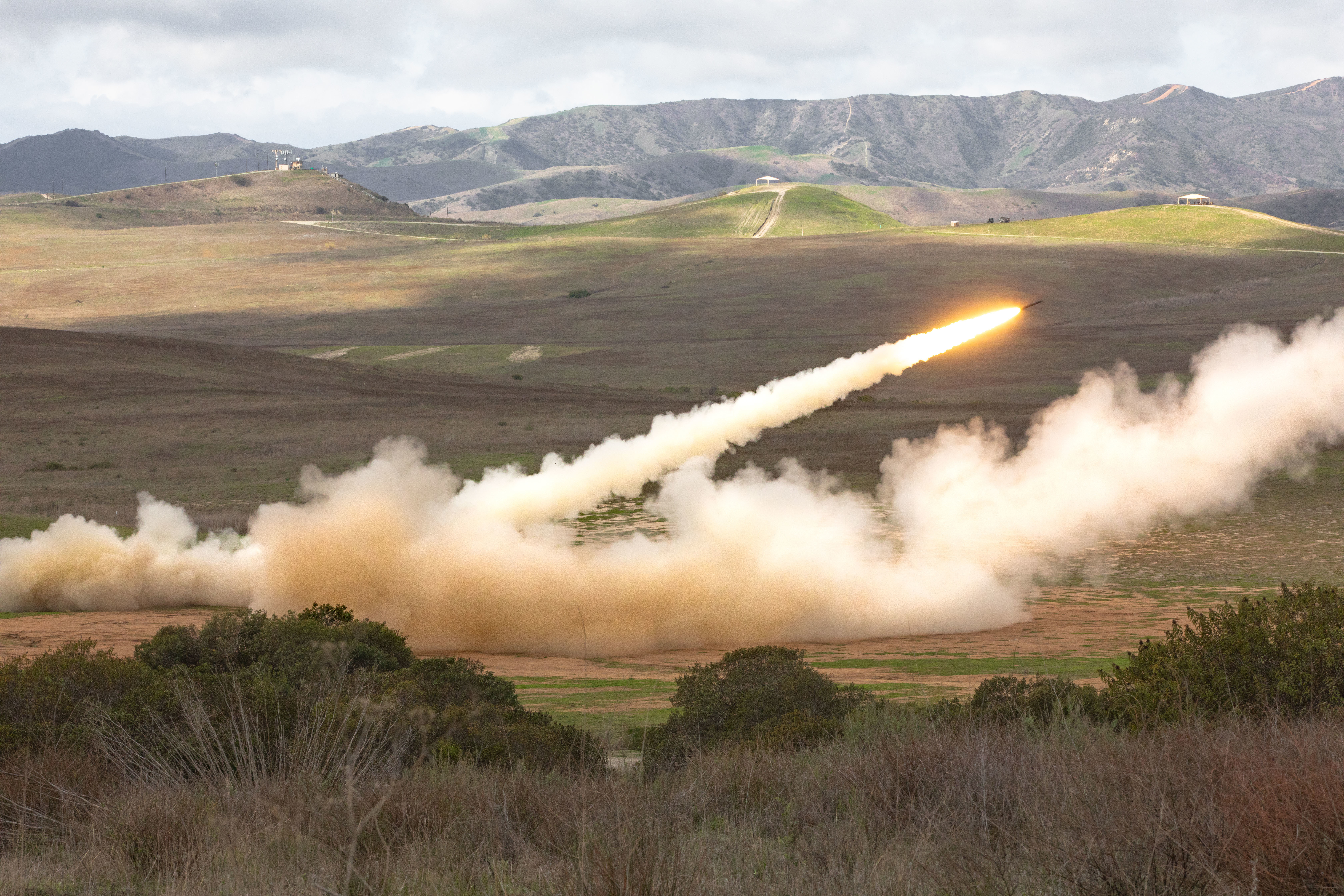
Marines fire a high mobility artillery rocket system in support of Exercise Chromite Watchfire at Marine Corps Base Camp Pendleton, Calif., Feb. 16, 2021. Chromite Watchfire is a training exercise that focuses on Navy and Marine Corps integration as well as combat readiness.

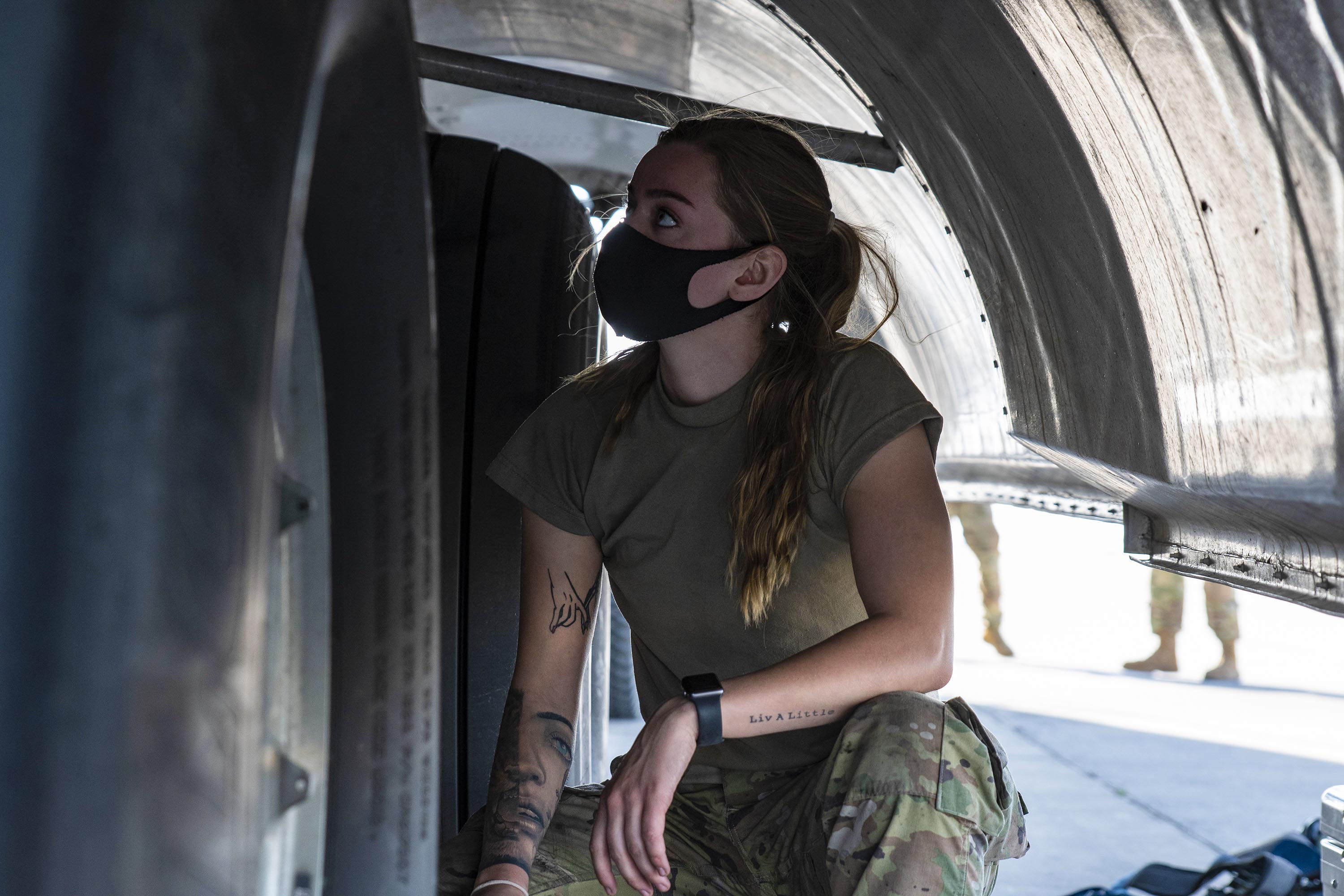
Air Force Senior Airman Jillian Strickland performs a post-flight check on a C-17 Globemaster III at Ali Al Saleem Air Base, Kuwait, Feb. 12, 2021.
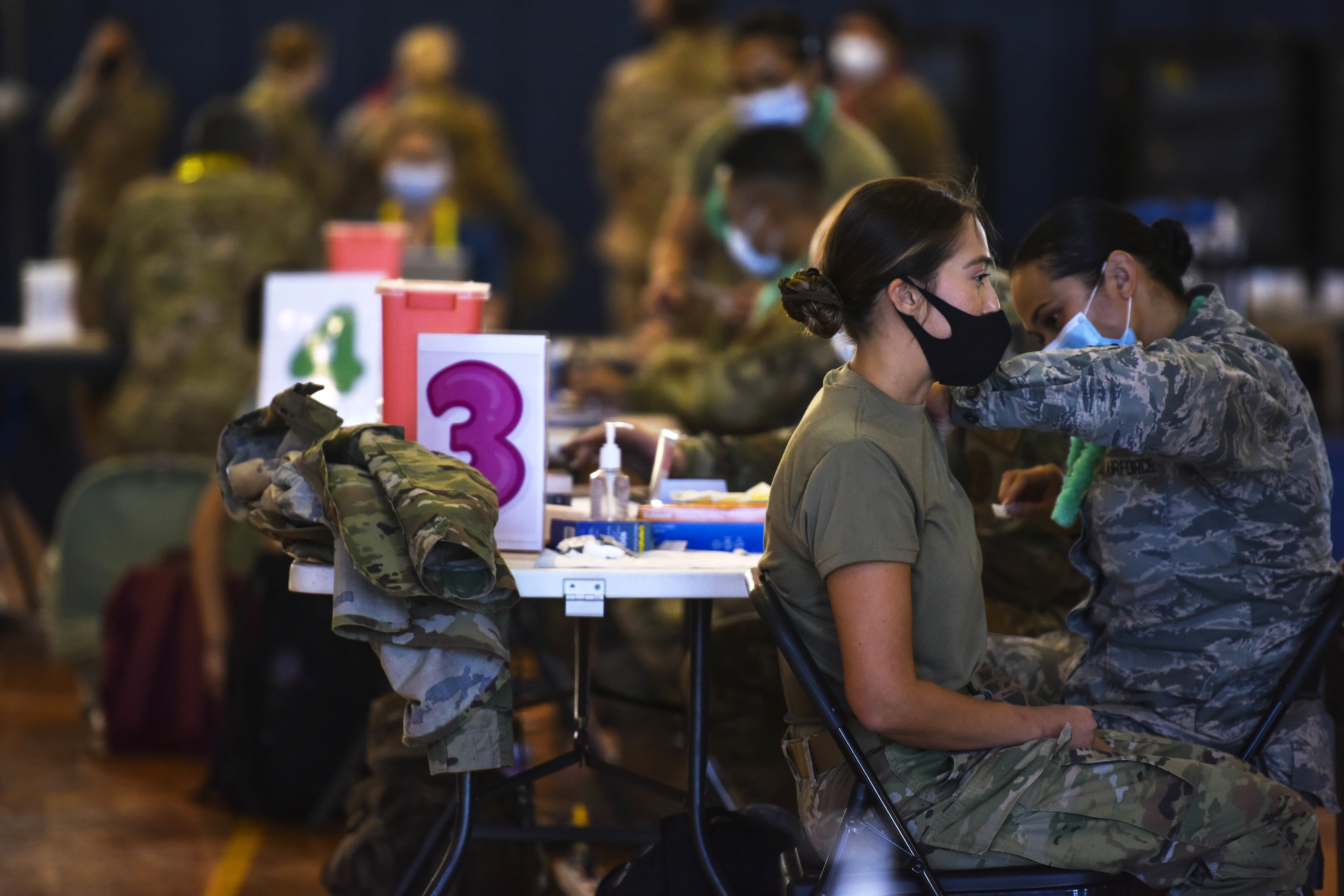
The 15th Medical Group hosts the first COVID-19 mass vaccination at Joint Base Pearl Harbor-Hickam, Hi., Feb. 9, 2021. Hawaii Military Medicine has begun providing the COVID-19 vaccine to eligible personnel on a voluntary basis.
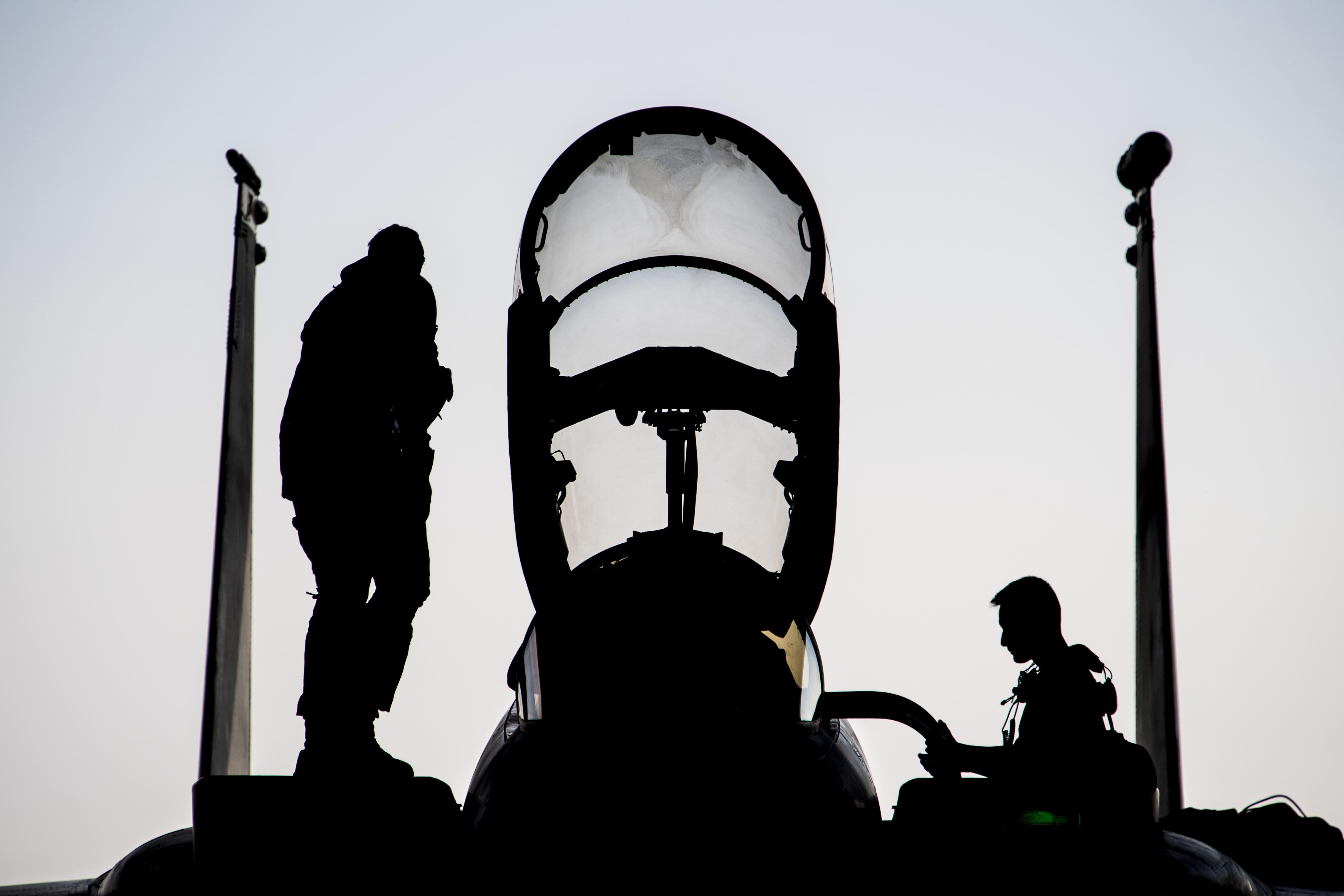
Air Force Capt. Ryan Heil stand on an F-15E Strike Eagle shortly after landing at Al Dhafra Air Base, United Arab Emirates, Feb 13, 2021.

Army Pfc. Valerie Strong and Army Sgt. Nathaniel Jones, both heavy vehicle operators with the 2220th Transportation Company, unload boxes of produce at a library to be distributed to local citizens in Tucson, Ariz., Feb. 16, 2021. The soldiers transported the produce from Nogales, Ariz., as part of the Arizona National Guard’s support of community needs during this state of emergency response.
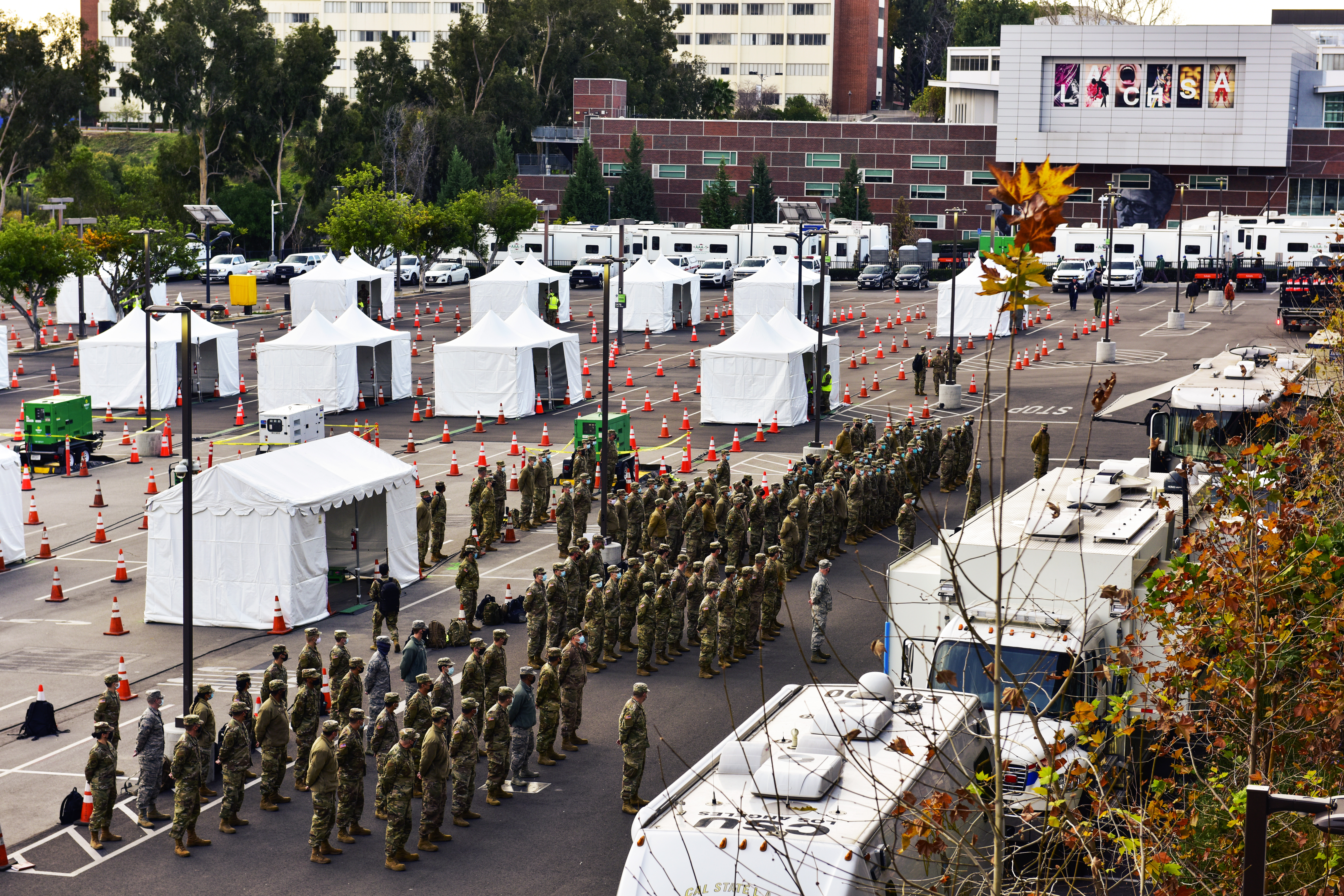
California Air National Guardsmen assigned to Joint Task Force Mustang attend a morning briefing at the California State University campus in Los Angeles, Calif., Feb. 15, 2021. The task force has been activated to support the Federal Emergency Management Agency’s and the California Governor’s Office of Emergency Services’ first whole-of-government, mega point of distribution site for the COVID-19 vaccine.
Feb. 17, 2021 | , DOD News
Europe and North America have an opportunity to open a new chapter in the security relationship within NATO, and the alliance defense chiefs are examining proposals during their virtual defense meeting, NATO Secretary General Jens Stoltenberg said in Brussels today.
It's Secretary of Defense Lloyd J. Austin III's first ministerial in his current role. The secretary has said he wants to rebuild U.S. alliances around the world.
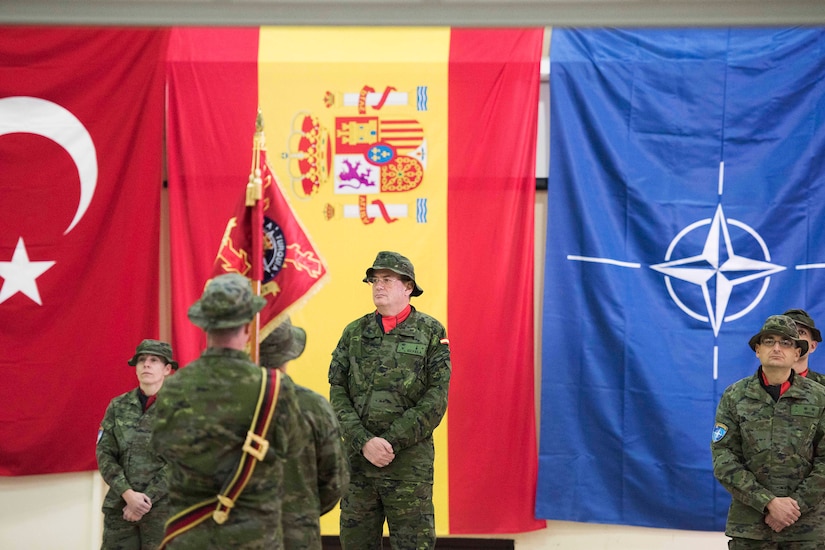
Today's discussions centered on proposals that could be part of the package presented to the alliance's heads of state when the NATO summit is held in Brussels later this year.
The defense chiefs examined proposals including strengthening allied commitment to deterrence and defense by providing incentives to contribute more capabilities and ensure fairer burden sharing, Stoltenberg said. "We also need to raise our level of ambition when it comes to resilience, which is our first line of defense," he said during a virtual news conference. "And we must do more to promote transatlantic cooperation on defense innovation so that NATO keeps its technological edge."
The ministers discussed increasing political coordination within NATO. Stoltenberg has said he favors using the organization more as a platform for consultation and coordination on more issues and in more formats. "At the same time, we need to enhance our political and practical cooperation with like-minded democracies around the world, so we can protect the rules-based order, which is undermined by countries that do not share our values, like Russia and China," he said.
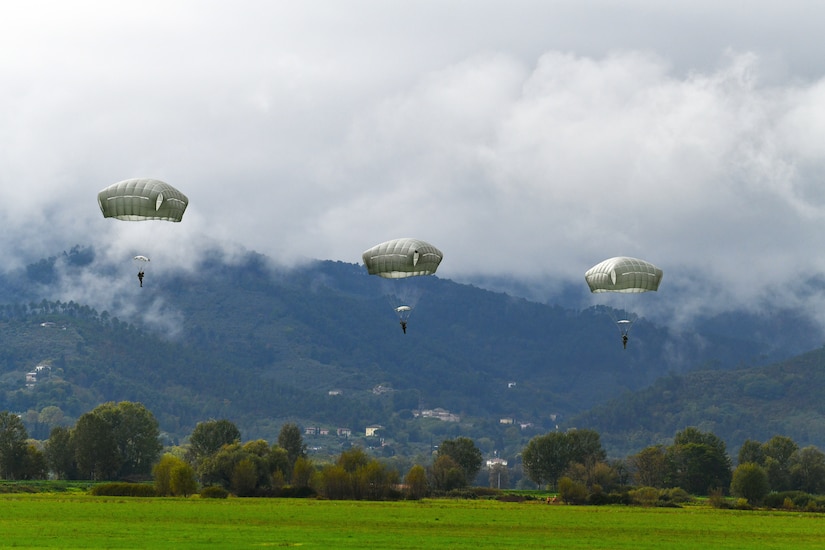
The ministers also discussed burden sharing. The secretary general noted that 2021 is the seventh consecutive year of increased defense spending by European allies and Canada. Nine allies will reach the goal of spending at least 2 percent of gross domestic product on defense this year; three met that goal in 2014. Since that year, European allies and Canada have cumulatively contributed an extra $190 billion.
"We are making real progress," Stoltenberg said. "But we must all keep the commitments we have made and continue to invest in our defense and increase the readiness of our forces. This is the only way to keep our nation safe in a more unpredictable world."
Tomorrow, the ministers will discuss NATO operations in Afghanistan and Iraq.
Feb. 17, 2021
Secretary of Defense Lloyd J. Austin III participated in his first NATO Defense Ministerial as the U.S. Defense Secretary today, providing remarks during two separate sessions. The first session discussed deterrence and defense, burden sharing, and Secretary General Stoltenberg’s ‘NATO 2030’ initiative. The second session discussed trans-Atlanticism, NATO-EU relations, Alliance resilience, and emerging and disruptive technologies.
The Secretary reaffirmed the President’s message that the United States intends to revitalize our relationship with the NATO Alliance and that our commitment to Article 5 remains ironclad. Secretary Austin referred to NATO as the bedrock of enduring trans-Atlantic security and said the Alliance serves as the bulwark of our shared values of democracy, individual liberty and the rule of law.
Secretary Austin emphasized that NATO’s most important task is to protect our populations and territory by presenting a credible deterrence and strong defense. He cited the multiple threats and challenges facing the Alliance including: Destabilizing behavior by Russia, a rising China, terrorism, and global challenges such as COVID-19 and climate change.
The Secretary thanked Allies for the seventh consecutive year of growth in defense spending and noted the importance of building on this progress. He also encouraged his colleagues to fulfill the 2014 Wales Summit Defense Investment Pledge where all Allies agreed to move toward spending two percent of GDP on defense and 20 percent of defense funds on modernization by 2024. Secretary Austin noted that defense spending is essential to ensuring we have the ready forces and capabilities needed to address Russia and other challenges to NATO.
On the ‘NATO 2030’ initiative, the Secretary supported the overarching goals of ensuring the Alliance remains strong militarily, becomes stronger politically and takes a more global approach.
The Secretary welcomed recognition by NATO Allies that China’s growing influence and international policies present challenges to trans-Atlantic security and looks forward to working together to address these challenges.
Secretary Austin welcomed the unique opportunities offered by increased NATO Partnership with the European Union, including efforts by EU countries to build capabilities that add value to our trans-Atlantic security, but emphasized that the NATO Alliance remains the essential forum for consultation, decision and action on issues impacting our collective security.
The Secretary closed his remarks during the second session by discussing the importance of working across the Alliance to improve early adoption of emerging and disruptive technologies, as well as the need to protect our supply chains, infrastructure and technologies from strategic competitors. He also emphasized the Department’s commitment to working with NATO to ensure democratic nations remain global hubs for innovation.
Secretary Austin thanked the allies for the opportunity to discuss these important issues and looks forward to continued consultation going forward.
Feb. 16, 2021
Secretary of Defense Lloyd J. Austin III spoke by phone today with Iraqi Minister of Interior Othman Al-Ghanimi regarding yesterday’s attack against U.S. and Coalition forces in Iraq. Both leaders condemned the attack and expressed condolences for the individual who was killed and the others who were wounded.
Secretary Austin and Minister Al-Ghanimi discussed the importance of a robust and expeditious investigation holding the perpetrators accountable for the attack, and Secretary Austin offered U.S. support to the Ministry of Interior as it conducts the investigation.
Both leaders reaffirmed their joint commitment to a strong U.S.-Iraqi partnership and the continued commitment to the defeat ISIS mission shared by the U.S., Iraq, and Coalition forces.
Feb. 16, 2021
The following individuals have been sworn-in virtually or in-person from Feb. 10, 2021, through today, Feb. 16, 2021.
For the lists of personnel sworn-in previously, please see the releases on Jan. 20, 2021, and Feb. 9, 2021.

A Marine conducts ice-breaking drills during extreme cold weather training in Setermoen, Norway, Jan. 31, 2021.

The USS Barry and the Japanese ship Towada sail connected during a replenishment in the East China Sea, Feb. 10, 2021.
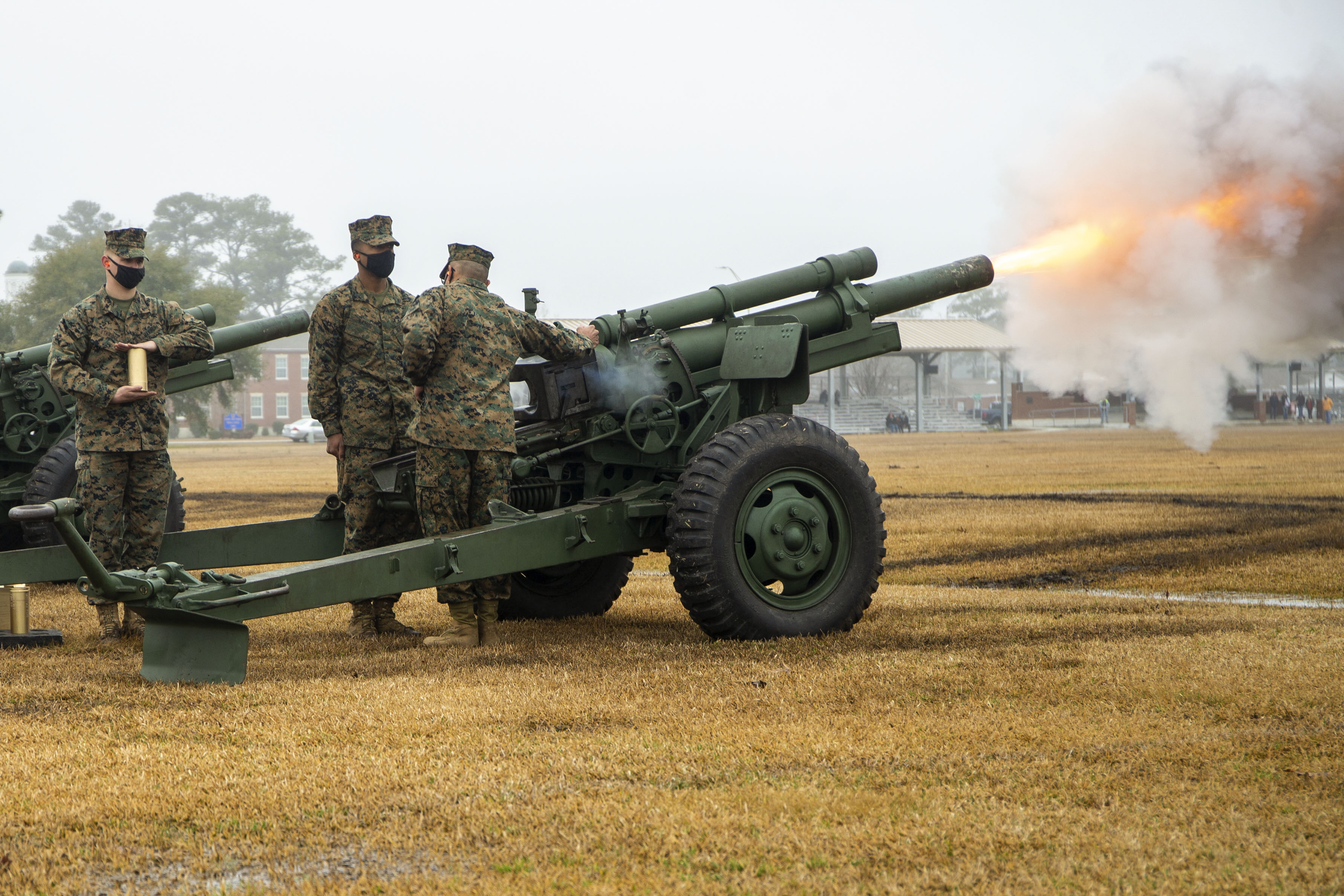
Marines fire blank rounds for a 21-gun salute during a Presidents Day ceremony at Camp Lejeune, N.C., Feb. 15, 2021.
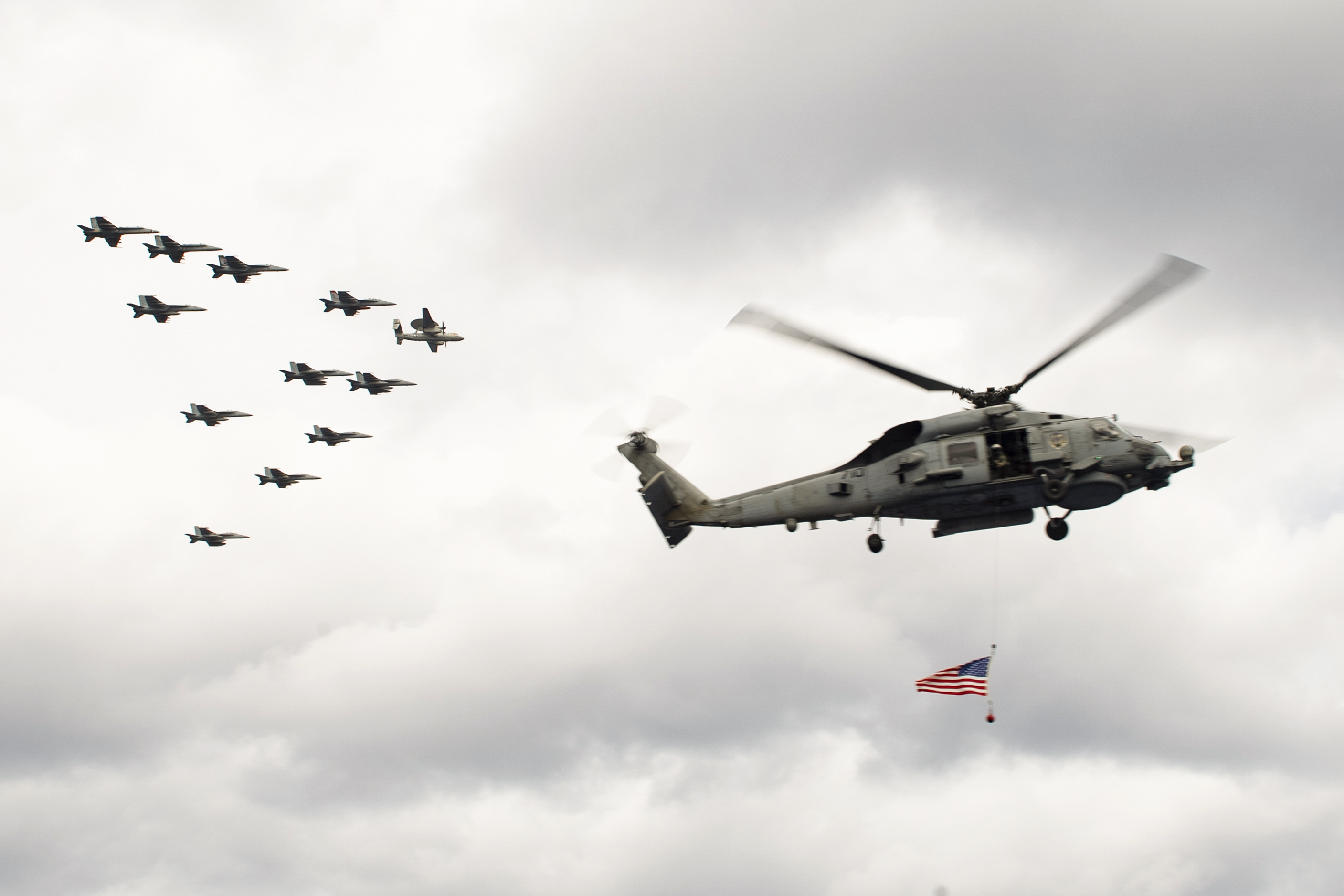
A Navy MH-60R Seahawk helicopter flies alongside other aircraft during an air power demonstration over the Pacific Ocean, Feb. 15, 2021.
Feb. 16, 2021
STAFF: We're ready to go.
(UNKNOWN): Yeah.
(UNKNOWN): Is it snowing outside?
STAFF: Jeez, I haven't seen a window in --
(Laughter.)
(UNKNOWN): -- (inaudible) 3:00.
STAFF: All right, I want to thank all of you for joining us today. In just a moment, we'll turn it over to acting FEMA Administrator Bob Fenton and NORTHCOM Commander General Glen VanHerck. They are here to talk with you -- or, well, they're here via phone to talk with you about the whole of nation COVID response and specifically support at community vaccination centers.
To all of the media that we've got on the phone lines, going to remind you the same reminder we give -- please mute your devices if you're not actually speaking. Got to have that happen, otherwise this -- this -- you know, all of the -- all of the feedback and all of that.
So without any further ado, we'll get moving. First up is acting FEMA Administrator Mr. Fenton.
ACTING ADMINISTRATOR ROBERT J. FENTON JR.: Hey, thank you for joining us today and appreciate being here today with General VanHerck. Along with a number of our partners, including -- not only including DOD but Health and Human Services and many other federal agencies, we are committed to ensuring every one that wants a vaccination can get one.
I'd also like to start by thanking Secretary Austin, as well as General VanHerck again, for their continuous, unwavering support as a part of whole of government response to COVID-19. I would also like to thank our partners from CDC, who have been instrumental in partnering with FEMA as we focus on the President's strategy for combating COVID.
This is the most pressing ethical and moral imperative of our time. Make no mistake about it, when we get through this, and we will get through this together, it will be because of the strength of the partnerships and the resiliency we build in our communities.
This week, we celebrated the opening of the community vaccination centers in Oakland and Los Angeles and DOD is playing a critical role here at the L.A. site -- in fact, all of the vaccinators are from the Department of Defense -- and we couldn't do this support without the partnerships like this.
In addition to these two sites, the White House has announced the opening of five additional federal (inaudible) sites and -- and more than -- and more to come -- two located in Texas and in New York -- in Texas, Arlington, Dallas and Houston, and New York in Queens and Brooklyn.
These pilot sites are designed to augment the safe, ongoing vaccination efforts. Together, we will work with them to ensure that we increase the operational throughput of those that need vaccines and we're working to connect all of the sites, from sites that the states are working to sites set up at the pharmacies to sites we're here and now setting up, to support social, vulnerable populations.
(Inaudible) with the President's strategy to combat COVID, FEMA’s plans include concrete actions to assist, augment and expedite equitable vaccination to the United States. One of the ways we're doing this is providing grant financial assistance. We've already authorized $3.2 billion in the first three weeks of the Biden administration to 40 states and territories, also providing federal personnel, equipment and supplies from a number of federal agencies to many sites across the country, and as I said, we're now opening up specific sites that are primarily federally supported but state managed here in Oakland and Los Angeles.
The pilot -- and we will continue to learn as we operate this site. It's important to understand the way that we selected and focused on these sites. We looked at large population areas, we used the CDC social vulnerability index, as well as census data to look at communities that were most (inaudible).
(Inaudible) is developing sites that can handle from several hundred to several thousand vaccinations a day. This site here is intended to, like, do 3,000 today, we'll ramp up to about 6,000 vaccines per day, to include supporting mobile sites throughout the community to hit those hard to reach population areas.
There's (inaudible) sites that we will open up, including, as you might've heard last -- this week, we've gone ahead and partnered with the pharmacies and provided a million doses out to the pharmacies next week. That will increase to two million doses to help them. In California, that's CVS. The other thing is in order to do that, we need to make sure that the supply is there (inaudible) next week but we actually project out three weeks so there's a confidence there will -- there to support that and that's increased each and every week since January 20th from a little bit over 8 million doses for the United States per week to 13.5 million doses now.
Just end with the president has made it clear that equitable access is paramount. FEMA established a Civil Rights Advisory Group to ensure equity in the allocation of scarce resources, our (audio gap). Also, housing and disability integration specialists (inaudible) in each state and working to support these needs.
Let me just close with a couple things and let me reiterate, FEMA is committed to ensuring everyone who wants a vaccine can get one. Two, everyone has a role to play in vaccinations, support your family, friends, and neighbors, and the need to help them get an appointment or getting a vaccination.
And lastly, we need continue to take safety precautions, wear a mask, practice social distancing, and get vaccinated. We're all a part of the solution for this pandemic safety.
STAFF: And for all of you on the line as well, I'd like to repeat, please if you're not speaking please have your device on mute. We're getting -- we're getting a little bit of feedback making it hard to share this information. Thank you. Without -- without -- without any further, NORTHCOM Commander General Glen VanHerck.
STAFF: Thank you.
GENERAL GLEN D. VANHERCK: Hey, thanks Bob, I -- I really appreciate the (inaudible) as we talk to the Pentagon press corps. I think it's important they understand the roles and responsibilities. And to the Pentagon press corps, thanks for your time. I look forward to talking to you about COVID today but more importantly further in the future about other NORTHCOM equities and NORAD equities moving forward.
After administrator Fenton and I completed a walk-through of the site, and then a conference with the governor and local leaders here today, I can tell you that the site is impressive, it is ramping up, and it is as planned right on time for today, despite what you've heard. All along we worked with FEMA and the -- the department and the target go for this site was 16 February and that was delivered upon. The site is ramping up quickly and it is like the FEMA administrator said, it will get toward 6,000 vaccinations per day.
As the commander of NORTHCOM and NORAD, I have a couple of missions. First, is defending North America in my NORAD hat, in my NORTHCOM hat defending the United States of America. We also provide defense support of civil authorities. All of those are no-fail missions.
I want to tell is the threat to our homeland is absolutely COVID and that's what we're attacking here today. It's important to realize that -- that it is a threat and we have to take an operational perspective. That is a no-fail admission.
In addition to the fact that defense support of civil authorities is no fail as well and we take great pride in that. I'll tell you the Secretary of Defense has been clear. Secretary Austin is a top priority as it is for the administration. He said that DOD can bring capability and capacity and that's exactly what we're doing and we're pretty good at it. And we look forward to bringing more. That's what you had ongoing here in California today. The first of its kind, a state-led, federally supported with DOD Title 10 active-duty forces.
I can't overemphasize the incredible partnership with FEMA that made this happen and working with the state and our local authorities here as well as the -- the California National Guard. As you're well aware, FEMA's request for our forces from DOD including 100 teams, 50 type 1 teams, 222 personnel, and 50 type 2 teams of 139 personnel.
I want to make it clear how we're sourcing those teams as we go forward, I think there's a little bit of confusion. So, my first request for forces as the NORTHCOM commander was the first five teams. That was for all type 1 teams and it included 1,110 personnel total. I have asked the Secretary and through the joint staff for the additional 95 teams as well.
Which importantly is this -- the sourcing for that is been -- has been tranches and so what I have been allocated as the commander of NORTHCOM is the first two tranches which is the first five type 1 team -- teams and then 10 type 1 teams in the second tranche along with 10 type 2 teams in the second tranche and that was about 3,700 personnel that are allocated to prepare to deploy. They haven't been given a tasking to deploy at this time.
This is clearly a whole government effort and we've been assisting for over a year for this whole government effort to get after this threat of COVID. I'd just like to quickly tell you that we've provided over 4,200 DOD personnel in support of FEMA mission assignments in 14 states, 44 separate locations, 63 hospitals, doing everything from our original response to embedding in local hospitals and as you know today, standing at this COVID vaccination center.
Right now what we have is we're completing our mission here in California for folks embedded in the hospitals. We still maintain our folks in Arizona, we have folks in Texas, and we have folks in the Navajo Nation.
I'm -- I'm encouraged by the downward trends I see and hopefully, we'll continue moving forward as the vaccine moves forward and not have to have more folks in the hospitals but we're prepared to do so if we can. You heard Mr. Fenton talk about the way forward with regards to further sites and so I won't go into detail but I will tell you, this site here on 16 February, type 1 provided by the -- the U.S. Army, 222 personnel.
We'll provide three sites, we'll have the Air Force in a type 1 team in Houston, we'll have a -- the Army in a type 2 team in -- in the Dallas area along with the United States Marine Corps. 24 February we should be up and running administering vaccines. In the New York area also on 24 February, in Queens, and Brooklyn -- in Queens, we'll have a Navy type 2 team and we'll have an Air Force type 2 team in Brooklyn.
I want to be clear with regards to the New Jersey support which is out in the public as well. That is separate from the FEMA request for 100 teams, that support is being provided -- provided by troops that the Secretary of Defense has already allocated to me to support hospitals.
Out of those forces I'm carving out teams that will support not only the New Jersey area but the U.S. Virgin Islands in the -- in the not too distant future. New Jersey actually, site one, the first team was effective on 14 February and administering shots. We're working with FEMA on the site two and site three and the potential exists for a fourth site in New Jersey.
Two sites currently being worked with FEMA in the U.S. Virgin Islands, St. Thomas, and St. Croix. We think they'll be about the first or second of March but don't hold me to that. Each of those teams in New Jersey and the U.S. Virgin Islands are 25 person teams strictly medical, no support there, (inaudible) and provide vaccinations and I'll pause there and we'll take your questions.
STAFF: Okay. So, yes, we will stop and take a couple of questions. When asking a question please let us know which of the principals you're addressing the question to. First up we'll go to the phones. For AP, Lolita Baldor, please.
Q: Thanks so much. I just want to let you all know that I think toward the end we could hear the General stated clearly that early on particularly we could not hear the FEMA Administrator very well at all. It -- it was very muffled and I think we missed large chunks of his conversation, just FYI.
I have questions for Mr. Fenton. Do you still expect that you would use and need the full 100 military teams? And how quickly do you think you'll be able to get those out to various parts of the country? And for the General, I don't know if either -- either you or Mr. Fenton, if you could explain a little bit to us about the difference between the 100 teams -- 100 vaccination centers that the Biden administration has said they want to set up and how that number jives with the 100 military teams or the other teams that the General has talked about? Thank you.
MR. FENTON: Yeah, this is Bob Fenton, acting Administrator of FEMA. Hopefully you can hear me better now.
Q: Yes, a little better, thank you.
MR. FENTON: Okay. So how did we get to the 100 teams? What we did is we looked at -- as vaccine becomes more available and we get more points, in March and April another vaccine comes on, we need to make sure we have the throughput in the system to vaccinate people.
And so we looked at 100 teams as having the capability to vaccinate over 400,000 people per day. For example, right now in the United States, we're up to vaccinating 1.67 million people today -- 1.67 million people a day.
So as vaccine increases or supply increases in the out months, we need to have other ability to vaccinate people. How do we do that? One, we're providing funding, the $3.2 billion that I talked about, to state and local governments to bring on their capability and resources. Two, the President's authorized the National Guard 100 percent to bring on more resources from the National Guard. Three, we're augmenting states and local governments with gaps of personnel from the federal side, whether they be vaccinators, equipment supplies, maybe locations to assist them in vaccinating.
But we always knew along the way we would have to provide predominantly federally supported sites, which today is a pilot of these federal sites. These will continue to grow as supply comes onboard. In addition to what we're doing through the states and the different sites they're using, whether it be medical facilities, those kinds of things, we're directly vaccinating this -- the (inaudible) nursing facilities and healthcare clinical homes.
And then we're also sending vaccines to the pharmaceutical -- the pharmacies, and sent a million doses last week, two million doses next week. And so we want to use all of the above to vaccinate Americans. How much will we have to get to that 100 teams? It depends on how much the pharmacies can do, how much states and local governments can handle and what is the gap? We wanted to make sure we had the capabilities to go up to almost 500,000 vaccines a day. That's what the 100 teams buys us. How much we'll use will depend on vaccine supply and the capability of state and local government, the pharmacies and other avenues.
GEN. VANHERCK: Yeah, to answer your second question, the -- the teams, the 100 teams were designed for high capacity -- 6,000 vaccines per day for a type one team and -- and for type two, 3,000 per day. That's all based on FEMA's request.
The -- the smaller sites in New Jersey did not have a requirement for that capacity. And so I was able to take those forces from forces I already had allocated to me to meet the demand signal by FEMA -- not DOD, by FEMA for those sites.
STAFF: Okay. Next up we'll take -- we'll take one from the floor here. Tara Copp?
Q: Hi, thank you for doing this. For General VanHerck, could you describe what the military personnel that will be assigned to the Dallas and Arlington sites, what they will actually be doing? And then for either one of you, just a numbers clarification -- the 3,700, are they all active duty? And is it 3,700 plus the 1,100 that have already been sent or is it 3,700 total? Thank you.
GEN. VANHERCK: Yeah, let me answer that last question first. They're all active duty. Only 222 have been sent, plus the 25 that I sent to New Jersey. They're all on prepare to deploy orders, they've been allocated to me as the Commander to NORTHCOM to utilize for mission assignments, approved by the Secretary at the request of FEMA.
So those forces are ready to go and they're all active duty. With regards to your -- your -- your first question, could you remind me of that? I forgot that one.
Q: If you could describe what, if -- you know, you're -- a civilian going to the Dallas or Arlington or Houston sites, what exactly will they see military personnel doing? And then I'm still confused, I'm sorry, on the number. Is it 3,700 total or is it 3,700 plus 1,100 that are on prepared to deploy?
GEN. VANHERCK: The 222 person team has 80 persons assigned to it that will administer vaccines. In addition to that, as other support -- for pharmacists, for example, you have to have pharmacy techs in pharmacies to prepare the vaccine. You have to have runners, et cetera, to distribute the vaccine.
As folks pull into this site where you drive in, we have to have support personnel who screen those persons, ensure that they've had a -- a -- a proper screening ahead of the vaccine, in addition to have supervisors that are nurses, such as RNs, providing supervisory roles over medics that are providing the vaccines, and we also have medical providers who are supervising after the vaccine to ensure there's no complications.
So gets pretty complicated to a person who may have the -- a -- a post-vaccine event that would be handled by a -- a -- a military active duty person providing that support. I hope that answers your question.
STAFF: (Inaudible). Next up -- Lucas.
Q: General, is the National Guard mission in Washington DC competing with National Guard troops that you need to help administer the vaccine?
GEN. VANHERCK: Hey Lucas, those -- those National Guard troops are not mine. That -- that would be a better question for General Hokanson or FEMA here. I -- I am not aware of any competition for those National Guard folks.
Q: Thank you.
STAFF: Okay, we'll go back to the phone lines. We've got Jared Zuba from Al-Monitor.
Q: Hi, no question at this time. Sorry.
STAFF: Okay, thanks. Back to the floor. Tom?
Q: Hi, thank you for doing this. Yesterday, some of the governors sent a letter to President Biden asking for a sort of a national approach to the whole vaccination effort. Is this part of what you're hearing from the White House and how does those requests from those governors to the President yesterday affect, like, your announcing today and -- and looking forward to doing?
MR. FENTON: So the President has a national plan (inaudible) his -- his strategy for the COVID-19 response and pandemic record has been -- we'll brief you today, here's what that strategy is, so (inaudible) providing the resources to states and local governments. So 100 percent funding for any support to vaccinate. It then provides federal resources to states and local governments if they need certain capabilities, specific personnel, expertise whether it be medical, or other capability. It made the National Guard 100 percent reimbursable, so that they could leverage the National Guard to the fullest extent possible.
And then lastly, increase throughput by providing primarily federally supported sites which is (inaudible). So we're doing this now in California, two locations, then we're moving on to Texas, New York, and the White House will announce other locations that we're working on.
The key and underlying principle to the president's plan is that that we need equity and that's no inequity as far as who we vaccinate. And we focus on the most socially vulnerable populations when we do that. So the president does have a strategy, we’re following that strategy, and it includes increasing supply in each week, which we have done, and then providing a dedicated number, that goes through which has happened.
STAFF: Okay, next up, Oren?
Q: Is FEMA bringing its own supply of vaccines to these sites that require -- will use type one and type two teams, or is it using the state supply of vaccines? And if you're aiming for 400,000 a day, or the capability to do that it seems by the math you're going to need many more type one and type two teams. Are there outstanding requests for sites like these from states that have not been fulfilled?
MR. FENTON: Yes, so let's start with the first question here. And there are no outstanding requests in the system right now, this is part of a pilot to build this federal capability and we've reached out to states.
As far as dedicated supply, this is a supply that is above and beyond what the state's allocation is. So this week the dedicated total was 11 million.
This is a vaccine split across the United States – next week it'll be 13.5 million, so it’ll increase next week and no less than that, or more than in each of the proceeding weeks after that after three weeks.
So this is a dedicated supply, above and beyond the state allocation, above and beyond what the pharmacies are achieving in a pilot phase right now. What we’re working through is the criteria for that pilot. Large population areas using the CDC Social Vulnerability Index to focus on populations at risk that -- to ensure equity in the vaccination of individuals.
STAFF: Okay. Hey this is Captain Kunze, we're going to have time for one last question. Thanks.
STAFF: Then we'll stay on the floor here. Kristina?
Q: Great. Thank you for doing this. Just to clarify, I think you said 500,000 vaccines a day, or did you say 400,000? And when will this capacity be up and running?
STAFF: I'm sorry, I missed the first part of your question, if you could ask it again, please?
Q: Yes. Did you say 400,000 or 500,000 vaccines a day? And when will this capacity be up and running?
MR. FENTON: So for each type one site that's 6,000 vaccinations per day. So we have two sites here in California that are primarily federally supported, state managed. So these sites will increase to three sites in Texas, two of those will be type two which have a throughput of 3,000 per day and one of them will be type one which is a 6,000 throughput.
In New York it will be two type twos which are 3,000 per day. So that's the throughput per day. What I said when I talked about 400,000 plus is if you took the 50 – when someone asked me, how did I get to 100 teams, I simply took 50 type ones and 50 type twos which would be 300,000 per day using that 6,000 per day and 150,000 per day which would be 50 type twos and projected a need over months to give DOD a demand signal.
So as supply ramped up that we had enough throughput to vaccinate people. That doesn't mean it all comes out at one point -- this is a phased operation (inaudible) supply and if there's other available throughputs such as all of the state and local sites out there -- the pharmacies, those will be taken into account.
So I don't think we will go past the 100 sites. In fact, I anticipate the number to be less than that, but I wanted to make sure I had that full amount ready and sent DOD a big enough demand signal that if we did need it that much in a short period of time, they were ready for the mission.
Q: Got it. Thank you.
STAFF: All right, folks, that's all the time we have for questions today. I want to thank you for joining us, and for the work you do. Have a great day.


 Posts
All Comments
Posts
All Comments
Posts
All Comments
Posts
All Comments


