Tuesday, February 16, 2021

NATO Defense Ministerial Background Briefing

 Feb. 16, 2021


STAFF:  I'm going to get ready and get started here. 

So this afternoon we have (senior defense official one) the ***  and (senior defense official two) the *** They are here to discuss the NATO Defense Ministerial and the Department's priorities for the event. 

In line with the ground rules in the media advisory, this interview is on background attributable to U.S. Senior Defense Officials.  So when you see the transcript later, *** will be identified as Senior Defense Official one, *** is Senior Defense Official two. 

So (senior defense official one) in a moment is going to offer some opening remarks. 

Following the opening remarks, I will call on reporters for questions.  We have about 20 minutes or so, so I'd ask that you keep the focus on the topic at hand and keep it to one question please.

With that, (senior defense official one), the floor is yours.

SENIOR DEFENSE OFFICIAL ONE:  Thanks so much and thank you all for your patience as we had tech adventures.  So good afternoon, I would like to thank you all for the opportunity to talk about the upcoming NATO Defense Ministerial and help communicate the importance of this ministerial to the Department.

I want to spend a few minutes just offering some context about the Department's priorities for the ministerial.  As you all are no doubt aware, this will be the administration's first engagement with the NATO alliance and with the international community.

The secretary's first priority will be to carry forward the message that you heard from the president at the State Department and at the Defense Department in recent weeks.  He underscored that diplomacy and working with our allies and partners is the basis for our global power and collective security. 

The secretary intends to assure our allies that the United States' commitment to the NATO alliance and to Article 5 remains ironclad.  He will reinforce that the United States is committed to consulting on issues that impact allies, including our global force posture review and the missions in Afghanistan and Iraq.

And the secretary is looking forward to virtually meeting and hearing from NATO counterparts and to -- and to -- and to addressing important issues including:  strengthening our collective deterrence and defense to protect our populations, our most important duty; reinforcing allies shared responsibility to procure, prepare, and provide the ready forces and capabilities necessary to accomplish this -- this duty; reviewing Russia's destabilizing activities; and discussing the challenges presented by China; reviewing our operations, specifically the Resolute Support Mission in Afghanistan and the NATO Mission in Iraq; and hearing about the secretary general's NATO 2030 initiative to ensure the alliance remains strong militarily, becomes stronger politically, and takes on a more global view.

With that, (senior defense official two) and I look forward to your questions.  Thank you.

STAFF:  All right, we'll start in the room with Bob, Bob Burns from A.P.

Q:  Hey, this is Bob Burns with A.P.  On the -- on the issue of Afghanistan, I don't know which one to address, but -- so the question obviously about the May 1st deadline looms, approaching quickly.  Can you say that -- that Secretary Austin will express the administration's view on that at this point? 

And in a related Afghanistan question, in -- you know, in your view -- in the administration's view, what incentive does the Taliban have to accept any delay of that deadline?  Why -- why would they do that?

SENIOR DEFENSE OFFICIAL ONE:  Thanks for that question, Bob, appreciate it.  So Afghanistan is, of course, on the agenda for the NATO Defense Ministerial and Secretary Austin looks forward to consulting with NATO defense allies on it.

As you know, of course, the Department is participating in an administration-wide review and there have not been any decisions on Afghanistan troop levels.  The United States and NATO went into Afghanistan together, we will adjust together, and if the time is right we will leave together.

On your final point regarding Taliban incentives, I would say right now there is this whole-of-government review that the Department of Defense is actively participating in, and I think we can assume they'll be looking at all the different aspects of that conflict.

Would you like to add anything?

SENIOR DEFENSE OFFICIAL TWO:  Yes, I guess I'd just add to that that, you know, one of the dimensions, of course, is reviewing the U.S.-Taliban agreement including Taliban compliance with that agreement.  And so as to their incentive, I think there's every incentive for them to -- to live up to that agreement. 

And -- and -- and we'll see how it turns out in the review, but -- you know, I think that it -- it will play into how -- how our government, you know, comes to a conclusion on where we should go.  And then we will look forward to consulting with our allies at NATO as well in the -- in the days and weeks to come.

STAFF:  Okay, thank you.  Let's go to, Tom.

Q:  Yes, obviously on Afghanistan -- and you mentioned compliance, Jens Stoltenberg just yesterday said there's a need for the Taliban to do more when it comes to delivering on their commitments.  Would you agree to that?  Both of you, if you could, address that?

And also, there was a USIP study, as you all know, mandated by Congress.  And General Joe Dunford, former chairman and -- a lot of Afghan time, he said, if the U.S. leaves precipitously you could likely have a civil war and the terrorists could reconstitute in 18 to 36 months.  I wonder if you could both address that.  Does that ring true to you from what you know?

SENIOR DEFENSE OFFICIAL ONE:  Thanks for that -- for that question.  I would say that violence must go down.  I think as you heard from the secretary general yesterday, we all are in agreement that we do not want Afghanistan to become a safe haven for international terrorism again.

My understanding is that the review being conducted across the government is -- is broad and deep.  And so I'm fully confident that folks are deeply cognizant of the USIP study and all of the, kind of, insights from the smart folks that -- that have conducted it.

Do you want to add anything?

STAFF:  Okay.  All right, let's jump over to the phones --

Q:  Wait --

(CROSSTALK)

Q:  -- You said "violence must go down."  If it doesn't go down, therefore, troops shouldn't leave?

SENIOR DEFENSE OFFICIAL ONE:  I am not saying that.  I'm saying that there is a desire across the board for violence to go down in Afghanistan.

STAFF:  Okay.  All right, let's jump to the phones now so I'm keeping it -- keeping it even as possible.  Sylvie from AFP?

Q:  Hello, thank you.  I would like to ask a question about Iraq.  Does the latest rocket attack in Erbil -- does it change the position of the administration on the strategy in Iraq?

SENIOR DEFENSE OFFICIAL:  Thank you very much for that question.  I'll refer you all to the readout that Secretary Austin just released of his call with the Iraqi defense minister.  He held that call just hours ago. 

I'd also refer you to the statement by Secretary of State Blinken yesterday.  It was a strong and powerful statement.

Obviously, the Department of Defense expresses our condolences to the injured service member, as well as to the family and friends of the contractor killed, and to those who were injured.

Would you like to add on that?

STAFF:  Okay.  All right, thank you very much.  Staying to the phones for the second -- or for the next question, let's go to Helene Cooper from The New York Times.

Q:  Hi, thanks for doing this.  I'd like to stay on Iraq.  The Trump administration sort of had a red line that an American killed was basically a line they did not want to see crossed.  Does the Biden administration have a similar red line?

SENIOR DEFENSE OFFICIAL:  Thanks for that question, Helene.  Right now, I think folks are studying hard the events that have happened in Iraq over the last 24 hours. 

You have seen various folks, including, of course, the Secretary of Defense, reach out to their counterparts and are looking closely at the situation and what makes sense from a U.S. policy perspective.

I should note, since we are, of course, trying to talk about the NATO defense ministerial today, Iraq will be on the agenda for the ministerial later this week and we are enthusiastic about the continued and, indeed, enhanced NATO focus on security and stability in Iraq.

STAFF:  Thank you.  Barbara Starr?

Q:  I wanted to turn to ask you about Russia at the ministerial.  Other than referring to generally Russia's destabilizing activities, what is the approach on Russia, on -- at the ministerial agenda?  What are the top priorities to be discussed about Russia specifically?  And at this point, what does the U.S., the Department of Defense need to see from Russia to be able to trust them?

SENIOR DEFENSE OFFICIAL ONE:  Great, thank you so much for those questions.  Look, the -- the -- the first session of the defense ministerial is going to focus on the alliance, on the strength of deterrence and defense, and I think that is inextricably tied to how one thinks about Russia, of course.

I mean, at the end of the day, NATO's most important function is to present a credible deterrence and defense.  That means protecting our populations and our territory.  We all share in that responsibility.  I do think that you are going to see at this ministerial a real focus on revitalizing the U.S. relationship with the alliance, a change in our tone and approach, a desire to work with our allies and partners.

And as I noted, that is all inextricably tied to what we have seen from Russia.  The -- you know, the -- the Secretary -- Secretary Austin talks about how we cannot succeed on our own, about this unparalleled network of allies, and I think that should be, in and of itself, a really strong and notable signal to Russia, whose destabilizing and irresponsible behavior just has -- has only continued to be profoundly unhelpful.  Do you want to add on that?

SENIOR DEFENSE OFFICIAL TWO:  Yeah, I'll just go just a little bit deeper on -- on Russia.  I mean, it's very apparent Russia's a threat to all NATO allies, including the United States.  Russia erodes transparency and predict -- predictability.  They are using military force to achieve their goals.  They support proxy groups and sow chaos and doubt, and undermining the rules-based international order.

So this administration has already made clear that we will work with Russia to advance our own interests while holding them to account for their reckless and aggressive actions.  And so we'll look forward to discussing that with our -- our allies this week.

Q:  I'm sorry but very quickly -- as you sit here today, how does Russia, in your views, specifically threaten the United States?

SENIOR DEFENSE OFFICIAL ONE:  I think we see a desire by Russia to undermine security and stability around the world with its authoritarian approach.  We see this also with its cooperation with China, a marriage of convenience -- excuse me, a partnership of convenience, as General Wolters has referred to it. 

That undermines global security and it has been in the U.S. interest and in NATO's interest over the last 72 years to have a -- an international rules-based order.  We've seen, whether it's through the hybrid warfare approach, through irresponsible use of cyber, we have just repeatedly seen examples where the Russians have tried to undermine security and stability.

STAFF:  OK.  (Inaudible)?

Q:  Thank you.

SENIOR DEFENSE OFFICIAL ONE:  Sorry I didn't (inaudible).

SENIOR DEFENSE OFFICIAL TWO:  Nope, it's good.

Q:  You mentioned about Afghanistan, that we stay together, we leave together.  Does this apply also to Iraq?

SENIOR DEFENSE OFFICIAL ONE:  I would say we will be consulting -- thank you for that question, first of all -- thank -- we are going to be consulting -- defense ministers will be consulting on Iraq during the defense ministerial and that consultation will be -- will be meaningful, of course.

The Defense Department is committed to supporting Iraq's long term security, stability and prosperity and to the enduring defeat of ISIS.  As I noted earlier, we are enthusiastic about and welcome NATO's increased -- increased focus on Iraq, its increased and expanded role on NATO Mission Iraq.

I would just underscore, given your question, that the department, as you know – right now , is in the throes of conducting a Global Force Posture Review.  That's happening with our interagency partners.  So I wouldn't want to comment obviously on the fruits of a review that I think just started but -- but I -- I would expect that -- that that would be relevant here.

STAFF:  OK.  Tara?

Q:  Thanks.  You know, previous ministerials have also given each of the defense ministers an opportunity to have these offline tops -- topics.  How does that happen in an online ministerial?  And related to that, with all of the review of global force posture, will there be another look at potentially relocating some forces to Poland?  That -- some of those decisions had been in process but I think you're on pause right now.

SENIOR DEFENSE OFFICIAL ONE:  Yeah, thanks so much for -- for that question.  This virtual ministerial is, of course, on one level, somewhat logistically easier, as you can imagine, since we're not all traveling, but -- but it -- it does inevitably just create, you know, new opportunities and new challenges.  And so we've tried to facilitate the Secretary engaging his counterpart, for example, the NATO Secretary General, which -- which he has been able to do.

And we're obviously tightly linked up with -- with folks across Brussels, in a way to try to ensure that we're well set for the ministerial and -- and for the margins, but as you know, of course, this being the fourth virtual defense ministerial, consultations are the priority but as we've all tried to figure out in COVID times, it's a little bit more complicated.

On the Global Force Posture Review, that will be looking holistically at U.S. global force posture and seeing how and in what ways it is or is not lined up with the -- with the departments and frankly the national security level strategy.

I -- I would expect, of course, that Europe will be under -- our -- our -- our posture distribution in -- in Europe will be explored through it.  To be very clear, the posture in Europe is critical to U.S. national security interests and I would in no way expect to see anything that would look like, say, a withdrawal along those lines.  Do you want to add to that?

SENIOR DEFENSE OFFICIAL TWO:  Yeah, sure.  I'll also note that the timing is actually very interesting here because Secretary Austin obviously just got in, has been doing a lot of initial phone calls with allies.  And so last week, he actually talked to his Polish counterpart, and I think we put a readout of that up online. 

But yeah, as we're looking at the -- at -- at the Global Posture Review, obviously Poland's included in that, Germany, Italy, any place that we have forces because it is so -- it's such a comprehensive review.  But that -- that being said, one of the President's key priorities for the review is reinforcing the relationships with allies as we confront global challenges.  And so that will be taken into context throughout this review, which is -- is going to be ongoing for the next couple of months.

SENIOR DEFENSE OFFICIAL ONE:  Yeah, I would just underscore on that that there will be consultations across the interagency and with allies and partners ...

SENIOR DEFENSE OFFICIAL TWO:  Definitely -- that's right.

SENIOR DEFENSE OFFICIAL ONE:  ... absolutely, as -- as this review is going on.  Consultation really is -- is kind of the name of the game here.

(CROSSTALK)

Q:  ... do you anticipate Poland coming up at the ministerial?

SENIOR DEFENSE OFFICIAL ONE:  The U.S. posture in Poland at the ministerial?

SENIOR DEFENSE OFFICIAL TWO:  I -- I don't think it will, no.  No, we had a good discussion last week with -- you know, between Secretary Austin and Minister Blaszczak but I think that there are larger issues that the alliance will be dealing with as a whole, and obviously Poland has a seat at the table for those discussions.

SENIOR DEFENSE OFFICIAL ONE:  So Secretary Austin will just -- you know, he will talk about the Global Force Posture Review that has just kicked off, obviously he will signal his desire to consult and to -- to hear from -- from -- from our allies in an effort to revitalize our relationship with -- with the alliance.  But I won't express sort of specifics on that.

STAFF:  OK.  I need to jump back to the phones.  Let me jump back to the phones here.  I'll come back to the room. 

Q:  Are you doing bilateral meetings with us or not?  No?

SENIOR DEFENSE OFFICIAL ONE:  Should I take that or….  OK.  Thanks for that.

(CROSSTALK)

STAFF:  Real quick response.

SENIOR DEFENSE OFFICIAL ONE:  There -- effectively there are not bilateral meanings tied to the defense ministerial but he's been doing -- the secretary has been doing just a slew of those over the last few days as you no doubt have seen.  He has been kept quite busy on that.

SENIOR DEFENSE OFFICIAL TWO:  That's right.

STAFF:  All right, let me jump back to the phones so Mr. Kirby doesn't get any upset emails, rightfully so of course.  Kristina Mason, let's go to you from Financial Times.  All right, we'll jump over to Paul Sonne from Washington Post. Paul?


Q:  Hey there, thanks for doing this.  I had two questions.  One, can you tell us what the timing is on the Afghan review and is there a risk that the internal administration timing on when that review is completed will sort of be overtaken by events on the ground?

And my second question is obviously in past NATO summits in the past four years, it has been quite stormy between the U.S. allegation and the Trump administration and NATO allies.  Do you guys have a plan in place to sort of explain the new U.S. position, apologize for some of those -- some of that pressure that was applied or behavior by the Trump administration?  Can you give us a sense of what your plan is going in as the first meeting from the administration?

SENIOR DEFENSE OFFICIAL ONE:  Thanks so much for that, Paul.  So on the first one, as you all know, the administration is effectively brand new and so it would make a lot of sense to review all -- some -- some key issues.  Right? Global Force Posture Review and obviously our way forward in Afghanistan.

I would say folks are taking this review very seriously.  It is consuming a lot of senior leader time and folks are deeply cognizant of the calendar, of course, which inevitably comes up whenever -- whenever someone raises the issue of the review.

On -- on your second question, Paul, you know I would say the secretary is really focused on trying to revitalize our relationship with the alliance.  I think it is fair to say that over the last four years the public perception of a U.S. commitment and our intent may have been a little bit unclear.

If you watched the Secretary General's press conference yesterday, he acknowledged that there had been some bumpy conversations over the last -- over the last four years.

And so I think what you'll hear from Secretary Austin is you will hear a change in tone and a change in approach, while also building on and recognizing the tremendous progress that NATO has made since 2014.

So he is going to underscore that diplomacy and working with our allies and partners is the basis for our global power.  I would just remind you, of course, Paul, that the secretary's very first call was with the NATO secretary general.  That of course does not just happen by accident. 

It was to send a strong message of the value that we -- that the administration places on the alliance, as I noted earlier, Secretary Austin likes to remind us we cannot succeed on our own.  So he will go into the defense ministerial with that -- with that approach, with that posture where he will underscore the importance of revitalizing our relationship with the alliance and his deep desire to consult with the alliance.  Do you want to answer that?

SENIOR DEFENSE OFFICIAL TWO:  No, that's it.

STAFF:  OK.  And we'll go to one more on the phones and we'll come back into the room.  Nancy from Wall Street Journal.

Q:  Thank you.  I was hoping if you could clarify something for me.  I'm having a hard time understanding; on one hand the Biden administration is that America's back and at the same time it's saying that there are reviews happening and therefore it can't sort of offer any specifics about how that return to the world stage happened.

Is there any sort of specific request that's going to NATO, any specific plan on drawn down in Germany, for example, or is the message really more about tone versus specifics ?  And if so, how do you reconcile a message of a change in policy without any specifics behind it to show those allies that it's not just a rhetoric?

SENIOR DEFENSE OFFICIAL ONE:  Thanks so much for that, Nancy.  Appreciate it.  So here's what I would say.  NATO has done a lot post 2014.  It's -- I mean obviously it has done a lot in the last 72 years but post 2014 we have seen a whole lot happen in the global security environment and a whole lot happen in the global security environment and a whole lot of really important work by NATO.

And I think the secretary will applaud that.  It is of course only responsible for a new administration to come in and review the previous commitments.  The commitments of the previous administration and think through how those commitments do or do not align with -- with its broader strategy.

So in -- in particular what I think you're asking is, so what -- what is the message.  I think there's a couple messages.  One, desire to consult with our allies.  Two, revitalizing our relationship with the alliance.  And three, and I think this may be especially where you're trying to -- trying to get us, which is we need to strengthen deterrence and defense.

That is job number one for NATO.  We all share in that responsibility to procure, prepare and provide ready forces and capabilities.  So you will hear from the secretary that as we are looking at this evolving security environment, it is incumbent on all of us to maintain our commitment to the 2014 Wales Defense Investment Pledge that we need to stay on a positive investment trajectory.

That we need to make sure that at the end of the day, NATO presents a credible deterrent and defense.  Do you want to add to that?

SENIOR DEFENSE OFFICIAL TWO:  No, not at all.

STAFF:  All right.  Want to come back into the room, Lara Seligman from Politico.

Q:  Hey, guys.  Thanks for doing this.  I wanted to ask you actually, just following up on the Russia question.  Can you talk about what you -- what will be on the table with regard to the SolarWind's attack and cyber attacks writ large?  Will there be a discussion of standards, for example?  When does a cyber attack constitute an act of war?

SENIOR DEFENSE OFFICIAL ONE:  Yes, thanks so much for that question.  The second session, I think, we'll talk about emerging and disruptive technology.  And so I would expect cyber issues to be addressed kind of in a more broad setting during that -- during that discussion.  You may want to add to that a bit. 

SENIOR DEFENSE OFFICIAL TWO:  Yes, I mean what I'll just say on that is there's a lot of very systemic problems that we're dealing with at the same time that Europe is dealing with. 

And so we're very pleased that we have the ability to meet not only with our NATO allies but we're also going to add the European Union and Sweden and Finland to one of the sessions, because it's a broader set of topics that we can take on with them; including you know, COVID, of course, response there. 

The disruptive technologies.  Like we were talking about cyber, A.I., that type of thing.  Also climate change, all of these types of things will be things that we can discuss both at NATO and in the E.U. and look at cooperating in the future, as far as the specifics that you relayed about the SolarWinds case, I think that there's probably still some good investigation going on there and -- and we'll be in touch with our allies about that in the future.

STAFF:  All right.  Kristina Wong from Breitbart.

Q:  Thank you so much for doing this.  You mentioned China at the top.  Can you talk about what role China will play in this defense ministerial compared to previous years, if there's -- how big that discussion may be and what may be on the table as far as discussions and cooperation.

SENIOR DEFENSE OFFICIAL ONE:  Yes, terrific. Thank you for that question. The alliance has done some really good work on China over the last two years, in particular that's worth nothing, and I would say we applaud the secretary general's increased focus on, what he calls, sort of a more global view for NATO.

I think that that just makes a lot of sense. It's part of the reason folks are enthusiastic about doing a new strategic concept because the last one was done about a decade ago when folks were looking at China in rather dramatically different ways.

So I think it is absolutely -- we absolutely expect China to be on the agenda. We would want to make sure that folks recognize both U.S. enthusiasm for the work that has been done -- done on China so far, and also to underscore that it's -- it's an opening act.

There's more to be done, and giving the geopolitical shifts, it's incumbent on NATO to ensure that China is on its priority list, given that ultimately it has a different -- Beijing has a different view of the global security environment then I think the one NATO has effectively promulgated for the last 72 years -- or propagated, excuse me. Do you want to add to that?

SENIOR DEFENSE OFFICIAL TWO:  Yes, just briefly and actually a very good reminder, China is another one of those systemic issues that we'll be dealing with, especially in the session with the E.U.. The E.U. labeled, as you might know, labeled China a systemic rival last year.

And so the work that we've been doing at NATO, the work that the E.U. has been doing, they are very complementary and -- and I believe that's where that will line up in the discussion with our allies and partners.

STAFF:  OK, Wafaa , yes.

Q:  Hi. So during the previous administration, there was like -- the administration wasn't satisfied at all about other NATO alliance commitment to defense spending. Should we expect a change maybe in the tone of the American -- new American administration to where this issue -- that issue will be on the table?

SENIOR DEFENSE OFFICIAL ONE:  Thank you so much for raising that. Look, we all share the responsibility to procure, prepare and provide ready forces and capabilities, right? And so we've all committed to the Wale's defense investment pledge, now seven years or so ago, that means that were supposed to all be on this trajectory to spend 2 percent of our GDP on defense, 20 percent on capabilities.

So I think what you're going to hear is that we expect all allies to live up to this commitment. It's a commitment we have all made. We're appreciative of those who have moved in this direction and we applaud that, but we also know that there's more work to be done and I think you're going to very much hear that, both applauding and underscoring that there's more work to be done.

At the end of the day, NATO's credibility comes down to its ability to provide deterrents and defense. And as you've probably heard the secretary general say, he's got these three C's he talks about, cash, contributions and capabilities. At the end of the day, cash is inextricably linked to those other two.

And if we don't invest enough cash today, if the allies don't invest enough cash today, we're just not going to be ready for tomorrow's challenges. So you will hear this -- the applause for those who have been making progress overall and also strong encouragement that -- that we keep on doing so. Did you want to add to that?

SENIOR DEFENSE OFFICIAL TWO:  That was perfect.

STAFF:  All right, so we've got time for one last question. I'm going to go to the phones. Luis Martinez from ABC.

Q:  Hey, Tom, thanks so much. Just following up on that question about the tone of the administration with regards to 2 percent GDP, is it safe to assume that the Trump administration followed, let's say, a stick approach that the Biden administration will follow a carrot approach when it comes to this, and do you still want to pursue that 2 percent GDP goal?

SENIOR DEFENSE OFFICIAL ONE:  Thanks so much for that question. You know, here's what I would say. I think the administration recognizes the unparalleled network of allies that NATO provides and recognizes it is incumbent on making sure this alliance is as strong and capable as possible.

And that -- that comes down to how we are all thinking about distributing the burden. And so I think you are going to hear enthusiasm from the secretary as he's consulting allies, enthusiasm for investment and he will underscore the need for those investments to continue.

We've got to commit to that, we've got to -- we've got to really -- really demonstrate that we're able to do it because at the end of the day, NATO has to remain strong militarily for its credibility.

So he will -- he will have those conversations as he is trying to revitalize the United States relationship with -- with the alliance.

SENIOR DEFENSE OFFICIAL TWO:  Yes, and just -- just on 2 percent. This wasn't something that the Trump administration came up with, right. It was something that was informal before and then in 2014, all of the NATO heads of states and governments agreed to commit to work towards 2 percent and 20 percent.

And so that is something that's been consistent over the -- with this administration, the last couple of administrations and we'll continue to working towards that with our allies.

STAFF:  OK, thank you very much for your time.

SENIOR DEFENSE OFFICIAL:  Thanks so much, ya'll.

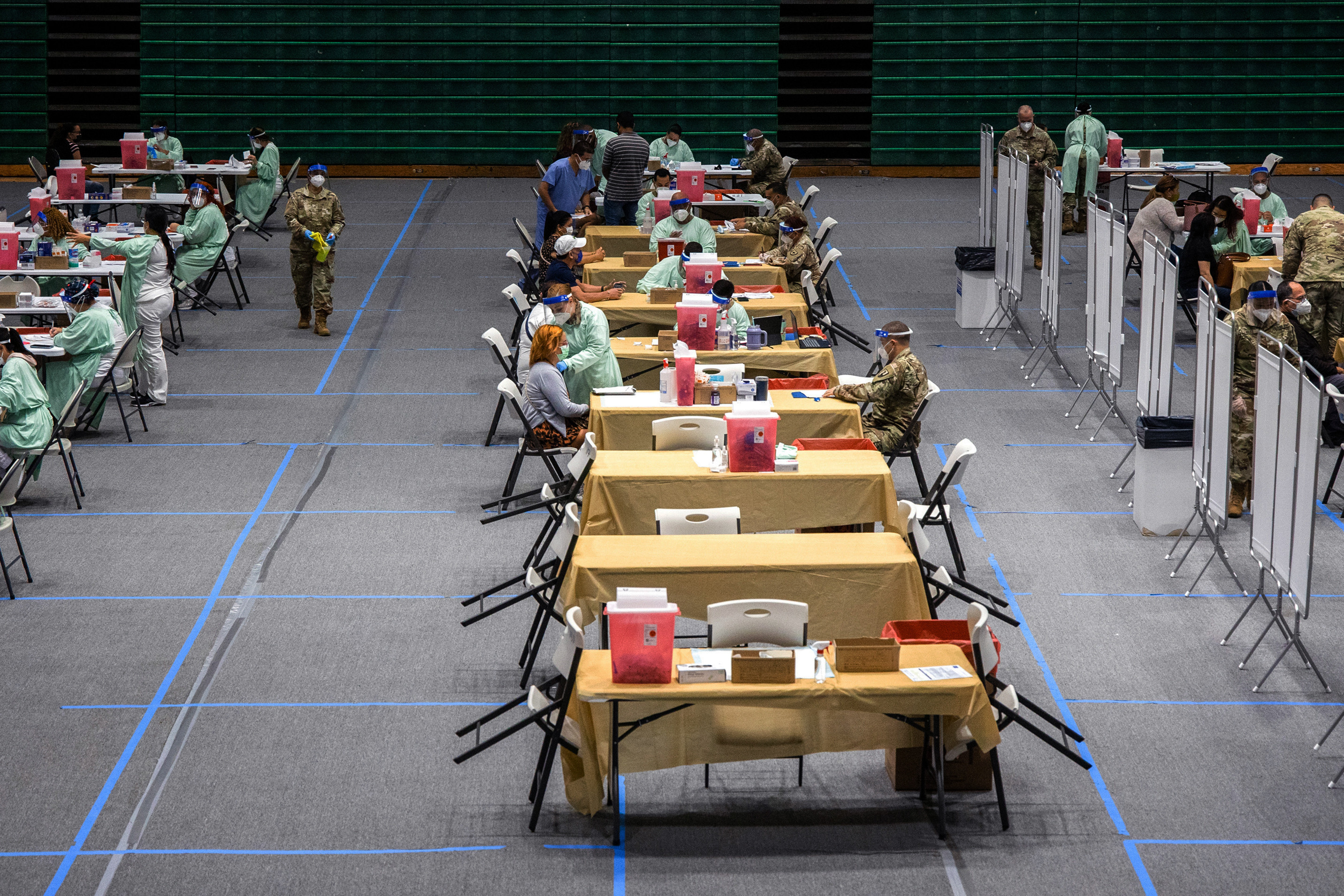
Vaccination Site


Puerto Rico National Guard members administer COVID-19 vaccines to medical personnel at the Pedrín Zorrilla Coliseum in San Juan, Puerto Rico, Jan. 29, 2021. The Puerto Rico National Guard took the lead in vaccination efforts by administering vaccines and delivering vaccine vials to medical centers and vaccination sites throughout Puerto Rico.

Officials Testify to Congress on Military Housing Privatization Progress

 Feb. 16, 2021 | BY David Vergun , DOD News

The goal of the Defense Department is to provide safe, quality housing for military members and their families, a DOD official told lawmakers today.

Paul Cramer, principal deputy assistant secretary of defense for sustainment (installations), spoke today at a House Appropriations subcommittee on Military Construction, Veterans Affairs and Related Agencies. The topic was the Military Housing Privatization Initiative. 

The military departments have increased their oversight of military housing by hiring more than 500 additional employees in the military housing offices, he said. These additional people are providing quality assurance, customer care services and advocacy for the residents. 

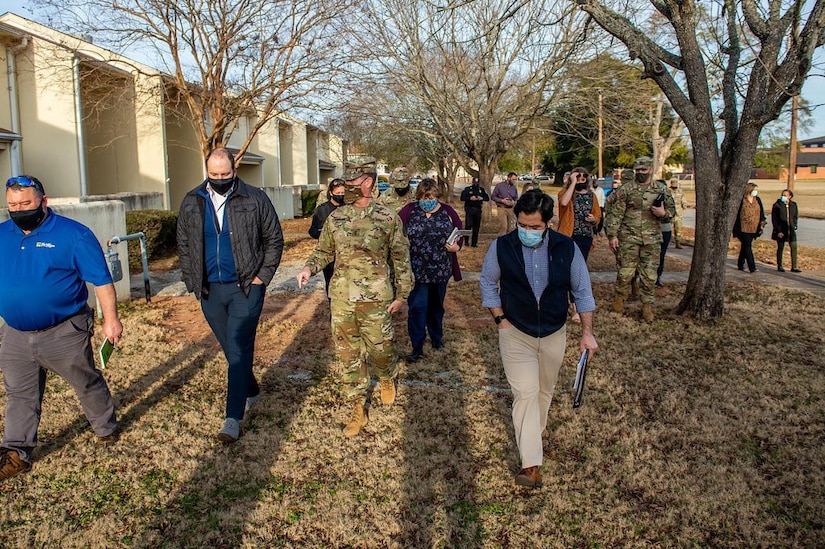
Group of people walk past base housing.

Since the March 3, 2020, MHPI hearing before this subcommittee, the department has made significant progress in implementing MHPI reforms set out in the fiscal year 2020 and 2021 National Defense Authorization Acts, Cramer noted. 

"We have worked to draw up department-wide privatization housing policies to reinforce and expand our programmatic oversight of MHPI housing projects," he said.

Among them are:

  • Senior leader engagement to collaborate internally and with MHPI companies on housing issues;
  • Taking necessary corrective actions to rebuild trust with military members and their families;
  • Accountability at all levels within the department by the MHPI companies;
  • Providing transparency and frequent communication with MHPI tenants; and
  • Ensuring the long term financial viability of MHPI projects and the program.

Elizabeth A. Field, director, defense capabilities and management, Government Accountability Office, also testified at today's hearing.

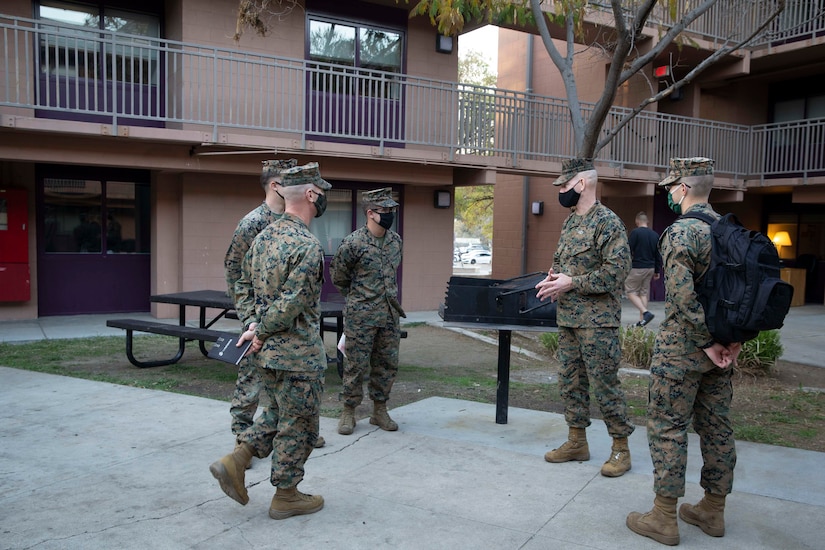
A group of Marines stands talking in front base housing.

Last year, GAO published a report in which it identified weaknesses in DOD management and oversight of MHPI. 

"We made 12 recommendations to address the problems we found. And I'm pleased to report that as of today, DOD has either fully or partially implemented all of our recommendations and expects to complete the remaining work needed to implement them this year," she said.

Some of the key actions that the department has taken include:

  • Instituting standardized quarterly reviews of the military department privatized housing portfolios, with a focus on quality and condition;
  • Developing a process for collecting and calculating resident satisfaction data to ensure that these data are more accurate and consistently used;
  • Establishing criteria for monitoring the financial viability of privatized housing projects and assessing risk;
  • Issuing a Tenant's Bill of Rights;
  • Developing a Common Lease Agreement; and
  • Piloting an effort to provide tenants with seven years of their unit's maintenance history.

"Given the significance of MHPI to the department's commitment to provide safe, adequate housing to service members and their families, sustained attention will be warranted for many years to come," she said.

Drive Thru Site


Air Force Airman 1st Class Victoria Moquin, a security forces officer assigned to the 157th Security Forces Squadron, New Hampshire Air National Guard, checks a patient in at a drive-thru vaccination site in Concord, N.H., Feb. 11, 2021. The site is located in the parking lot of a shopping mall; personnel stationed there administer hundreds of COVID-19 tests and vaccinations a day.

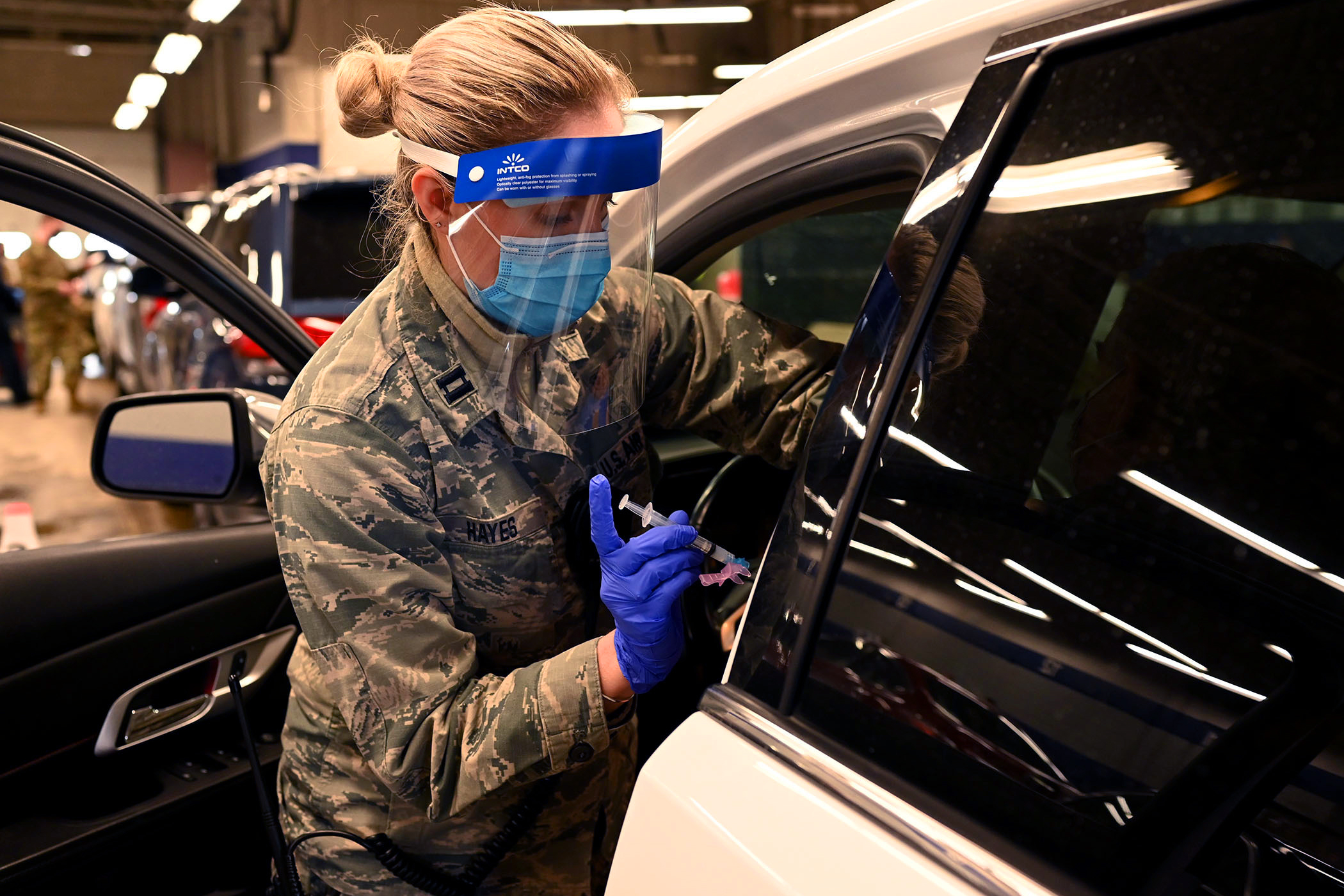
Vaccine Site

Air Force Capt. Alexa Hayes, assigned to the 157th Medical Group, 157th Air Refueling Wing, New Hampshire Air National Guard, administers the Moderna vaccine to a patient in Concord, N.H., Feb. 11, 2021. Guardsmen administer hundreds of tests and vaccinations each day at a former Sears Auto Center.


Working Together


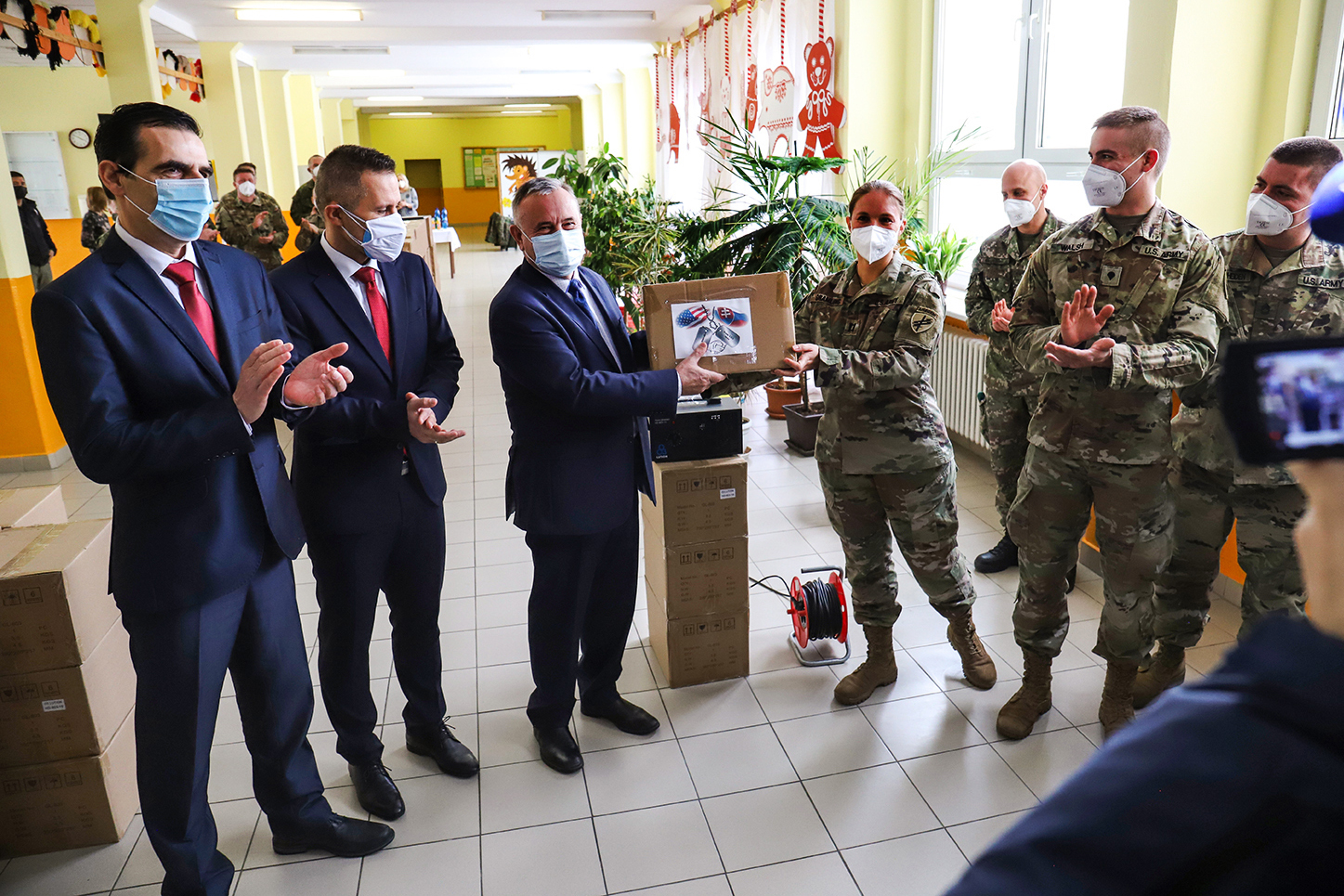
Soldiers assigned to the 432nd Civil Affairs Battalion and their counterparts in the Slovak military give ozone generators to a school in Martin, Slovakia, Feb. 12, 2021. Two-hundred and forty-five generators that were supplied by a Slovak company were presented to Aurel Stodola Elementary School to be used in the classrooms. The donation is intended to increase the safety of children and young people in primary schools through effective and regular disinfection of school classrooms and common areas to combat the spread of COVID-19.

Preparing Shots


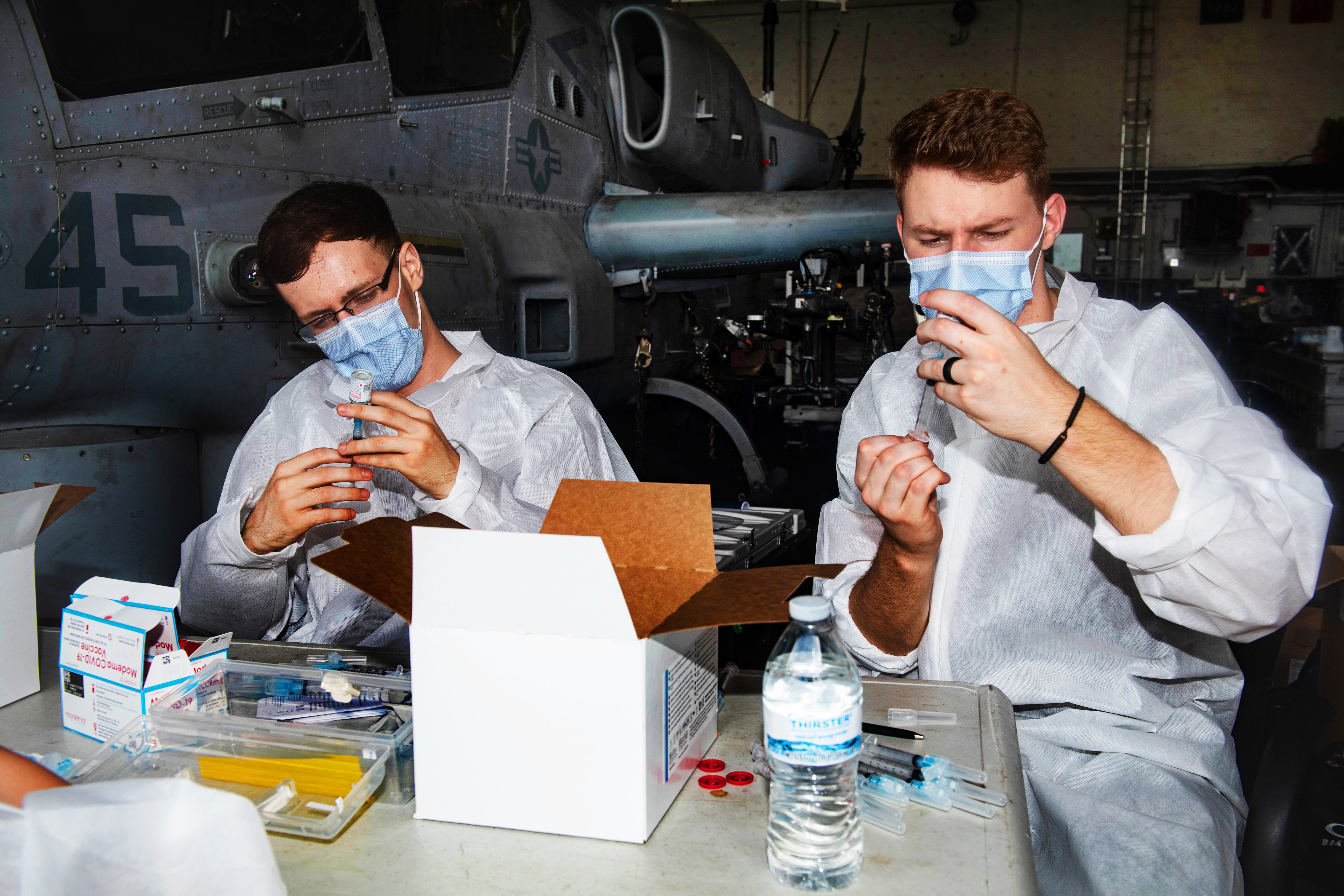
Navy Seaman Dillon Bothell, left, and Navy Seaman Devin Declercq prepare COVID-19 vaccination shots aboard amphibious transport dock ship USS New Orleans in Okinawa, Japan, Feb. 14, 2021. New Orleans, part of the American Expeditionary Strike Group, along with the 31st Marine Expeditionary Unit, is operating in the 7th Fleet area of responsibility to enhance interoperability with allies and partners and serve as a ready response force to defend peace and stability in the Indo-Pacific region.

Sports Heroes Who Served: President Ford Was a Football Star, WWII Veteran

 Feb. 16, 2021 | BY David Vergun , DOD News

Sports Heroes Who Served is a series that highlights the accomplishments of athletes who served in the U.S. military.

Gerald Ford, 38th president of the United States, World War II Navy veteran and collegiate football star, is also the president who, in 1975, signed Public Law 94-106 admitting women to the all-male military colleges — West Point, Annapolis and the Air Force Academy. 

In a posed picture, a football player prepares to hike a football.

Ford attended the University of Michigan, where he played center, linebacker and long snapper for the Wolverines football team. The Big 10 team had two undefeated seasons and won national titles in 1932 and 1933. 

However, even though the team won only one game In 1934,  Ford was considered the team's star player. 

He was a star player off the field, as well. That year, the Wolverines were scheduled to play Georgia Tech, which said it would not play Michigan if a Black player named Willis Ward took the field, and University officials kept Ward out of the game.

Ford was Ward's best friend on the team, and they roomed together during road trips. Ford threatened to quit the team in response to the university's decision. He eventually agreed to play against Georgia Tech, but it was only after Ward personally asked him to play.

Navy officers pose for a group photo.

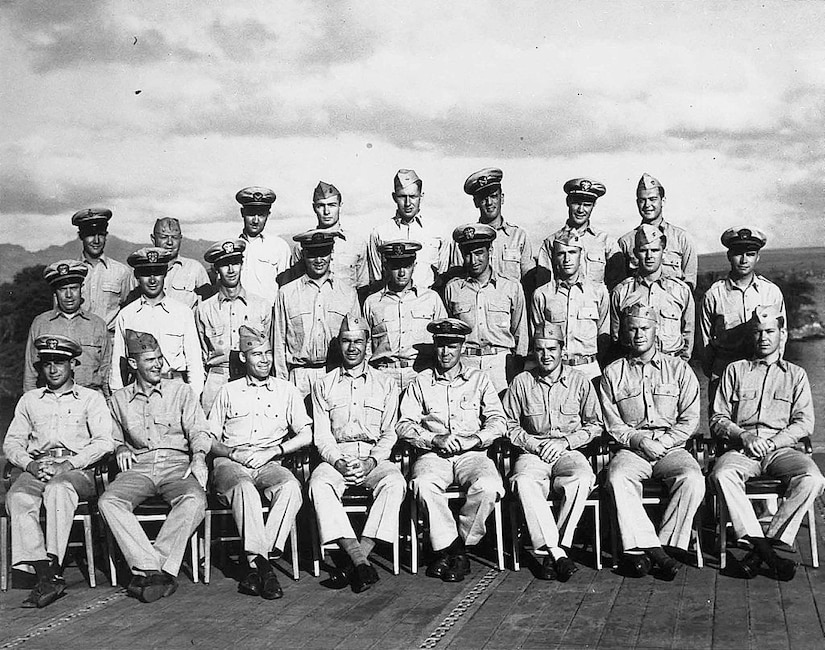
On April 13, 1942, shortly after the start of World War II, Ford received a commission as an ensign in the Navy Reserve. He attended flight school in Annapolis, Maryland, and became an instructor at Navy Preflight School in Chapel Hill, North Carolina, where he taught navigation skills, ordnance, gunnery, first aid and military drill. He also coached swimming, boxing and football. 

After Ford was promoted to lieutenant, in March 1943, he was assigned to the new aircraft carrier USS Monterey, at New York Shipbuilding Corporation, Camden, New Jersey. 

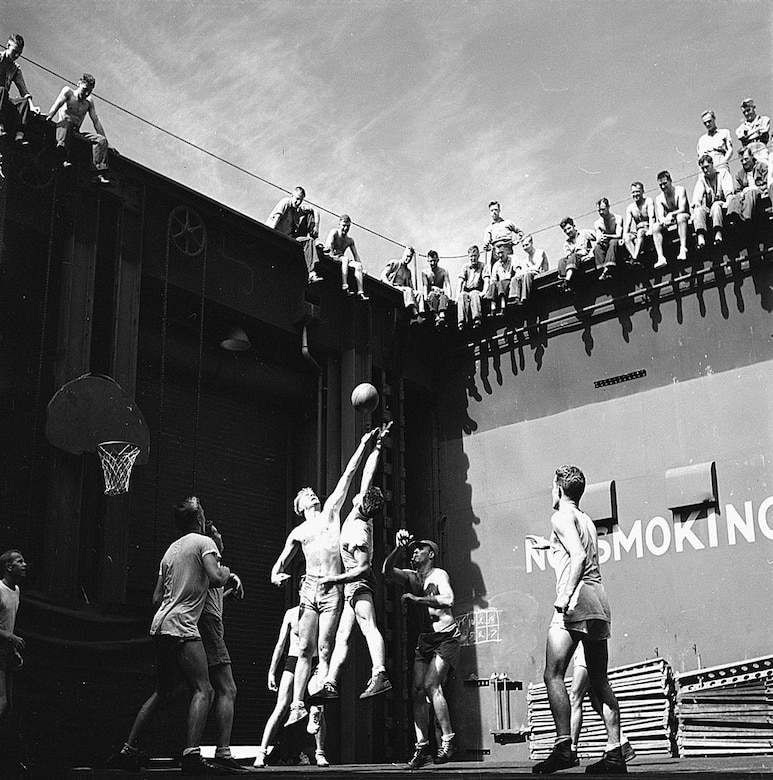
From the ship's commissioning on June 17, 1943, until the end of December 1944, Ford served as the assistant navigator, athletic officer and anti aircraft battery officer on the Monterey. 

In 1943, the Monterey saw combat action in the Pacific Theater, including at Makin Island in the Gilberts, and New Ireland. During the spring of 1944, the Monterey supported landings at Kwajalein and Eniwetok and participated in carrier strikes in the Marianas, Western Carolines, and northern New Guinea, as well as in the Battle of the Philippine Sea.

Men on a ship play a game of basketball.

In November and December 1944, the Monterey's aircraft launched strikes against Wake Island and the Ryukyu Islands of Japan, and supported the landings at Leyte and Mindoro in the Philippines.

The Monterey was one of several ships damaged by Typhoon Cobra that hit Navy Adm. William Halsey's Third Fleet on December 18-19, 1944. The Monterey was damaged by a fire, which was ignited by several of the ship's aircraft tearing loose from their cables and colliding on the hangar deck. 

As the general quarters officer of the deck, it was Ford's job to assess the damage and help contain the fire. The ship got underway again but was declared unfit for service due to the extensive damage that occurred. 

In 1945, Ford was stationed at the Navy Pre-Flight School at Saint Mary's College of California, where he was assigned to the athletic department until April 1945. From the end of April 1945 to January 1946, he was on the staff of the Naval Reserve Training Command, Naval Air Station, Glenview, Illinois, with a rank of lieutenant commander. He received an honorable discharge in February 1946.

Men sign a treaty.

Interesting Ford Facts

  • Ford once said that his experiences on the gridiron helped prepare him for the "rough-and-tumble world of politics."
  • In honor of his athletic accomplishments, the University of Michigan retired Ford's No. 48 jersey in 1994. With the permission of the Ford family, it was placed back into circulation in 2012.
  • When he became president, Ford often had the Navy band play the University of Michigan fight song, "The Victors," instead of "Hail to the Chief."
  • Ford graduated from Michigan in 1935 and received offers to play football with the Detroit Lions and Green Bay Packers of the National Football League. Instead, he took a job in September 1935 as the boxing coach and assistant varsity football coach at Yale University, where he also attended and graduated from law school.
  • Gerald Ford's name at birth, July 14, 1913, was Leslie Lynch King Jr. Ford's parents later divorced and on Dec. 3, 1935, Ford legally changed his name to Gerald Rudolph Ford Jr., in honor of his stepfather, who had that name except for the junior.

Readout of Secretary of Defense Lloyd J. Austin III’s Call with Iraqi Minister of Defense Jumaah Saadoon

 Feb. 16, 2021


Secretary of Defense Lloyd J. Austin III spoke by phone today with Iraqi Minister of Defense Jumaah Saadoon. Secretary Austin condemned yesterday’s attack against U.S. and Coalition forces in Iraq, and expressed condolences to the Iraqi people. Secretary Austin and Minister Saadoon also both expressed condolences for the U.S. service member who was injured in the attack.

The Iraqi people deserve a secure and stable Iraq, and the United States remains committed to supporting our Iraqi partners in their efforts to defend Iraq’s sovereignty. Both leaders reaffirmed commitment to the strategic partnership between the United States and Iraq.

Patching Practice


Navy Petty Officer 3rd Class Ashley Bass practices patching a ruptured pipe during a general quarters drill aboard the USS Porter in the Mediterranean Sea, Feb. 13, 2021.

Canopy Concentration


Navy Petty Officer 2nd Class Teresita Joyce, Petty Officer 3rd Class Nathaniel Tucker and Petty Officer 3rd Class Jmilriyon Jacobs de-arm the canopy of an F/A-18E Super Hornet aircraft aboard the USS Dwight D. Eisenhower in the Atlantic Ocean, Feb. 8, 2021.

Aeromedical Effort


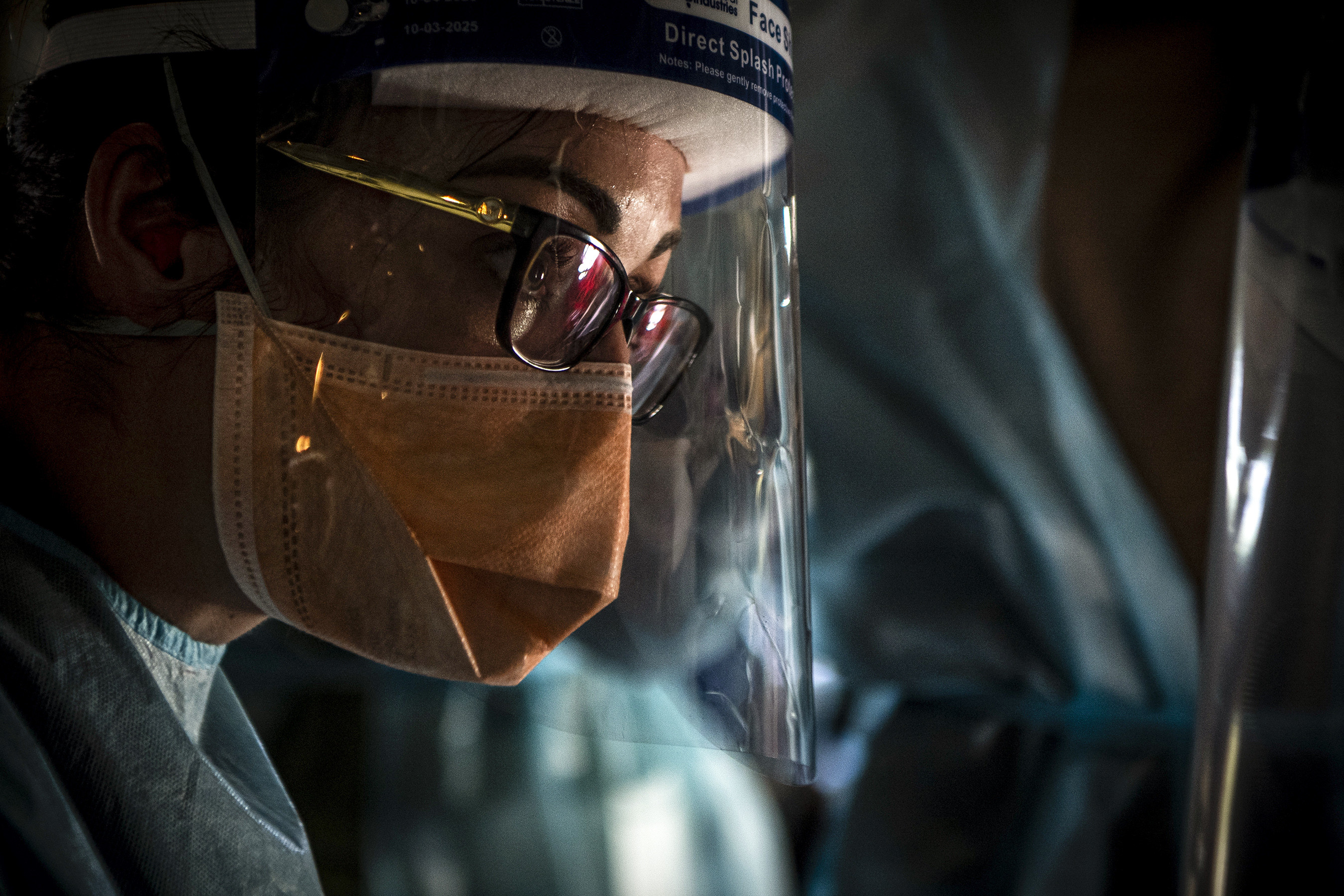
An Air Force nurse participates in a simulated mass casualty aeromedical evacuation during exercise Cope North at Northwest Field in Guam, Feb. 10, 2021. The annual exercise serves as a keystone event to enhance U.S. relations with regional allies and partners, promoting security and stability throughout the Indo-Pacific region.

Walker Wave


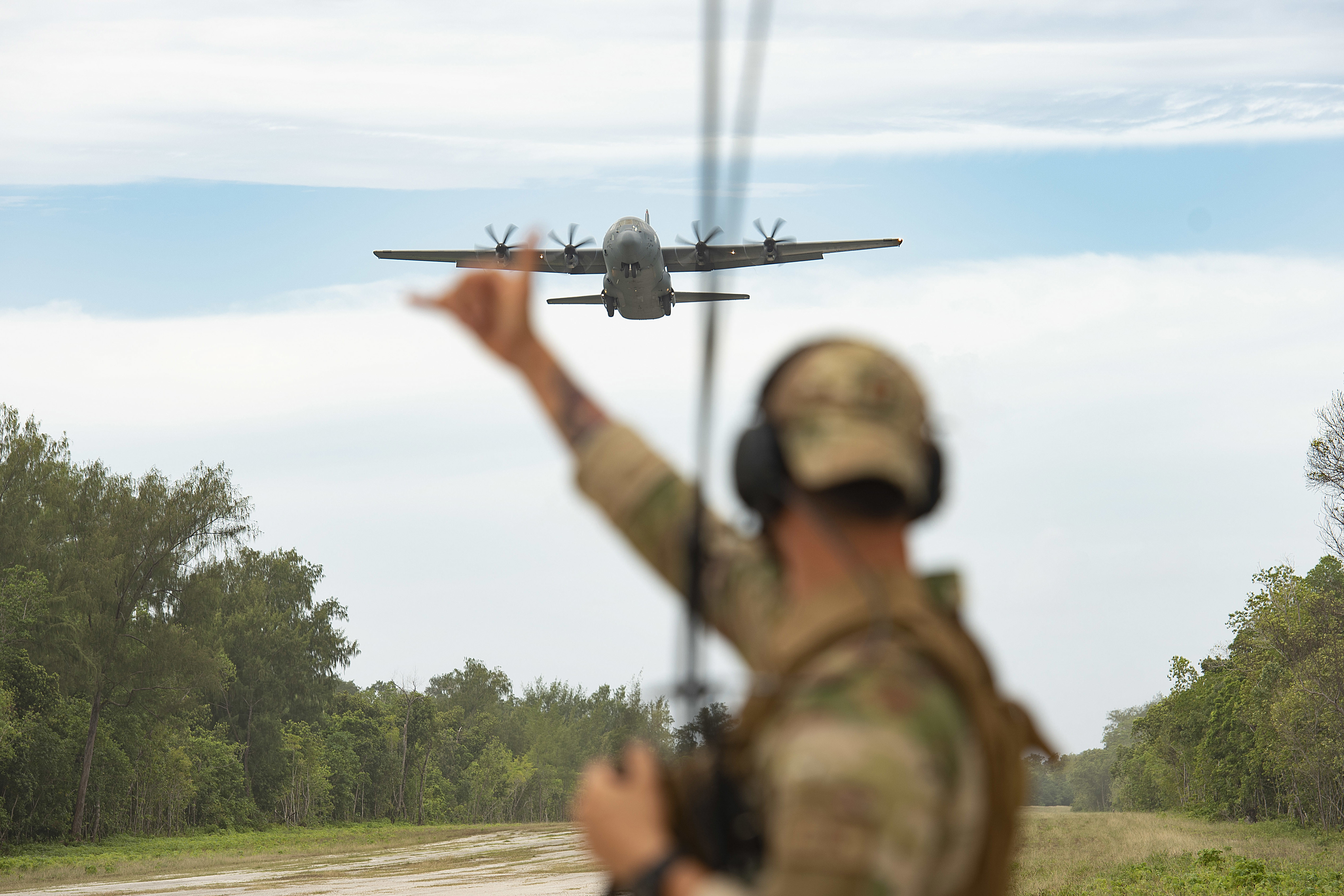
Air Force Capt. Gene Walker signals a C-130J Super Hercules as it approaches the landing zone during Cope North in Angaur, Palau, Feb. 11, 2021. The annual exercise enhances U.S. relations with regional allies and partners, and promotes security and stability throughout the Indo-Pacific region.

Monday, February 15, 2021

NATO Defense Ministers to Discuss Future of Alliance During Ministerial

 Feb. 15, 2021 | BY Jim Garamone , DOD News

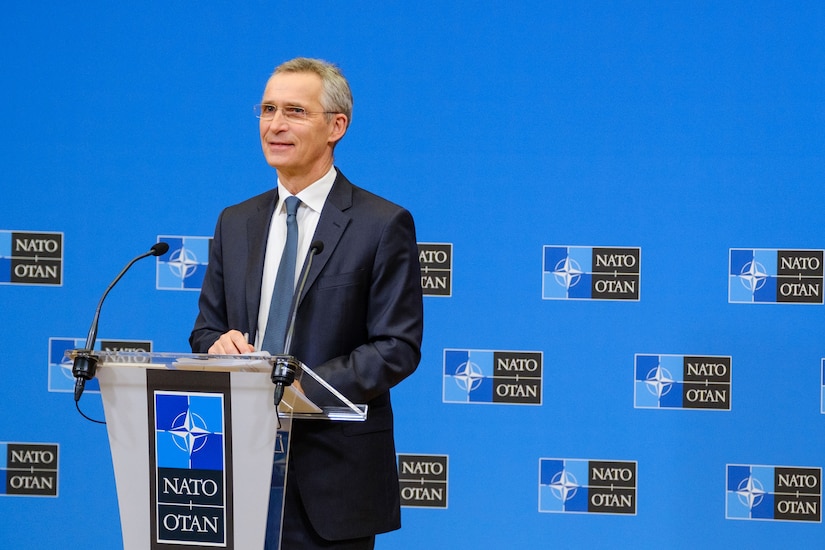
NATO Secretary General Jens Stoltenberg outlined proposals for alliance leaders to discuss that will capitalize on NATO's ability to adapt and change to changing security conditions. He spoke during a virtual press conference in advance of the virtual Defense Ministerial starting Wednesday.

The defense ministers will discuss Stoltenberg's NATO 2030 proposals and ongoing operations in Iraq and Afghanistan. This will be Secretary of Defense Lloyd J. Austin III's first ministerial in his position.

The ministers will discuss issues that will be presented at the NATO Summit that will be held later this year in Brussels. "Our summit later this year will be a unique opportunity to start a new chapter for transatlantic relations," Stoltenberg said from Brussels. "When we meet, I want to present leaders an ambitious agenda for transatlantic security and defense."

A civilian speaks at a lectern.

His NATO 2030 proposals are the heart of the discussion he would like to see. The secretary general outlined those proposals for reporters.

The secretary general wants to see an increase in alliance funding for the core deterrence and defense activities. "This would support allied deployments in our battle groups in the eastern part of our alliance, air policing, maritime deployments and exercises," he said. 

This would have the effect of strengthening the alliance and contribute to fairer burden-sharing, he said. 

Stoltenberg also wants the alliance to adopt clearer and more measurable national resilience targets to ensure a minimum standard of shared resilience among allies. Part of this would be an annual review of vulnerabilities in critical infrastructure and technologies. This review would include risks stemming from foreign ownership and influence of capabilities.

NATO must preserve its technological edge. "I will propose a NATO Defense Innovation Initiative to promote interoperability and boost transatlantic cooperation on defense innovation," he said. There is a real danger that more advanced nations could develop capabilities that won't communicate with capabilities of lesser advanced NATO nations. He wants to preclude that.

In an era of "whole-of-government" strategies, Stoltenberg wants to increase political coordination between allies with more consultations on more issues including economic matters related to security. "We have the procedures in place to do this today, but what we need is more political will to use them," he said. 

Foreign soldiers discuss a mission.

It is the North Atlantic Treaty Organization, but NATO must address global challenges and develop a more global approach to problems and challenges, the secretary general said. "China and Russia are at the forefront of an authoritarian pushback against the rules-based international order," he said. "So we should enhance our political dialogue and practical cooperation with like-minded partners to promote our values and protect our interests."

A part of this proposal is to strengthen training and capacity building with European partner countries, "because prevention is better than intervention," he said. 

Climate change is real and is already having effects. The alliance needs to address the security implications of climate change. "I will therefore propose that NATO should set the gold standard on reducing emissions from the military sector and contribute to the goal of net-zero carbon emissions and conduct an annual assessment of how climate change might impact our troops and deployments," he said. 

NATO has kept the peace for more than 70 years. A creature of the Cold War, the alliance – now with 30 members – adapted to the fall of the Soviet Union and still keeps the peace. Stoltenberg would like to see this legacy continue. " I will recommend [updating] NATO's Strategic Concept to jointly address the changing strategic environment to recommit to our values and to reinforce the transatlantic bond," he said.

Key to NATO has always been the unbreakable transatlantic bond, he said. The last four years tested that. "I think it's no secret that over the last four years we had some difficult discussions inside NATO, but now we look to the future," he said. "The future is that we now have an administration … in Washington, which is strongly committed to the transatlantic bond, to NATO and to Europe and North America working together."

Stoltenberg has spoken with President Joe Biden and he called Biden "very strong, very clear on the importance of re-building alliances and further strengthening NATO."

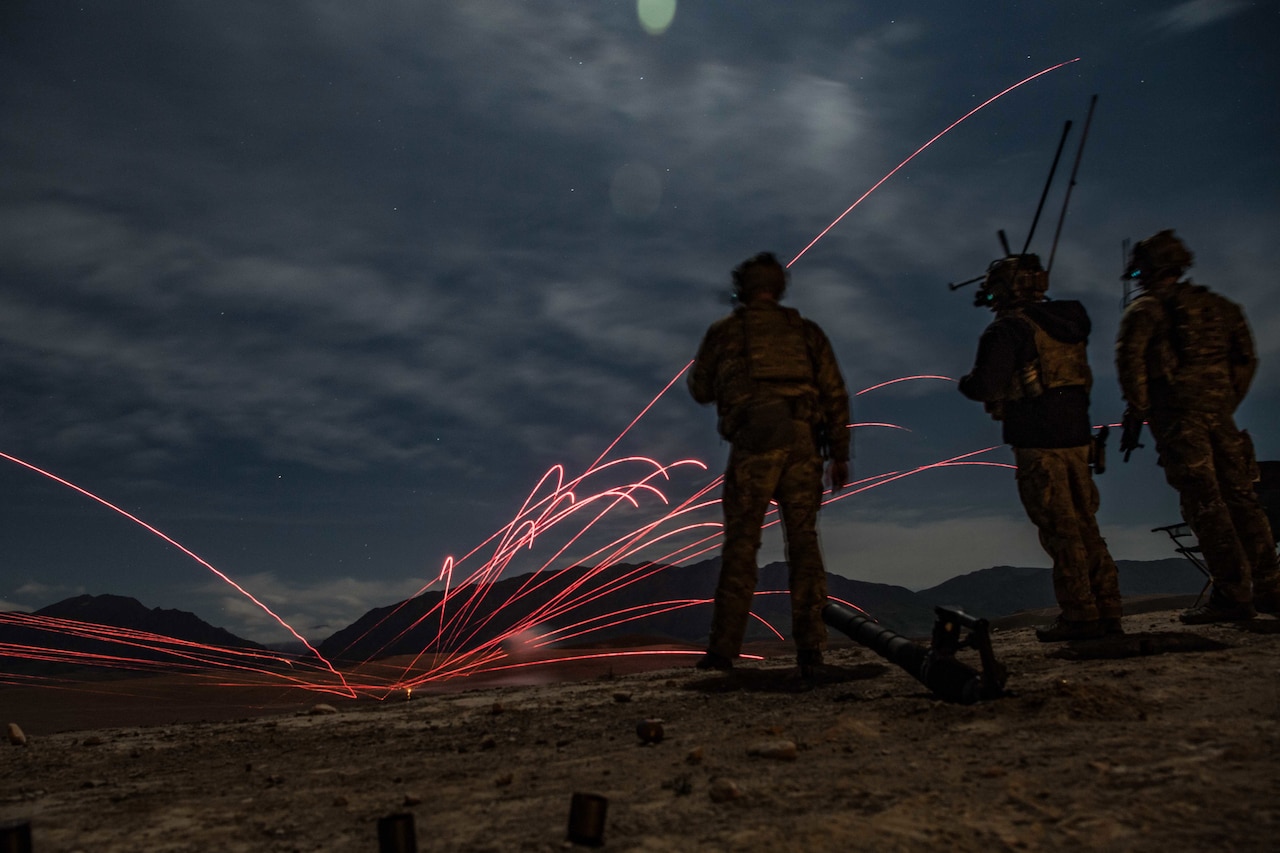
Tracers skim through the sky as service members look on in Afghanistan.

Afghanistan is a contentious issue that the defense ministers will contend with. Under the U.S. agreement with the Taliban, all foreign troops are supposed to be out of the country by May 1. "I will not preempt the conclusions of the ministerial meeting this week, but what I can say is that we need to find the right balance between making sure that we do not stay longer than necessary, but at the same time that we don't leave too early," Stoltenberg said. "We should not end up in a situation where Afghanistan again becomes a platform, a safe haven, for international terrorists, which is actually the reason why we went in there."

There are about 10,000 NATO troops – including 2,500 Americans – in Afghanistan today. The NATO force is performing a train, assist and advise mission. 

A final issue the ministers will discuss is Iraq's request for more alliance help in training forces and building security capabilities. 

The Defense Ministerial will end Thursday.

Saturday, February 13, 2021

Pentagon Press Secretary Updates Reporters on DOD Operations

 Feb. 12, 2021

Pentagon Press Secretary John F. Kirby

PRESS SECRETARY JOHN F. KIRBY: Alright, good afternoon everybody. Thanks for coming, happy Friday.

Q: Happy lunar new year.  

MR. KIRBY: Happy what?

Q: Lunar New Year!

MR. KIRBY: Lunar New Year.

Q: Happy Lunar New Year.

MR. KIRBY: Happy Lunar New Year to you. So just a few things at the top and then we'll get right at it. Let me start with some partner activity in the Indo-Pacific Theater; Exercise. Yudh Abhyas 20 kicked off in India this week. This is a U.S. Army Pacific-sponsored exercise that involves approximately 250 U.S. military personnel and 250 Indian Army soldiers and is designed to enhance combined interoperability capabilities through training and cultural exchange. This exercise continues to solidify the U.S./India major defense partnership and advances cooperation and support of a free and open Indo-Pacific region. 

By way of schedule, just to let you know, today Secretary Austin had a call with recently confirmed Denis McDonough, our new Veteran Affairs Secretary, to congratulate him on his confirmation and to discuss areas of mutual concern in supporting those who have given so much to defend the nation and they look forward to a very close working relationship going forward.

Now hopefully you've seen our announcement this morning on the commission on the naming of items of the Department of Defense that commemorate the Confederate States of America, commonly referred to as the Confederate-Base Naming Commission. It was set up of course, as you know in the fiscal year '21 National Defense Authorization Act and as part of that the Secretary was required to nominate four members to that commission. 

You saw their names but I'll repeat them here; Retired Admiral Michelle Howard, Retired Marine Corps General Bob Neller, Dr. Kori Schake, the Director of Foreign and Defense Policy Studies at the American Enterprise Institute and Retired Army Brigadier General Ty Seidule, who is an Emeritus Professor of History up at West Point.

The Secretary was very grateful that they agreed to take this on and he looks forward to seeing the results of their hard work with the other commissioners were named by Congress in a bipartisan way in the months ahead.

Finally, in support of FEMA, as one of the many federal agencies involved, we continue with our deliberate and phased support for emerging FEMA requirements. The first team of 222 personnel; we've talked about this team before, they arrived in California and they'll be operational. we expect, by Monday, supporting a mega vaccination site in Los Angeles. 

We will expect to have more information for you next week about the other four teams that were announced, the original, the first five. So we'll have more information we expect next week in terms of where they'll be going and where they'll be coming from, quite frankly.

Additionally I want to tell you that the Secretary has authorized an additional 20 teams to support FEMA at vaccination sites around the country. Ten of these teams will be Type 1 of the same one that we talked about last week, 222 personnel supporting mega vaccination sites and then the other 10 will be smaller Type 2 teams of 139 personnel supporting smaller vaccination sites.

These 20 teams are being organized to support FEMA-identified sites and will be deployed as requirements evolve. This will bring out total amount to more than 4700 active-duty personnel supporting or preparing to support FEMA. These personnel are in addition to the more than 26,000 National Guard members and 3000 active-duty personnel who have been supporting COVID efforts over the last year. We're going to continue to work with FEMA as they continue to work with state and local authorities to refine their plan for vaccination sites across the country. Details are still being worked out across the interagency and we'll keep you up-to-date as we know more. I'm giving you everything I know today. We don't have sites for all these additional 20 teams that the Secretary authorized; he did this out of a request for forces from General VanHerck, the Northern Command Commander and they and we will continue to work through more details about where they're going and when they're going and where they're going to come from; where their sourcing is.

So with that we'll start with Lita on the phone.

Q: Hi, thanks. One quick follow-up from the FEMA announcement and then a second question. First on the FEMA team, do you expect that both of these will be active duty? Other Guard officials that have already said this that’s their expectations but it will be mostly the active duty and is this, do you expect that you're still working towards the 100 teams? Or is this, do you think, a more scaled-back version of what FEMA initially asked?

And my second question is just an update. You had talked previously that in questions about the U.S. military response to the Southern border; I think people have been asking questions about this for a couple weeks now, and I'm wondering if there's a problem in getting some of the accounting for the funding; is there an issue with the information from the previously administration that left, or is the Pentagon having a hard time gathering the totals? It's FEMA, so it wouldn't be that hard to get that kind of accounting.

MR. KIRBY: Let me start with your first two, Lita, and I'm not quite sure I completely understand your second question but so you asked if they're all going to be active-duty; we expect that again the sourcing isn't complete but I would expect that certainly many of these teams will be sourced out of the active component, but again, the sourcing is not complete so I don't want to get ahead of decisions right now, sourcing decisions.

You asked if this was, you know, if we didn't envision sourcing the whole 100 and as I said in my opening comments, this will be a deliberate and phased approach and we want, what we're trying to do is to make sure that when FEMA has identified sites that we are poised, properly poised and ready to support those sites and the Secretary believed, after consulting of course, with the Chairman and with the NORTHCOM Commander that authorizing another tranche of 20 teams to put them on a Prepare-to-Deploy Order, or a Prepare-to-Deploy basis in a rolling fashion; what was the right way to do this.

And so they will be put on, as we know as PTDO, in keeping with General VanHerck's scheme, as he works with FEMA and certainly we would defer to him on that. But this is again a phase and deliberate approach here to try to make sure that we are poised and ready to support FEMA on their timeline and the timeline of the states and authorities, the local authorities that they're working with.

On your Southern border question, if you're asking about reprogramming and maybe I'm wrong, that's not what you meant, I know of no reprogramming decisions that we are considering at this time but I'm not sure that that was your question, Lita, so I'm going to throw it back over to you to see if I missed it.

Q: Well yeah, so reprogramming is part of it. I think there's just been a number of questions over the last couple of weeks about where the department stands on the Southern border mission, considering the White House has ended the – formerly ended the mission. And I think we're just trying to figure out what exactly that means including the reprogramming which you said you – as far as you know right now there's no money. Are you saying no money can be reprogrammed or no money is currently being reprogrammed?

MR. KIRBY: What I'm saying is I don't of any –

Q: I think there was some indication early on that some could be reprogrammed but –

MR. KIRBY: I don't know of any reprogramming decisions that are being made right now with respect to the decisions that were made by the previous administration to move money out of military construction and other infrastructure support to building the wall. So, if we have something to announce in that regard or a decision that has been made we'll certainly keep you apprised. But I'm not aware, and I did ask about this this morning, I'm not aware of any reprogramming decision that's in the works right now. 

If that changes of course I'll let you know. And as for the mission itself I think I said this yesterday, that a small number of troops that are down there now they will remain there for the remainder of the year, that's the plan right now. 

Let me go back to the phones again. Dave Martin from CBS. 

Q: When you said the total number of troops that are now on prepare to deploy orders there was a call in that blocked out the number and I didn't hear it. So if you could repeat that. And the original FEMA request was always put in terms of 10,000 troops. You said it could be more, it could be less. Now that you see what it takes to man a type one and type two site, if you do all 100 do you have any – do you have any estimate on how many troops we are talking about?

MR. KIRBY: Well, so the – the number that you missed was 4,700 and that would put you at 25 teams and obviously you can do the math if you times that by four. If you get – if you get to all 100 teams. But again, I want to stress the very deliberate and phased approached that we're taking here. Working in lock-step with FEMA and with other federal governed authorities here to make sure that what we're trying to do is to be ready when we're needed and to be – and so these additional 20 teams that the Secretary has now authorized, we now we can start to prepare them. 

Even though if they don't have a location to go right now, even if it hasn't – all the sourcing hasn't been done. As that sourcing is determined we can make sure that they're properly trained, make sure that they're properly resourced, make sure that the – that the commands that they will be leaving have time to prepare for their departure.

To make sure that any risks to the military treatment facility requirements is mitigated. So it's again a phased approach. But that's how we're thinking about it. So right now, as I said, we're at this 4,700 that the Secretary has authorized. One team, as you know, is already on the ground and will be ready by Monday. 

And then we'll just – we'll just see where it goes from there. We're going to take a very deliberate approach on this. Tom.

Q: So the NATO Defense Ministers will be meeting next week. Of course, Afghanistan will be on the table, and I know that Secretary Austin's taking part in that. Do we expect a decision at that point on whether the U.S. will abide by the U.S.-Taliban agreement, withdraw troops by May 1, or there's some talk they may kick that decision into March if you can kind of walk us through that?

MR. KIRBY: Well there's no question that the NATO mission in Afghanistan will a topic of discussion at the Defense Ministerial, and the secretary's very much looking forward to it. And as I think I've said before that discussion will clearly help inform his thinking and the sort of advice that he will be expected to give to the Commander in Chief.

I wouldn't get ahead of the ministerial and where it's going. And I certainly won't speak for our allies. I can just tell you that the secretary's looking forward to having that conversation with them. And as he has said in every conversation he's had with his counterparts, particularly his NATO counterparts, no decision that we make is going to be done without proper consultation and discussion with them, and he very much looks forward to the ministerial meeting next week as another avenue to have that. I mean, he's already spoken to many of them individually. He'll have a chance now to speak to them more collectively.

Q: The bottom line is it's too soon for a decision on troop reductions? It's more informational gathering information on the way ahead?

MR. KIRBY: The Commander in Chief makes those decisions, so I certainly won't speak for President Biden or what timeline he's on. Nothing has changed about the fact that we continue to review the status of the agreement and the degree of compliance by parties, and no decisions have been made on force structure. If and when that happens, that's a decision for the Commander in Chief. The secretary wants to obviously be able to help inform that decision making process. And again, as I said the Defense Ministerial will help give him a chance to do that, to be able to go back and inform his own policy recommendations. Jen?

Q: Why has it been so difficult to close Guantanamo Bay, and can the president just order it closed?

MR. KIRBY: I won't speak for the president. Your question about why it's been so difficult, I mean, there's a lot of factors there, Jen, including the process of making sure that we are properly holding detainees accountable, and there's a military commission process that is in place to do that. 

You have seen in the past where some detainees have been transferred to third-party countries after, you know, giving security guarantees and assurances. So it's a – it's a multi-tiered effort to make sure that we are protecting our national security interests but also apply and subscribing ourselves to proper accountability and the rule of law.

Q: I guess just a follow up is why does the president want to close Guantanamo Bay? Why would –

MR. KIRBY: I will not and cannot speak for the president from this podium. What I can tell you is that the secretary believes that Guantanamo Bay, the detention facility should be closed. He fully supports the administration's desire to do that, and he fully expects to be a partner in the interagency process and discussing as that goes forward. I got to go back to the phones. Sorry. I want to make sure that I'm not forgetting this. Idrees?

Q: Thanks, John. So going back to FEMA and COVID, I understand it’s going to be a phased and deliberative approach, but given that we – you know, we're a few weeks into this and only – I think it's 1,000 troops have moved out or about to move out to get to 4,700, is there a bottleneck somewhere either FEMA or the states aren't ready to accept the troops or what's taking them so long for them to actually get onto the ground and start doing this work, which I think, you know, the administration has said is a priority? And then I have another separate question.

MR. KIRBY: Well there's – it's a complicated process, Idrees, and again, we are supporting FEMA. We are very much in a support role here to the interagency. And there are lots of factors that have to be factored in as sites are considered, appropriate location, and coordination with local and state authorities about how those sites can be set up, the infrastructure that's needed, the support that's needed. I mean, it's a complicated process, and we don't want to move any faster than – we don't want to move too fast so that we're overwhelming the process of the system. That's not the goal.

The goal is to make sure, as I said, that we're poised and ready the moment a team is needed. And so, it's a FEMA-led process. We respect that process, and we understand that, you know, that there's a lot that goes into this. It's not – you can't just mandate. You can't just tell a state or a city that well this is a convention center or this is a stadium and that's what it's going to be. That has to be negotiated and worked out with them.

So it's – again, we're a full party to the process and we want to assist the best we can. And where the secretary is, again, is to making sure that he's authorized enough teams that we have them sufficiently ready so that when these decisions are finally made they're ready to move out, and that's our goal. Again, we are very much a supporting element. We're not driving the process. Did you have another question, Idrees?

Q: Yes. It's actually on a similar topic because Secretary Austin's predecessor did speak with their – or the governors of different states periodically with COVID and some of the other issues. Has he spoken with any of the state governors or some of the local officials where some of the active duty troops might be going for the vaccination effort?

MR. KIRBY: I'm not aware of any phone calls he's had specifically with local authorities. Again, we've been coordinating our efforts through FEMA. Sangmin ? Sangmin Lee, are you there? Okay. I'll move on. Jeff from VOA?

Q: Hi. Thanks very much for doing this. Appreciate it. A couple quick questions. First, any update on the security request for help from Capitol Police or the Secret Service? Can you hear me?

 MR. KIRBY: I got you.

Q: Okay. Any updates to the security request from the Secret Service or the Capitol Police in terms of security by the National Guard in D.C. Capitol region during the impeachment trial?

MR. KIRBY: Any additional requests?

Q: Yes, any changes in the status in terms of anything with the National Guard that's gone through the Pentagon?

MR. KIRBY: No. I think the number today is – I don't want to guess. It's 6,061, as of today they continue to support the FBI, the Capitol Police, the Park Police, Secret Service, and the city of Washington, and I know of no changes to the mission requirements. Okay.

Q: Thanks very much. And also –

MR. KIRBY: Go ahead. Go ahead.

Q: Thank you. A little more in depth question would be, looked at the Pentagon's taking on extremism in the ranks. How much is the Pentagon concerned about some of the extremist groups who are targeting either current military members or soon-to-be former military members, soon-to-be veterans, those groups having links to foreign groups or foreign governments. Is that something that the Pentagon is taking a look at?

MR. KIRBY: I don't know of any particular study here in the building to look at that linkage between some of these extremist groups and foreign entities, but as I've said before we are certainly mindful of the fact that some of these groups, you know, actively try to recruit soon-to-be veterans, to bring them in, and that is of concern.

And one of the things that the secretary and the chiefs have talked about is – and I suspect they'll continue to explore is the degree to which we need to do a better job educating future veterans as they get ready to leave the service as to what's waiting for them and who's waiting for them on the other side of that. Does that answer your question?

Q: Yes. Thank you.

MR. KIRBY: Okay.  Dan?

Q: On the joint – I have another question. Just wanted to ask is there any update on the Joint Andrews incident and the security breach that occurred?

MR. KIRBY: I don't have one for you. I'd refer you to the Air Force on that.

Q: Okay. And then would the secretary be open to the idea that's been proposed in Congress that we create a new criminal offense in the military code where if you advocated violent extremism that would be kind of a particular offense. Is that something that's being looked at?

MR. KIRBY: I'm not aware of an active effort to look at that, but I will say and the secretary's made it clear that, you know, that he wants to conduct a review. He wants to learn more about the depth of the problem and potential solutions. And I wouldn't rule anything in and out of that. I mean – and I would not be surprised if they – if they take a look at whether other accountability measures need to be in place.

Now again, wouldn't speculate about changes to the UCMJ. As you well know the kinds – many of the kinds of conduct and behavior that some extremist ideology inspirers want to do, to conduct is already punishable by the uniform code of military justice. So again, I think it's a fair question for which I don't have a very specific answer other than to say the secretary wants to be open-minded as we begin to explore this problem and to get our arms around it.

Q: Sorry could I just have one on Asia. Sorry (inaudible), Obviously over time the U.S. has deployed more forces, more assets into the Pacific to counter China. Do you see that as a trend that will continue and that the secretary when he's looking at this posture review will take into the account the importance that the administration places on the Asia-Pacific region strategically?

MR. KIRBY: If you watched his confirmation hearing you'll see how seriously he considers the pacing challenge that China poses. I would not get ahead of the global force posture review, it’s one of the reasons it's so important to do it is so that we take a fresh look as we come in at what is in the Pacific. What is the footprint both fixed and rotational, and what's the health of our alliances and partnerships there? In other words from our perspective are we doing enough? And then he'll make force structure posture decisions based on that. So again, I wouldn't get ahead of that. I'll go back to here, Meghann?

Q: All right. The 10 Army posts have gotten the most press, of course, about changing the confederate names, but is there a list of entities, buildings, everything else that OSD has that they're going to be working from to change names?

MR. KIRBY: That's a good question. Let me take it.

Q: Okay.

MR. KIRBY: Let me take it. I mean, we have lots of lists here and we might very well have one. We're certainly going to rely, though, on the work of the commission. I'm sure they will be working off a list of – because remember it's not just bases. It's items. It's virtually anything inside the DOD portfolio that is commemorating the confederate states, so it's bigger than just bases. It's a good question, though, so let me ask. Yes, go ahead.

Q: Thank you, John. I have two questions for you. One on the burden share and the other one for Burma issues. It is reported that there's a 13 percent increase of defense cost sharing between the United States and South–

MR. KIRBY: You should pull your mask up.

Q: Okay, thank you. You do –

MR. KIRBY: I have a waiver right here.

Q: All right, thank you. That's a good point. Thank you.

MR. KIRBY: Go ahead. What's your question?

Q: Okay, that the 13 percent increase of defense cost sharing between U.S. and South Korea we reach an agreement. Do you have anything on that?

MR. KIRBY: I don't, and I would refer you to the State Department for that.

Q: Okay, but also another one. I think you better know about this because this is the defense sharing, cost sharing, Why you –

MR. KIRBY: It's an issue for – it's an issue for our colleagues at the State Department to speak to.

Q: I hopeful you have a right answer to me today. A lot of things that you just ask there, ask there ... Anyway, second question –

MR. KIRBY: I'm very sorry I'm disappointing you.

Q: Okay, second question for you. I think this one you can answer for me.

MR. KIRBY: Well we'll see.

Q: President Biden signed an executive order for Burma last Wednesday. What military sanctions were included in this executive order?

MR. KIRBY: Again, that is a better question for our colleagues at the State Department, but just to reiterate that U.S. military interactions with Burma are heavily constrained by law, including statutory restrictions on military assistance due to Burma's human rights record. The United States does not have foreign assistance programs that directly benefit the Burmese military as an institution, and our minimal interactions have supported humanitarian response capability and human rights.

And as President Biden made clear the reversal of Burma's democratic transition will necessitate an immediate review of our sanctions – our sanction laws and authorities followed by appropriate action.

Q:  Yes, well do you have individual military sanctions, like, so I mean, chief of commander in Burma, they got, against –

MR. KIRBY: For specific sanctions you're going to have to go to my colleagues at the State Department.

Q: Thank you.

MR. KIRBY: Was that an acceptable answer? (Laughter.)

Q:  A little bit. Not quite, like, this is like –

MR. KIRBY: In my – in my book a little bit's okay. That's a success for me.

Q: You don’t tell me about it–

MR. KIRBY: If I can get halfway there I win. I win. (Laughter.)

Q: That’s your job, you ask for military for –

MR. KIRBY: And I answered you on military issues.

Q: All right. Thank you very much.

MR. KIRBY: But there are some things that's not appropriate for me to talk to you here.

Q: 60 percent –

MR. KIRBY: 60 percent. 

Q: All right.

MR. KIRBY: For me that's an A. (Laughter.)

I'm graded on – I am graded on a curve.

Q: Maybe the next time I–

MR. KIRBY: Marcus, on the phone.

Q: Hey, John. Thanks. I know we're only three weeks in, but Secretary Austin and Deputy Secretary Hicks I believe are the only two of 61 political positions that require Senate confirmation who are actually confirmed. When should we expect to hear about the more nominees who will be making up the rest of Secretary Austin's team? And do you have any type of goal in place for when you'd like the bulk of the team, you know, in the building? Thanks.

MR. KIRBY: Well, that's a great question, Marcus. Obviously, we want to get the team fully on board as soon as possible. And we continue to on board new members every week. I can see if I've got the number for this week – don't know if I do. I'll – I'll look for it. But we continue to do that. We're putting them on our website so you can see exactly who's coming in and what jobs they're – that they have. 

You're – you're talking about Senate-confirmed positions. And clearly, we look forward – the secretary looks forward to working with the Senate to continue to make – you know, working with the president and the Senate to make those nominations and to get people confirmed. But you know, there's a process here and we're still – and we're still at it. 

He is, more broadly, very, very dedicated to making sure that – the civilian oversight is applied here in the Pentagon. And that requires, you know, nominating – or recommending to the president, nominating the right people with the right skill-sets for these – jobs. They're very important jobs. 

And so, while we certainly want to get the right talent on board as quickly as possible, we don't want to rush to do that either. You want to make sure that the process is deliberate and that you are – you know, that you're able to tee up to the president the sorts of people who have the leadership skills and the experience to handle these big jobs. 

So it's – it's something, Marcus, that I can tell you and I know firsthand that he's – that he's thinking about and talking about every single day. But he wants to do it the right way, not necessarily, you know, an overly fast way. Does that answer your question, Marcus?

Q: Yes. Does – does he plan to go from, like, a top-down – you know, under service secretaries, under secretaries or will – is there another part of this deliberate process that you referenced that he – or another way of conducting this deliberate process that you referenced?

MR. KIRBY: Well, you know, I don't – I don't have a scheme to lay out for you, Marcus. He's – obviously, we're aware of the Senate-confirmed positions that still have to be filled. And I – I don't – I'm not aware that he's got, sort of, a – a certain tiered approach. But if I'm wrong about that, I'll go back and – and correct that. I do know that is something he's very focused on.

I got one more here. Jared from Al-Monitor?

Q: Hi, thank you for doing this. Just a quick question, Israeli police revealed yesterday that more than 20 Israeli citizens, including former military and defense industry personnel, are under criminal investigation in a scheme to apparently quietly sell advanced drone technology to an undisclosed country in Asia. 

Has Israeli authorities been transparent with the Defense Department on this investigation from the start? And has the revelation affected the cooperation with the Israel's, you know, military or defense industry in any way?

MR. KIRBY: I do not have details on that investigation. So I'm really not at liberty to discuss that in any way. And I don't know that even if I did have specific information that that would be something we would be talking about from the podium. So I'm afraid I'm not going to have much for you on that today.

Yes, sir?

Q: Thank you. Iran is enriching more and more uranium of a higher grade and with more quantities, is it something that alarms you? Is it something that there is a message to Iran to understand that America will not take it from them?

MR. KIRBY: Certainly, as the president has said, you know, we want to see Iran meet its commitments to the JCPOA, the – Iran deal, and as Secretary Austin has said, no problem in the Middle East get easier to solve with a nuclear-armed Iran.

And the administration has been clear that they don't want Iran to achieve that – that kind of capability. I will defer to our colleagues at the State Department for specifics on what they're thinking about in terms of managing that process from a diplomatic perspective. 

From our perspective here at DOD, it's about making sure that we have a robust enough presence and deterrent capability in the – in the Middle East. And as I've said many times, the secretary constantly looks at that. Certainly it will be part of the Global Posture Review. But on a day-to-day basis it's very much on his mind and – to make sure that – you know, that we have both the fixed and the rotational capabilities in the region to deal with the treats that are posed by Iran.

Q: On that, sir, you do have enough in the area now?

MR. KIRBY: It's something that we look at every day. The secretary’s comfortable that – and he's in constant communication with General McKenzie, he's comfortable that we are able to meet the – threats. But it is something you have to constantly evaluate and look at. 

That's why we have a combination of fixed forces in the region as well as rotational. And those rotational forces – we just talked about aircraft carriers a couple weeks ago – they constantly change. So it's – again, it's something that he's – he's always thinking about and we always want to make sure that we're – adequately postured and prepared to defend our interests there in the region.

Q: Thank you.

MR. KIRBY: Okay. Yes, sir.

Q: Thanks, John. Jack Detsch from Foreign Policy. Our colleagues at Vox reported today that Bishop Garrison is going to start next week – I guess Monday or Tuesday – as the special assistant for diversity to the secretary. I just wanted to ask what his mandate will be what his relationship will be with this congressionally appointed commission with regards to the base renaming?

MR. KIRBY: Look, I've – I've seen the article about Mr. Garrison. What I can tell you today is that we certainly look forward to having him on board. He will be working on diversity issues here at the Pentagon. The secretary looks forward to – benefiting from his experience and wisdom on that. As for the specifics, I'd rather just wait, you know, until we're a little bit farther along in the process to speak to that.

Q: Thanks. And just to follow on Marcus' question from earlier, do you have a timeline for when Colin Kahl will be up for his hearing for USDP?

MR. KIRBY: That's a question for the Senate Armed Services Committee.

Tony?

Q: I have a question about the F-35 program. It's one of those rotational forces the U.S. has now to deter bad actors. The Air Force is facing an engine shortage. Your acquisition and sustainment people are all over it, apparently, to solve the problem. From – can you, in layman's language, lay out what's the issue and what the level of concern is since this is the Pentagon's largest weapons program and it is being used around the world to send messages to our – to our adversaries?

MR. KIRBY: Right. So since about August of last year, acquisition people here in the Pentagon, along with the military services and Pratt & Whitney senior leadership have been actively engaged on F-35 engine availability issues. The leadership team here is focused on a comprehensive recovery plan to mitigate the readiness impact to our F-35 operational units.

The – they don't deem the engine issues right now to be a safety of flight issue, but maintenance inspections are resulting in unscheduled engine removals. And as I understand it – and I don't want to get too in the weeds because I'm not an aircraft mechanic, but it has to do with the turbine blades of the – of the engine and some malfunctioning that they're experiencing there.

Q: What's the level of concern among the acquisition people here – is this a nuisance, an urgent problem, a significant issue? I mean, what's –

MR. KIRBY: I think – no, that's a fair question, Tony. I think they're taking it very seriously. I mean, you're right, this is a very expensive program and it's an important – critically important platform for the Joint Force going forward, and we're very dedicated to the future of the program. So honestly, I think everybody's taking it seriously, as you would expect we would. Let me go back to the phones. Alex from Vox. 

Q: Hi, thanks for taking the question. Jack asked the most of it for me, so that was very kind of him, but I guess I would add is Bishop's position going to satisfy the chief diversity officer position that is mandated in the FY '21 NDAA? Thank you.

MR. KIRBY: Yes, again, I would – I'd like to defer on specifics about Mr. Garrison until – you know, until we're a little further along in the process. Again, I won't – not going to dispute the reporting that you did, but I'm just not able to get into too much more detail. 

We're – again, obviously he'll be working on diversity issues. The secretary is very much looking forward to getting him onboard and – we'll certainly have more detail about what his role will be as we get a little closer. Abraham, Washington Examiner. 

Q: Thanks for taking my question, John. First off, you've spoken a lot recently about the vital importance of Saudi Arabia as an ally – as a partner in the region, but does Secretary Austin have any plans to speak to his counterpart in Saudi Arabia, or for that matter Israel?

The White House has said that President Biden is not – doesn't have plans to speak to leaders of those counties. So, that's my question, and then I have another question about Space Force, if I may.

MR. KIRBY: On the Saudi question, I mean there's no question that the secretary views Saudi as a critical – Saudi Arabia as a critical partner against terror in the region. And as we've said before, we're going to continue to meet our security commitments and helping our Saudi partners with the defense of their borders and their country.

We're committed to that. I don't have any calls – advanced calls to announce today in terms of his individual outreach, but nothing has changed about our commitment to helping Saudi defend itself – Saudi Arabia defend itself, sorry. Your second question?

Q: Oh, also Israel, is there a call that Israel scheduled? And then I have a Space Force question.

MR. KIRBY: Yes, I don't have any advanced calls to announce. I tend to prefer to do it after we're done on the phone because sometimes it's hard to get two leaders to coordinate their schedule. So I don't have any advanced calls to announce to you today. Barb?

Q: Great. And on Space Force, has the Biden administration directed DOD to make any changes or given any guidance for the continued rollouts and of the Space Force?

MR. KIRBY: Have we given – can you say that one again?

Q: Sure. Has the Biden administration directed the Department of Defense to make any changes or given any guidance for the continued rollout and standing up of the Space Force?

MR. KIRBY: I think you saw a statement from my White House colleague Jen Psaki a week or so ago reiterating the full support of the Biden administration for the Space Force. And the secretary, obviously, is in full support. 

I know of no changes to either that support or to the continued progress of the Space Force and in terms of advancing their recruiting, their retention, their capabilities. They're a full player on the Defense Department team and the secretary looks forward to continuing to work with them. Barb?

Q: Can I come back to the question of Bishop Garrison one more time?

MR. KIRBY: Sure.

Q: Not addressing Mr. Garrison's expertise at all, but separately what is it that led the secretary to so quickly decide he did not have the needed expertise within either the military or civilian structure of the department? What led him to decide he had to have outside advice on this and that he didn't have the expertise he wanted inside the Pentagon?

MR. KIRBY: It's a lot less about feeling like he didn't have something and much more about wanting to put a very special focus on this issue and wanting it to be led and to be, you know, internally focused on and managed here at the department. Yes, ma'am.

Q: My name is Harianna, you can call me Harianna.

MR. KIRBY: Okay. I'm John, you can call me John.

Q: So I have two questions. The first one is what is the yanks’ strategy to reduce conflict and promote peace and security in China Sea? And the second is how the yanks intend to accelerate efforts to combat drawing terrorists in West Africa and countries more effectively to peace and stability in Africa?

 MR. KIRBY: Well, that is a lot. You've covered a lot of territory there. Did you say the yanks?

 Q: Yes.

 MR. KIRBY: Meaning like Yankees, like Americans, or Baseball yanks?

 Q: The Pentagon, let me put it that way.

MR. KIRBY: The Pentagon. Just – I'm going to – it's going to sound like I'm giving you an answer Janne will hate, but it's the truth. There's a lot here. The secretary made it very clear that he believes China is the chief pacing challenge for the department and that the Indo-Pacific region is of critical importance, not just in the United States and to our allies and partners, but to the world.

And that's going to be a key factor in this global posture review that he's going to do. You have seen in just the two or three weeks that the secretary has been in office that he's continuing to make it clear, particularly in South China Sea, that the United States forces are going to sail and fly and operate in accordance with international law, as needed, to protect our security interests and those of our allies and partners.

Five of our seven treaty alliances are in the pacific, and we take those responsibilities very seriously. 

And, so, there's a key focus on this and I think just yesterday, well actually two days ago when the president was here, talked about the stand up the establishment of the China task force here at the Pentagon, and Dr. Ratner was in the briefing room, sort of walking everybody through the eaches of that, the components of that task force, and what they're going to be doing.

So there's a sharp focus on that region and China in particular. A lot of work to do, but clearly a sharp focus on it. And then as for Africa, I won't, and I don't want to get into a point where we're talking about hypothetical future operations, but we have commitments to African partners.

There are significant terrorist threats throughout the continent that, again, we take seriously, and we – concerns that we share with many partners, not just African partners but partners in Europe that also have forces that operate inside Africa.

So again, I think you'll see us continue to focus on the counterterrorism threat that that's posed, not just to people in the region, but to us here at home. I've got time for one more and then I'm really going to have to go. 

Go ahead. 

Q: I have a follow-up. Thank you. 

MR. KIRBY: You have a follow-up to an earlier one? 

Q: Yes, I do. 

MR. KIRBY: All right. I'll take you and you – okay, I'll do you three and then I've got to go. 

Q: Thank you very much, John. Again, (inaudible) journalist, I know you don't like that ... 

MR. KIRBY: No, it's not that I don't like it, but you don't have to introduce yourself every time. 

Q: Okay, but please (inaudible). 

MR. KIRBY: Okay. Okay. 

Q: Thank you. 

MR. KIRBY: You're welcome. 

Q: As you know, Taliban increased their attacks in Afghanistan; yesterday on U.N. base, five Afghan guards have been killed. Nobody take the responsibility, Pentagon knows who’s behind this attack? And a short question, people have an expectation from President Biden that he was here yesterday. 

He didn't mention about Afghanistan once, although he said he is going to end this war in some countries. Like U.S. involvement – military involvement in some countries but didn't mention Afghanistan. Do you have any comment about that? 

MR. KIRBY: I think – again, I don't want to speak for the president, but I think he's been very consistent about – when he talks about ending forever wars that that certainly includes Afghanistan, and he's also many times talked about doing it in a responsible way and through a political settlement. So I think there's no question to why the commander in chief sits on what needs to happen long-term in Afghanistan. 

On your second question, on the attack, it was certainly – we decry that violence, and I don't have an update for you on accountability or attribution of it. You're right, nobody has necessarily claimed responsibility for it, but we're going to continue to watch this – monitor that very, very closely. 

The violence is too high in Afghanistan, that's the bottom line. And the Afghan people are suffering as a result – and that's the important thing, and that's what we're focused on. That's why we want to get to a political settlement to end this war in a responsible, sustainable way. 

Ma'am? 

Q: Yes, Terace Garnier, Newsy. Earlier you had mentioned that there's going to be some kind of training for soon to be veterans so they're not glorifying extremists. But when I've spoken to veterans, one of the main concerns that they felt unappreciated when they're getting out, it's kind of like thank you for your service, bye – see you later. 

Either they go with housing situations, assault in the military – so what kind of training are you going to be able to provide to soon-to-be veterans when they're already feeling unappreciated for their time and service to keep them from wanting to be a part of extremists groups when they get out? 

MR. KIRBY: Well look, it's certainly troubling if any vet leaves the service feeling that they were underappreciated by the services. I can't certainly speak to any one particular anecdote, or any batch of veterans. Obviously that's of concern. We do the best we can to make sure that people have opportunities in the military to grow and develop. 

I certainly didn't feel underappreciated when I left, I can only speak for myself, and the Navy was very, very good to me and to my family. And as a vet myself, I certainly don't feel like the American people didn't appreciate my service. I think and feel that they give me far too much credit for what I did in uniform. 

But if other vets feel differently then that's something that certainly we would – you want us, and we should be concerned about. And it's not necessarily about training, but we do think perhaps there is the potential for better education as vets get ready to transition into civilian life, to understand more fully what's on the other side. 

You know, when I got ready to retire, they – I had access to a terrific transition program that taught me how to apply for V.A. benefits and taught me how to write a resume, taught me how to dress, you know, although it may not look it today. But –

(Laughter.)

(CROSSTALK)

MR. KIRBY: Thank you. So at least I made something right. 

Q: ..Nice tie (Laughter.)

MR. KIRBY: Thank you, Janne. 

(CROSSTALK)

MR. KIRBY: The point – point is that there is a concerted effort to prepare people as they get ready to retire. And I witnessed that, went through it myself. Maybe there is more we can do. Maybe we need to help veterans – future veterans understand the pull that can come from some of these groups. And maybe those groups are targeting potential veterans that feel disaffected. 

So this disaffection – I'm not at all the dismissing that, and I am certainly not questioning that you have heard that legitimately from some. That is a concern. And so again back to what the secretary wants to do is to better understand what we are doing on the front end when somebody decides they want to join the military, to understand who they are and what values they espouse and how much of those values, you know, align with our own, as well as while they're in the service and then certainly as they are getting ready to leave. 

And so it's a – to pardon the phrase, it's a soup to nuts approach I think he wants to take here in terms of making sure that when people leave they certainly should feel appreciated, but also informed about the risks that are out there. Lara

Q: As you mentioned, I believe it's TAPS, what, seven to 10 days where they – they're going through what you can do (inaudible) their training is not long enough, they're getting a bunch of information thrown at them and then at the end they're just saying, oh here's a book! And I've gone through that program, so I know. 

So what – are you going to expand that program or make it longer? Like –

MR. KIRBY: I don't think it's called TAPS, And I don't have any specific things to read out to you now in terms of decisions about transition planning, except to say – except to say that is certainly on the secretary's mind, and I would not – I don't want to impose that on his decision space, but I fully expect that he will be looking at transition programs as part of this process of trying to get a handle on the degree to which these groups can recruit and inspire recruitment of future veterans. 

But I just – you know, we're not a point right now where I can tell you for certain that we're going to look at this program or we're going to change it this way. 

Lara, you get the last question today. 

Q: Yes, thank you. So the Trump administration used these NATO ministerials to hammer Europe on increasing defense spending, and those kinds of things. Can you say what tone or message Secretary Austin needs to strike on this topic? 

And related, what message does he want to convey during the ministerial regarding Turkey and its moves towards Russia?  

MR. KIRBY: I'm not going to get ahead of the secretary on specific issues. But to your broader question, I suspect that the secretary will certainly reinforce the view that collective security is a shared responsibility. And every ally bears that responsibility. And part of that responsibility, of course, is an adequate level of defense spending, at the 2 percent according to the Wales Summit. And that we certainly, you know, want to see everybody take that shared responsibility.

But I also think that he will recognize that many of our NATO allies are, in fact, meeting and/or exceeding that 2 percent. And many that aren't there yet are striving mightily to get there. You know, the NATO secretary general calls it the three Cs, "cash, competencies, and capabilities." I think that's right. I might have that wrong. 

See, I should not have used it if I didn't – if I couldn't say it accurately. (Laughter.)

But, and he shares the secretary-general's desire here to make sure that – you know, that the alliance is fully relevant and fully ready. But I think you'll see a supportive message from the secretary, about how relevant NATO is. I mean, his first call was to the NATO secretary general, Jens Stoltenberg. And there was a reason for that. He wants to revitalize our commitment to the alliance and I think – again, I think you'll see that overall that will be the message that he sends. That we're better when we act together. That teams make us stronger. And that collective security really is a shared responsibility, but also in our shared interests in a very dynamic world. 

Q: And on Turkey? 

MR. KIRBY: As I said, on specific issues that's why I demurred on your – I said I wasn't going to talk about specific issues on the agenda. I would rather not close down his decision space based on this. But I just was on a more – on your first more broad question about shared responsibility, I wanted to address that. 

Okay? Thanks, everybody. Appreciate it. 

(CROSSTALK)

MR. KIRBY: I'm sorry? 

Q: A quick follow-up to what Dan was asking about extremism. Has the secretary received any statistics from the services about extremism, how many have been kicked out, how many recruits turned away, anything that would give him a sense of scope of this? 

MR. KIRBY: I don't have an update on data for you today, sorry. 

Okay. Thank you, everybody. 

Q: Have a good weekend.

MR. KIRBY: Yes. Thank you.