The international, rules-based system that has brought security and
stability to much of the globe is under duress, Defense Secretary Dr.
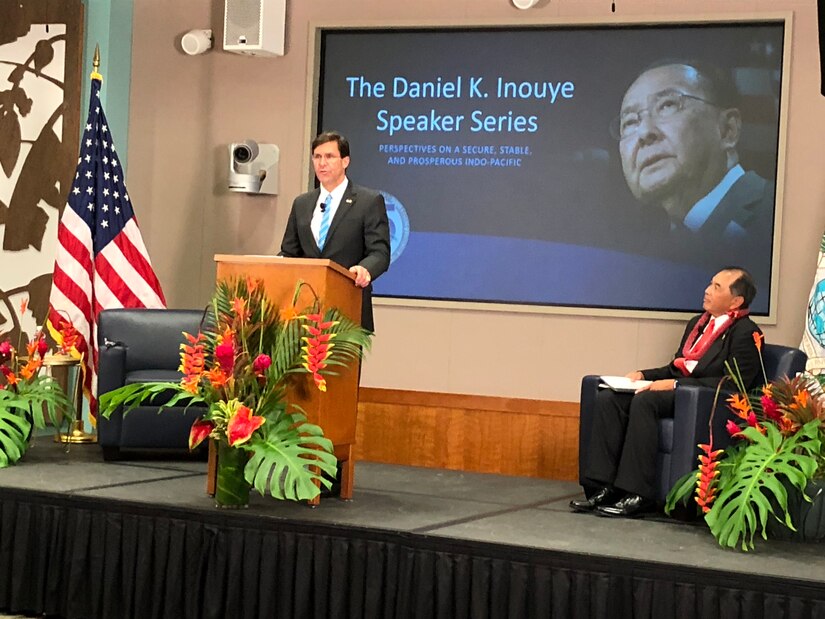
Mark T. Esper said in Honolulu today.
Esper said China is threatening the basis for prosperity in the
Indo-Pacific region, and like-minded nations must band together.
Allies and partners are crucial in this new era of great power
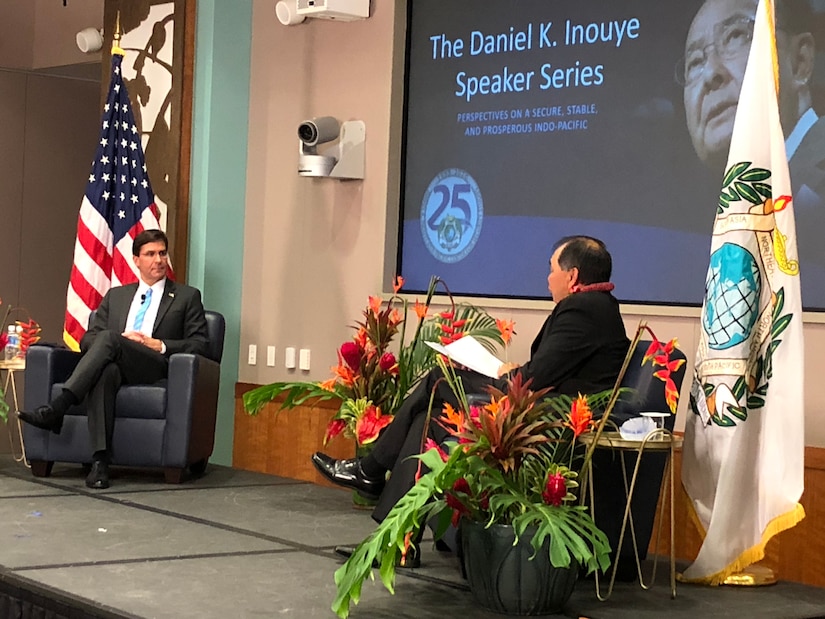
competition, Esper said at a ceremony marking the 25th anniversary of
the Daniel K. Inouye Asia Pacific Center for Security Studies. The
United States recognizes the dangers and is reaching out to nations
around the globe to counter China's moves.
That U.S. network of allies and partners ''remains the enduring
asymmetric advantage we have over near-peer rivals, namely China, that
attempt to undermine and subvert the rules-based order to advance their
own interests – often at the expense of others,'' he said.
Great power competition is the foremost threat facing the globe, and
the United States has made it the foundation of the National Defense
Strategy promulgated in 2018.
''One of the goals that drives our implementation of the [strategy] is to focus the department on China,'' he said.
The Defense Department has taken a number of steps including the
creation of a new policy office to counter China. There is now a China
strategy management office to integrate DOD efforts to deter China.
The National Defense University has shifted its curriculum with 50%
of the coursework concerning China. He also decreed that the services
make China ''the pacing threat'' in all DOD schools, programs and
training.
''These efforts are critical to preparing our military's future leaders for tomorrow's challenges,'' he said.
The Chinese Communist Party – not the people – rule China, and the
leaders in Beijing have repeatedly fallen short of their promises, and
China does not abide by international laws, rules or norms, Esper said.
This is despite continuing to reap the benefits of the international
system and free markets.
These efforts prepare our military for future conflicts that we
hope we won't need to fight, but must – and will – be prepared to win.''
Defense Secretary Dr. Mark T. Esper
The Communist Party also reneges on commitments it made, including
promises to safeguard the autonomy of Hong Kong and not to militarize
features in the South China Sea, the secretary said.
''Beijing's self-serving behavior … is not isolated to just the
Indo-Pacific region,'' he said. ''Increasingly, our like-minded partners
around the world are experiencing the CCP’s systematic rule-breaking
behavior, debt-backed economic coercion and other malign activities
meant to undermine the free and open order that has benefitted nations
of all sizes – China included.''
Fishing fleets with no care for the ecological and economic damage
they create around the world are an example of China flexing its
muscles. Beijing has failed to uphold its obligations under the World
Trade Organization. Chinese leaders also hampered global efforts to
control the coronavirus pandemic due to its lack of transparency with
the World Health Organization, Esper said.
There are direct military implications to the Chinese attitude.
''To advance the [Chinese Communist Party's] agenda, the People's
Liberation Army continues to pursue an aggressive modernization plan to
achieve a world-class military by the middle of the century,'' the
secretary said. ''This will undoubtedly embolden the PLA's provocative
behavior in the South and East China Seas, and anywhere else the Chinese
government has deemed critical to its interests.''
The PLA does not serve the people or swear an oath to a constitution
but is the military arm of the Communist Party. It is in league with
attempts to undermine rules and norms across the globe, including
Djibouti, Sri Lanka, Latin America and Africa.
''Clearly, China seeks to undermine the free and open order itself,
which impacts every nation supporting and benefitting from this
system,'' he said.
DOD's answer to this is preparedness, strengthening alliances and
partnerships, and promoting and expanding a network of like-minded
partners.
The United States is focusing on modernizing the force to deter,
compete, and, if necessary, fight and win, across all domains: air,
land, sea, space, and cyberspace, Esper said.
''Thanks to our largest research and development budget in the
department's history, we are prioritizing the development and deployment
of game-changing technologies, such as hypersonic weapons, 5G and
artificial intelligence,'' he said. ''We are also investing in platforms
critical to the future of a free and open Indo-Pacific, such as
submarines, B-21 stealth bombers, P-8 maritime patrol aircraft, unmanned
underwater and surface vehicles, long-range precision munitions,
integrated air and missile defense, and a new class of frigates.''
But it is not just equipment. DOD is developing a new Joint
Warfighting Concept for the 21st century. Part of that is making the
U.S. military more strategically predictable to our partners, and
operationally unpredictable to our competitors, Esper said.
''These efforts prepare our military for future conflicts that we
hope we won't need to fight, but must – and will – be prepared to
win,'' he said.
Allies and partners are key in this struggle. DOD must assist
countries across the region to develop their national security policies,
strategies, plans, and laws.
''This type of work — with nations such as Bangladesh, Mongolia, the
Philippines and several Pacific Island nations — has helped put
like-minded partners on a path toward greater preparedness, enabling
them to become more confident in their sovereignty,'' he said.
Allies and partners provide an asymmetric advantage adversaries do not have.
''Our shared security concerns and desire to maintain a free and open
Indo-Pacific have yielded countless bilateral and multilateral
initiatives throughout the region aimed at strengthening and expanding
defense cooperation and alignment,'' Esper said.
Part of this process is through an improved and expanded foreign military sales program.
''By streamlining the FMS process, we have lowered costs and
accelerated our response time to partner nation requests, allowing us to
deliver critical capabilities more quickly and effectively,'' he said.
The United States is working with long-established allies, including
Australia and Singapore, and with other nations in South Asia, Southeast
Asia and Oceania.
Bilateral alliances are good, but multilateral efforts are better.
Promoting a more networked region encourages the growth of
inter-connected security partnerships, Esper said. This is a force
multiplier for nations that share U.S. interests.
''As we continue to implement our Indo-Pacific strategy, the United
States needs our allies and partners to contribute in ways that are fair
and equitable,'' the secretary said. ''We need them to pursue close
alignment in policies that uphold a free and open order, and reject
decisions that would benefit malign actors to our collective detriment.
And, we need them to make the necessary investments to improve their
capabilities so that, together, we can safeguard our interests,
strengthen our readiness, and defend our sovereignty and values.''














 Posts
Posts

