Tuesday, June 02, 2020

Oklahoma National Guard Supports Statewide COVID-19 Contact Tracing

June 2, 2020 | BY Air Force Tech. Sgt. Kasey Phipps

Members of the Oklahoma National Guard are supporting the Oklahoma State Health Department in fulfilling Gov. Kevin Stitt's continued efforts to slow the spread of COVID-19 throughout the state.

In this latest push, Oklahoma guardsmen are helping with contact tracing, which is the process of tracing and monitoring the contacts of infected people.

Oklahoma guardsmen conduct contact tracing operations.

"We're minimizing the spread and helping with the community," said Army Sgt. Anna Aranda, a member of the Oklahoma National Guard who serves as the noncommissioned officer in charge of the guardsmen working at the Texas County Health Department in Guymon, Oklahoma. "We're working closely with the Oklahoma State Department of Health and making a tremendous impact with them. You know, they needed our help, and so we're here."

The tracing, which begins with a positive COVID-19 test, follows the same procedures for any other disease or contagion tracing process. An employee from the Health Department makes the initial call, and after confirming their identity, informs the individual of the positive test result. They then work with the call recipient to voluntarily build a list of contacts who could have had exposure to the infected individual. That list gets passed to a trained person who then follows up with each of the contacts.

"There's the same procedure, same protocol, same stratagems to limit exposure," said Eddie Garza, a disease intervention specialist with the Oklahoma State Health Department. "But morbidity is so high here — and actually everywhere in Oklahoma, but especially in Texas County — that we needed reinforcements. The National Guard has been a tremendous help in contact tracing, because for one person who tests positive, we've had upwards of 10 to 15, sometimes 25 contacts."

Guardsmen working in a call center setup are trained to make the calls to each of the contacts while also protecting the contact's identity and medical information. Despite the "tracing" aspect of the interactions, the initial outreach begins regular contact with potentially infected people for the duration of their contagious period. These phone calls can include education of symptoms and prevention, resources such as food and supplies for those who need to quarantine and symptom monitoring for those who contract COVID-19 or have the potential to.
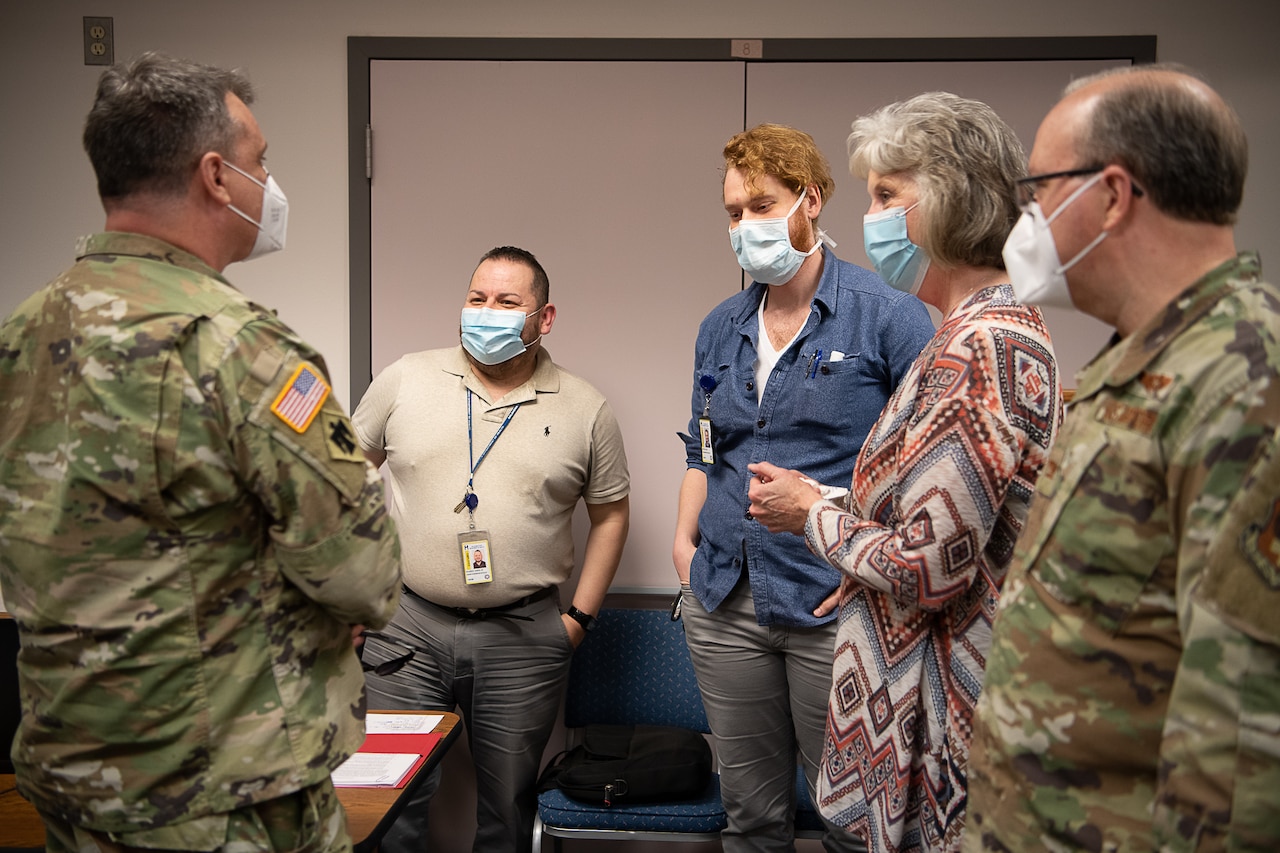
Oklahoma guardsmen conduct contact tracing operations.

"We make phone calls and we inform them of their possible contact, and the response has been great," Aranda said. "Most everyone has been polite, encouraging and thanking us for following up with them. A lot of them are worried, you know, of course, and you've got to show empathy. You build a kind of trust with them."

For Aranda's region, which focuses heavily on Guymon, being bilingual provides a special skill set that goes further than their contact tracing training and is especially important. The population of Guymon speaks 37 different languages, with English and Spanish being the most prominent.

"We want to help the community to feel safe and for them to have an understanding of what we’re saying," Aranda said. "We have three service members who are bilingual, and they are a tremendous asset to our team. You want to speak the language that you're comfortable with, so that's what we do, and that gives them peace of mind when we call them."

Aranda, who is one of the three bilingual guardsmen there, says their ability to communicate with the community has really built rapport with those they have contacted.

"They're not afraid," she said. "They're not scared. So it makes me feel great that we're making such a big impact in this community. It's an amazing feeling. You can't beat that."

Aranda said the trust between the community and the guardsmen who are helping to carry out the contact tracing in their area is paramount to the success of their jobs as contact tracers.
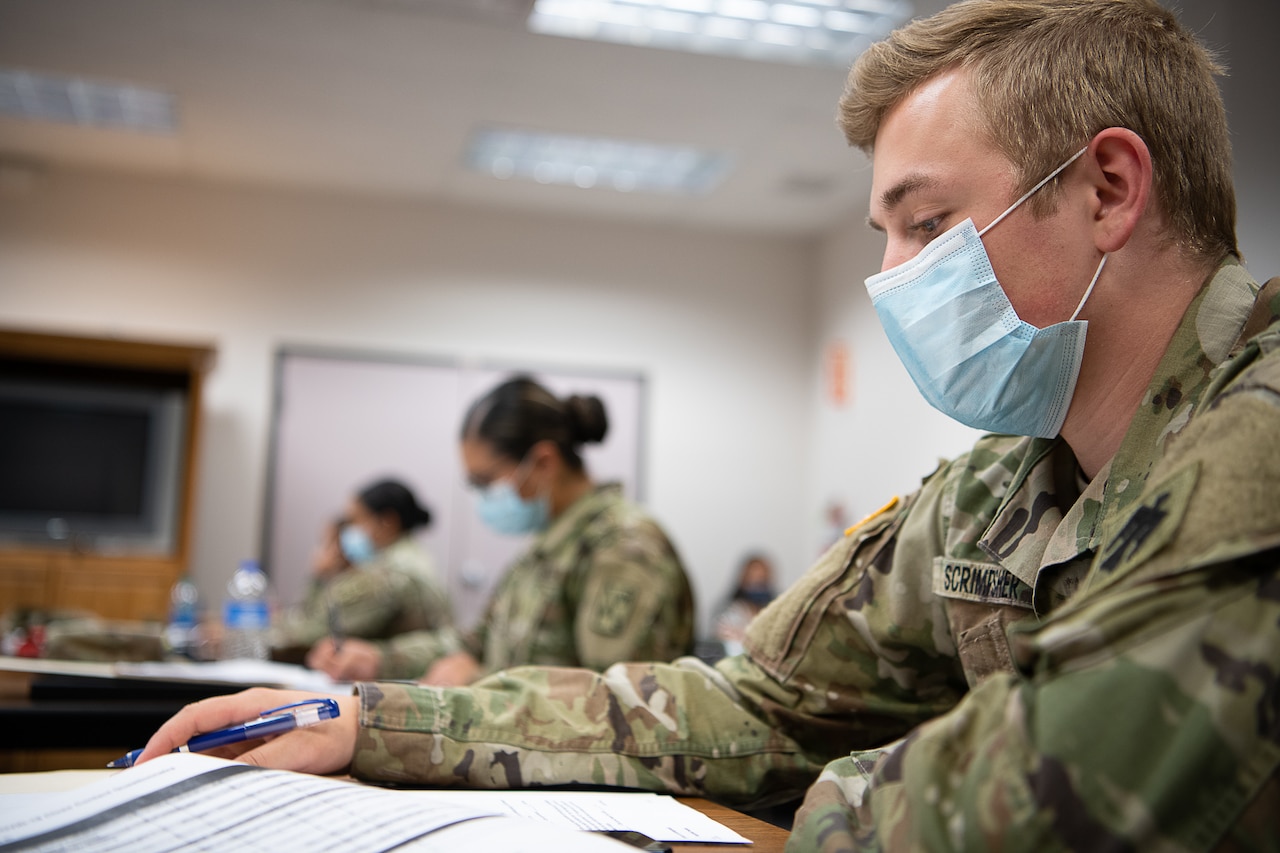
Oklahoma guardsmen conduct contact tracing operations.

"When we do contact tracing, there is fear that people have in the community about privacy," Aranda explained. "So we're not there to worry about what they're doing. We're just worried about their symptoms and making sure that they are aware that they came in contact with somebody with COVID-19. So our goal is to make them aware so they can help [prevent] the spread, and they’re usually grateful for that."

An exponential increase in the number of COVID-19 cases in Guymon demanded more contract tracing. Since their arrival in May, the guardsmen from the Oklahoma Air and Army National Guard have more than doubled the calling and testing capacity in the area.

"The guard has probably doubled my staff here in Guymon," said Terri Salisbury, the Oklahoma State Health Department regional director. "I really appreciate the National Guard coming out and being so willing [to help]. Most people don't come to Guymon, Oklahoma, and they've all been great. They've stayed and worked through the weekends and everything else. So I'm very, very thankful for them."

Teams like this one are spread throughout the state to help their communities limit their exposure to COVID-19 and fight against the pandemic together alongside other state agencies.

(Air Force Tech. Sgt. Kasey Phipps is assigned to the Oklahoma Air National Guard.)

Baseball 'Legend' Abner Doubleday Also Served in the Union Army

June 2, 2020 | BY David Vergun, DOD News

Most sporting events have been postponed or cancelled due to the COVID-19 pandemic. Because many service members are sports fans and the games are mostly on hold, here's a look at a purported baseball legend who also served in the Army.

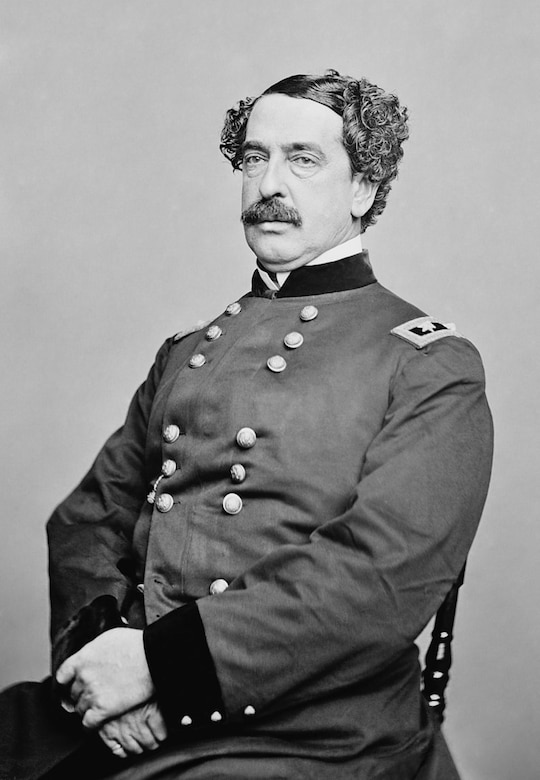
For a very long time, Abner Doubleday was widely thought to have invented the game in 1839 at age 20 in his hometown of Cooperstown, New York. 

A man in a Civil War-era uniform poses for a portrait.

However, that year, Doubleday was a cadet at the U.S. Military Academy in West Point, New York, and permission to travel home was rarely granted to first-year cadets.  Doubleday never claimed to have invented the sport; nonetheless, the claims were made by others after his death.

Although variations of baseball were thought to have existed as early as the Revolutionary War, no one knows exactly who created the game.

In 1907, the Mills Commission, composed of seven prominent baseball officials and former players, investigated the matter and deemed Doubleday was baseball's inventor. But sports historians later said the commission's findings were flawed due to lack of solid evidence. 

Still, the findings were great news for the local businesses in Cooperstown and major league officials, who established the town's National Baseball Hall of Fame and Museum in 1939, which today is a major tourist attraction.

Another myth is that Doubleday invented San Francisco's cable cars. He did co-establish the city's first cable car company, however.

Aside from baseball and the cable car, Doubleday's life and illustrious military career were fascinating.

After graduating from West Point in 1842, he became an artillery officer with the 3rd Artillery Regiment. He and the regiment were deployed to Mexico from 1846 to 1848 during the Mexican-American War.

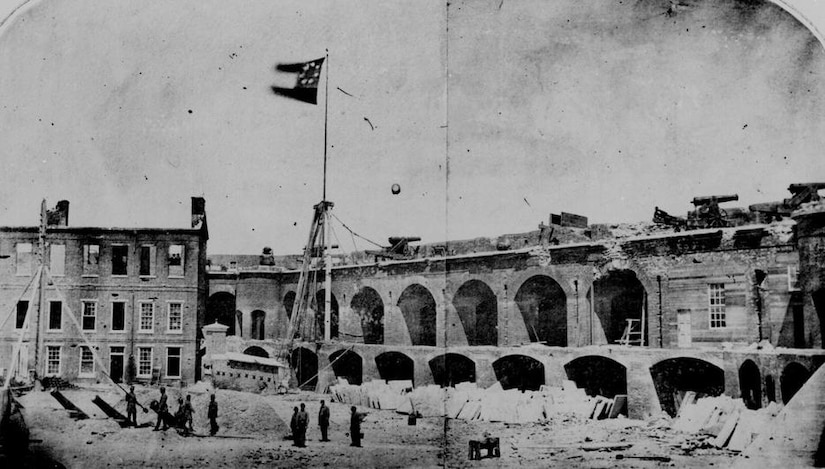
A Civil War-era photograph of a southern fort.

He later was assigned to Florida from 1855 to 1858 where he participated in the Third Seminole War.

The following year found Doubleday at Fort Moultrie on Sullivan's Island, South Carolina. Secessionist fervor was sweeping large areas of the South, and many officers resigned their commissions to join the rebellion.

In the face of growing hostility to Union soldiers, the garrison commander decided to move the garrison to nearby Fort Sumter, which was considered more defensible.

After a four-month standoff, the South Carolina militia attacked the fort with artillery. Doubleday is said to have aimed his battery to fire the first return shot. As a result, he and his gun crew were the Union soldiers who fired the first shot that started the Civil War on April 12, 1861. 

With supplies and munitions low, after 34 hours of bombardment, the Union soldiers — led by Army Maj. Robert Anderson and second-in-command Doubleday — surrendered.

The garrison was allowed to depart and head north, since it was so early in the war and prisoners were not yet being taken. After a promotion to major, Doubleday commanded artillery defenses around Washington, D.C.

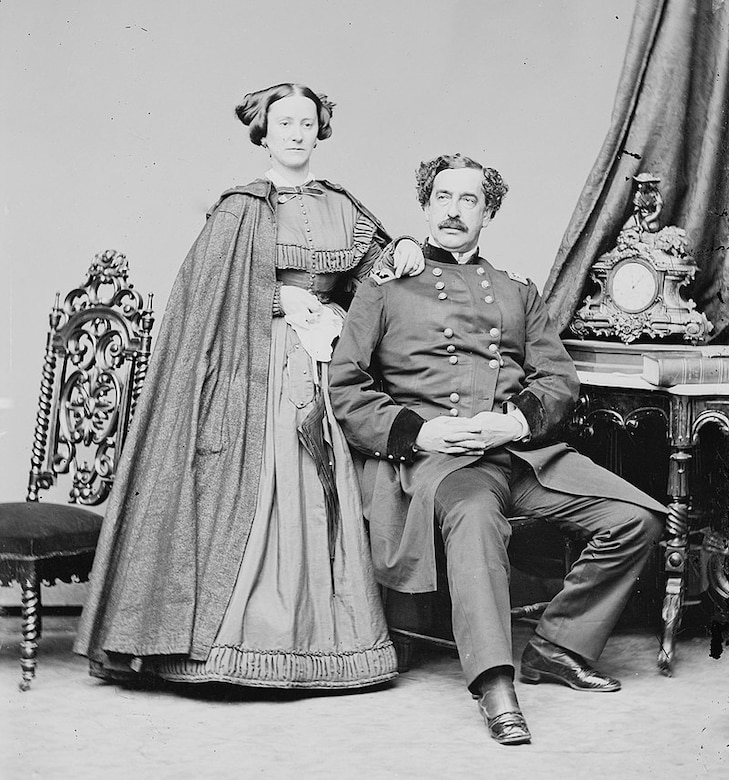
A mid-19th century couple pose for a portrait.

Following a rapid promotion to brigadier general, he was given command of a brigade, under Army Gen. Irvin McDowell. On Aug. 29-30, 1862, he led his men into combat at the Second Battle of Bull Run, which Southerners even today call the Battle of Second Manassas.

During the ensuing battle, his men helped hold the line against Confederate Maj. Gen. Thomas ''Stonewall'' Jackson's advance for a time. However, on Aug. 30, Confederate Maj. Gen. James Longstreet pushed back all the Union soldiers, including McDowell's.

Nonetheless, Doubleday is said to have conducted himself well during the battle.

Doubleday participated in many more battles, including the Battle of South Mountain, Sept. 14, 1862, near Boonsboro, Maryland. During the battle, Army Brig. Gen. John P. Hatch was wounded so Doubleday took command of I Corps and successfully blocked a Confederate assault.

At the Battle of Antietam on Sept. 17, 1862, near Sharpsburg, Maryland, Doubleday led a division assigned to I Corps. About 23,000 men on both sides were killed. He, again, did well leading men on the battlefield during the bloodiest day of battle in U.S. history. He was promoted to major general about two months later.

After leading his division again in combat during the Battle of Fredericksburg in Virginia on Dec. 11-15, 1862, Doubleday was assigned to command a new division.

From April 30 to May 6, 1863, Doubleday led this division at the Battle of Chancellorsville in Spotsylvania County, Virginia.

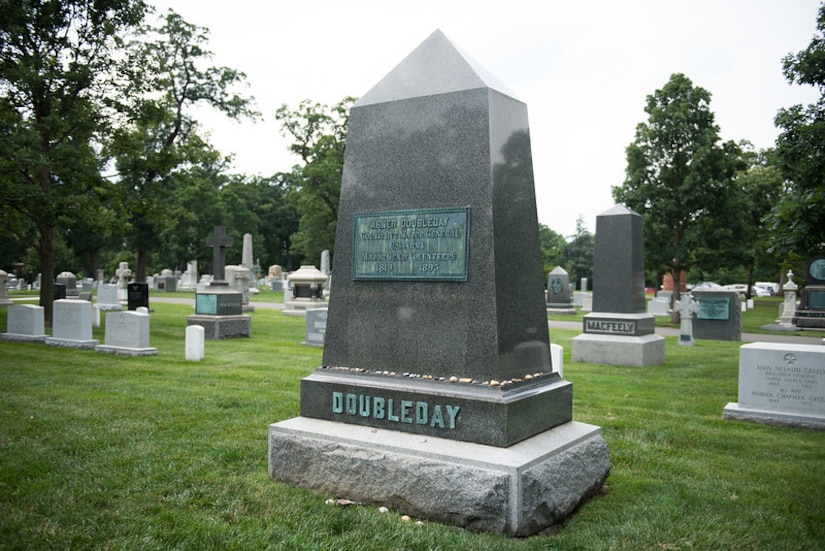
A photograph of a tombstone bearing Doubleday’s surname.

Perhaps Doubleday's biggest moment of glory, however, was at the Battle of Gettysburg in Pennsylvania on July 1-3, 1863.

On the first day of battle, I Corps commander, Army Maj. Gen. John F. Reynolds was killed, and Doubleday took his place. His 9,500 men held back more than 16,000 Confederate attackers.

Despite his unit's extraordinary heroism, Doubleday was relieved of command on day two of the battle by Army of the Potomac commander Maj. Gen. George G. Meade. It has been said that Meade personally disliked Doubleday. After having been relieved of command from I Corps, Doubleday again became a division commander for the remaining days of the battle.

Doubleday had a number of other assignments during the Civil War, and, unlike many of his fellow officers, he remained in the Army when the war ended.

In 1871, he commanded the 24th U.S. Infantry Regiment, an all African-American regiment headquartered at Fort McKavett, Texas. Doubleday requisitioned baseballs and baseball bats for his regiment, valuing sports as a camaraderie-building activity. It is said that he did this throughout his Army career.

Two years later Doubleday retired from the Army.

Other Interesting Facts

  • The baseball field at the U.S. Military Academy at West Point was named Doubleday Field in his honor in 1939, the same year the National Baseball Hall of Fame and Museum opened. Many baseball fields around the U.S. are also named Doubleday Field, including in Cooperstown, which opened in 1920.
  • Doubleday’s father, Ulysses Doubleday, fought in the War of 1812 and was a U.S. congressman, representing the 24th District in New York. Doubleday’s grandfather fought in the Revolutionary War at Bunker Hill, Stoney Point and at Valley Forge.
  • Abraham Gilbert Mills, who headed the Mills Commission which was to determine the origin of baseball, also has an interesting background. He enlisted in the 5th New York Volunteers in 1862 as a private. During the war, he was commissioned a second lieutenant and served for the duration of the war.
  • During World War II, the liberty ship SS Abner Doubleday was named in his honor.
  • Doubleday, who died in 1898 at age 73, is buried at Arlington National Cemetery in Section 1, Grave 61, very close to the James Tanner Amphitheater.


Monday, June 01, 2020

Continental Intercept

A U.S. Navy F/A-18E Super Hornet intercepts two U.S. Strategic Command B-1B Lancers as they enter the Canadian Air Defense Identification Zone, and again as they enter the Continental U.S. North American Aerospace Defense Command Region, May 29, 2020. The intercepts were part of a U.S. Northern Command-led, large-scale homeland defense exercise.

Physical Training

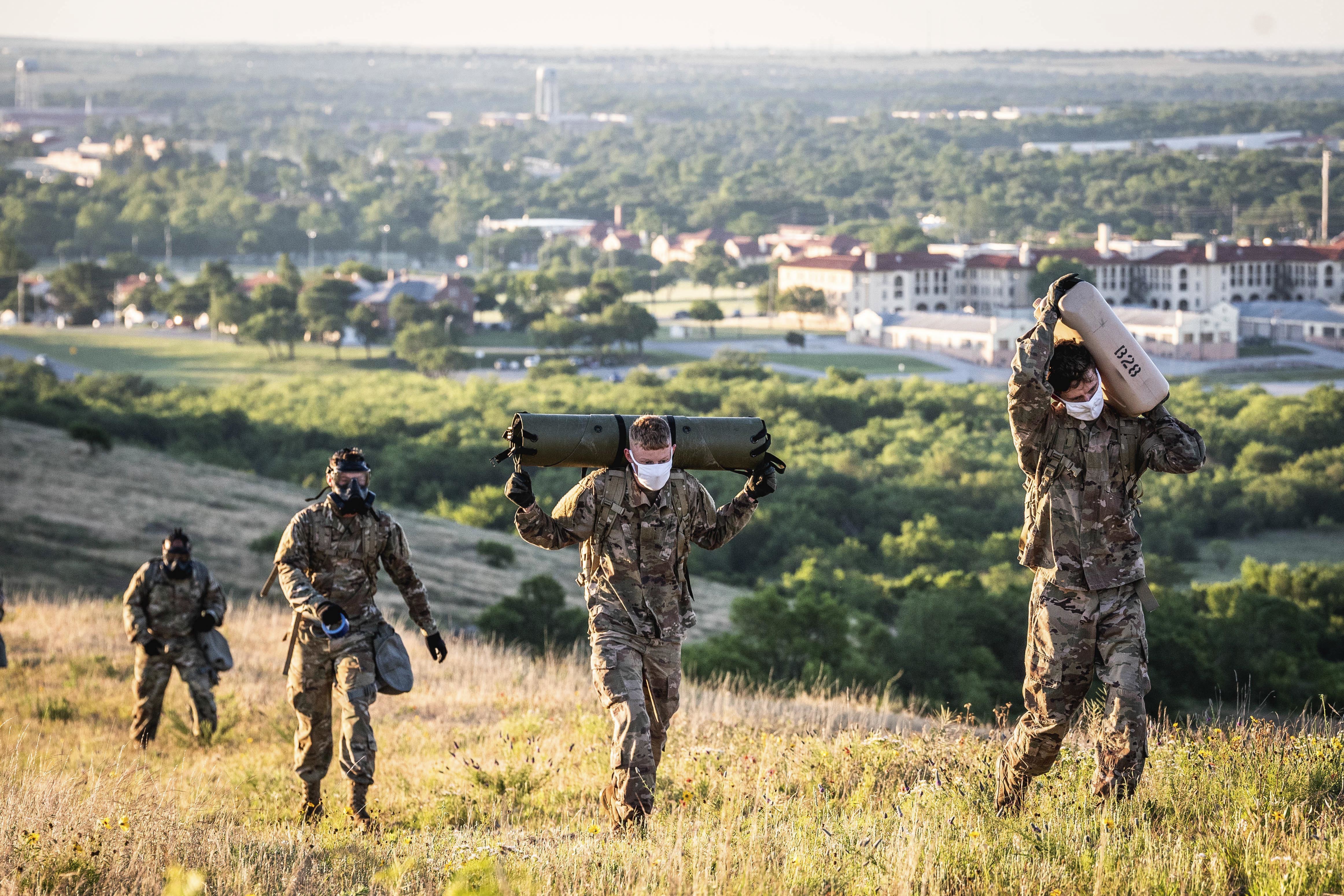
Soldiers participate in a physical training session at Fort Sill, Okla., May 29, 2020.

Marine Flight

Marines operate MV-22B Ospreys during a training exercise over Oahu, Hawaii, May 28, 2020.

Honor Guard Soldiers Continue Performing Final Salutes During COVID-19

June 1, 2020 | BY Army Capt. Avery Schneider , New York Army National Guard

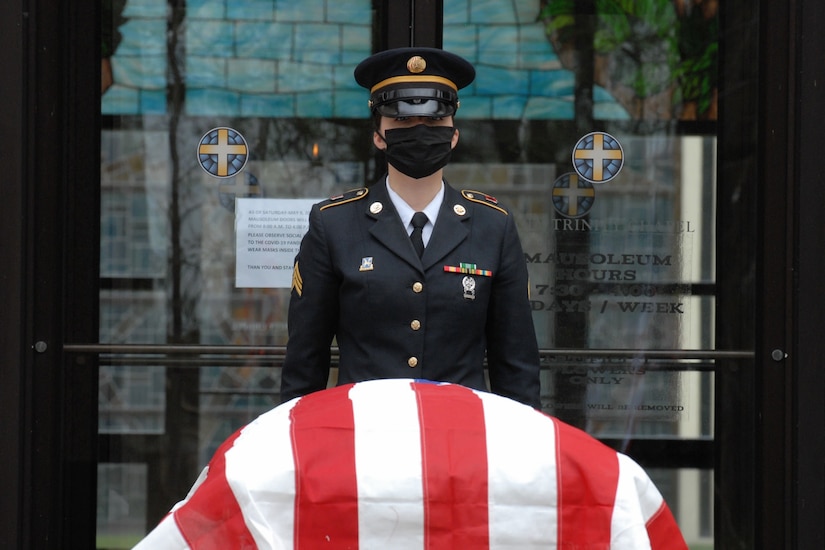
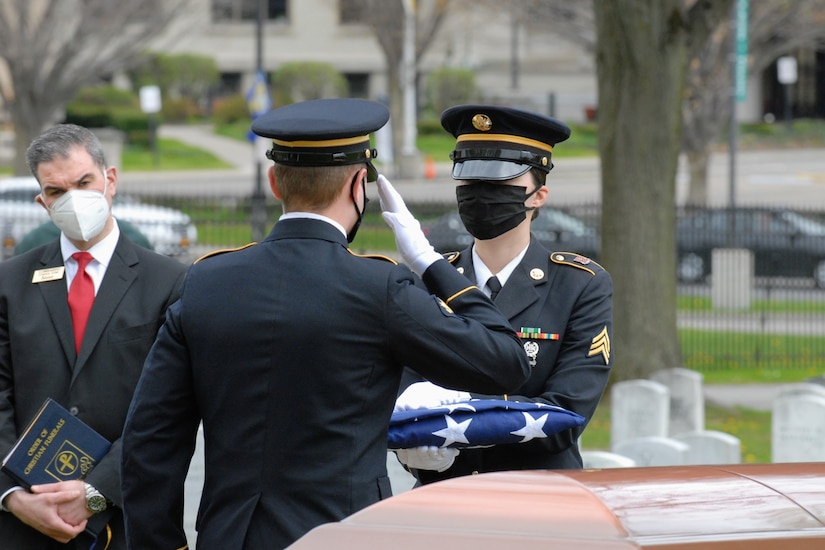
On a warm and cloudy morning, Army Sgt. Nikole Clark and Army Spc. Austin Dycha stepped out of their cars at Holy Cross Cemetery in Lackawanna, New York, to conduct a funeral ceremony in honor of former Army Air Force Cpl. Raymond Kegler, who served during World War II.

Honor guard soldier at a military funeral.

Despite the impact of the COVID-19 pandemic, the New York Army National Guard's Military Funeral Honors Program continues to provide final salutes to Army veterans.

The two-member honor guard team surveyed the cemetery's granite-walled mausoleum and began final preparations for Kegler’s May 14 funeral.

They donned jackets and service caps, brushed off lint, and pulled on their white gloves.

Then they added the newest part of their uniforms: a black cloth mask. These masks are the primary protection against the spread of COVID-19 and are now required during funeral honors.

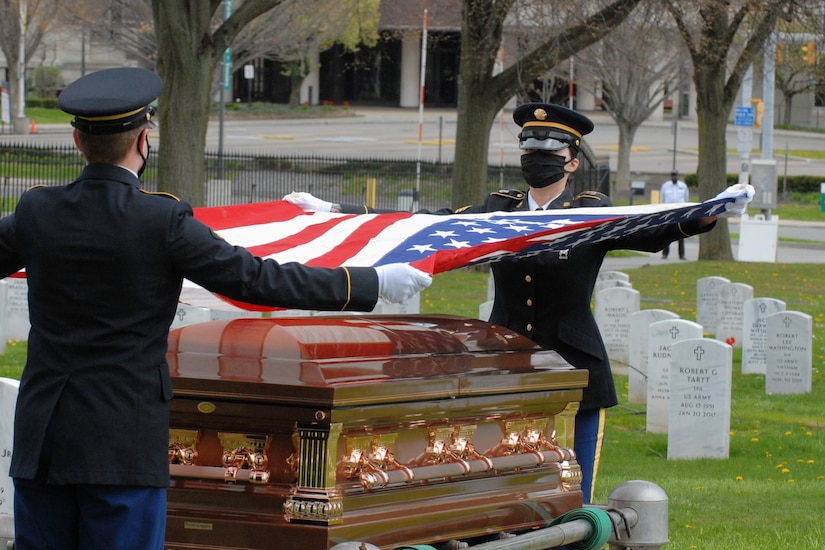
Honor guard soldiers at a military funeral.

Before the pandemic, the New York Army National Guard's Military Funeral Honors Program was performing an average of 850 services per month, statewide. Now, the average is down to 350..

"Although veterans are passing, some cemeteries are not allowing honors to be performed at the moment," explained Army 1st Lt. Melisa Rosario, the officer in charge of the program.

Two types of ceremonies would normally be available. The first is modified full honors for retirees with 20 or more years of service, or those who died while on active duty. The second is modified honors for Army veterans with an honorable discharge. Nine soldiers, including a firing party, perform the modified full honors, and only two soldiers perform the modified honors.

Based on National Guard Bureau guidelines, a maximum of three soldiers are currently allowed at a funeral, so New York's program is offering only modified honors. Where they are permitted, each individual ceremony is directed by a detail leader like Clark, who has the duty of presenting the burial flag to the veteran's family.

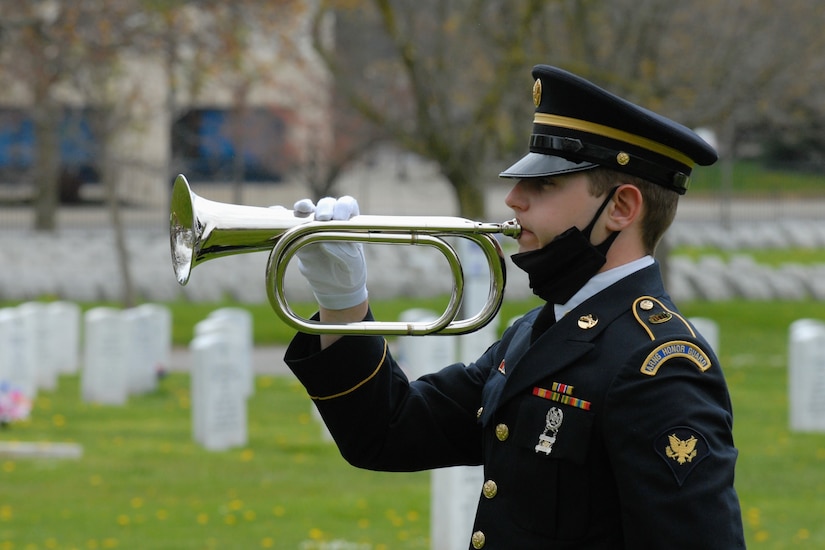
Honor guard soldier plays a trumpet at a military funeral.

"The detail leader will determine how safe they feel at the service and has the option to place the flag 6 feet from the next of kin, or on the casket," Rosario said.

New COVID-19 protection guidelines are causing a lot of uncertainty in the way the time-honored traditions of the final salute are performed. Small details such as which way a funeral procession arrives at the cemetery are normally the same each time, but with gate restrictions and casket arrival times affecting when and how the service takes place, honor guard members have to adjust quickly to each situation.

"We're trained to manage it and think on our feet," Clark said. "We make it work, whatever we've got to do."

The personnel restrictions don't just affect the honor guard. They also affect the number of family members allowed to attend.

"We've done services where it's hundreds of people there, and now it's a handful of people," Clark explained. "And once in a while you get them live-streaming, too. It's not really something you saw before."

onor guard soldiers at a military funeral.

Clark has performed more than 700 funeral honors. The steps become near-muscle memory, she said. What took the most getting used to was not kneeling in front of the next of kin to present the burial flag, she said.

"Kneeling in front of someone and looking into their eyes, and presenting them a flag is kind of a worth-a-thousand-words kind of thing, a big gesture, a more powerful gesture," Clark explained.

Clark and Dycha say that what they offer families during funerals while the COVID-19 pandemic continues is a sense of normalcy in a far-from-normal time.

"It's definitely less intimate," Clark said. "You just have to make do with it and still know that the family understands."

(Army Capt. Avery Schneider is assigned to the New York National Guard.)

New Jersey Air National Guard Helps Veterans Home Staff, Residents

June 1, 2020 | BY Air Force Master Sgt. Matt Hecht , New Jersey National Guard

When the call for volunteers was sent out, 31 airmen with the New Jersey Air National Guard's 177th Fighter Wing stepped up to help the state's most vulnerable population at the New Jersey Veterans Memorial Home at Vineland.

Armed with cleaning supplies and a desire to help others, the airmen have integrated themselves with the staff at the facility.

Airmen working at a veteran home.

"Having the National Guard here has been really helpful," said Allyson Bailey, the chief executive officer of the Vineland Home. "They're supplementing our mission here, which is taking care of our residents. Some of the duties the guard has assumed have been instrumental in helping us to reduce the spread of the virus in the home."

Bailey noted that the housekeeping mission has been especially important.

"For our housekeepers, who have been working seven days a week with no days off, having that extra support has been pivotal," she said. "The guard is also helping us out with life enrichment. Residents and families have not been able to directly interact for more than a month and a half now, so virtual visits, emails and phone calls are very important to the residents' families. It has been a tremendously positive thing to have them here helping us."

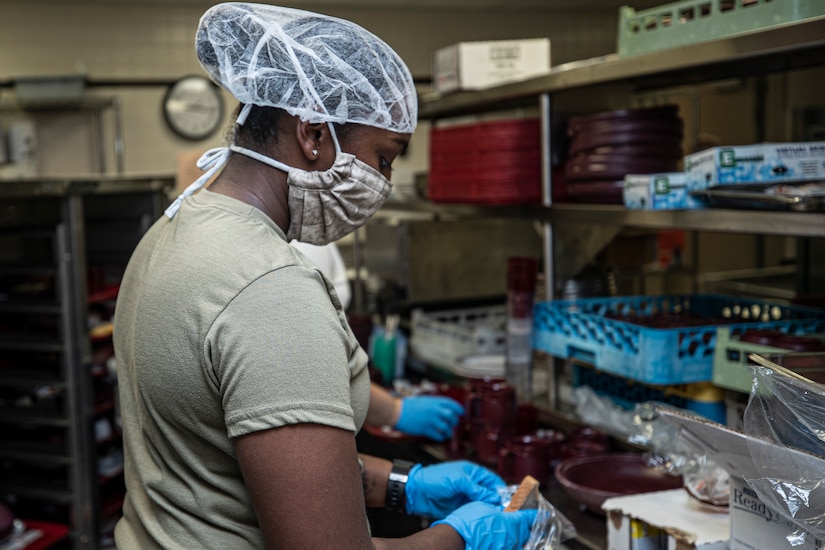
An airman wearing a hairnet, face mask and gloves prepares food.

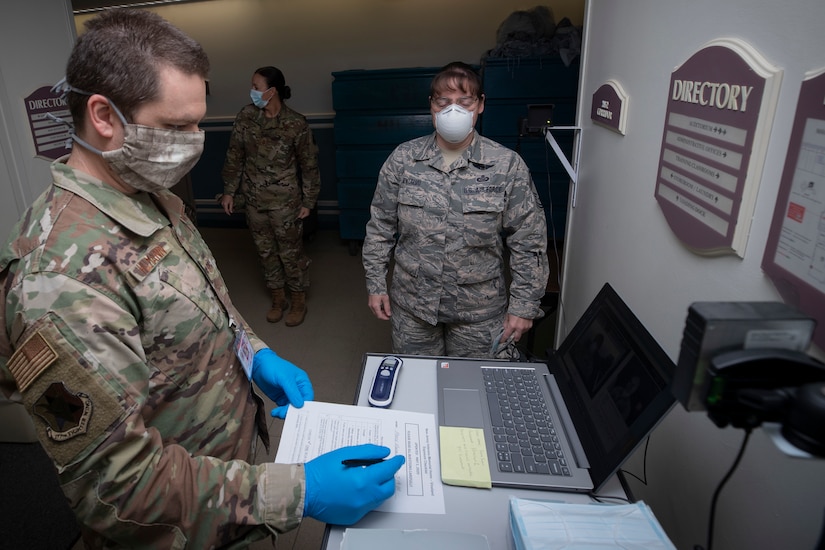
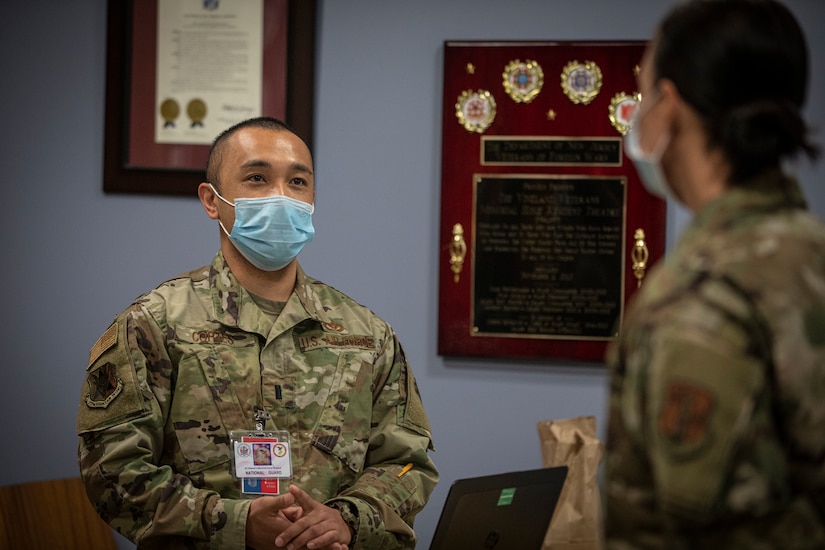
"We're supplementing where the facility really needs help," said Air Force 1st Lt. Bernard Cortes, the officer in charge of Team Vineland. "Housekeeping, food service, health screening checkpoints, facility engineering and life enrichment are some of the missions we're doing here. Airmen are getting food orders for residents, talking with them and keeping them in touch with their families. We're giving them that interaction that is a basic human need."

Cortes said that the guardsmen have developed a great relationship with Vineland's staff.

Airmen working at a veteran home.

"It means a lot for me to be a part of this," Cortes said. "I'm from New Jersey, I grew up here. I look at the veterans, and I want to give them the best care that I can. To see the residents smile and salute us, it makes it feel worthwhile."

"It's very rewarding," said Air Force Senior Airman Connor Jarvis, who is working on the housekeeping team. "It's nice to be able to help. I'm mopping floors, I'm sanitizing countertops, cleaning bathrooms and common areas eight hours straight."

Air Force Senior Airman Casey Keevill said that working with residents in life enrichment has been a meaningful experience and has made an impact on the lives of the guardsmen as well as the veterans.

An airman wearing a face mask.

"I work directly with the residents," Keevill said. "Our job is to keep residents involved and active. We start the morning by delivering newspapers and engage with them to see how they're doing and what they need. It's been great because you really get to know these people.

"It's been amazing seeing what the National Guard can do when our state needs us," Keevill continued. "You get a whole new perspective. Seeing it and being a part of it gives it so much more meaning."

DOD Supports Partner Nations With COVID-19 Mitigation Assistance

June 1, 2020 | BY David Vergun , DOD News

The Defense Department's Cooperative Threat Reduction Program has supported COVID-19 requests for assistance from 13 nations totaling about $2.9 million, said Deputy Assistant Secretary of Defense for Countering Weapons of Mass Destruction David Lasseter, whose office provides strategic guidance for the program to ensure mission alignment with broader National Defense Strategy objectives.

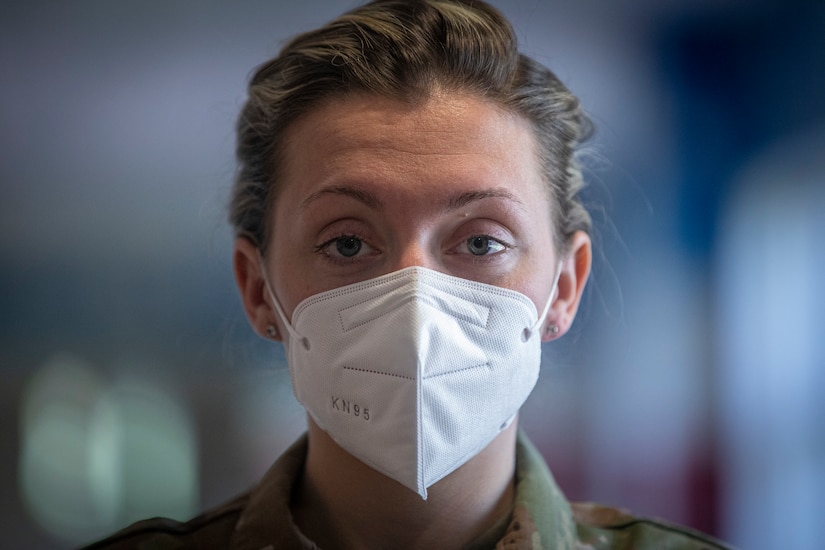
A woman places a pathogen sample into a test tube.

This recent support is part of the department's ongoing efforts to counter biological weapons of mass destruction threats. The DOD CTR Program works cooperatively with international partners to mitigate WMD-related threats to the U.S. homeland, U.S. forces abroad, and U.S. partners and allies. This includes biological, nuclear, and chemical weapons and related delivery systems. 

With regard to biological threats, the program has partnered with more than 30 countries since 2004 to improve their ability to detect, diagnose and report the spread of especially dangerous pathogens. It has accomplished this through training, information exchanges, scientific partnerships, providing equipment, and laboratory construction. It works across sectors to help partner scientists and technicians safeguard pathogen samples held in laboratory facilities against accidental or intentional release, promote research collaboration, and facilitate trainings and best practices.

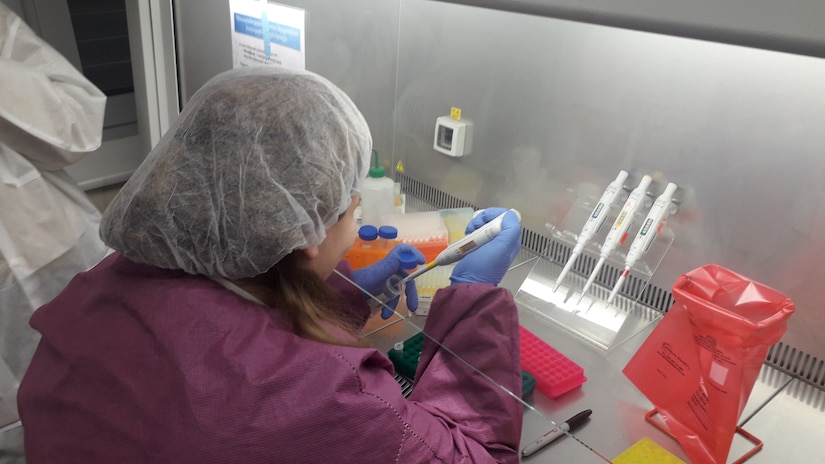
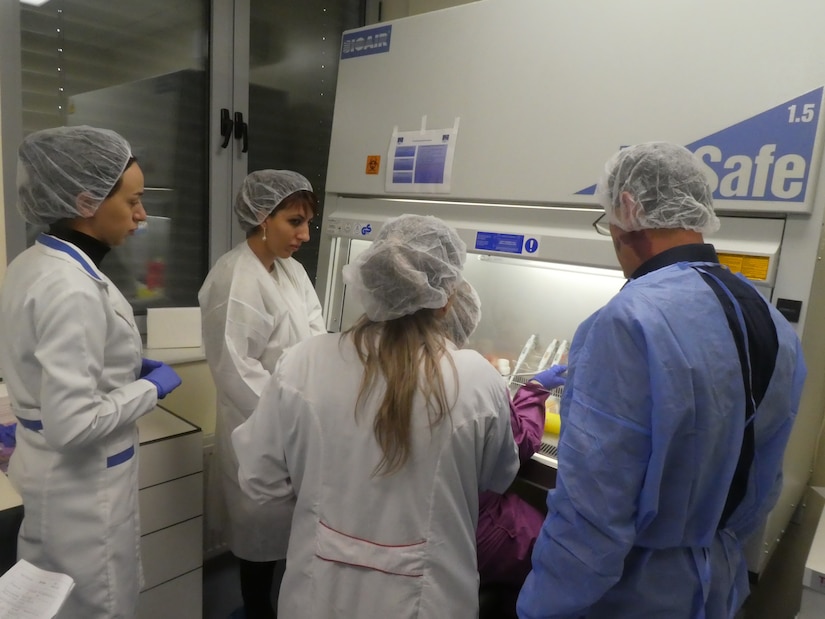
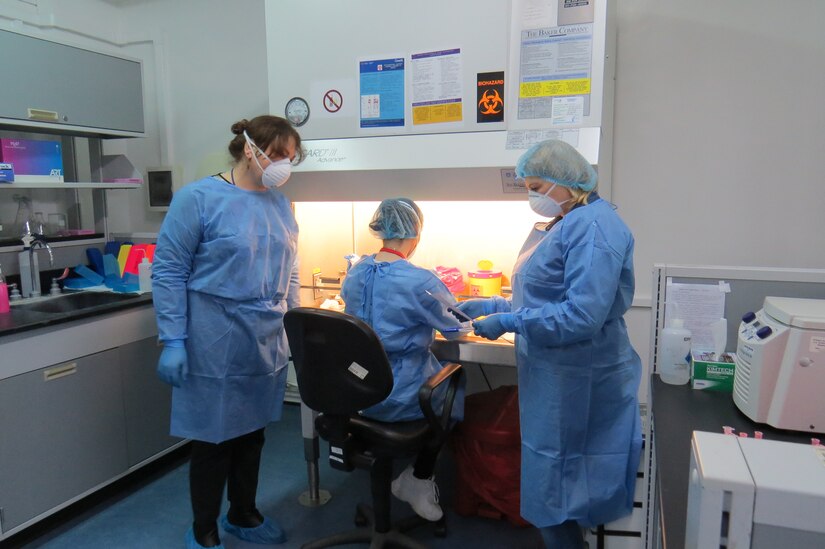
Laboratory technicians work at a biosafety cabinet.

Partner nations are now leveraging these capabilities developed over the last 15-plus years as part of their COVID-19 preparedness and response efforts. Laboratory facilities that CTR previously helped partner nations construct or renovate are playing a particularly crucial role, Lasseter said. These facilities, fully owned and operated by the partner nation, are often the central facility in a country or region running diagnostic tests and research for COVID-19. For example: 

  • Georgia's National Center for Disease Control and Public Health in Tbilisi is running COVID-19 diagnostic tests and sharing COVID-19 research and procedures with other partners in the region;
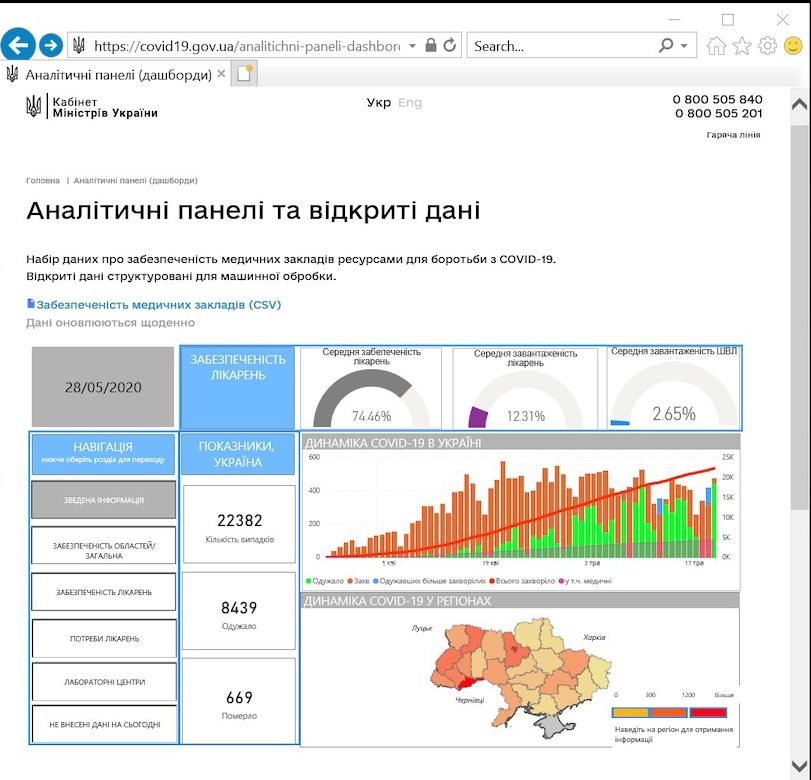
  • Ukraine's Public Health Center’s Emergency Operation Center is sharing outbreak data and practices for safe and effective COVID-19 diagnosis and reporting; and
  • Armenia's Health Ministry, through its network of biological analysis laboratories, is conducting analyses of COVID-19 samples.

The DOD CTR Program also is supporting foreign partner requests for assistance to help stem the spread of COVID-19. These vary from requests for information and subject matter expertise to requests for diagnostics support and personal protective equipment. For example, between March 19 and April 7, Azerbaijan's Ministry of Health requested 400 protective goggles and masks, 51 infrared thermometers, 200 disposable coveralls, and 2.4 tons of disinfectant, all of which the DOD CTR Program provided by April 10.

Screenshot of Ukrainian COVID-19 tracking.

More generally, he explained, a unique aspect of the program involves helping a partner nation's military and civilian components improve cross-ministerial communication and capability to address biological threats that are of concern to both the host nation and the U.S.   

A long-standing principle of the DOD CTR Program is extending that spirit of cooperation across geographic borders, supporting regional biosurveillance networks to enable a coordinated and timely response to disease outbreaks. These efforts have helped stem the spread of COVID-19.

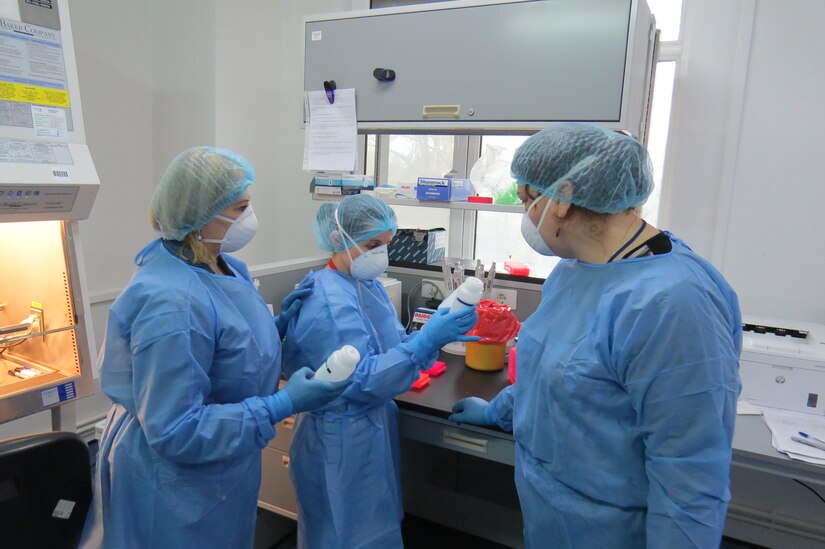
Three women and a man work at a biosafety cabinet.

For example, the Biosurveillance Network of the Silk Road, a regional network of health science experts from a range of countries, including Armenia, Azerbaijan, Bulgaria, Georgia and Ukraine, coordinates with DOD CTR subject matter experts on best practices for safe and effective disease diagnosis and reporting.

''Given the work we have done with these countries, BNSR members have shared with one another COVID-19 outbreak data, diagnosis and reporting,'' said Dr. Robert Pope, director of the Cooperative Threat Reduction Program at the Defense Threat Reduction Agency.

Laboratory technicians work at a biosafety cabinet.

The DOD CTR Program also is helping partner nations implement the Electronic Integrated Disease Support System, which facilitates the collection and analysis of infectious disease information across medical, veterinary and environmental health communities. ''Several countries are now using EIDSS to quickly report COVID-19 cases,'' Pope noted.

''DOD remains firmly committed to working with partners and allies to achieve U.S. WMD threat reduction goals, even in light of COVID-19,'' Lasseter said. ''Threats around the world have not paused, and neither will we.''

Pakistan Delivers COVID-19 Response Supplies as Gesture of Partnership

June 1, 2020 | BY AIR FORCE AIRMAN 1ST CLASS SPENCER SLOCUM , 11th Wing

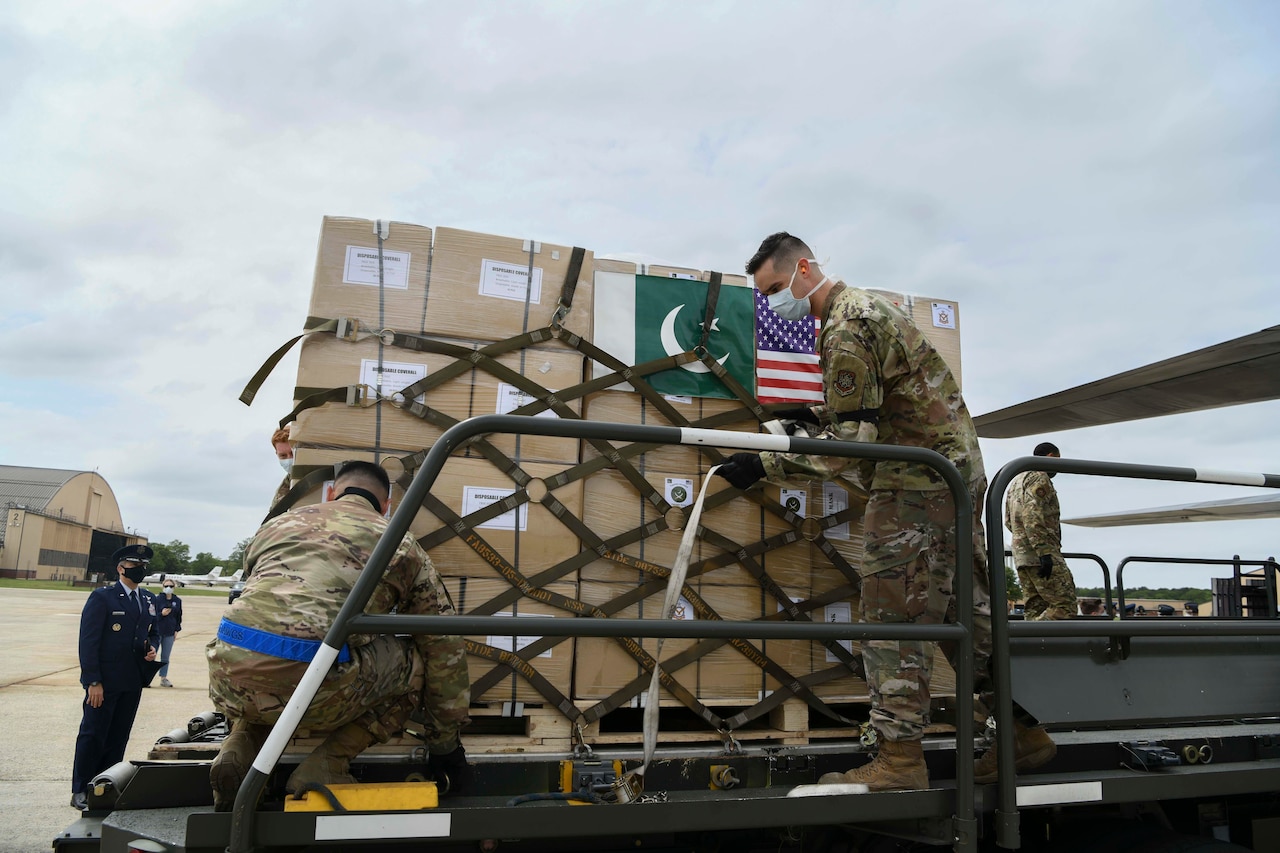
A Pakistan air force C-130 transport aircraft landed at Joint Base Andrews, Maryland, with 100,000 protective masks and 25,000 coveralls donated to the Federal Emergency Management Agency for COVID-19 response efforts.

A Pakistani aircrew member collecting straps.

Ambassador Asad Majeed Khan and other Pakistan Embassy officials greeted the air crew after landing.

Khan highlighted the historic ties between the two nations and their armed forces, noting that both countries have fought together against terrorism and now stand together in the fight against the COVID-19 pandemic.

Acting Assistant Secretary of Defense for Indo-Pacific Security Affairs David F. Helvey represented the Defense Department. He expressed DOD's thanks to Pakistan, underscoring that the donation of personal protective equipment was a display of generosity and goodwill from a long-standing partner. Helvey emphasized that DOD is proud to stand with Pakistan's military in the global fight against COVID-19.

U.S. airmen unload a Pakistan Air Force C-130.

Air Force Brig. Gen. Matthew C. Isler, the director of regional affairs for the deputy undersecretary of the Air Force for international affairs, thanked the Pakistani representatives for their support.

"We are grateful to Pakistan's military for its generosity and partnership," the general said. "Partners stand together as we move through challenges in these unprecedented times."

The materials were offloaded by airmen assigned to the 89th Airlift Wing.

New 'EFMP & Me' Web Tool Launched to Help Families With Special Needs

June 1, 2020

The Department of Defense Office of Special Needs and Military OneSource launched today a new digital tool to guide military families with special needs to the specific information and resources they need. The tool, called EFMP & Me, conveniently connects families anytime and anywhere with tools and information about the Exceptional Family Member Program, or EFMP. Using the tool, families can learn about support services, preparing for a move or deployment, responding to changes in education or medical needs, and adjusting to new life situations.

“The Department of Defense is committed to supporting our families with special needs, and EFMP & Me is an important enhancement to the Exceptional Family Member Program,” said Kim Joiner, deputy assistant secretary of defense for Military Community and Family Policy. “EFMP & Me provides virtual access to EFMP support services for all stages of their military lives, whether they’re just starting out in the program, navigating medical or educational systems, or preparing for retirement from the service.”

Available on computers or mobile devices, EFMP & Me gives families personalized assistance based on their specific circumstances. On the homepage, users answer a few questions then select the types of information they want, such as medical, education, EFMP enrollment, PCS, child care, accessibility or housing. The tool then creates customizable checklists, at the DOD policy level, for users to follow. These checklists include important to-dos, tips and resources that help fine-tune the individual’s experience. Users with a Military OneSource account can save their checklists to view again later.

EFMP & Me is one part of a broad system of support for military families with special needs. That support starts with EFMP Family Support on installations and includes the Military OneSource network, which provides 24/7 support to service members and families anywhere in the world. Click here to access the EFMP & Me tool. Contact Military OneSource EFMP Resources, Options and Consultations for free, around-the-clock support, tools, assistance and more. Call 800-342-9647 or live chat with a consultant. OCONUS/International? Click here for calling options.

The Office of the Deputy Assistant Secretary of Defense for Military Community and Family Policy is responsible for oversight of quality-of-life policies and programs that support the wellness and mission-readiness of Service members, their families, and survivors.

Sunday, May 31, 2020

Former VA Nurse Pleads Guilty to Stealing Controlled Drugs from VA Urgent Care Clinic

ALEXANDRIA, La. – United States Attorney David C. Joseph announced today that a registered nurse formerly employed with the VA Medical Center in Pineville, Louisiana, pleaded guilty before Senior U.S. District Judge Dee D. Drell to one count of fraudulently obtaining Hydromorphone. Hydromorphone, a Schedule II controlled substance, is a powerful opioid designed to relieve pain, but can also be abused and sold on the black market.

While working as a registered nurse at the VA Medical Center Urgent Care Clinic, Jolie King, 40, of Alexandria, used her position as a registered nurse to access the clinic’s narcotics supply cabinet and retrieve vials of controlled substance medications that were intended for the treatment of patients. As a part of the plea agreement reached today, King admitted that she used the drugs for her own personal use. King also admitted that she would log into the narcotics supply cabinet, randomly select a patient’s name, and then withdraw the drugs without a physician’s orders. In one instance, in an attempt to avoid detection, she refilled two vials with saline solution and placed them back in the supply cabinet. From September 2017 to October 2018, she fraudulently acquired approximately 31 vials of Hydromorphone and two vials of Morphine.

A sentencing date has not been set. King faces up to four years in prison and a $250,000 fine.

The U.S. Department of Veterans Affairs, Office of Inspector General, conducted the investigation. Assistant U.S. Attorney Brian C. Flanagan is prosecuting the case.

Army Sergeant Sentenced To Eight Months For Marriage Fraud Scheme

DENVER – United States Attorney Jason R. Dunn announced that Sergeant Galima Murry was sentenced today by Senior U.S. Circuit Judge David M. Ebel to serve 8 months in federal prison for conspiracy to commit marriage fraud and making false statements regarding that fraud to the government.  Murry was one of four defendants who were tried and convicted together in January 2020.  Homeland Security Investigations (HSI), U.S. Citizenship and Immigration Services (USCIS), and Army Criminal Investigations Division (Army CID), joined in the announcement. 

According to facts established at trial, the purpose of the conspiracy was to obtain immigration benefits for Rajesh Ramcharan, Diann Ramcharan, and one of their minor children.  The Ramcharans, a married couple, came to the United States from Trinidad & Tobago on visitor visas in 2007.  They overstayed their visitor visas and settled in Colorado.  They then devised a scheme to defeat United States immigration laws and stay in the country illegally.

The scheme had several steps.  First, in 2010, the couple was married by Pastor Ken Harvell, who signed a marriage certificate for the Ramcharans.  The couple then filed for a divorce.  Five days after that divorce was finalized, Pastor Harvell signed a new marriage certificate for Diann Ramcharan and Sergeant Galima Murry in 2011.  Sergeant Murry is a citizen of the United States and at the time was a soldier at Fort Carson.  Diann Ramcharan and Sergeant Murry entered into this marriage for the purpose of evading immigration laws and enabling Diann Ramcharan to stay in the United States. 

Sergeant Murry’s involvement in the conspiracy spanned over six years and included participation in the filing of numerous documents with immigration authorities submitted to prove the fraudulent marriage was real.  He received a vehicle as payment for his role in the scheme.  In addition, Sergeant Murry obtained military benefits from the Army based on his fraudulent marriage to Diann Ramcharan.  The military benefits included additional money in every pay check during the time that he fraudulently reported being married.  Specifically, he got a family separation hardship allowance when deployed and received a housing allowance based on his dependents when in the United States.  He also received reimbursements for moving expenses based on his fake wife and one of her children.  He also claimed one of the Ramcharan children on his tax return.

In 2015, Rajesh Ramcharan entered into a marriage with Angelica Guevara, who also is a citizen of the United States.  Pastor Harvell, whom the jury found knowingly and voluntarily participated in the conspiracy, also signed the marriage certificate between Guevara and Rajesh Ramcharan.  During the time of both the Ramcharans’ fraudulent marriages to Murry and Guevara, the Ramcharans lived with each other and held themselves out to the public as married.

“Prison is an appropriate consequence for this defendant,” said U.S. Attorney Jason Dunn.  “Mr. Murry not only committed immigration fraud, but stole from taxpayers and the military.  Hopefully this sentence will be a deterrent to like-minded criminals.”  

Each defendant was also convicted for their involvement in the submission of at least one false statement to U.S. immigration authorities as part of the Ramcharans’ attempts to gain lawful immigration status in the United States.  Guevara pleaded guilty to the conspiracy and testified at trial about the marriage fraud scheme.

The nine-day jury trial was held before the Honorable David M. Ebel.  The jury reached their guilty verdicts on January 16, 2020.  Murry was one of four defendants that were found guilty at trial.  The other defendants are pending sentencing. 

The defendants were prosecuted by Assistant U.S. Attorneys Daniel McIntyre and Emily Treaster.  This case was investigated by Homeland Security Investigations (HSI), U.S. Citizenship and Immigration Services (USCIS), and Army Criminal Investigations Division (CID), with assistance from the El Paso County Sheriff’s Office.

East Bay Resident Ordered To Pay Over $17,000 For Making False Statements To Gain Admittance For Military Service

Defendant also spent more than six months in jail at the time of his sentencing

SAN FRANCISCO – Ross Anthony Farca was ordered to pay $17,832 in restitution for making false statements to a government agency, announced United States Attorney David L. Anderson and Federal Bureau of Investigation Special Agent in Charge John F. Bennett. The sentence was handed down by the Honorable Jon S. Tigar, U.S. District Judge. 

Farca, 24, of Concord, pleaded guilty to the charge, without a plea agreement, on April 9, 2020.  As part of the proceedings for pleading guilty, Farca acknowledged he falsely certified on an electronic questionnaire that he had not consulted with a health care professional about an emotional or mental health condition when in fact he had. 

Additional facts about the case appear in other court filings, including a complaint filed November 19, 2019.  According to the complaint, on June 22, 2017, Farca traveled to a U.S. Army Recruitment Center in Mountain View, Calif., where he completed and submitted an online background check application in his bid to join the U.S. Army.  The background check application, also known as an SF-86, contains language specifically warning that falsifying or concealing a material fact on the application is a felony which may result in fines or imprisonment.  In this case, the criminal complaint alleges that Farca nevertheless knowingly made false statements about his mental health when completing the form.  Specifically, he affirmatively stated that he had not received mental health treatment when, in fact, Farca had been in regular contact with a psychiatrist since 2011.  In addition, the complaint alleges Farca had received prescriptions for various medications and had received treatments to manage his mental disorders. 

According to the complaint, Farca understood that because of his diagnosis, he needed a letter of clearance from a mental health professional before he would be qualified to enlist in the army.  The complaint alleges that Farca requested a letter of clearance from both his psychiatrist and a caseworker familiar with his condition; both mental health professionals, however, denied Farca’s request for a clearance letter.  The complaint further alleges that when Farca completed the SF-86, rather than admit he had been seeing a psychiatrist and that he was unable to obtain a letter clearing him for duty, Farca instead denied he had ever had counseling for his psychological or emotional health.  According to the complaint, Farca reported to basic training on August 28, 2017, and was discharged October 3, 2017.  The discharge paperwork cited "failed medical / physical / procurement standards" and noted, "erroneous enlistment; medical condition disqualifying for military service, with no medical waiver approved."

A federal grand jury indicted Farca on December 3, 2019, charging him with making a false statement, in violation of 18 U.S.C. § 1001(a).  Farca pleaded guilty to the count. 

In addition to the restitution order, Judge Tigar also sentenced the defendant to time served in jail—a period of more than six months as defendant has been in custody since his arrest on November 21, 2019—and a 3-year period of supervised release, to include special conditions restricting his computer usage. Defendant will be released from federal custody and transferred to the custody of Contra Costa County, to face additional pending charges. 

The Office of the U.S. Attorney’s Special Prosecutions Section is prosecuting the case.  The prosecution is the result of an investigation by the Federal Bureau of Investigation and the Concord Police Department. 

Friday, May 29, 2020

Gulf Ops

An air-cushioned landing craft operates in the Persian Gulf, May 27, 2020, after exiting the well deck of the USS Bataan.

Flight Prep

Air Force Senior Master Sgt. Ryan Clauss prepares for takeoff at Eielson Air Force Base, Alaska, May 21, 2020.

Fighting Fire

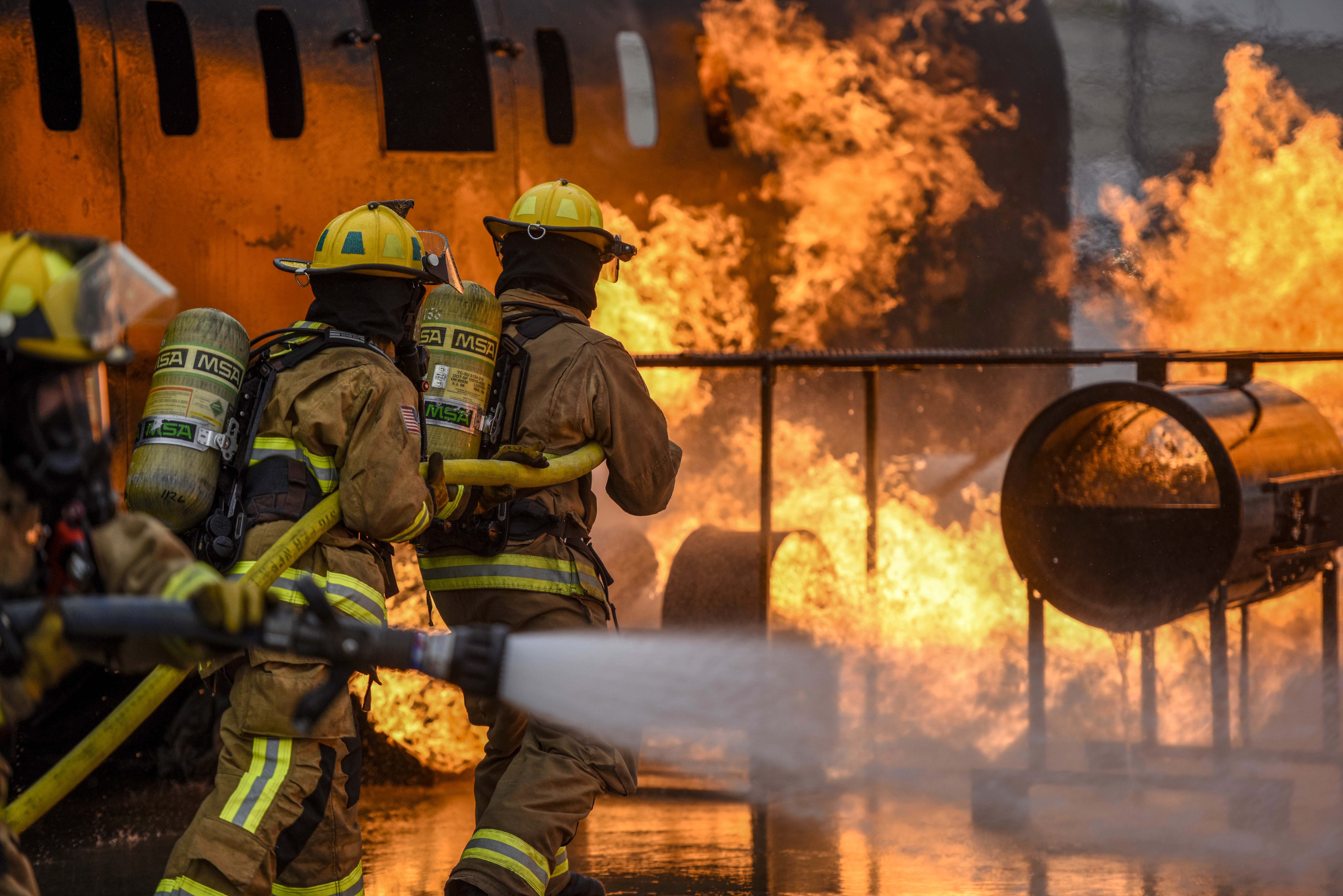
Firefighters assigned to the Ohio National Guard extinguish controlled fires during an exercise at the Toledo Express Airport in Swanton, Ohio, May 19, 2020.

DOD Launches Effort to Collect 8,000 Units of COVID-19 Convalescent Plasma

May 29, 2020 , DOD News

Patients who have recovered from COVID-19 may hold treatment in their veins that could help others who are critically ill with the respiratory infection.

The Defense Department has begun an effort to collect 8,000 donated units of plasma from patients who have recovered from COVID-19 to support the development of an effective treatment against the disease. 

"We may want to ask you to stick your arm out and donate blood," Army Gen. Mark Milley, chairman of the Joint Chiefs of Staff, said in a virtual town hall yesterday. "What that can then do is help others who are severely ill, and if we can do that, then we'll be on a good path toward getting some really powerful therapeutics."

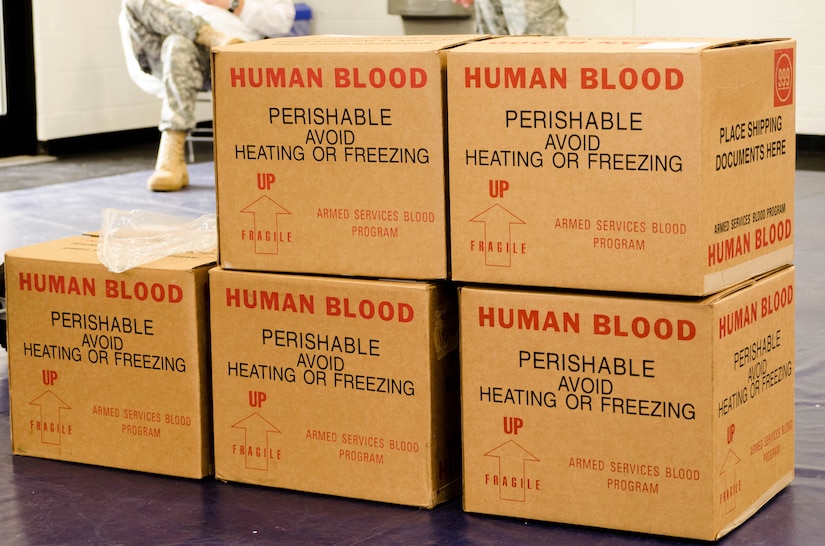
Donations will be accepted at 15 Armed Services Blood Program centers across the continental United States, and in Hawaii, Guam and Germany.  (A complete list of centers accepting donations appears at the end of this article, and is available online.) 

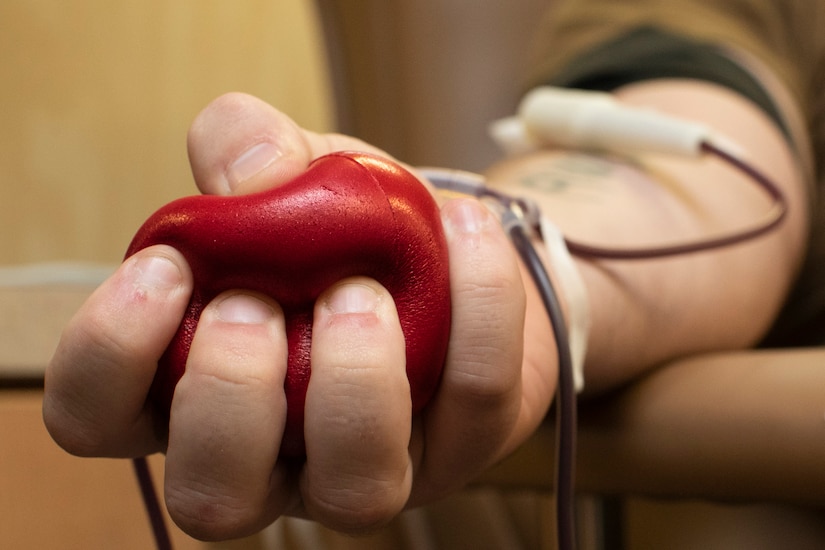
A closeup of a stress ball in a person’s hand.Patients fully recovered from COVID-19 are the only ones who qualify to be a COVID-19 convalescent plasma donor, said Army Col. Audra Taylor, chief of the Armed Services Blood Program. DOD personnel and their families, as well as non-DOD civilians with access to collection facilities on installations, are welcome to donate.

"Our goal as a lifesaving program is to always provide a safe and ample supply of blood products. The need is now," Taylor said. "We are calling for all who are healthy, able and eligible, to donate today to help us all stand mission ready and save lives."

Why Convalescent Plasma is Collected

When a person contracts SARS-CoV-2, the virus that causes COVID-19, their immune system creates antibodies to fight the virus. These antibodies are found in the plasma, the liquid part of blood, Taylor explained. 

Plasma with infection-fighting antibodies is called convalescent plasma, she said. Through the blood donation process, this plasma is collected from a donor who has recovered from COVID-19 and may be transfused into a sick patient who is still fighting the virus, if they qualify for this type of treatment. This may boost the immune system of the patient and help with the recovery process, Taylor said.

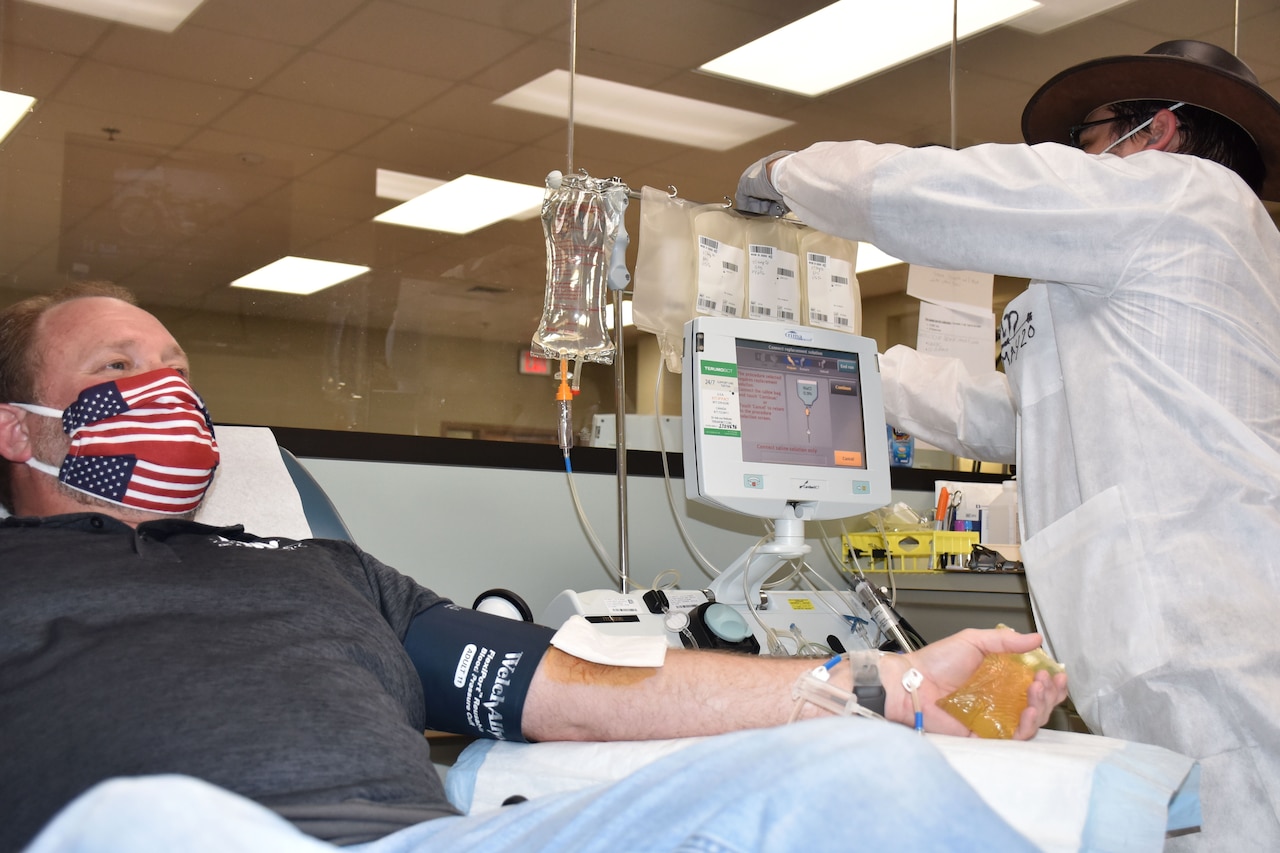
A man wearing an American flag face mask sits in a donation chair while a medical professional adjusts a machine above his head.

The collection process for this type of plasma is the same as standard apheresis collection, she noted. It is being investigated for the treatment of COVID-19 because there is no approved treatment for the disease at this time, and there is some indication that it might help some patients recover from COVID-19. 

Several COVID-19 patients in the Military Health System have received convalescent plasma transfusions as part of their treatment, Taylor said. The treatment, which must be carried out under and approved protocol, is used for those hospitalized and severely ill with the disease.

Eligibility Requirements

Donating CCP is the same as a standard platelet or plasma donation and must meet specific requirements set by the Food and Drug Administration. Donors must be at least 17 years old, weigh at least 110 pounds, and be in good health. Women who have ever been pregnant may need additional testing for specific human leukocyte antigen antibodies that may be present in their blood. In addition to these standard requirements, those who have fully recovered from COVID-19 must be symptom-free for at least 14 days. Donors must also produce documented laboratory test results proving they tested positive for the virus, Taylor explained.

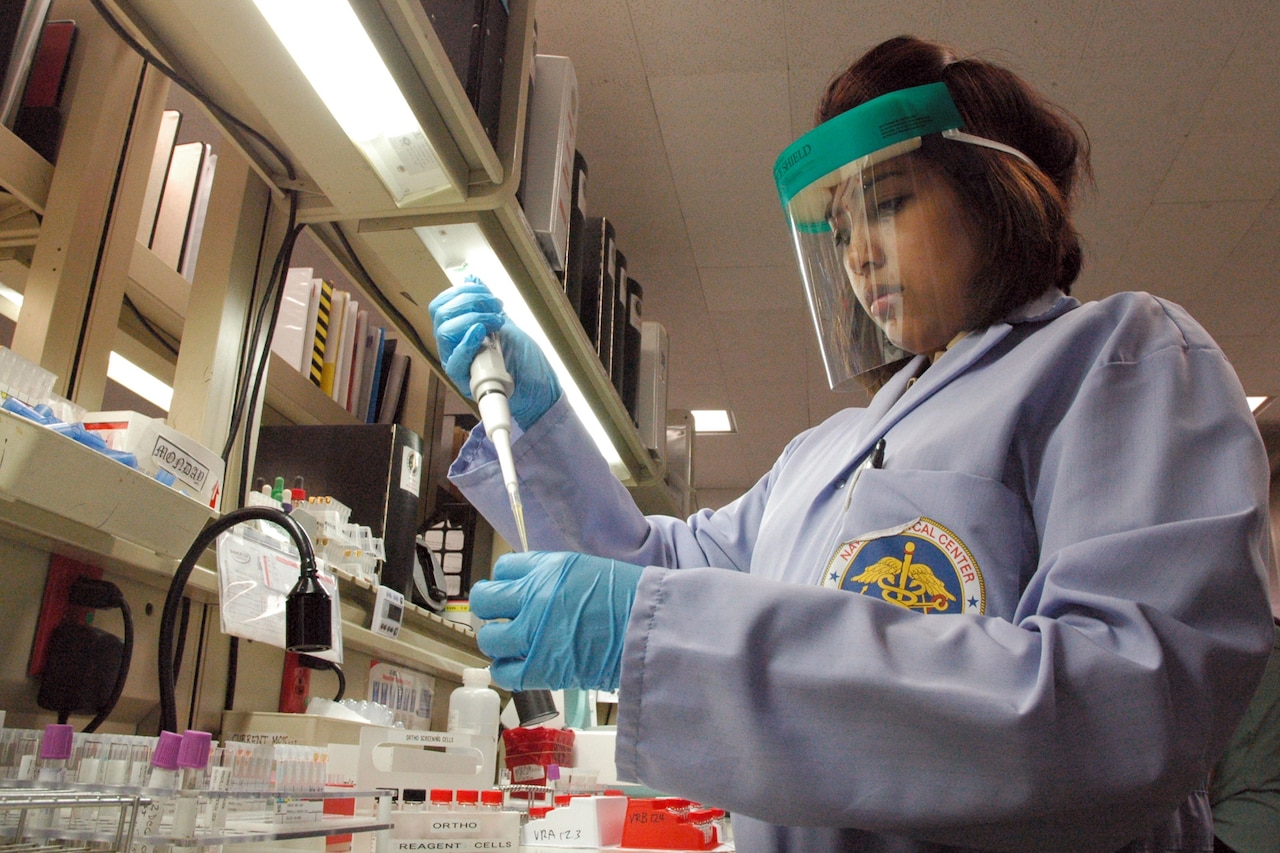
A scientist wearing PPE conducts a test.

"If a donor believes they meet these requirements, they must first contact the local blood donor center before coming in, and if they qualify, set up an appointment," Army Col. Jason Corley, Army Blood Program director, said. "Once set up, the donor must bring the required documentation and undergo the standard donation procedure. Final determination will be made by the medical director or designee."

ASBP Centers Collecting Convalescent Plasma

  • Armed Services Blood Bank Center, Walter Reed National Military Medical Center, Bethesda, Maryland;
  • Naval Medical Center Portsmouth Blood Donor Center, Portsmouth, Virginia;
  • Fort Bragg Blood Donor Center, Fort Bragg, North Carolina;
  • Kendrick Memorial Blood Center, Fort Gordon, Georgia;
  • Sullivan Memorial Blood Center, Fort Benning, Georgia;
  • Blood Donor Center, Keesler Air Force Base, Mississippi;
  • Lackland Air Force Base Armed Services Blood Bank Center, Joint Base San Antonio-Lackland, Texas;
  • Robertson Blood Center, Fort Hood, Texas;
  • Akeroyd Blood Donor Center, Fort Sam Houston, Texas;
  • Fort Bliss Blood Donor Center, Fort Bliss, Texas;
  • Naval Medical Center San Diego Blood Donor Center, San Diego, California;
  • Armed Services Blood Bank Center – Pacific Northwest, Joint Base Lewis-McChord, Washington;
  • Tripler AMC Blood Donor Center, Tripler Army Medical Center, Hawaii;
  • Naval Hospital Blood Donor Center, Guam; and 
  • Armed Services Blood Bank Center Europe, Landstuhl Regional Medical Center, Germany

More Information

Armed Services Blood Program
COVID-19-specific page 
Blood Drive and Donor Registration 
Facebook: militaryblood  
Twitter: @militaryblood  
Instagram: @usmilitaryblood

Agile Wolf

Airmen descend onto an airfield at Ramstein Air Base, Germany, May 26, 2020, during Agile Wolf, an exercise designed to sharpen tactics, techniques and procedures for establishing expeditionary airfields on demand.

Thursday, May 28, 2020

Flyover Preps

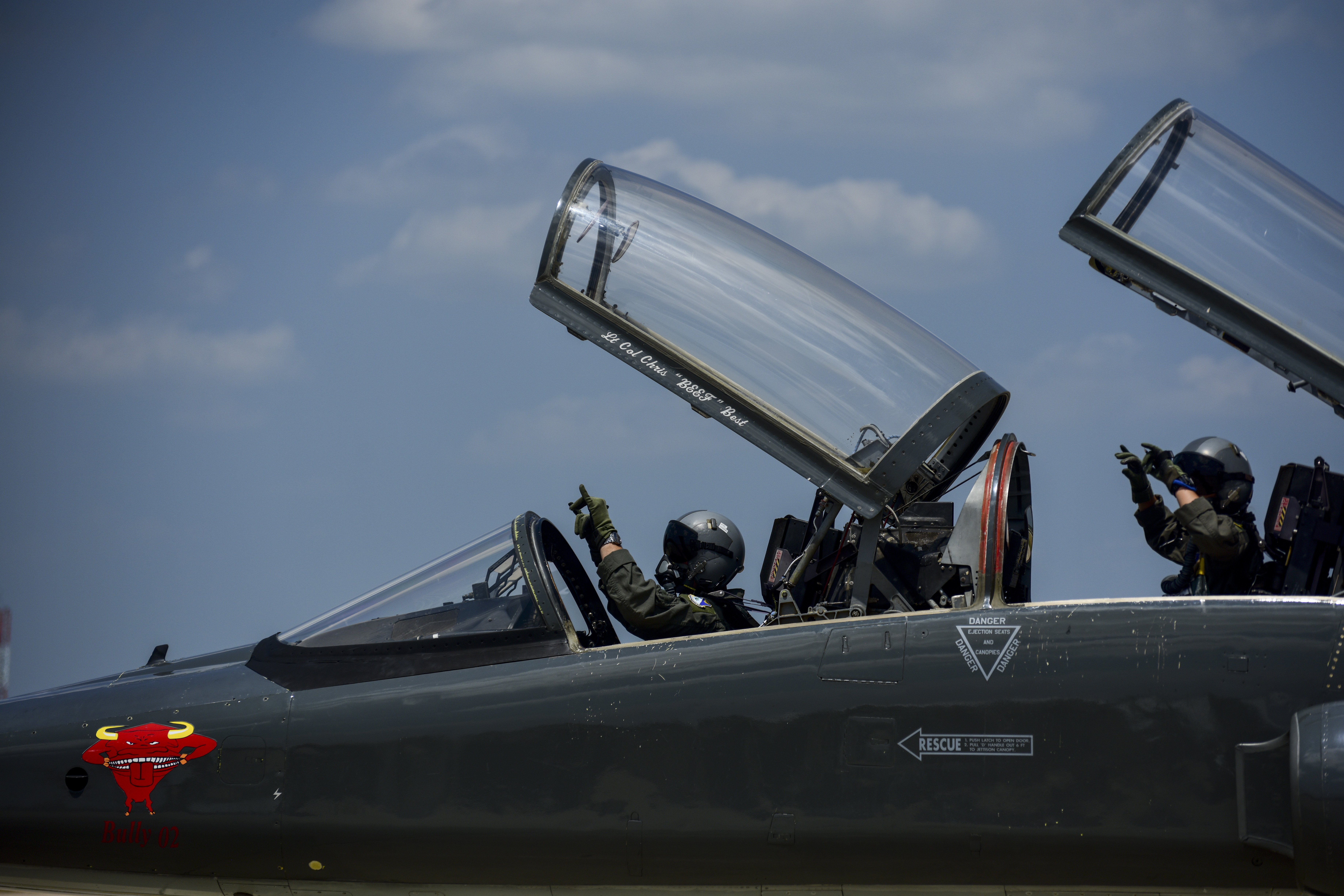
Two instructor pilots at Laughlin Air Force Base, Texas, prepare to take part in a flyover above Del Rio and Eagle Pass, Texas, to honor the men and women on the front lines of the fight against COVID-19 during the Defense Department’s #AmericaStrong salute

Military Medical Experts Explore Psychological Impacts of COVID-19

May 28, 2020 | BY Terri Moon Cronk, DOD News

As the number of COVID-19 deaths in the U.S. exceeds 100,000 and people continue to take precautions, military medical experts expect the need for mental health care to increase because of stress, anxiety and other psychological symptoms.

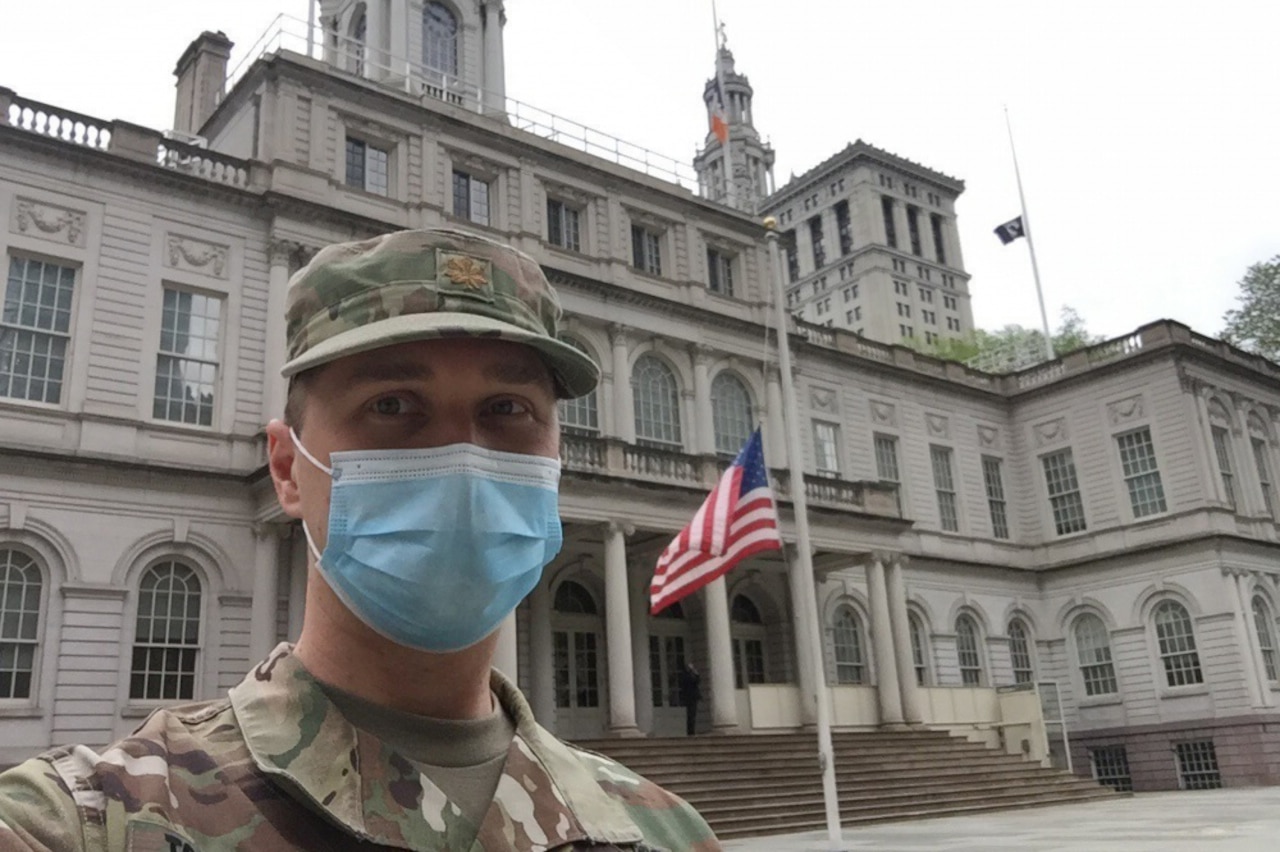
A man dressed in a military uniform and wearing a face mask poses for a photo in front of a large building where the flag is flying at half-staff.

During the COVID-19 emergency and the existing phase in which some communities are starting to emerge from restrictions, the psychological impact can affect health care workers, service members, veterans, civilians and their families. Four medical specialists of the Military Health System agreed yesterday in a media telephone roundtable. 

[S]ometimes a little bit of help is all we need to improve our mental health and [be] mission ready; taking small steps to address problems early on makes a big difference, especially during the pandemic."
Dr. Holly O'Reilly, clinical psychologist, Defense Health Agency

The panelists were Dr. Nicholas Polizzi, action officer for the inTransition Program and the Real Warriors Campaign, Psychological Health Center of Excellence; Dr. Holly O'Reilly, clinical psychologist with the Defense Health Agency; Army Col. (Dr.) David Benedek, chief of psychiatry at the Uniformed Services University of the Health Sciences; and Dr. Stephen Cozza, associate director of the Center for the Study of Traumatic Stress at the USUHS. 

May is Mental Health Month, but the Defense Department focuses on the health of its people year-round, O'Reilly said, adding that this month's theme is "Need a Little Help."

"[S]ometimes a little bit of help is all we need to improve our mental health and [be] mission ready; taking small steps to address problems early on makes a big difference, especially during the pandemic," she explained.

"During the COVID-19 pandemic, people can experience stress, anxiety, fear, sadness and loneliness. It's changed how we live and … how we interact," O'Reilly said.

DOD has many resources for mental health help, she said, adding that service members and veterans are encouraged to ask for help and recognize that seeking help is a sign of strength.

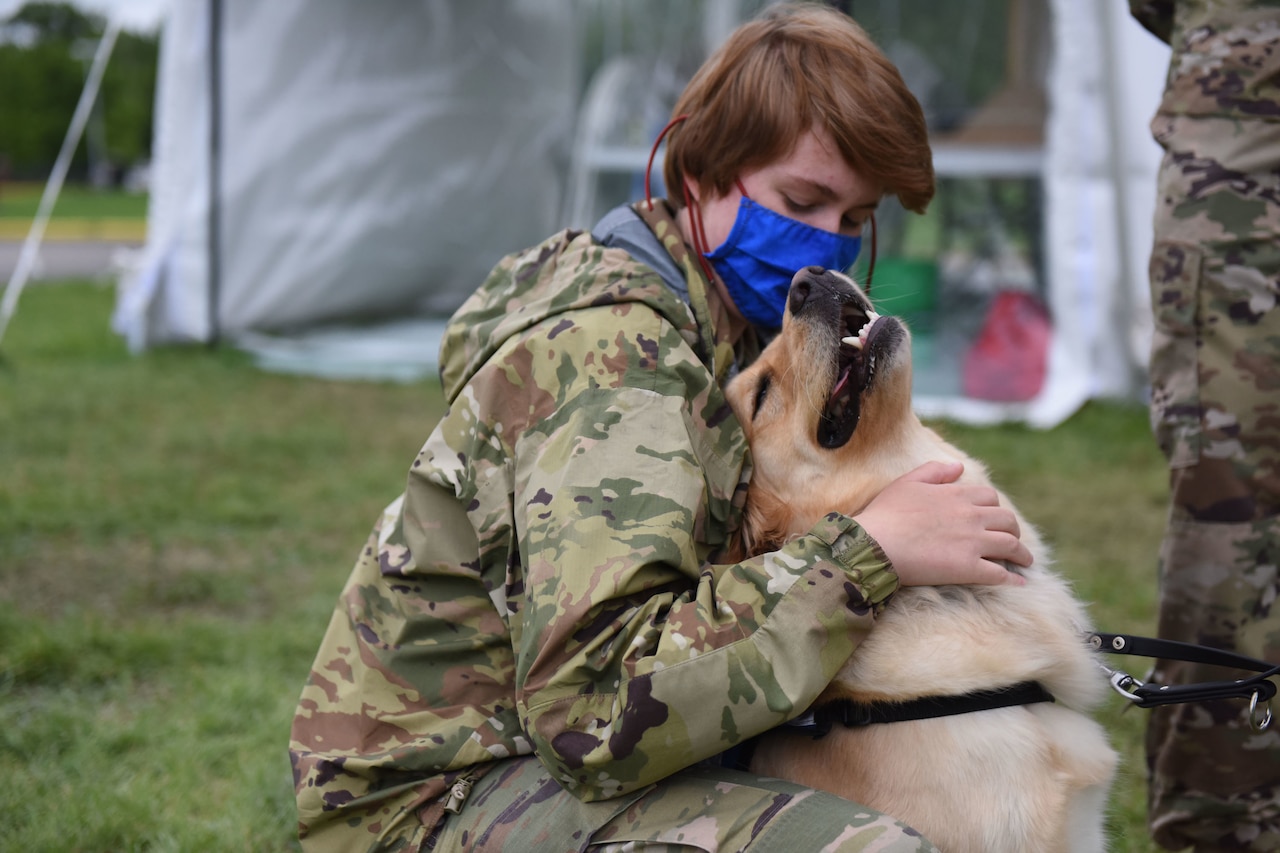
An airman hugs a dog.

While many facets of society are affected in different ways by the pandemic, in the health care realm, it's not just doctors and nurses who are overwhelmed, Benedek said.

Other front-line workers — such as hospital administrators, janitorial workers and other hospital employees — have been exposed to a lot more sickness, severe illness, surges and greater numbers of deaths, he said. 

While most people will be resilient and recover from exposures and experiences, stress and anxiety can be side effects of working in a COVID-19 environment, Benedek noted. 

The effects on health care workers can also affect their family members when they are faced with long and extended absences from their loved ones, while they work under varying circumstances and put themselves at risk by having close exposure to the virus, Cozza said. 

It's hard to have a crystal ball, but we believe that because the concerns are higher across society, the demand will be higher, and we're prepared and ready to address those demands as they declare themselves."
Army Col. (Dr.) David Benedek, chief of psychiatry, Uniformed Services University of the Health Sciences

The invisible nature of the war on COVID-19 can also escalate from stress and anxiety to post-traumatic stress disorder, Benedek said. 

"In terms of the challenges confronting health care workers, I think it's important to know that, to some degree, we are in uncharted territory, so it's hard to know how many will develop post-traumatic stress disorder or depression," he said.

If someone has thoughts of suicide, that's a big red flag, and certainly should be taken seriously, Benedek said. The National Suicide Prevention Lifeline and Military OneSource offer the phone line 1-800-273-8255 for crisis intervention.

"Concerns about decreases in levels of function, the inability to concentrate, or the inability to interact as normal with other people should prompt concerns about seeking additional help," he emphasized.

"In terms of resources, I think it's important to emphasize that DOD has both Real Warriors Campaign and inTransition that [are] able to work with National Guard and reserve leaders … to help support not just individual people… but to help create a whole culture at the installation that supports psychological health … and to normalize psychological health care as just health care," Polizzi said.

Military members in masks and a therapy dog are deployed to assist COVID-19 residents.

According to their websites the Real Warriors Campaign encourages help-seeking behavior among service members, veterans and military families coping with invisible wounds. The second mental health care resource, inTransition, is a free, confidential program that offers specialized coaching and assistance for active-duty service members, National Guard members, reservists, veterans and retirees who need access to mental health care during relocation, returning from deployment and other life changes.

Mental health experts anticipate a rise in demand for seeking care, Benedek said, and they are taking steps to be ready for that surge whether it's in a hospital environment or a behavioral health or telehealth capacity.

"[We] think we're a little bit in unchartered waters," Benedek said. "It's hard to have a crystal ball, but we believe that because the concerns are higher across society, the demand will be higher, and we're prepared and ready to address those demands as they declare themselves."