Sunday, September 16, 2018

Northern Command Provides DoD Hurricane Support Update


PETERSON AIR FORCE BASE, Colo. -- U.S. Northern Command provided an update last night as to the Defense Department support to Federal Emergency Management Agency along with state and local responders in the wake of Hurricane Florence’s landfall.

In a release, Northcom said DoD has assigned 13,470 personnel to support hurricane relief efforts. The specific numbers continue to change as individuals respond to the area, officials said. Northcom serves as the overall synchronizer of all DoD support to FEMA.
-- Active duty: 5,400
-- National Guard: 7,857
-- Army Corps of Engineers: 121
-- Defense Logistics Agency: 92

DoD also deployed 1,286 military assets to establish air and ground transportation and search and rescue capabilities. They are:

-- Rotary wing aircraft: 100
-- Fixed wing aircraft: 16
-- High-water vehicles: 1,154
-- Swift-water boats: 14
-- Navy amphibious ships: 2

The Defense Department authorizes local commanders to execute lifesaving actions to assist their local communities without waiting for orders. This is called local response authority.

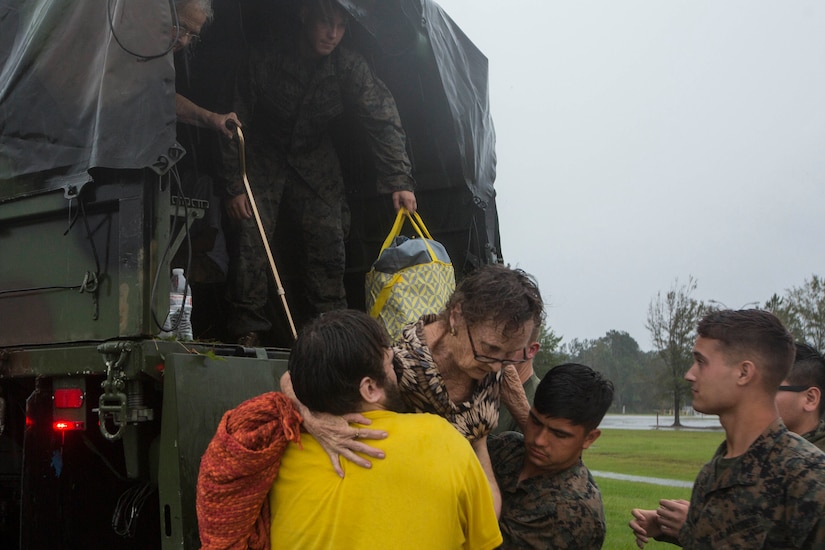
On Sept. 14, upon request from the North Carolina Department of Public Safety, Marine Corps Air Station Cherry Point, N.C., provided shelter for displaced people around New Bern, N.C. In less than three hours, 209 people arrived by bus and were sheltered.

At the request of city officials in Onslow, N.C., Marine Corps Base Camp Lejeune sent two Humvees and two amphibious assault vehicles to assist in the rescue of about 20 stranded people near Piney Green road in Jacksonville. The Marines then transported the personnel to the Piney Green Volunteer Fire Department for follow on transfer to Onslow County shelters.

Additionally, Camp Lejeune dispatched12 high-water vehicles at the request of Onslow city officials to support transport of state rescue personnel in the Onslow area.


The military services will perform accountability, damage assessments, recovery and preparation of forces for follow-on support at all of the installations in the affected areas. The DoD stands ready for assistance requests,

Saturday, September 15, 2018

NATO Chief Lists Benefits of Alliance to United States


By Jim Garamone, DoD News, Defense Media Activity

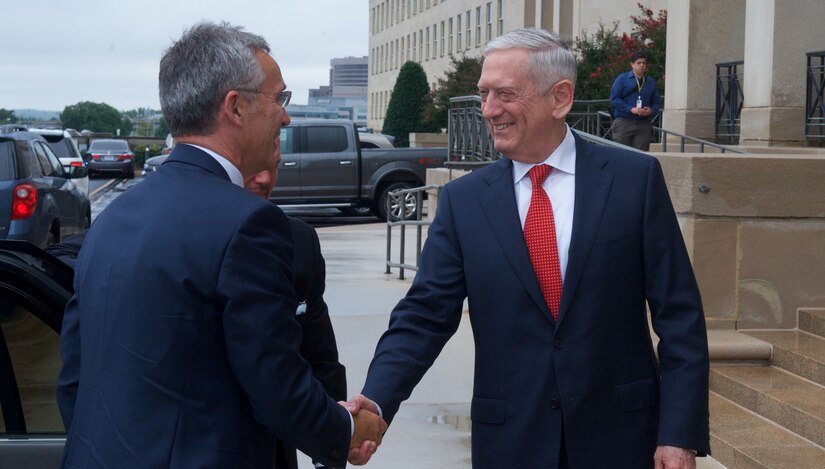
WASHINGTON -- The North Atlantic Treaty Organization is as important to the United States as it is to Europe, NATO Secretary General Jens Stoltenberg said here at the Heritage Foundation yesterday.

The NATO chief spoke at the foundation following talks with U.S. security officials. In his remarks, he stressed the importance of the nearly 70-year-old organization to America.

The alliance has guaranteed peace and stability in Europe since it was founded in 1949, Stoltenberg said. NATO was a response to aggression from the Soviet Union in the aftermath of World War II, and has morphed into an alliance seeking a stable, rules-based international climate where all nations can prosper.

The past 70 years have seen an unprecedented period of prosperity in Europe and North America, Stoltenberg said. NATO is the foundation for that prosperity. “Europe and North America together represent half of the world’s economic output,” he said. “And while we now have our disagreements over tariffs, it does not change the fact that Europe and North America are each other’s biggest trading partners.”

Ensuring a peaceful, prosperous Europe is in the interests of all parties “on both sides of the Atlantic,” he said.

“NATO allies share and support the fundamental values which are at the heart of American society,” he said.

Alliance nations are democracies, support individual liberties and abide by the rule of law. “They are the foundations of our free societies, but they are also the foundations of our engagement with the rest of the world,” the secretary general said. “These values are magnets for other countries, and lead them to join our alliance.”

After the Berlin Wall came down and the Soviet Union dissolved, former Warsaw Pact and Baltic nations joined the alliance. Nations in the Balkans and others aspire to join, he said. “NATO has helped to spread democratic values, free enterprise, and stability to millions of people in the eastern part of Europe, and this represents a historic geopolitical shift that has benefitted the United States and the world at large,” Stoltenberg said.

Finally, NATO allies are a boost to American military power. The Europeans have nearly 2 million active duty service members with cutting-edge capabilities. The European allies are on duty in Afghanistan, Iraq and Syria. They work with the United States in counter-piracy operations and in maintaining sea lines of communication and the airways.

“France and the United Kingdom contribute 30 percent of NATO’s nuclear ballistic-missile submarine fleet,” he said. “America’s NATO allies also maintain dual-capable aircraft for nuclear delivery to enhance our deterrence and keep the peace.”

NATO allies have strong and capable intelligence networks that work alongside American professionals. This alliance intelligence sharing runs the gamut of capabilities from tracking submariners in the Arctic to identifying terrorists, the secretary general said.

“NATO allies also hosts 28 American main operating bases across Europe,” he said. “These bases in Europe are not only for Europe, they enable the U.S. to project military power across the wider Middle East and Africa providing a clear strategic advantage in the fight against terrorism and other threats.

The classic example of this is U.S. Africa Command which is based in Stuttgart, Germany, or the U.S. 6th Fleet based in Naples. “When US troops are wounded in places like Iraq and Afghanistan, they are flown for quick treatment to Ramstein, Germany,” he said. “When thinking of the value of NATO to the United States, I am also reminded of what [Defense] Secretary [James N.] Mattis once told me that never in his entire career had he fought a war without NATO allies at his side. The U.S. never has to fight alone.”

Stoltenberg noted that the only time the alliance invoked Article 5 of the Washington Treaty establishing the alliance was in the aftermath of an attack on the United States – 9/11. “Since then, hundreds of thousands of European and Canadian soldiers have fought alongside the United States in Afghanistan,” he said. “More than a thousand have paid the ultimate price.”

NATO continues to be relevant and effective in Afghanistan, in the Defeat-ISIS coalition and in deterring Russia. “For nearly seven decades, the United States has been able to call upon its close allies and friends in NATO,” he said. “No other power can match that. No other power in the world has so many friends and allies.”

Friday, September 14, 2018

More than 7,000 Service Members ‘Leaning Forward’ to Aid Fellow Citizens


By Jim Garamone, DoD News, Defense Media Activity

WASHINGTON -- More than 7,000 service members -- National Guard and active duty -- are standing by ready to assist as Hurricane Florence hits the Carolina coast, DoD officials said here today.

Defense Secretary James N. Mattis and Deputy Defense Secretary Patrick M. Shanahan are monitoring the Category 2 hurricane and the department is “leaning forward” to help civilian agencies as the storm approaches.

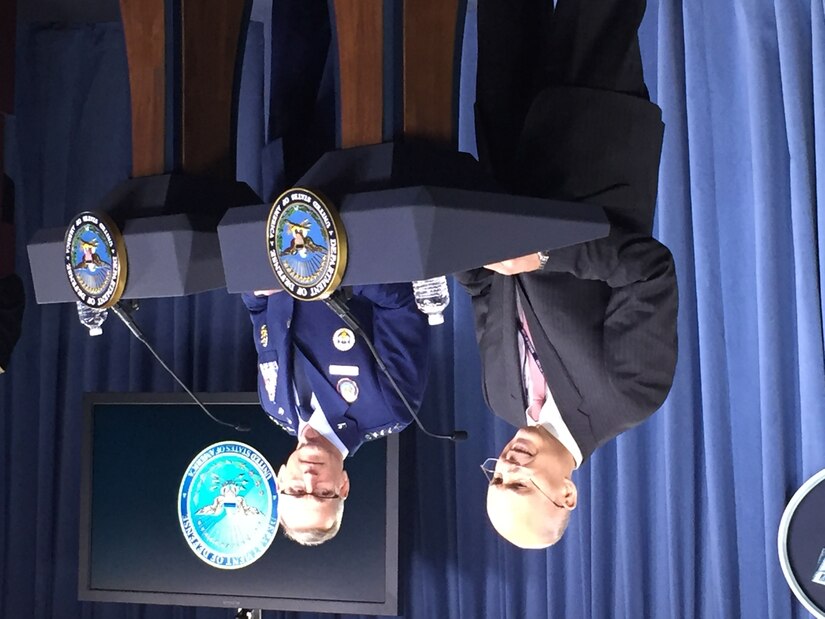
“The secretary is also receiving reports throughout the day on actions the military services are taking to protect the safety and well-being of the military community, and ensure the readiness of DoD installations in the region affected by Hurricane Florence,” Kenneth P. Rapuano, assistant secretary of defense for homeland defense and global security, said at a Pentagon news conference.

‘Dangerous Storm’

Both Rapuano and U.S. Northern Command commander Air Force Gen. Terrence J. O'Shaughnessy called Hurricane Florence a “dangerous storm” and urged Americans to listen to the warnings from state and local officials.

O’Shaughnessy also commands North American Aerospace Defense Command.

Outer bands of the storm have already started hitting the coast and officials said there are already winds exceeding 100 mph in some areas. The storm surge has hit in North and South Carolina and the storm is expected to slow down and deposit huge amounts of rain.

DoD is already working with the Federal Emergency Management Agency to pre-position helicopters, vehicles and supplies. The department is prepared to assist FEMA and our other federal partners in supporting the affected regions, Rapuano said.

O’Shaughnessy said DoD assets have virtually surrounded the area where the storm is expected to make landfall.

Positioning Forces

“We are proactively positioning forces now to respond from the north, from the south, from the east and from the west, across the full spectrum of DoD capabilities at every level -- by air, by sea and by land,” the general said.

Fort A.P. Hill, Virginia; Joint Base Bragg, North Carolina; North Auxiliary Airfield, South Carolina; and Maxwell Air Force Base in Alabama are staging areas for FEMA.

About 80 light/medium tactical vehicles are staged at Fort Stewart, Georgia, set to respond quickly once Florence passes through the area. These trucks are high-water-clearance vehicles which can carry supplies or first responders. These vehicles proved their worth in this type of situation last year during Hurricane Harvey in Houston.

At Hunter Army Airfield, Georgia, there are 35 helicopters available for search-and-rescue operations. A similar unit is at Fort Bliss, Texas, ready to move forward.

At Fort Bragg, there are 40 high-wheel vehicles for rescue and transportation, as well as seven helicopters staged for use in search and rescue and recovery missions, the general said.

The USS Kearsarge amphibious assault ship and the USS Arlington amphibious transport dock ship are following behind Florence. These vessels have Navy and Marine personnel, 16 helicopters and six MV-22 Osprey tilt-rotor aircraft.

At Moody Air Force Base, Georgia, the Air Force has six HH-60 helicopters, two HC-30 aircraft and four pararescue teams at the ready.

At Tyndall Air Force Base in Florida, 1st Air Force will provide robust command-and-control, air operations support to the DoD effort. This will include airborne command-and-control assets.

‘Ready to Respond’

“North Carolina, South Carolina, Virginia and Georgia are all home to well-known military bases and installations, and the secretary of defense is given authority for life-saving and life-sustaining actions in order to make DoD capabilities immediately available, and local commanders are proactively positioning forces and equipment to be ready,” O’Shaughnessy said. “At the state level, National Guard units, whether Army or Air, under the authority of their governors, are ready to respond to the individual and oftentimes neighboring states' needs.”

Mattis has activated dual-status commanders in North Carolina, South Carolina and Virginia to provide seamless command and control over assigned active duty and National Guard forces.

Rapuano said U.S. Transportation Command is staging and prepositioning FEMA resources. “The Defense Logistics Agency is directly supporting FEMA logistics with the procurement and distribution of relief commodities, including food, fuel and water,” he said.

The U.S. Army Corps of Engineers is also directly supporting FEMA and is poised to support flood mitigation, temporary emergency power, temporary roofing and debris removal, Rapuano said.

The National Geospatial-Intelligence Agency will provide imagery analysis and assessment, he said.