Friday, September 14, 2018

Navy Assists Typhoon Mangkhut Recovery Efforts in Marianas, Guam

By Navy Petty Officer 1st Class Alexandra Seeley, Amphibious Squadron 11

PACIFIC OCEAN -- The USS Wasp Expeditionary Strike Group, with embarked 31st Marine Expeditionary Unit, are providing air assistance to the Federal Emergency Management Agency and local officials in the Northern Mariana Islands and Guam following Typhoon Mangkhut, Sept 12.

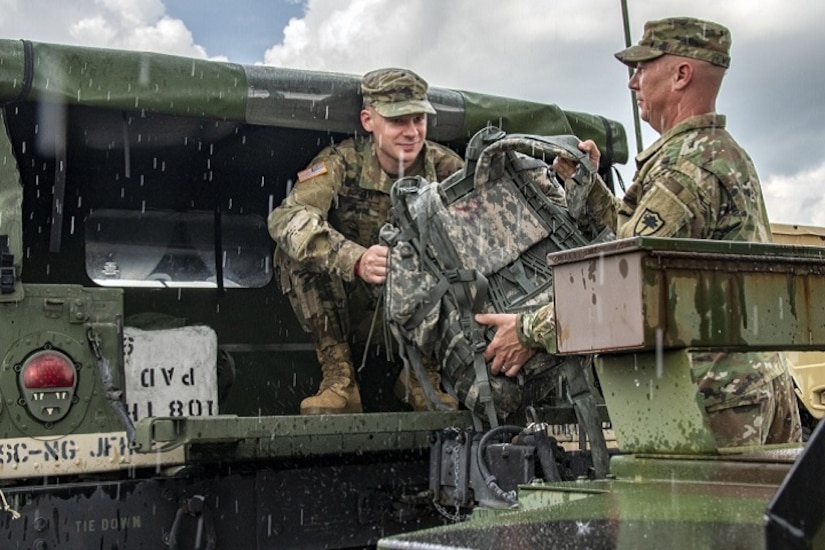
“The MEU assembled teams on board in order to provide water support on the island and generators for the local population if necessary” said Marine Corps 1st Lt. Cameron Field, the combat cargo team embarkation officer. “We also had company-sized teams of Marines ready to assist with debris clean-up at a moment’s notice.”

As support efforts continue, Task Force 76 is engaged in support activities on Rota, Tinian and Saipan islands in the Northern Mariana Islands. Two vessels with CTF 76 -- the amphibious assault ship USS Wasp and the amphibious dock landing ship USS Ashland -- are supporting FEMA requests for assistance through the tasking of personnel and distribution of supplies throughout the islands.

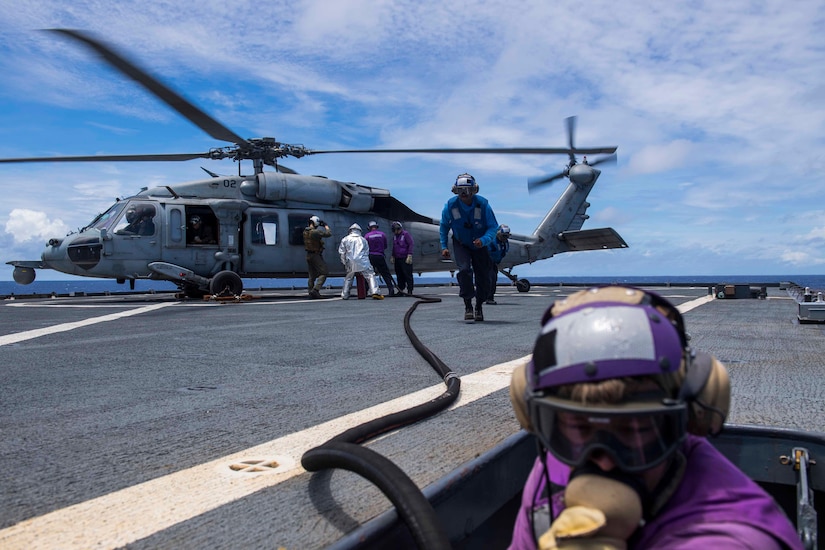
Following Navy and Marine Corps aerial surveys to ensure the safe movement of equipment, multiple types of aircraft are on standby to assist in any future operations, including an MH-60S Sea Hawk helicopter assigned to Helicopter Sea Combat Squadron 25 and MV-22 Osprey tilt-rotor aircraft assigned to Marine Medium Tiltrotor Squadron 262.

‘We Want to be Prepared for Anything’

"We want to be prepared for anything,” said Navy Lt. Cmdr. Ryan McAllister, assistant officer in charge of Tactical Control Squadron 12, Detachment 1. “Making sure that our planes are ready to go at any moment for support is our top priority.”

To prepare for operations, the ships must position themselves to ensure launch and recovery of aircraft is effective and timely. This is accomplished through coordination and communication between watch officers on all ships, who must maintain precise time, distance and speed to ensure aircraft have a place to land or refuel. According to McAllister, having a ship in the right place is the most critical aspect of conducting air movement between the islands.

“It was fortunate Wasp was in the right location for quick aid,” McAllister said. “Our ability to be closer to shore allowed us to be forward-pressing and flexible in accomplishing our mission.”

The Wasp group continues to work with officials with efforts focused on augmenting and supporting FEMA in conjunction with Guam and local officials.

Thursday, September 13, 2018

Face of Defense: Former Drill Sergeant Brings Leadership Experience to Commissioned Service


By Army Staff Sgt. Neysa Canfield, 2nd Brigade Combat Team, 4th Infantry Division

KANDAHAR AIR FIELD, Afghanistan -- As the medical provider here, Army Capt. Jennifer Hawkins works closely with enlisted health care specialists to ensure service members throughout Kandahar Air Field receive proper medical care.

However, unlike for most officers, this is familiar and comfortable territory for Hawkins. The soldier from 1st Battalion, 12th Infantry Regiment, wears the evidence on her right front pocket; the Army Drill Sergeant Identification Badge.

“When I became a drill sergeant, for me that’s when I really learned how to be a leader,” she said. “Breaking down a civilian and turning them into a soldier and understanding what it takes to do that, was a learning experience. There is not a single thing a soldier can present to me at this point in my career that will surprise me.”

Hawkins began her Army journey as a practical nursing specialist. She enlisted in October 1998 after graduating from Lake Havasu City High School in Arizona.

“My first assignment was at Fort Sam Houston [Texas] at a critical care unit, and I think that’s where my love of medicine first started,” Hawkins said. “I was promoted to the rank of sergeant within two years of being in the military, and I just kept climbing up the ranks very quickly.”

Drill Sergeant

As a 25-year-old staff sergeant, Hawkins was selected to go to the U.S. Army Drill Sergeant School.

“Although I was afraid and, in my mind, not ready to be a drill sergeant, it’s what made me the leader I am today,” she said. “If I could, I would go back and do it all over again.”

After serving her time shaping civilians into soldiers, Hawkins was promoted to sergeant first class and continued to challenge and improve herself by earning her associate and bachelor’s degrees.

“At this point I thought to myself, ‘Well, what’s next?’ and then I heard about the physician assistant program for the Army and became interested,” she said. “However, once again I was afraid and pushed away from it when I heard people talking about how difficult the school was and how low the passing rate was.”

Hawkins’ battalion sergeant major persuaded her to apply for a direct commissioning board.

“I decided to do it and applied in October of 2009,” she said. “In February of 2010 the master sergeant list was released and I had been selected for promotion, a month or so later the board results came out, and out of 500 applicants, five were selected, and I was one of them.”

Decision Time

At 11 years in the military, Hawkins had an important decision to make.

“The day I raised my hand and I was no longer a [sergeant first class] promotable and was now a second lieutenant, I cried because I felt like an NCO through and through and now I was leaving it,” said Hawkins. “It was a very hard decision leaving the NCO corps but the experience is something I will always take with me.”

With the knowledge Hawkins holds, many superiors view her as an example of an experienced and extraordinary leader.

“Capt. Hawkins is a team player and she inspires senior [officers] like myself because she is all about the mission and putting her soldiers above herself,” said Navy Capt. Cynthia J. Gantt, commander of the Kandahar Air Field NATO Role III Multinational Medical Unit.

Hawkins and her team enhance the capabilities of the hospital, with Hawkins being the primary reason for that, Gantt said.

“She brings invaluable experience, particularly to the officers who have never had the honor or privilege of being enlisted,” she said. “She is able to coach and mentor us on how to better partner with our enlisted members to be able to provide better care for our patients.”

As Gantt and her team of sailors near their end of time in country, she said she is thankful for the opportunity to meet someone such as Hawkins and privileged to have had her as part of the team.

“We have some very highly trained surgeons and doctors in our team but we have definitely learned so much from Capt. Hawkins and her team that we will be able to take with us throughout the years,” she said. “Without a doubt I would work for Capt. Hawkins any day.”

Hawkins said she attributes her success to her experience as an enlisted soldier.

“I believe that having the experience of being in the shoes of a private, a junior NCO and a senior NCO have made me a better officer,” she said. “My priority will always be my soldiers, because at the end of the day a leader is a leader regardless of what you wear on your chest.”

Hurricane Florence Illustrates Need to Prepare Health Care Packages


FALLS CHURCH, Va. -- Hurricane Florence’s imminent arrival is a reminder for people to prepare for their health care needs during severe weather.

TRICARE experts recommend making a list that includes your physician’s name and contact information, medications with dosage and frequency, and type and model number of medical devices. Those with chronic health conditions or issues with vision, hearing, or mobility should get medical alert tags or bracelets, and identify how to get to safety.

Health care officials recommend that people gather immunization records, insurance paperwork and medical documents in a waterproof container that’s easy to carry. Put together a basic first-aid kit with enough medication to ride out a storm. TRICARE authorizes early prescription refills when emergency procedures are in place, as they currently are in, because of Hurricane Florence.

As a reminder, TRICARE beneficiaries not on active duty do not need a referral to receive care from urgent care providers. They can receive urgent care from any TRICARE-authorized urgent care center or provider. This allows beneficiaries to seek nonemergency care for illnesses or injuries if their primary care provider is unavailable because of weather disruptions.

Preparing for Natural Disasters

The Military Health System also prepares for natural disasters. Retired Air Force Brig. Gen. James “Jay” Burks is among those who understand that firsthand. In August 2011, Burks was a colonel commanding the 87th Medical Group at Joint Base McGuire-Dix-Lakehurst, New Jersey, when Hurricane Irene hit. In October 2012 -- only 14 months later -- Hurricane Sandy struck.

In the days leading up to Hurricane Sandy, Burks’ team systematically canceled patient appointments, prepared for a surge of prescription refills, and worked with public affairs to advertise the timeline for when services would be shut down.

“My primary concern was the safety and well-being of our staff and our patients as we followed the installation commander’s guidance to prepare,” Burks said.

Additionally, cots and provisions were brought in to the medical facility so two ambulance crews could work in shifts around the clock. Computer systems were taken offline, and big-ticket equipment such as radiology machines were covered to protect them from possible water damage. Burks also contacted civilian hospitals in the area to check on their capacity in case it was needed.

Fortunately, the installation was largely spared from Sandy’s wrath. But many communities in the multistate region were devastated, Burks said. The joint base community of about 44,000 airmen, sailors, soldiers, Marines, Coast Guardsmen and family members grew by about 5,400 when responders with the Federal Emergency Management Agency arrived when the installation became a staging area for recovery efforts.

The MHS is the DoD component of the National Disaster Medical System, which also includes the Departments of Health and Human Services, Homeland Security, and Veterans Affairs. The system provides health and medical support when requested by civilian authorities when disasters and other emergencies happen.

“We’re involved in the full spectrum of medical support, from national to state and local levels,” said Dr. Mark Gentilman, director of medical preparedness policy in the Office of the Assistant Secretary of Defense for Health Affairs, Health Readiness Policy and Oversight.

That support may include moving civilian hospital patients out of harm’s way, Gentilman said, and performing food safety operations and inspections through the Veterinary Service.