Tuesday, September 04, 2018

Dunford Gets Greek View of Regional Challenges


By Jim Garamone, DoD News, Defense Media Activity

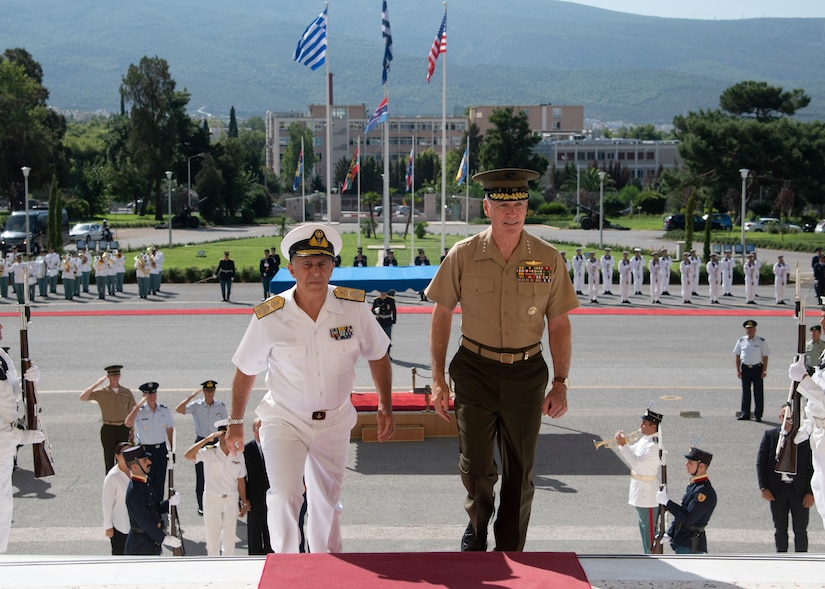
ATHENS -- The chairman of the Joint Chiefs of Staff said he very much welcomed seeing the Eastern Mediterranean region “through a Greek lens” as he finished consultations with his counterpart, Greek navy Adm. Evangelos Apostolakis, the chief of the Hellenic National Defense General Staff.

Marine Corps Gen. Joe Dunford told reporters traveling with him that the bilateral relationship between the two NATO allies “is probably as good as it has been in many, many years.”

Dunford and Apostolakis discussed the situation in the region. Greece looks north into the Balkans, east to the Middle East and south into Libya and the rest of North Africa. “[He] shared some thoughts about the region, and I greatly benefited from the perspective of the Greeks, who have a regional view,” the chairman said.

Increased Cooperation

The Greeks are open to increasing military cooperation with the United States, he said. “[They] made a general overture saying they would be willing to consider that, and I certainly was enthusiastic about the possibility,” Dunford said.

U.S. European Command and the State Department will work with Greek ministries to continue these conversations, he said.

“If you look at geography and you look at current operations in Libya and current operations in Syria, [and] you look at potential operations in the Eastern Mediterranean, the opportunities here are pretty significant,” the chairman said.

Dunford said hearing directly from the Greek military about their experiences with the refugee crisis gave him a better appreciation of the scope of the problem and the capabilities they brought to bear on it. “They also have some interesting perspectives on the Russian naval presence in the eastern Mediterranean, as well,” he said. “I think we both agreed that we are seeing something we haven’t seen since the 1980s in terms of the operational patterns of the Russians in the area.”

The two leaders talked about the importance of sharing information and intelligence particularly in the area of counterterrorism, the chairman said.

Expanded Base Access

Dunford said the Greek defense chief “expressed interest in expanding our access to their bases.”

This access can be used to move personnel and equipment in and out of theater.

“We … have taken advantage of Souda Bay -- it’s a critical piece of infrastructure here in the region, and Greece has also been open to expanding training opportunities for our forces that are stationed in Europe, in particular for U.S. Army units to do training with helicopters,” he said.

The two men talked about deepening relationships through the International Military and Training program. This program increases military-to-military engagement through service member exchanges. Young Greek service members attend U.S. professional military education schools and young Americans attend Greek schools. He noted that Apostolakis attended the Marine Corps’ Expeditionary Warfare School -- then the Amphibious Warfare School -- earlier in his career and the Greek army chief of staff attended a school in Fort Knox, Kentucky.

Finally, Greece also plays a unique role in the region in terms of bringing together multinational exercises. The United States is certainly amenable to participating in those exercises, Dunford said.

The U.S.-Greek relationship is in “a very positive place” today, a senior government official said here on background today, and the foundation to this turn of events has been the defense relationship between the two nations.

Regional Concerns

Greece has suffered through an economic crisis from which the country is still recovering. Yet the nation continued to spend 2 percent of gross domestic product on defense -- a benchmark for NATO members.

“The Greeks live in this neighborhood and they have been looking around and seeing the same instability that we have,” the official said.

Greece is nervous about NATO ally Turkey and want that country to remain firmly rooted in the West, the official added. They also confronted the refugee crisis with limited resources, but see the possibility of it continuing.

“They are deeply concerned with what is happening in Libya and Africa, because even if Syria stabilizes, you’ve got Africa that is right on their doorstep,” the official said.

The Greeks, too, are worried about what the Russians are up to in the Black Sea and the Eastern Mediterranean, the official said. “They are looking around, and the U.S. is still the best partner available to them.”

On the security front, more is happening. In addition to NATO forces, U.S. European Command, U.S. Transportation Command, U.S. Africa Command and U.S. Special Operations Command use the facilities at the Naval Support Activity in Souda Bay.

The U.S. Air Force is now operating MQ-9 Reaper unmanned aerial vehicles at Greece’s Larissa Air Force Base. The unarmed UAVs will focus on information-gathering, surveillance and reconnaissance in the region.

Both Dunford and the official said the United States is not looking for large bases in Greece. The U.S. footprint in the country will remain light. But there will probably be more American service members rotating in and out of the country for training, education and exercises.

Face of Defense: Guard Soldier’s Experiences Put Her Ahead of Civilian Peers


By Army Capt. Robert Taylor, Idaho Army National Guard

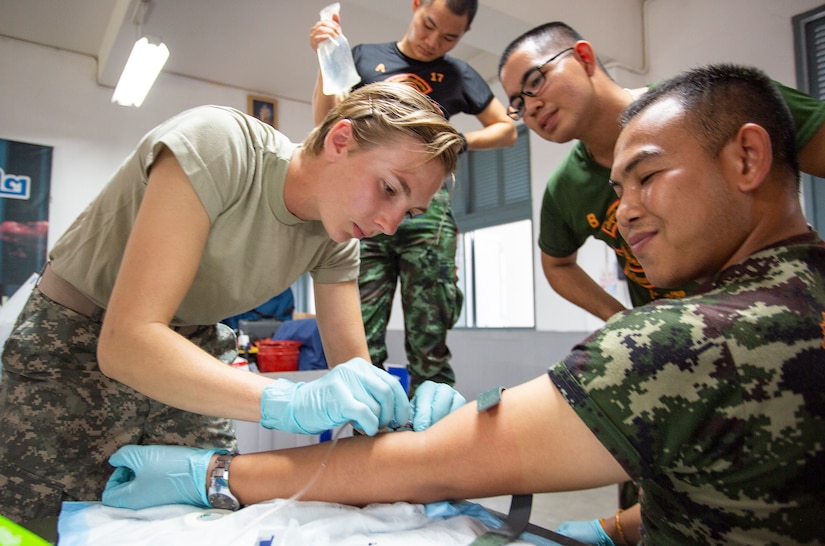
SARABURI PROVINCE, Thailand -- Sgt. Mikki Fritz joined the Idaho Army National Guard because she wanted to jump-start her medical career. Though she decided not to pursue a civilian medical career, she’s found experiences that she feels have placed her ahead of her peers.

“I feel ahead of my peers who aren’t in the military sometimes with all the difference experiences I’ve had,” she said.

Her military experience has also taken her to places the past four years that most of her friends won’t ever visit. She participated in exercises Angkor Sentinel 2015 in Cambodia as well as Saber Guardian 2016 in Romania and is currently participating in Hanuman Guardian 2018 at the Royal Thai Army’s Cavalry Center in Thailand.

“None of my friends can say they have flown over Romania in a [UH-60] Black Hawk [helicopter],” she said.

Best of Two Worlds

Fritz joined the Idaho Army National Guard when she was 17 and has spent the past five years as a combat medic.

During high school at Meridian Medical Arts Charter High School she earned her emergency medical technician certification and wanted to become a flight medic. She joined the Idaho Army National Guard because she thought it would help prepare her to do so while she also went to college. In college she decided she didn’t want to have a civilian medical career but has no regrets about being a combat medic.

“I like doing both and having two different worlds of experience in my military and civilian careers,” Fritz said.

She graduated college from the University of Idaho with a geography degree because she likes being outdoors. She currently works as a soil lab technician in Boise, where she tests soil for engineer projects; a job she likes because it keeps her outdoors.

Around the World

While in Thailand, Fritz is attached to the 116th Cavalry Brigade Combat Team’s Company C, 2nd Battalion. Throughout the exercise she is spending time in the field with the Idaho Army National Guard’s only infantry company.

Because she’s attached to the state’s medical detachment, Hanuman Guardian 2018 is the first time Fritz has been assigned to a line unit to perform combat medic tasks.

“It’s been really great to work with a line unit,” she said.

She can add Thailand to the list of countries she’s flown over in a Black Hawk helicopter and on a recent overnight mission she ate every bug a vendor was selling near the training site just to try something new.

Cambodia was Fritz’s first trip abroad. She’s now used to seeing different cultures and has come to know what to expect when she travels.

“I love international missions,” she said. “They really help me grow and I get to travel. I like to learn how other people live.”

She’s also made friends in each country she’s visited and uses Facebook to stay in touch with them.

Hanuman Guardian 2018

Fritz is one of more than 150 U.S. Army and Army National Guard soldiers participating in the Hanuman Guardian 2018 exercise alongside 350 Thai soldiers at the Royal Thai Army’s Cavalry Center in Thailand’s Saraburi province.

The 11-day training event began Aug. 20, and is a bilateral army-to-army exercise that strengthens capability and builds interoperability between U.S. and Thai forces. Soldiers from both countries completed a battalion staff exercise, conducted infantry operations, and improved their skills in counter-improvised explosive device operations, battlefield medical treatment and aviation capabilities.

“I get experiences in the military that none of my friends get to have,” Fritz said.

Monday, September 03, 2018

Dunford Arrives for Consults in Athens, Readies for Indian 2+2


By Jim Garamone, DoD News, Defense Media Activity

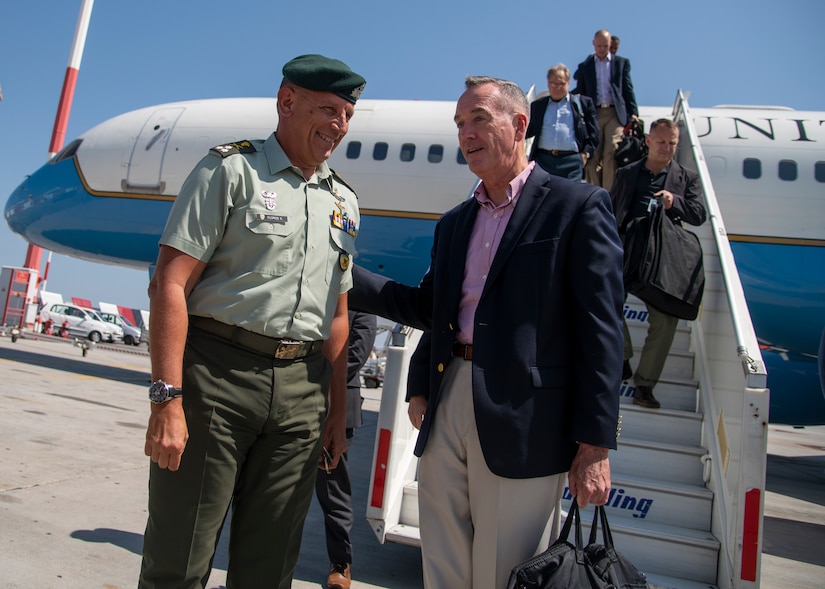
ATHENS, Greece -- The chairman of the Joint Chiefs of Staff arrived here today for meetings with Greek defense officials.

Marine Corps Gen. Joe Dunford is being hosted by Greek navy Adm. Evangelos Apostolakis, the chief of the Hellenic National Defense General Staff. The two men and their staffs will discuss ways to increase cooperation between the two already close NATO allies.

Greece is a member of the coalition to defeat the Islamic State of Iraq and Syria and Greek forces are also cooperating in the refugee crisis that affects the nations of the Mediterranean Sea.

Both countries would like to see greater cooperation moving forward, defense officials said.

India

The chairman will leave Greece and travel to New Delhi to attend the two-plus-two meetings there. Secretary of State Mike Pompeo, Indian Minister of External Affairs Shushma Swaraj, Defense Secretary James N. Mattis and Indian Defense Minister Nirmala Sitharaman will be leading the meetings.

“India is one of our premier security partners and an important and influential global leader,” Dunford said to press traveling with him. “Our nations are united by shared values and a commitment to freedom. The Two-plus-Two presents an historic opportunity to develop our growing partnership and to explore ways of enhancing our security cooperation.”

India is the only non-treaty ally with whom the United States has this form of discussion, officials said.

A senior administration official speaking on background put the meeting in perspective: “[Pompeo’s] travel in tandem with Secretary Mattis is a strong indication of the deepening strategic partnership between the United States and India, and of India’s emergence as an important security provider in the region,” the official said. “India's central role in our National Security Strategy is enshrined in the President's National Security Strategy as well as the administration’s South Asia and Indo-Pacific strategies.”

Officials said the U.S. would like to see increased cooperation with India and would like to explore ways to “operationalize” India’s unique status as a Major Defense Partner.

The U.S. would like to see defense trade grow with India and would like to see an expansion and broadening of the exercise program between the two nations, officials said.