Saturday, August 11, 2018

Selva Highlights Need for Nuclear Enterprise Recapitalization


By Jim Garamone, DoD News, Defense Media Activity

WASHINGTON -- On Aug. 16, 1968, the Air Force launched the first Minuteman III missile into the Eastern Test Range off the coast of Florida.

The intercontinental ballistic missile was state-of-the-art with multiple independently targeted reentry vehicles. It was needed to cement nuclear deterrence of the Soviet Union during a time of high tensions in the Cold War.

At the time, there were 500,000 U.S. service members in Vietnam. The Soviets brutally put down a move to freedom in Czechoslovakia. North Korea took the USS Pueblo. China was at the height of Mao’s Cultural Revolution.

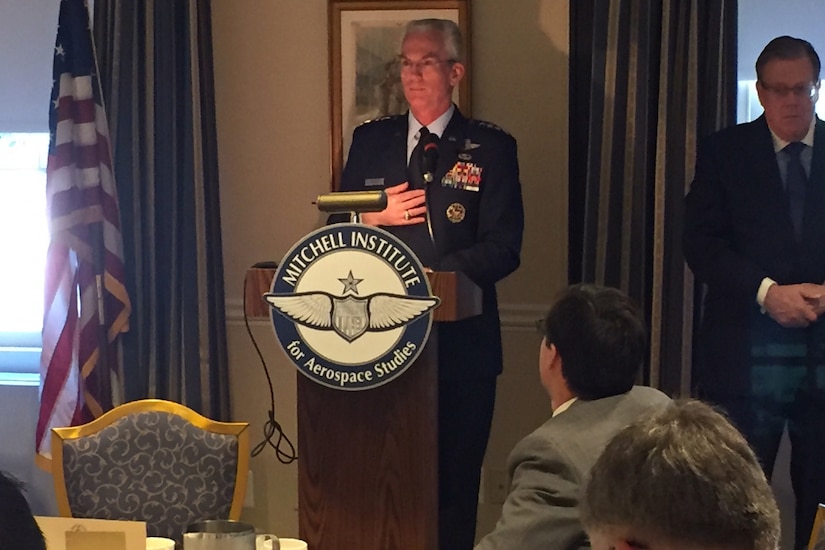
“Those same Minuteman IIIs are still in our inventory,” Air Force Gen. Paul J. Selva told the Air Force Association’s Mitchell Institute breakfast here today.

U.S. Nuclear Enterprise

Selva, the vice chairman of the Joint Chiefs of Staff, discussed nuclear deterrence, missile defense and space, and why it is important to invest in the nuclear enterprise.

“Were it not for the exceptional airmen who man those systems and the civilians in the depots who maintain them, the Minuteman III would, long ago, have exited our inventory,” Selva said.

The first Minuteman III went on alert in 1970, and the weapon has been the heart of nuclear deterrence since.

The missile was designed for an operational life of 30 years. Due to the skill of the maintainers and those who handle “the physics packages” -- the weapons themselves -- the Minuteman II has served 50 years.

The entire nuclear triad needs recapitalization, the vice chairman said. ICBM replacements are one part of it, but so is building the Columbia-class ballistic missile submarine and a new bomber. The recapitalizing and modernizing of nuclear command and control and detection systems also is required, he said.

And, there has to be a discussion of deterrence itself, Selva said.

Nuclear Deterrence

“That we not miss a critical key element of nuclear deterrence … that nuclear deterrence is about the capability, the will and the capacity to respond in kind, and the declaratory statement that says we will do so,” he said.

All of those issues, Selva said, are discussed in the Nuclear Posture Review.

During the Cold War, the United States maintained its nuclear deterrence capability, Selva said, noting the nation must also maintain that in this new era.

The current nuclear triad is safe, secure, reliable and ready, “but that is not a birthright,” the general said.

Office of the Chairman of the Joint Chiefs of Staff Marks 69th Anniversary


By Jim Garamone, DoD News, Defense Media Activity

WASHINGTON -- The United States is a global power, and the U.S. military requires a global viewpoint. That was the reasoning behind establishing the office of the Chairman of the Joint Chiefs of Staff 69 years ago today.

On this day in 1949, President Harry Truman signed an amendment to the 1947 National Security Act, which officially created the position of the Chairman of the Joint Chiefs of Staff to help provide unified direction of the services following World War II to address the growing nuclear Soviet threat.

A Global Perspective

Bradley put the pressures of the job in perspective in testimony before the Senate Foreign Relations Committee in 1951: “The Joint Chiefs of Staff, in view of their global responsibilities and their perspective with respect to the worldwide strategic situation, are in a better position than any single theater commander to assess the risk of general war,” he said. “Moreover, the Joint Chiefs of Staff are best able to judge our own military resources with which to meet that risk.”

This statement contrasted with General of the Army Douglas MacArthur’s approach as commander in the Far East prosecuting the Korean War. As the fight in Korea was the only active combat zone at the time, MacArthur believed it was the most important theater in the world. But Bradley and the other Joint Chiefs understood the Soviet Union posed the greater threat, given the Soviets’ ability to menace the United States and its allies across multiple regions.

This global focus has not changed since Bradley took office.

In fact, the National Defense Authorization Act of 2017 lists global military strategic and operational integration among the chairman’s responsibilities. The chairman provides advice to the president and the secretary of defense on ongoing military operations and advises the secretary on the allocation and transfer of forces among geographic and functional combatant commands, as necessary, to address transregional, multidomain and multifunctional threats, the legislation says.
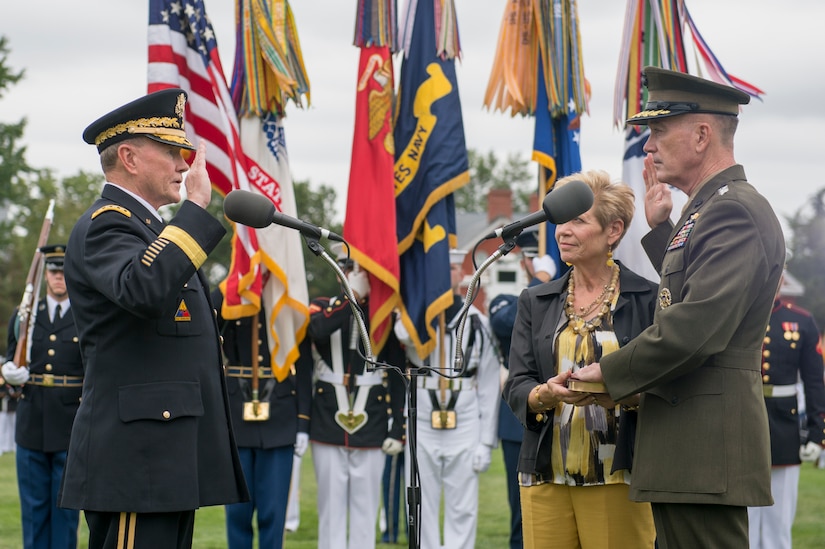
Defense Secretary Louis A. Johnson swears in General of the Army Omar N. Bradley as the nation’s first chairman of the Joint Chiefs of Staff, Aug. 16, 1949.
Defense Secretary Louis A. Johnson swears in General of the Army Omar N. Bradley as the nation’s first chairman of the Joint Chiefs of Staff, Aug. 16, 1949. DoD photo

The role of the chairman, as spelled out in the 1949 amendment to the National Security Act, was to serve as the presiding officer of the Joint Chiefs of Staff and to assist the Joint Chiefs to prosecute their business as promptly as practi­cable. This also included informing the secretary of defense and, when appropriate, the president, of those issues upon which agreement among the Joint Chiefs of Staff had not been reached. The chairman, in his advisory role, was initially considered the “first among equals” advising the president, the secretary of defense and the National Security Council.

The Defense Reform Act of 1958 clarified the role of the chairman as military advisor.  Furthermore, it reinforced the concept of civilian control of the military by establishing the operational chain of command to run from the president to the defense secretary to the combatant commanders.  The chairman thus does not exer­cise military command over the combatant commands, the Joint Chiefs of Staff or any of the mili­tary services.

The last major defense legislative reform was the Goldwater-Nichols Act of 1986. The act, signed by President Ronald Reagan, strengthened the role of the chairman as the senior ranking member of the Armed Forces and principal military advisor to the president. It also established the position of the vice chairman and added that the chairman of the Joint Chiefs of Staff serves as the spokesperson for the Joint Chiefs and the combatant commanders to the defense secretary and the president.  Most importantly, it retained the concept that the chairman is the senior military advisor to the president and secretary and does not command any military forces.

Friday, August 10, 2018

U.S., Malaysia Commence 24th Cooperation Afloat Exercise


By Navy Petty Officer 3rd Class Christopher A. Veloicaza, Logistics Group Western Pacific

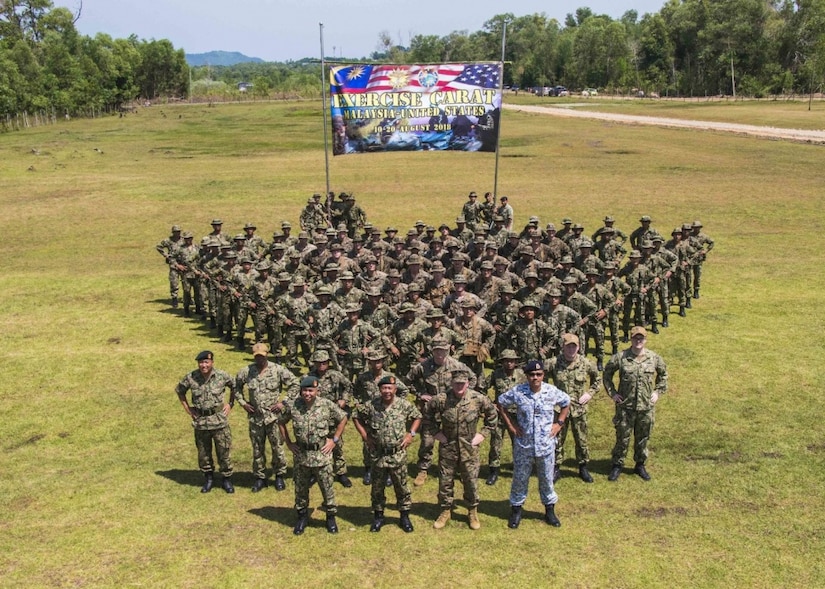
KOTA KINABALU, Malaysia -- The U.S. and Royal Malaysian navies commenced the 24th iteration of Cooperation Afloat Readiness and Training exercise here today.

CARAT exercises focus on the full spectrum of naval capabilities and are designed to strengthen the close partnership between both navies while cooperatively ensuring maritime security, stability and prosperity.

“In nearly a quarter of a century of CARAT exercises, we have continued to ensure forward presence, deterrence and sea control each time when U.S. and Royal Malaysian ships get underway together and conduct cooperative exercises,” said Navy Rear Adm. Joey Tynch, commander of Task Force 73.

The expeditionary fast transport ship USNS Millinocket and a P-8A Poseidon maritime patrol aircraft will conduct nearly a dozen at-sea exercises with the Malaysian navy, including a gunnery exercise to maintain sailors’ readiness with onboard weapon systems, visit, board, search, and seizure drills to increase and maintain proficiency in boarding vessels that may harbor illegal weapons and drugs, and division tactics to enhance cooperative fleet maneuvers.

‘Great Opportunity’

“This is a great opportunity for all of us working side by side, to improve and enhance all of our operational capabilities,” said Marine Corps Brig. Gen. William Jurney, commanding general of 3rd Marine Infantry Division. “We look forward to continuing to advance all of our joint and integrated capabilities, both here and in the future.”

The exercise builds upon other engagements with Malaysia, including Pacific Partnership, the largest annual multilateral humanitarian assistance and disaster relief preparedness mission and Southeast Asia Cooperation and Training, which involves nearly a dozen partner nations. These engagements serve to enhance information sharing and coordination and support long-term regional cooperation.

"I have seen, firsthand, the professionalism of the Malaysian armed forces. Annually for the past 24 years our armed forces have engaged and exercised with each other in increasingly complex and sophisticated scenarios. Throughout this time we have learned much about each other -- how we communicate and operate -- and it is vital to effectively working together to ensure security, stability and prosperity in the region,” said Navy Capt. Lex Walker, commodore of Destroyer Squadron 7.

Enhancing Interoperability

“The aim of this exercise is to enhance interoperability as well as individual capacity to conduct amphibious operations at a tactical level,” said Malaysia army Maj. Gen. Dato Zulkapri bin Rahamat, the commander of Task Force 450. “It is also to provide good opportunities for all of us to reshape ideas and experiences so that we can plan and conduct operations in the region whenever something arises.”

He added, “We are looking forward to an active discussion and a productive outcome in the planning and conduct of amphibious assault and ship-to-ship training as well as other exposures through subject matter expert exchanges.”

Malaysia has been part of the CARAT exercise series since it began in 1995. The exercise remains a model for cooperation that has evolved in complexity and enables both navies to refine operations and tactics in response to traditional and nontraditional maritime security challenges.