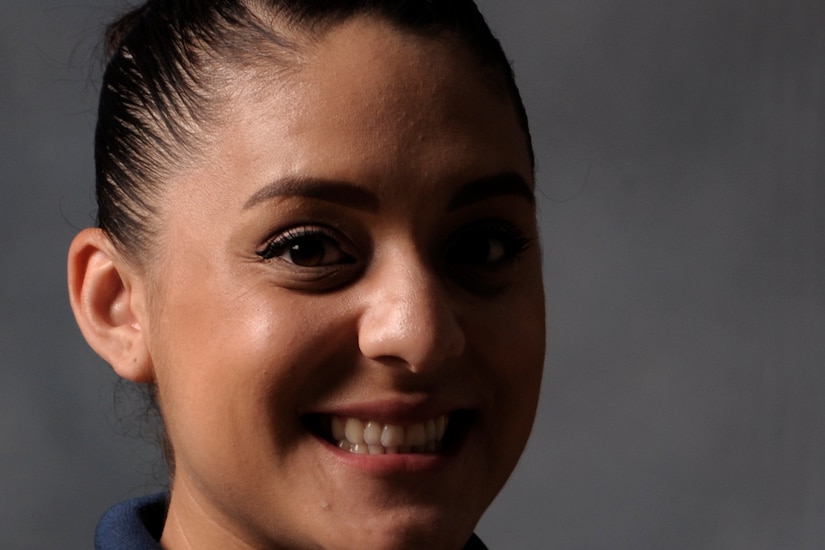
By Robb Lingley, Air Force Space Command
PETERSON AIR FORCE BASE, Colo. -- Growing up in Gilroy,
California, Jacqueline Jauregui had everything a girl could wish for: money,
designer clothes and so much more. Shortly after her high school graduation,
her father took everything from her and kicked her to the streets.
Now an Air Force staff sergeant and the enlisted aide to the
Air Force Space Command deputy commander, Jauregui was determined to make her
life right, but struggled to get there. She talked about her past to fellow
airmen during a “Storytellers at The Club” event here March 30.
“Growing up in Gilroy was a place where everybody knew each
other,” Jauregui said. “The way I was raised my dad gave me everything I
wanted. I was the girl who spent up to $3,000 on myself every month.”
Although it seemed that everything was perfect on the
outside, her home life was not great.
“My dad was diagnosed with bipolar disorder, for which he
didn’t take his medication and he was an alcoholic,” Jauregui said. “When he
came home we wouldn’t know what kind of mood he would be in and he would just
trash the house. The next day he would leave a $1,000 check on the table to
replace what he broke.”
She became tired of depending on her father and his money.
When Jauregui was close to graduating high school he told her he wasn’t going
to pay for her college.
“I decided that since I wasn’t going to college I would join
the Air Force,” she said.
Two weeks before her high school graduation, Jauregui was in
a car accident and injured her back. The injury was serious enough that she
wasn’t able to enlist in the Air Force right away because she was on pain
medications.
Cut Off
A week after she graduated high school, Jauregui’s father
kicked her out of the house and completely cut her off.
“I could only take with me what I paid for with my own
money,” she said.
Jauregui bounced around living with various friends until
she settled in with her cousin and his wife. For a while things went well. Her
cousin gave her a car and she had a job. The problem was her cousins were Crip
gang members.
For Jauregui, their gang affiliation didn’t matter because
for the first time in years she felt like she was a part of a family. She was
close with her cousins and their friends and having fun. Because of this she
actually wanted to be more involved with the gang.
Two of Jauregui’s cousins sat her down and explained to her
that if she joined the gang there would be only two ways out: death or prison.
“My cousins wouldn’t let me become a gang member,” she said.
“They told me I was young, had a clean slate, and they didn’t want that life
for me because I had so much potential.”
Jauregui’s cousins gave her money and kicked her out of the
house. She ended up moving in with her boyfriend. After a while, he quit his
job and they were living off her $12.99 an hour salary. To help make ends meet
they sold all of their furniture, leaving them with just a mattress.
“All we could afford to buy was ramen and frozen burritos,”
Jauregui said. “We couldn’t even afford toiletries. My boyfriend and I had to
share a bar of soap, which was disgusting.”
Her low point came when she couldn’t afford to buy soap to
bathe with. She took a bottle of laundry detergent from the laundry room of her
apartment and she and her boyfriend used that to wash themselves.
They weren’t be able to buy necessities, but Jauregui’s
boyfriend bought and sold drugs. She told him she wanted to join the military
and couldn’t be around drugs.
‘What Am I Doing Here?’
The following summer Jauregui went to stay with her best
friend after she returned from college. Her friend’s parents, seeing how
desperate she looked, bought her necessities. Before her friend left on
vacation, she drove Jauregui back home to the apartment she shared with her
boyfriend. Jauregui discovered her boyfriend was throwing a party.
She said she got mad and took a walk around the
neighborhood.
“I was walking when I saw a mother with her young son and
daughter,” Jauregui said. “All of a sudden I heard a car screech up and then
gunshots. I remember ducking behind a pillar and watched the mother chuck her
kids in her apartment as she hid behind a pillar as well.”
In that moment, while gunshots were going off, she said she
thought to herself, “What am I doing here? This isn’t the life that I wanted.”
After, Jauregui went to a payphone and called her
grandmother in Del Rio, Texas, for help. Her grandmother immediately flew her
out to Texas in July 2008. Two months later, she was finally able to join the
Air Force.
“What I learned is that life is hard,” Jauregui said. “It
literally takes one second to wreck your entire life. I almost joined a gang
and did drugs, and that would have ruined my entire life.”
She said she remembers when her cousins prevented her from
joining the gang, and told her not to make a bad decision that would negatively
impact her life just because she was having a bad day.
She made the right decision.




 Posts
Posts

