Monday, April 02, 2018

Army Provides Animal Care, Surgeries in Yap During Pacific Partnership 2018


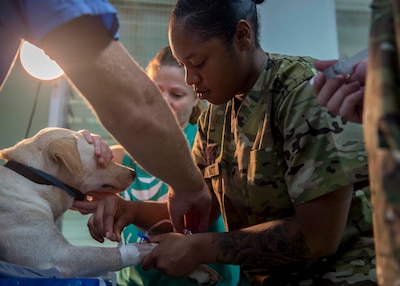
YAP, Micronesia, April 2, 2018 — Two U.S. Army veterinarians and an Army animal care specialist conducted surgeries on dogs and cats and shared knowledge and practices with local volunteers during Pacific Partnership 2018 here, March 26-29.

Veterinarians Dr. (Capt.) Adam Boe from Fort Shafter, Hawaii; Dr. (Capt.) Trevor Tenney from Naval Base Yokosuka, Japan; and animal care technician Spc. Diamond DeWindt from Kadena Air Base in Okinawa, Japan, provided vaccinations and conducted spay and neuter surgeries on nearly fifty animals.

‘We Are Honored to be Here’

“There are no practicing veterinarians in Yap,” Boe said. “The U.S. Army is the only branch of service with clinical veterinarians and we are honored to be here in Yap working side-by-side with local professionals.”

Before conducting the surgeries on March 23, the three veterinarians met with volunteers from the Yap Animal Protection Society to discuss the basics of first aid, euthanizations, preventative medicine, zoonotic diseases, animal husbandry and other common animal medical issues.

“YAPS consists of nearly twenty volunteers dedicated to bringing veterinarians from nearby countries through donations and fundraising campaigns,” Tenney said. “YAPS is a great resource, and we realized that by sharing techniques and practices, YAPS volunteers will be able to better assist veterinarians during surgeries.”

As part of the Pacific Partnership 2018 mission to provide sustainable practices in Yap, the veterinarians shared knowledge to improve and increase efficiency of food production from chickens and pigs through discussions on nutrition, housing and medical care.

“As the animal care specialist, Spc. DeWindt’s expertise in these areas was truly appreciated by YAPS,” Boe said. “Spc. DeWindt encounters every aspect of animal care and she is a vital member of our Pacific Partnership team.”

The veterinarian team also participated in the community health engagement at the Yap Memorial Hospital as part of a team of more than 35 sailors, soldiers and airmen from the United States, the United Kingdom, Australia and Japan.

“The most important aspect that we as visiting veterinarians can do is to provide the necessary education to the local community about animal care so the knowledge and experiences we share together during this year’s Pacific Partnership will last well into the future,” Tenney said.

Since 2006, 22 partner nations around the globe in 18 host nations have participated in Pacific Partnership, providing medical care to more than 300,000 patients, veterinary services to nearly 40,000 animals and completed nearly 200 engineering projects while building meaningful and close partnerships throughout the Indo-Pacific region.

American, Jordanian Forces to Support Eager Lion 2018


TAMPA, Fla., April 2, 2018 — About 3,600 U.S. service members will partner with Jordanian military forces in Jordan April 15-26 during Exercise Eager Lion 18, one of U.S. Central Command’s premier exercises, Centcom officials announced today.

Eager Lion is a major training event that provides U.S. and Jordanian military forces the opportunity to improve their collective ability to plan and operate in a coalition-type environment.

Variety of Scenarios

A wide variety of scenarios -- from long-range bomber missions to maritime security operations to a ground force attack of a fictitious adversary -- will occur throughout Jordan during the event.

The U.S. Agency for International Development’s Office of U.S. Foreign Disaster Assistance play a larger role this year, as will Jordan’s National Center for Security and Crisis Management, which coordinates and unifies national-level capabilities to confront and manage any crisis Jordan might face.

Thursday, March 29, 2018

Defense Budget Provides Air Force With Needed People, Money, Time


By Jim Garamone DoD News, Defense Media Activity

WASHINGTON, March 29, 2018 — People, money and time are needed to address urgent issues the Air Force faces today, the service’s chief of staff told the Defense Writers’ Group here today.

Air Force Gen. David L. Goldfein said that readiness and morale go hand-in-hand.

“I find where readiness is highest, morale is highest,” the general said. “So you walk the line today in Bagram [Afghanistan], you walk the line in Kunsan [South Korea], you walk the line where we have invested the people, parts -- all the things that are required to continue engaging in an active campaign like in Bagram or supporting the pressure campaign in Kunsan, you will find that morale is fairly high.”

But there is a cost to the readiness at bases on the point of the spear and the bases in the United States are paying it, Goldfein said.

Cost of Maintaining Readiness

“When you walk those bases and you see lower levels of readiness, lower levels of manpower, higher levels of operational tempo as they not only prepare for a continual rotational to the Middle East -- because that footprint hasn’t come down -- but also ensure we have continued bomber presence, to ensure we have what’s required to support the pressure campaign and we’re doing that with less people, less parts on the shelves, less flying hours, you will find the morale there is not high,” he said.

Conventional airpower and people paid the bills for more intelligence, surveillance and reconnaissance assets, the general said. They paid for the continual bomber presence. They paid for space assets. And people left the service, but that didn’t mean the number of missions declined. Those who remained had to pick up the slack.

The fiscal year 2018 DoD budget goes a long way toward addressing the problem, Goldfein said. The first thing the service must invest in is its people, the general said.

“It’s more than just those who strap on the aircraft,” he said. “It’s the maintainers, it’s the refuelers, it’s the avionics technicians; it’s all those folks who have their fingerprints on the airplane before it takes off.”

Adding More Airmen

Getting that number right will go a long way to improving readiness and morale, the general said. The Air Force will add 4,700 more airmen this year and 3,300 a year into the future.

The Air Force also must have a healthy number of weapon systems that it can generate, employ and sustain at combat rates, the general said. This means the depots need an infusion of money and people. Parts inventories must be increased.

“It’s the flying hour program and all those things that sustain a healthy weapon system,” he said.

There also needs to be an operational training environment that allows airmen to realistically train for higher-end combat, Goldfein said.

“We’re doing a lot of work now in looking at if China and Russia … are our pacing threats that we have to train against, what exactly does that mean to answer the question, ‘Ready for what?’” the general said.

Training now must reach into space and into the digital realm, he said.

And, the Air Force must have the time required to invest in the training, Goldfein said.

“What’s really going to be helpful in the budget is we are really going to be able to make some advancements that we haven’t in the past,” he said.