Thursday, March 15, 2018

AF Secretary: Proposed Budget Aligns With National Defense Strategy


By Air Force Staff Sgt. Rusty Frank Secretary of the Air Force Public Affairs

WASHINGTON, March 15, 2018 — Secretary of the Air Force Heather Wilson and Air Force Chief of Staff Gen. David L. Goldfein yesterday testified before the House of Representatives’ Committee on Appropriations about the Air Force’s proposed fiscal year 2019 budget.

The proposed budget “aligns with the National Defense Strategy,” Wilson said.

She said the budget also recognizes and reflects that the United States is experiencing “a more competitive and dangerous international security environment than we have faced in decades.”

Wilson added, “We have returned to great power competition and the central challenge to security and prosperity is one we must meet. That’s what you expect of your Air Force and of your joint force, and we’re here to deliver.”

Bold Moves

According to Wilson, there are “two bold moves” in this budget.

“The first is accelerating defendable space. We need to deter, defend and prevail against anyone who seeks to deny our ability to freely operate in space,” Wilson said.

“The second is the shift to multi-domain operations,” she added. “We are proposing to change the way we do command, control and communication on the battlefield. A mission we perform for the joint force and particularly for the ground forces.”

In addition to the two bold moves, the Air Force will continue to prioritize the readiness of the force to win any fight, any time, Wilson said.

“Let there be no doubt, your airmen stand ready to defend the homeland, deter nuclear conflict through nuclear readiness, own the high ground with air and space superiority and project global vigilance, reach and power with our joint teammates, allies and partners,” Goldfein said.

Fiscal year 2019 funds will expand pilot training and address experience shortfalls, continue incentive pay and bonuses, improve administrative support at the squadron level and support flying hours to executable levels, officials said. The funding also will address gaps in space, nuclear, cyber and intelligence career fields and support battlefield airmen -- the service’s air-to-ground integration force.

“Airmen participate in some way in every mission the joint force performs,” Goldfein said. “We operate from below the surface in a remote missile silo to the outer reaches of space, and everywhere in between. We can do all of this only with the unwavering support of the American people and the leadership and support of Congress.

The general added, “This Air Force budget request allows our nation to confront today’s threats and moves us toward the Air Force we need to face tomorrow’s challenges.”

The Air Force’s fiscal 2019 budget request of $156.3 billion builds on the progress made in 2018 to restore the readiness of the force, increase lethality and modernize in a cost-effective manner, officials said.

Wednesday, March 14, 2018

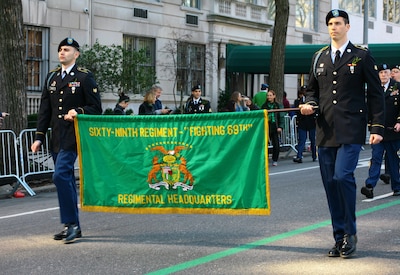
'Fighting 69th' to Lead New York City’s St. Patrick's Day Parade for 167th Year


By Army Col. Richard Goldenberg New York National Guard

ALBANY, New York, March 14, 2018 — More than 800 New York Army National Guardsmen from the 1st Battalion, 69th Infantry Regiment, will lead the world’s largest St. Patrick’s Day Parade for the 167th time on March 17.

The battalion, known as the "Fighting 69th," was originally organized as a militia unit for Irish immigrants. In 1851, the battalion was asked to lead the annual parade of Irish Catholics in case of anti-immigrant violence.

The battalion has had this honor ever since, celebrating its Irish-American heritage.

The unit was dubbed “that fighting 69th Regiment” by Confederate army Gen. Robert E. Lee, after he witnessed their charge at the Battle of Fredericksburg in 1862.

The unit's soldiers further distinguished themselves in World War I, World War II, and during combat deployments to Iraq and Afghanistan.

Reflection of the Community

While today’s 69th Infantry Regiment is no longer the Irish-only unit of a century ago, it remains a reflection of New York City’s immigrant community, said Army Lt. Col. Don Makay, commander of the 1st Battalion.

“The [unit] … continues to reflect the immigrant nature of the city,” he said, “although that immigrant is no longer just Irish, but from many different countries.”

“For the 69th, the day doesn't necessarily instill pride in being Irish, as many of our soldiers aren't Irish. It instills the pride in being a New Yorker, an American, and a soldier,” Makay said. “Something the Irish started with the regiment, but has since been carried on by many nationalities.”

This year the unit will host Army Lt. Gen. Daniel Hokanson, the vice chief of the National Guard Bureau, and mark the unit’s centennial of service in World War I as part of the 42nd Infantry Division in France.

Douglas MacArthur, at the time a brigadier general commanding the 84th Brigade with regiments from Alabama and Iowa, said of the regiment’s actions after a particularly arduous battle: "By God, it takes the Irish when you want a hard thing done!”

Traditions

A host of traditions surround the 69th and the St. Patrick's Day parade.

Members of the 69th place a sprig of boxwood on their uniform as a reminder of the regiment's charge against Confederate lines at Marye's Heights in Virginia at the Battle of Fredericksburg, Dec. 13, 1862.

To mark their Irish heritage, the men of the Union Irish Brigade, including the 69th Regiment, put sprigs of boxwood in their hatbands.

The Union attack failed, but the burial details found that the Union troops who made it closest to the enemy fortifications before being killed had sprigs of boxwood in their hats.

Officers of the 69th carry a fighting stick made of blackthorn wood imported from Ireland. The sticks, much like a British officer's swagger stick, are considered the mark of an Irish leader and gentleman.

The soldiers are accompanied on their march by two Irish Wolfhounds, the official mascot of the 69th Infantry. The dogs are representative of the regimental motto, "gentle when stroked, fierce when provoked" and will be led this year by Sgt. Quentin Davis and Spc. Ilya Titov, the battalion’s noncommissioned and soldier of the year, respectively.

For the officers of the 69th the day begins at 6 a.m. in the commander's office, a room lined with relics dating back to the Civil War. The traditions of the boxwood and the blackthorn sticks are explained to new officers, along with a look at the "Kilmer Crucifix."

The religious icon was once worn by poet Joyce Kilmer -- the author of the poem "Trees" -- who died while serving in the 69th in World War I. Today it is handed down from battalion commander to battalion commander.

These mementos of the unit’s Irish lineage and the lead role in the city parade are meant to inspire a new generation of immigrant citizen-soldiers, Makay explained.

Ready to Defend

“I imagine the value of seeing this unit march is a reminder that the old values of opportunity, freedom, [and] equality are still alive and represented in the “Fighting 69th” and U.S. military,” Makay said. “The soldiers marching in the parade remind [us] all of a time when the Irish risked it all, sailed here, helped build a city, formed the 69th, and that regiment has fought for the same values from the Civil War to the War on Terrorism.”

“The parade is always a chance to show people, "Yes, we are still here, and still ready to defend," he said.

At 7 a.m., the regiment's honorary bag piper leads the men out of the Lexington Avenue and over to 51st Street for a special mass at St. Patrick's Cathedral.

Following mass, the battalion marches to 44th Street and 5th Avenue, the official start of the parade.

The battalion is joined by its support company from the 427th Brigade Support Battalion, the 42nd Infantry Division Band, and numerous guests of the regiment from the unit’s higher headquarters, including the 27th Infantry Brigade Combat Team and 42nd Infantry Division, two other notable Army formations of World War I fame.

The march formation also includes members of the Veterans Corps of the 69th. The corps, comprised of former members of the 69th, helps preserve the history of the regiment and foster camaraderie, morale and welfare of the 69th's soldiers and families.

The parade is also joined by volunteers from the Irish Defense Forces’ 58th Reserve Infantry Battalion, who travel to New York at their own expense to share in the celebration with the battalion.

It takes an hour for the soldiers to march up 5th Avenue to the end of the parade route, where a special subway train picks them up and transports them back downtown to the East Village.

This year’s unit awards and recognition ceremony will be held at the Great Hall of The Cooper Union, a similarly historic part of New York City, which opened in 1858.

“I say to the soldiers-- take pride in the history of this great unit, which has always stood for fighting for something bigger than yourself,” Makay said of the parade and celebration of the unit’s Irish roots. “Take pride in what it means to be a 69th soldier -- to be tough, fit and ready to fight and protect what's important.”

Makay noted that after nearly 170 years of service, the commitment of soldiers to serve and train to defend their neighbors and their nation has not changed.

“Many of the men that marched in the first St. Patrick's Parade with the 69th went off to defend the Union less than a decade later,” he said. “The men and women who march this Saturday are of the same level of commitment, should they be called, and will serve and fight accordingly.”

Infantry Task Force Looks to Overmatch Potential Foes


By Jim Garamone DoD News, Defense Media Activity

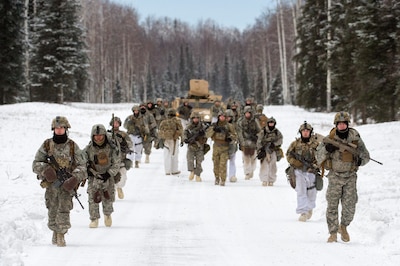
WASHINGTON, March 14, 2018 — The United States already has the best infantry soldiers, Marines and special operators on the face of the Earth, but Defense Secretary James N. Mattis wants them to completely overmatch any potential foes.

Joseph L’Etoile, the senior advisor in the Office of the Assistant Secretary of Defense for Readiness, is leading a Close Combat Lethality Task Force to ensure this overmatch becomes a reality.

The task force is laser-focused on capabilities, policies and doctrine that will allow close-combat squads to overmatch any opposing foe. “The idea is to ensure a squad can impose its will on a like-sized organization in any operational environment in any condition,” L’Etoile said in an interview in his Pentagon office.

A career infantry Marine, L’Etoile is working with Army, Marine Corps and special operations personnel to examine every aspect of infantry operations. This effort is aimed at the roughly 130,000 Defense Department personnel who engage in close-combat operations. This group historically suffers 90 percent of war casualties.

Improving Squad Lethality and Protection

Many things can be done to improve squad lethality and protection, L’Etoile said. “There’s some low-hanging fruit, there’s some that’s going to be a lot of work. There’s some that is futuristic,” he added. “In some areas, we are going to plant seeds that others are going to harvest.”

Over the last 30 years, most of the changes in infantry squads have been evolutionary, he said. He pointed to the first night-vision goggles he used in the late 1980s as an example. “The NVGs that are out there today are eye watering with the capabilities they have,” he said. But those are evolutionary changes. “What we’re also looking for are  breakout capabilities – more revolutionary than evolutionary,” he said.

Infantry personnel are still shooting 5.56 mm rounds out of an M-4 rifle, which is a derivation of the Vietnam era’s M-16. “There is an element of this that bears repeating — first do no harm,” L’Etoile said. “We produce magnificent infantry that have been very successful. What we are looking at is, ‘What is technologically available today that will have a revolutionary impact?’ This is about optimizing for success.”

Training, human performance and manpower policy are three nonmaterial aspects that the task force will examine. “A good guideline is [that] it is what is in the soldier or Marine, not what is on the soldier or Marine, that is much more important,” he said. “Human performance enhanced by modern training techniques is what we are looking at.”

The task force is looking at weaponry that has greater range and lethality and the ability to find and defeat concealed enemy forces. “The material components are there – they are in the sensing arena. What can we give a squad that can look over the next ridge line -- and the one after that -- that is man portable?” he said.

Lightening the Load

This last is crucial, he said, as the task force does not want to add any more weight; in fact, it wants to decrease the warfighter’s load. A fully equipped infantry soldier carries weapons, water, ammunition, batteries, food, personal protective equipment, hand grenades, goggles and more. The weight easily tops 120 pounds. “The piece about reducing the soldier’s load is central to what we’re looking at,” he said. “There’s some opportunity there, but there are some technological challenges.”

The task force is looking at what exoskeletons can accomplish and is considering the possibility of autonomous robots carrying gear, food and ammunition.

Not all battles occur in the same clime or place. Combat in cities requires different equipment, sensors and weapons than combat in the desert or jungle or tundra or forest, L’Etoile said. These environmental challenges need to be factored into how military officials design, experiment and procure these capabilities.

One of the innate advantages American squads enjoy is the innovative spirit. Soldiers and Marines take the initiative to find new ways to use equipment, capitalize on new technology or use old technology in new ways.

“When they come up with a solution, we have to listen, and we have the mechanisms in place to exploit that creativity,” L’Etoile said. “We have a bias for action on the task force. We are not going to let ‘perfect’ be the enemy of ‘good enough.’”