Tuesday, January 09, 2018

Airmen Keep A-10s Flying Despite Frigid Weather


By Air Force Airman Eugene Oliver, Moody Air Force Base

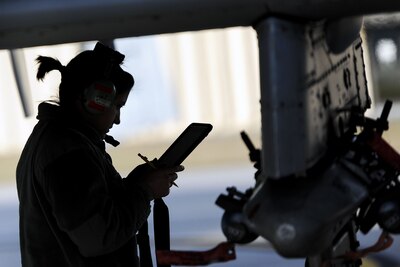
MOODY AIR FORCE BASE, Ga., Jan. 9, 2018 — After a snowstorm halted all flying and maintenance operations, the 75th Aircraft Maintenance Unit here took extra measures to ensure their A-10C Thunderbolt II aircraft could operate in frigid temperatures.

The maintainers were able to get the A-10s flying and mission-ready within 24 hours by performing extra inspections and increasing their workload to get back on schedule.

“Ice can significantly reduce lift, increase drag and add significant weight to the aircraft, which can be dangerous.” said Air Force Senior Airman Carlos Ramon-Cruz, 75th Aircraft Maintenance Unit crew chief. “We perform extra inspections and allow the aircraft to warm up longer to ensure everything goes smoothly.

Ice, Snow

“We keep an extra eye out for any ice or snow on the aircraft during conditions like this,” Ramon-Cruz added.

While aircraft are affected by the cold weather, the airmen working on them are also vulnerable to the frigid temperatures.

“The cold more affects the maintainers then it does the aircraft,” said Air Force Senior Master Sgt. Jeffrey Zimmerman, 75th AMU superintendent. “The maintainers have to wear more clothes and they mainly work with their hands, so when they get cold and frigid it slows down the entire maintenance process.”

While the maintainers have to adapt to the cold, the 75th AMU will have to work extra to make up for lost production due to the snowstorm.

“Jan. 4 was supposed to be our first flying day of the year,” Zimmerman said. “Consequently, we got behind, and all together we lost 18 sorties from the snow day that we will have to make up.”

Increasing Production

To make up for the flying hours that were lost, the 75th AMU will increase its production over the next few weeks to get back on its normal flying schedule.

“We already perform 24-hour operations on the flight line, so we’re increasing our sorties at the end of each week to help us regain the time that was lost,” Ramon-Cruz said. “We’re going to be ramping up the workload to get back on the track that we were on before the snowstorm.”

Because Moody doesn’t experience below-freezing temperatures on a frequent basis, the maintainers are not fully equipped to handle the frigid conditions.

“We keep our aircraft covered to help keep the snow off, but we don’t have any de-icing machines to heat up the planes,” Zimmerman said. “If we have ice on the planes, we have to just wait it out until we can get them flyable.”

While continuing to adapt to the cold weather and staying on schedule, the 75th AMU emphasized how nothing, including the weather, will stop them from completing their mission.

“There’s no heat, or air conditioning out there on the flight line,” said Zimmerman. “If the base is open, we’re going to be working around the clock to keep our aircraft flying.”

Monday, January 08, 2018

Task Force Darby Aids Boys in Cameroon


By Army Staff Sgt. Christina Turnipseed U.S. Army Africa

GAROUA, Cameroon, Jan. 8, 2018 — In Task Force Darby’s efforts to support the Cameroon military’s fight against the violent extremist organization Boko Haram, other humanitarian opportunities often present themselves.

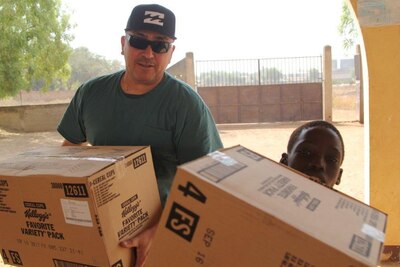
One such opportunity was a civil affairs-led team made up of soldiers from the 1st Battalion, 87th Infantry Regiment; the 806th Adjutant General Detachment; Civil Affairs Team 4032 and other service members. This team provided food, soccer balls and moral support to the boys of Saare Jabbama, a youth rehabilitation center for boys ages 8 to 18.

According to Army Capt. Scott Wyly, commander of Civil Affairs Team 4032, many of the boys living at the center either can't find jobs, can't find their parents or are homeless.

The reasons why several soldiers and service members volunteered to deliver food, soccer balls and nets also vary.

“The civil affairs team has had a strong relationship with the center for the last couple years and visits the center on a monthly basis. Private donors from the United States frequently send donations for the [civil affairs] team to give to the children at Saare Jabbama,” Wyly said.

Love for Giving

The motive for some of the participating troops to volunteer for the humanitarian mission was a love for giving.

“Giving to the boys’ home was the best feeling for me,” said Army Sgt. Adrian Cordova, a mail clerk with the 806th Adjutant General Detachment.

“It was great to be able to see the excitement and smiles on their faces when we arrived. Playing soccer with the boys was an even greater feeling,” he said.

Army Sgt. John Marshall, also a mail clerk with the 806th Adjutant General Detachment, said he also enjoyed giving.

“I wanted to give back to other families and children that are less fortunate than I am. I feel really blessed to be able to help others in their time of need,” Marshall said. “I know what it's like to hit rock bottom. So for me, it is a blessing to give back.”

Army Spc. Ryan Worwood, with the 1st Battalion, 87th Infantry Regiment, said he took part out of a general love for children.
“I’ve always wanted to do this since I got here,” he said. “I love little kids a lot. So, it was no surprise to my family that I volunteered.”

Army Engineers Compete in Iron Ram 2018


By Army Sgt. Thomas X. Crough U.S. Army Central

KUWAIT NAVAL BASE, Kuwait, Jan. 8, 2018 — Soldiers from the 40th Brigade Engineer Battalion, 2nd Brigade, 1st Armor Division, competed in Iron Ram 2018, an annual battalion-level exercise testing physical fitness and proficiency in soldier skills, Jan. 5 at Kuwait Naval Base in Kuwait.

Iron Ram consists of a World War II-style physical training test followed by functional training stations focusing on basic soldier skills, which teams of three negotiated as quickly as possible, explained Army Master Sgt. Martin Pelayo, with the 40th Brigade Engineer Battalion.

Events

The World War II-style physical training test consisted of pull-ups, squat jumps, pushups, straight-leg sit-ups and a 300-yard run.

“The training events included disassemble and reassemble of a Mark 19, a machine grenade launcher. We also had the M240B and M249, which are our squad automatic weapons, along with the .50-caliber machine gun,” said Army Sgt. Dustin Calderwood, an Iron Ram competitor assigned to the 40th BEB. “[After] that we had a tire-changing station, which we knocked out in less than 20 minutes for two vehicles. Then we went to the OE-254, which is one of our communication antennas that we use on a regular basis … The hardest event for our team today was the combat lifesaver event.”

There was also a station testing soldiers’ ability to don protective gear, known as Mission Oriented Protective Posture, in response to a chemical, biological, radioactive or nuclear event.

“We were giving them a scenario … where they had to get into MOPP level two. Then they are presented with an issue that requires them to don their protective mask within nine seconds and conduct immediate decontamination … within one minute and then move on directly into MOPP level four,” said Army Staff Sgt. Chasity Welch, a CBRN specialist with the 40th BEB. “At the end of that scenario, that’s when we go over the mistakes that they’ve made and some of the things that we can improve on to make sure that we are better as a whole and as an individual.”

All of the participants were volunteers from the 40th BEB, which is based at Fort Bliss, Texas.

Training Builds Fundamentals

The events promote teamwork, competiveness, and the the warrior spirit, Pelayo said.

“It [also] incorporates readiness [training] … and it also maintains proficiency,” he added.

Readiness and proficiency were themes stressed by both cadre and participants.

“Making the training fun allows them to retain the fundamentals that they need to have in case of a real-world event,” Welch said.
“I think overall the competition was good … it definitely showed us what we were good at, where we need a little work, and it definitely brought our team together. I feel like the spirit was high throughout the competition,” Calderwood said.