Friday, August 25, 2017

Women's Equality Day


What is it?

Women's Equality Day celebrated in the United States on August 26 each year commemorates the addition of the 19th Amendment to the Constitution, which guaranteed women the right to vote. The passage of the 19th Amendment was the first step towards shaping gender equality in today's work force. President Harry Truman signed the Women's Armed Services Integration Act into law. It granted women permanent status in the Regular and Reserve forces of the Army, Navy, and Marine Corps, as well as the newly-created Air Force in 1948.

In celebrating Women's Equality Day the Army recognizes not only the significance of women's contributions but also the value of diversity and an inclusive environment.

What has the Army done?

Current Army Policy ensures equal opportunity to serve for both genders and is consistent with Department of Defense guidance. The Army celebrates Women's Equality Day by recognizing that women of the highest caliber have served in the Army for generations and have proven that sacrifices and selfless service are genderless.

The Army has lifted and overturned the 1994 Pentagon decision that explicitly prohibited women from serving in combat. The Army is in the process of integrating women into previously closed units and has begun the next phase where they have recruited over 500 women to potentially serve in combat and physically demanding jobs.

The Army continues to celebrate and commemorate the diversity of the Army and leverage and draw strength from the rich variety of personnel within the ranks by recognizing the critical role played by all in strengthening the nation's presence around the world.

What continued efforts are planned for the future?

The Army will continue with its efforts to:

    Build a diverse pool of talent.
    Build upon the tremendous advancements made in the struggle for equality for Soldiers and Civilians.
    Remain diligent in enforcing the nation's laws which assist women and men in balancing work and family responsibilities.
    Eliminate barriers that prevent people from reaching their professional aspirations.

The Army will continue to celebrate and commemorate its diversity. It will leverage and draw strength from the rich variety of personnel within the ranks by recognizing the critical role played by all in strengthening the nation's presence around the world.

Why is this important to the Army?

American's Army is a world-class force. The Army recruits the best talent regardless of gender or race and ensure the integration of diverse attributes, experiences and backgrounds in ways that enhance decision making and inspire high performance.

Women have served in the United States Army since 1775 and remain an invaluable and essential part of the Army today. Women make up 16.4 percent of the Army. They play vital roles in today's Army; as Soldiers, Army Civilians and Family members-- all critical members of the Army team.

Leveraging data to provide insight into complex issues surrounding Veteran homelessness


Deming, a well-respected statistician, reminds us that identifying the what is critical in determining how to be successful. Deming is widely known for helping to develop the sampling techniques still used by the U.S. Census Bureau and the Bureau of Labor Statistics.

VA has taken a similar approach in working toward its priority goal to end Veteran homelessness, gathering and reviewing data on homelessness that then inform strategies to address it. As a result, the nation saw a nearly 50 percent reduction in the number of homeless Veterans between 2010 and 2016.

For the last four years, VA and partners at the state and community levels have been using a data-driven management platform to determine and update the number of Veterans who are homeless and track those Veterans by name so that they can be served most efficiently and effectively. The platform houses data from multiple sources, including but not limited to the U.S. Department of Housing and Urban Development (HUD) Point-in-Time count and the VA Homeless Registry. This web-based resource, available to homeless program officers at every VA medical center throughout the country, gives VA and its partners the ability to:

    Seamlessly share strategies and best practices for ending Veteran homelessness.
    Rapidly gain situational awareness to address emerging needs at the local level.
    Organize and integrate analysis and planning activities.

Communities that have effectively ended Veteran homelessness — or that are coming close to doing so — are using the data not only to identify where homeless Veterans are, but to also highlight gaps in services that those Veterans may need to exit homelessness.

Veteran homelessness is a multifaceted issue that goes beyond housing. It is rooted in complex causes, including mental health challenges and substance abuse, and it is affected by the state of the economy and availability of affordable housing. With data on services that support Veterans holistically, VA and its partners can see where additional resources may need to be allocated as well as what Veterans in a particular community may need in the future.

These community-level efforts are supported by coordinated federal technical assistance and funding for homeless programs, which include:

    HUD-VA Supportive Housing
    Supportive Services for Veteran Families
    Homeless Patient Aligned Care Teams
    Grant and Per Diem
    Health Care for Homeless Veterans
    Veterans Justice Outreach
    Homeless Veterans Community Employment Services

VA’s adoption of a data-driven approach linking operational planning to a careful assessment of gaps in services generated significant increases in the annual number of homeless Veterans placed into permanent housing. For instance, in fiscal 2015, the first year of full adoption of this model, VA placed nearly 65,000 homeless Veterans into permanent housing — about a 21 percent increase over the 53,000 of homeless Veterans placed into permanent housing in fiscal year 2014.

This data-driven approach to ending Veteran homelessness helps all of us — national organizations like VA, community groups, and individuals in every corner of the U.S. — ensure that we’re doing our best to give every Veteran a safe, stable place to call home and the resources they need to stay there.

To learn how you can get involved in your community, and to see a full list of the communities that have ended Veteran homelessness, visit va.gov/homeless.

Secretary Pledges Support in Meetings With Leaders in Ukraine


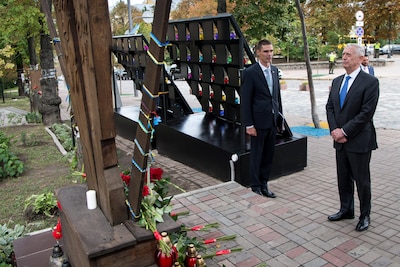
WASHINGTON, Aug. 25, 2017 — Defense Secretary Jim Mattis pledged continued U.S. support to build the capacity of Ukraine's forces and applauded Ukraine's commitment to modernizing its defense sector according to NATO standards in meetings with two of the country's top leaders yesterday in Ukraine's capital of Kyiv, chief Pentagon spokesperson Dana W. White said.

Mattis met with Ukrainian President Petro Poroshenko and later with Ukrainian Defense Minister Stepan Poltorak as part of an overseas trip. This was his first official meeting with Poltorak, White said in a statement summarizing the meetings.

Steadfast Partnership

In both discussions, White said, the leaders emphasized the steadfast partnership between the two countries.

"The leaders also discussed the strategic challenges associated with Russian aggression and the need for Russia to adhere to its commitments under the Minsk agreements, including an immediate ceasefire, withdrawal of heavy weapons, and unfettered access for security monitors in eastern Ukraine," she added.

The secretary also attended a military parade commemorating Ukraine's Independence Day alongside Poroshenko and eight defense ministers from allied and partner nations, White said.