Friday, April 09, 2021

Secretary of Defense Austin Announces Immediate Actions to Counter Extremism in the Military and the Establishment of the Countering Extremism Working Group

 April 9, 2021


Today, Secretary of Defense Lloyd J. Austin III issued a memorandum announcing the Immediate Actions to Counter Extremism in the Department and the Establishment of the Countering Extremism Working Group (CEWG).

The immediate actions are as follows:

  • Review and Update of DODI 1325.06 Extremism Definition: Office of the Secretary of Defense (Personnel & Readiness) and the Office of the General Counsel (OGC) will review and update DODI 1325.06 to more specifically define what constitutes extremist behavior.
  • Updating the Service Member Transition Checklist: The military departments will add provisions to their service member transition checklists that include training on potential targeting of service members by extremist groups and work with other federal departments agencies to create a mechanism by which veterans have the opportunity to report any potential contact with an extremist group should they chose to do so.
  • Review and Standardization of Screening Questionnaires: All military departments to update and standardize screening questionnaires to solicit specific information about current or previous extremist behavior.
  • Commission of Extremism Study: The Department will commission a study on extremist behavior within our Total Force, to include gaining greater fidelity on the scope of the problem.

Led by Bishop Garrison, Senior Advisor to the Secretary of Defense on Human Capital and Diversity, Equity and Inclusion, the CEWG will oversee the implementation of immediate actions as well as the development of mid-term and long-term recommendations for the continued engagement of this issue. The CEWG will report through the Workforce Management Group (WMG) to the Deputy's Workforce Council (DWC).

The CEWG will pursue four initial Lines of Effort (LOEs) within subcommittees that receive information from both internal and external Subject Matter Experts as well as coordination and input from the interagency.

The Lines of Effort are as follows:

  • Line of Effort 1: Military Justice and Policy. This LOE will focus on the role of military justice and policy. It will evaluate whether seeking to amend the Uniformed Code of Military Justice (UCMJ) or amending related department policy is appropriate in order to address extremism. This LOE will determine if regulations are sufficient or should be expanded.
  • Line of Effort 2: Support and Oversight of Insider Threat Program. This LOE will determine how the Department should facilitate better information collection and sharing among Service Insider Threat Programs, law enforcement organizations, security organizations, and commanders and supervisors. This group will work to strengthen Insider Threat Programs and the Direct Awareness Campaign with the goal of promoting the use of the Insider Threat programs to report concerning behaviors for both military and civilian personnel.
  • Line of Effort 3: Screening Capability. This LOE will discuss the Department's pursuit of scalable and cost-effective capabilities to screen publically available electronic information in accessions and continuous vetting for national security positions. The LOE will make recommendations on further development of such capabilities and incorporating machine learning and natural language processing into social media screening platforms. This LOE will also endeavor to develop policy to expand user activity monitoring of both SIPR and NIPR systems. 
  • Line of Effort 4: Education & Training. This LOE will utilize the current extremist and Insider Threat training review being conducted by OUSD(P&R) and OUSD(I&S) and  examine existing training and make recommendations and updates to those trainings for different leadership levels and separate and discrete targeted audiences, as necessary. It will use lessons learned from the Stand Down to enhance current reviews of training and education. This LOE will also ensure training addresses issues raised by commanders and supervisors on “gray areas” such as reading, following, and liking extremist material and content in social media forums and platforms.

The memorandum for the Immediate Actions to Counter Extremism in the Department and the Establishment of the Extremism Working Group can be found here.

Thursday, April 08, 2021

Colorful Competition


Army Spc. Caleb Romero, a California National Guardsman, scans his sector as smoke billows behind him during the mystery event of the California Guard’s Best Warrior Competition at Camp Roberts, Calif., March 31, 2021.

Family Parade


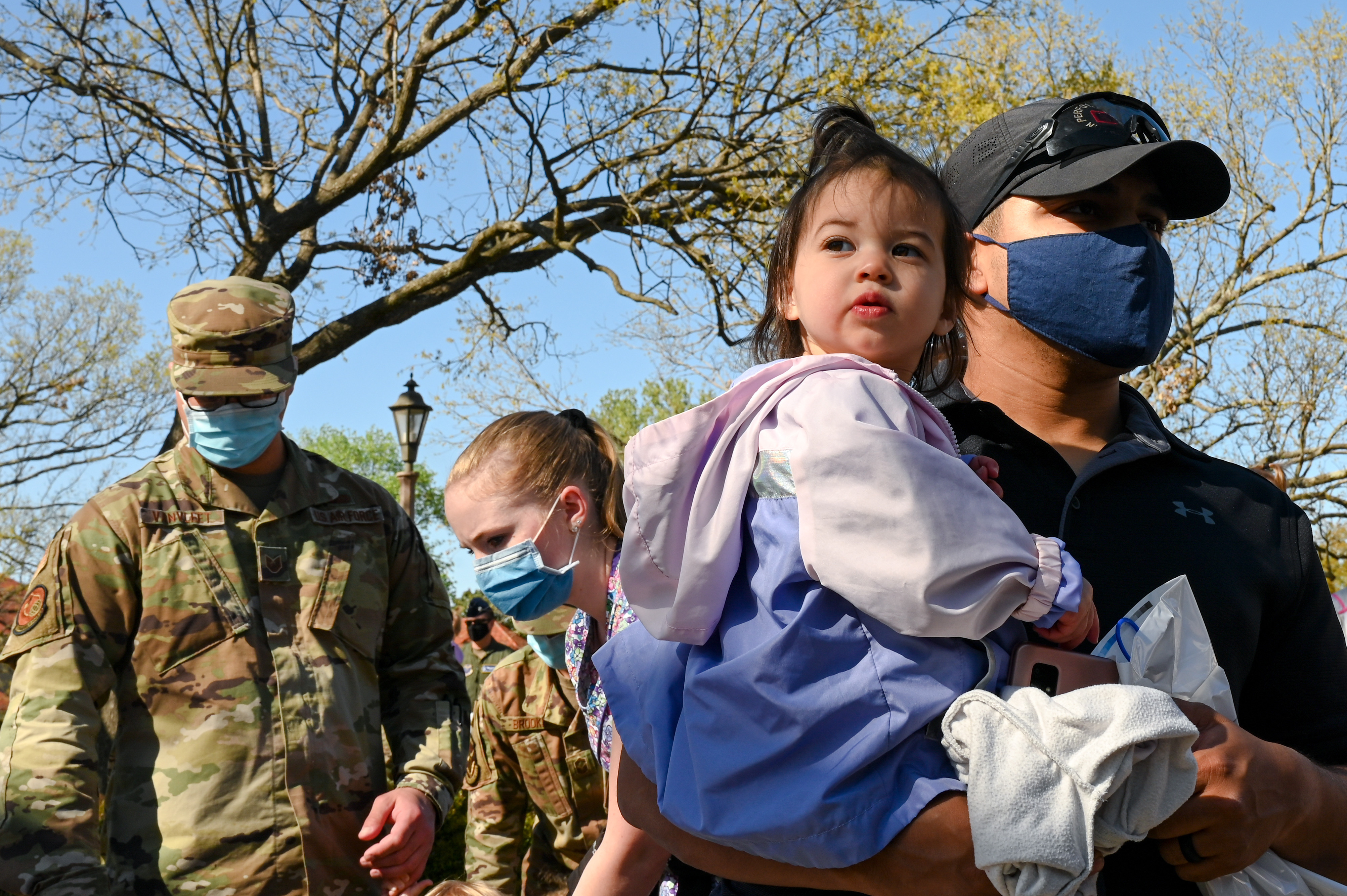
Military families participate in a parade at Barksdale Air Force Base, La., April 1, 2021, to commemorate Month of the Military Child as well as National Child Abuse Prevention Month.

Defense Health Officials Provide a COVID-19 Update to Media

 April 8, 2021

Army Lieutenant General Ronald J. Place, Director, Defense Health Agency; Army Major General Jill K. Faris, Deputy Surgeon General, Army National Guard; Navy Rear Admiral Gayle Shaffer, Deputy Surgeon General, U.S. Navy; Air Force Major General Robert Miller, Deputy Surgeon General, U.S. Air Force; Pentagon Press Secretary John F. Kirby

PRESS SECRETARY JOHN F. KIRBY: Good morning, everybody, and welcome to our briefing this morning focused on COVID vaccinations in overseas destinations and locations. That's what we're hoping to provide some context on for you this morning.

And to help us out, we're very pleased and delighted to have representatives from each of the services, and of course, as you all know, you know General Place quite well, the director of Defense Health Agency. He's going to shortly provide you with an update on vaccine distribution to DOD personnel, again, with a focus on OCONUS (Overseas) vaccination efforts to our troops and -- and beneficiaries. And he's being joined this morning by Army Major General Jill Faris, the interim G357 U.S. Army Medical Command; Navy Rear Admiral Gayle Shaffer, deputy surgeon general of the United States Navy; and Air Force Major General Robert Miller, director of medical operations, Office of the Surgeon General. After they each have a -- a few moments to provide you some context, and then we'll open it up for -- for some -- some Q&A with them.

And with that, General Place, thank you.

LIEUTENANT GENERAL RONALD PLACE: Thanks, Mr. Kirby.

And thanks to all of you for the opportunity to talk about where we are and where we're headed in the coming weeks in regard to our COVID vaccine efforts.

First, some data points on our vaccination program: Four months ago almost to the day, I sat -- well, I stood at a podium right over there and told you that our vaccination program was one of 64 jurisdictions across the United States. I also said that we'd be receiving about 1.3 percent of the total U.S. doses, and that we would begin vaccination the following week with a few thousand doses of vaccines.

Over the course of the holidays, the DOD quickly validated our pilot program and began the expansion process to our current 350 vaccination locations. It took us 70 days to administer the first million vaccines, 35 days for the next million, and with more than a quarter of a million doses administered in the last eight days we're on track for the next million in somewhere between 25 and 30 days.

Further, the department recognizes the limited options of our OCONUS beneficiaries to receive the vaccine in one of our military medical treatment facilities. In order to support our OCONUS beneficiaries, we made the decision to distribute 14 percent of the doses we received to OCONUS locations. That's significant because the OCONUS population is seven percent of our eligible population.

That said, if you're a service member stationed overseas or a family member likewise stationed overseas, and you haven't received the vaccine and you don't know when you'll be able to, these numbers mean nothing, and it's understandably frustrating.

The recent event that caused the loss of about 15 million doses of the Johnson & Johnson, or Janssen, vaccine has affected the DOD allocations, as is true for all United States jurisdictions. We targeted the overseas community for our J&J vaccine supplies, so we're actively exploring other means to offset this temporary shortage of the J&J product.

Now, consistent with the president's announcement on Tuesday that all jurisdictions will begin offering vaccines to all Americans by April 19th, the DOD will also be opening to all tiers beginning that day to any eligible person to make an appointment for a vaccination. In fact, approximately 40 percent of our vaccination sites have already provided at least some vaccinations in this final tier, representing that segment of our population without health risk factors who are otherwise eligible to receive the vaccine.

This step doesn't mean that the prioritized tiers are no longer being used. If individuals in our initial tiers now want an immunization, they still get to the front of the schedule.

Our service members, families, retirees, DOD civilians and contractors, along with their eligible family members are understandably excited to be vaccinated, and we're equally pleased to be opening up availability to everyone. We're administering the vaccine as fast as we receive it. The good news is this week, we're distributing significantly more Pfizer and Moderna vaccine to our sites than in previous weeks.

Our hospital and clinic commanders have prepared for this moment and are expanding their local operations. Depending upon local missions, some sites will even have seven-day-a-week operations in order to make it easier for our beneficiaries to get vaccinated.

Based on current projections of supply of medical personnel available to perform vaccinations and the current interest of individuals wishing to be vaccinated, we expect that we will be able to deliver at least an initial dose to every eligible OCONUS person who wants one by the middle of May. The safety and efficacy of the vaccines approved for use under EUA grow more impressive with each passing week.

The military beneficiary population is a microcosm of the American populations and the trends that we see in the larger population are being mirrored in the DOD. Our people are paying attention and coming in for vaccination. We're thankful for those who've taken this step, protecting themselves, their families, their teammates and those most vulnerable.

Now, as I noted at the press conference two weeks ago, we continue to see many individuals who were taking a wait and see approach now coming in for the vaccine. I'm proud of the exceptional work our military medics are doing both on military installations and in support of vaccination efforts at FEMA sites around the country.

Thanks to progress in administering these vaccines, combined with our ongoing public health measures and laboratory testing, we're turning the corner in our country and in the DOD.

Thanks for being here today. Along with my colleagues, I look forward to your questions.

MR. KIRBY: General Faris

MAJOR GENERAL JILL K. FARIS: Thank you, Mr. Kirby.

Good morning, everyone. I -- I really thank you for the opportunity to discuss our Army's efforts to combat COVID-19 and the administration of the vaccines.

The Army understands the situation that our families overseas are in because of the limited access to vaccines. We have shipped more vaccine in proportion to stateside locations to try to address those challenges with access to the vaccines.

Moderna has been the primary vaccine shipped to Europe because of the difficulty of shipping Pfizer vaccine overseas due to the ultra cold storage requirements. As the supply of Johnson & Johnson's single dose vaccine becomes more readily available, the U.S. Army Europe and Africa will receive an additional distribution of vaccine to soldiers who are in remote locations around Europe, where we don't have Army medical treatment facilities.

As Lieutenant General Place has just stated, there are expected increases in the supply in the coming weeks and Army Medicine will ensure that all individuals will be eligible for the vaccination. We have roughly 12,000 allocations arriving this week and should have a similar number, if not increases, arriving in the subsequent weeks.

We are working in corporation with the Department of Defense to support the presidential initiative to get America vaccinated against COVID-19. The Johnson & Johnson vaccine should allow us to increase the flow of vaccines to our soldiers and their families outside of the United States.

As of this week, U.S. Army Europe and Africa has administered at least 37,000 COVID-19 vaccine doses and -- and to 17,000 to fully vaccinated members in Europe. The number of active duty soldiers in Europe is more than 50,000 and there are roughly 150,000 eligible people in the Army military community in Europe, and that would include active duty, their family members, civilians, contractors and their eligible family members.

Based upon the projections that Lieutenant General Place has shared with you, we should be able to vaccinate at least 100,000 beneficiaries in the coming weeks. Army Medicine is committed to ensuring when the vaccine is available, we will be ready to administer to all our eligible Army family members.

Thank you.

MR. KIRBY: Admiral

REAR ADMIRAL GAYLE SHAFFER: Thank you, Admiral Kirby, for the opportunity to be here today.

Protecting, you know, our sailors, Marines, our civilian employees, our contractors, our families in -- in the Department of the Navy is our North Star.

Having served overseas myself for almost a third of my career, you know, I certainly understand the fact that when you're serving overseas, you rely solely on the local military treatment facility for that care, and the -- with that in mind, the Department of the Navy leadership recognized this from the very beginning and therefore focused additional vaccine to all of our overseas locations in accordance with the DOD's vaccine prioritization schema.

For our European locations, over 50 percent of the Department of the Navy's population, which includes family members, it also includes civilians, contractors and those from the host nation who are eligible to receive it, they have all received at least -- we have 50 percent of those individuals who have received at least one dose of the vaccine, and we also have more vaccine operations occurring daily.

To make things a little easier for our sailors, our families, our Marines, those who are -- are going overseas, the Navy released a Navy administration -- administrative message last week which prioritized service members and their families moving overseas for the COVID-19 vaccine prior to transfer. So if they needed overseas screening, they come into the military treatment facility, we can certainly give them the vaccine prior to going overseas. Our goal would be to have as many fully immunized prior to transfer.

And then just lastly, I want to quickly thank all of our Navy and Marine Corps personnel that are currently serving at FEMA vaccination centers across the country. We have over 1,000 personnel out there working with the whole of government, providing -- so far have provided more than 500,000 vaccines in support of our state and federal partners. So we're glad to be a part of that effort.

And that's all I have right now. Thank you.

MR. KIRBY: Thank you.

General Miller, sir

(CROSSTALK)

MAJOR GENERAL ROBERT MILLER: -- the Department of the Air Force appreciates the opportunity to address your questions regarding the COVID-19 vaccination process. As of 7 April, the Air Force has delivered 499,683 vaccines to over 125 sites worldwide and we've vaccinated 444,083 individuals.

Our OCONUS commands, the United States Air Forces Europe, or USAFE, and the United States Pacific Air Forces, PACAF, have been prioritized for vaccine distribution over the past three weeks, resulting in the highest percentage of personnel receiving vaccine compared to other major commands.

In fact, as of 4 April, 2021, of the 53,000 eligible DOD personnel in USAFE, approximately 35 percent of those individuals have received at least one vaccine dose and 22 percent have been fully vaccinated. Of that 109,000 eligible DOD personnel in PACAF, approximately 26 percent of these individuals have received at least one vaccine dose and 20 percent have been fully vaccinated.

As we immunize individuals in accordance with the DOD population schema, we are ensuring timely vaccinations of personnel were critical to executing the mission, to include front-line and essential workers and those with known health risks, which includes family members.

Understanding that off-base opportunities for COVID-19 vaccinations do not exist for overseas DOD-eligible personnel, OCONUS locations will continue to be a focus for vaccine distribution. I'm happy to report Moderna shipments for OCONUS sites have been increasing. For example, in USAFE, we've increased from six -- 6,500 doses in February to 7,700 doses in March and are now up to 11,000 doses in April.

In addition, the Johnson & Johnson vaccine continues to be prioritized for OCONUS. Finally, we're also working plans to ship Pfizer vaccine to OCONUS to vaccinate 16- and 17-year-olds, given the age requirements of other vaccines. The readiness of our force, including our Air and Space Force families is our number one priority. And we'll continue to advocate for increased OCONUS allocations of vaccine as nationwide supplies increase.

MR. KIRBY: Thank you, General.

Okay, we'll take some questions. Meghann, go ahead.

Q: So overall what's the total of service members OCONUS who have been vaccinated, either gotten a dose or gotten both doses?

GEN. PLACE: Megan that's a great question.

I'm not prepared to answer specifically to the total OCONUS versus CONUS and what that might look like. Each of the different geographical combat commands are a little bit different. The service members at each of those locations and the commands can talk about it.

But in general, the OCONUS uniformed personnel are vaccinated at somewhere between, I don't know, 10 or 15 percent higher rates than the continental United States at this point. But remember, that fits to the schema that we've talked about before. Deployed forces, for example, in particular those that are there actively employed in missions in the CENTCOM area of operations or any of the COCOMS.

But it is significantly higher in OCONUS locations than it is here in the United States.

MR. KIRBY: Okay.Oren Liebermann, CNN.

Q: Hey, thanks for doing this.

I was just wondering about where OCONUS stands in relation to CONUS with the tiering system, because as I think you've mentioned, CONUS has moved through one-alpha, one-bravo, one-charlie even perhaps, and some have started tier two, if I understood you correctly. Is OCONUS in the same position or are they still behind in terms of one-alpha or one-bravo. Could you compare those two?

GEN. PLACE: Sure.

So in general there are more OCONUS locations that have migrated into tier two than CONUS-based locations. That said, there are some CONUS locations that have also migrated into tier two. Again, it depends on the mission set and also depends on the acceptance rate or the ability of those in tier one-bravo, or specifically tier one-charlie to be available to be vaccinated on a day that the particular vaccination site is offering them.

Remember, voluntary vaccine. So each of these local clinic commanders or vaccination site commanders are doing everything they can to use every single moment of every single vaccination minute to get a vaccination into somebody's arm. And so if the mission set requires everybody who would otherwise in the schema be eligible today, they're not available today, they're going to vaccinate somebody else, and then go back and offer again to those in tier one-bravo or tier one-charlie et cetera.

So it's mission dependent, but OCONUS and CONUS have moved into tier two.

GEN. FARIS: If I many answer from an Army perspective, our acting secretary of the Army has asked the Army to go shoulder to shoulder on our tiers. So let me give you an example. So let's say one location is getting -- has moved through an area of the tier and the schema and moving on to the next, we will slow down distribution to that location because we want to get the entire Army as close to being on-line as possible with the tiers.

And so that's a technique that the Army is employing as we get after the schemas.

MR. KIRBY: Thank you.

Idrees, from Reuters

Q: Thanks, John.

Two questions. Firstly, for each of the services, could you give us a percentage of how much your service has been vaccinated? And secondly, do you believe there will be a time when you will know or publicly be able to say how many service members turned down the emergency use vaccines? Or is that something that you don't think will be tracked or made public in the future?

GEN. FARIS: Thank you for the question.

From an Army's perspective, we administer -- of -- of the vaccine, it -- it's centrally managed and allocated to the various locations. We have over 80 locations globally in the Army that we make distribution to.

Of the vaccines that we have been given, we have administered every week, on average, about 94 percent of what gets shipped to us, gets into the arms. And currently, as of yesterday, we have over 688,000 vaccines that have been administered. Now, some of those are -- are first dose and second dose but fully vaccinated of -- people with second dose, of the vaccine given, we have about 67 percent of those individuals.

We do not keep track of declinations -- those are people that have had the opportunity to sit down with a medical provider, ask their questions about the emergency use vaccine and make a determination of -- about whether or not they choose to take the immunization at that time, but what we have learned over time is as the vaccines have been around, as people have been getting vaccinated, we are having -- seen an increase of -- of the take of the vaccine and we have people from previous tiers in the schema that have come forward to get vaccinations, and we believe that that's due in large part to the education and the materials we put out and the information that our clinicians are able to push out via social media, getting information in town halls and -- and pushing it to the commanders for questions that our service members have.

Thank you.

ADM. SHAFFER: So from a -- a Navy perspective -- a Department of the Navy perspective, I think we have roughly 35 percent, last I checked, of the active force that's been vaccinated. Greater -- we've delivered, administered over 650,000 doses and recognizing that we're also trying to balance not only getting the active force vaccinated but also following the schema of ensuring that those who are 65 and older have an opportunity to go into an MTF and receive a -- a vaccine, along with those who may be medically compromised.

So it's a balancing act but we're certainly trying to do the best we can to distribute this as efficiently and equitably as possible.

GEN. MILLER: In the Air Force, I can tell you as of 5 April, for dose one, we have vaccinated 11.1 percent, and dose two is 7.2 percent. As -- as I mentioned, we do track these by different major commands and that's why the -- the percentages I shared -- for example, with USAFE, 35 percent for one dose and 22 percent -- that's -- that's kind of an in comparison.

Regarding declinations, that -- that is something that is always a little bit challenging to track but there has been an overall trend, seeing it in a positive way with more people accepting vaccine, and it does appear to be that the educational efforts are -- are working and -- and we feel strongly that once someone has been notified, appreciating that that is an individual choice, that it's -- it's so important that they understand what the vaccine is all about and -- and the potential benefit and the risk.

And -- and the only other thing I would mention is I'm very happy to report, you know, as far as once we get vaccine in the Air Force, we're getting shots in arms, and the execution rate has generally been well above 90 percent. So that will continue to be the focus moving forward.

Thank you.

MR. KIRBY: Thank you.

Abraham, Washington Examiner

Q: Can you hear me?

MR. KIRBY: Yes, we've got you Abraham --

Q: Can you hear me? Yeah, terrific, thank you.

So my question is about -- so I understand the Janssen vaccine spoilage caused a problem, but you were also ahead 10 to 15 percent in vaccination -- vaccination rates. So can you -- can you talk about how that compares with CONUS vaccinations? And are you trying to catch up with -- with Janssen, or are you trying to channel some of the other vaccines into OCONUS in order to catch up? And then where -- and -- and I apologize, because I had some bad audio. Where do beneficiaries stand in -- in -- in their vaccination rates?

Thanks so much.

GEN. PLACE: Sure. Thank you.

So yes, the -- as -- as General Miller mentioned before, there's some challenges with the Pfizer vaccine and its truly ultra-cold storage requirements and the requirement for us to have an American emergency use application or certification on every vial that we use. Getting the Pfizer vaccine overseas is a challenge for us.

So we are making up the -- the -- the delta, the difference between what we thought we were going to get with the Johnson & Johnson, or Janssen vaccine with Moderna, while still not overly-decrementing any other area of operation, geographic area of the operations. But the -- that will be the -- the large majority of how we make it up.

Now, from the -- the family member, the beneficiary population, let's be careful about different -- different categories. So other beneficiaries, family beneficiaries can be retirees, and those -- some of those retirees are over 65 and over 75. And according to our schema, that puts the over-75 in one Bravo. So all of them have been approached one way or another with the opportunity to be vaccinated.

On the other hand, if you're -- you are a young, otherwise-healthy family member, that makes you in tier two, and so those locations that have gotten to tier two, they would have been notified of the potential for them to make an appointment to be vaccinated. But as I mentioned, if -- if 40 percent of our operations have at least touched into tier two, that means fully 60 percent of our locations have not, which means family members at over 60 percent of our locations have not yet been notified of their potential eligibility to be vaccinated at this point.

If you recall from my initial comments, however, by the 19th of April we anticipate opening up eligibility to make an appointment for a vaccination at every location, meaning 100 percent of locations would then be open to potential appointments for all beneficiaries, to include our young, healthy active-duty family members who are in our -- our final scheme.

I hope that answers the question. Over.

MR. KIRBY: Okay, next --

Q: May I have a follow-up, please?

MR. KIRBY: -- Patricia Kime, Military.com

Q: Yeah, thanks for -- thanks for taking my question.

So there's reopenings going on across -- across the services in terms of, like, mess halls and gyms to vaccinated people. And I'm wondering, you know, like, if they have to share their vaccine cards to get in. I'm -- I'm wondering if you could comment, sort of, on, given that the vaccine is voluntary, you know, is this sort of the equivalent of a vaccine passport? And can you comment on this -- this way of reopening?

GEN. FARIS: Thank you for the question. General Faris for the Army.

So local commanders make determinations on how they want to open up their installations. At each installation, we have health force protection levels. It's managed by what we see prevalent in the environment around where our installation is at, what we've seen on the installation for COVID positive, how many people have been vaccinated. So the determination in the prescribed location is done wholeheartedly by that senior mission commander, and the senior mission commander through the advisement of their public health officer, as well medic -- as well as medical officers, will make the determination about what it is they feel comfortable from a -- a medically-informed decision to begin opening up installations. So I couldn't speak specifically to each location because that is a senior mission commander's prerogative.

ADM. SHAFFER: Okay, from a Navy perspective, that's what General Faris just mentioned. That's -- that applies to Navy and Marine Corps installations, as well.

GEN. MILLER: And -- and same for the Air Force. I think, you know, you will see that it's a very collegial approach. I mean, the teams are working very closely with the DHA and all the services so that in general, we have a fairly consistent response. We're all very attuned to what the CDC is recommending and -- and making sure that our -- our beneficiaries -- it really shouldn't matter, you know, where they're assigned. They -- they -- ideally, it's a very similar response, especially in a joint base setting.

MR. KIRBY: Thank you, sir.

Okay, our final question today comes from Carol Rosenberg from the New York Times. Carol, do we have you on audio?

Q: Actually, do you hear me now?

MR. KIRBY: We've got you, Carol.

Q: Thanks, Admiral.

Recognizing that you cannot currently compel vaccination, is there a discussion of not deploying people who don't take the vaccine?

GEN. FARIS: General Faris from the Army.

So currently, it is a voluntary vaccination. However, prior to deploying, we provide the opportunity for all individuals to have access to be able to be vaccinated. It is not a -- a -- a mandatory requirement for readiness, and so we will have soldiers that will make the determination whether or not they choose to get the voluntary vaccine at this time. So yes, in fact, we would have potentially people deploying that are not vaccinated.

ADM. SHAFFER: And the same goes for Navy and Marine Corps. And, you know, what we would do is if we're deployed on board a ship, you know, we still continue to do all of the public health measures that we've been doing for the last year -- wearing masks, socially distancing, that type of thing. So they still would go on deployment.

GEN. MILLER: And -- and a very consistent response from the Department of the Air Force also.

MR. KIRBY: Okay. Thank you. I think that's all the time we have for today. Appreciate you all coming. Thank you all very much for -- for doing this session. I think really important discussion, and we're grateful for your time and your expertise.

Thanks, everybody.

Muddy Mission


Soldiers crawl under an obstacle course during a jungle operations training course near Schofield Barracks, Hawaii, April 1, 2021.

Airman in Action


An airman participates in a hot pit refueling at Al Udeid Air Base, Qatar, April 2, 2021.

Beach Ops


Marines conduct the first joint helicopter-borne training with Army helicopters at Numazu Beach in Shizuoka, Japan, April 6, 2021.

Signal Service


A service member signals to a Marine Corps AV-8B Harrier during training at Gowen Field in Boise, Idaho, April 7, 2021.

Readout of Secretary of Defense Lloyd J. Austin III's Phone Call With Swiss Minister of Defence Viola Amherd

 April 8, 2021


Secretary of Defense Lloyd J. Austin III spoke by phone today with Federal Councillor Viola Amherd, Switzerland’s Head of the Federal Department of Defence, Civil Protection, and Sport (DDPS), to exchange views on the global security environment and reinforce mutual commitment to the U.S.-Switzerland bilateral defense relationship. 

Secretary Austin thanked Switzerland for its unique and important contributions to international diplomacy and security, including its important role as the U.S. protecting power in Iran, and lauded U.S.-Swiss cooperation in producing one of the first COVID-19 vaccines.  

The two leaders also discussed the significance of the 2020 U.S.-Switzerland Memorandum of Understanding on Military Education, Training, and Exercises and bilateral Defense Talks held in March 2021 to enhance U.S.-Swiss cooperation in areas such as cybersecurity, green technology, and Women in the Armed Forces.  

Secretary Austin and Councillor Amherd also discussed Switzerland’s upcoming Air2030 defense modernization procurement decision, which the Secretary cited as an opportunity to continue advancing U.S.-Swiss defense and economic cooperation.

Big Breath


A Kentucky Army National Guard ROTC cadet participates in advanced underwater egress training at Fort Campbell, Ky., March 12, 2021

Single Serve


U.S. Air Force Academy's Ksenia Vasilyev prepares to serve a ball during a tennis match at the academy in Colorado Springs, Colo., April 2, 2021.

COVID-19 Vaccine


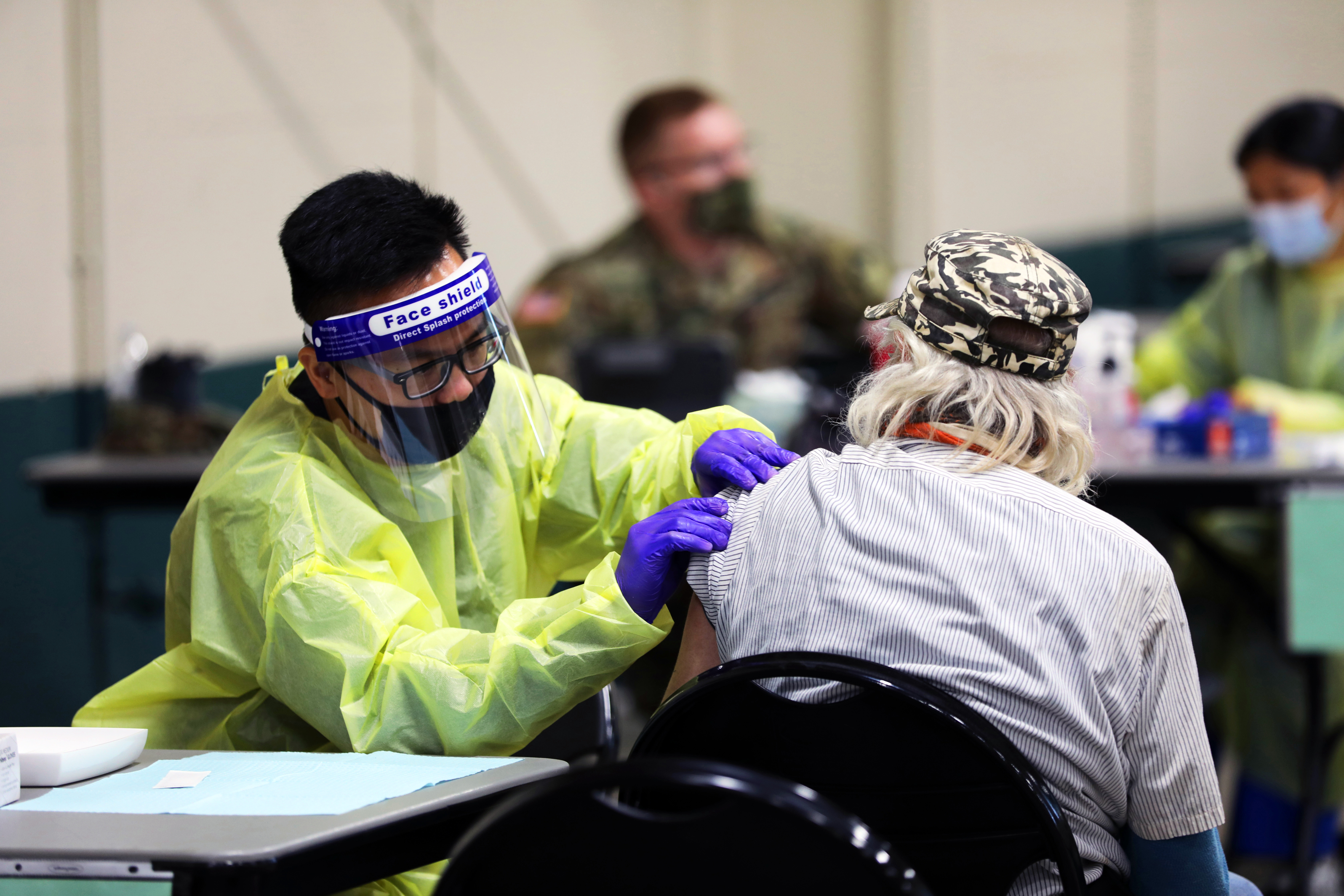
Army Spc. Corey Lee, assigned to the California National Guard’s 270th Military Police Company, Joint Task Force 115, administers the COVID-19 vaccine to a resident at the Yuba-Sutter Fairgrounds in Yuba City, Calif., March 26, 2021. The California Guard activated special collection, transportation and analysis teams to help inoculate Californians, focusing on areas where the public -- especially elderly residents -- that cannot travel long distances to receive the vaccine.

Asking for Assistance


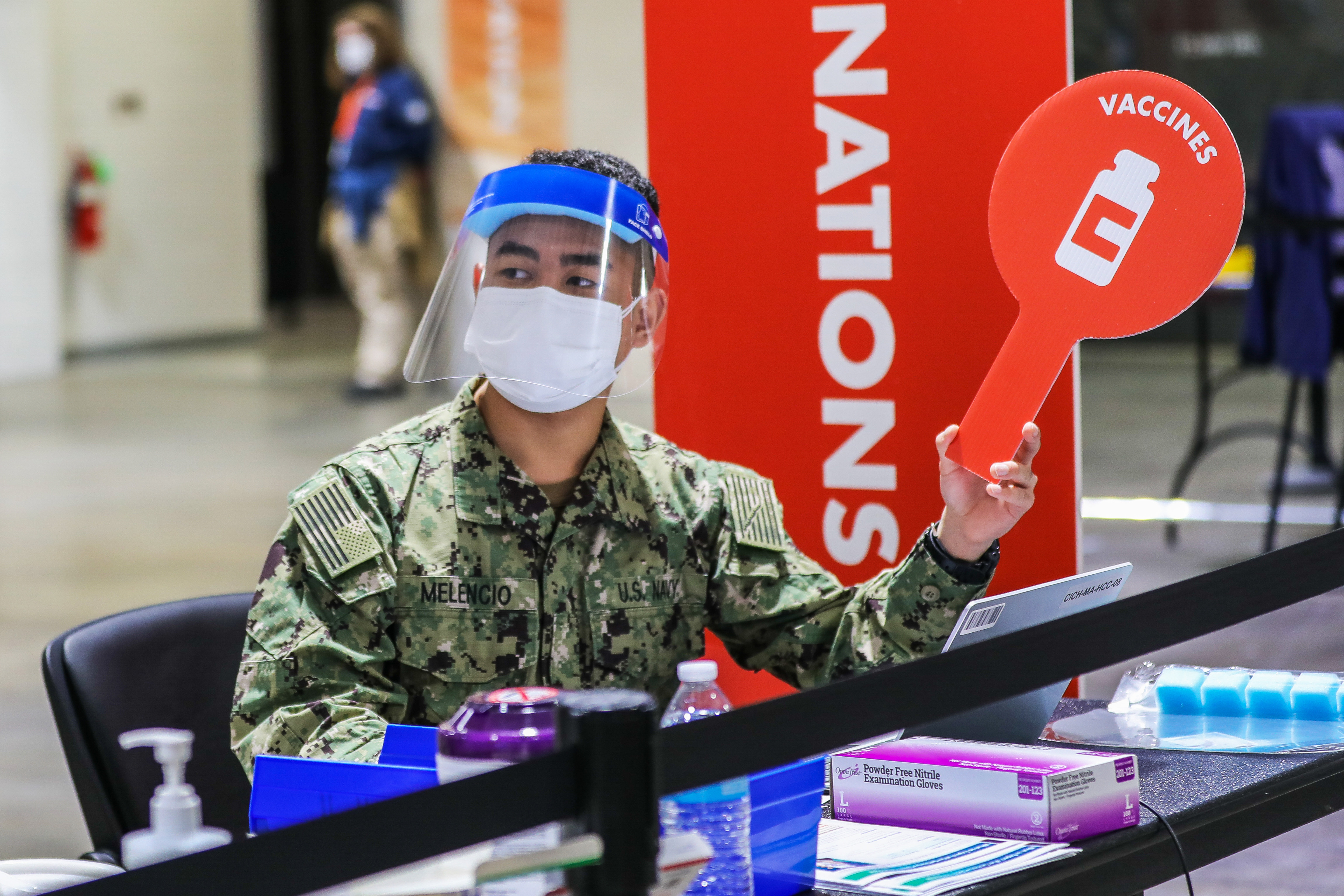
Navy Seaman Noel Melencio, assigned to the Naval Medical Center Portsmouth, Va., signals teammates for more syringes at a COVID-19 vaccine center at the Hynes Convention Center in Boston, March 31, 2021. Service members from across the country are deployed in support of the Defense Department's vaccine response efforts. U.S. Northern Command, through Army North, remains committed to providing continued, flexible DOD support to the Federal Emergency Management Agency as part of the whole-of-government response to COVID-19.

First Lady Calls Joining Forces Effort a National Security Imperative

 April 8, 2021 | BY Terri Moon Cronk , DOD News

Joining Forces, an Obama administration initiative, is being reintroduced with new priorities, First Lady Dr. Jill Biden announced April 7 in a virtual White House event.

Joining Forces supports military and veterans' families, caregivers and survivors by helping them find employment, securing child care and making sure families' well-being is addressed.

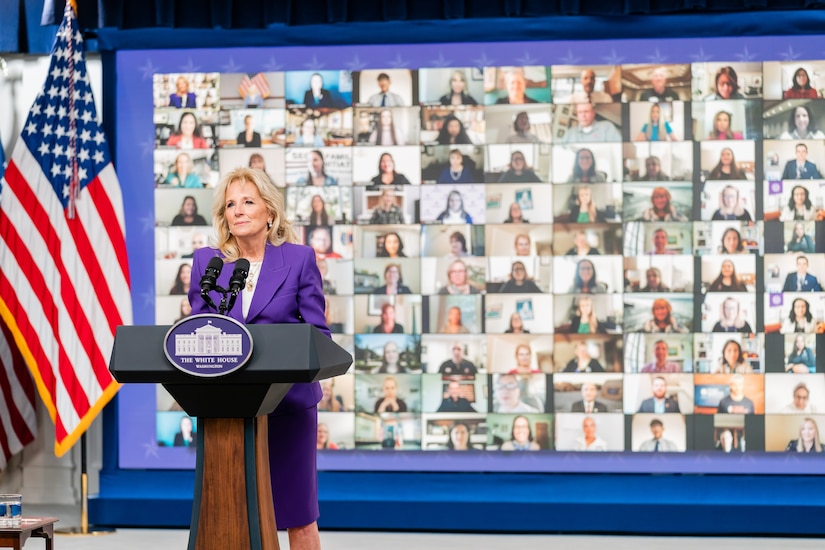
A woman in a suit stands behind a lectern with microphones. A sign on the lectern indicates that she is at The White House. A collage of monitors is behind her.

The first lady was joined by Secretary of Defense Lloyd J. Austin III's wife, Charlene Austin, and Chairman of the Joint Chiefs of Staff Army Gen. Mark. A. Milley's wife, Hollyanne Milley. Military family members, advocates and stakeholders from around the world joined the virtual event on myriad monitors as Biden outlined the new priorities for Joining Forces. 

"We're here because of you … because of the stories you have shared with me, your joys and your challenges from difficult [permanent changes in station] to the lack of child care on and off bases, for fighting to keep your own careers, and to saying goodbye to beloved schools and friends, from caring for your loved ones to mourning those who have been lost," Biden, also a military mother, said. "You are the rudder that steers our military, and supporting your physical, social and emotional health is a national security imperative."

Service members cannot focus on their mission if their families don't have what they need to thrive at home, she emphasized. The nation can't keep the best and the brightest talent in its military ranks if service members are forced to choose between their love of country and the hopes and dreams they have for their families, she said. 

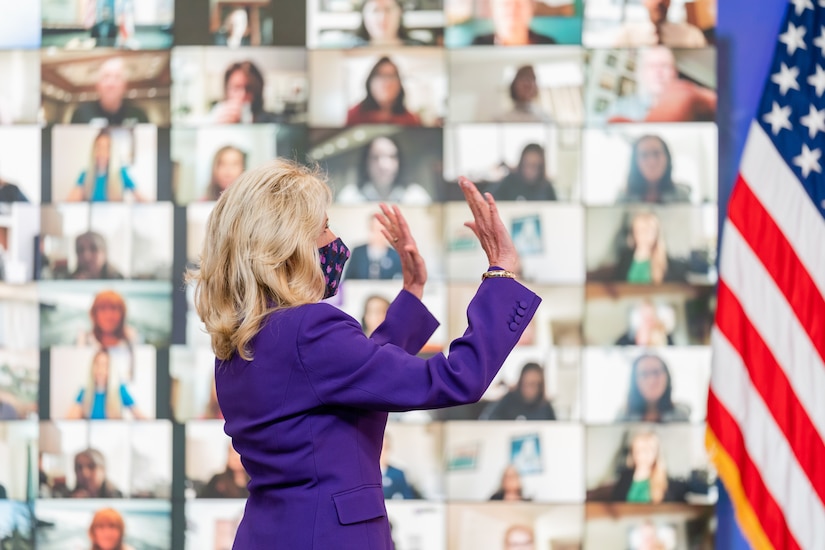
A woman in a suit, with her back to the camera, holds up both hands to the monitors that were behind her showing the faces of those virtually attending the event. An American flag is to her right.

The U.S. military, as an all-volunteer force, continues only because of generations of Americans who see the honor, dignity and patriotism of that calling, Biden said. "How can we hope to keep our military strong if we don't give our family survivors and caregivers what they need to survive if we don't act on our sacred obligation," she asked. 

That is what Joining Forces is all about, the first lady said. During the Obama-Biden administration, under the direction of then-First Lady Michelle Obama and then-Second Lady Biden, "we made a lot of progress … and now we're ready to do more," she said.

Over the next few years, Joining Forces will focus on these issues, Biden said: 

  • Military family employment and entrepreneurship. Before the pandemic, the Defense Department estimated the military spouse unemployment rate was about 22%, she said. "All of you deserve opportunities to do the work you love, whether that means keeping your job when you move from base to base, or owning your own businesses." 
  • Quality child care when families need it, so they don't have to feel like they're choosing between their job and taking care of their children. 
  • Education for military children. There are more than 2 million children whose parents are service members, National Guard reservists or veterans. Schools want to support all students, but they don't always know how to do so, she said. "We're going to work with educators and our government partners to make sure that your military-connected kids have what [they] need to succeed."
  •  Military family health and well being will also be highlighted. Because only 1% of our country has shouldered the burden of 20 years of war, no one has more strength, grit and resilience than our military families, Biden said, adding, "But you can't do this alone. We have to help you carry this weight by improving access to mental health resources, ensuring everyone can put food on the table and supporting caregiving families and survivors." 

Joining Forces has commitments from the departments of defense, labor and education, and this initiative will take all of our government working together, she noted. "We expect every agency to step up and be part of it. This is a community bound together by love, love for our country, love for your service members and love for the communities you build together. And it's time that we match that devotion," the first lady said.

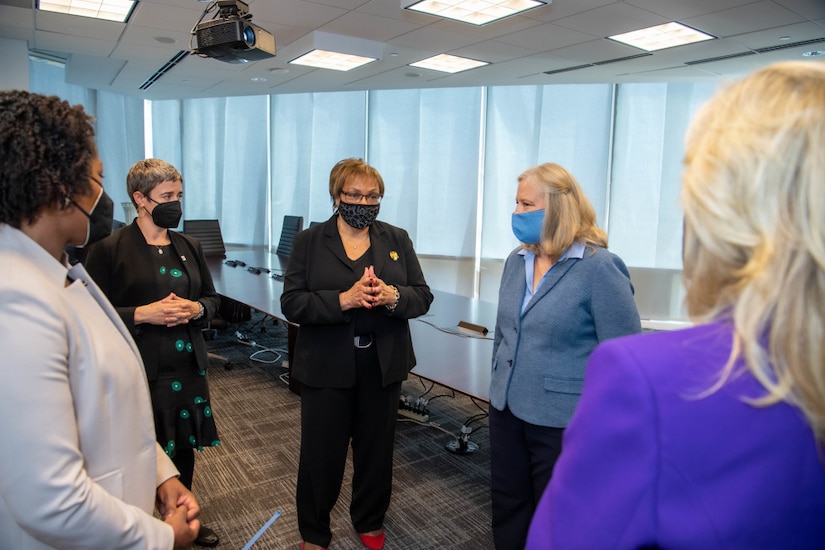
Five women stand in a semicircle visit with each other at  a military call center.

"Your commander-in-chief understands there is no greater honor than serving those who serve our country, [and for] everyone who serves, he's going to make sure that you and your community are seen," Biden said. "Our goal is this work will live on long after we leave as a permanent priority for every White House, because you deserve nothing less. So thank you for all that you do." 

Following her remarks, the first lady, joined by Austin and Milley, went to Arlington, Virginia, where they toured a Military OneSource call center, one of three in the nation. The Arlington call center also is the home of the Military OneSource website and comprises a DOD resource providing 24/7 support to service members, their families and survivors. They were met by Patricia "Patty" Montes Barron, deputy assistant secretary of defense for military community and family policy.

Arctic Fire


Marines fire a missile system during Arctic Littoral Strike in Blatind, Norway, March 29, 2021. The exercise demonstrates the Marine Corps’ ability to confront the challenges of anti-access, area denial capabilities posed by a notional peer adversary in a contested littoral environment.

Command Senior Enlisted Leader Assignment

 April 8, 2021


The Office of the Senior Enlisted Advisor to the Chairman of the Joint Chiefs of Staff (OSEAC) announced today the following assignment:

Marine Corps Sgt. Maj. Cortez L. Brown, currently assigned as sergeant major for Marine Corps Recruiting Command, Quantico, Virginia, was selected to replace Navy Command Master Chief Lucas M. Pullen as the command senior enlisted leader for Combined Maritime Forces, Bahrain.

Field Figures


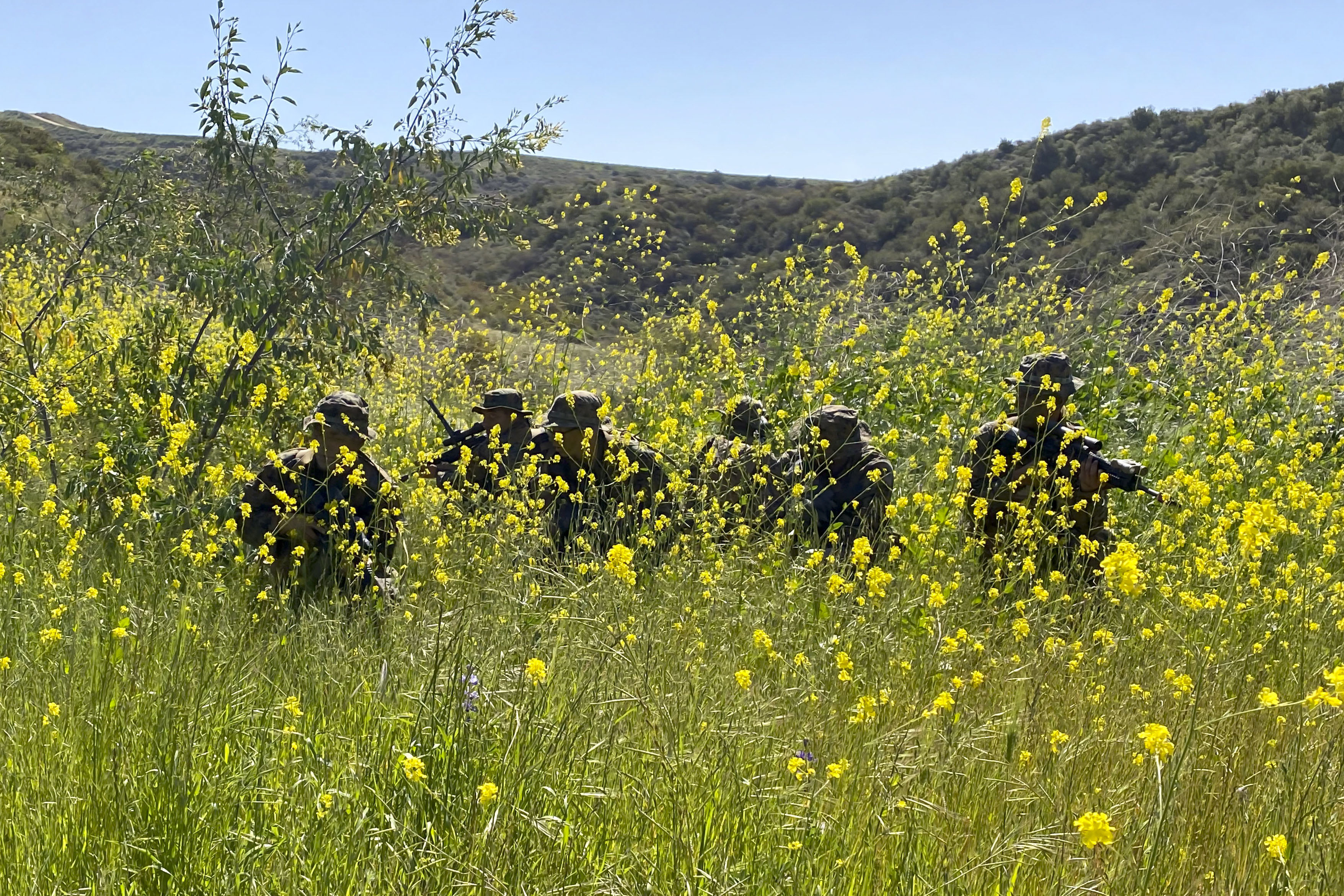
Marines participate in a patrolling session during the Infantry Marine Course at Marine Corps Base Camp Pendleton, Calif., March 31, 2021. The 14-week pilot course was designed to create better trained and more lethal entry level infantry Marines prepared for near-peer conflicts.

Fuji Flock


Air Force F-22 Raptors fly alongside an Air Force KC-135 Stratotanker during training near Mount Fuji, Japan, April 1, 2021.

Sea Scene


U.S. Navy and Malaysian air force aircraft fly above the USS Bunker Hill as it travels in the South China Sea, April 7, 2021. The guided missile cruiser is part of the Theodore Roosevelt Carrier Strike Group, which is on a scheduled deployment to the U.S. 7th Fleet area of operations.

Wednesday, April 07, 2021

Language Lesson


Navy Seaman Aeri Moon teaches a Japanese language class aboard the aircraft carrier USS Dwight D. Eisenhower in the Mediterranean Sea, April 1, 2021.

Readout of Acting Under Secretary of Defense Amanda Dory's Participation in a Multinational Roundtable on Ukraine

 April 7, 2021


Today, Acting Under Secretary of Defense for Policy Amanda Dory participated in a virtual meeting of NATO colleagues from Canada, Lithuania, Poland, and the United Kingdom, the key contributors to Ukraine security assistance. The meeting was hosted by UK Secretary of State for Defence Ben Wallace. 
 
The leaders reaffirmed their unwavering support for Ukraine’s sovereignty, territorial integrity, and Euro-Atlantic aspirations and discussed concerns about the increase in Russian military activity in the region. Russia’s destabilizing actions undermine the de-escalation in tensions achieved through the OSCE-brokered agreement on July 27, 2020.

The leaders reiterated their commitment to providing training and support to build the capacity of Ukraine’s forces to preserve the country’s territorial integrity and continue progress toward NATO interoperability.

Dignified Duty


Air Force Senior Airman Katherine Buckley practices marshaling during nighttime dignified transfer training at Dover Air Force Base, Del., March 30, 2021.

Medical Assistance


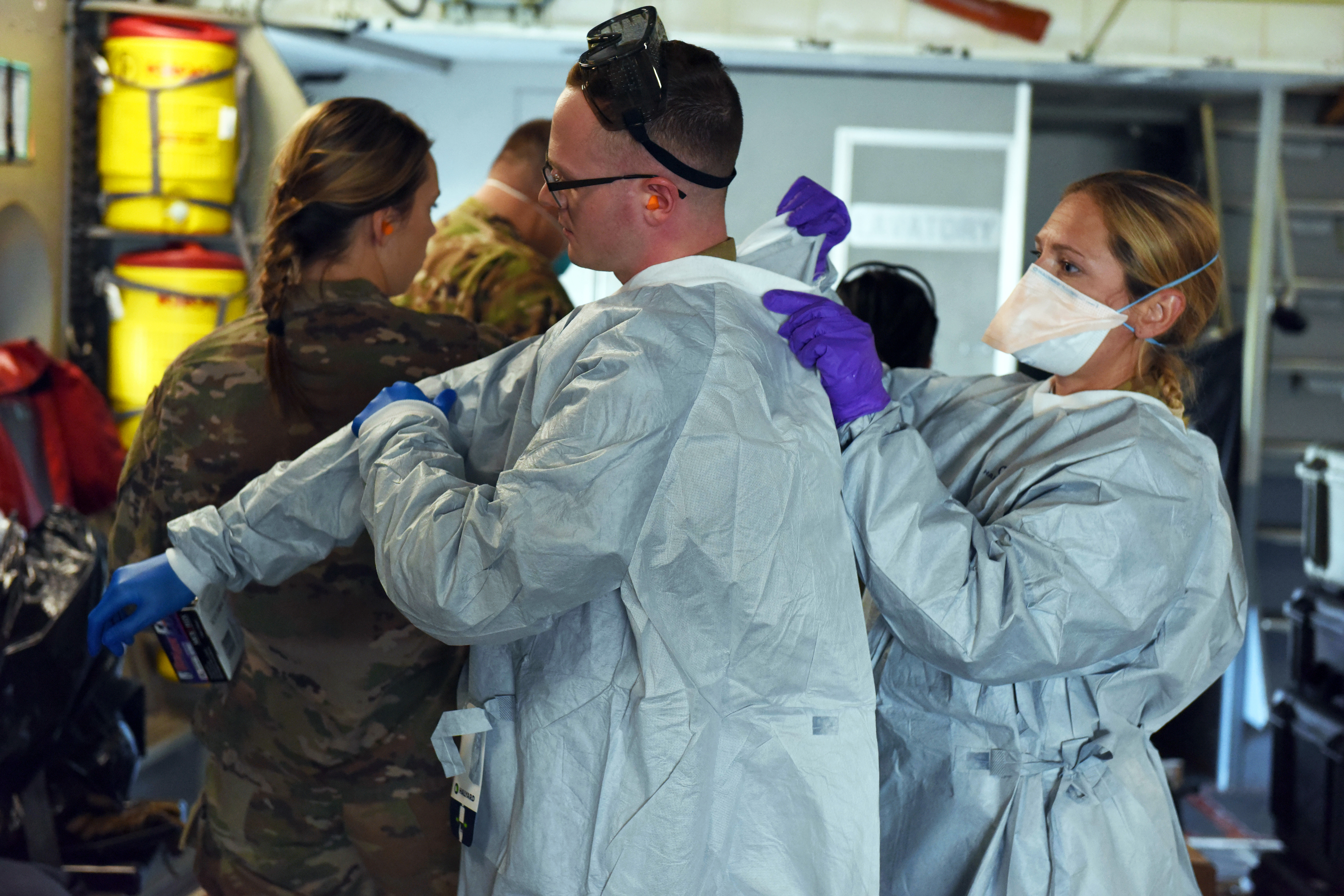
Airmen assigned to the 775th Expeditionary Aeromedical Evacuation flight from Travis Air Force Base, Calif., don personal protective equipment aboard a C-17 Globemaster III at Joint Base Lewis-McChord, Wash., March 31, 2021. Aeromedical evacuation personnel are responsible for caring for medical patients in-flight and preparing a safe environment for them as well as the aircrew.

COVID-19 Check-In


Army Spc. Jose Lopez, with the 856th Military Police Company, Arizona Army National Guard, checks-in a patient before the COVID-19 vaccination is administered on the Yavapai-Apache Nation in Camp Verde, Ariz., April 6, 2021. More than 900 Arizona National Guardsmen continue to assist at vaccination sites, testing locations and food banks throughout Arizona.

DOD Announces New Discharge Appeal Review Board Option

April 7, 2021

Today, the Department of Defense (DOD) announced a new board of appeals for Service members with separation dates on or after December 20, 2019. The Discharge Appeal Review Board (DARB) will provide final review of discharge or dismissal characterization upgrade requests when petitioners have exhausted all available administrative remedies.

Any DOD Service member separated on or after December 20, 2019, who has exhausted all available appeals with the appropriate Service Discharge Review Board (DRB) and Board for Correction of Military/Naval Records (BCM/NR), may apply to the DARB. If a current or former Service member is deceased or incapacitated, the surviving spouse, next of kin, or legal representative may apply on their behalf. The DARB is a document review board with no provision for personal appearances. Only records from the Service BCM/NR case file will be reviewed. Any petitioner wishing to present new evidence must first submit a reconsideration request to, and receive a decision from, their Service BCM/NR before that new evidence may be considered. If the DARB recommends that the petitioner’s service characterization be upgraded, this recommendation will be transmitted to the Secretary of the Military Department concerned for final action.

The DARB was created by Congress in the Fiscal Year 2020 National Defense Authorization Act, and is the final level of administrative review provided by the Department. There are no provisions for further administrative appeal or reconsideration of recommendations by the DARB, or of the Secretaries’ final action. The DOD has designated the Air Force as lead agent to execute and operate the DARB process. 

The DOD has sent information about the DARB, including guidance for members who wish to apply for reconsideration, to Veterans Service Organizations and Military Service Organizations in order to reach as many potential applicants as possible. Individuals who believe their discharge or dismissal was unjust, erroneous, or warrants an upgrade, are encouraged to apply for review. To learn more about the DARB and how to apply for review, visit the Air Force Review Board Agency Portal located at https://afrba-portal.cce.af.mil.

Jungle Journey


Soldiers participate in the Green Mile physical endurance course at the end of jungle training at Lightning Academy in Wahiawa, Hawaii, April 1, 2021.

Cargo Crew


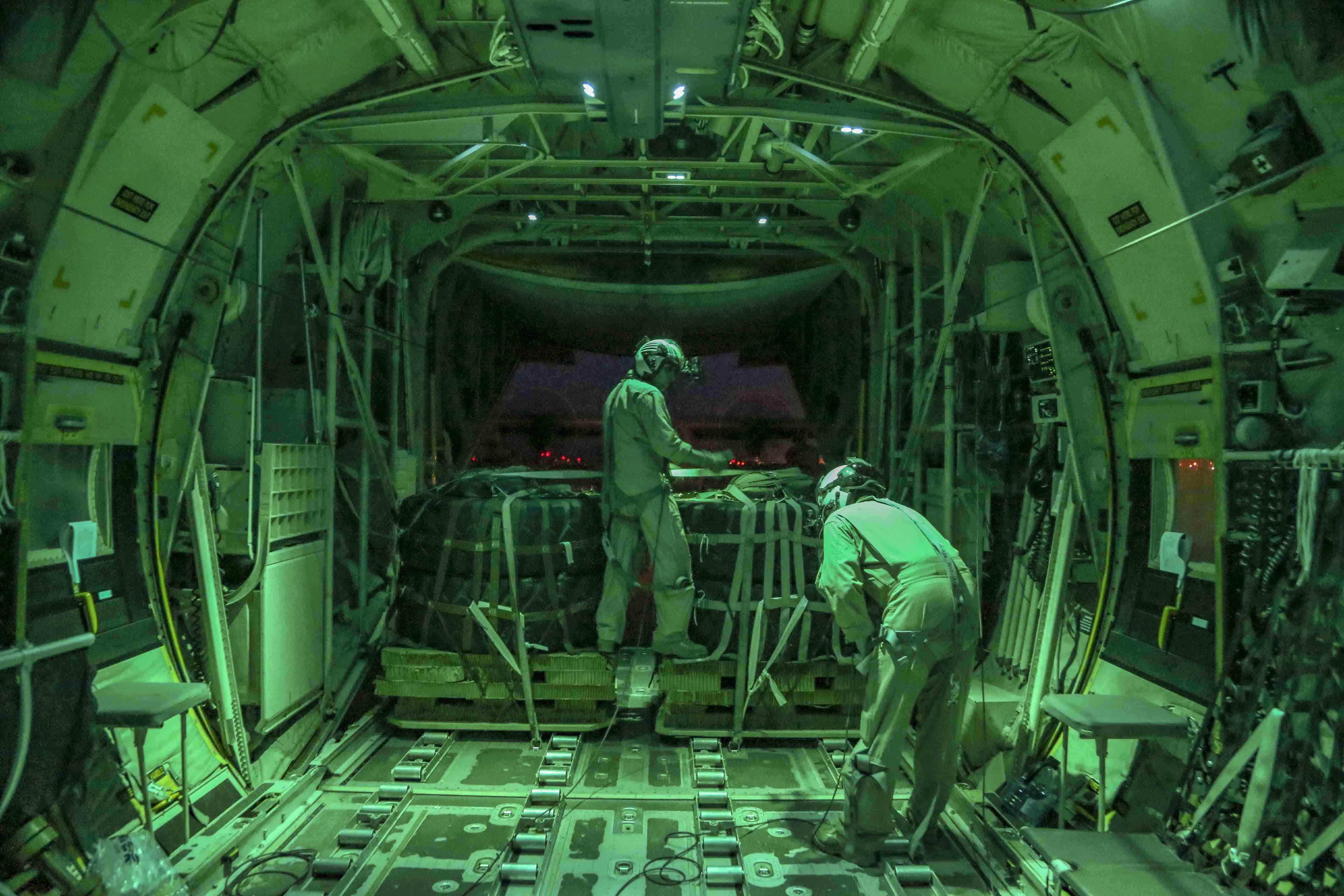
Marines prepare for takeoff during a cargo air delivery aboard a KC-130J Hercules at Libby Army Airfield in Sierra Vista, Ariz., April 3, 2021.

Fire Fight


Air Force firefighters put out a fire during a live-burn exercise at Joint Base Charleston, S.C., March 30, 2021.

Fenway Flyover


An Air Force F-35A Lightning II, a KC-46 Pegasus and an F-15 Eagle conduct a flyover during the Boston Red Sox 2021 season home opener at Fenway Park in Boston, April 2, 2021.

Ring Rotation


U.S. Air Force Academy's Frankie Valentin performs on the rings during a gymnastics competition at the academy in Colorado Springs, Colo., April 3, 2021.

Eye Exam


Air Force and Space Force Surgeon General Lt. Gen. Dorothy Hogg receives an eye exam from Air Force Reserve Maj. Leslie Wilderson at Joint Base Anacostia-Bolling, Washington, D.C., March 26, 2021.

River Rope


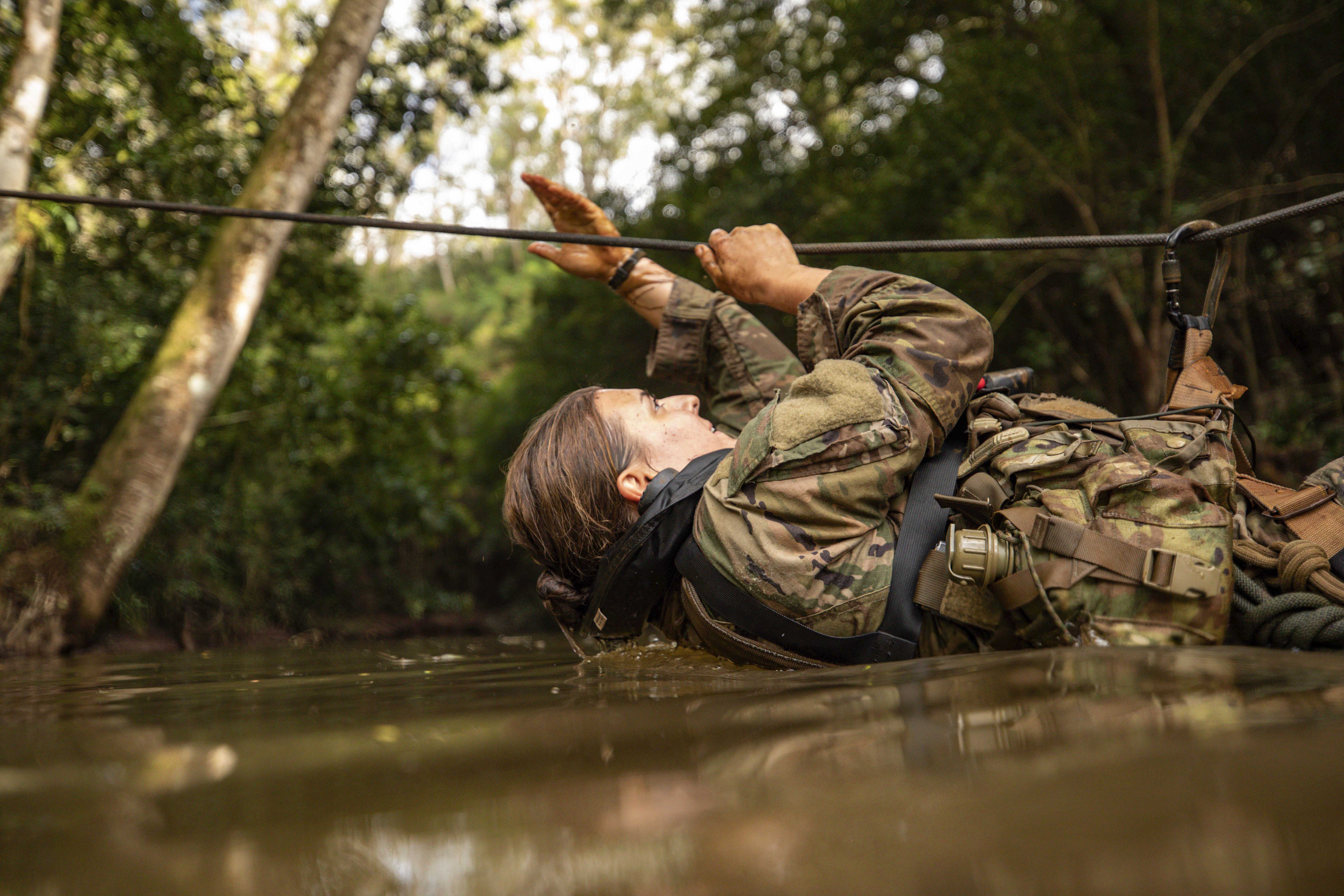
Army 1st Lt. Brianne Hanley Division crosses a river on a one-rope bridge during jungle operations training at East Range, Hawaii, March 27, 2021.

Live Fire


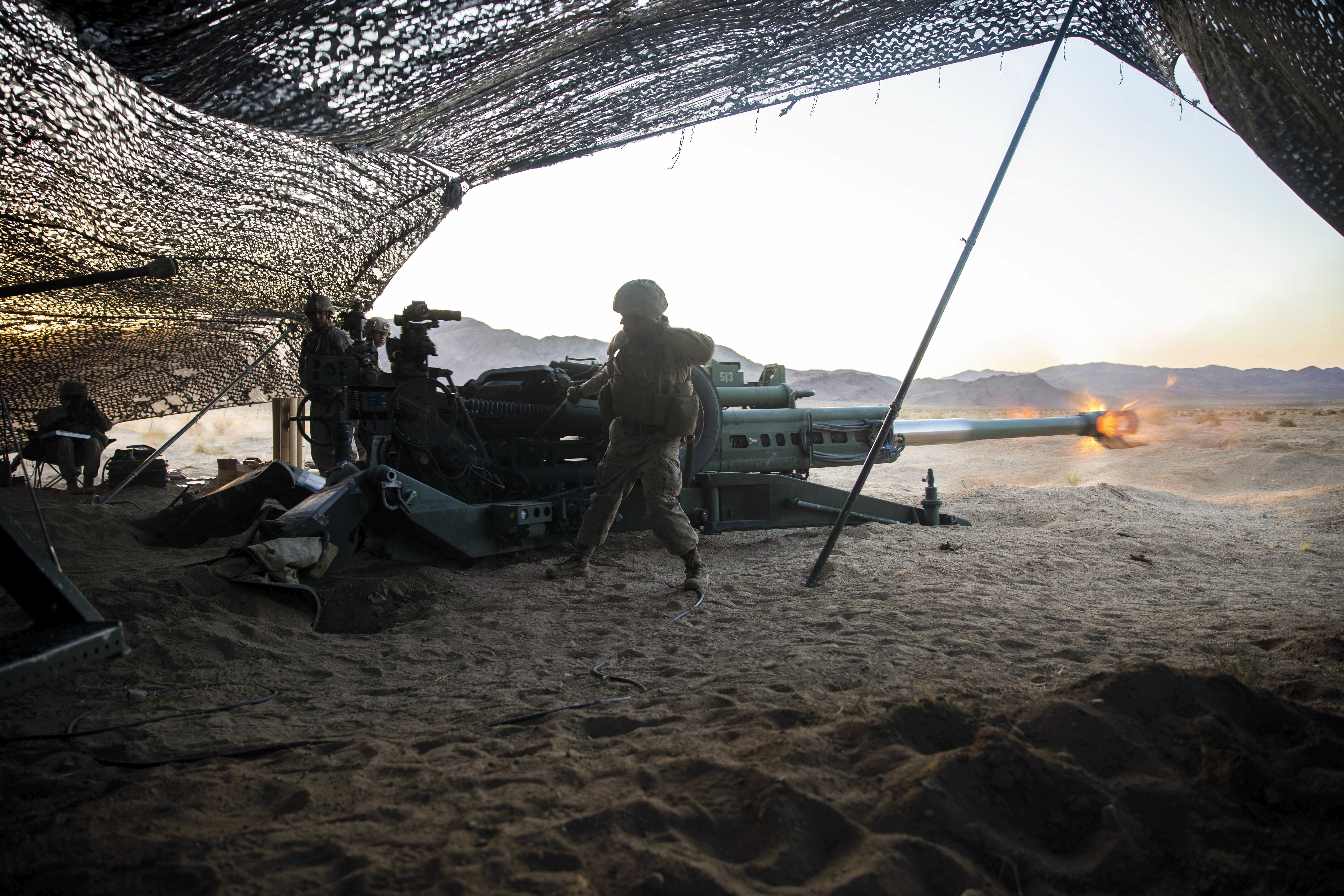
Marine Corps Cpl. Manuel Bautista fires an M777 howitzer during live-fire training at Marine Corps Air Ground Combat Center in Twentynine Palms, Calif., March 30, 2021.

Refuel Ready


Marines unravel a fuel hose during joint refueling training at Marine Corps Air Station Iwakuni, Japan, April 1, 2021.

Grateful Recipient


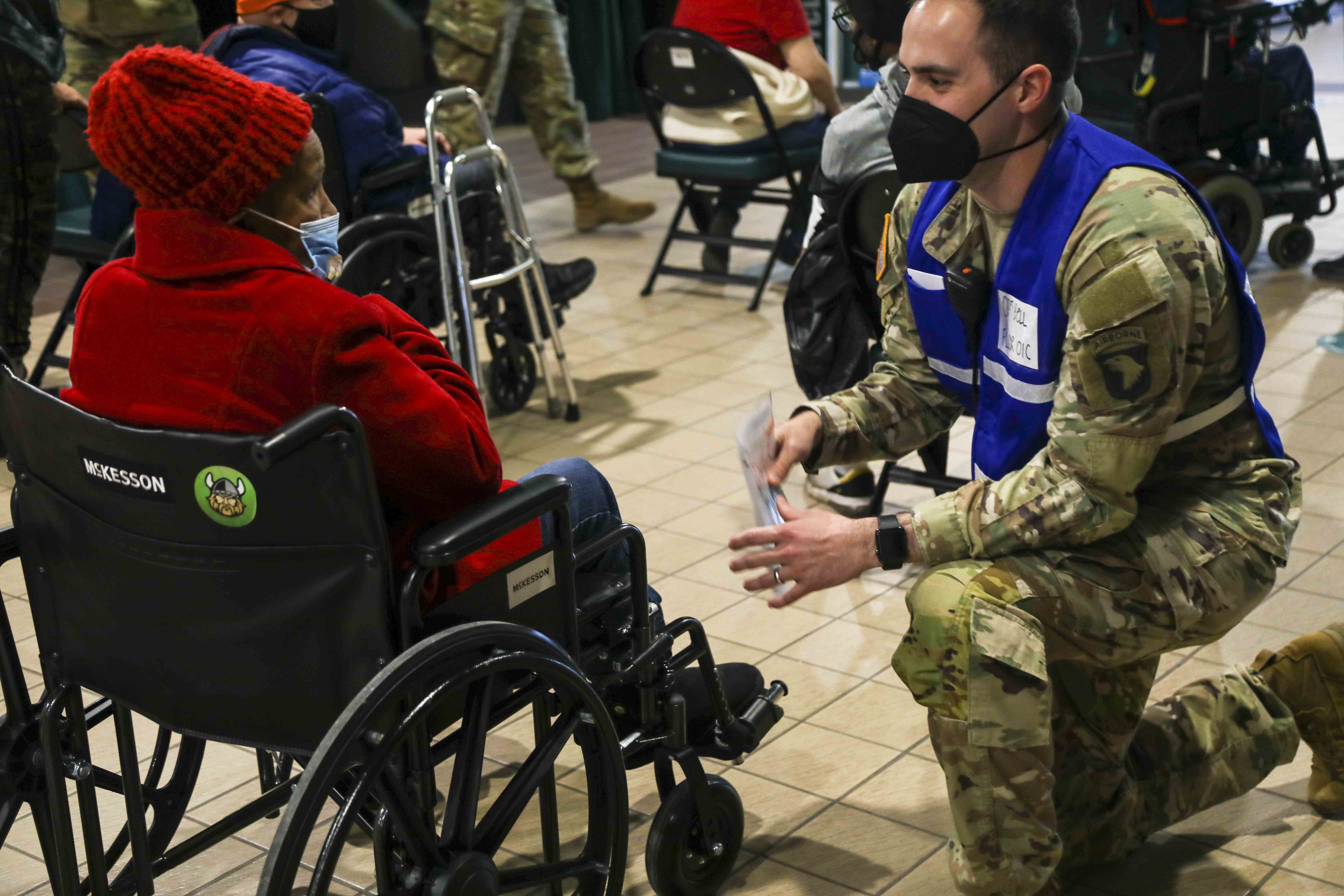
Army Capt. Jacob Bell talks to Ruby Davis at the Wolstein Community Vaccination Center in Cleveland, April 2, 2021. Davis was the 100,000th person to receive a COVID-19 vaccination at the center.

Musical March


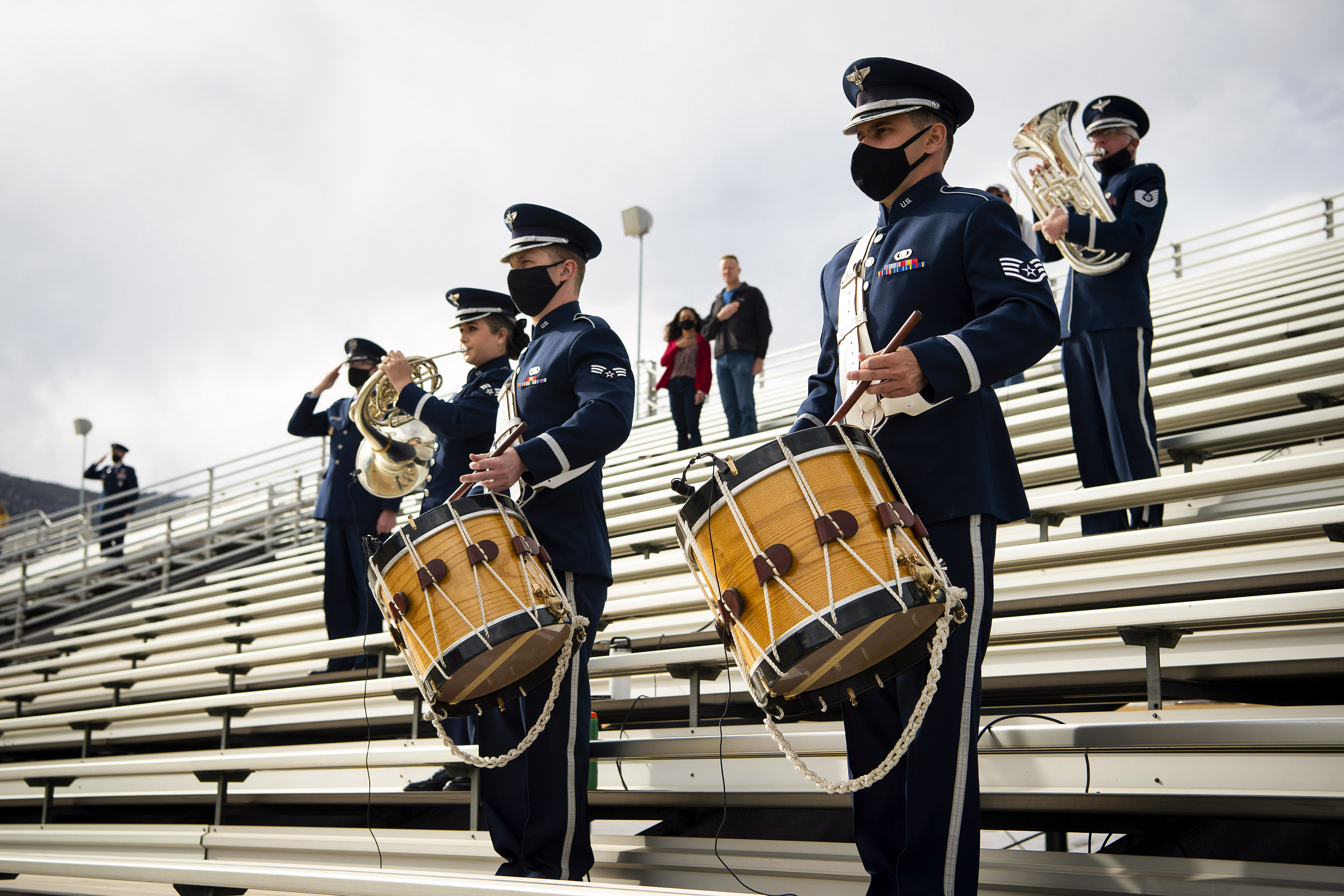
The U.S. Air Force Academy Band performs at Stillman Field in Colorado Springs, Colo., April 2, 2021.

Corps Course


A Marine Corps KC-130J Hercules flies during a weapons and tactics instructor course near Yuma, Ariz., April 3, 2021.

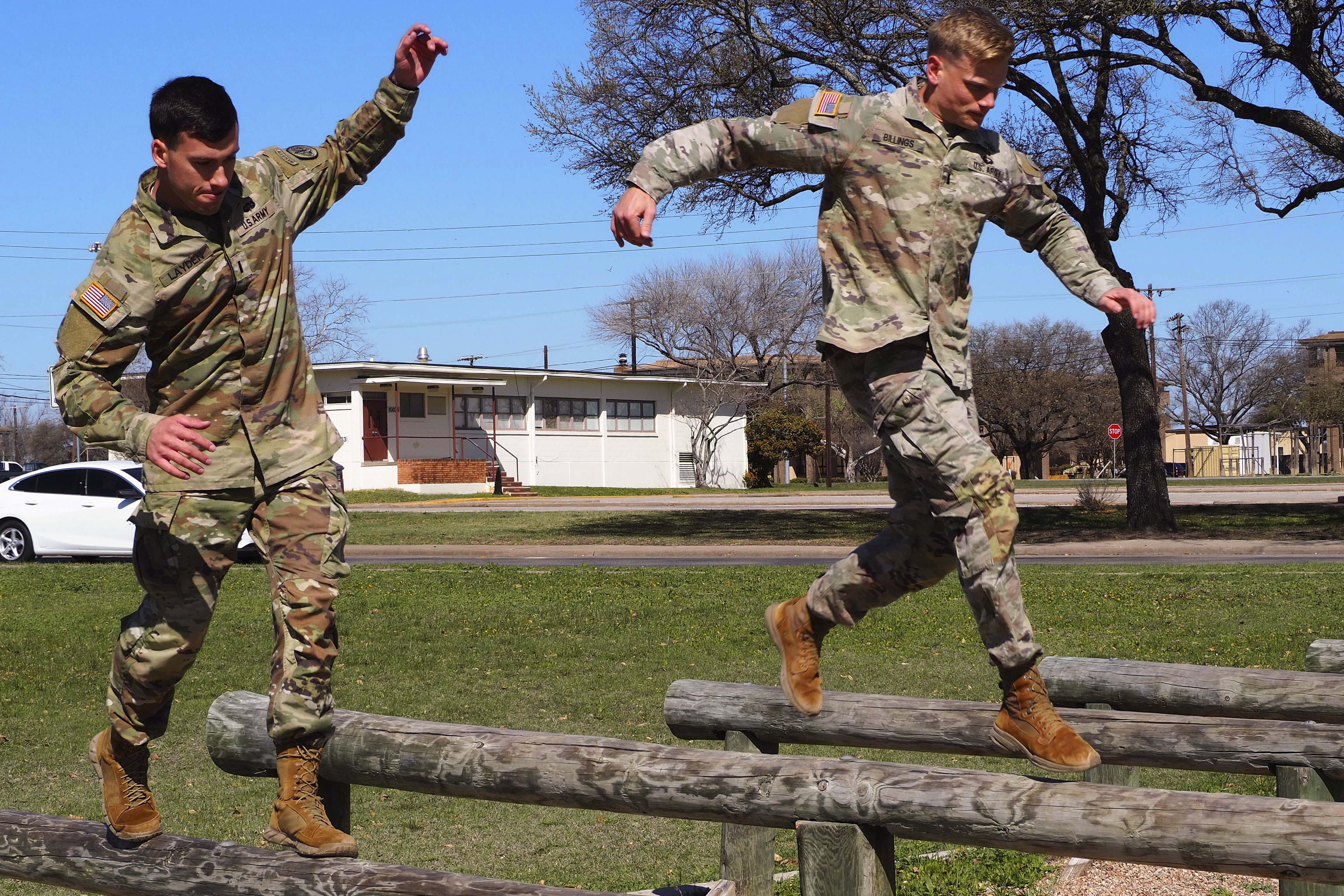
Log Lanes


Air Force 1st Lts. Nick Layden and Brian Billings train on an obstacle course for a competition at Fort Hood, Texas, April 5, 2021.

See the Sea


Sailors prepare for flight operations on the flight deck of the USS Theodore Roosevelt in the South China Sea, April 6, 2021.

General Officer Assignments

 April 7, 2021


The secretary of the Air Force announces the following general officer assignments:

Maj. Gen. Michele C. Edmondson will be assigned as commander, 2d Air Force, Air Education and Training Command, Keesler Air Force Base, Mississippi. Edmondson is currently serving as commandant of cadets, U.S. Air Force Academy, Colorado. 

Maj. Gen. Kenneth P. Ekman will be assigned as the director, plans and programs, J-5, Headquarters U.S. Africa Command, Stuttgart, Germany. Ekman is currently assigned as deputy commander, operations and intelligence, Combined Joint Task Force-Operation Inherent Resolve, U.S. Central Command; and commander, 9th Air Expeditionary Task Force-Levant, Air Combat Command, Southwest Asia.

Maj. Gen. Andrew J. Gebara will be assigned as the commander, Eighth Air Force; and commander, Joint-Global Strike Operations Center, Air Force Global Strike Command, Barksdale Air Force Base, Louisiana. Gebara is currently assigned as director, strategic plans, programs and requirements, Headquarters Air Force Global Strike Command, Barksdale Air Force Base, Louisiana. 

Maj. Gen. Jeannie M. Leavitt will be assigned as chief of safety and commander, Air Force Safety Center, Headquarters U.S. Air Force, The Pentagon, Washington, D.C. Leavitt is currently serving as director, operations and communications, Headquarters Air Education and Training Command, Joint Base San Antonio-Randolph, Texas. 

Maj. Gen. Aaron M. Prupas will be assigned as director of defense intelligence for warfighter support, Office of the Under Secretary of Defense for Intelligence, The Pentagon, Washington, D.C. Prupas is currently serving as director, intelligence and information, J-2, North American Aerospace Defense Command and U.S. Northern Command, Peterson Air Force Base, Colorado. 

Maj. Gen. Andrea D. Tullos will be assigned as deputy commander, Headquarters Air Education and Training Command, Joint Base San Antonio-Randolph, Texas. Tullos is currently serving as commander, Second Air Force, Air Education and Training Command, Keesler Air Force Base, Mississippi. 

Maj. Gen. (select) Michael L. Downs will be assigned as deputy director, intelligence, surveillance and reconnaissance operations; and director, Joint Intelligence, Surveillance and Reconnaissance Operations Center, J-32, Joint Staff, The Pentagon, Washington, D.C. Downs is currently serving as vice director, intelligence, J-2, Joint Staff, The Pentagon, Washington, D.C. 

Maj. Gen. (select) Thomas K. Hensley will be assigned as deputy director, operations, National Security Agency, Fort George Meade, Maryland. Hensley is currently serving as director, J-2, Headquarters U.S. European Command, Combined, Stuttgart-Vaihingen, Germany.

Maj. Gen. (select) Michael E. Martin will be assigned as commanding general, Special Operations Command Korea, U.S. Special Operations Command, Camp Kim, Yongsan Garrison, South Korea. Martin is currently serving as director, operations, Headquarters Air Force Special Operations Command, Hurlburt Field, Florida.

Maj. Gen. (select) Clark J. Quinn will be assigned as assistant deputy commander, U.S. Air Forces Central Command; and assistant vice commander, 9th Air Expeditionary Task Force, Air Combat Command, Shaw Air Force Base, South Carolina. Quinn is currently serving as deputy director, plans and policy, DJ5, Headquarters U.S. Central Command, MacDill Air Force Base, Florida. 

Maj. Gen. (select) Daniel H. Tulley will be assigned as vice director, joint force development, Joint Staff, The Pentagon, Washington, D.C. Tulley is currently serving as commander, 379th Air Expeditionary Wing, U.S. Air Forces Central Command, Air Combat Command, Al Udeid Air Base, Qatar.

Brig. Gen. David W. Abba will be assigned as director, Department of Defense Special Access Programs Central Office; and director, Special Programs, Office of the Under Secretary of Defense for Acquisition and Sustainment, The Pentagon, Washington, D.C. Abba is currently serving as director, F-35 Integration Office, Office of the Vice Chief of Staff of the Air Force, Headquarters U.S. Air Force, The Pentagon, Washington, D.C. 

Brig. Gen. Christopher R. Amrhein will be assigned as vice commander, 19th Air Force, Air Education and Training Command, Joint Base San Antonio-Randolph, Texas. Amrhein is currently serving as inspector general, Headquarters Air Mobility Command, Scott Air Force Base, Illinois. 

Brig. Gen. Jason R. Armagost will be assigned as director, strategic plans, programs and requirements, Headquarters Air Force Global Strike Command, Barksdale Air Force Base, Louisiana. Armagost is currently serving as director,  operations and communications, Headquarters Air Force Global Strike Command, Barksdale Air Force Base, Louisiana.

Brig. Gen. Charles D. Bolton will be assigned as chief, Global Operations Center, Headquarters U.S. Transportation Command, Scott Air Force Base, Illinois. Bolton is currently serving as deputy director, operations, strategic deterrence and nuclear integration, Headquarters Air Mobility Command, Scott Air Force Base, Illinois. 

Brig. Gen. Julian C. Cheater will be assigned as commander, NATO Air Command-Afghanistan; deputy commander, air, U.S. Forces-Afghanistan; commander, 9th Air and Space Expeditionary Task Force-Afghanistan; and director, Air Forces Central Command Air Component Coordination Element for U.S. Forces-Afghanistan, Kabul, Afghanistan. Cheater is currently serving as deputy director, intelligence, surveillance and reconnaissance operations; and director, Joint Intelligence, Surveillance and Reconnaissance Operations Center, J-32, Joint Staff, The Pentagon, Washington, D.C. 

Brig. Gen. Brenda P. Cartier will be assigned as director, operations and communications, Headquarters Air Education and Training Command, Joint Base San Antonio-Randolph, Texas. Cartier is currently serving as vice commander, 19th Air Force, Air Education and Training Command, Joint Base San Antonio-Randolph, Texas.

Brig. Gen. Matthew W. Davidson will be assigned as director, operations, Headquarters Air Force Special Operations Command, Hurlburt Field, Florida. Davidson is currently serving as deputy commander, Special Operations Joint Task Force-Afghanistan, U.S. Central Command, Bagram Air Field, Afghanistan. 

Brig. Gen. Eric P. Delange will be assigned as director, cyberspace operations, Headquarters North American Aerospace Defense Command and U.S. Northern Command, Peterson Air Force Base, Colorado. Delange is currently serving as director, cyberspace operations, Deputy Chief of Staff, Intelligence, Surveillance, Reconnaissance, and Cyber Effects Operations, Headquarters U.S. Air Force, The Pentagon, Washington, D.C.

Brig. Gen. Russell D. Driggers will be assigned as director, air, space and cyberspace operations, Headquarters Air Force Materiel Command, Wright-Patterson Air Force Base, Ohio. Driggers is currently serving as deputy commander, NATO Mission Iraq, U.S. Central Command, Baghdad, Iraq. 

Brig. Gen. Jeffrey H. Hurlbert will be assigned as commandant, National War College, National Defense University, Fort Lesley J. McNair, Washington, D.C.  Hurlbert is currently serving as deputy inspector general of the Air Force, Office of the Secretary of the Air Force, The Pentagon, Washington, D.C. 

Brig. Gen. John M. Klein Jr. will be assigned as chief of staff, Headquarters Air Mobility Command, Scott Air Force Base, Illinois. Klein is currently serving as director, Central Command Deployment and Distribution Operations Center, U.S. Central Command, Camp Arifjan, Kuwait. 

Brig. Gen. Laura L. Lenderman will be assigned as director, operations, strategic deterrence, and nuclear integration, Headquarters Air Mobility Command, Scott Air Force Base, Illinois. Lenderman is currently serving as director, plans, programs, and requirements, Headquarters Air Education and Training Command, Joint Base San Antonio-Randolph, Texas. 

Brig. Gen. Joseph D. McFall will be assigned as senior military advisor to the assistant secretary of state for political-military affairs, Department of State, Washington, D.C. McFall is currently serving as assistant deputy commander, U.S. Air Forces Central Command; and assistant vice commander, 9th Air Expeditionary Task Force, Air Combat Command, Shaw Air Force Base, South Carolina. 

Brig. Gen. Albert G. Miller will be assigned as director, training and readiness, Deputy Chief of Staff, Operations, Headquarters U.S. Air Force, The Pentagon, Washington, D.C. Miller is currently serving as chief of staff, Headquarters Air Mobility Command, Scott Air Force Base, Illinois. 

Brig. Gen. David A. Mineau will be assigned as vice commander, Fifteenth Air Force, Air Combat Command, Shaw Air Force Base, South Carolina. Mineau is currently serving as director, current operations, Deputy Chief of Staff, Operations, Headquarters U.S. Air Force, The Pentagon, Washington, D.C. 

Brig. Gen. Paul D. Moga will be assigned as commandant of cadets, U.S. Air Force Academy, Colorado. Moga is currently serving as deputy director of operations, U.S. Northern Command, Headquarters North American Aerospace Defense and U.S. Northern Command, Peterson Air Force Base, Colorado. 

Brig. Gen. Paul J. Murray will be assigned as deputy director of operations, J-3, Headquarters North American Aerospace Defense Command, Peterson Air Force Base, Colorado. Murray is currently serving as inspector general, Headquarters Air Combat Command, Joint Base Langley-Eustis, Virginia. 

Brig. Gen. Derek J. O’Malley will be assigned as deputy commander, Canadian North American Aerospace Defense Region; and deputy Combined/Joint Force Air Component commander for the 1st Canadian Air Division, North American Aerospace Defense Command, Winnipeg, Manitoba, Canada. O’Malley is currently serving as commander, 455th Air Expeditionary Wing, U.S. Air Forces Central Command, Bagram Airfield, Afghanistan. 

Brig. Gen. Evan L. Pettus will be assigned as vice commander, U.S. Air Force Warfare Center, Air Combat Command, Nellis Air Force Base, Nevada. Pettus is currently serving as commander, 378th Air Expeditionary Wing, Air Combat Command, Prince Sultan Air Base, Kingdom of Saudi Arabia. 

Brig. Gen. Neil R. Richardson will be assigned as deputy director, operations, strategic deterrence, and nuclear integration, Headquarters Air Mobility Command, Scott Air Force Base, Illinois. Richardson is currently serving as chief, Air Force Senate Liaison Office, Office of the Secretary of the Air Force, Headquarters U.S. Air Force, The Pentagon, Washington, D.C. 

Brig. Gen. Jennifer M. Short will be assigned as deputy director, strategic planning and policy, J-5, U.S. Indo-Pacific Command, Camp H.M. Smith, Hawaii. Short is currently serving as chief of staff, Pacific Air Forces, Headquarters Pacific Air Forces, Joint Base Pearl Harbor-Hickam, Hawaii.

Brig. Gen. Ernest J. Teichert III will be assigned as assistant deputy to the under secretary of the Air Force for international affairs, Office of the Undersecretary of the Air Force, Headquarters U.S. Air Force, The Pentagon, Washington, D.C. Teichert is currently serving as senior defense official and defense attaché-Iraq, U.S. Embassy, Baghdad, Iraq. 

Brig. Gen. Claude K. Tudor Jr. will be assigned as chief of staff, Pacific Air Forces, Headquarters Pacific Air Forces, Joint Base Pearl Harbor-Hickam, Hawaii. Tudor is currently serving as director, Integrated Resilience Office, Deputy Chief of Staff for Manpower, Personnel and Services, Headquarters U.S. Air Force, The Pentagon, Washington, D.C. 

Brig. Gen. Parker H. Wright will be assigned as director, intelligence and information, J-2, North American Aerospace Defense Command and U.S. Northern Command, Peterson Air Force Base, Colorado. Wright is currently serving as director, intelligence, surveillance, and reconnaissance operations, Deputy Chief of Staff for Intelligence, Surveillance, Reconnaissance, and Cyber Effects Operations, Headquarters U.S. Air Force, The Pentagon, Washington, D.C. 

Brig. Gen. (select) Tad D. Clark will be assigned as director, electromagnetic spectrum superiority, Deputy Chief of Staff, Strategy, Integration, and Requirements, Headquarters U.S. Air Force, The Pentagon, Washington, D.C. Clark is currently serving as senior executive officer to the vice chief of staff, U.S. Air Force, Headquarters U.S. Air Force, The Pentagon, Washington, D.C. 

Brig. Gen. (select) George T.M. Dietrich III will be assigned as director, logistics, engineering and force protection, Headquarters U.S. Air Forces Europe and Air Forces Africa, Ramstein Air Base, Germany. Dietrich is currently serving as deputy director, resource integration, Deputy Chief of Staff for Logistics, Engineering and Force Protection, Headquarters U.S. Air Force, The Pentagon, Washington, D.C. 

Brig. Gen. (select) Melissa S. Cunningham will be assigned as director, cyberspace operations, Deputy Chief of Staff, Intelligence, Surveillance, Reconnaissance, and Cyber Effects Operations, Headquarters U.S. Air Force, The Pentagon, Washington, D.C. Cunningham is currently serving as chief, Cyberspace Operations Branch, Joint Staff, The Pentagon, Washington, D.C. 

Brig. Gen. (select) Brian S. Hartless will be assigned as deputy director, resource integration, Deputy Chief of Staff, Logistics, Engineering, and Force Protection, Headquarters U.S. Air Force, The Pentagon, Washington, D.C. Hartless is currently serving as commander, 10th Air Base Wing, U.S. Air Force Academy, Colorado. 

Brig. Gen. (select) Debra A. Lovette will be assigned as director, Integrated Resilience Office, Deputy Chief of Staff for Manpower, Personnel and Services, Headquarters U.S. Air Force, The Pentagon, Washington, D.C. Lovette is currently serving as director, Executive Action Group, Office of the Chief of Staff of the Air Force, The Pentagon, Washington, D.C. 

Brig. Gen. (select) Robert A. Masaitis will be assigned as chief innovation officer and deputy director, integration and innovation, Deputy Chief of Staff, Strategy, Integration and Requirements, Headquarters U.S. Air Force, The Pentagon, Washington, D.C. Masaitis is currently serving as commander, 27th Special Operations Wing, Air Force Special Operations Command, Cannon Air Force Base, New Mexico.

Brig. Gen. (select) Michael A. Miller will be assigned as director, operations and communications, Headquarters Air Force Global Strike Command, Barksdale Air Force Base, Louisiana. Miller is currently serving as chief of staff, Headquarters Air Force Global Strike Command, Barksdale Air Force Base, Louisiana. 

Brig. Gen. (select) Max E. Pearson will be assigned as director, intelligence, surveillance, and reconnaissance operations, Deputy Chief of Staff, Intelligence, Surveillance, Reconnaissance and Cyber Effects Operations, The Pentagon, Washington, D.C. Pearson is currently serving as senior military assistant to the under secretary of defense for intelligence, Office of the Secretary of Defense, The Pentagon, Washington, D.C.