Thursday, March 18, 2021

SEAC: DOD Will 'Move Fast' Against Extremism After Completion of Stand Downs

 March 18, 2021 | BY C. Todd Lopez , DOD News

The services have just two weeks left to complete a military-wide stand down to conduct training on and discussion of extremism in the ranks with every service member, a task assigned in early February by Secretary of Defense Lloyd J. Austin III.

On April 1, the services must collect data from subordinate commands and provide notification to senior Defense Department leadership about having completed the training for every service member, and any feedback they received during the training stand-downs — information the department will use in finding better ways to educate the forces about extremism in the ranks and root it out, Senior Enlisted Advisor to the Chairman Ramón "CZ" Colón-López, the senior enlisted advisor to the chairman of the Joint Chiefs of Staff, said.

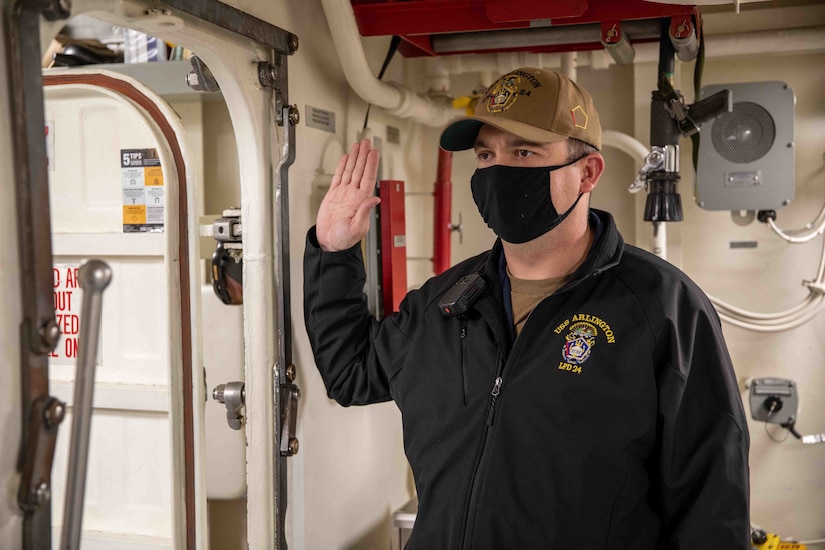
A man in military uniform stands upright and holds his right hand in the air.

"I will tell you that we are wanting to move fast on all these initiatives because we're dealing with people, and we just need to make sure that we provide the results that they need to have an environment that is worthy of serving," Colón-López said during a press briefing today, adding that extremism is not going to be tolerated. "We're committed to confronting and rooting out extremism in the military."

The initial training is just the beginning, Colón-López said. In the future, there will be more training and that follow-on-training will be developed and revised based on feedback from the services.

"Training may actually evolve into something else that we need to go ahead and give [to] specific people, like first sergeants as an example, [who] are the ones that are gauging the behavior of units," Colón-López said. "I foresee that there will be some changes coming based on what we learn from people."

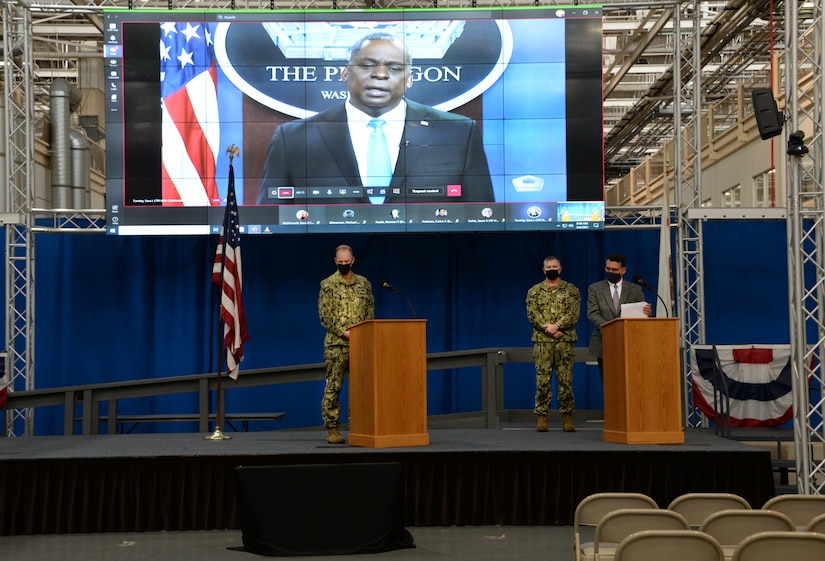
Two military personnel and a man in civilian clothes stand behind lecterns on a stage. In the rear, a large display screen shows a video that features the secretary of defense speaking from the Pentagon..

Something else, he said, is that the military services must collaborate on how to set policy regarding extremism and the training on extremism as well, so that it's relatively uniform across the services, because the future wars we fight are going to be joint. For that to happen, there must be uniformity across all services in how things like extremism are addressed.

"We see that we need to collaborate a lot more," he said. "Nothing that we do is unilateral by service. Everything that we do is likely to be joint. And if you have a commander that's in charge of different people ... then I cannot be applying different rules for [one or the other] ... we need to have a common understanding. And that is the direction that the military needs to go."

Military leaders have speculated that the number of extremists in the ranks is not high, though concrete numbers are not yet available. Colón-López said that right now, what's important is that those who are in the ranks know the military is seeking them out and will put an end to extremism.

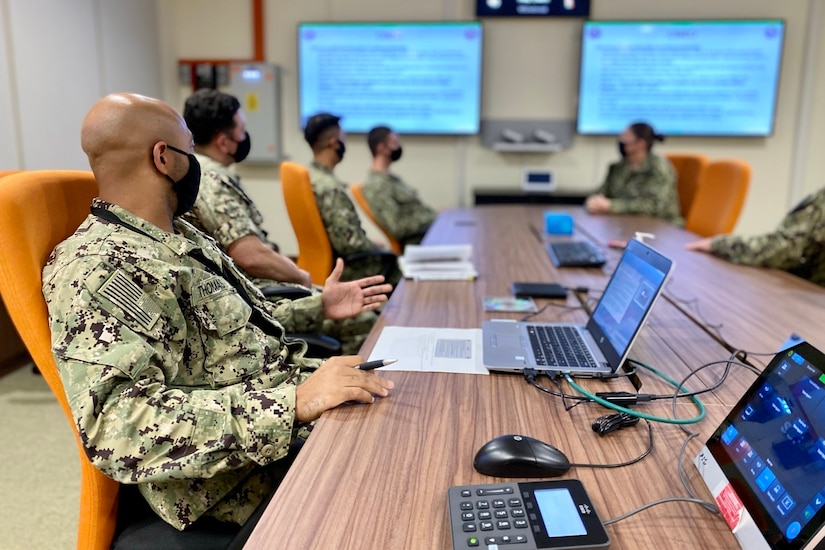
Multiple military personnel sit at a long table.

"What is most important to me right now is the prevention of that behavior," he said. "Because even if they exist right now, if they know that the department and the institution is looking for that behavior, and wanting to crush it, then they will think twice about performing those acts. This is all about prevention. We don't want people to commit criminal activities. ... The key point here is that we need to make sure that we let our personnel right now, past and present, know that we do not tolerate that behavior, and that we're going to educate our people to know right from wrong."

Patient Information


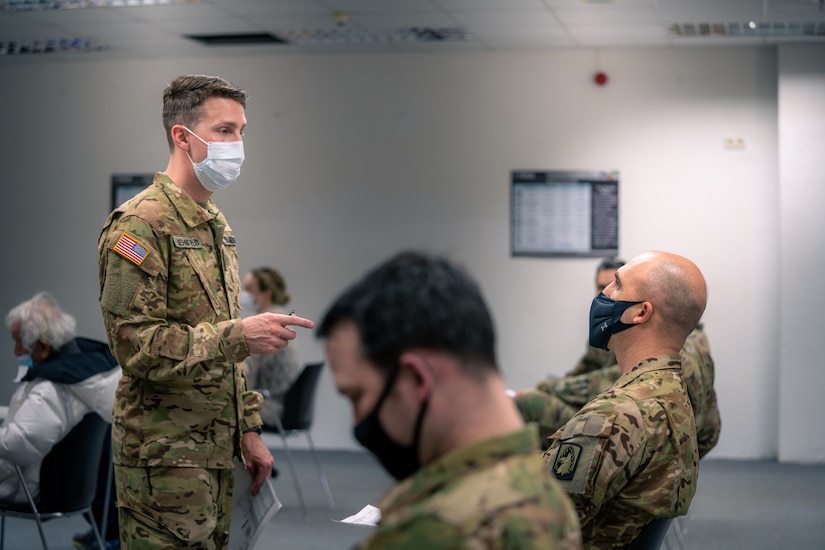
Army Spc. Michael Renteria, an automated logistical specialist assigned to California National Guard's Alpha Company 3-140th Security and Support Aviation Battalion, takes down a patient’s information before they receive the Moderna COVID-19 vaccine at the Long Beach Convention and Entertainment Center in Long Beach, Calif., March 16, 2021. Nearly 70 service members with the California National Guard have been working at the site supporting the city of Long Beach.

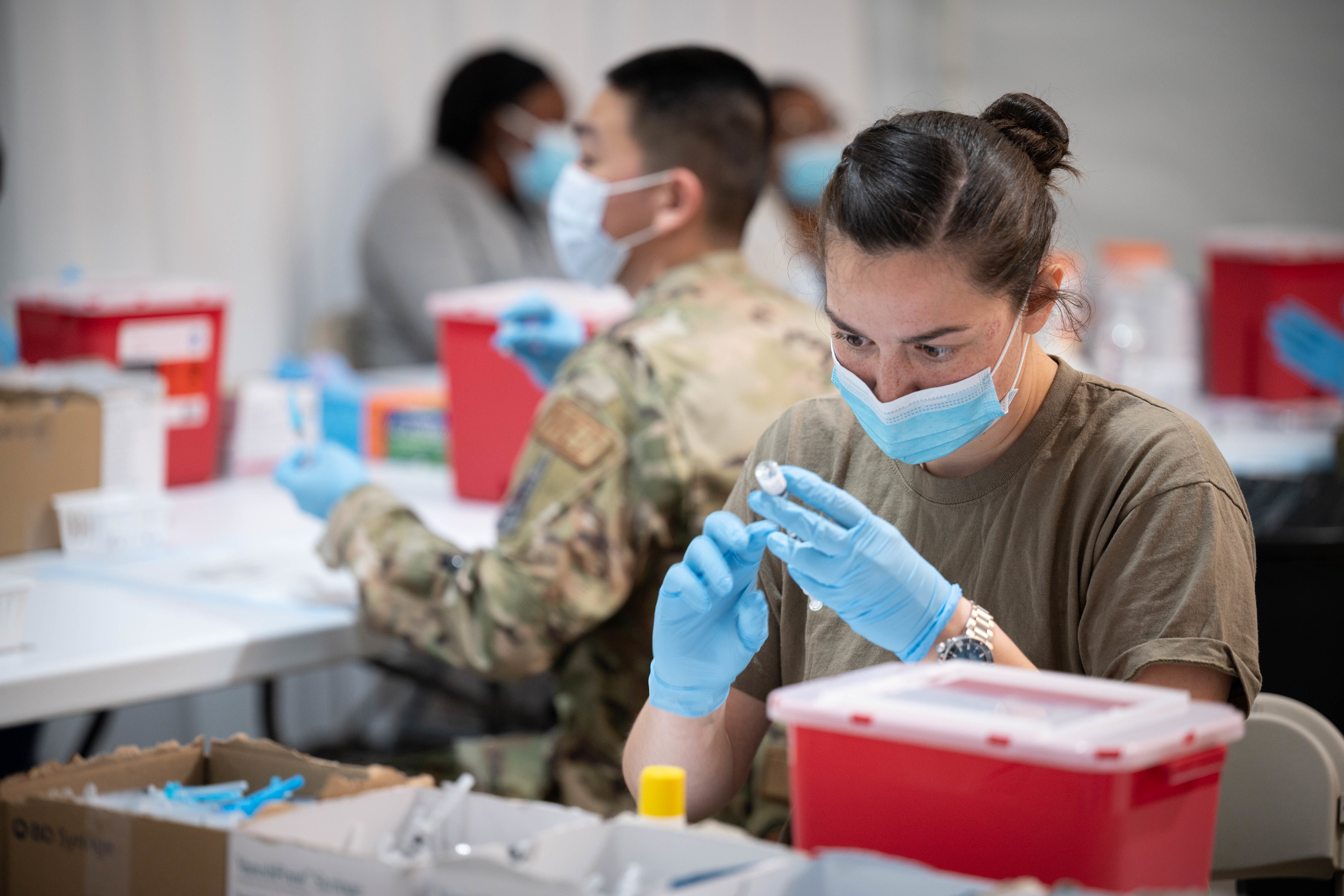
Preparing Vaccines

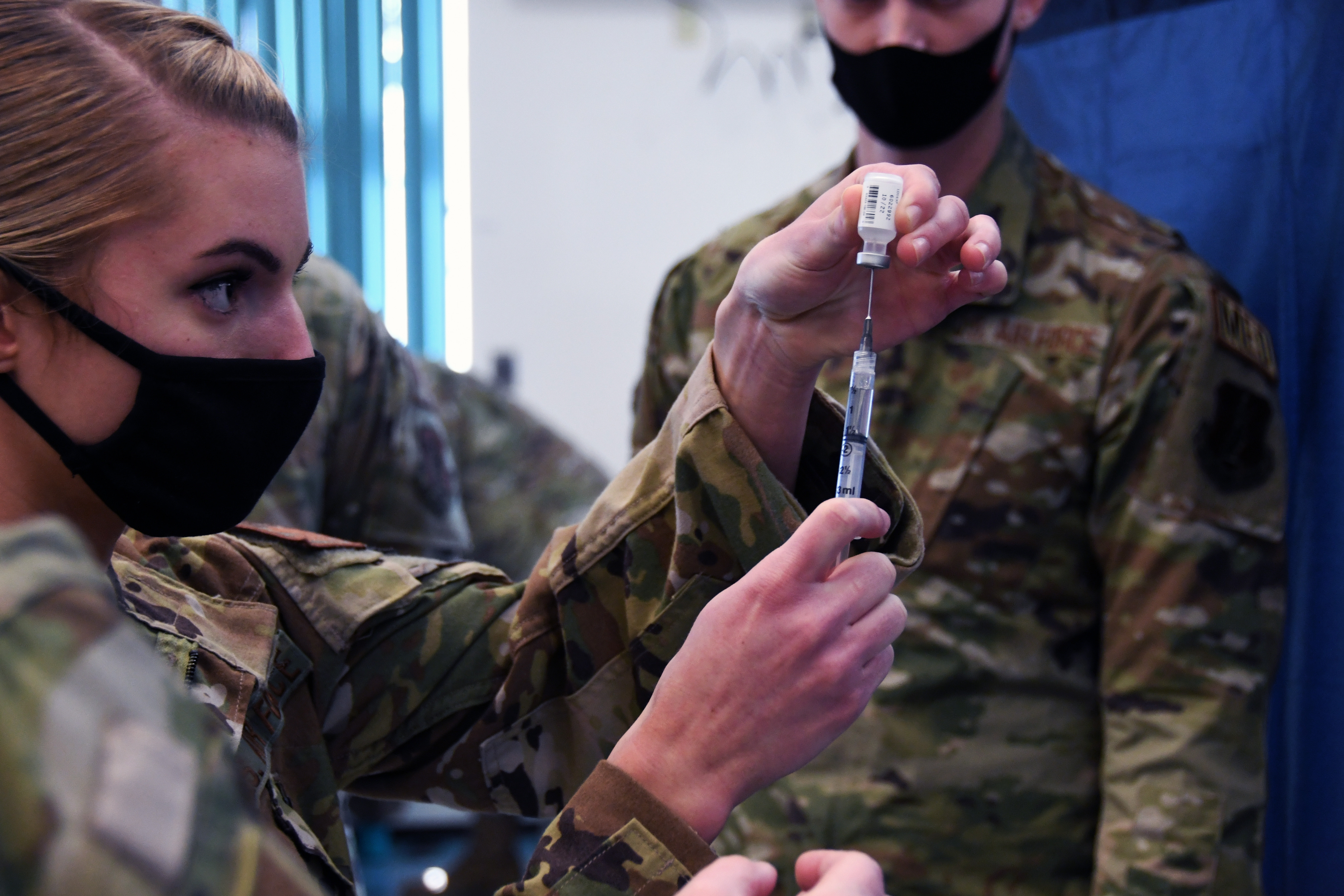
Air Force Staff Sgt. Santana Sanborn, an aerospace medic assigned to Buckley Air Force Base, Colo., prepares a vaccine at the Tampa Community Vaccination Center in Tampa, Fla., March 5, 2021. Sanborn works throughout the day to transfer the vaccines from storage vials into syringes as needed. U.S. Northern Command, through U.S. Army North, remains committed to providing continued, flexible Defense Department support to the Federal Emergency Management Agency as part of the whole-of-government response to COVID-19.

Eagle Pangea


Soldiers engage a target during Eagle Pangea, a squad live-fire and platoon external evaluation training event, in Sardinia, Italy, March 10, 2021.

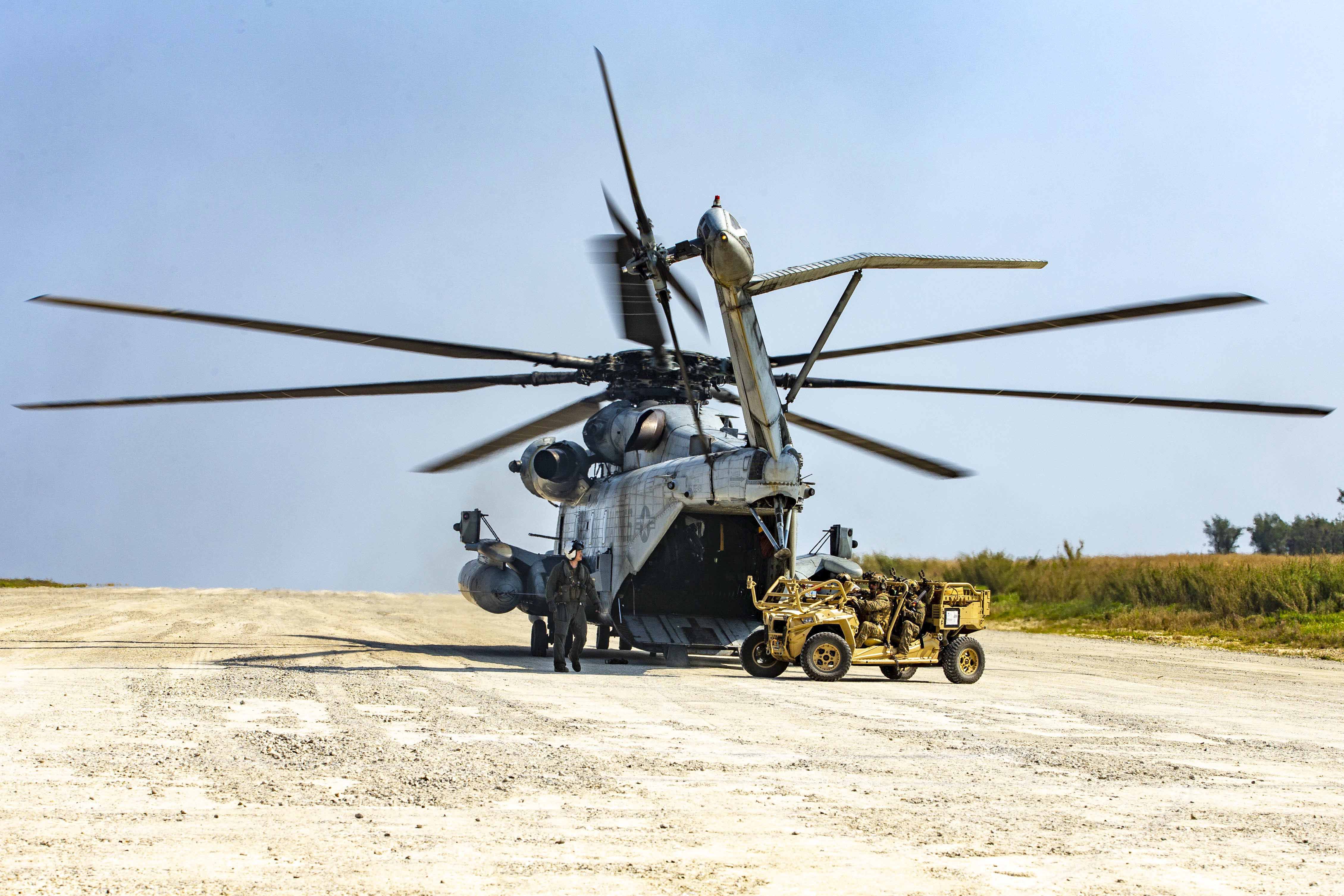
Castaway Crew


Marines and Army Special Forces soldiers exit a CH-53E Super Stallion during Castaway 21.1 at Ie Shima, Okinawa, Japan, March 17, 2021. Marines train to integrate with the joint force to seize and defend key maritime terrain, provide low-signature sustainment and execute long-range precision fires to support naval operations.

Distribution Exercise


Civilian and military personnel at Commander, Fleet Activities Yokosuka participate in a COVID-19 vaccine distribution exercise for front line essential personnel at the command's Hawk’s Nest Gymnasium in Yokosuka, Japan, March 7, 2021. Personnel from ships as well as from Defense Department Education Activity, and CFAY’s Child & Youth Programs received their vaccines during the event. For more than 75 years, CFAY has provided, maintained and operated base facilities and services in support of the 7th Fleet's forward-deployed naval forces, tenant commands and thousands of military and civilian personnel and their families.

Honoring the Fallen


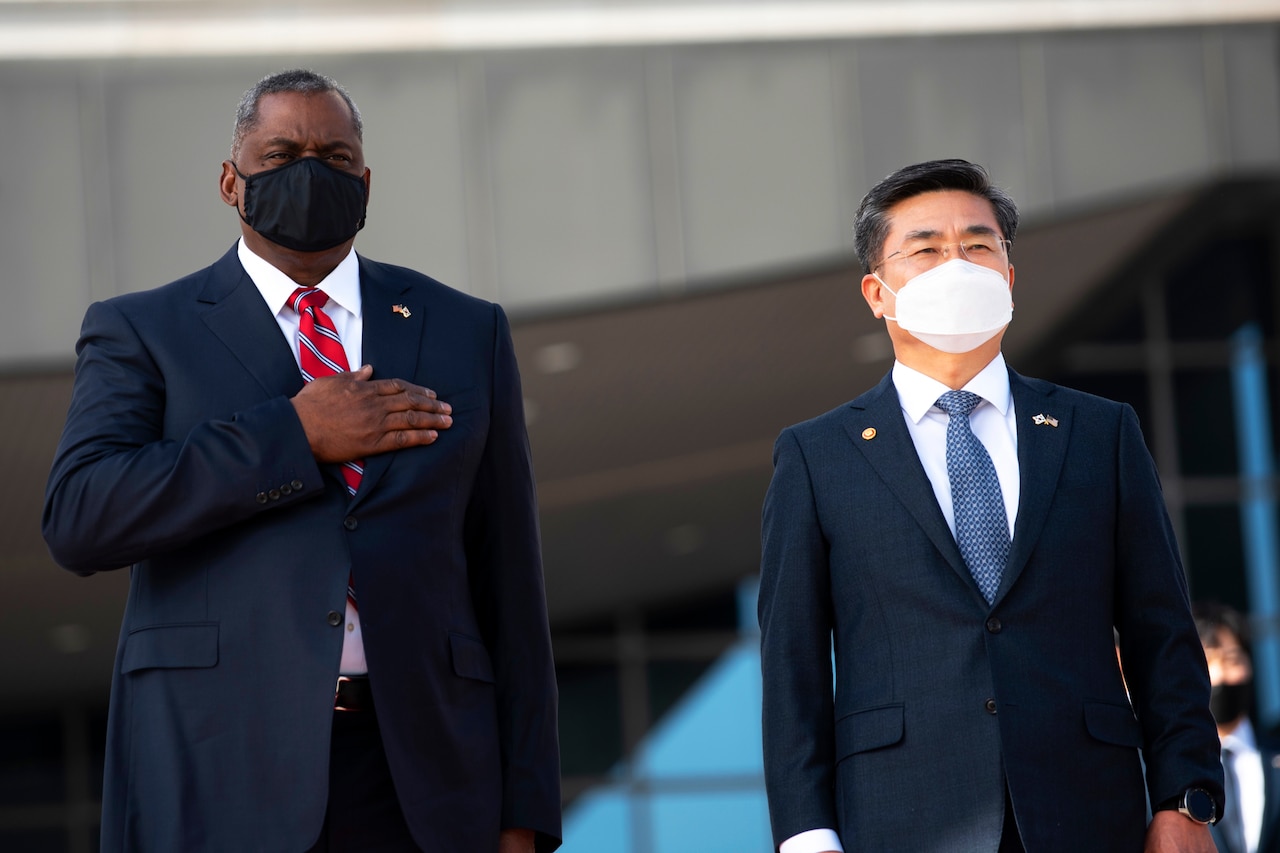
Secretary of Defense Lloyd J. Austin III burns incense to honor the fallen while attending a ceremony with South Korean Minister of National Defense Suh Wook at Seoul National Cemetery in South Korea, March 18, 2021.

Canine Skills


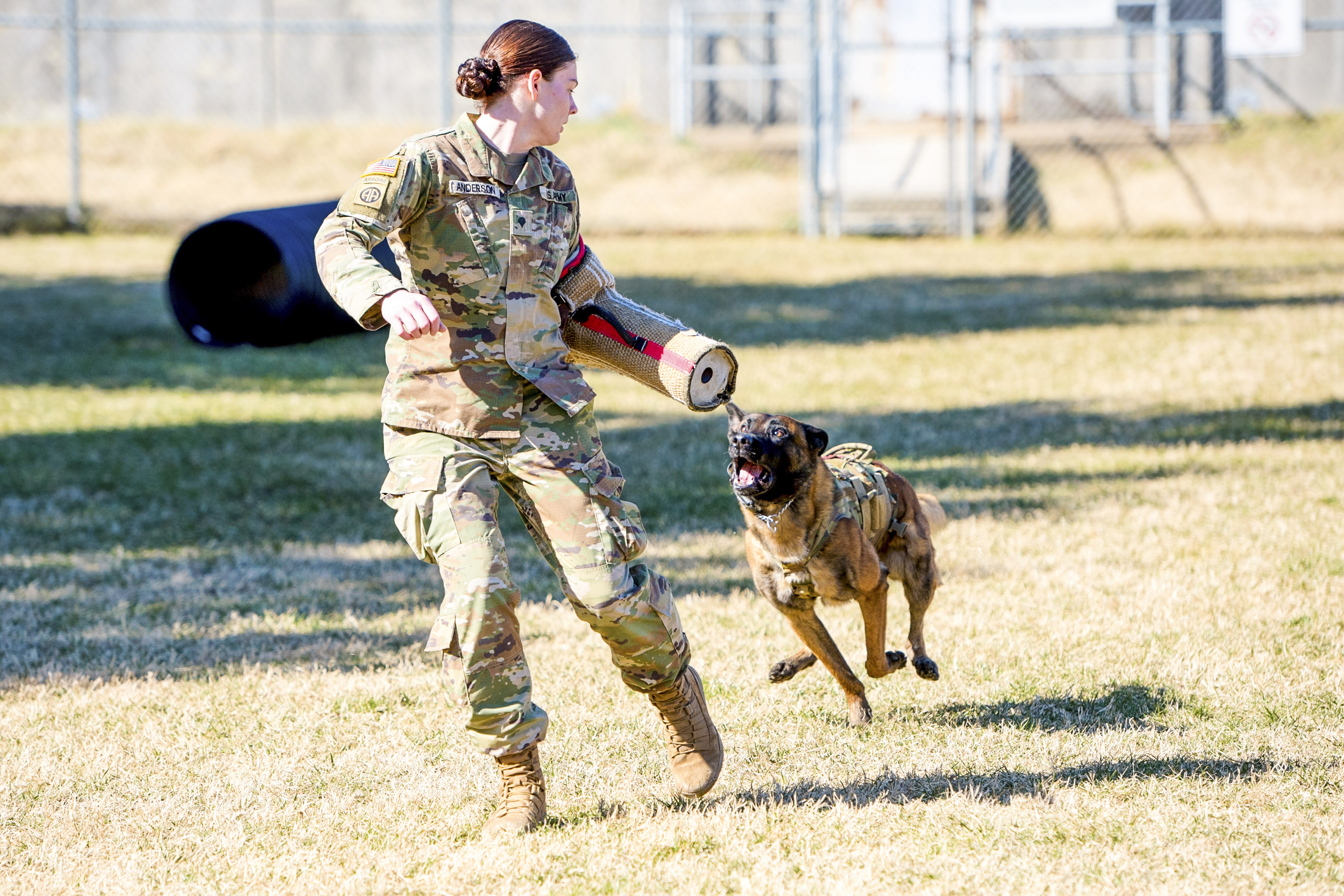
A soldier demonstrates the capabilities and skills of a military working dog at Joint Base Myer-Henderson Hall, Va., March 8, 2021.

Intense Illumination


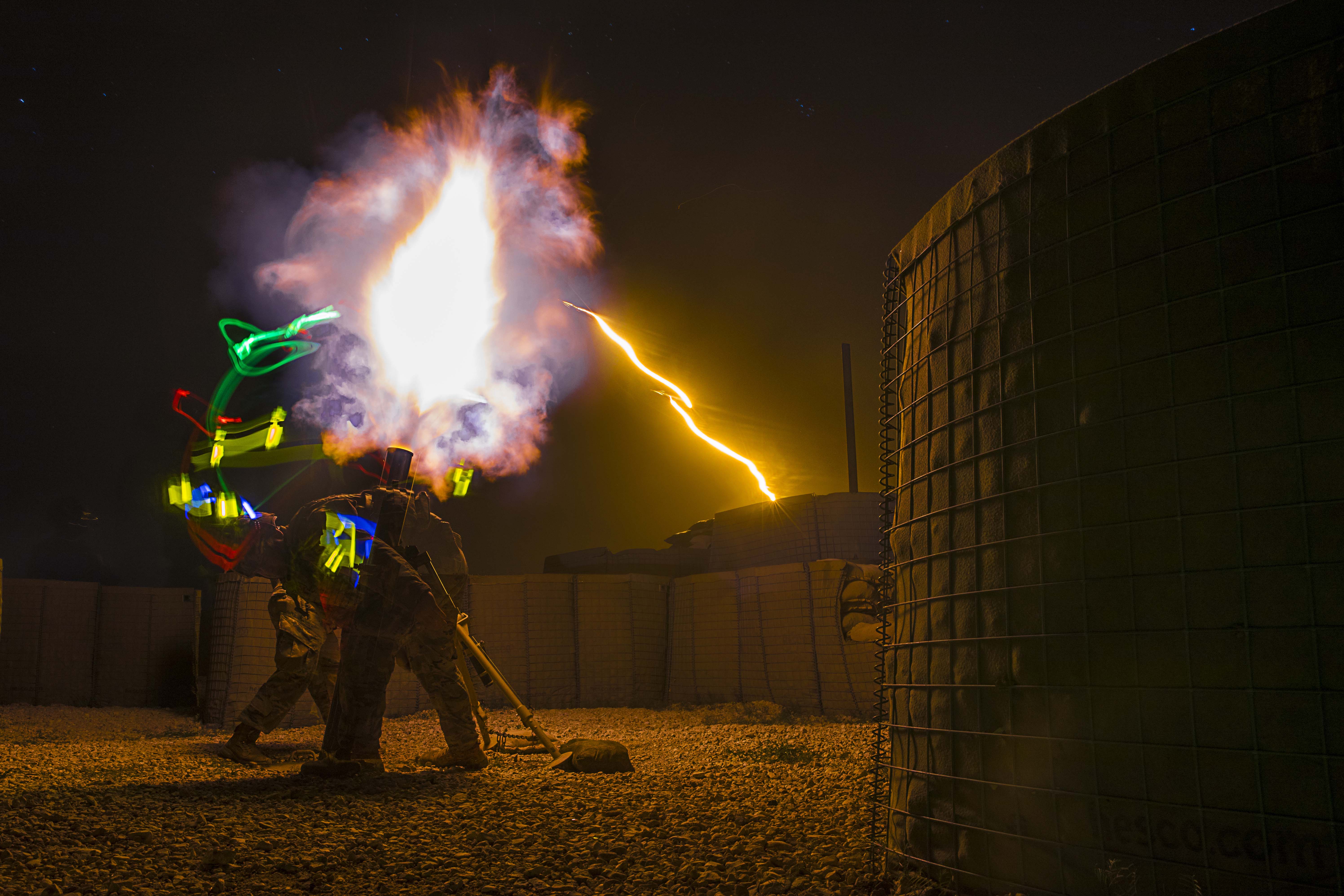
Soldiers fire illumination rounds from a 120 mm mortar during live-fire training in Syria, March 16, 2021.

Missile Fire


Soldiers fire a missile from a Humvee during Eagle Sokol at Pocek Range in Postojna, Slovenia, March 16, 2021. The bilateral training exercise with the Slovenian Armed Forces builds teamwork and readiness between NATO allies.

Color Craft


Marines and sailors navigate a combat rubber raiding craft after launching from the USS Ashland during an exercise in the Philippine Sea, Feb. 24, 2021.

Super Silhouette


Marines load a CH-53E Super Stallion during Castaway 21.1 at Ie Shima, Okinawa, Japan, March 16, 2021. Marines train to integrate with the joint force to seize and defend key maritime terrain, provide low-signature sustainment and execute long-range precision fires to support naval operations.

Plank Partners


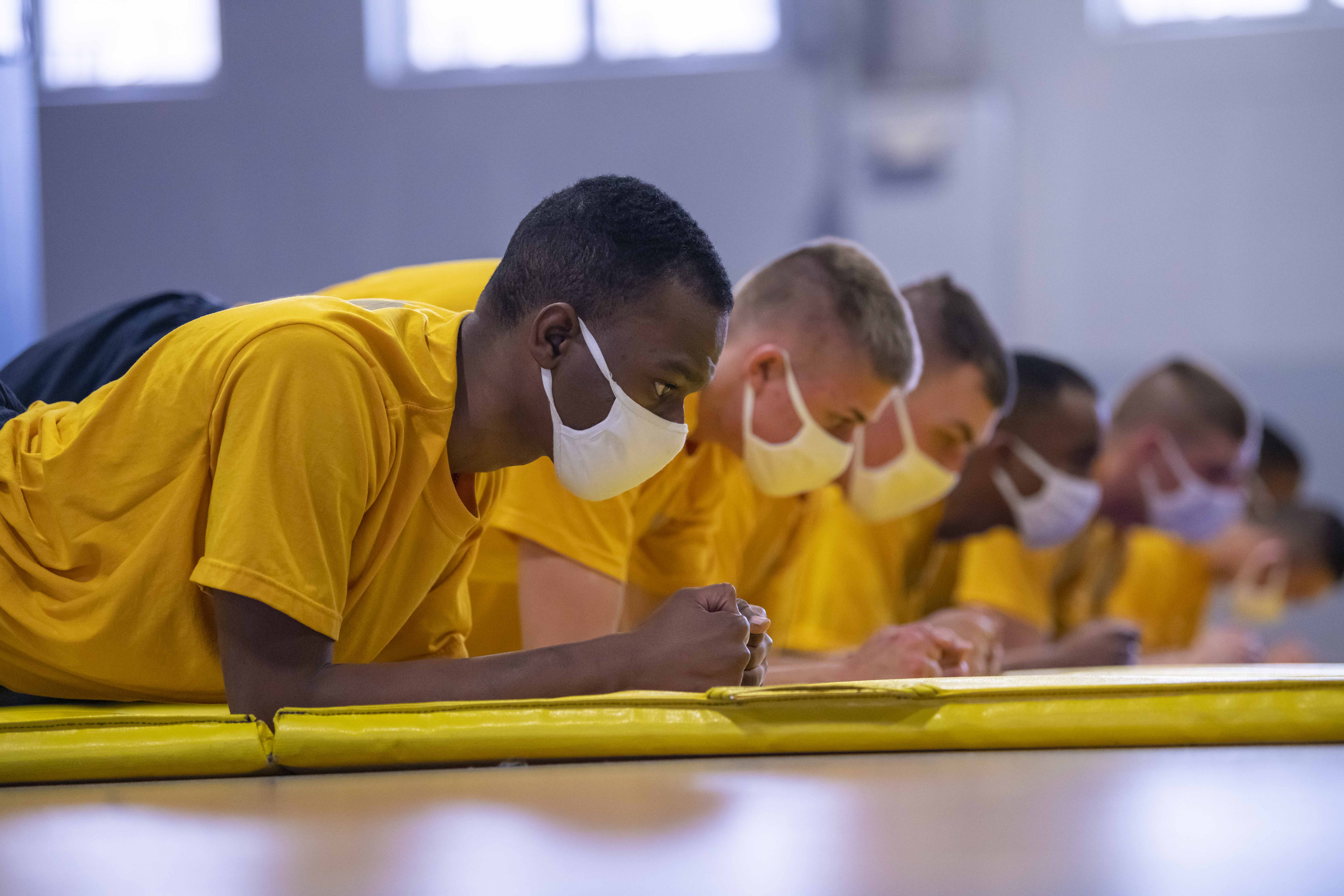
Navy recruits perform a forearm plank during a physical fitness assessment at Recruit Training Command in Great Lakes, Ill., March 16, 2021.

Test Prep


Airmen prepare a test cell before starting an F-15E Strike Eagle engine at Royal Air Force Lakenheath, England, March 17, 2021. Each engine is tested and monitored to ensure it is safe for flight before being installed into the aircraft.

Bomber Takeoff


An Air Force B-1B Lancer takes off from Orland Air Force Station, Norway, March 14, 2021.

Marines participate in a casualty evacuation drill during Castaway 21.1 at Ie Shima, Okinawa, Japan,


Marines participate in a casualty evacuation drill during Castaway 21.1 at Ie Shima, Okinawa, Japan, March 17, 2021. Marines train to integrate with the joint force to seize and defend key maritime terrain, provide low-signature sustainment and execute long-range precision fires to support naval operations.

U.S.-Korean Alliance is Key to Peace, Stability in Northeast Asia

 March 18, 2021 | BY Jim Garamone , DOD News

The American commitment to the U.S.-Republic of Korea Treaty remains ironclad, Secretary of Defense Lloyd J. Austin III said today following the ROK-US Foreign and Defense Ministerial Meeting in Seoul.

Secretary of State Antony J. Blinken joined Austin for talks with South Korean Minister of Foreign Affairs Chung Eui-yong and Minister of National Defense Suh Wook. The ''Two-plus-Two'' meeting is part of the American delegation's first overseas trip to meet with allies and friends. It is a clear indication of the importance the Biden administration places on reinvigorating the network of allies and partners at the heart of American strategy.

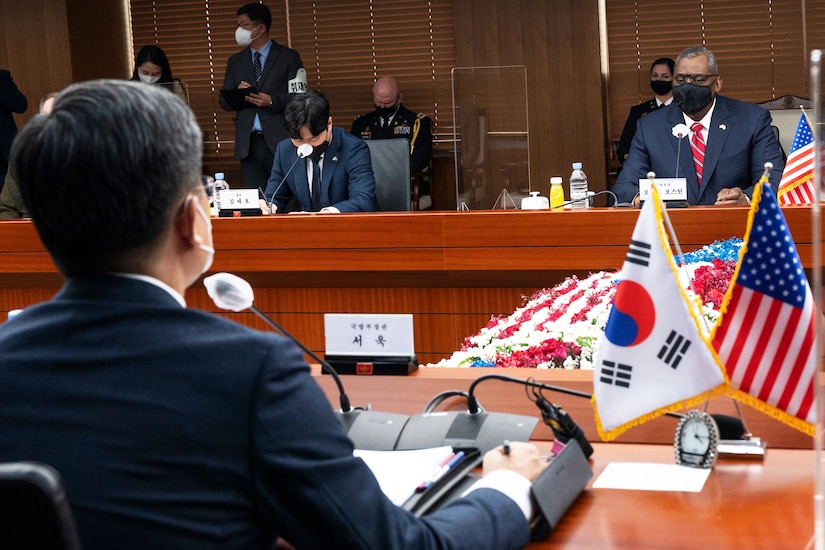
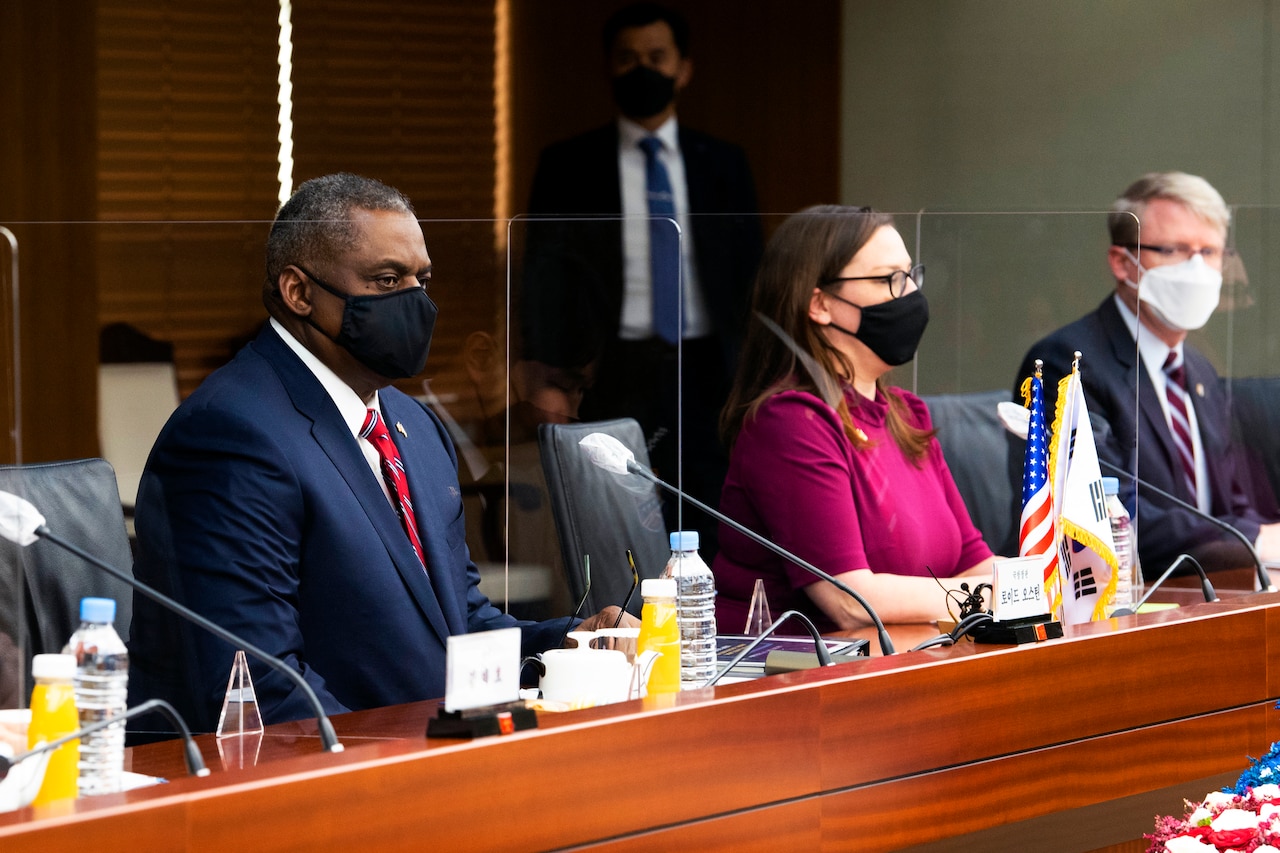
South Korean leaders sit across a table from their American counterparts.

After the meeting at the Foreign Ministry, Austin and Blinken met with South Korean President Moon Jae-in who thanked the American leaders for the constructive meetings.

South Korea is an important military ally. American and South Korean forces fought together during the Korean War, and South Korean soldiers deployed to combat alongside American in Vietnam. They also supported efforts in the fight against violent extremists. 

Austin noted that the interoperability among the two forces today may be the best in the world. The military is only a part of this, however. The two nations share common interests and values beyond the Korean peninsula. "With the many challenges we face, our bond — forged through shared sacrifice – is more important now than ever," he said. "[The alliance] is critical not only to the security of the Republic of Korea and the United States, but also to the peace and stability of Northeast Asia and a free and open Indo-Pacific region."

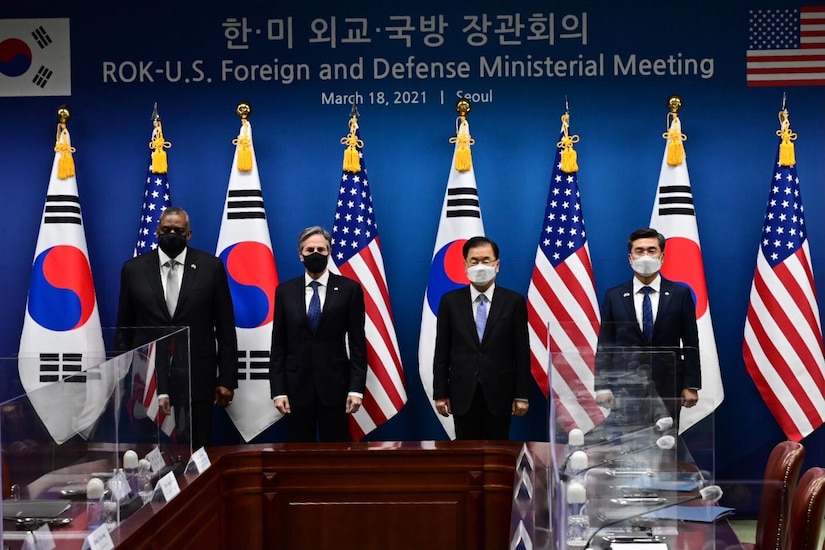
American and South Korean leaders stand for a photo in front of country flags.

Austin said the U.S. commitment to South Korea covers the full range of capabilities America brings. The alliance is defensive in nature and the two nations maintain a robust combined defense posture. 

North Korea continues to act against United Nations resolutions calling on the nation to stop its nuclear weapons program. The United States and South Korea "remain committed to the denuclearization of the Korean Peninsula," he said. "There is no daylight between us on this point."

Working closely with our allies and partners will allow us to meet every challenge and outmatch any competitor.''
Secretary of Defense Lloyd J. Austin III

Austin stressed the importance of maintaining military readiness. "Our force remains ready to 'fight tonight,' and we continue to make progress toward the eventual transition of wartime operational control to a [Republic of Korea]-commanded, future Combined Forces Command."

Combined Forces Command is currently commanded by Army Gen. Robert Abrams, but the command is truly a combined headquarters. "While meeting all the conditions for this transition will take more time, I’m confident that this process will strengthen our alliance," Austin said.

The secretary said the United States and South Korea together must address global security challenges and engage in long-term strategic competition with China. China, more than Russia, is the Defense Department's "pacing threat" for the years ahead, the secretary said.

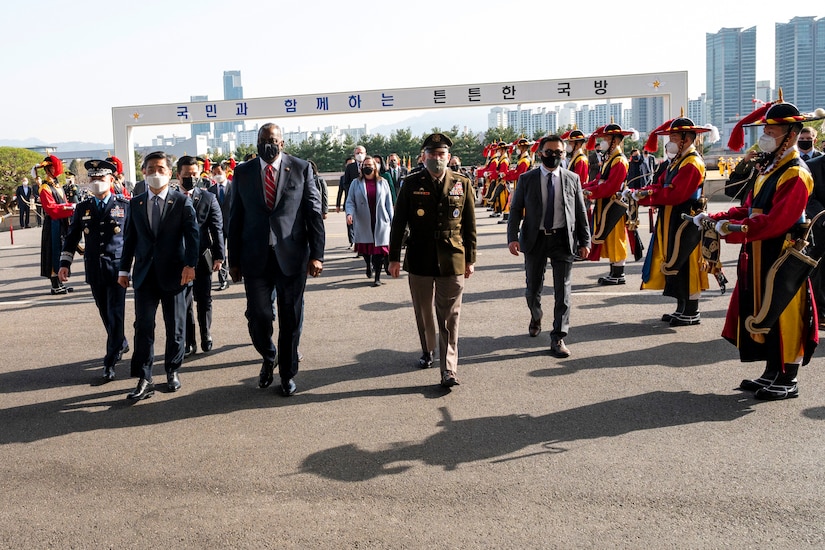
American and South Korean leaders walk together during a welcoming ceremony.

The meeting served to help the leaders of the two nations to identify areas where the United States and South Korea can work together to uphold the rules-based international system that has served the region so well. The meeting also looked at how to help partner nations build capacity and capabilities to support their own sovereignty.

Although a State Department document, Austin noted he was pleased at the initialing of the Special Measures Agreement with South Korea. It is part-and-parcel of the new administration's efforts to revitalize the network of alliances and partnerships, he said.

"That is why we also reaffirmed our commitment to the U.S.-ROK-Japan trilateral defense cooperation, because we recognize the value of 'multilateralism' and we value a forward-looking agenda to address both current and future shared challenges," Austin said.

The combined meeting of foreign affairs and defense ministers reflects the U.S. belief in leading with diplomacy with backing from a strong military posture. Allies and partners are key, the secretary said, to American strategy. "Working closely with our allies and partners will allow us to meet every challenge and outmatch any competitor," Austin said.

Secretary of Defense Lloyd J. Austin III and Secretary of State Antony Blinken Conduct Press Conference With Their Counterparts After a U.S.-ROK Foreign and Defense Ministerial (“2+2”), Hosted by the ROK’s Foreign Minister Chung Eui-yong and Minister of Defense Suh Wook

 March 18, 2021


MODERATOR (THROUGH TRANSLATOR):  Ladies and gentlemen, foreign and defense ministers.

Good morning, ladies and gentlemen.  We will now start the joint press conference of the ROK-U.S. foreign and defense ministers.  The opening remarks will be made in the order of Minister Chung, Secretary Blinken, Minister Suh, and Secretary Austin.

After the opening remarks of the four ministers and secretaries, we will have a Q&A by two journalists from the Korean and the U.S. side, respectively.

First, Minister Chung.

FOREIGN MINISTER CHUNG (THROUGH TRANSLATOR):  Good morning, everyone.  It is my utmost pleasure to welcome and to stand with Secretary Blinken, Secretary Austin, and Minister Suh.

First of all, regarding the gun shoot that happened in Atlanta, Georgia last night, I would like to send our deepest heart to those who are sacrificed.  Among those sacrificed, we confirmed that there are Korean Americans as well.  It is our utmost interest to seek the safety of those Koreans living in the U.S.  Our heart also go to those who are sacrificed as Americans.  Also, in the starting of the meeting today, both Secretary Blinken and Secretary Austin expressed their concerns and also the disheartening of the incident.  Thank you very much for mentioning that.

And also, I'd like to welcome two secretaries once again for coming to Korea in the early days of their appointment.  It has been 11 years since we had the both secretaries of the State and Defense from the U.S. that happened in 2010.  We confirmed once again today in this meeting that both countries are the linchpins of the peace, security, and prosperity on the Korean Peninsula, and the South -- in Northeast Asia with the ROK-U.S. Alliance having the 70 years of history.  Based on the solid alliance, we made sure of the commitment to strengthen our strategic communications.  Also, we are expecting that this kind of effort will be -- lead to the summit meeting between our two countries in the coming future.

Also, we decided that reciprocal and the future-oriented cooperations will be further expanded having the cooperation of the discussions on the coming issues.  The signing ceremony that happened right before -- regarding SMA -- has been reaffirming the solidity of the ROK-U.S. Alliance, having resolved a long-term issue.

And also, both countries have confirmed our consensus on three major areas.  First of all, the North Korea nuclear issue is the most immediate issue and it is necessary to have the close coordination between our two countries.

Secondly, in order to resolve the North Korea nuclear issue in a peaceful manner, the best diplomatic efforts will be made based on the solid security base.

Lastly, in the process of review process of the North Korea by the U.S., as well as the implementation period, fully coordinated strategy will be the base for our coordination.  Both countries will continue to have the cooperation for the sake of the progress of the Korean peace process.  Also, for the regional peace, security, and prosperity, both countries have decided to continue our cooperation, reciprocal, and the futuristic manner among the three lateral countries, with Japan.  Also with the New Southern Policy and its cooperation, we decided to have the common prosperity and stability, especially in the Indo-Pacific area.  Regarding climate change and COVID-19, we decided to have the joint responses based on our alliance.  We also decided to have that cooperation of the 2+2 meeting.  It will be very meaningful.

And also, we reaffirmed that when both countries are together, we can have the strongest power, and also our greatest asset, which is the U.S. alliance, can be sound and is reciprocal in the future and meet the time of the demands.

MODERATOR (THROUGH TRANSLATOR):  Thank you very much.  Secretary Blinken, please.

SECRETARY BLINKEN:  Well, good morning, everyone, and Mr. Minister Eui-yong, thank you for hosting us.  It's an honor to join you, to join the defense minister, and of course, my friend and colleague Secretary of Defense Austin, for today's 2+2 ministerial meeting.

Thank you also just for hosting me for two days in a row, and to the people of the Republic of Korea for, as always, their incredibly warm hospitality.  And I want to reiterate again our outrage and grief over the deaths of eight women in Atlanta yesterday, including, we hear, four of Korean descent.  We stand with the Korean community and everyone united against violence and hate.

This trip, as has been noted, is the first by any member of President Biden's cabinet overseas, and it's no accident that Secretary Austin and I came here.  The U.S.-Republic of Korea Alliance is, as we have long said, the linchpin of peace, security, and prosperity in Northeast Asia, the Indo-Pacific, and around the world.  But we came here not only to reaffirm that fact and to reaffirm our alliance, but to build on it, and that is exactly what we've been doing.

We just witnessed, as the minister said, the initialing of an agreement in principle on the text of the Special Measures Agreement.  And this is the result of very diligent efforts by both sides to arrive at a fair and equitable agreement.  It will strengthen our alliance.  It will strengthen our shared defense.

This effort and our trip to the region is part of the Biden-Harris administration's commitment to reinvigorate and modernize our alliances and partnerships around the world, which are critical and crucial to the security and prosperity of the American people.  That's the message we've underscored earlier this week in our meetings with our counterparts in Japan.  That's the message you see reflected in the joint statement that we signed and we'll release today.

Our renewed engagement will put us on firmer footing to address a series of shared security challenges in the region and beyond, including the threat posed by North Korea.  President Biden plans to complete a North Korea policy review in the weeks ahead in close coordination and consultation with the Republic of Korea, with Japan, with other key partners, including reviewing pressure options and potential for future diplomacy.

But as we conveyed to the foreign minister and the defense minister, the goals of this policy are clear:  We are committed to the denuclearization of North Korea, reducing the broader threat the DPRK poses to the United States and our allies, and improving the lives of all Koreans, including the people of North Korea who continue to suffer widespread and systematic abuses at the hands of their repressive government.

We also discussed China.  We are clear-eyed about Beijing's consistent failure to uphold its commitments and we spoke about how Beijing's aggressive and authoritarian behavior are challenging the stability, security, and prosperity of the Indo-Pacific region.  Beijing's actions make forging a common approach among our allies all the more important at a time when we're seeing a rollback of democracy and human rights around the world, including in Burma, where the military is attempting to overturn the results of the democratic election by brutally repressing peaceful protesters.

It is more important than ever that we stand together for the values, for the interests that unite us.  And we covered a range of challenges that transcend borders, including cyber security, health security, climate change.  At the time this alliance was forged, many of these threats were not even on the horizon, but they certainly are now, and we're determined to work together, particularly through trilateral cooperation among the United States, South Korea, and Japan to meet them.  While our diplomacy and security ties are ironclad, I think it's also very clear that the U.S.-ROK relationship goes even deeper than that.  It's rooted in mutual trust, in shared values, deeply intertwined economic interests, and, of course -- and maybe most important -- generations of family and community ties and having one another's back in the most difficult times.

That's what we saw in the early days of the pandemic when the Republic of Korea donated two million face masks to our country to help us fill a critical shortfall.  Five hundred thousand of those masks went to our Department of Veterans Affairs, which means that some Americans who 70 years earlier had fought side by side with Koreans found themselves protected from a deadly virus thanks to the masks donated by the Republic of Korea today.  That is what an alliance looks like.

Thank you, and it's really wonderful to be with you.

MODERATOR (THROUGH TRANSLATOR):  Thank you, Mr. Secretary.  Minister Suh, please.

DEFENSE MINISTER SUH (THROUGH TRANSLATOR):  Today, we have held the ROK-U.S. foreign and defense ministers meeting in five years.  It was a great opportunity for us to reaffirm the rock-solid ROK-U.S. Alliance that has been growing in the last seven decades based on trust and commitment.  We have appreciated the strong combined defense posture of the alliance based on the Mutual Defense Treaty, and reaffirmed the U.S. commitment to the defense of Korea and extended deterrence.

Despite the COVID-19 pandemic, we have successfully completed the Combined Command post training in the first half of this year and created the necessary conditions for OPCON transition in enhancement of the preparedness of the alliance.  The alliance has made coordinated efforts to reach the conditions for a successful OPCON transition and agreed to continue to cooperate for OPCON transition.  The ministers also agreed to closely communicate and cooperate to achieve common goals of complete denuclearization of the Korean Peninsula and establishing permanent peace.

We have also decided to continue the harmonious cooperation between the New Southern Policy of Korea and the Indo-Pacific Strategy of the U.S. for peace, stability, and prosperity in the Indo-Pacific.  The two ministers will continue to cooperate in a future oriented manner.  Thank you.

MODERATOR (THROUGH TRANSLATOR):  Now, Secretary Austin, please.

SECRETARY AUSTIN:  Well, Minister Suh, Minister Chung, Secretary Blinken, it is a privilege to be here in Seoul with all of you.

And first and foremost, as my colleagues have pointed out, I am also saddened by the horrific attacks in Atlanta, Georgia yesterday, where we believe several women of Korean descent were killed.  Our deepest sympathies go out to all those affected by this horrific crime and specifically the families of those who were killed.  And I share my colleague's view that violence of this type or any other type has no place in our society.

Now today's meeting is a testament to the importance of our alliance.  With the many challenges that we face, our bond, forged through shared sacrifice, is more important now than ever.  For 70 years, the U.S. commitment to the U.S.-ROK Alliance has remained -- as Secretary Blinken described, has remained ironclad.  It is founded on our shared interests and values and is among the strongest bilateral, interoperable, and dynamic alliances in the world.  And it is critical not only to the security of the Republic of Korea and the United States, but also to the peace and stability of Northeast Asia and a free and open Indo-Pacific region.

The United States remains fully committed to the defense of the Republic of Korea, using the full range of U.S. capabilities, including our extended deterrent.  As the United States and the Republic of Korea continue to maintain a robust combined defense posture, we also remain committed to the denuclearization of the Korean Peninsula.  There is no daylight between us on this point.

And today, we discussed the way forward on a host of critical strategic and operational issues.  And at the top of my agenda was ensuring a shared understanding of the importance of maintaining military readiness.  Our force remains ready to fight tonight and we continue to make progress toward the eventual transition of wartime operational control to an ROK-commanded future combined forces command.

While meeting all the conditions for this transition will take more time, I am confident that this process will strengthen our alliance.  And so we have a lot to look forward to as, together, we address global security -- the global security challenges and engage in long-term strategic competition, mainly with China, which, as some of you know, is our department's pacing challenge in the years ahead.

Today, we continue to work together to identify areas for collaboration within our respective regional strategies, particularly upholding a rules-based international order and building capacity for partners in the region.  I'm especially pleased with the initialing of the Special Measures Agreement, which reflects our commitment to this alliance and illustrate the Biden administration's promise to revitalize our network of alliances and partnerships.  And so that is why we reaffirmed our commitment to the U.S.-ROK-Japan trilateral defense cooperation, because we recognize the value of multilateralism.  And we value a forward-looking agenda to address both current and future shared challenges.

Our work in today's foreign and defense ministerial meetings reflects our firm belief that leading with diplomacy backed by a strong combined defense posture and working closely with our allies and partners will allow us to meet every challenge and outmatch every competitor.  It is why we place great value on the U.S.-ROK Alliance, which has remained the linchpin of peace, security, and prosperity in the Indo-Pacific for nearly three quarters of a century.

We face many challenges together and we've risen to the occasion each time.  And we are grateful to the call of the Republic of Korea, one of our closest friends and most steadfast partners, and I'm confident that our two countries will work to -- continue to work shoulder-to-shoulder to meet all challenges and any competitor for the next 70 years and beyond.

As I said to Minister Suh in our meeting yesterday, we will continue to go together in the future.  Thank you.

MODERATOR (THROUGH TRANSLATOR):  Thank you, Mr. Secretary.  Next, we're going to have Q&A.  Due to time constraint, as previously arranged, two journalists from the Korean and the U.S. sides will ask questions respectively.  First, the Korean side.  We have Mr. Hong Ju-hyeong from Segye Daily to ask a question.

QUESTION (THROUGH TRANSLATOR):  Nice to meet you all.  My name is Hong Ju-hyeong.  I have two questions.

First of all, North Korea policy -- this question goes to Minister Chung and Secretary Blinken:  Do you believe that the U.S. needs to respect the Singapore agreement?  Recently, Choe Son-hui of North Korea said that the difficult situations will continue unless U.S. stops its hostile policy to North Korea.

The second question goes to global cooperation.  Minister Chung, have you been asked to join Quad in this series of meetings?  Secretary Blinken, do you believe Korea can contribute to the strengthening of Quad?  And what kind of active engagement are you planning toward the ROK-U.S. Alliance?

FOREIGN MINISTER CHUNG (THROUGH TRANSLATOR):  Let me answer the question first.

Regarding North Korea policy, now the Singapore agreement, from the Korean Government's perspective, is a confirmation of fundamental principles to resolve the UK -- resolve the U.S.-North Korea relations, establishing peace on the Korean Peninsula, and denuclearization, though it needs to be considered seriously.  Recently, Kim Yo-jong made a statement and Choe Son-hui made another statement today, and I am closely monitoring the situation.  It seems North Korea is reviewing its policy toward the U.S., and it seems that North Korea is closely monitoring the dialogue between ROK and U.S. regarding North Korea policy.  I believe it's their own way of sending messages to us and the U.S.  Today, we briefly discussed on this issue.  Now we will continue to closely coordinate on this issue with the U.S., and I support the Biden administration's efforts to engage North Korea, and hope that the talks will be resumed.

On the visit of the secretaries from the U.S., there was no direct discussion about Korea joining Quad.  However, we discussed how we can harmonize and coordinate the New Southern Policy of South Korea and the Indo-Pacific Strategy of the U.S.  As I have stated several times, the Korean Government's position is that if it conforms with the national interest of Korea and transparency and inclusiveness is ensured, we can join any regional cooperative body.

SECRETARY BLINKEN:  Well, thank you very much for the question.  I think as you know, with regard to North Korea, we're engaged in a comprehensive policy review, which we hope to complete in the weeks ahead.  But what's significant about that review is it's being done in very close consultation with the Republic of Korea, with Japan, with other allies.

We have a shared concern, a shared interest in having a strong, effective, and coordinated policy and proceeding together in lockstep.  We're focused on reducing the threat to the United States, to our allies, posed by North Korea's nuclear program, its missile programs, and to improving the lives of people in North Korea, throughout the region as well.  And we will continue to consult very closely in the weeks ahead as we complete the review.

With regard to the Quad, I would just say it's -- I think as you know, it's an informal grouping of likeminded countries that have come together to deepen cooperation on a whole host of issues.  Many of these issues we're also working very closely with the Republic of Korea.  We find that working through some of these sub-regional groupings, including the trilateral, the work we do with Korea and Japan, is very beneficial in addressing some of the challenges we face.

One of the -- one of the, I think, realities of the moment we're in is that when you consider virtually all of the issues that are actually affecting the lives of our people and of our citizens, whether it's climate, whether it's the pandemic, whether it's emerging technologies -- and I could go down the list -- not a single one can be effectively addressed by any one country acting alone.  We have to find ways to deepen cooperation, to deepen coordination with likeminded countries.  That's exactly what we've been doing with our close allies and partners here.  It's what we do in our trilateral cooperation as well with Japan.  It's what we do through the Quad.  It's what we do through ASEAN.

That is, I think, the imperative of the moment we're in.  And we're very, very pleased that we've been able to do the work we've done here today because it's evidence of our determination to revitalize, to strengthen our alliances, to build on them, because that is the single best way to tackle the problems that actually affect the lives of our citizens.

MODERATOR (THROUGH TRANSLATOR):  Thank you very much.  Now, moving on to -- would like to receive the questions from the U.S. press.

MR PRICE:  The next question will go to Christina Ruffini of CBS.

QUESTION:  Good afternoon, gentlemen.  Mr. Secretary, North Korea has so far not responded to U.S. attempts to engage, and as was just mentioned, today the vice minister of foreign affairs called such efforts a cheap trick and said U.S. calls for complete denuclearization were groundless rhetoric.  When it comes to this policy review that you mentioned, given how far the two sides are apart, is the U.S. considering a policy of containment rather than engagement with North Korea?  And will you be asking the Chinese to take any specific actions regarding Pyongyang when you meet in Alaska?

And Mr. Foreign Minister, if I may, you said it appears North Korea is reevaluating its relationship with the U.S.  Do you feel North Korea is more or less dangerous after the efforts of the previous administration, and have you asked Secretary Blinken to convey any message or request from your government to the Chinese?  Thank you.

SECRETARY BLINKEN:  Thank you very much.  Look, the -- with regard to North Korea, the most important outreach and engagement we're doing is with our partners and allies.  That's a big part of the reason why we're here.  It's a big part of the reason why, as part of the review that we're doing, we're in close consultation with the Republic of Korea, with Japan, with other allies and partners who are concerned by the actions and activities of North Korea.  And I don't want to get ahead of the review and pre-judge its conclusion.  We'll have an opportunity, I know, to talk about that going forward.

China has a critical role to play in working to convince North Korea to pursue denuclearization.  China has a unique relationship with North Korea.  Virtually all of North Korea's economic relationships, its trade go -- are with or go through China, so it has tremendous influence.  And I think it has a shared interest in making sure that we do something about North Korea's nuclear program and about the increasingly dangerous ballistic missile program.

So I would hope that whatever happens going forward, China will use that influence effectively to work on moving North Korea to denuclearization.

FOREIGN MINISTER CHUNG (THROUGH TRANSLATOR):  Since 2018 on the Korean Peninsula, the peace building, indeed reconciliation of these tensions have been fruitful, in my opinion, especially in September 2018.  The Comprehensive Military Agreement between the two Koreas was a great achievement and meaningful, and that agreement is still the basis for both Koreas to be abiding by.  So that should -- worthy of notice.

For the last three years, the ROK and the U.S. have been maintaining close coordination, and based off of that, we have maintained our engagement policy with North Korea.  And we believe that there is a possibility for us to have the denuclearization, and that has been proven in principle.

Through the 2+2 meeting today, both the ROK and the U.S. demonstrated that we have the fully coordinated strategies and plans, and we decided to have further plans in the future.  Based off of that, we can have the full and effective engagement with North Korea.  Having said that, we believe that it's possible for us to have the full peace building in the Korean Peninsula.

MODERATOR (THROUGH TRANSLATOR):  Thank you, Mr. Secretary, Mr. Minister Chung.

Now the Korean side.  Mr. Lee Seung-yun from YTN.

QUESTION (THROUGH TRANSLATOR):  Good morning.  I have two questions for Minister Suh.  First, the U.S. is strengthening cooperation with Quad member-states.  Was there any request from the U.S. for a combined military exercise with Quad members or intelligence sharing with the Quad members?  Second, now the U.S. DOD is reviewing the USFK deployment posture.  Did you have any discussion on that?

(In English.)  This question goes to Defense Secretary Austin.  Welcome to South Korea.

In order to strengthen national defense, the Korean Government wishes to build nuclear-powered submarine and a light aircraft carrier.  Do you think that they will be feasible and essential assets for Korea-U.S. combined forces?  And is the U.S. willing to help Korean Government to build nuclear-powered submarine?

Second, although you emphasized the challenges posed by North Korea and China yesterday, China is still necessary to solve out the North Korean nuclear issues.  So how would you cope with this dilemma?  Maybe Secretary Blinken can answer for these questions, too.  Thank you very much.

DEFENSE MINISTER SUH (THROUGH TRANSLATOR):  Let me answer the question first.  So the question about intelligence sharing or combined military exercise with Quad member-states, there is no such request from the U.S.  We discussed measures to ensure stability in the Indo-Pacific and shared the understanding of the two sides, however there was no specific mentioning or a request on those issues you just raised.

Regarding the military cooperation with the U.S., the U.S. discussed emerging security threats in our responses and stressed the necessary cooperation with the U.S., Japan, and Korea.  Basically, Korea agrees that the trilateral cooperation is important.  With the occasions of bilateral meetings and multilateral meetings, we will continue to cooperate with the U.S. in terms of military cooperation.  And I believe Secretary Austin is better positioned to answer this part of the question.

Now, the U.S. DOD is reviewing the USFK redeployment or repositioning.  And we didn't discuss this issue specifically in this meeting.  However, basically, the U.S. reaffirmed the importance of USFK in ensuring stability and peace in Northeast Asia, and U.S. commitment to the defense of Korea is steadfast.

SECRETARY AUSTIN:  Yeah, so thanks.  On the issue of nuclear submarines or any other capability that the Republic of Korea might seek to acquire, I think it's best that the leadership of the republic speak to that versus me.  And so I'll leave it to Minister Suh to entertain those questions in the future.

You should know, though, that we're focused on ensuring that we have the required capability to defend the alliance and to defend the ROK if and when called upon to do that.  And our efforts to continue to work together routinely to strengthen our capability I think is evident in kind of everything we do.  It's all -- it's what we really spent a lot of time talking about in the last two days.

So we have tremendous capability at hand.  We're going to increase that capability by ensuring that we can continue to operate as a combined team.

SECRETARY BLINKEN:  And I want to first commend you on demonstrating the art of the multi-party, multi-part question.  (Laughter.)

And again, with regard to Beijing, Beijing has an interest, a clear self-interest, in helping to pursue the denuclearization of the DPRK, because it is a source of instability, it's a source of danger, and obviously a threat to us and our partners.  But China has a real interest in helping to deal with this.

It also has an obligation under the UN Security Council resolutions to implement fully the sanctions that the international community has agreed are there in response to North Korea's program and to its provocations.  So we look to Beijing to play a role in advancing what is in, I think, everyone's interest.

MODERATOR (THROUGH TRANSLATOR):  Thank you very much.  Now the last question, back to the U.S. press.

MR PRICE:  The final question will to go Lara Seligman of Politico.

QUESTION:  Good afternoon, gentlemen.

Secretary Austin, you spoke about the importance of maintaining military readiness.  For the past three years, the joint military drills between South Korea and the United States have been downsized due to ongoing negotiations over North Korea's nuclear arsenal.  What impact has that had on readiness?  And do you plan to continue the smaller-scale exercises in future, or will they return to their former size and scope?

Secretary Blinken, if I may:  As has been mentioned, North Korea's vice minister of foreign affairs said today that there would be no dialogue until the United States drops what she called its "hostile policy."  Can I get you to respond directly to that?  And by insisting from the start that the end state is its complete denuclearization, aren't you closing the door to talks and setting the stage for four years of stalemate?

And finally, if I may, for Minister Chung:  The U.S. delegation has repeatedly called for the denuclearization of North Korea -- specifically North Korea, not the Korean Peninsula.  So does the Government of South Korea back this call rather than the Korean Peninsula?  Or can I have you just to respond to that, please?

SECRETARY AUSTIN:  Well, thanks, Lara.  I'll start, and the question was training and readiness.  And as you would expect, for me and for everyone that works with me and for me, readiness remains a top priority.  And I know that that is a top priority for our teammates here in the republic as well.  And so we're always looking for ways to make training better, and I think not only here but around the globe we've learned to be flexible, we've learned to be adaptive, and we have always, always been effective.

In terms of whether or not -- what the training regimen will be going forward, that will be a joint decision between us and the ROK, and we'll continue to work with the leadership here in the ROK to address those issues.

SECRETARY BLINKEN:  And Lara, with regard to the comments from North Korea, I'm aware of them.  But what I'm most interested in right now are the comments and thoughts of our allies and partners, which is why we're here, as we complete our review.  So that's what we're focused on.

FOREIGN MINISTER CHUNG (THROUGH TRANSLATOR):  Yes.  Regarding the denuclearization of the Korean Peninsula was the result of the agreement of the denuclearization of the -- both Koreas.  And also because of that we have the manufacturing and positioning and seven very concrete measures of denuclearization measures that have been under that agreement.  And also, that means that we are quite having the very sure definition of the denuclearization in the Korean Peninsula, and also the nuclear weapons will not be owned by -- as according to our declaration.  And that was the declaration we made.

When we talk about the denuclearization of the Korean Peninsula, it means that to the North Korea we are showing that South Korea has been already denuclearized.  And also, according to the agreement made in 1995, we are suggesting North Korea that we have to go along together, and the North Korea is fully aware of that as well.

And the international community, rather than talking about the denuclearization of the North Korea, if we can say the denuclearization of the Korean Peninsula, we are very much more confident that we can convince the North Korea to follow our suit.  So I believe that it is more correct to say that it is about the denuclearization of the Korean Peninsula.

MODERATOR (THROUGH TRANSLATOR):  Thank you very much.

Now this concludes the joint press conference of the ROK-U.S. foreign and defense ministers meeting.  Thank you very much.
Wednesday, March 17, 2021

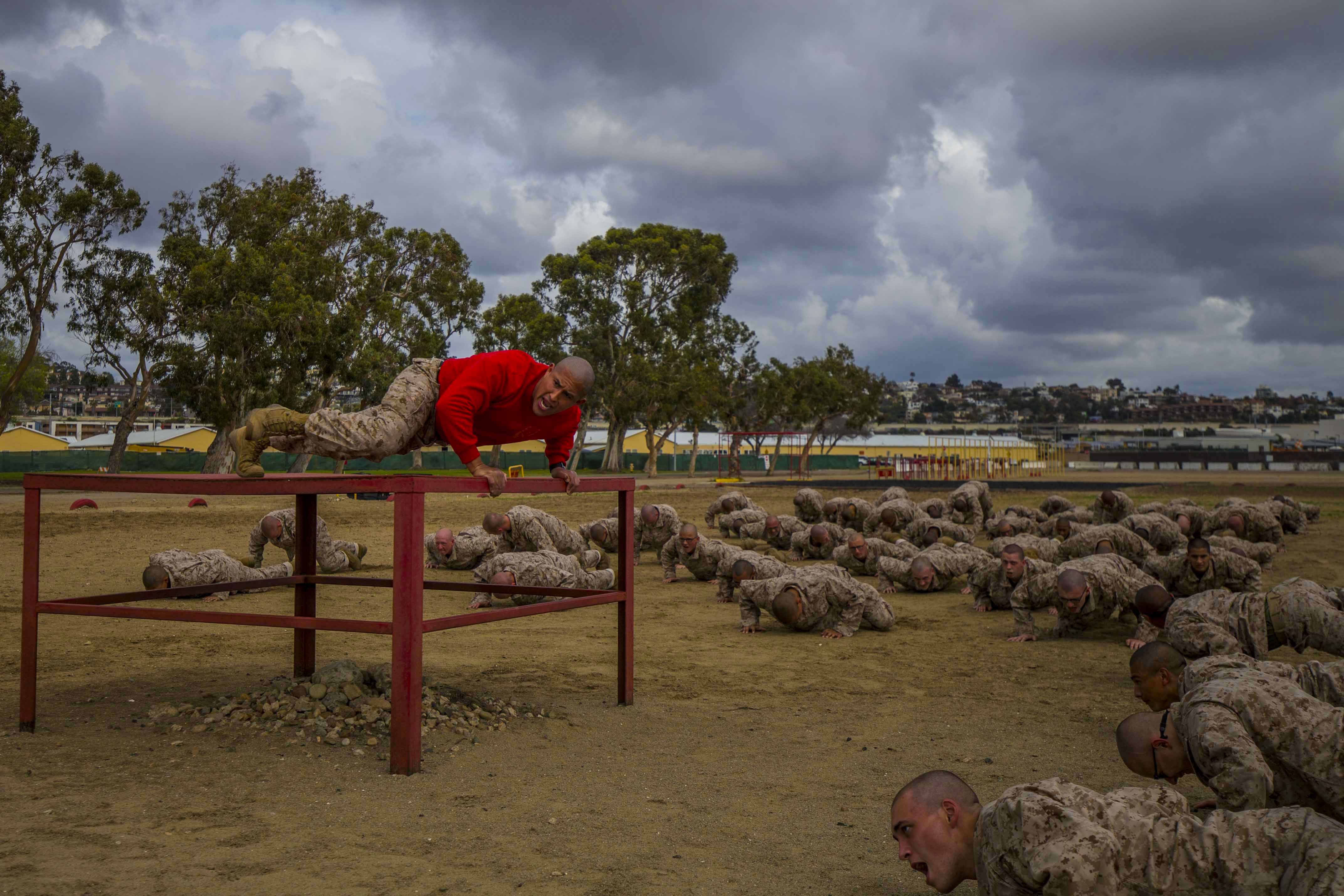
Combat Course


Marine Corps recruits participate in a combat conditioning course at Marine Corps Recruit Depot San Diego, March 10, 2021.

Site Survey


South Carolina National Guardsmen conduct site survey training to detect chemical threats and decontamination in Myrtle Beach, S.C., March 11, 2021.

Tactical Watch


Navy Petty Officer 2nd Class Javontae Kelley works as a tactical information coordinator during a ballistic missile defense scenario aboard the USS Curtis Wilbur in the East China Sea, March 15, 2021.

DOD Health System Archives COVID-19 Vaccination Data

 March 17, 2021 | BY Thomas Walsh , Military Health System

MHS GENESIS, the Defense Department's new electronic health record system, has recently created a large digital record of COVID-19 vaccinations administered to service members and their families.

Referred to as 'MassVax,' the digital archive will accurately track and ensure that the DOD's patient population has received COVID-19 vaccinations, considered essential to both a ready medical force and medically ready force.

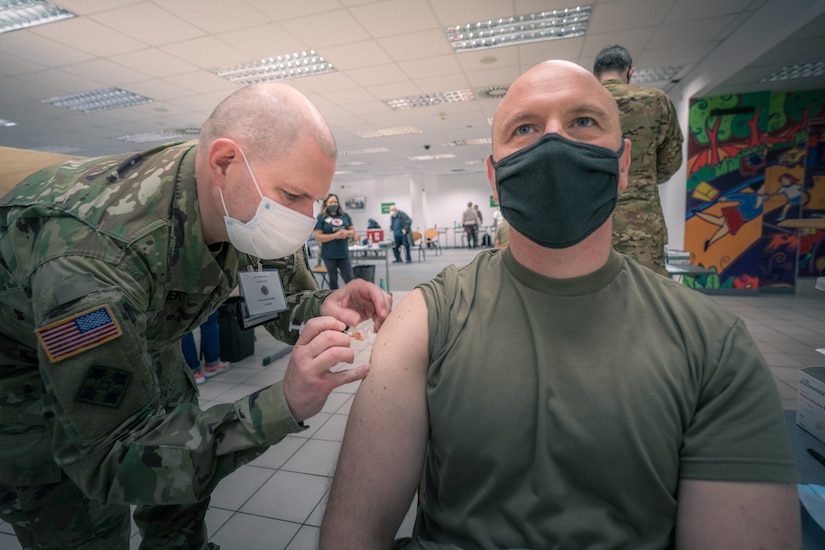
A soldier receives his final COVID-19 vaccine.

Air Force Col. (Dr.) Thomas Cantilina, chief health informatics officer for the Defense Health Agency, said the DOD partnered with Cerner Corp., the company that designed the still-evolving MHS GENESIS, to develop the new capability.

"MassVax is designed to help us quickly record who gave what vaccine, as well as when and where it was given," Cantilina said. "Additionally, and more importantly, MHS GENESIS and its MassVax capability have enhanced safety and efficiency at our COVID-19 vaccine sites, through its ability to provide clinicians with patient data related to drug and allergy interactions - prior to vaccines being administered."

There is plenty to keep track of. According to the Defense Department, as of March 5, 84% of vaccines received by the DOD have been administered, accounting for nearly 1.3 million total doses given at 335 sites; additionally, 81,256 vaccinations at retail pharmacies were administered to MHS beneficiaries. And the newly approved single-shot Janssen COVID-19 vaccine (also known as Johnson & Johnson) was being prepared for immediate DOD roll-out.

MassVax went live at Naval Hospital Twentynine Palms in California in September 2020, giving staff sufficient time to become proficient with the new system and recognize the powerful tool they had to administer vaccinations on a massive scale, touted Dave Marks, public affairs officer at NHTP. The facility supports the Marine Corps Air Ground Combat Center in the Mojave Desert, the largest Marine Corps base in the world.

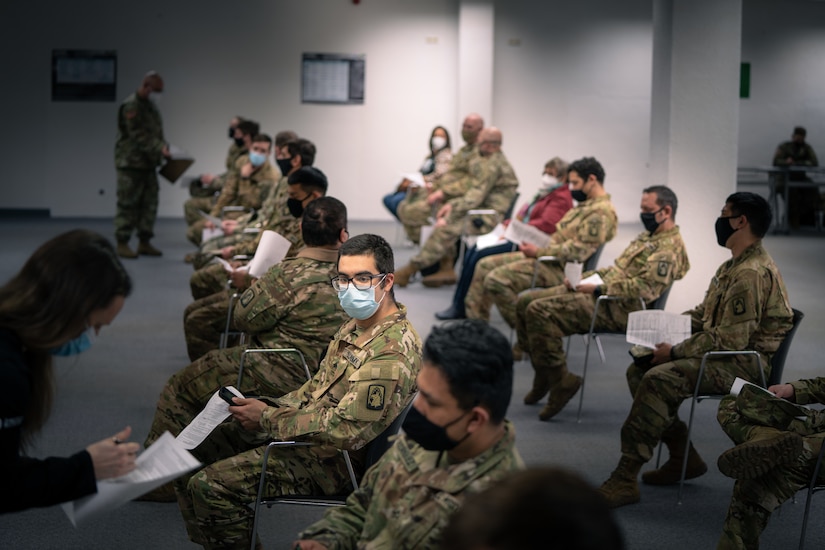
Soldiers are briefed before receiving the COVID-19 vaccine.


"Because an average Marine battalion is around 1,000 members strong, we needed something that was quick and efficient," Danielle Vasquez, a licensed vocational nurse and the Twentynine Palms COVID-19 vaccine program manager, said. "We've had great success with our through-put. We can vaccinate up to 150 [service members] per hour, and that's not even using MassVax at its full capability."

Developing, Pre- and Post-Pandemic

MassVax is speeding up the patient intake process by pre-populating registration data directly from a patient's electronic health record, or EHR, saving valuable time and allowing teams to focus on getting shots in arms, added Cantilina, who also serves as the Military Health System's deputy EHR functional champion. Patients have their identification cards scanned, rather than filling out traditional intake forms. Providers can quickly administer shots while scanning to record the exact moment a specific medication is given to a patient.

"As far as the post-pandemic use of MassVax is concerned, we not only plan on using it, but the capability was being developed for our use prior to the COVID-19 outbreak," he said. "In fact, our teams were particularly interested in using MassVax to facilitate the rapid administration of vaccines to troops preparing to deploy, as well as quickly administering vaccines to new recruits preparing for boot camp."

In its development cycle, MassVax is akin to the COVID-19 vaccines. The technologies to deliver similar products were in development long before March 2020 but were accelerated with additional resources set to respond to the pressing emergency of the deadly virus.

An Army doctor instructs soldiers who are waiting to be vaccinated.

Cantilina explained that because of the pandemic, certain MHS GENESIS deployment activities that required staff to travel to support training efforts or facilitate new hardware and software installations were paused. But teams found ways to execute the mission of deploying MHS GENESIS while also mitigating the risk of contracting or spreading COVID-19, he added. MHS GENESIS is on track to be fully deployed by the end of 2023. At that point, the end state will be a single health record for all service members, veterans, and their families.

MHS GENESIS helps health care workers by "making it easy to do the right thing," Cantilina explained. Since it has been configured at an enterprise level, the system "leverages standardized workflows in each clinical area of practice, whether you're a doctor, nurse or technician. This simplifies how our providers care for patients as the system is designed to walk them through certain aspects of each patient encounter."

Cantilina again emphasized how the system alerts medical professionals of potential risks with each patient, like drug interactions or allergies.

Vasquez was involved in the years-long planning that led up to the implementation of MHS GENESIS, and she already had experience with the new system from her prior employment at a civilian hospital.

 "I love it," she said. "I'm excited about having one military record for everyone. And I love that there's a patient portal available, especially since a lot of our families travel, and it's great for them to have access to their vaccination records and their actual patient history anywhere they go. It's amazing."

Fighting Fire


Airmen conduct fire training at Tyndall Air Force Base, Fla., Feb. 25, 2021.

COVID-19 Vaccines


The 109th Airlift Wing began administering COVID-19 vaccines in Scotia, N.Y., March 10, 2021. The vaccines are available to New York Army and Air National Guard members.

Quick COVID-19 Test


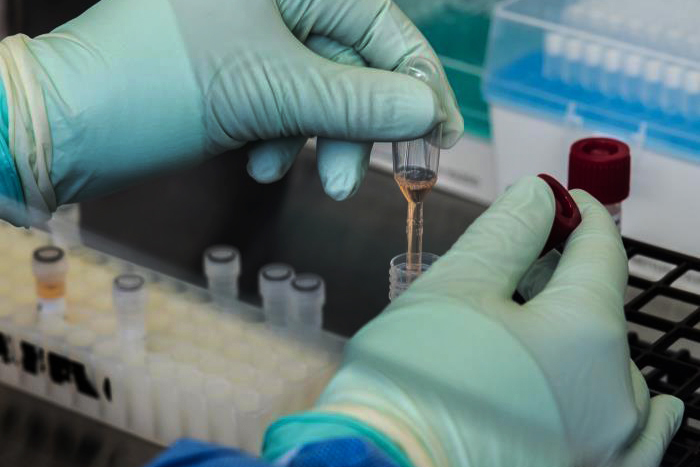
Free COVID-19 quick-tests are offered in Wiesbaden, Germany, March 15, 2021.

Tire Turnover


Marine Corps 2nd Lt. Riley Compton flips a tire Marine Corps Base Camp Pendleton, Calif., Feb. 11, 2021.

Preparing Vaccinations


Army 2nd Lt. Sharice Jones, an active-duty medical surgical nurse, assigned to the Brooke Army Medical Center, Fort Sam Houston, Tx.; Army 1st Lt. Erin Adelmann, an active-duty medical oncology nurse assigned to Walter Reed National Military Medical Center, Bethesda, Md.; and Army 1st Lt. Abigail Santora, an active-duty medical surgical nurse assigned to the Carl R. Darnall Army Medical Center, Fort Hood, Tx., prepare doses of the COVID-19 vaccine at the Fair Park Community Vaccination Center in Dallas, Tx., March 8, 2021. U.S. Northern Command, through U.S. Army North, remains committed to providing continued, flexible Defense Department support to the Federal Emergency Management Agency as part of the whole-of-government response to COVID-19.

Smoky Sokol


Soldiers participate in a live-fire exercise during Eagle Sokol at Pocek Range in Postojna, Slovenia, March 16, 2021. The bilateral training exercise with the Slovenian Armed Forces builds teamwork and readiness between NATO allies.

Slide for Life


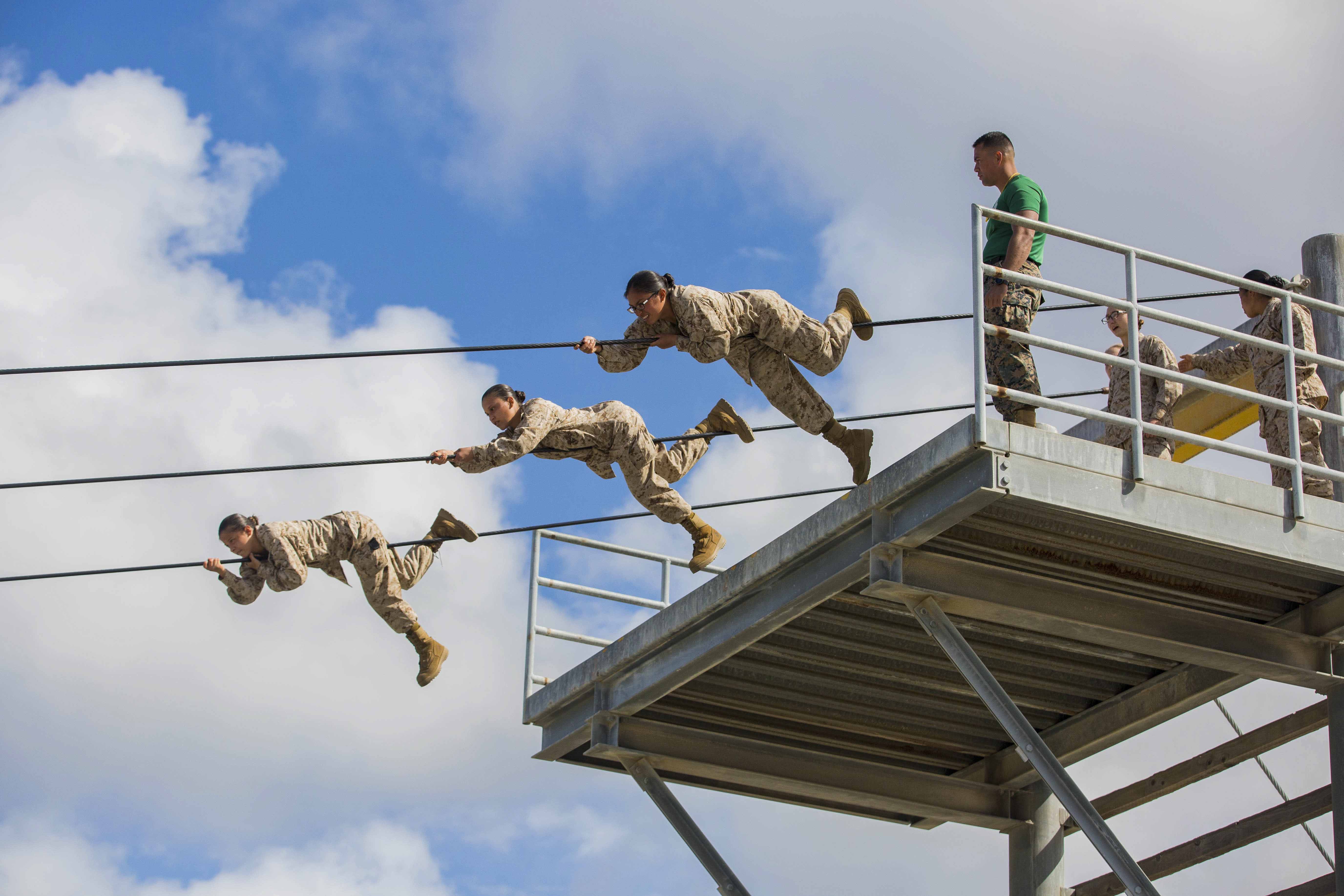
Marine Corps recruits take on the Slide for Life obstacle on a confidence course at Marine Corps Recruit Depot San Diego, March 9, 2021.

U.S., South Korean Defense Leaders Consult on Issues, Plan for Future of Alliance

 March 17, 2021 | BY Jim Garamone , DOD News

Secretary of Defense Lloyd J. Austin III reiterated America's ironclad commitment to the defense of the Republic of Korea in his first face-to-face meeting with South Korean Minister of National Defense Suh Wook today in Seoul.

The alliance was signed in 1953. South Korea had endured invasion and combat on its soil with millions of its citizens killed. 

The United States as part of the United Nations effort came to the aid of the nation. The peace and security that followed the armistice enabled the Republic of Korea to rebuild its nation and forge ahead to become a democracy and an economic powerhouse.

Two men stand at attention.

Austin said South Korea is "the linchpin" of peace, security and prosperity for Northeast Asia. "Our alliance is founded on shared interest and values and is among the most combined, interoperable, capable and dynamic bilateral alliances in the world," he said at the beginning of the meeting. "The ROK is also a critical partner for our shared priorities in the region. The principle among them is upholding the rules-based international order. You have become a key provider of security and stability in the Indo-Pacific region, and for that we are grateful."

The two defense leaders met on the eve of a larger meeting called the "Two-plus-Two" with Austin and Suh being joined by Secretary of State Antony J. Blinken and Minister of Foreign Affairs Chung Eui-yong. It is a measure of the importance of the region and the friendship between the two countries that these meetings take on added significance, said a senior defense official. This is the first official overseas trip by both Blinken and Austin.

Today's meeting concentrated on the military portion of the alliance. The two leaders reviewed the situation with North Korea, including the threat posed by North Korea's nuclear and missile programs, said the senior defense official. Both men agreed that this threat requires the continued vigilance of the alliance. 

American defense leaders ready for discussions with South Korean counterparts.

The alliance grew out of the Korean War and in the initial part of its history, was almost totally focused on deterring North Korea. While North Korea remains a threat, as South Korea rebuilt and became a regional power, the focus of the alliance has expanded to include the region. The two leaders spoke about the regional security environment beyond the Korean peninsula. These included China's actions to overturn the current rules-based system that has served the region so well since World War II, the official said. 

This broader regional focus means increasing the contact and interaction between the US-South Korea Alliance and other like-minded partners. The defense leaders spoke about the trilateral relationship among the United States, South Korea and Japan. They also spoke about cooperation with nations such as Australia, India, Malaysia and others. Engaging in multilateral relationships would allow the nations of the region to build a network dedicated to supporting the rule-based system in the Indo-Pacific, the official said. 

Austin also spoke frankly with his South Korean counterpart about the administration's Korean policy review. He wanted to consult with Suh because the secretary wants to get his observations, thoughts and input into that process. 

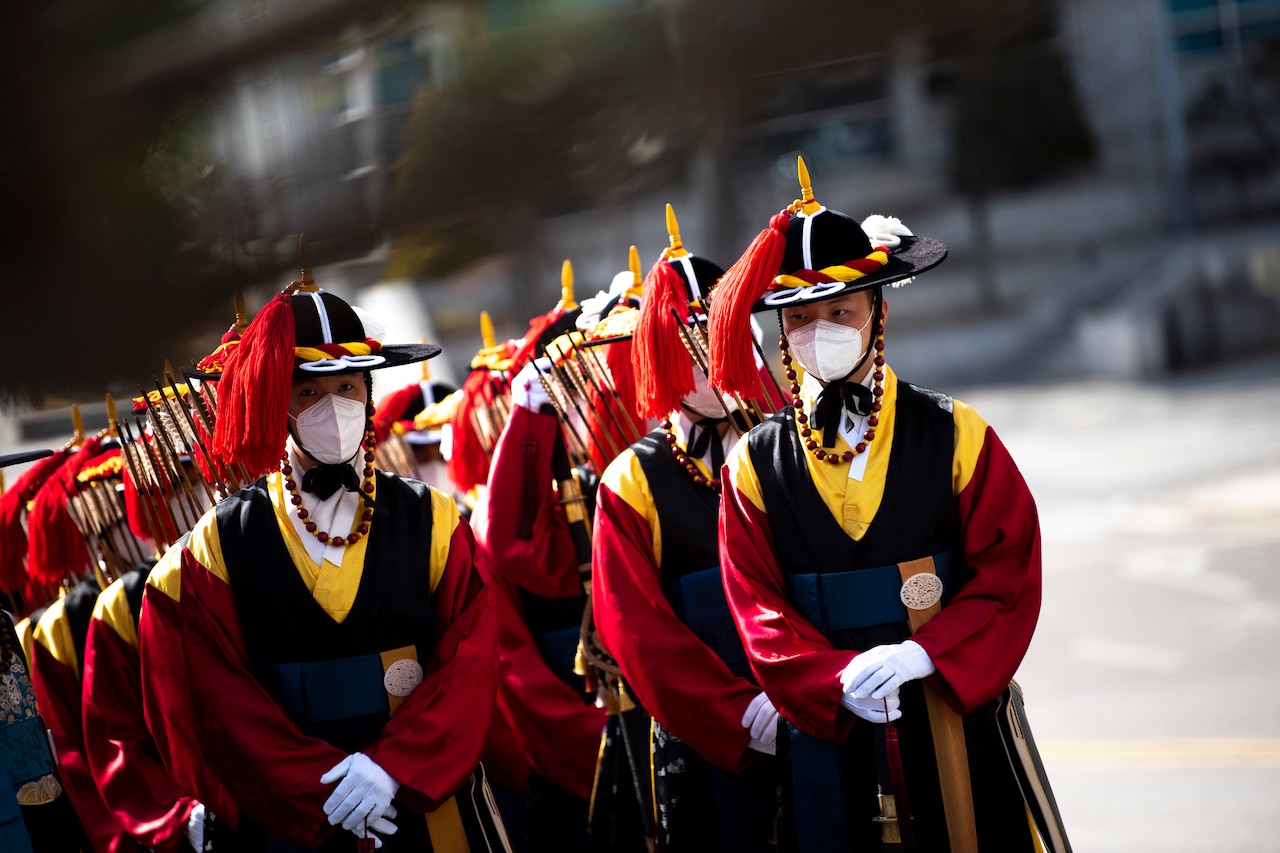
South Korean soldiers in period dress uniforms stand.

The two men discussed the readiness of the forces in South Korea especially in light of the COVID-19 pandemic. They discussed ways to increase readiness overall, and looked at the exercise program.

The North Korean border is just miles from the heart of Seoul. Long-range artillery, alone, could reach this vibrant city of 10 million. 

There are 28,000 American service members assigned in South Korea ready to help that country "fight tonight" if need be. There are many, many more on call, if the North tries to duplicate 1950.

Secretary of Defense Lloyd J. Austin III Remarks With Defense Minister Suh Wook of the Republic of Korea in Seoul, Korea

 March 17, 2021

Secretary of Defense Lloyd J. Austin III, Defense Minister Suh Wook of the Republic of Korea

DEFENSE MINISTER SUH WOOK (THROUGH TRANSLATOR):  First, I would like to extend my warmest welcome to Secretary Austin and the U.S. delegation on your visit to the Republic of Korea.  Despite the busy schedule and challenging circumstances including the COVID -19 pandemic.  Along the same lines, I again express my congratulations on the successful launch of the Biden administration and becoming the 28th United States secretary of defense.

This meeting is the first of its kind of the ROK minister of national defense and the U.S. secretary of defense at the start of the Biden administration, and it's also our first in-person meeting after our phone conversation a few months ago following your swearing in.

In that phone conversation, I remember your mentioning that you wanted -- you wanted for us to meet soon and construct close, bilateral cooperation between the Republic of Korea and the United States.  I thank you, Mr. Secretary, for following through on exactly those words in just over a couple months.  I believe such a quick visit to the Republic of Korea by you, Secretary Austin, resulted from the high value the Biden administration placed on our ROK-U.S. alliance.

For the ROK – U.S. alliance, born in the fire of the Korean War seven decades ago, forged in the blood shed together by our forefathers, both Korean and American.  Since then, the alliance has conquered this lynchpin of peace and stability for not only the Korean Peninsula, but also, Northeast Asia.  Our alliance continues to develop in a mutually-reciprocal manner following the start of the Biden administration.  Our bilateral coordination mechanisms have never been more robust, and will continue to be strengthened.

(Inaudible) paramount in the process of our alliance's development is the maintenance of combined defense posture, formidable deterrence against North Korea.  Going forward, the ROK and the U.S. will continue to further strengthen our bonds in the military alliance.  Furthermore, I am certain we'll continue to develop (inaudible), mutual complementary and future-oriented global alliance, expanding the horizons of our cooperation.

Mr. Secretary, due to the firm trust we built between you and me, and between the ROK minister of national defense and the U.S. Department of -- of Defense, I hope our great institutions will be able to contribute immensely with the Biden and the Moon Jae-in administrations to upgrade our alliance (inaudible).

I believe trust and cooperation are the core of the ROK-U.S. alliance's development.  I hope today's meeting will be a great start for the meaningful development of our alliance following the launch of the Biden White House.  At the same time, I also hope the ROK minister of national defense and the U.S. Department of Defense, based on our shared values and trust, will continue leading the way for reciprocal cooperation between our two countries.

One thing Secretary Austin and I have in common is that we both enjoyed long careers in the militaries of our respective nations.  By the end of today's meeting I hope, and certainly look forward to sharing much more in common with Mr. Secretary in many more areas.

Again, my warmest welcome to Secretary Austin.  Thank you very much.

SECRETARY OF DEFENSE LLOYD J. AUSTIN III:  Minister Suh and distinguished Korean friends, I am honored to be here with you in Seoul.  And at the outset, Mr. Suh, please convey my thanks to your wonderful troops, who -- who really provided a -- a tremendous show of professionalism for us upon our arrival.  We are very impressed.  They are marvelous.
And Minister Suh, thank you for your gracious hospitality during my first overseas trip as secretary of defense to the Republic of Korea.  Our commitment to the U.S.-ROK alliance, which has been steadfast for seven -- over 70 years, remains ironclad, and it is the linchpin of peace, security and prosperity for Northeast Asia, a free and open Indo-Pacific region and across the world.

Our alliance is founded on shared interest and values.  It is among the most combined interoperable, capable and dynamic bilateral alliances in the world.  The ROK is also a critical partner for our shared priorities in the region.  Principle among them is upholding the rules-based international order.  You have become a key provider of security and stability in the Indo-Pacific region, and for that, we are grateful.  Given the unprecedented challenges posed by both the Democratic People's Republic of Korea and China, the U.S.-ROK alliance has never been more important.

I am here today to reaffirm to the United States' commitment to the defense of the Republic of Korea.  You and I can both agree that military readiness is a top priority, and our combined readiness must ensure that we are ready to fight tonight, if needed.  And I look forward to discussing a range of strategic and operational issues that will prepare our alliance to address our shared challenges in the years ahead.

Tomorrow, I also look forward to the initialing of the new Special Measures Agreement.  Now, this agreement reflects our president's commitment to reinvigorating and modernizing our democratic alliances around the world to advance our shared security and prosperity.  The United States and the Republic of Korea have faced many challenges together over the past several decades.  We have risen to the occasion each time, driven by our mission to ensure the security and stability and prosperity of the Korean Peninsula and the Indo-Pacific region.  It is obvious that we still are.  Since its establishment in 1953, the U.S.-ROK alliance has proven strong and durable in the face of shifting global dynamics.  I am confident that we will remain focused on our mutual ironclad commitment to each other's security as we build upon our long-standing trust and friendship.  We will continue to go together into the future. “Katchi Kapshida”

TRANSLATOR:  We go together.

Serene Scene


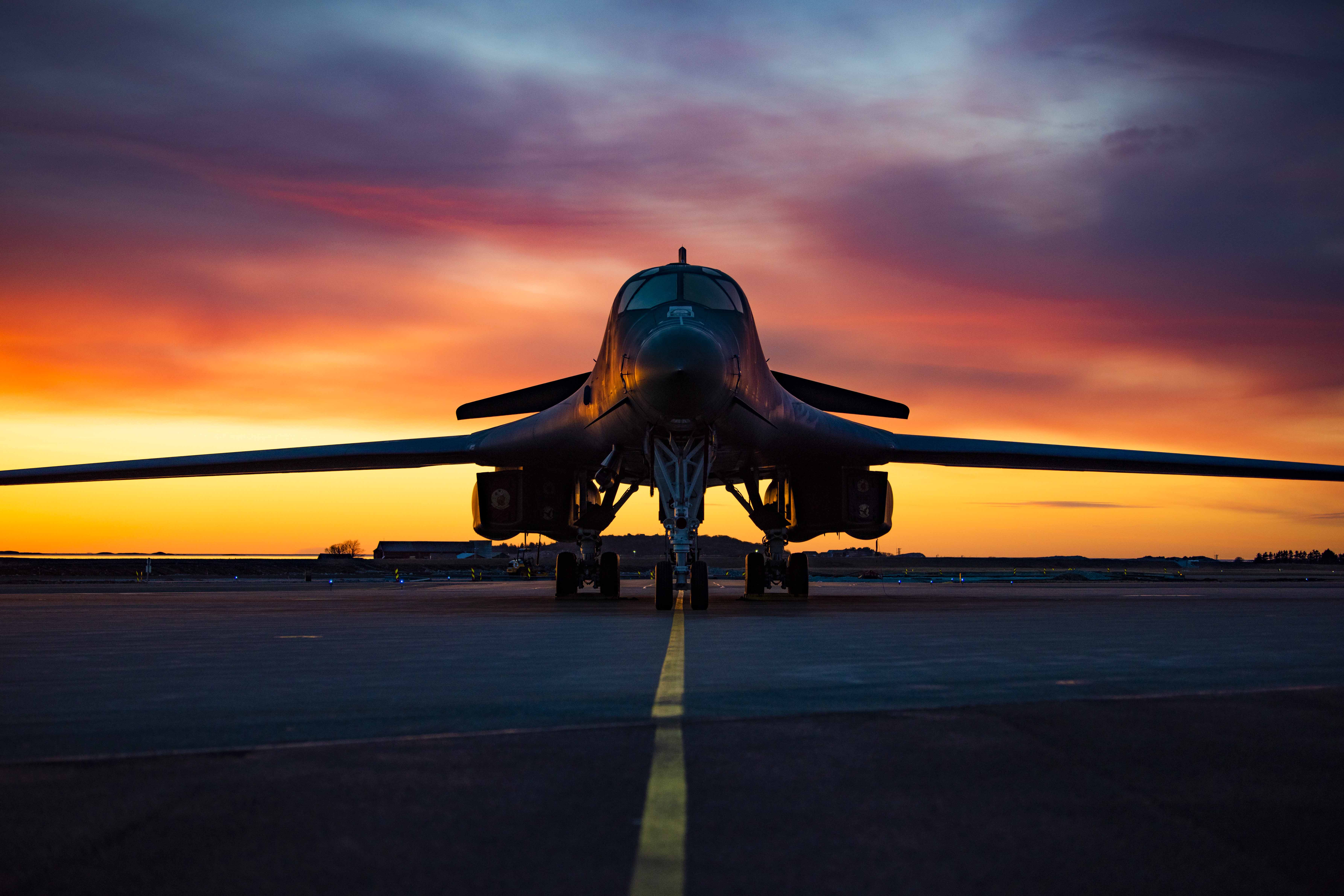
An Air Force B-1B Lancer sits on the flightline at Orland Air Force Station, Norway, March 14, 2021.

Tuesday, March 16, 2021

Ministry Meeting


Secretary of Defense Lloyd J. Austin III meets with Japanese Minister of Defense Nobuo Kishi at Japan’s Ministry of Defense in Tokyo, March 16, 2021.