Tuesday, March 16, 2021

Golden Gift


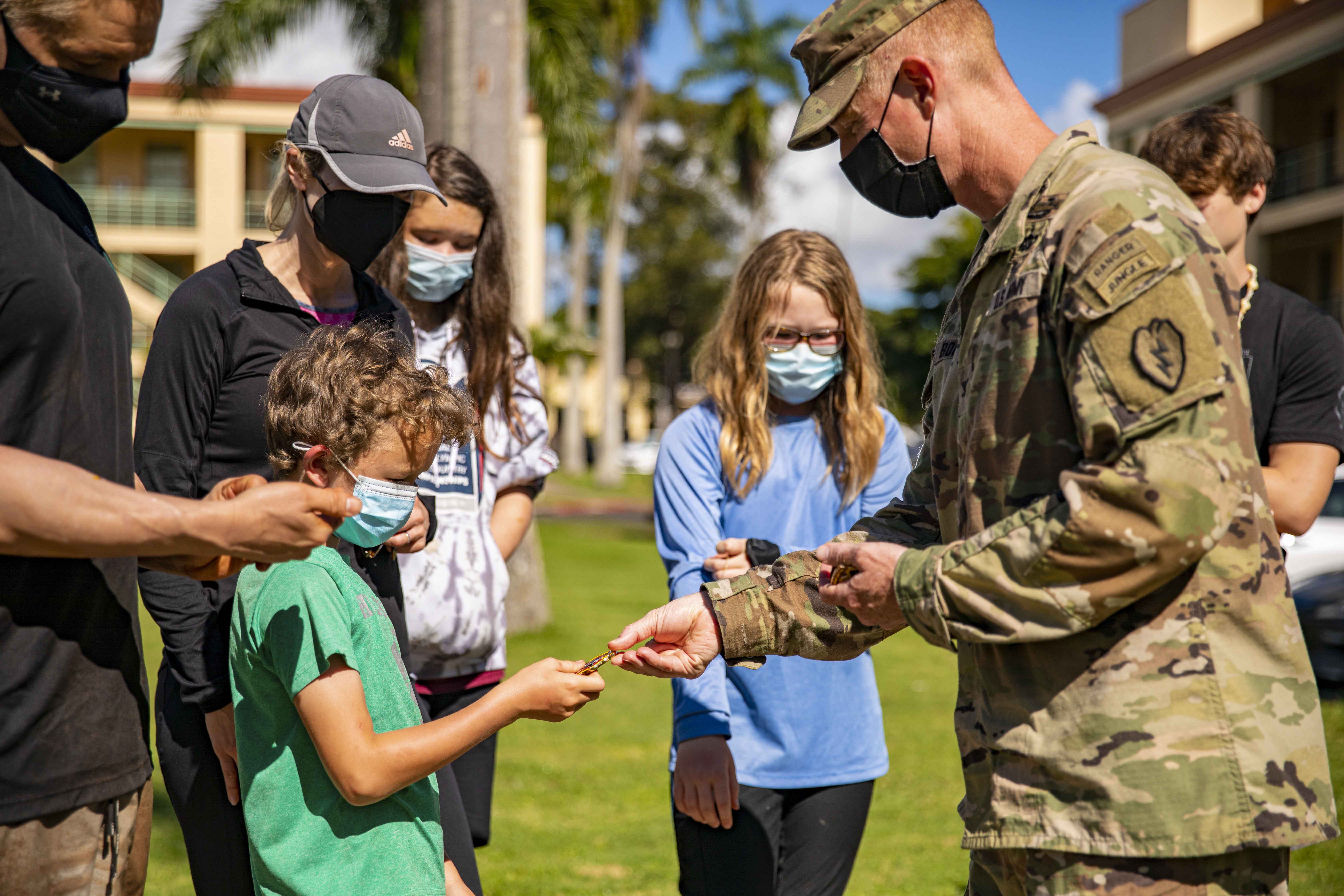
Army Col. Joshua Bookout gives a brigade coin to the child of Ed Ray, a Gold Star Family member, at Schofield Barracks, Hawaii, March 15, 2021. Ray’s twin brother, 1st Lt. Clovis T. Ray, died of wounds suffered during an enemy attack in Kunar province, Afghanistan, March 15, 2012.

Secretary Antony J. Blinken, Secretary of Defense Lloyd J. Austin III, Japanese Foreign Minister Toshimitsu Motegi, and Japanese Defense Minister Nobua Kishi at a Joint Press Availability

 March 16, 2021

Secretary Antony J. Blinken, Secretary of Defense Lloyd J. Austin III, Japanese Foreign Minister Toshimitsu Motegi, and Japanese Defense Minister Nobua Kishi

MODERATOR:  (Via interpreter) The ministers and secretaries will enter the room shortly.  Please stay seated.

We will begin the joint press conference of Japan-U.S. 2+2.  At the outset, Foreign Minister Motegi, State Secretary Blinken, Defense Minister Kishi, and Defense Secretary Austin will make remarks in that order to be followed by Q&A.

I now give the floor to Minister Motegi.  Please, go ahead.

FOREIGN MINISTER MOTEGI:  (Via interpreter) Thank you very much.  With Secretary Blinken, Secretary Austin, and Minister Kishi, we held the Japan-U.S. 2+2 and we were able to engage in extremely enriched and extensive exchange of views.  The two secretaries have been kind enough to come to Japan as the first destination of their overseas travel in their new duties under the new administration.  Again, my heartfelt gratitude.

As I mentioned at the outset of the meeting, the strategic environment of the Indo-Pacific has entered into a completely different dimension than where it used to be, and the importance of our alliance has never been elevated to such heights.  At this timing, when the Biden administration is engaged in a series of policy reviews, we were able to hold Japan-U.S. 2+2 to conduct in-depth discussion on the strategic environment and the policy towards strengthening the deterrence and response capabilities of our alliance.  It was extremely useful, and this was a strong manifestation of the robustness of our alliance.

At today’s 2+2, there were three major outcomes.  First, we were able to renew the unwavering commitment towards the alliance.  Based upon the notion that our alliance is the very foundation for regional peace, stability, and prosperity, we agreed that Japan and the United States will continue to collaborate with likeminded nations, including Australia and India, to promote a free and open Indo-Pacific.

Further, we reconfirmed the strong commitment of the United States regarding defense of Japan using all types of U.S. forces including nuclear.  Second, we conducted extensive discussion on the regional strategic environment on the situation in China.  We agreed on the recognition that China’s behavior, where inconsistent with the existing international order, presents various challenges to the alliance and the international community.  We remain opposed to any unilateral action that seeks to change the status quo, including in the East and South China Seas.  We share serious concerns over the China coast guard law.

On regional strategic environment, we reconfirmed the application of Article 5 of our security treaty on the Senkaku Islands and continued our – and confirmed our continued opposition to any unilateral action that seeks to undermine Japan’s administration of these islands.  Further, we confirmed the importance of peace and stability of the Taiwan Straits.

Further, as we strive for realization of complete denuclearization of North Korea, we confirmed the importance of complete implementation of UNSC resolutions and confirmed that cooperation will continue amongst the three countries Japan, U.S., and ROK, in addition to the bilateral cooperation with the United States.  Further, U.S. full support was gained after confirming the importance of early resolution of the abduction issue.

Thirdly, in light of this very difficult security environment, we agreed to further reinforce our collaboration for deterrence and response capability of the alliance.  Further, at the timing when various policy reviews are underway in the United States, we were able to meticulously coordinate the strategies and policies of both nations.  We confirmed that partnership will continue to bolster extended deterrence and confirmed the deepening of cross-domain cooperation including space and cyber.

At this 2+2, we also agreed on the importance of maintaining the deterrence of the alliance, and at the same time reducing the impact of the local community in Okinawa.  Especially in order to avoid the indefinite use of Futenma Air Station, we confirmed that construction of the replacement facility in Henoko is the only solution.  Further, I also again requested the U.S. side for safe operation and smooth response to incidents and accidents by paying maximum consideration to the impact to the local community by the USFJ.

And also, we made public a joint statement, and based upon the discussions and the joint statement, both governments will embark upon more specific work towards strengthening of our alliance, and then the next 2+2 will be held by the end of the year to confirm the outcome and deliverables.  I look forward to further achieving progress in our alliance with Secretary Blinken and Secretary Austin.

I now will hand over to Secretary Blinken, Minister Kishi, and Secretary Austin in that order.

SECRETARY BLINKEN:  Toshi, thank you so very much, and good afternoon, everyone.  I just want to start by thanking our hosts Foreign Minister Motegi, Defense Minister Kishi, and everyone behind the scenes who helped make this visit such a success.

I’m very pleased that we’ve been able to represent the United States alongside Secretary of Defense Austin, whose commitment to the security of our country and our allies is unsurpassed.  There’s a reason that he and I came to Japan for the first Cabinet-level, in-person, overseas travel of the Biden-Harris administration: because this alliance matters deeply to the United States and to Japan.  And after today, I feel very confident in saying it is stronger than ever.  Together, we’re addressing core security concerns, including North Korea’s nuclear weapons program and maritime security across the region as well.

We’re tackling other urgent issues facing our countries, including COVID-19, climate change, cyber security.  And in each of these areas, we are dealing together with issues that affect the lives of our citizens.  That’s our focus.  We’re also standing together in support of our shared values.  We believe in democracy and human rights, the rule of law, because we’ve seen how our own countries are stronger because we adhere to those values, and because they’re under threat in many places, including in this region.

In Burma, the military is attempting to overturn the results of a democratic election and is brutally repressing peaceful protesters.  And China uses coercion and aggression to systematically erode autonomy in Hong Kong, undercut democracy in Taiwan, abuse human rights in Xinjiang and Tibet, and assert maritime claims in the South China Sea that violate international law.

We’re united in the vision of a free and open Indo-Pacific region, where countries follow the rules, cooperate whenever they can, and resolve their differences peacefully.  And in particular, we will push back if necessary when China uses coercion or aggression to get its way.  As we’ve discussed today, the Indo-Pacific region is increasingly the center of global geopolitics.  It’s where so much of the history of the 21st century is going to be written.  There are competing visions for how that story should go.  Japan and the United States, together with our allies and partners, will be strong advocates for our shared approach, grounded in our values and our joint commitment to the security and well-being of all our people.

This will be the message we reiterate later this week in Seoul, when Secretary Austin and I will meet our counterparts in the Republic of Korea.  As we discussed today, greater trilateral cooperation among all three of our countries will make us stronger.  Secretary Austin and I are charged with ensuring that our national security and foreign policy delivers for the American people.  There’s no doubt that the work we’ve done today meets that test.  The people of the United States share bonds of friendship and family with the people of Japan.  We’ve stood together in tough times like 10 years ago, when the devastating 3/11 earthquake struck.  We join you now in remembering those who were lost.

And we look ahead.  We look ahead to the future together with confidence that the friendship between our countries will endure – but not only endure, it will grow.  And together, we will build a stronger, healthier future for all of our people.

Thank you for having us here today.

MODERATOR:  (Via interpreter) Minister Kishi.

DEFENSE MINISTER KISHI:  (Via interpreter) Yes, thank you very much.  At the outset, I would like to again extend our appreciations to the Operation Tomodachi by the U.S. forces as we commemorate the 10th anniversary of the Great East Japan Earthquake.  The Japanese people and the Self-Defense Force – land, ground, maritime, and air – will never forget the relief activities and humanitarian assistance by the U.S. forces.

It’s been two years since the last 2+2 meeting, and the security environment has greatly changed.  Furthermore, we are in the midst of our battle against the COVID-19 pandemic.  Despite that, in the surrounding areas of Japan and the Indo-Pacific, unilateral action that seeks to change the status quo by force and introduction of advanced military technology has not ceased.  In fact, these trends are accelerating, and in the midst of such security environment, the four ministers responsible for defense and foreign policy of the United States and Japan got together to reconfirm the importance of the alliance and agreed that we will be engaged in the bolstering of the alliance.  That was very meaningful.

At the meeting on regional strategic environment, I mentioned the China coast guard law that was enacted most recently and presented my strong concern of the increased activities of the China coast guard recently and stronger partnership with the military forces, and this was agreed by all four ministers.  We must not allow the coast guard law to undermine the legitimate interests of relevant nations, including Japan, and it is absolutely unacceptable if the law were to elevate tension in the waters, including the East China Sea and the South China Sea.

I am of the determination to protect Japanese territory by use of all means, and I also asserted the importance of peace and stability over the Taiwan Straits.

On the strengthening of deterrence and response capability of the alliance, in order to strengthen our defense and to bolster our alliance, I explained that we continue to build up multi-domain defense force under the National Defense Program Guidelines.  Further, since cross-domain initiatives are important in our relationship, we agreed to further promote cooperation in the domains of space and cyber.  With difficulty in the security environment increasing, in order for the U.S. forces and the Self-Defense Force to serve their missions, we agreed on the notion of the necessity to engage in more sophisticated bilateral as well as multilateral exercises.

The U.S. forces and Self-Defense Force gaining high capability through exercises and demonstrating that they are acting together are important from the perspective of deterrence and response capability of our alliance.  That is my view.

On the transformation of the U.S. forces, the four ministers welcomed the progress and reconfirmed that the current agreement will be implemented.  On the construction of the Futenma Replacement Facility, we again confirmed that relocation to Henoko is the only solution to avoid the indefinite use of Futenma Air Station.  I also briefed them on the progress of landfill, and the four ministers agreed that we will work hard for early completion of the work.

In addition, I also updated my colleagues on the progress in the FCLP facilities.  Based upon the discussions that have taken place today, I look forward to further bolstering the deterrence and response capability of our alliance with Secretary Austin and Secretary Blinken.  While the administration is still young, the secretaries have been kind enough to visit us physically despite the pandemic.  And again, my deepest appreciations to the two secretaries.

SECRETARY AUSTIN:  Well, thank you all for coming.  I’d like to start by thanking Minister Motegi and Minister Kishi for being gracious hosts.  And I thank the Japanese people for their incredibly warm hospitality.

I’d also like to thank Secretary Blinken for his leadership and for the opportunity to work together as we share President Biden’s message of our strong commitment to reinvigorating our alliances and partnerships around the globe.

The U.S.-Japan Alliance in particular is a cornerstone of our Indo-Pacific strategy, and is absolutely critical in supporting a free and open region.  And today’s 2+2 engagement charts an effective course for our alliance, and I was pleased with our discussions on how we can further strengthen our bonds to seize the opportunities and address the challenges that we face together.

As you have heard, we spoke on a number of issues, to include our commitment to the denuclearization of North Korea, and enhancing alliance capabilities across all domains, and addressing aggressive and coercive behaviors from China, especially in the South and East China Seas.

I know Japan shares our concerns with China’s destabilizing actions, and as I have said before, China is a pacing challenge for the Department of Defense.  And we know that competing in today’s shifting global dynamics can only be done through the spirit of teamwork and cooperation, which are the hallmarks of our alliance with Japan.

Our alliance remains resolute and resilient because of our shared values and history of shared sacrifices.  Ten years ago, the Japanese people suffered a disaster of terrifying magnitude during the 3/11 East Japan Earthquake.  And U.S. and Japanese forces embodied the spirit of friendship that underpins our alliance in the ensuing Operation Tomodachi.  And in the decade since, we have made great strides in strengthening the bonds between our people.

And so as we stand by Japan during this moment of remembrance, I also offered my deepest condolences to Minister Kishi for the tragic accident in February where both of our nations lost two brave service members near Montgomery, Alabama.  It is indeed a sober reminder of the sacrifices our men and women in uniform make defending our nations.

And so today I want to thank the thousands of our service members who are standing shoulder-to-shoulder and arm-in-arm with their Japanese counterparts.  They all work tirelessly to preserve peace and stability in this part of the world.  And thanks to them and their families, we will always operate from a position of strength, ever ready to back up the hard work of diplomacy.  Thank you.

MODERATOR:  (Via interpreter) Thank you very much.  We now accept questions.  When appointed, please proceed to the microphone, identify yourself and your affiliation, and specify to whom you are asking the question.  Please be brief in asking the question.

First of all, we will accept a question from the Japanese press.  Yomiuri newspaper, Nishida-san, please.

QUESTION:  (Via interpreter) Nishida of Yomiuri newspaper.  Thank you very much.

I have a question to Minister Motegi:  With the security environment in East Asia becoming harsher, there are voices seeking Japan’s contribution towards regional peace and stability.  What kind of specific discussion took place on the alliance?  And what specific contribution is the Japanese Government planning to make?

FOREIGN MINISTER MOTEGI:  (Via interpreter) At today’s 2+2, based upon the recognition that our alliance is the very foundation of the regional peace, stability, and prosperity, we renewed our unwavering commitment to the alliance and agreed to deepen our partnership towards bolstering the deterrence and response capability of our alliance in light of the difficult security environment.

Which side bears what?  Rather than such a topic, in order to respond to such difficult circumstances, what roles should Japan and the United States play?  That was more of a focal point as we try to coordinate our views.  Specifically, as various policy reviews are underway in the United States, we agreed to meticulously coordinate our strategies and policies and measures, and to deepen cross-domain cooperation, including the space and cyber domains, and to strengthen collaboration to bolster extended deterrence, and engage in practical drills and exercises from the perspective of maintaining operational readiness and deterrence.

On top of that, we discussed not only regional situation, but challenges faced by the international community.  Free and open Indo-Pacific must be realized.  Climate change, COVID-19 pandemic – these are the challenges the global community faces.  Japan and the United States must exercise leadership, and we need to also partner up with likeminded nations against those global challenges.

Based upon today’s discussion and the joint statement, more concrete tasks will be embarked upon for the strengthening of our alliance.  We will continue to work hard for further strengthening of the deterrence and response capability of our alliance, and based upon the vision of free and open Indo-Pacific, we will engage in the promotion of rules-based international order.

Secretary Blinken, Secretary Austin, they have chosen Japan as the first destination in their current duties, and I think it was an important 2+2 that matched up the importance of their travel to Japan.

MODERATOR:  (Via interpreter) Thank you very much.  Next, we will accept a question from the U.S. press.

MR PRICE:  We will go to Humeyra Pamuk of Reuters, please.

QUESTION:  Hello.  Mr. Secretary Blinken, Secretary Austin, is there a new credible – an increased threat by China not just to Senkaku Islands but also Taiwan?  And if so, what is the U.S. doing about it, given Japanese defense minister just spoke about specific initiatives that Japan and U.S. should work on to boost deterrence?

And for the Japanese foreign minister, if I may, how should this issue be addressed in U.S. meetings later this week in Alaska?

And if I may very quickly, for Secretary Blinken, the sister of the North Korean leader issued a threatening statement.  She said if U.S. “wants to sleep in peace for” the “coming four years, it had better refrain from causing a stink at its first step.”  Given that the North Koreans have so far resisted talking to the Biden administration, what does this portend for future negotiations?  Thank you.

SECRETARY BLINKEN:  I’m happy to start on your last question and then turn to Lloyd to start on China, if you like.  Let me say that I’m familiar with the comments you referenced, but the comments I’m actually most interested in today are those of our allies and partners.  That’s why we’ve come to this region.  That’s why we’ve come to Japan, precisely to listen to our allies and to discuss how collectively we might seek to address the threat from North Korea.

This engagement is a task that I actually started on my first day in office when I spoke to Toshi, I spoke to my South Korean counterpart.  And I prioritized those calls precisely because we so value their input and know the importance of these alliances across every challenge and opportunity we face, including dealing with the DPRK.  We’ve engaged bilaterally with our Japanese and South Korean allies when it comes to North Korea.  We’ve also done it trilaterally, and that continued trilateral engagement and cooperation will be, in my judgment, very important going forward.  We have no greater strategic advantage when it comes to North Korea than this alliance, and we’ll approach that challenge as an alliance.  And we’ve got to do that if we’re going to be effective.

This is all, by the way, part and parcel of a review that we’ve been undertaking.  And as we’ve said, it’s a thorough interagency review of U.S. policy toward North Korea, including evaluation of all available options to address the increasing threat posed by North Korea to its neighbors and the broader international community.  It has integrated a very diverse set of voices from throughout the government and incorporated inputs from thinktanks, outside experts, including former government officials.

To reduce the risks of escalation, we reached out to the North Korean Government through several channels starting in mid-February, including in New York. To date, we have not received a response from Pyongyang.  This follows over a year without active dialogue with North Korea, despite multiple attempts by the United States to engage.  We look forward to completing the policy review in the coming weeks, and we’ll continue to be in very close touch with Japan with Korea, our partners, as we do so.

SECRETARY AUSTIN:  So with respect to China and the threat that China poses, you’ve heard me say on a number of occasions that China is the pacing threat that our Department of Defense will continue to focus on.  For the last two decades, we’ve been focused on – necessarily focused on issues in the Middle East, and while we were focused on issues in the Middle East, China has modernized its military.  In addition to that, it has engaged in aggressive and in some cases coercive behavior, and some of that behavior has been directed against our allies in the region.

And so our goal is to make sure that we maintain a competitive edge over China or anyone else that would want to threaten us or our alliance, and that we develop the operational plans and capabilities to be able to deter any aggressor, China or anyone else, that would want to take us or the alliance on.  And so, our – part of our strength, a big part of our strength, comes from the fact that we operate as an alliance, and we benefit from the great value that countries such as Japan bring to the to the alliance, and so we are much stronger when we operate as a team.

MODERATOR:  (Via interpreter)  Thank you very much.  We will accept one more question from the Japanese press.  Kato-san, please.

QUESTION:  (Via interpreter)  Thank you very much.  TV Tokyo, Kato.  I am with the MOD Press Club.  I have a question to Minister Kishi.  Including the entry into force of the coast guard law, China is becoming more assertive at sea.  What kind of recognition was shared by both nations that led to today’s joint statement?  You said that you will aim for increased deterrence and response capabilities, but as Chinese coast guard vessels become more active around the Senkaku Islands, did you talk about countermeasures like joint exercises between SDF and U.S. forces?

DEFENSE MINISTER KISHI:  (Via interpreter)  At today’s 2+2, in light of the difficult security environment, we exchanged views on the updated situation in the area, including the Indo-Pacific, especially the Chinese activities inconsistent with the existing international law is a political, economic, or military and technological challenge to the international community, and we agreed on such recognition.  Rules-based international order is undermined and coercive action in the region must be opposed, and we were able to confirm our position.

Around the Senkaku Islands, Chinese coast guard vessels take – conducting activities which is a clear breach of international law.  At the 2+2, we shared the deep concern over the coast guard law.  And I reaffirmed my determination to protect the Japanese territory by all means, and the United States mentioned that Article V of the Japan-U.S. Security Treaty applies to the Senkaku Islands, and we were able to confirm the commitment to the defense of Japan.

Deterrence and response capability must be strengthened, and for that purpose, through exercises by U.S. forces and SDF, a high level of capabilities must be gained.  And yesterday at East China Sea, the air Self-Defense Force and U.S. forces did joint exercises, and also in the south western area, many joint exercises have been conducted.  And we will with certainty, steadfastly conduct such joint exercises and demonstrate to the general public that Japan and the U.S. are acting together.

MODERATOR:  (Via interpreter)  Thank you very much.  We have surpassed the allocated time and the next question will be the final question.  U.S. press, please.

MR PRICE:  Great.  Our final question will go to Dan Lemothe, please.

QUESTION:  Good evening.  Thank you for your time today, and Japan, thank you for having us.  Secretary Austin, if I could, the top officer in the Pacific, Admiral Davidson, said last week that he is concerned about the Chinese military launching an operation potentially within the next six years on Taiwan.  Do you agree with that assessment?  And what would you say to those who raise concerns that the United States military simply isn’t moving fast enough to counter China?

Secretary Blinken, if I could, in light of the Kim regime’s unwillingness to respond to attempts at dialogue and their continued threats, what will the Biden administration do in coming weeks and months to balance diplomacy with continued military cooperation and exercises in the region?  Thank you.

SECRETARY AUSTIN:  Thanks, Dan.  As you know, en route to Japan, I stopped in to visit with the INDOPACOM commander, and we had a great conversation.  And it was very useful for me to, again, see the region through his eyes and listen to what his concerns were and talk about what his strengths were as well.  And one of the strengths, of course, is this great alliance that we’ve been discussing today.

In terms of the time – specific timeline of China, I won’t get involved in any kind of hypotheticals or speculate on what that might be.  I think you know that as Secretary of Defense, my job is to make sure that we are as ready as fast as we could possibly be to meet any challenge that would face us or the alliance.  And so in my view, we cannot move fast enough to develop the right capabilities to be relevant today and to be relevant tomorrow in any kind of future scenario.  But again, in terms of specific timelines, I won’t speculate on that.

SECRETARY BLINKEN: Thank you.  And as you know, the North Korea policy is under review.  We’re looking at whether various additional pressure measures could be effective, whether there are diplomatic paths that makes sense.  All of that is under review, and it’s under review and close consultation with our allies and partners.

Going forward, we have a shared determination to deal with the challenge posed by North Korea, particularly when it comes to its nuclear missile programs, as well, of course, as its abuse of human rights.  And we stand in very strong solidarity with Japan when it comes to the abductees.  Earlier today, I received a letter from the families.  It was very powerful and very moving to read, and that too is very much present in our minds as we think about the challenge posed by North Korea.

SECRETARY AUSTIN:  Thank you.

MODERATOR:  (Via interpreter)  Thank you very much.  That concludes the joint press conference.
U.S., Japanese Leaders Agree Chinese Behavior Endangers Peace

 March 16, 2021 | BY Jim Garamone , DOD News

U.S. and Japanese defense and foreign affairs leaders agreed today that China's behavior has become more aggressive, and the U.S. and Japan will work together to counter China's destabilizing efforts.

Secretary of State Antony Blinken and Secretary of Defense Lloyd J. Austin III traveled to Tokyo as the first trip outside the United States by Biden administration officials. They met with Japanese Foreign Minister Toshimitsu Motegi and Defense Minister Nobuo Kishi in the so-called "two-plus-two" meetings hosted by Motegi. They later met with Japanese Prime Minister Yoshihide Suga.

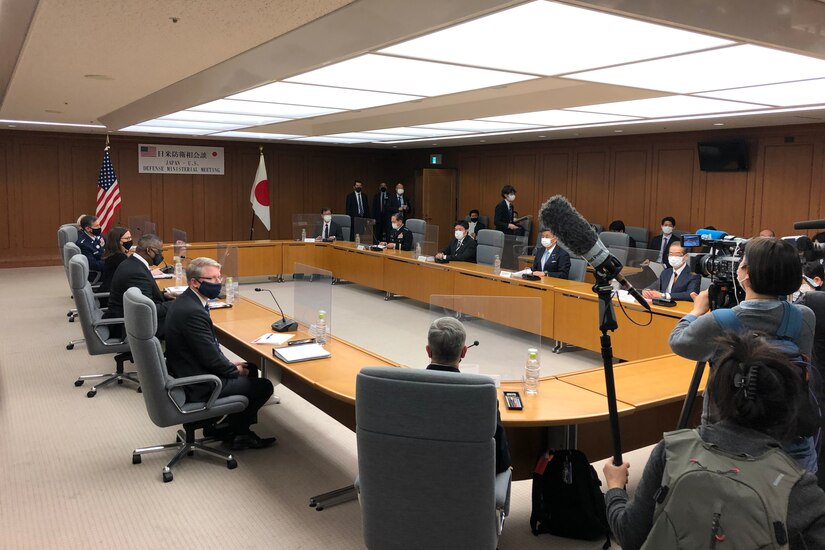
People sit around a large table.

All four men said they were pleased by the talks and stated that the alliance is strong and that their decisions will further strengthen it.

Austin emphasized the teamwork inherent in the alliance, and said the alliance system is the best way to confront China's "coarsening" behavior. "I was pleased with our discussions on how we can further strengthen our bonds to seize the opportunities and address the challenges that we face together," he said during a press conference following the meeting. "We spoke on a number of issues to include our commitment to the denuclearization of North Korea, and enhancing alliance capabilities across all domains, and addressing aggressive and coarsened behaviors from China — especially in the South and East China Seas."

Without question, the U.S.-Japan alliance remains a cornerstone in addressing today's and tomorrow's challenges as we work together to uphold a free and open Indo-Pacific."
Lloyd J. Austin III, Secretary of Defense

Japan shares the U.S. concerns about China's destabilizing actions. "China is the pacing challenge for the Department of Defense," he said. "And we know that competing in today's shifting global dynamics can only be done through the spirit of teamwork and cooperation, which are the hallmarks of our alliance with Japan."

Motegi said the strategic situation in the region is completely different from what it was just a few short years ago. It makes the U.S.-Japan Alliance, signed in 1960, even more important.

The Japanese are concerned about China's aggressive actions in the Taiwan Strait and brought up the situation in the meeting, said a senior defense official. The Japanese are also concerned about a recent Chinese law authorizing the Chinese coast guard to patrol the Senkaku Islands, which both China and Japan claim. U.S. officials reiterated that the Senkakus come under Article 5 of the U.S.-Japan treaty mandating America's defense of Japan. 

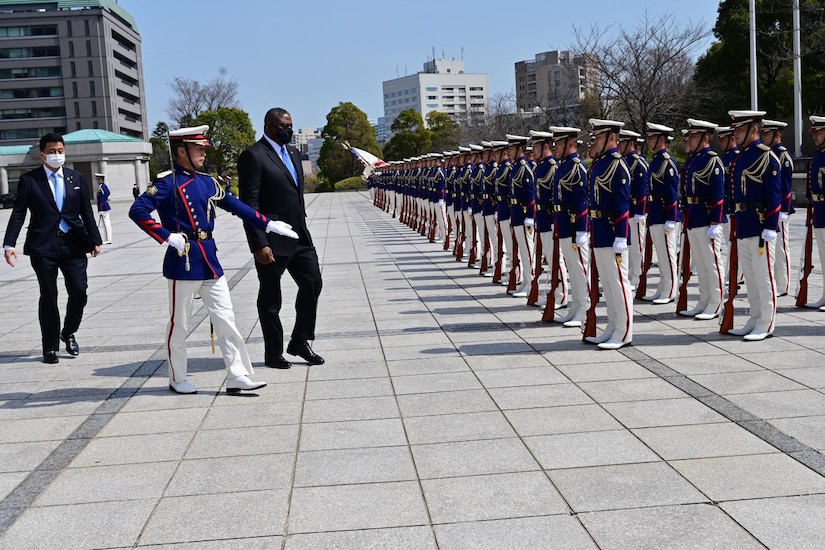
A soldier escorts a man in front of a military formation.

"We remain opposed to any unilateral action that seeks to change the status quo, including in the eastern South China Seas,” Motegi said.

Blinken and Motegi called the U.S.-Japan alliance the very foundation of regional peace and stability. "We agree that Japan and the United States will continue to collaborate with like-minded nations — including Australia and India — to promote a free and open Indo-Pacific," Motegi said. "Further, we reconfirmed that the strong commitment of the United States regarding defense of Japan using all types of U.S. forces, including nuclear."

It has been two years since the last set of meetings, and the ministers addressed new topics, which included COVID-19, climate change, cybersecurity and more. Each issue affects the citizens of both nations, Blinken said. "We're also standing together in support of our shared values," the secretary said. "We believe in democracy and human rights [and] the rule of law because we've seen how our own countries are stronger because we adhere to those values — and because they're under threat in many places, including in this region."

Blinken said China uses coercion and aggression to systematically erode autonomy in Hong Kong, undercut democracy in Taiwan, abuse human rights in Xinjiang province and Tibet, and assert maritime claims in the South China Sea that violate international law. 

"We're united in the vision of a free and open Indo-Pacific region where countries follow the rules, cooperate whenever they can, and resolve their differences peacefully," Blinken said. "We will push back, if necessary, when China uses coercion and aggressions, to get its way."

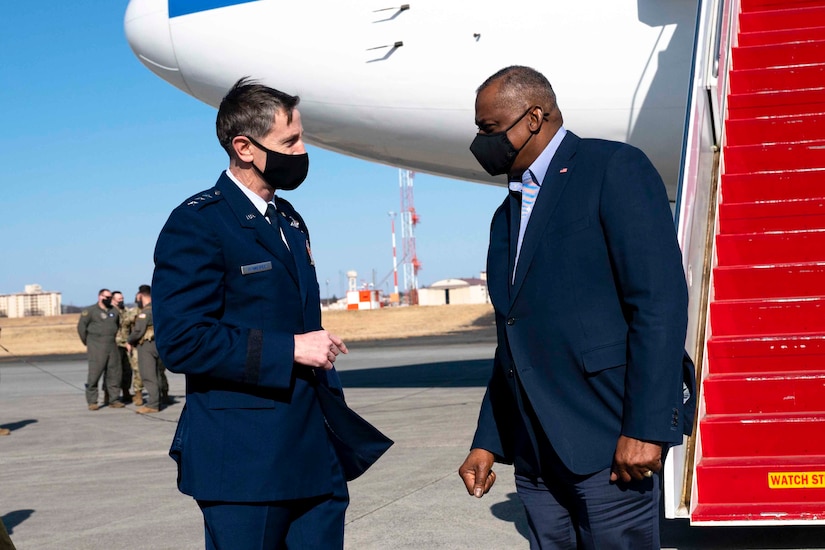
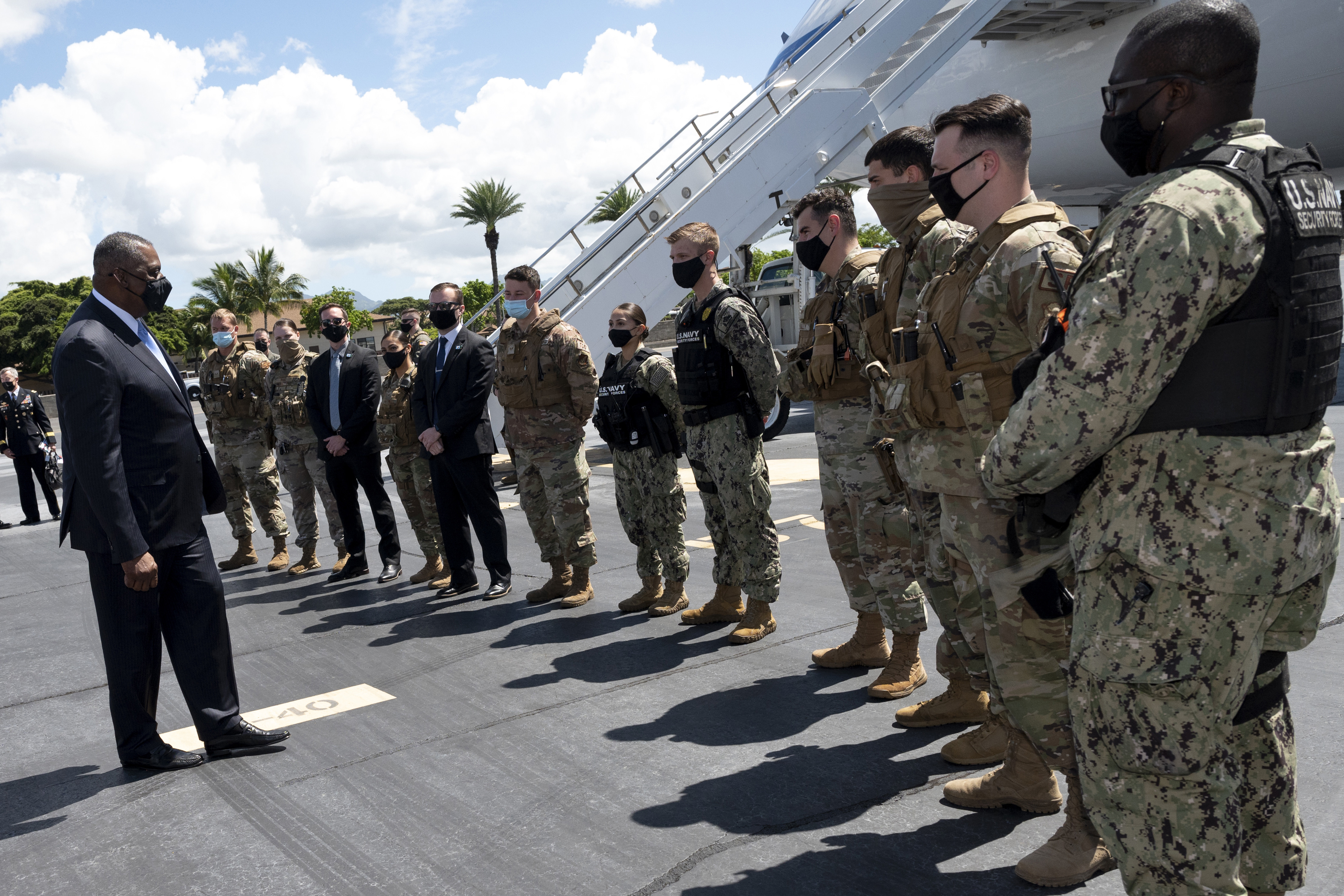
Secretary of Defense Lloyd J. Austin III stands facing an airman in front of a plane on a flightline.

The region is the priority theater for the Defense Department. In addition to China, Defense officials said North Korea is still trying to build up its military and developing nuclear weapons and the means to deliver them. Blinken said it is becoming the center of global geopolitics. "It's where so much of the history of the 21st century is going to be written," he said. "There are competing visions for how that story should go. Japan and the United States, together with our allies and partners, will be strong advocates for our shared approach, grounded in our values and our joint commitment to the security and well-being of all our people."

For U.S. service members in Japan, the discussions will mean more exercises with Japan's self-defense force. "In order for the U.S. forces and the self-defense force to serve the missions, we agreed on the notion of the necessity to engage in more sophisticated bilateral, as well as many multilateral exercises," Defense Minister Kishi said. 

"Today, our alliance forges on, resolute and resilient in the face of our shared challenges," Austin said. "Without question, the U.S.-Japan alliance remains a cornerstone in addressing today's and tomorrow's challenges as we work together to uphold a free and open Indo-Pacific. I am confident that working together we can meet any challenge and outmatch any competitor in the years ahead."

Recruit Inspection


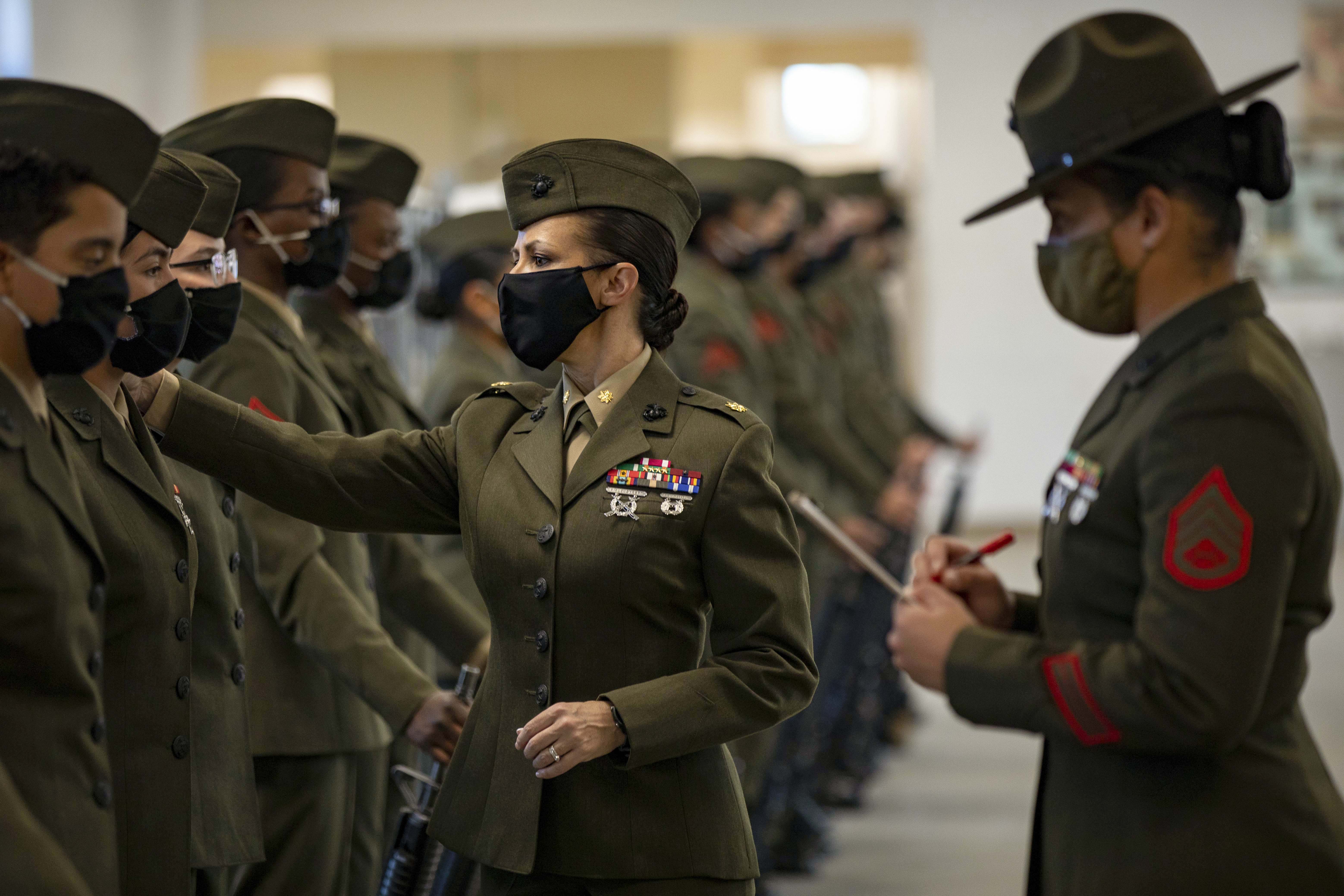
Marine Corps Maj. Angela Youmans inspects recruits during training at Marine Corps Recruit Depot Parris Island, S.C. March 5, 2021.

Corps Castaway


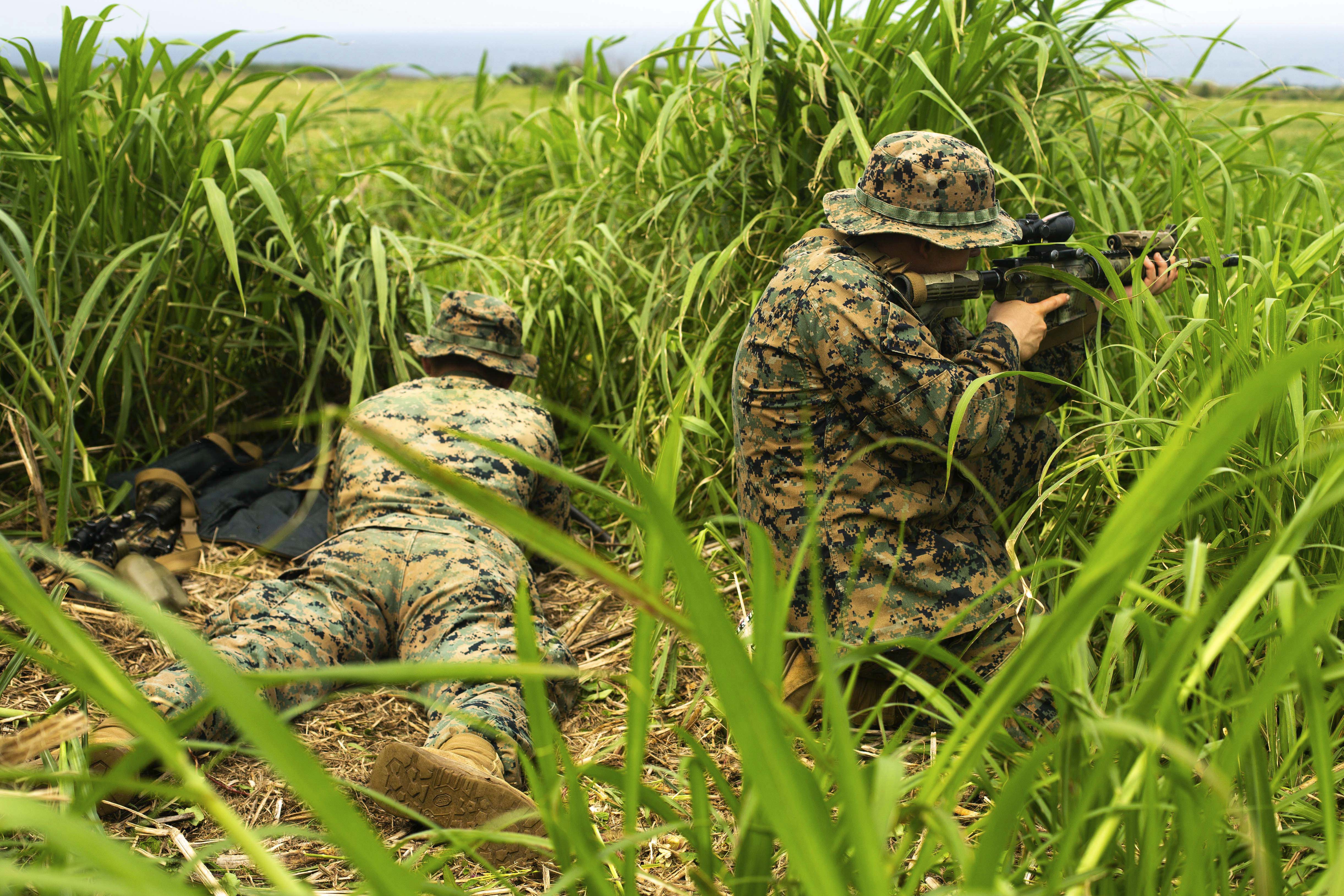
Marine Corps Lance Cpls. Clayton Takacs and Tyler Crawford fire weapons during Castaway 21.1 at Ie Shima, Okinawa, Japan, March 12, 2021. Marines train to integrate with the joint force to seize and defend key maritime terrain, provide low-signature sustainment and execute long-range precision fires to support naval operations.

Rapid Rescue


Coast Guardsmen pull Army Sgt. Maj. Mario Terenas to shore on a rapid deployment craft during winter rescue training at the Alexandria Bay Coast Guard Station, N.Y., March 1, 2021.

Stop the Shot


Army Pfc. Arylle Bryant blocks a shot during a basketball tournament at Camp Humphreys, South Korea, March 13, 2021.

Signaling in Silhouette


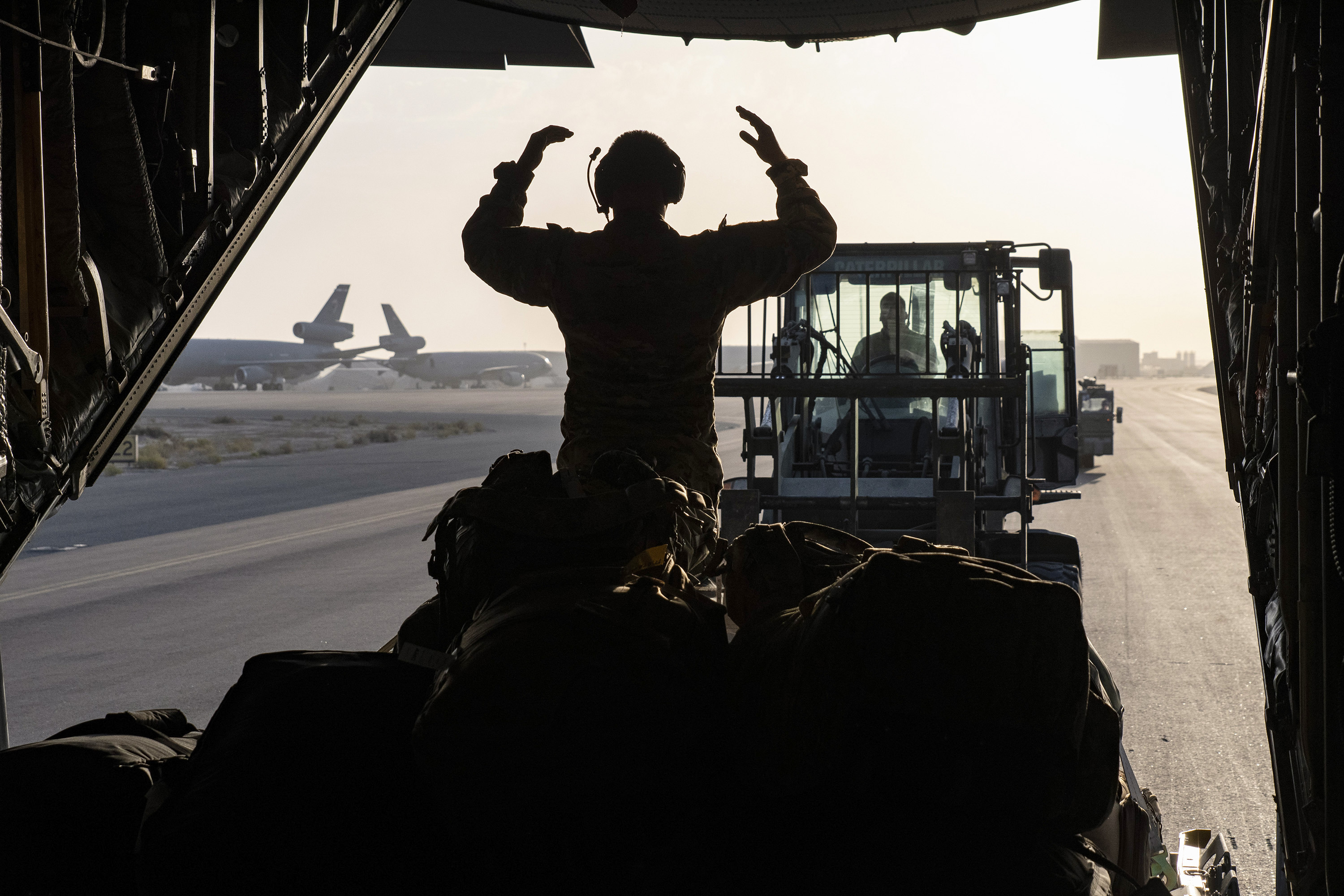
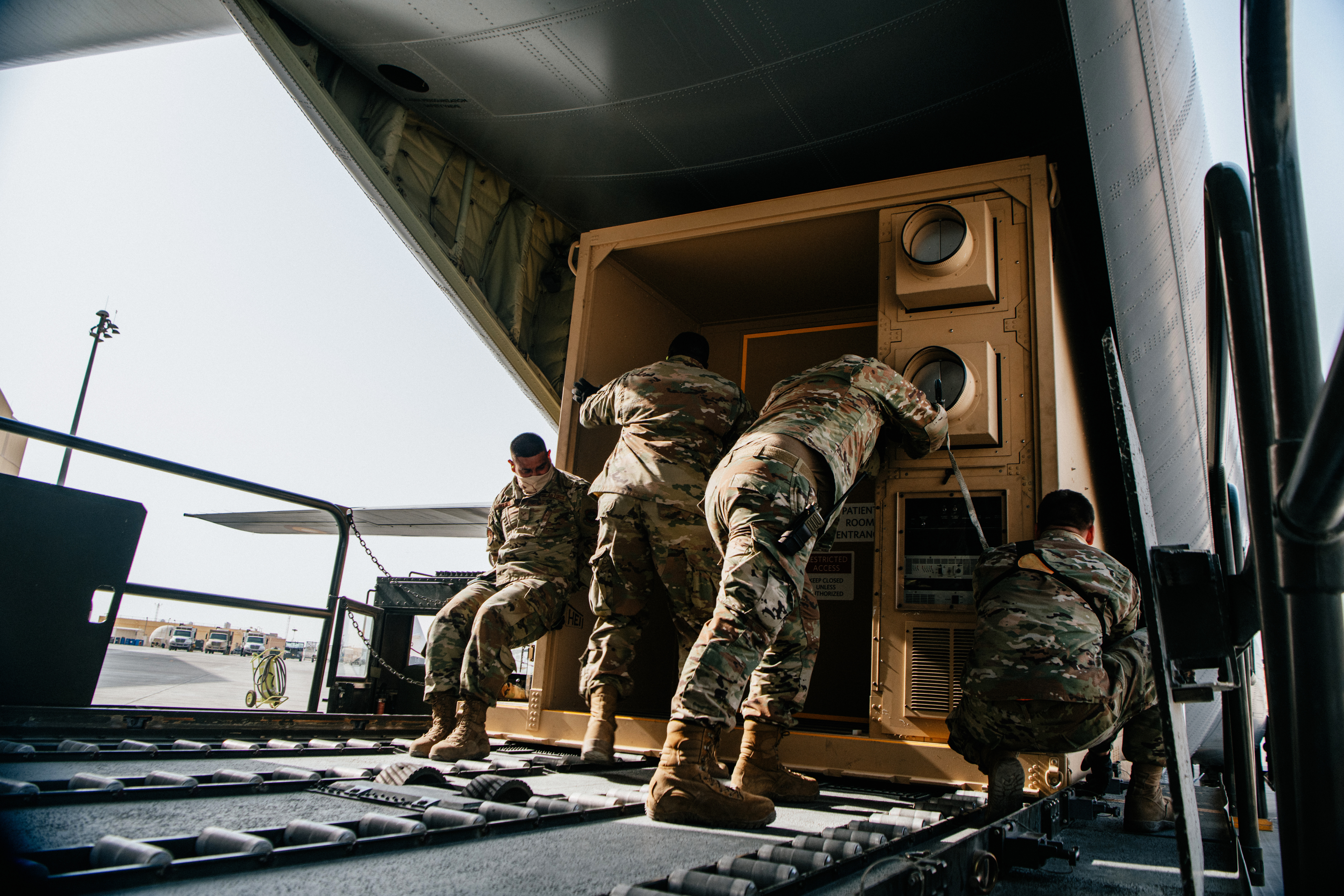
Airmen load cargo on to an Air Force C-130 Hercules aircraft during a capstone mission at Al Udeid Air Base, United Arab Emirates, March 3, 2021.

Patient Information


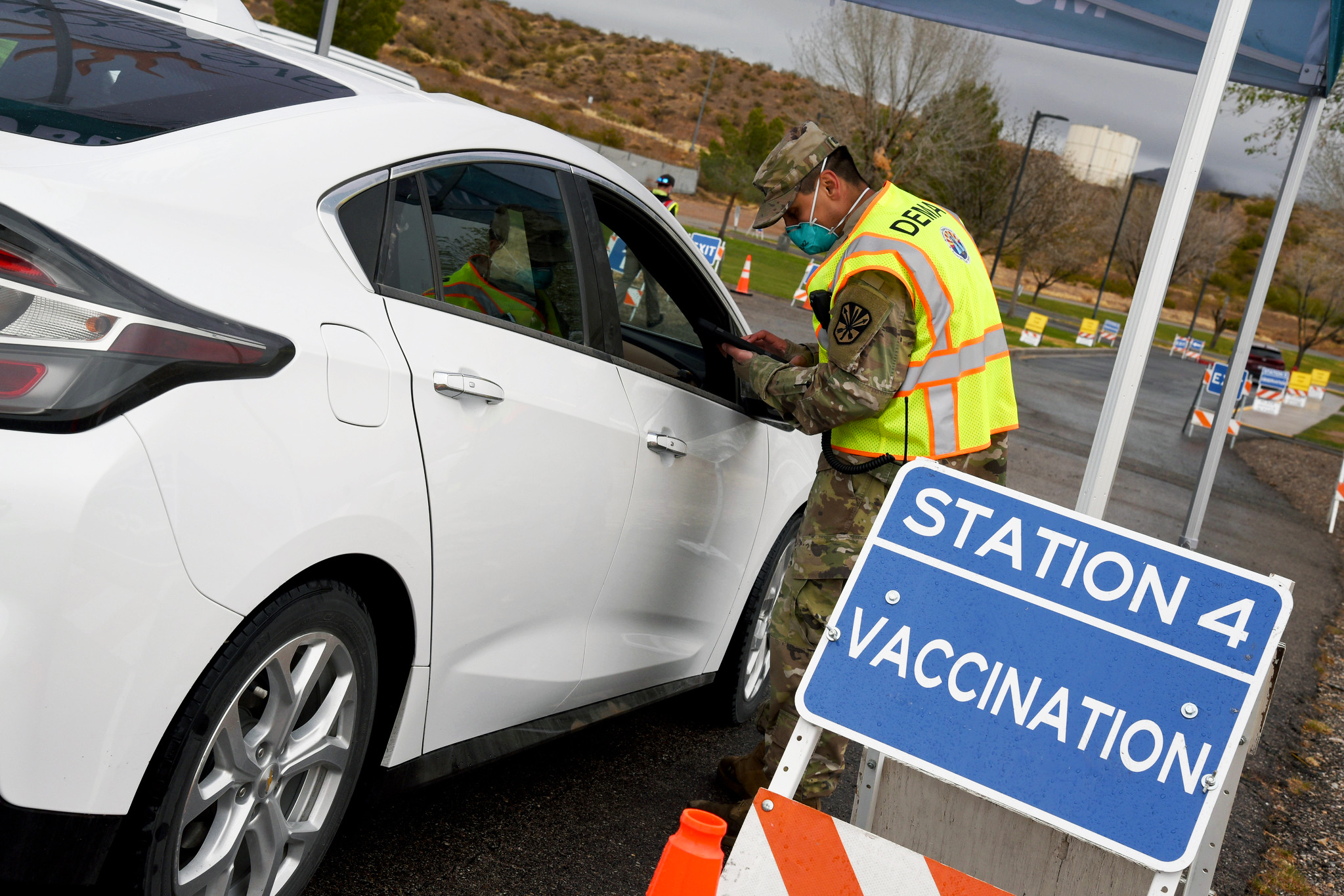
Army Spc. Chris Rodriguez with the 996th Area Support Medical Company, Arizona Army National Guard, reviews medical information with a patient before the COVID-19 vaccination is administered by a member of the Mohave County Department of Health in Littlefield, Ariz., March 13, 2021. The Arizona Army National Guard continues to work with state, county and city entities to facilitate the administration of vaccinations throughout the state.

Gunnery Blast


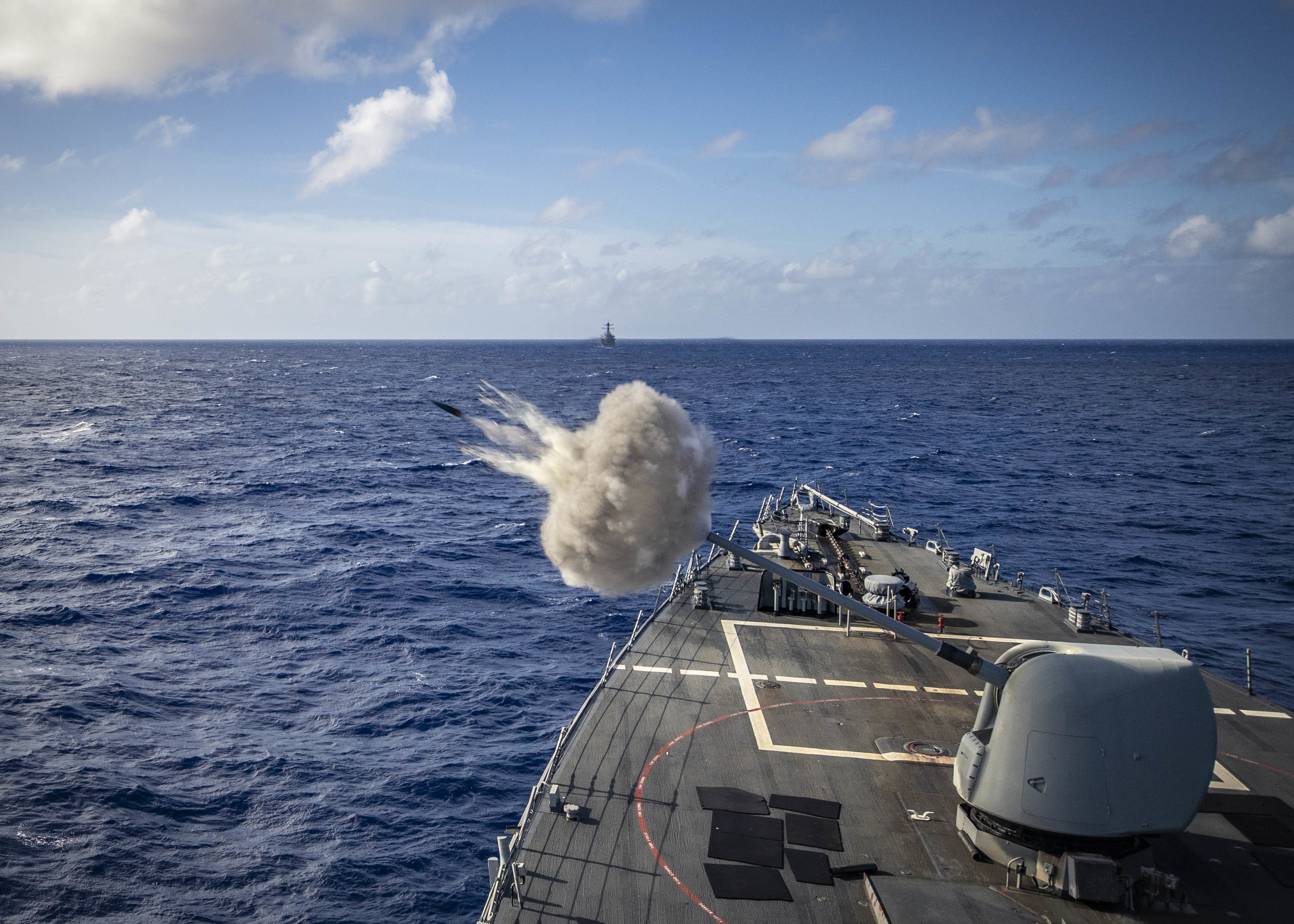
The guided missile destroyer USS John S. McCain fires a 5-inch gun during a live-fire gunnery exercise in the Philippine Sea, March 14, 2021.

Loading Equipment


Air Force ramp service specialists with the 8th Expeditionary Air Mobility Squadron load a negatively pressurized conex onto a Qatari Emiri Air Force C-130 Hercules aircraft in preparation for a Qatar-U.S. Air Force Friendship Event at Al Udeid Airbase, Qatar, March 9, 2021. Members assigned to the 379th Expeditionary Aeromedical Evacuation Squadron showcased how the NPC enables caregivers to transport and treat infectious patients in a safe and self-contained environment. The NPC was developed in response to COVID-19 patient transport requirements. The negative pressure inside allows for air to leak into the NPC, rather than out, risking contamination of the aircraft.

Secretary of Defense Austin's remarks at the U.S.-Japan Security Consultative Committee in Tokyo, Japan

 March 16, 2021

Secretary of Defense Lloyd J. Austin III

SECRETARY OF DEFENSE LLOYD J. AUSTIN III:  Minister Motegi, Minister Kishi, I want to thank you for your warm welcome, and I offer my profound thanks to the people of Japan for their gracious hospitality.

I am tremendously honored to join all of you here in Tokyo on my first international trip as secretary of defense.  I'm grateful to join my dear colleague Secretary Blinken as we work together to build upon the resolute and resilient bond between our two countries.

As I mentioned to Minister Kishi earlier today, the U.S.-Japan alliance is strong, and I look forward to charting a path towards continued success in the future as we work together to uphold a free and open Indo-Pacific.

I am a firm believer in the notion that we are at our strongest when we work together as part of a larger team.  And that's why we stand shoulder-to-shoulder, arm-in-arm with Japan, the cornerstone of the alliance in the Indo-Pacific that has preserved -- preserved peace and security in this region and across the globe for more than half a century.

As we lead with diplomacy on the range of issues that Secretary Blinken mentioned, I want you to know that we at the Department of Defense stand ever ready to buttress the hard work of our diplomats.  Diplomacy and defense complement one another, and together they make us stronger.

Today's meeting is a testament to that premise, as we work together in the spirit of teamwork and cooperation to seize the shared opportunities and address our shared challenges now and in the years ahead.  We -- we need only look at Operation Tomodachi in the wake of the 3/11 tragedy 10 years ago to give us confidence that our resolute and resilient alliance rests firmly on our bonds of friendship and shared sacrifice.

Thanks again for welcoming -- welcoming us today, and I look forward to a productive discussion.

Sports Heroes Who Served: Undefeated Boxing Champ Served in World War II

 March 16, 2021 | BY David Vergun , DOD News

Sports Heroes Who Served is a series that highlights the accomplishments of athletes who served in the U.S. military.

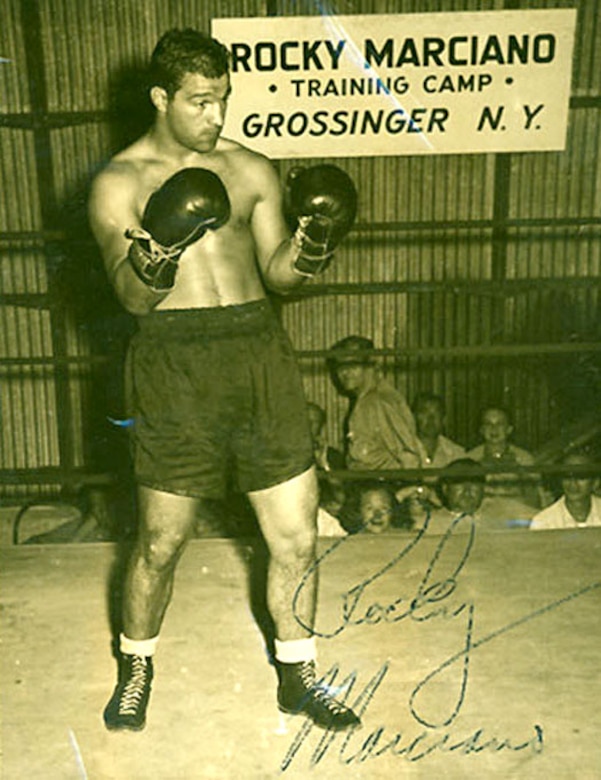
Rocky Marciano is the only heavyweight professional boxer to have finished his career undefeated. He also holds the record for the highest knockout-to-win ratio in world heavyweight title fights at 85.71%.

A boxer poses for a photo.

Marciano gave himself his name because his real name, Rocco Francis Marchegiano, was said to be hard to pronounce by boxing promoters and sportscasters. Both of his parents were immigrants from Italy.

In March 1943, he was drafted into the Army to serve in World War II. He was stationed in Wales in the United Kingdom where he helped ferry supplies across the English Channel to Normandy, France, after the June 6, 1944 invasion.

While awaiting discharge, Marciano represented the Army and won the 1946 Amateur Armed Forces Boxing Tournament. In March 1946, he received an honorable discharge at Fort Lewis, Washington, where he was stationed.

On Sept. 23, 1952, Marciano, then 29, took on the World Heavyweight Champion Joe Walcott in Philadelphia. Throughout most of the fight, Walcott was ahead on points and even dropped Marciano in the first round.

A boxer poses for a photo.

But in round 13, Marciano knocked out Walcott and became the new heavyweight champion.

Some thought Marciano couldn't repeat his performance, so the two had a rematch on May 15, 1953, in Chicago. This time, Marciano knocked out Walcott in the first round.

Marciano's next win came in New York City against Roland La Starza on Sept. 24, 1953. In the 11th round, Marciano was victorious with a technical knockout. 

The next two bouts were against former World Heavyweight Champion Ezzard Charles. Marciano won the first fight on points at Yankee Stadium in New York City on June 17, 1954.

They had a rematch on Sept. 17, 1954, at the same venue. This time, Marciano knocked out Charles in round 8.

On May 16, 1955, in San Francisco, Marciano went up against Don Cockell from the United Kingdom, who was also the boxing champion of Europe. Marciano knocked him out in round 9.

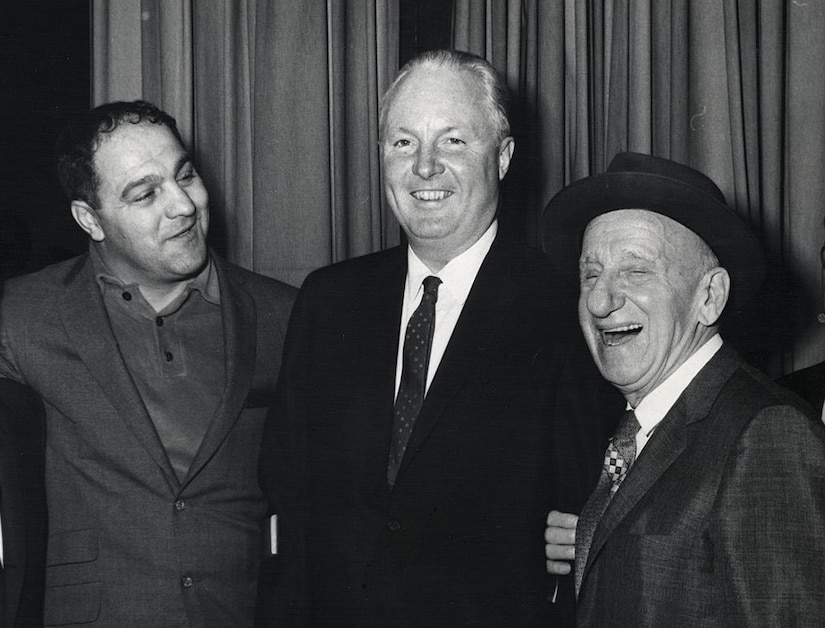
Three men pose for a photo.

Marciano's last fight was against Archie Moore on Sept. 21, 1955, at Yankee Stadium. Marciano knocked him out in round 9.

On April 27, 1956, Marciano announced his retirement at age 32, finishing his career at 49-0.

After his retirement, Marciano hosted a weekly boxing show on TV in 1961; he later appeared in the TV series "Combat!" in an episode titled "Masquerade."

He had a number of other jobs, including becoming a business partner and vice president of Papa Luigi Spaghetti Dens, a San Francisco-based franchise.

In July 1969, he and heavyweight boxing champion Muhammed Ali, starred in the film "The Superfight: Marciano vs. Ali."

On Aug. 31, 1969, Marciano was a passenger in a private plane that crashed in bad weather at a small airfield near Newton, Iowa. Everyone on board was killed. Marciano was 45.

Readout of Secretary of Defense Lloyd J. Austin III’s Meeting with Defense Minister Nobuo Kishi of Japan

 March 16, 2021


Pentagon Press Secretary John Kirby provided the following readout:

Secretary of Defense Lloyd J. Austin III held his first in-person bilateral engagement with Japanese Minister of Defense Nobuo Kishi, today in Tokyo. 

During the meeting, Secretary Austin reaffirmed the importance of the U.S.-Japan Alliance in upholding a free and open Indo-Pacific, and highlighted that the Alliance is the cornerstone of regional security and stability. He also emphasized the need for the Alliance to prepare for long-term challenges.

The two leaders addressed a broad range of defense issues, to include China’s growing capabilities and aggressive actions in the East and South China Seas, the threat from North Korean nuclear and missile programs, the importance of Japan’s role in regional security, advanced capabilities development, building partner capacity, and enhancing multilateral cooperation.

Secretary Austin reaffirmed that the United States remains opposed to unilateral attempts to change the status quo in the East China Sea and undermine Japan’s administration of the Senkaku Islands, reiterating that Article V of the Mutual Security Treaty applies to the islands.

Secretary Austin and Minister Kishi committed to continue working closely to strengthen the U.S.-Japan defense relationship, including at the Security Consultative Committee later this year.

Monday, March 15, 2021

Military Meeting


Secretary of Defense Lloyd J. Austin III exchanges greetings with Air Force Lt. Gen. Kevin B. Schneider, commander of U.S. Forces Japan, upon arriving at Yokota Air Base, Japan, March 15, 2021.

COVID-19 Vaccine


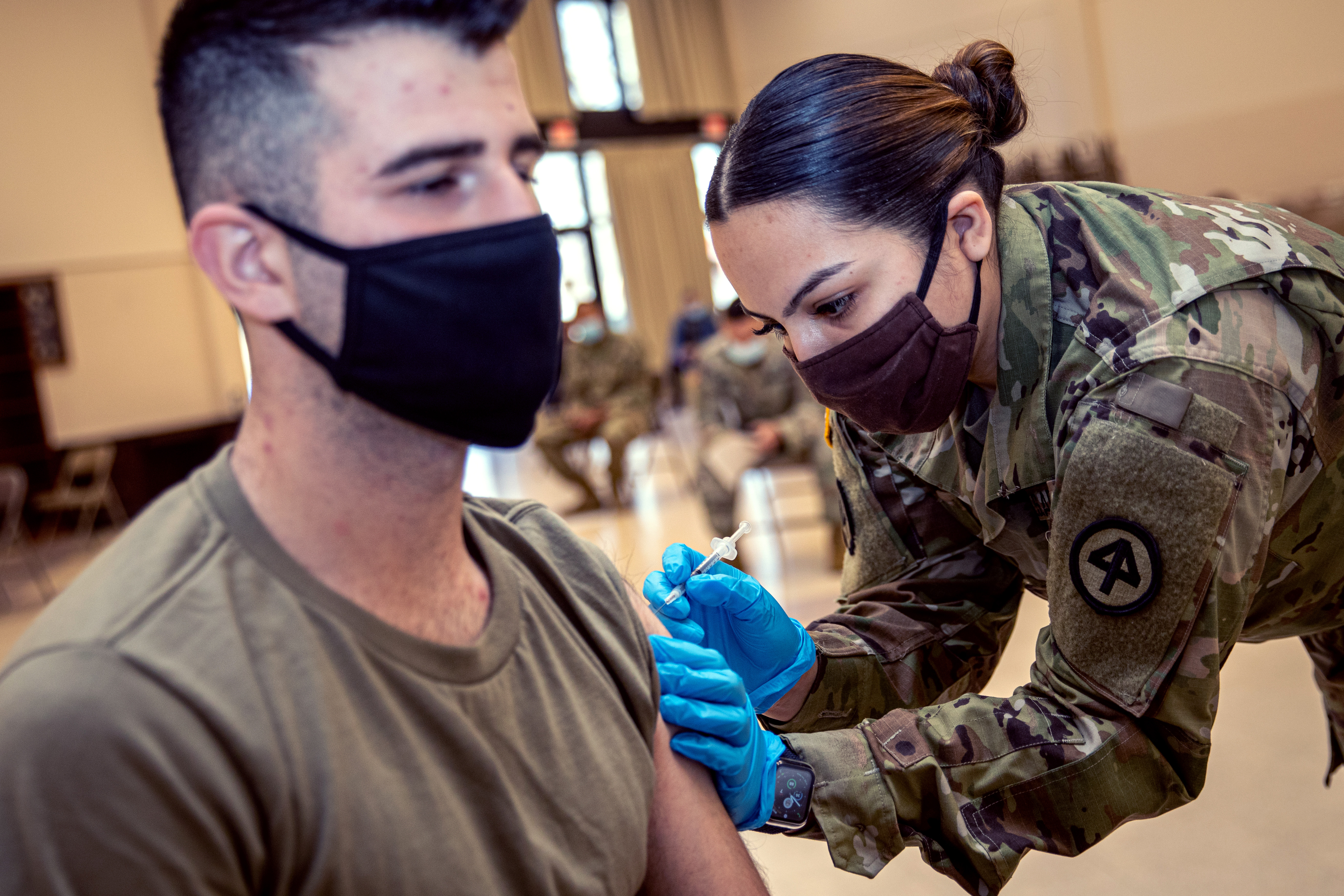
Army Sgt. Alexa Caramb gives the COVID-19 vaccination to a soldier at Joint Base McGuire-Dix-Lakehurst, N.J., March 6, 2021. Caramb is a medic with Charlie Company and is assigned to the 250th Brigade Support Battalion. The vaccination hub was run by the 108th Medical Group, New Jersey Air National Guard.

COVID-19 Examination


Air Force Master Sgt. Nicole Jacocks examines a COVID-19 vaccine at Robins Air Force Base, Ga., March 6, 2021. Jacocks is assigned to the 413th Aeromedical Staging Squadron and is in charge of the immunizations clinic. During their March unit training assembly, the 413th ASTS administered 92 vaccines. Next month, they will give out second doses to those 92 people.

COVID-19 Testing


Dr. John S. Baxter, director of the Pentagon Flight Medicine Clinic, conducts COVID-19 testing as Secretary of Defense Lloyd J. Austin III and staff travel from Hawaii to Japan, March 14, 2021.

New Officials Sworn-in at the Department of Defense

 March 15, 2021


The following individuals have been sworn-in virtually or in-person from March 9, 2021, through March 15, 2021. 

  • Alex Sanchez, Special Assistant to the Chief of Staff to the Secretary of the Air Force
  • Stefanie Tompkins, Director, Defense Agency
  • Daniel Erikson, Deputy Assistant Secretary of Defense for Western Hemisphere
  • Sarah Farnsworth, Special Assistant to the Secretary of Defense for Protocol
  • Joseph Federici, Speechwriter, Office of the Assistant to the Secretary of Defense for Public Affairs
  • Siddharth Mohandas, Deputy Assistant Secretary of Defense for East Asia
  • Christian Urrutia, Counsel to the General Counsel

For the lists of personnel sworn-in previously, please see the releases on Jan. 20, 2021, Feb. 9, 2021, Feb. 16, 2021, Feb. 22, 2021, March 1, 2021, and March 9, 2021.

Smoke Grenade


Three soldiers in the 2021 Best Warrior Competition employ a smoke grenade to conceal their movement as they prepare to capture a high value target during a military operation in urban terrain event at Camp Navajo, Ariz., March 4, 2021.

Sprinkler Checkup


Sailors check the functionality of the flight deck sprinkler system on board the USS Hershel “Woody” Williams during operations in the Atlantic Ocean, March 13, 2021.

Northern Lights


A LC-130 Skibird sits on the ramp at Kangerlussuaq Airport, Greenland, with the Northern Lights dazzling in the sky above, March 14, 2021.

Grading Targets


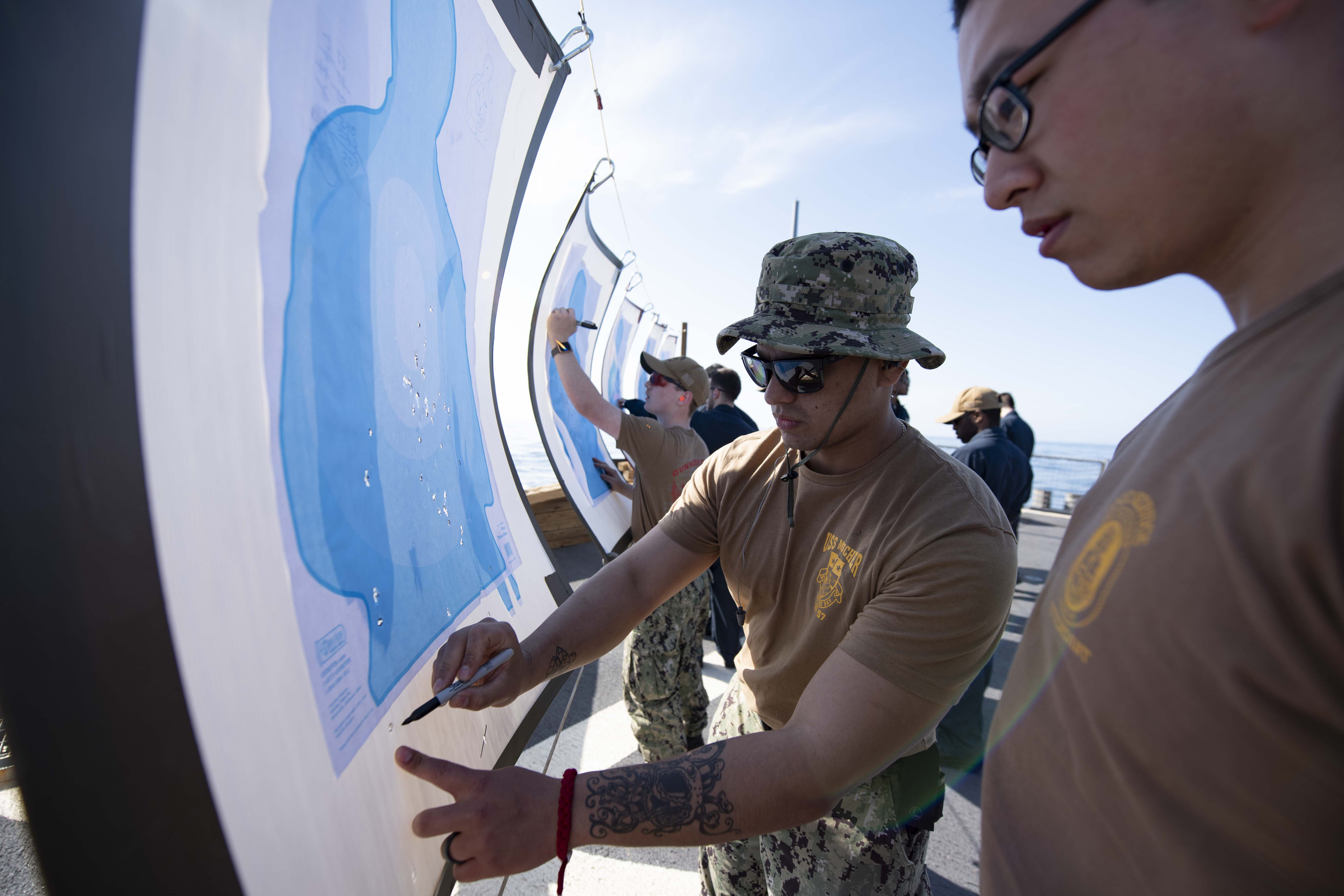
Two sailors grade targets during a small-arms qualification course aboard the guided missile destroyer USS Mitscher in the Mediterranean Sea, March 13, 2021.

Giving Directions


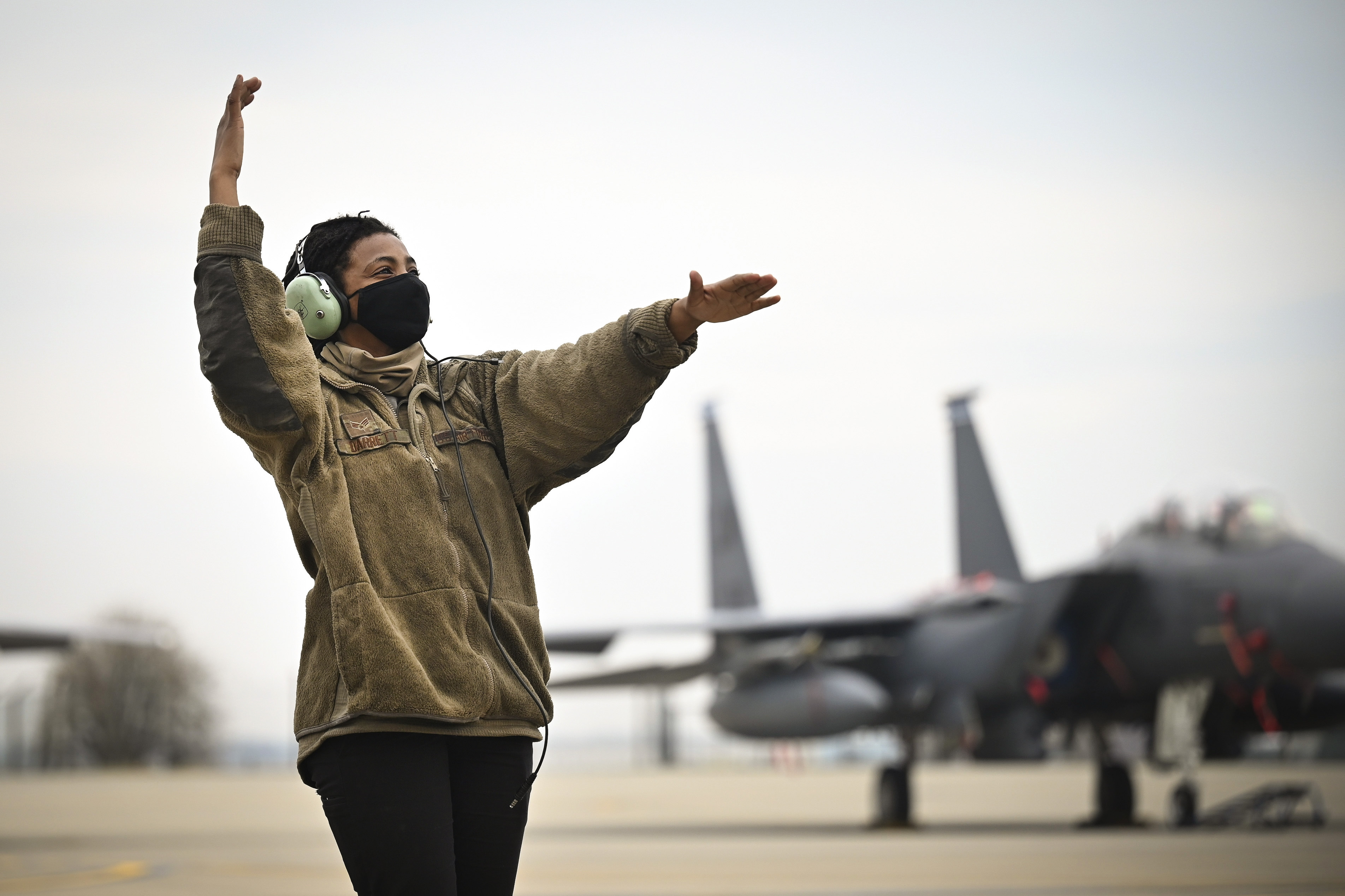
Air Force Senior Airman Lael Darrett communicates with the pilot before takeoff at Royal Air Force Lakenheath, England, March 8, 2021.

Sea Ops


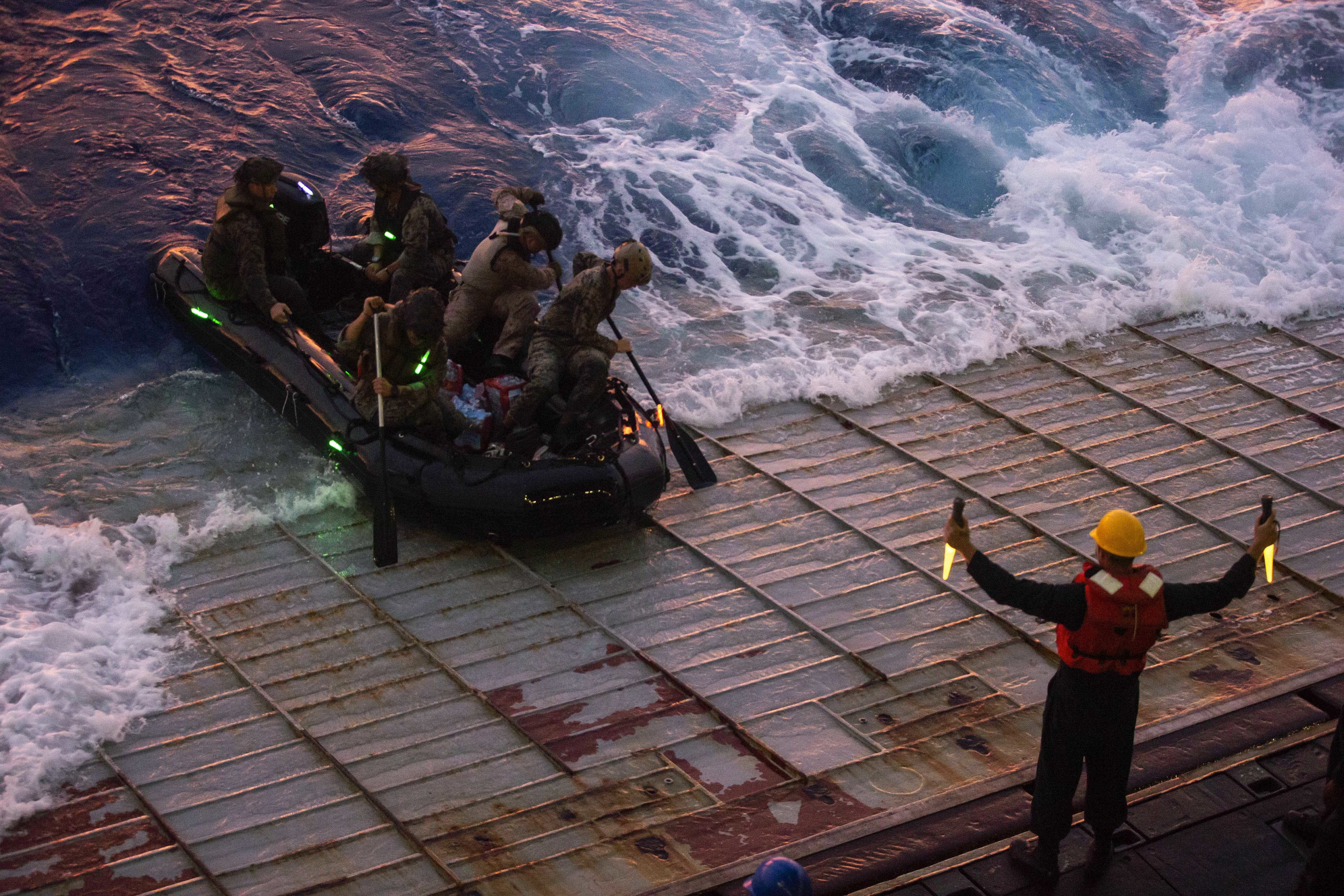
Marines and sailors prepare to launch a combat rubber raiding craft during an onload exercise aboard the USS Ashland in the Philippine Sea, Feb. 24, 2021.

Leaders Meet


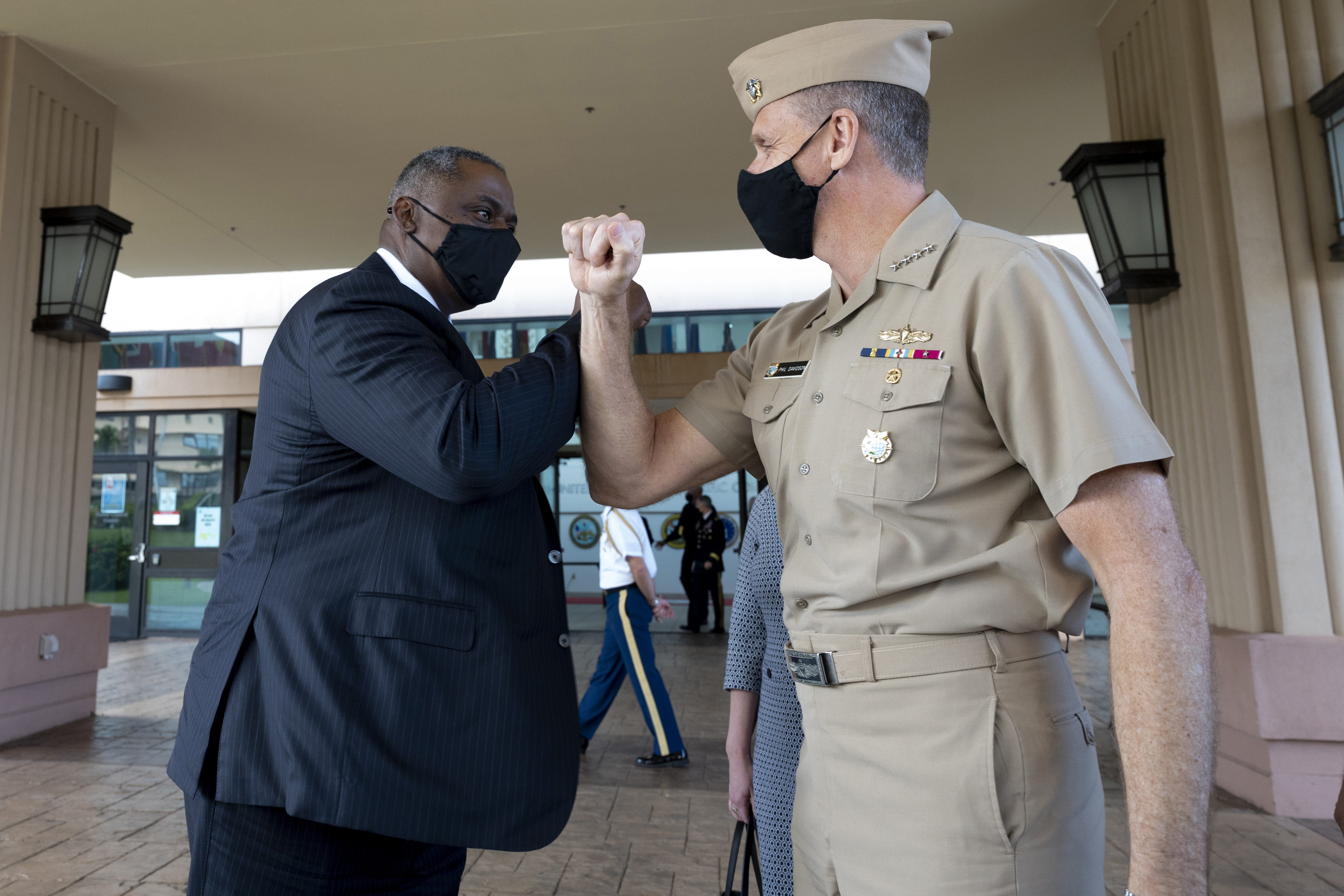
Defense Secretary Lloyd J. Austin III greets Navy Adm. Philip S. Davidson, commander of U.S. Indo-Pacific Command, at Indo-Pacific Command headquarters in Hawaii, March 14, 2021.

Austin Greeting

Defense Secretary Lloyd J. Austin III greets military personnel at Joint Base Pearl Harbor-Hickam, Hawaii, March 14, 2021.

DOD Receives Approval for Grants to Develop Interstate Compacts for Licensure Portability

March 15, 2021

The Department of Defense announced Friday the approval of a series of grants that will help military spouses with the issue of professional license portability.

Through a cooperative agreement with the Council of State Governments, grants will allow selected professions to work with CSG’s National Center for Interstate Compacts to develop model interstate occupational licensure compact legislation, addressing license portability affecting transitioning military spouses, along with other practitioners in the profession.

The five selected professions are teaching, social work, cosmetology, massage therapy, and dentistry/dental hygiene.

This is the first time the department has provided this kind of grant.

“The department views the selection of these professions as a significant milestone in achieving the long-term goal of providing license portability for military spouses,” Lernes J. Hebert, performing the duties of the assistant secretary of defense for manpower and reserve affairs, said Friday to the Senate Armed Services Committee staff at their staffer day presentation. “We look forward to working with the National Center for Interstate Compacts and the selected professions on the completion of compacts for these professions.”

Today’s announcement is the first installment of the cooperative agreement authorized by10 U.S.C. 1784, a bill that addresses the burden associated with relicensing by assisting professions interested in developing interstate licensing compacts except that the organizations overseeing these professions lack the resources necessary to engage in the process. Medicine, nursing, physical therapy, psychology, emergency medical services, audiology/speech-language pathology, licensed professional counseling and occupational therapy are professions that have successfully developed interstate licensing compact prior to the cooperative agreement grant process.

Reducing the burden associated with the occupational relicensing of military spouses is a priority for the department. The annual percent of the military spouse population that moves across state lines is 14.5% — compared to 1.1% for civilian spouses. As much as 34% of military spouses in the labor force are required to be fully licensed; and of those spouses, 19% experience challenges maintaining their licenses.

Military spouses can call Military OneSource at 800-342-9647 to speak with a Spouse Education and Career Opportunities career coach to learn about free tools and resources to help them achieve their education and career goals.  

About the Department of Defense-State Liaison Office

The Department of Defense-State Liaison Office engages state policymakers on the needs of military members and their families. Currently, efforts focus on 10 key issues (as approved by the assistant secretary of defense for Manpower and Reserve Affairs), which promote the well-being of service members and their families. The DSLO is the department’s point of contact for the cooperative agreement with Council of State Governments.

About Spouse Education and Career Opportunities

The Defense Department established the Spouse Education and Career Opportunities program to provide education and career guidance to military spouses worldwide, offering free comprehensive resources and tools related to career exploration, education, training and licensing, employment readiness and career connections. This program also offers free career coaching services six days a week.

About Military OneSource

Military OneSource is a DOD-funded program that is both a call center and a website providing comprehensive information, resources and assistance on every aspect of military life. Service members and the families of active duty, National Guard, and reserve (regardless of activation status), Coast Guard members when activated for the Navy, DOD expeditionary civilians, and survivors are eligible for Military OneSource services, which are available worldwide 24 hours a day, seven days a week, at no cost to the user.

Red Rescue


Navy Petty Officers 3rd Class David Rapp, left, and Jonathan Payanparra fight a simulated fire during a damage control drill on the USS John Finn, March 13, 2021.

Live Fire


A soldier participates in a live-fire exercise during Eagle Sokol 21 at Pocek Range in Postojna, Slovenia, March 12, 2021. The bilateral training exercise with the Slovenian Armed Forces builds a foundation of teamwork and readiness between NATO allies.

Japan Visit Aims to Cement Cornerstone Alliance

March 15, 2021 | BY Jim Garamone , DOD News

The visit of Secretary of Defense Lloyd J. Austin III and Secretary of State Antony J.  Blinken to Japan is all about consulting on shared concerns and opportunities in the Indo-Pacific, a senior defense official said today.

The official told reporters traveling with Austin that the meetings in Tokyo signify the importance the new administration places on U.S. relationships in Northeast Asia.

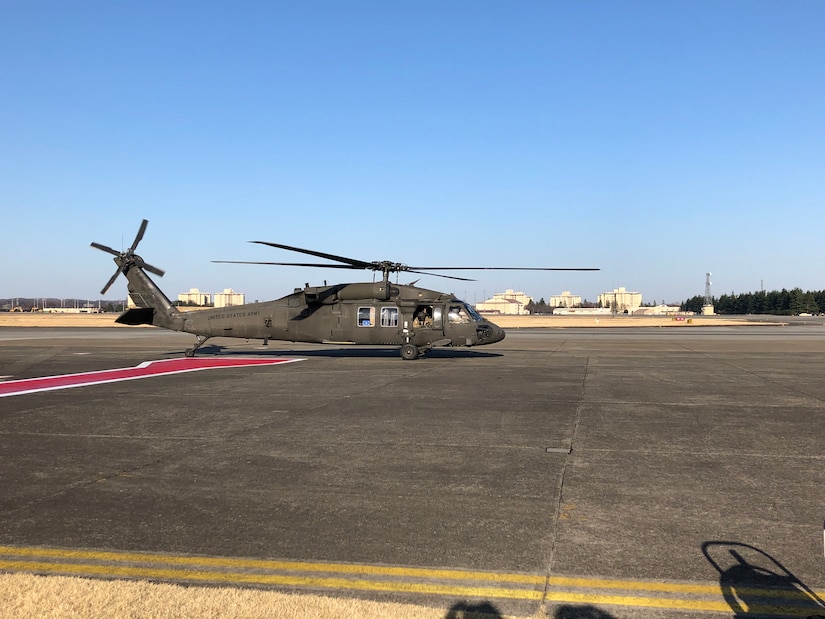
A Blackhawk helicopter takes off.

Blinken and Austin will meet with Japanese Foreign Affairs Minister Toshimitsu Motegi and Defense Minister Nobuo Kishi.

The trip is about investing in the U.S.-Japan relationship, "which is our cornerstone alliance for Indo-Pacific strategy," the official said. "It's about maintaining peace and stability across the priority theater for the department and for our country."

Diplomacy is at the center of U.S. foreign policy. The Defense and State department secretaries making the visits by cabinet-level leaders in the Biden administration to Northeast Asia sends an unmistakable signal of the importance that America places on the relationship. The official said Austin wants to engage in a deepened, sustained discussion about the regional security environment. He will get the Japanese perspective of the region, including the situation in North Korea, the rise of China and adventurism by the Russians. 

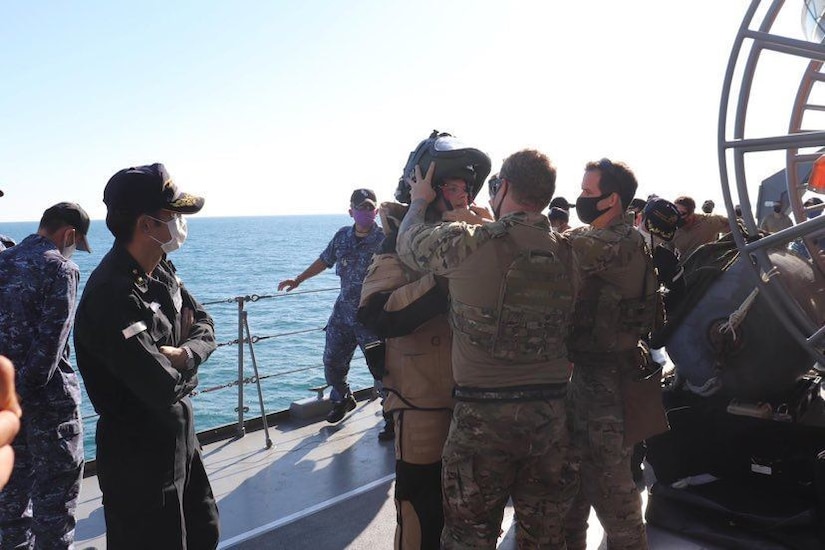
Sailors help a diver into his suit.

Japan and the United States are treaty allies. But beyond that both nations share the commitment to defending the rule-based international order, the official said.

Finally, Austin wants to discuss ways to increase military interoperability with Japanese leaders. "We've got a very strong alliance with Japan, and we're going to be looking at ways where we can make it stronger," the official said. 

He noted that just as the United States military is looking at a strategic posture review, so, too, are the Japanese. "So, this is an opportunity for us to talk about how we can build interoperability within the alliance to strengthen the interoperability within our alliance, what kind of capabilities we need to invest in, [and] how we can work together to better advance our shared goals and common objectives," he said.

DOD Officials Describe Conditions in Indo-Pacific

March 15, 2021 | BY Jim Garamone , DOD News

The Indo-Pacific has always been a region of superlatives, but the terms have changed over the past decades.

Now people talk about the Indo-Pacific being a "region of consequence," "the priority theater," or the "global economic engine."

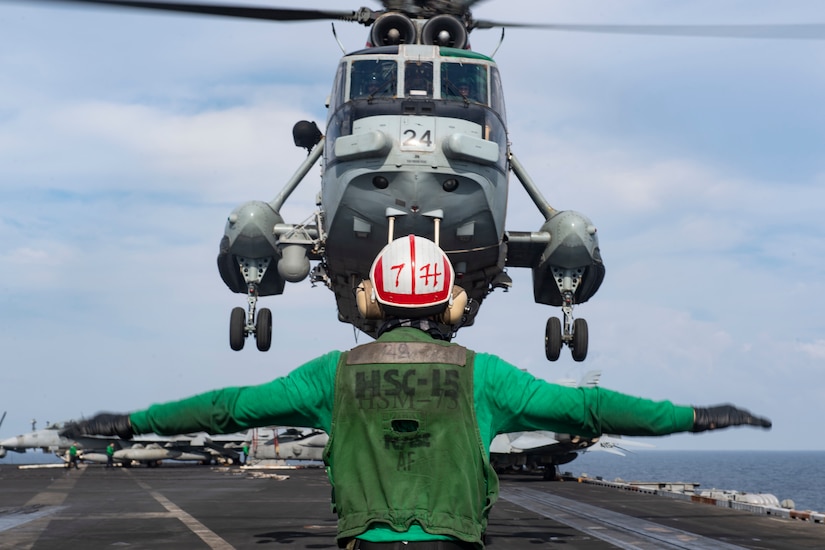
A sailor guides a helicopter as it lands on an aircraft carrier.

For decades, the U.S. military has recognized the importance of the theater. U.S. Indo-Pacific Command covers 51 percent of the globe. The region has 60 percent of the world's population. The United States and China are the world's largest economies. The most soldiers, the biggest navies, the longest distances, most endangered and much, much more. There are hundreds of languages and cultures and environments.

China is the pacing challenge for the United States military, and service members must respond — but it's not the only challenge in the region.

"We've all had these concerns for decades — the rising China, [North Korea], Russia, violent extremist activities — but their scope, volume, scale are much more problematic," said a senior defense official. 

Added to all this is the issue of climate change, which touches fundamentally on many of the island nations of Oceania. Also a problem is that this is the Ring of Fire, where tectonic plates collide causing volcanoes, earthquakes and tsunamis. Top it off with COVID-19 and the global pandemic, and there is a complex brew of problems and issues.

China, Russia, North Korea and violent extremism are in the Indo-Pacific and operate there every day. The threats are a direct challenge to the mission of the U.S. Indo-Pacific Command to provide freedom and mobility for commerce in the region, to support good governance, and to deter aggression. 

The best weapon in the arsenal is the U.S. network of allies and partners. Unlike Europe where NATO and the European Union have inured the nations to working together multilaterally, the Indo-Pacific doesn't have that architecture, a senior defense official said. 

The United States has treaty allies in the region: the Republic of Korea, Japan, the Philippines, Thailand, Australia and New Zealand.

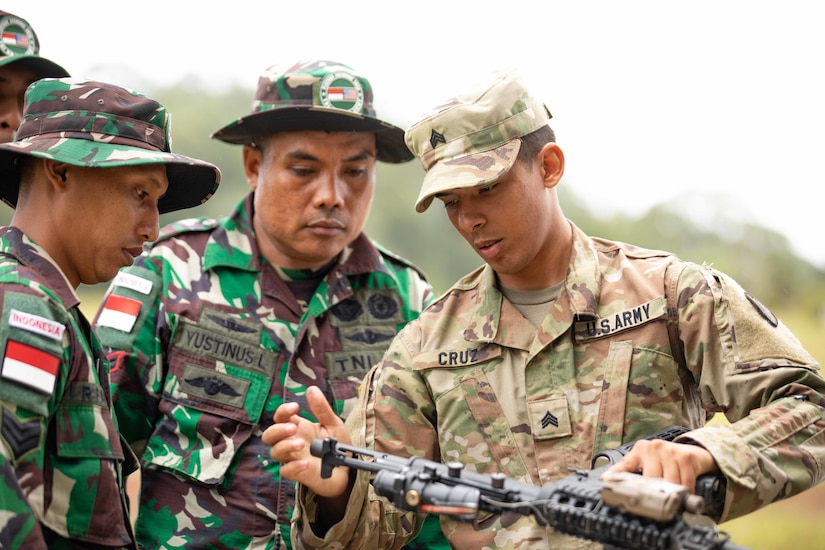
A soldier holding  a gun speaks to other soldiers.

While the United States works bilaterally with many nations in the region, leaders would like to see more multilateral engagement. "The Quad" call that President Joe Biden participated in with the leaders of Australia, India and Japan is promising, officials said. The Quad is not a security pact, but it could grow into an arena that allows the countries to cooperate more.

China's behavior in the region — from fighting with India at the line of control, to increasing efforts and patrols in the Indian Ocean region — is worrisome to India. "They are aware of that and the traditionally non-aligned country is starting to do more with the United States, with Australia and with Japan," the official said. "India is not going to sign a mutual defense treaty with us any time soon, but they are a major defense partner of the United States and they are trying to become more interoperable with the U.S. military in their military capabilities, their command and control, their information sharing."

This is important because the region is so vast and so varied that no one country can do it alone. The United States will need allies and partners to defend the rules-based architecture that has benefited so many — including China. 

The U.S. center of gravity is the friends and allies who want a free and open Indo-Pacific. China and Russia really do not have a network even close to this. 

U.S. government officials will study the basing of U.S. troops in the region. This doesn't mean bases, but spaces. "We are not looking to reposition large numbers of troops, in large vulnerable concentrations," the official said. "We want to get the virtues of massing without the vulnerabilities of concentration."

This means troops positioning in many different countries in episodic and dynamic ways. The U.S. military doesn't require new and permanent bases in Indonesia and Malaysia, for example. "What we need is episodic places that support operations with our allies and partners," the official said. 

Also, officials do not know China's plans, "and anyone who says they do, is probably being a little disingenuous," officials said. 

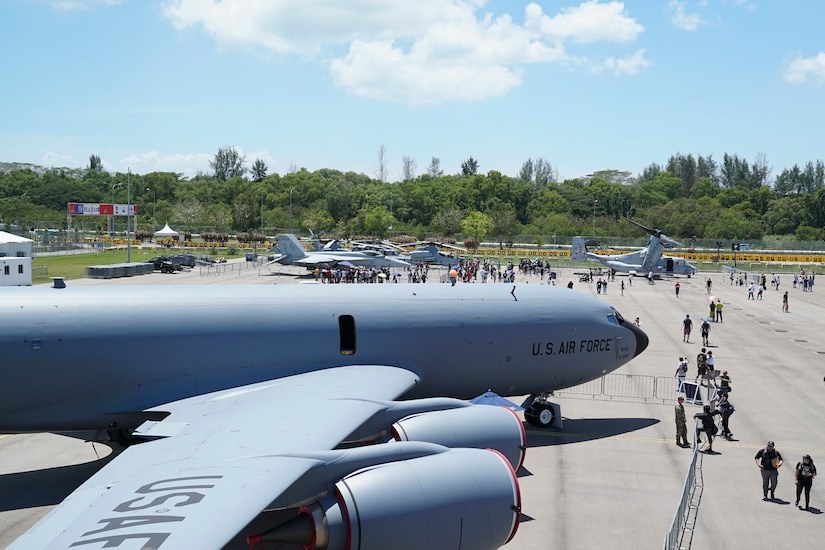
People walk on a tarmac looking at large planes.

China has built islands in the South and East China Seas and plunked missiles on top. Chinese leaders talk of unifying Taiwan under Chinese rule, but Taiwan was never part of China.

With Taiwan in particular, Defense Department officials look at Chinese capacity. "Do they have sufficient numbers of the right pieces of equipment necessary to execute what … they would believe would be a successful operation?" 

China has fielded scores of new and modern systems. "Just in 2020, in the midst of all the COVID related stuff, China still commissioned 25 major new ships," the official said.

A second part of this is that while the U.S. military was fighting in Afghanistan and Iraq, "China went to school on us: We're their pacing threat," the official said. 

The Chinese army has training centers similar to those the U.S. has at Fort Irwin, California, and Fort Polk, Louisiana. "They're trying to become joint interoperable," he said. 

All this leads to an erosion of U.S. conventional deterrence. Leadership processes are weak. "We believe in decentralized execution," the official said. "The American GI or Marine fights best when there are hand grenades being thrown at them, and nobody's around to tell them what to do."
China has nothing comparable. Chinese leaders can write excellent plans, but once they confront the unexpected, there will be trouble for them.