Friday, August 14, 2020

Maintenance Group Supports Flying Mission While Protecting Workers

 Aug. 14, 2020 | BY Lori Bultman , 502nd Air Base Wing

More than four months ago, Robert West, director of the 12th Maintenance Group at Joint Base San Antonio-Randolph, Texas, learned through a social media video sent to him from his uncle in Australia that the Czech Republic was encouraging its citizens to wear masks in an effort to slow the spread of the novel coronavirus, which was quickly gaining momentum.

Like many agencies across the Air Force, we implemented COVID-19 mitigation strategies to support our most vulnerable employees."
Brant Bushnell, 812th AMXS director

At about the same time, as the United States was feeling the effects of the coronavirus pandemic and JBSA was transitioning into Health Protection Condition C, the 12th Maintenance Group, like other base organizations, followed the advice of the Centers for Disease Control and Prevention, sending its most at-risk workers home — including those at its 812th Aircraft Maintenance Squadron at Naval Air Station Pensacola, Florida — to prevent contraction of COVID-19, the disease caused by the coronavirus.

"I sent folks home on hazardous and safety leave because of their age and underlying medical conditions," West said. "I could have kept everybody here under mission-essential status, but we went the extra step to make sure there were folks who were protected because we still had so much that was unknown about the virus. And at that time, there was such a run on all the supply chain that it was very difficult to get hand sanitizer."

But West said he circled back to the video that his uncle had sent him and went online to find a suitable mask for the workers whose mission-essential duties kept them on base, especially the mechanics and other maintainers who support the 12th Flying Training Wing's pilot training mission.
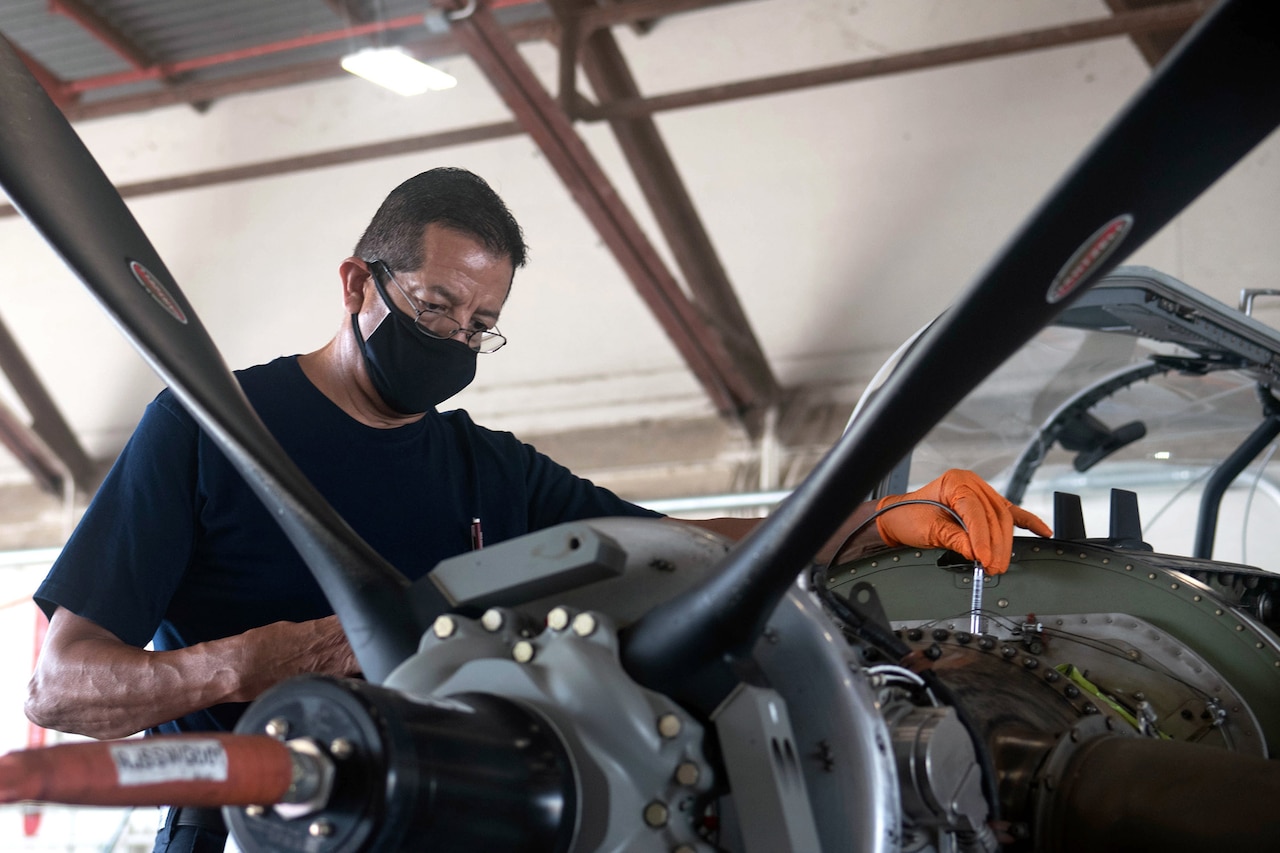
A man wearing a face mask checks an aircraft engine.

"We knew that we couldn't get the N95 mask because those needed to be kept for those in the medical professions, so we went after a black cloth mask that was washable, and we immediately got 1,000 of them," he said. "We got them before the Department of Defense had made it mandatory. At that point, it was almost impossible to get masks, so we beat everybody to the punch."

The mask was a critical tool for the maintenance group, West said.

"You can social distance when you're at least 6 feet apart, but when the maintainers are working, they are side by side in a tug or they're up inside of an aircraft," he said. "They're working in teams, so there's no way you can be 6 feet apart."

The maintenance group initiated a number of other mitigation efforts as well, West said.

"We separated everybody if they were capable of doing it," he said. "If we had a one-shift operation, it became a two-shift operation. If they were a two-shift operation, they went to a three-shift. We also spread them out into another building so we could further distance our folks."

Stay-at-home measures primarily affected office personnel, though it also affected those who had underlying medical conditions and those who were at least 65 years old.

"There were members who were on situational teleworking to keep them away from the office, but they could come in if they needed to take care of files they couldn't access at home," West said.

We have used all available tools at our disposal, including restricted movement and quarantine."
Brant Bushnell, 812th AMXS director

The same challenges faced the 812th Aircraft Maintenance Squadron at Naval Air Station Pensacola, which supports two flying squadrons of the 12th Flying Training Wing's 479th Flying Training Group.

"Like many agencies across the Air Force, we implemented COVID-19 mitigation strategies to support our most vulnerable employees," said Brant Bushnell, 812th AMXS director. "This included employees on some form of teleworking and safety leave. Our lean civil service unit of 125 employees is approximately 30 percent smaller than a comparable active-duty unit, so any reduction in available manpower creates significant challenges to our ability to continue supporting the mission."

The squadron partnered with the 479th Flying Training Group to develop a sustainable strategy that enabled the mission to continue at a reduced rate while supporting COVID-19 mitigation strategies in both operations and maintenance, Bushnell said.

"Our biggest challenges were the ability to inspect the aircraft each evening in time for the next day's flying and maintaining our scheduled phase inspection requirements," he said. "To address these challenges, we first looked internally to support our daily shortfalls. [People] were shifted around to different work centers daily to fill the most critical holes each day, not a normal occurrence."

The squadron also partnered with the 479th Student Squadron to secure the services of eight combat systems officer second lieutenants in casual status awaiting training, Bushnell said.

"They were trained to marshal aircraft in and out of the parking spots, freeing up mechanics to begin inspecting aircraft sooner for the next sortie," he said. "This has been very successful and critical to our ability to support the continuation of the [combat systems officer] training mission."
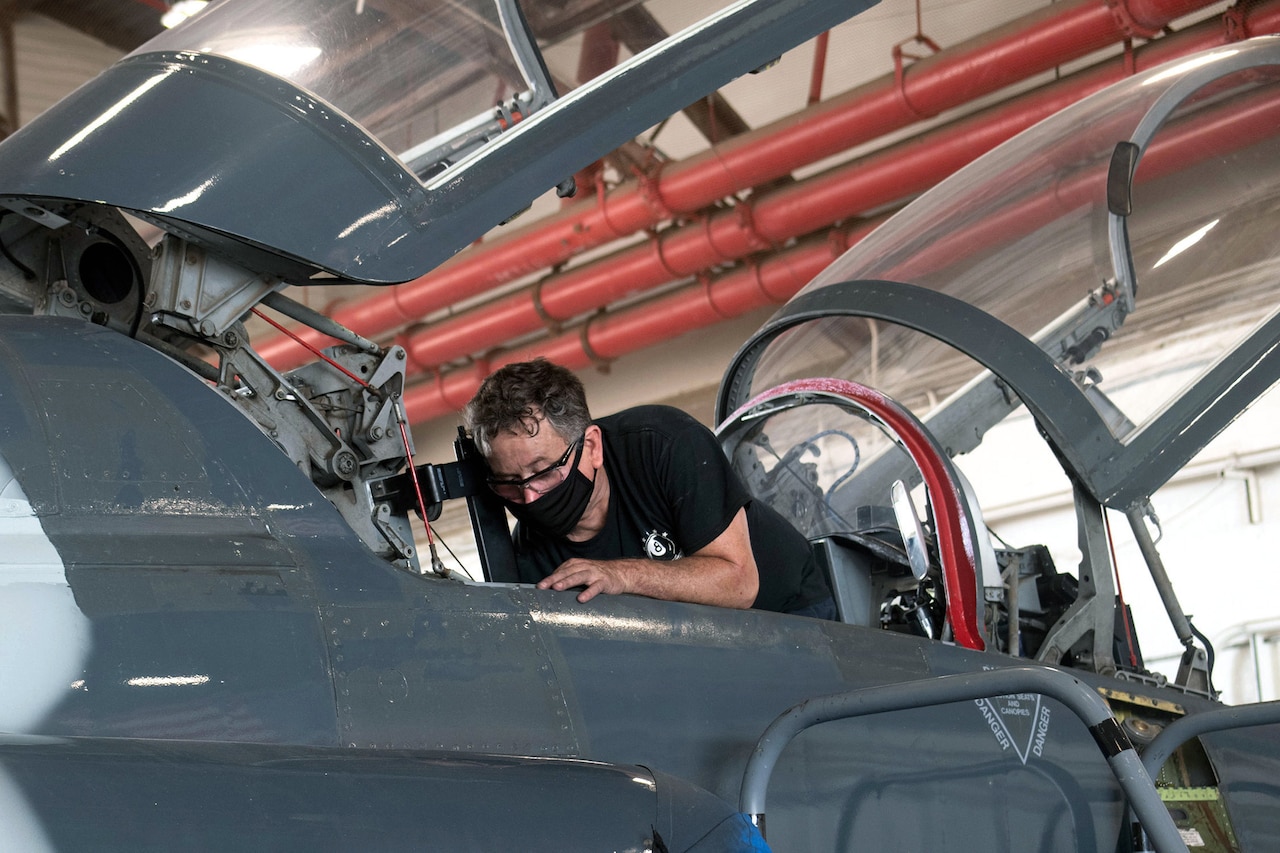
A man wearing a face mask repairs an aircraft seat.

In addition, the squadron is leaning on the 12th AMXS at JBSA-Randolph to accomplish a phase inspection on its T-6A fleet.

"That inspection is currently in progress and will enable us to maintain our phase flow, which is extremely important to having aircraft available for training," Bushnell said.

The squadron also mirrored its counterpart at JBSA-Randolph by using the CDC-recommended cleaning methods, wearing masks and social distancing.

"We have used all available tools at our disposal, including restricted movement and quarantine," West said. "We wanted to make sure that they were all healthy," he said. "When those folks returned to work, they had to go through the public health protocols for JBSA. Either they had to have two negative tests to return or they had to have three days of symptom-free issues after the 14 days of quarantine."

After a series of HPCON changes and a return to the current HPCON C, more 12th MXG employees — except those who are 65 and older or have underlying medical conditions — are back at work. But the maintenance group remains focused on the 12th FTW mission while adhering to CDC guidelines.

One of the maintenance group's biggest challenges has been achieving a balance between supporting the mission and protecting its most vulnerable employees, West said. "My senior management team has been very good at articulating policy and keeping a good communications flow," he added. "If anybody felt uncomfortable, even if they didn't have underlying conditions, they could take leave."

The maintenance group benefited greatly from teleconferencing to keep the lines of communication open, West noted. "We were also the very first organization to have a virtual unit effectiveness inspection, which we did very well on," he said.

West said his team has risen to the challenges it is facing during the pandemic.

"They're rocking along," he said. "We've had some of the best stats we've ever had in terms of aircraft availability and fixing aircraft."

U.S.-Japan Alliance Increasingly Strengthened Since End of WWII

 Aug. 14, 2020 | BY David Vergun , DOD News

The United States and Japan share common goals in the Indo-Pacific region such as freedom of navigation, economic prosperity within the rules of international law, and deterrence of aggression from nations such as China, Russia and North Korea, as well as from terrorist organizations.

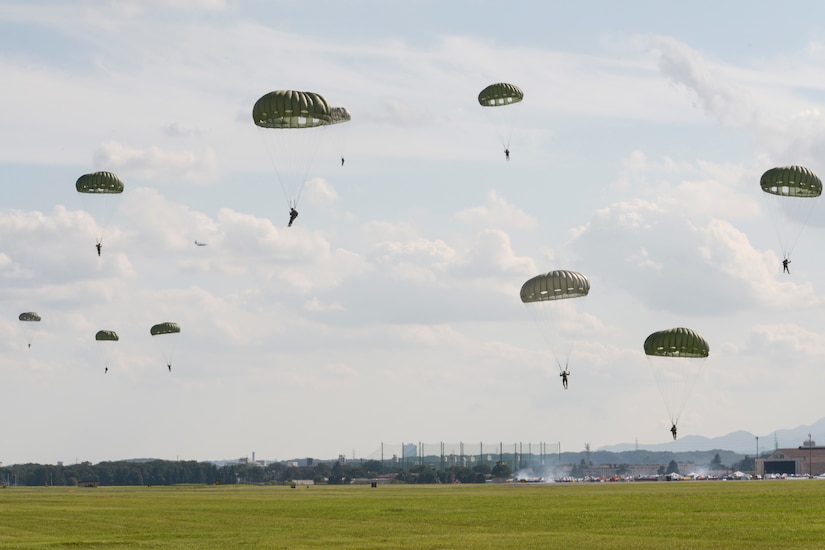
Soldiers parachuting from a C-130 Hercules.
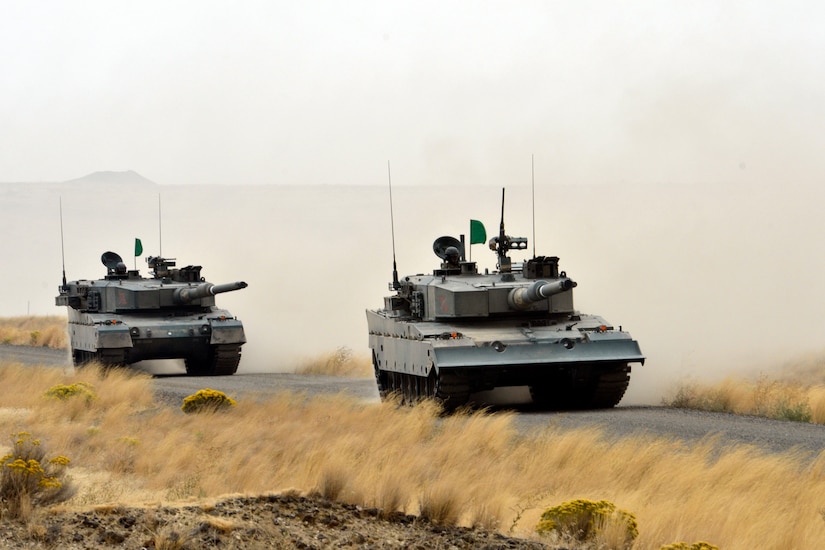
Tanks roll down a road.

As an important ally, Japan increasingly has participated with the United States and other partners in a number of bilateral and multilateral military exercises and operations, especially since the fall of the Soviet Union. For example:

  • In the early 1990s, Japan participated in a United Nations peacekeeping operation in Cambodia.
  • In November 2001, Japan dispatched the Maritime Self-Defense Force to the Indian Ocean to provide logistical support for U.S. military operations in Afghanistan, marking Japan's first overseas military action during a combat operation.
  • In 2003, Japan sent forces to aid in Iraq's postwar reconstruction efforts.
  • Since 2007, Japan has actively participated in Exercise Malabar with the United States and India.
  • The U.S. and Japanese militaries worked effectively together to respond to a March 11, 2011, earthquake and tsunami, which devastated large areas of the main Japanese island of Honshu.
  • At the beginning of October 2018, the new Japanese Mobile Amphibious Forces held joint exercises with U.S. Marines in the Japanese prefecture of Kagoshima, the purpose of which was to work out the actions in defense of remote territories.

In recent years, Japan donated dozens of used and new patrol boats to coast guards in the region, complementing similar U.S. efforts toward building partner capacity and capabilities, such as the Indo-Pacific Maritime Security Initiative foreign military financing, international military education and training and the Asia Reassurance Initiative Act.

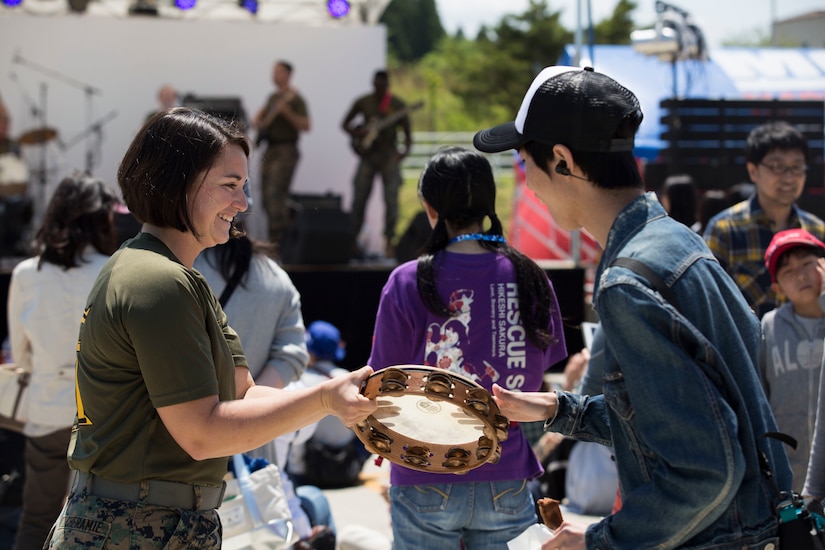
Two people play a tambourine.
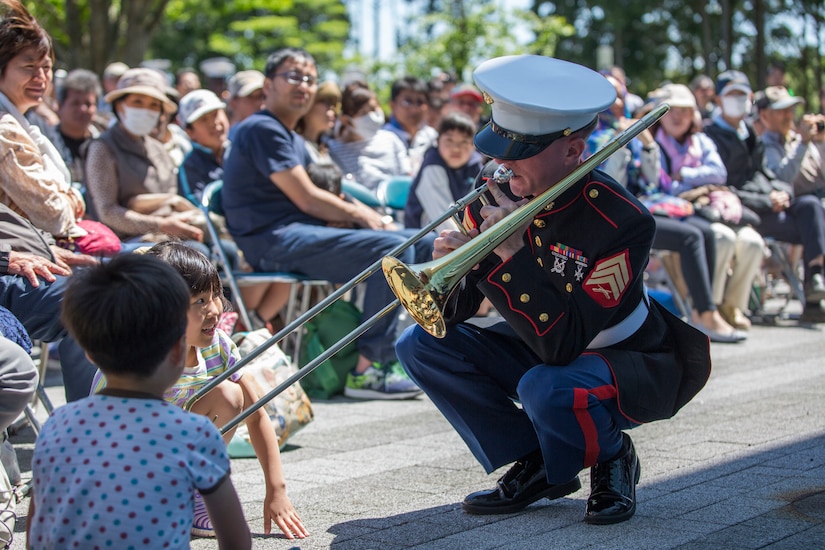
A Marine plays a trombone for an audience.

The depth of the U.S. commitment to the U.S.-Japan alliance is evidenced by the nearly 55,000 U.S. military personnel stationed in Japan, and the thousands of Defense Department civilians and family members who live and work alongside them.  

The United States has also deployed its most capable and advanced military assets to Japan, including the Ronald Reagan carrier strike group, two missile defense radar sites and the F-35 joint strike fighter.

Japan acquires more than 90 percent of its defense imports from the U.S. and has expressed growing interest in interoperable technology with advanced capabilities.  

The United States has approved some $20 billion in foreign military sales to Japan, including Japan's purchase of F-35s, E-2D airborne early warning aircraft, the KC-46 refueling tanker, the Global Hawk unmanned aerial system and MV-22 tilt-rotor aircraft, as well as missiles such as the AIM 120 advanced medium-range air-to-air missile, and UGM-84 Harpoon and SM-3 Block IIA ballistic missile defense interceptor missiles.

The Japanese government provides nearly $2 billion per year to offset the cost of stationing the 55,000 U.S. forces in 85 facilities across Japan

History of the U.S.-Japan Alliance

After the official surrender of Japan to the Allies on Sept. 2, 1945, the United States began the process of helping to bring Japan back into the international community by strengthening military, political and economic ties, much as it was doing with former foes Italy and Germany.

Machine gunner in position.

The American military occupation of Japan lasted from 1945 to 1951. During that time, Japan categorically rejected militarism, embraced democracy, eagerly sought economic prosperity and began to embrace the U.S. as an ally and equal partner.

However, the U.S. still occupied several island chains in the Western Pacific that used to be part of Japan. That occupation ended when the U.S. returned the Bonin Islands, including Iwo Jima, to Japan in 1968 and Okinawa and other Ryukyu Islands in 1972.

A series of treaties followed the occupation of mainland Japan. First was the San Francisco Peace Treaty, signed Sept. 8, 1951, that went into effect April 28, 1952. It marked the end of the Allied occupation of the Japanese mainland. Japan's first security agreements with the United States and with nations other than the Soviet Union also were signed then. 

The Treaty of Mutual Cooperation and Security between Japan and the U.S.

Bilateral talks on revising the 1952 security pact began in 1959, and the new Treaty of Mutual Cooperation and Security was signed in Washington, Jan. 19, 1960. Also, the status of forces agreement under that treaty came into effect, setting the rules under which U.S. forces stationed in Japan would operate with respect to Japanese domestic laws.

In 1976, the U.S. and Japan established a subcommittee for defense cooperation in the framework of a bilateral Security Consultative Committee, provided for under the 1960 security treaty. 

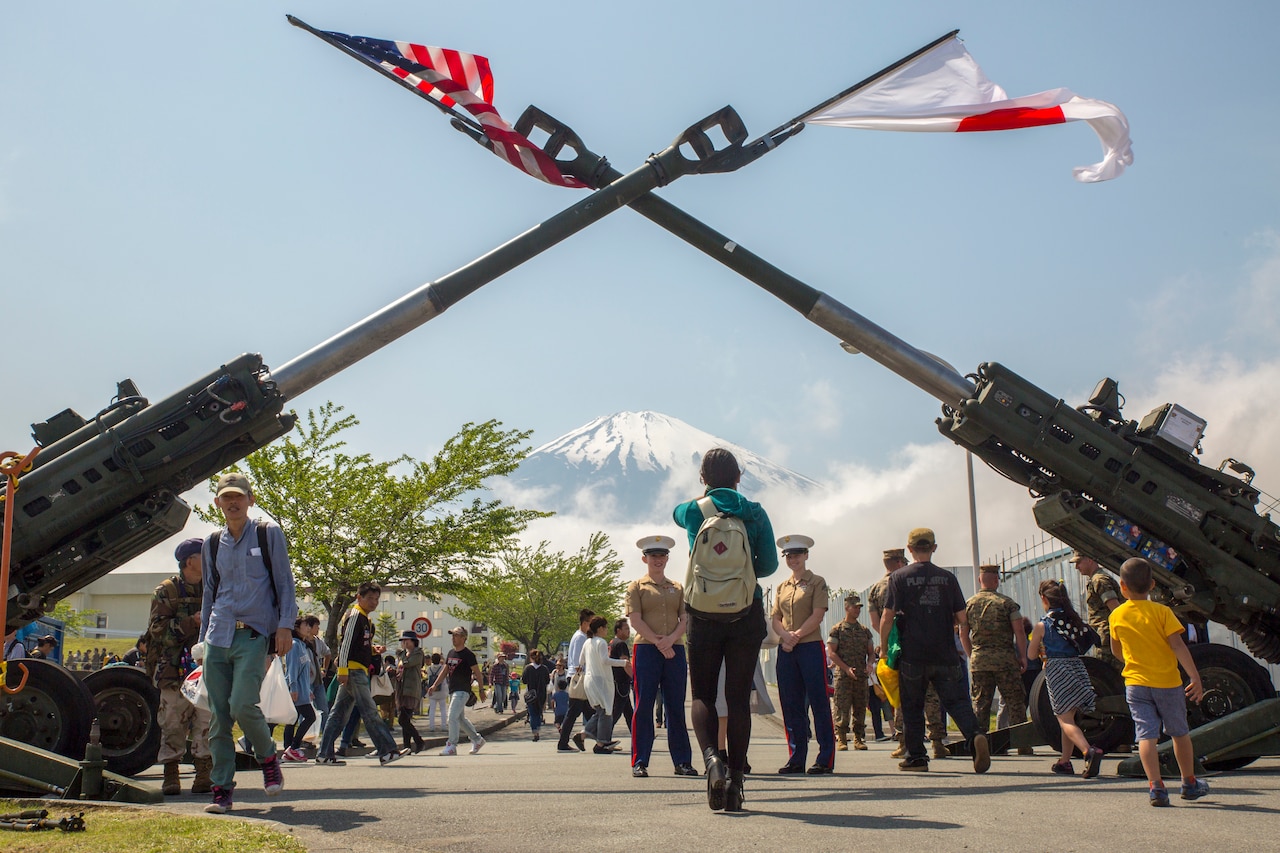
A crowd of people walk up and down a street.

This subcommittee, in turn, drew up the first guidelines for Japanese-U.S. defense cooperation, under which military planners of the two countries have conducted studies relating to joint military action in the event Japan were to be attacked. The guidelines were updated in 1997 following the collapse of the Soviet Union and the beginning of the "post-Cold War" era. The U.S.-Japan alliance was strengthened further in 2015 through the release of revised guidelines, which provided for new and expanded forms of security-oriented cooperation.

General Officer Announcements

 Aug. 14, 2020


Secretary of Defense Mark T. Esper announced today that the president has made the following nominations:

Air Force Lt. Gen. David W. Allvin for appointment to the rank of general with assignment as vice chief of staff, United States Air Force, Pentagon, Washington, District of Columbia.  Allvin is currently serving as director for strategy, plans, and policy, J-5, Joint Staff; and senior member, United States Delegation to the United Nations Military Staff Committee, Pentagon, Washington, District of Columbia.

Air Force Maj. Gen. James C. Dawkins, Jr., for appointment to the rank of lieutenant general with assignment as deputy chief of staff, Strategic Deterrence and Nuclear Integration, Headquarters United States Air Force, Pentagon, Washington, District of Columbia.  Dawkins is currently serving as director, Global Power Programs, Office of the Assistant Secretary of the Air Force (Acquisition, Technology and Logistics), Pentagon, Washington, District of Columbia.

The Enola Gay's History Lives On

 Aug. 14, 2020 | BY Katie Lange, DOD News

Seventy-five years ago, the United States dropped the first atomic bomb on Hiroshima, Japan, bringing an end to a long and devastating World War II and making the Enola Gay, the B-29 that delivered it, one of the most famous in history.

It’s a plane with a huge, controversial, world-changing story to tell.

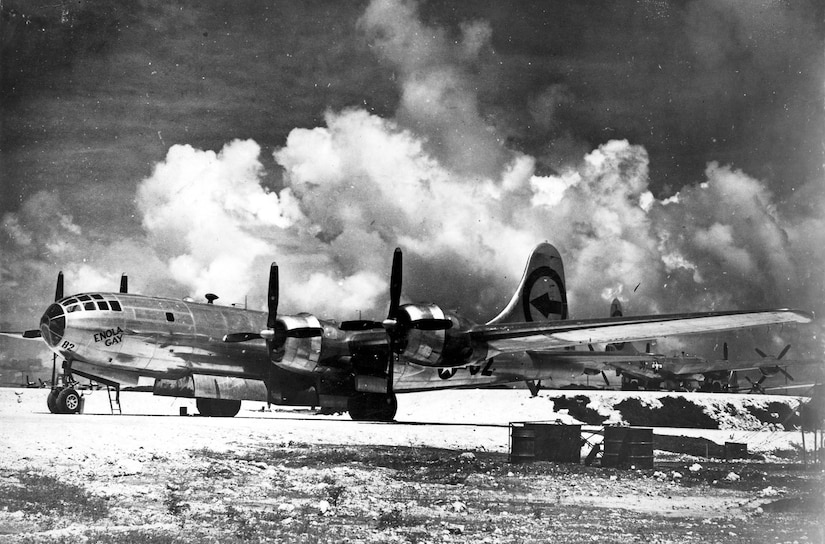
Boeing B-29 "Enola Gay" on Tinian in the Marianas Islands. (U.S. Air Force photo)

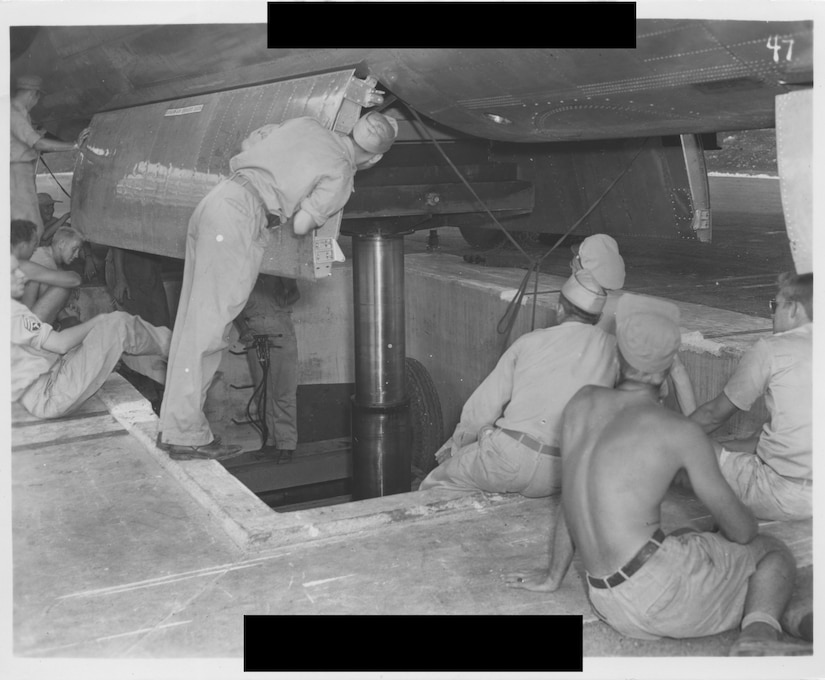
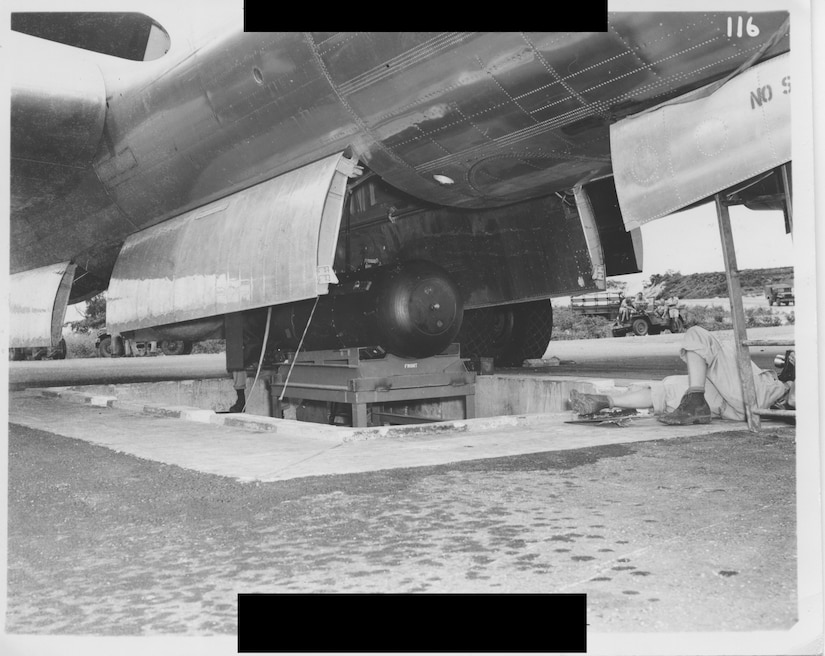
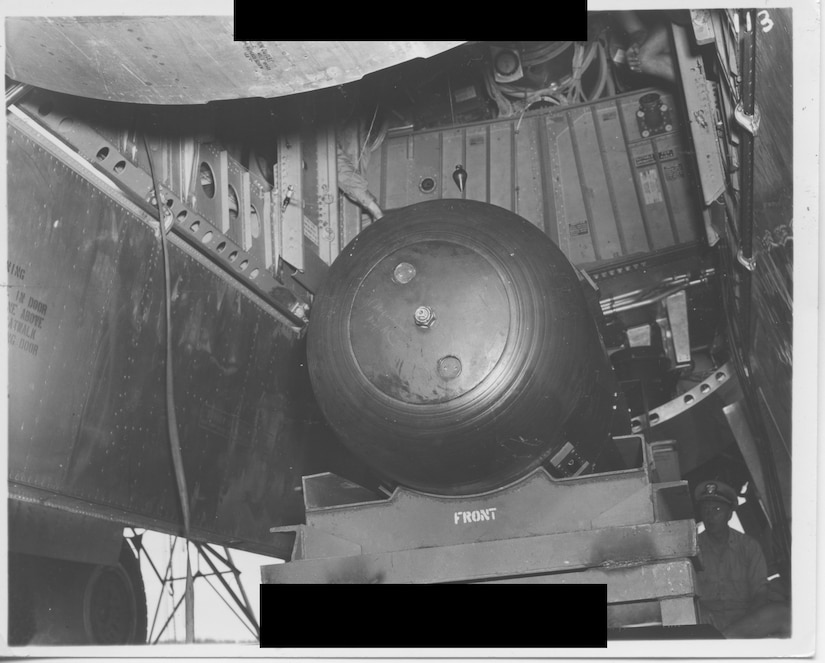
The famous B-29 Superfortress rolled off the Glenn Martin assembly line in the spring of 1945 with what was known as a "silverplate modification" specifically for the atomic mission.

"All of the armor that protects the crew was removed to save weight," said Dr. Jeremy Kinney, the Air and Space Museum’s curator of American military aviation, 1919-1945. "You have a 10,000 pound atomic bomb you have to carry, so you have to lighten the airplane."

The remote-controlled gun turrets were also taken away to increase speed. Only the tail gun position was left to defend it from enemies.

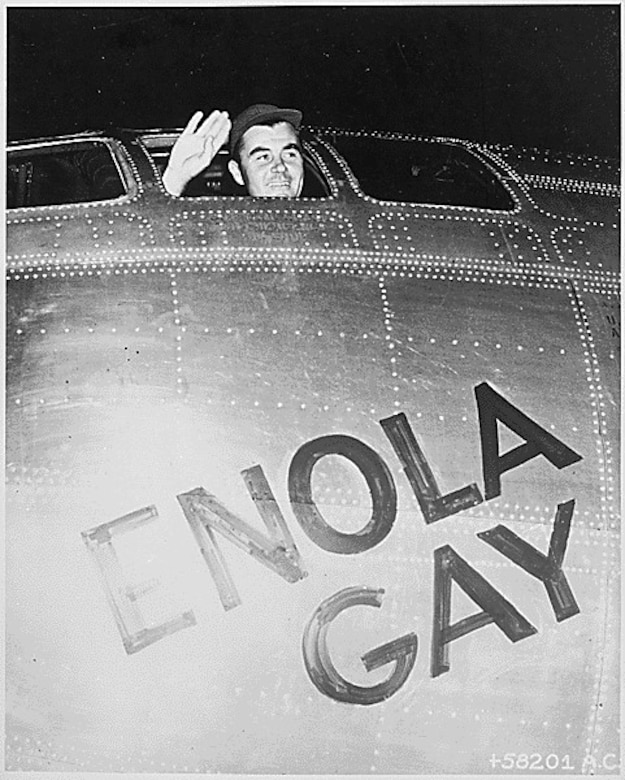
A man waves from the window of a B-29 bomber.

The Enola Gay, known only as No. 82 then, was flown by Army Air Forces Capt. Robert Lewis, of the 509th Composite Group, from the factory to New Mexico, then to Tinian in the Mariana Islands, where its crew practiced flight maneuvers, loading the massive bomb and dropping it. But Lewis would not end up leading the atomic mission. That role belonged to Col. Paul Tibbets Jr., the commander of the 509th. He handpicked the plane the night before the mission, to the surprise of its crew, and had his mother’s name -- Enola Gay -- painted on its side.

"There was some animosity between [Lewis and Tibbets], because … a lot of Lewis’ crew was bumped," Kinney said. "Lewis himself was bumped from command pilot to copilot."

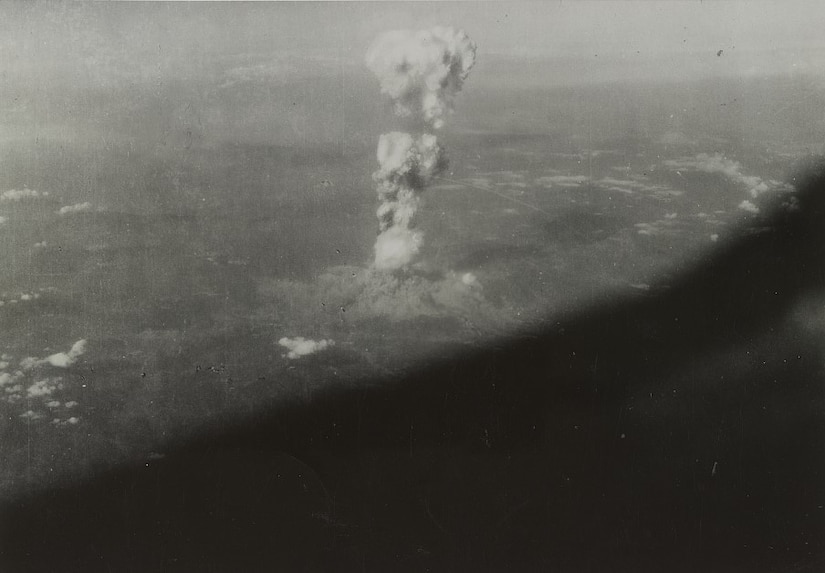
In the early morning hours of Aug. 6, 1945, the Enola Gay took off for Hiroshima, an important Japanese military center. Around 8:15 a.m., on a calm, sunny morning, bombardier Maj. Thomas Ferebee dropped Little Boy -- a 10,000 pound, uranium-enriched bomb -- which detonated 1,800 feet above the city’s center. In one blinding flash, it leveled the heart of Hiroshima with the equivalent of 15,000 tons of TNT.

It was a moment for which none of the Enola Gay’s crew -- miles away by then, but still rocked by the blast -- was quite prepared.

"What’s horrifying about this mission is that it’s one bomber, one bomb and one city. I think that sank in with them, in the sense that you see the mushroom cloud and this firestorm and this city in ruin," Kinney said. "I don’t think they really understood it until they saw it."

A mushroom cloud can be seen over land.

At the moment of impact, those closest to ground zero turned to char, while birds reportedly ignited in mid-air. Around 70,000 people died from the initial blast, according to the U.S. Department of Energy, while tens of thousands more perished in the coming weeks due to radiation poisoning.

The bombing brought controversy as it ushered in the nuclear age, but the crew was just doing its job, and it was clear they believed in what they did.

"[They] felt very strongly that the use of the atomic bomb ended World War II in the Pacific," Kinney said. "They recognized the loss of life and what that meant to the Japanese people, but they felt like it was necessary because they didn’t want more Americans to die in what they thought would be a bloody, long invasion [of Japan]."

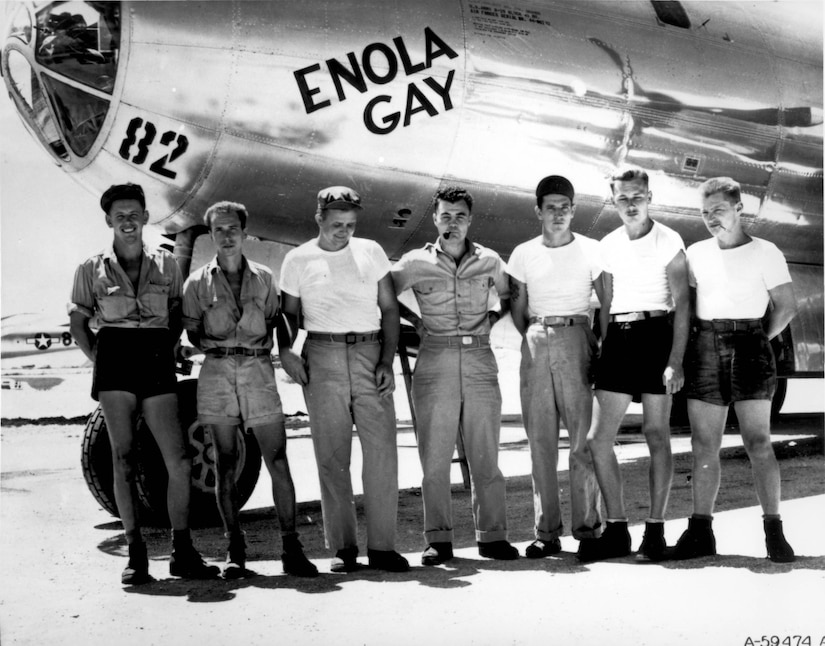
Seven men stand in front of the nose of a B-29 bomber.

The more powerful plutonium bomb known as Fat Man was dropped on Nagasaki three days later by Bockscar, another B-29. Only one member of the Hiroshima mission was on it: Lt. Jacob Beser, the radar operator who tracked both bombs as they fell.

What some don’t know is that the Enola Gay flew that mission, too.

"Usually it’s a three- to four-ship formation. Some fly ahead to check the weather to see what it’s like at the actual target, and Enola Gay was part of that for Nagasaki," Kinney said.

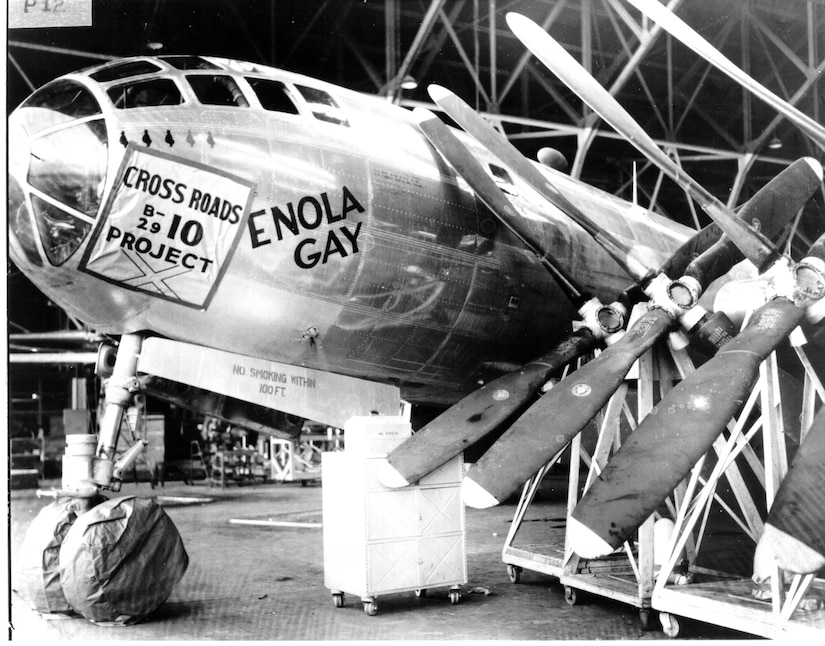
Several propellers are propped up against the nose of a plane under construction.

After the bombings and the war’s quick end, the Enola Gay remained with the Army Air Forces, taking part in the Bikini Atoll atomic tests before being shipped to the Smithsonian in 1960. It was then put in storage near Andrews Air Force Base in Maryland, completely disassembled.

"The wings were off. The tail was off. It was all in big pieces," Kinney said.

It sat that way until 1984, when officials finally decided to fix it up, piece by piece. It took about 10 years and 300,000 hours to restore.

"Every square inch of the duralumin surface has been polished. The engines have been completely overhauled, and the propellers," Kinney said. "It had some fat men painted under the pilots’ windows to indicate the Hiroshima, Nagasaki and Bikini missions. Those were taken off because the decision was to restore it to a particular moment [before Hiroshima]."

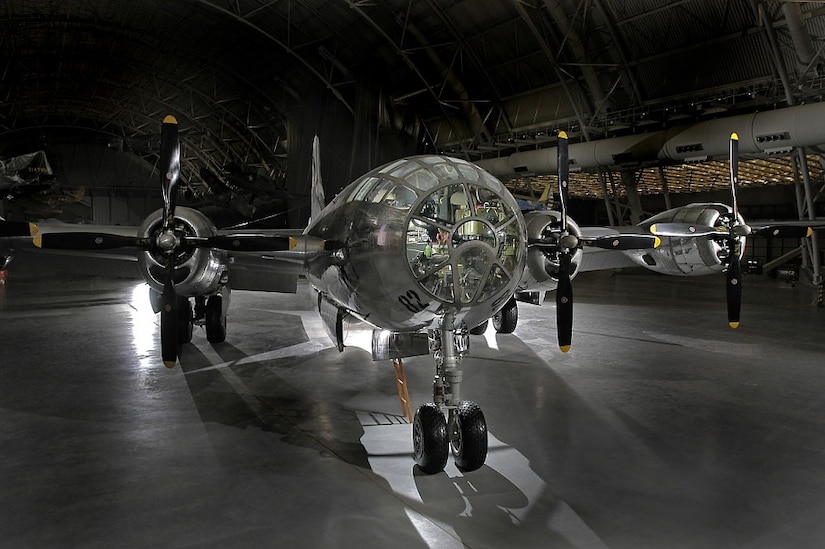
A refurbished B-29 Superfortress sits inside a large hangar.

The plane wasn’t fully reassembled until 2003, when it was put on display in its full glory at the Air & Space Museum’s Udvar-Hazy Center in Chantilly, Virginia. The original painting of the words “Enola Gay” can still be seen on its side.

While no members of the crew that flew the Enola Gay remain to tell its story, the aircraft lives on for visitors.

"Enola Gay is a recognized airplane of World War II, and people want to see it," Kinney said. "They want to see the spaceship Discovery, they want to see the [SR-71] Blackbird, and they want to see the Enola Gay."

Thursday, August 13, 2020

What you need to know to slow the spread of COVID-19 in Hawaii

 Story by Amber Kurka, Public Health Command - Pacific

TRIPLER ARMY MEDICAL CENTER, HONOLULU – Over the last few weeks, new COVID-19 cases have broken record numbers in Hawaii.

As the state grapples with the uptick in positive cases, local leaders have implemented new restrictions and guidelines to help slow the spread of the virus.

Some of these restrictions have included the temporary closure of parks, beaches, and bars, as well as having many schools start the year with online distance learning.

To help fight COVID-19, Lt. Col. Ronald Cole, Public Health Command-Pacific Human Health Services director, dispels myths while sharing tips and advice on how military members and Families can help reduce the spread of COVID-19.

“As military members, we need to take COVID-19 seriously because we are the defense of the nation,” said Cole. “We are not immune from catching or contracting COVID-19 - we are just as vulnerable as anyone else.”

While the overall number of positive COVID-19 cases in Hawaii remains much lower than other parts of the nation, Cole warns that the numbers provide a false sense of safety, and the recent increase needs to be taken seriously.

“We must be cautious since the low numbers do not indicate that there isn’t a large number of cases here,” explained Cole. “Not everyone is getting tested every day, so you are not sure who is positive since some people can be asymptomatic and not know they have COVID-19.”

According to the Centers for Disease Control and Prevention, COVID-19 is thought to spread mainly through close contact from person to person, and the virus may be spread by people who are not showing symptoms.

Additionally, the CDC states that the COVID-19 virus spreads more efficiently than influenza, but not as efficiently as measles.

In general, the more closely a person interacts with others, and the longer that interaction lasts, the higher the risk of spreading COVID-19.

While the number of positive cases remains the highest in the Honolulu area, Cole wants to dispel the myth that rural areas around Oahu are safer than the city.

“Some people think COVID-19 is only in the city and populated areas; however, that is not the case,” said Cole. “Rural communities are being significantly impacted as well.”

To help reduce the spread, Cole suggests service members and Families follow all recommended CDC guidelines and government mandates.

“We must follow the mandates, such as 14-day quarantine, wearing a mask, and maintaining 6 feet of social distancing,” said Cole. “I also encourage mask-wearing 100% of the time when out of your house, as well as avoiding large crowds.”

While beaches on Oahu are currently closed, Cole noted that large beach gatherings and crowds have contributed to the spread of COVID-19 throughout the island.

“It’s okay to get out and enjoy the beach, but when people are not practicing social distancing or keeping groups limited to 10 people or less, and not wearing masks around people outside their household, it becomes an issue,” said Cole. “Recently, there was a big surfing competition, and people were literally sitting on top of each other with no space; that’s not a good thing.”

In addition to people failing to follow guidelines at the beach, Cole suggests that younger people need to be more mindful of others who are at a higher risk, such as the elderly.

“The military community is embedded in the local community, and Hawaii is a family community and culture,” explained Cole. “Many homes are multi-generational with grandparents, children, and grandchildren living together. Younger people can put the elderly who live in these multi-generational homes at risk.”

Cole warns younger service members to think of others when out in the community, as well as looking out for their own health and well-being.

“Typically, when you are younger, you feel that you are invincible and that you are not able to be affected by conditions that most people are, because you tend to have a more active lifestyle and a strong immune system,” said Cole.

“COVID-19 is not the case. If you notice in the news recently, a lot of younger individuals are contracting COVID-19 and succumbing to the virus. So the virus is just as potent to young individuals as well as the elderly and children,” he added.

Additionally, Cole warns that children can be impacted by or carry the virus, and parents should take proactive measures this school year.

“First and foremost, make sure your children’s vaccines are up-to-date,” said Cole. “Next, ensure your children understand the seriousness of COVID-19 and why it is important to follow proper hygiene rules.”

According to the CDC, parents should review and practice proper hand-washing techniques at home, especially before and after eating, sneezing, coughing, and adjusting a mask or cloth face covering.

The CDC recommends washing hands often with soap and water and for a minimum of 20 seconds. If soap and water are not available, use a hand sanitizer that contains at least 60% alcohol.

Additionally, the CDC suggests developing daily routines before and after school—for example, things to pack for school in the morning, like hand sanitizer and an additional back-up mask, and things to do when children return home, like immediately washing hands and washing masks.

When it comes to masks, Cole recommends that military Families review Army Public Health Center and CDC guidelines.

“Each mask has a proper way of usage,” said Cole. “You can go to the CDC.gov website and look at each type of mask. Once the mask is wet and soiled, it is no longer providing any type of protection. You are supposed to wear the mask daily and switch them out. If that is not possible, then do your best to keep that mask from being soiled.”

While face shields are popular, Cole warns that people often wear them incorrectly out in public.

“The face shield is meant to protect you from splatter, but it doesn’t protect you and others from the aerosols,” explained Cole. “If you are going to wear a face shield, be sure you are wearing a mask underneath the shield.”

Masks with exhalation vents or valves are also problematic.

In recently updated guidance, the CDC warned against the use of these types of masks, pointing out that masks with one-way valves or vents allow exhaled air to be expelled out through holes in the material, but can allow exhaled respiratory droplets to reach others and potentially spread the COVID-19 virus.

While all of these guidelines and recent restrictions can seem a bit discouraging and daunting, Cole reminds service members and Families to prioritize self-care and keep the team concept in mind.

“Just know that we are in this together,” said Cole. “Make sure you are taking care of yourself both mentally and physically, whether exercising, reading, going for a walk, those are the things that you need to do right now. You don’t have to be alone, just make sure you follow social distancing and the recommended guidelines. Together, we can help slow the spread.”

For more information on how you can stop the spread of COVID-19 visit: https://www.cdc.gov/coronavirus/2019-ncov/index.html

West Point graduates return as part of summer training task force

 West Point graduates return as part of summer training task force

Story by Brandon OConnor, United States Military Academy at West Point

As Capt. Jack Christoffersen arrived at the West Point gates in February, the old feeling from his cadet days returned and his heart began to beat faster.

It was his first time being back since graduating from the U.S. Military Academy with the Class of 2014 and nearly 10 years since he had begun his cadet career on Reception Day. This time, instead of arriving at the academy to begin Cadet Basic Training, he was at West Point for a pre-deployment survey as a member of 3rd Brigade, 10th Mountain Division, which would be serving as the task force overseeing Cadet Summer Training.

“Seeing how much work and effort from so many people goes into (planning Cadet Summer Training) was pretty incredible, and I don’t think I really appreciated that as a cadet, because I was just trying to get through it every day,” Christoffersen said. “I didn't realize there’s people dedicating hours and hours and hours to making sure that water buffalo is full, and the ammo is here so you can just pick it up and go shoot.”

The full task force of more than 1,000 Soldiers arrived at West Point from Fort Polk in June and has spent the last two months leading cadets through CBT and Cadet Field Training during a compressed training schedule. Christoffersen, who is the company commander for Bravo Company, 2nd Battalion, 2nd Infantry Regiment, is one of eight West Point graduates who have returned this summer to help lead summer training.

Throughout the summer, his company has been running Basic Rifle Marksmanship mostly for CFT cadets, and during the one-day course taught to new cadets during CBT. They have overseen the entire process from the initial train-up to the cadets qualifying on the range by taking the new Army Rifle Qualification Test.

As a company commander, his one-on-one interaction with cadets has been limited. Still, he has leaned on his experience attending West Point to make sure his Soldiers are prepared to train the members of the Class of 2023 going through Basic Rifle Marksmanship.

“I remember the task force when I was in summer training,” Christoffersen said. “I remember the positive experiences I had, and I remember the negative experiences I had. I’m able to tell that to my Soldiers. The impact that you make on this cadet, he’s going to remember in five or 10 years when he's a captain or company commander … So, you have to be professional and I can attest to the fact I remember the people who were unprofessional and who weren’t.”

First Lt. Jack Lucie had made a much more recent trip to West Point compared to Christoffersen as he just graduated with the Class of 2018 and then spent time after graduation serving as an athletic intern with the wrestling team. Despite his short time away from West Point, when the opportunity to serve as a member of the task force came about he jumped at it and volunteered for what was originally planned as a four-month mission before being shortened to two months due to COVID-19.

“I’m pretty passionate about the United States Military Academy and West Point,” Lucie said. “I still have a lot of friends that go here, and my brother is a rising firstie (senior). So, I really wanted to come back and help these guys out.”

Lucie, who is a plans officer for 3/89 Cavalry, 3rd Brigade, 10th Mountain Division, served as a platoon trainer during CFT this summer. His job was to work with the cadet cadre and help develop future officers as they learn how to be platoon leaders.

“I’m not actively training them because they have dedicated lane markers and instructors for each block of instruction that they go through,” Lucie said. “But during their downtime, I’m teaching them classes about anything that they might want to learn. They have a lot of questions about the big Army and what’s different from what you experienced at West Point.”

His shared experience of having gone through CST and graduating from West Point enabled him to quickly build a strong relationship with the cadets he is overseeing, he said.

That relationship then helped create an environment where he could teach and mentor the cadets who will be in his same shoes in the near future. The biggest thing he said he worked to instill is how they should interact with their platoon sergeants and other noncommissioned officers once they begin their Army careers.

“A lot of them haven’t had a lot of NCO interactions,” Lucie said. “(West Point is) very officer heavy and field grade officer heavy at that like majors, lieutenant colonels and colonels. So, they get really used to speaking to high ranking officers, but their interaction with E-5s and E-6s is very minimal. So, kind of explaining to them how you interact with those guys has been a large chunk of my conversation with them.”

First Lt. Maylon Robertson, who graduated from West Point with the Class of 2017, has spent his summer serving as the executive officer for 5th Battalion, 25th Field Artillery Regiment, which is running the various call for fire ranges during CFT.

His role has given him the chance to speak with almost every Class of 2023 cadet taking part in the training and answer any questions they have about West Point and life after the academy. That has included questions about picking a branch, the cow loan they can receive during their third year and more.

“For the most part, we’re just trying to impart some type of field artillery knowledge that they can use when they choose their branching decision,” Robertson said. “When they ask their questions, I’m just trying to help them be a little more positive about things than I was when I came through here. It’s easy to fall into the cynicism monster when you’re here.”

For each of the West Point graduates serving as members of the task force, it is a chance to see the other side of training they went through themselves and also work to make an impact on future officers following the same path they did in the recent past.
“I actually was out here on June 28, which was the 10-year anniversary of when I first got to West Point,” Christoffersen said. “So, June 28, 2010 was my R-Day and it was very surreal to come back and see people who I remember being in their shoes and now I’m on the other side. Definitely seemed to come full circle in a way that was actually pretty cool to see.”

Garrison Modernization to Support Warfighters

 Consolidated battle simulation center

Story by Amy Phillips, Fort Hunter Liggett Public Affairs Office

Fort Hunter Liggett (FHL) has been upgrading facilities and training systems to meet the Army modernization efforts in support of the nation’s warfighters.

“It’s very important to me that we provide as much training support we can so troops can train safely, and use what they learn here on the battlefield,” said Garrison Commander Col. Charles Bell.

Some modernization projects include the on-going upgrades to the Multi-Purpose Range Complex (MPRC) facility to construct new target emplacements and to upgrade existing target lifters to wireless operations; expansion of several training sites to accommodate increased engineer training; and the “301 Complex” renovation which will be the future home of the High Tech Regional Training Center currently located in Sacramento.

“Another major project is the consolidation of all the battle simulators on post to increase delivery efficiency for customers,” said Bill Riley, Director of Plans, Training, Mobilization, and Security. Every minute on ground is crucial to units who have a short time-frame to execute many essential tasks.

“We’re also working with the Army Corps of Engineers to plan potential troop projects such as the expansion of Training Area 10 for increased engineer training,” said Riley. Troop projects provide engineer Soldiers with hands-on training in real-world missions, and help the garrison save money.

“We have a dedicated garrison staff and tenant assets that work in unison to do what is needed to meet the garrison and customer missions,” said Bell.

The “301 Complex” renovation requires infrastructure upgrades and new communications lines to support the High Tech Regional Training Center mission. The FHL Network Enterprise Center, a tenant unit, is installing new fiber and other communication equipment.

“Our range modernization plan is based on troop requirements to meet their readiness,” said William Duckworth, Training Management Specialist. “Range projects are prioritized and approved by the Senior and Garrison commanders for each fiscal year.”

Future projects include the expansion of the Urban Assault Course (UAC) and new live-fire range for platform gunnery for lightly-armored, wheeled and tracked vehicles. The UAC provides troops an ideal space to learn how to fight in an urban environment, and consists of buildings and targets throughout the course. The new live-fire range includes multi-purpose machine gun lanes for dismounted fire.

“There’s a misconception out there that it is difficult to get to Fort Hunter Liggett,” said Bell. There are three airports (San Jose, Monterey and San Luis Obispo) within 1.5 to 2 hours from FHL. There is also a rail head at nearby Camp Roberts for units to transport equipment for training. With the continued increase of training, FHL is working on a contract to transport troops from the airport to the installation. This alleviates the transportation burden from units.

“We have the capacity and the great California weather to host training year-round. I look forward to making it easier for units to get here,” said Bell.

Class of 2024 marches back after CBT like none before


Class of 2024 marches back after CBT like none before

Story by Brandon OConnor, United States Military Academy at West Point

From the moment they arrived at the U.S. Military Academy, the Class of 2024’s experience was destined to be different from any class before.

Their arrival on Reception Day was delayed and split across three days in July because of the COVID-19 pandemic. Their Cadet Basic Training program was shortened from six weeks to four in order to accommodate the change. The training itself was also modified from previous years. Monday’s March Back, which marked the end of CBT, took on a different look as well as 1,099 members of the class followed a nine-mile route around West Point instead of rucking from Camp Buckner like previous years.

It was a continuation of a tumultuous year for many of the members of the class who had their senior years of high school interrupted by the pandemic causing them to miss out on key events such as prom and graduation.

Instead of being deterred by the adversity they have faced at the beginning of their 47-month experience, the new cadets chose to wear it as a permanent badge of honor.

As they prepared to step off from the West Point Golf Course for the final leg of March Back, the class unfurled a black banner on which bright gold letters announced the motto they will carry with them for the rest of their lives — Like None Before.

“That’s the one I voted for, because we’re definitely different,” New Cadet Samuel Hein said. “We’re all coming out of this whole pandemic. It’s like none before. We’re just unique, and we’re going to take the experiences that we’ve learned from in our past and become better people and great leaders in the Army for the future.”

The three words were unveiled for the first time Monday, but over the next four years, they will become a part of the class’ crest and eventually be proudly displayed on the side of the class rings that designate a member of the Long Gray Line. New Cadet Rich Juin said the class’ motto is “ambiguous,” but it also challenges the Class of 2024 to continue to lead in new ways as the world changes before their eyes.

“It basically gives us a challenge because the Army has always persevered in difficult times,” Juin said. “I feel like all the world’s in relative chaos right now. I feel like for our generation we can be a sort of spearhead for them and just show that we can still function despite these times.”

The first step in becoming leaders was spending the four weeks of CBT learning how to be followers. From the moment they arrived at West Point on R-Day, the new cadets were taught how to take orders and were guided through the transition from civilian to cadet and eventually to Soldier after 47 months.

“I hope that I’ve grown a lot,” New Cadet Chloe Doubrava said. “I don’t quite see changes within myself just yet. I definitely have gotten stronger. I’ve lost some weight with those MREs. But I think that CBT rounds out people and changes them in a way that will make them better teammates, better people, more compliant and better followers in the world. That’s kind of what we need before we become good leaders.”

The lessons were instilled in them even though CBT was different than a typical year. After four weeks of training, Class of 2021 Cadet Evan Walker, who was CBT commander this summer, said she wanted the new cadets to know she was inspired by all they accomplished despite the unique challenges of training during a pandemic.

“I'm actually just planning my little closeout speech to them and making them aware of how amazing they did,” Walker said. “We actually just accomplished the unthinkable. Amidst the pandemic and everything that they left prior to this not really getting any closure from their senior year, they still received quality training and had the same Beast as me, basically. They’re all just so proud and happy, and it makes me really happy.”

Hein said his favorite — and also least favorite — part of CBT was the gas chamber, fondly known as the House of Tears, where new cadets learn to trust their protective equipment if they encounter a chemical attack. Although having to go through it himself “sucks,” Hein said he enjoyed seeing his classmates’ reactions to the gas. For Juin, it was learning to rappel that stood out and he said it was the training event he was most excited to tell his family about when he is able to talk with them again.

Doubrava said she enjoyed the challenge and adrenaline rush of the grenade training exercise as they learned to use new weapons throughout CBT.

“At the very end, when you’re able to throw the actual grenade, that's a deadly weapon in your hand,” Doubrava said. “But you have enough self-control and enough knowledge to be able to handle this weapon carefully and well. I think that’s a lot of growth. It changes people to have these rifles in your hand all the time. To have access to grenades. To have access to bayonets, just like chilling in your room.”

After a CBT like none before, the Class of 2024 will enter an academic year that is also expected to be vastly different than previous ones. Because of the changes, Juin said he expects the class and the cadet companies will become incredibly tightknit as they work together to overcome challenges, something that has already begun during their summer training.

“Coming in, I was nervous meeting new people,” Hein said. “It feels like I haven’t met new friends since the beginning of high school. That’s really a challenge but everybody here is in the same boat. Now, we’re all here four weeks later and these are my best friends. I know I’m going to have these relationships for the next 46 months of our leadership development here at West Point, and definitely for the rest of my life.”

USS Winston Churchill Departs on Deployment

USS Winston S. Churchill


NORFOLK (NNS) – Sailors aboard guided missile destroyer USS Winston S. Churchill (DDG 81) departed August 10, for an independent deployment to maintain maritime stability and security and ensure access, deter aggression, and defend U.S., allied and partner interests around the globe.

Sailors aboard Churchill will also be navigating the continuing global pandemic, following strict protocols to keep the crew healthy while maintaining the highest states of operational readiness. All personnel assigned to the ship completed a minimum, 14-day quarantine and were tested for COVID-19 prior to getting underway.

This deployment comes in the wake of countless hours of training, maintenance and practice.

“This Team of Teams has trained hard for the last year, prepping to go overseas and execute whatever tasking and mission sets come our way,” said Cdr. Timothy F. Shanley, Churchill’s commanding officer. “This crew has very much taken extra steps compared to the typical Navy deployment, in having to take proper pre-deployment quarantine measures ahead of embarking the ship.”

Most recently, the ship participated in a rigorous Task Force Exercise (TFEX) alongside other U.S. and other coalition ships. A scenario-driven training event, TFEX serves as the certification exercise for independent deploying ships and is designed to test mission readiness and performance in integrated operations.

“We are a front line asset ‘warship,’ expected to be combat ready with the potential to conduct prompt and sustained combat operations at sea, said Cdr. Timothy F. Shanley, Churchill’s commanding officer. “However, this year is the unprecedented 2020, and this crew has had to first adapt to being a ‘COVID warship’ by tackling the various challenges of keeping the coronavirus off our ship so we can get underway and properly execute the nation's bidding, on time. I am blessed to be the Captain of such a fine crew of professional surface warriors, each with their different strengths.”

The ship is deployed with “Spartans” of Helicopter Maritime Strike Squadron (HSM) 70.

“HSM-70 stands firm in our commitment to the mission, undeterred by the challenges imposed upon us by COVID-19,” said Lt. Cdr. Mark D. Kummer, Churchill’s air boss.

Unique to the fleet, Churchill is the only U.S. Navy ship to have a Royal Navy officer assigned permanently to ship's company as a symbol of the partnership between the British and American navies. It is also the only U.S. Naval vessel to fly a foreign ensign - the Royal Navy's White Ensign is flown alongside the Stars and Stripes. Churchill is the fifth U.S. warship to be named in honor of an English subject.

The ship, whose motto is "In War: Resolution, In Peace: Goodwill," was commissioned in 2001 as the 81st Arleigh Burke-class destroyer.

U.S. Marines implement Emergency Transfusion Program in Middle East

U.S. Marines implement Emergency Transfusion Program in Middle East

Story by Capt. Joshua Hays, 13th Marine Expeditionary Unit   

A U.S. Marine Corps infantry battalion implemented an emergency blood transfusion program while deployed to the Middle East.

Marines and Sailors from 2nd Battalion, 5th Marine Regiment, assigned to Special Purpose Marine Air-Ground Task Force – Crisis Response – Central Command, standardized an emergency blood transfusion program across the ground combat element. The combat causality technique allows the battalion to have a viable and pre-screened donor pool for emergency situations.

The Emergency Fresh Whole Blood (EFWB) program, originally utilized by members of the special operations community, allows pre-screened low titer group (type) O whole blood (LTOWB) donors the ability to deliver life-saving treatment at the point of injury to increase the chance of survival while awaiting transit to the next echelon of care. A similar U.S. Army program, known as the “Ranger O Low Titer (ROLO) Whole Blood Program,” was used for the first known time in Afghanistan earlier this year.

According to a Department of Defense study, from 2001-2011, during Operation Enduring Freedom and Operation Iraqi Freedom, there were approximately 887 deaths resulting from massive blood loss that were potentially survivable had additional blood been available before arrival at an expeditionary surgical suite. By enabling multiple on-the-spot donors, blood can be safely transfused from a mobile donor to a critical patient during transport or from a location shielded from hazard.

The force surgeon and emergency physician, U.S. Navy Lt. Cmdr. Sean Nardi, noted that by pre-identifying LTOWB donors, Marines and Sailors can quickly find a donor and begin the EFWB transfusion.

“Our ground combat element has really spearheaded this program and brought it to the entire command,” said Nardi. “We, along with champions of the program stateside, are currently validating training plans and standard operating procedures in order to truly make it a program of record for conventional forces throughout the service.”

Before a deployment, each consenting Marine or Sailor with group O blood is screened. This screening confirms their blood type, titer levels, and evaluates for transfusion transmitted diseases. Once the screening is complete, and if the service member is deemed to be a LTOWB donor, the service member is provided a donor identification card to keep on their person at all times.

“The EFWB program gives the ground combat element a capability that it hasn’t had in the past,” said U.S. Navy Lt. Lauren Murray, the infantry battalion’s surgeon. “Having the ability to resuscitate casualties with whole blood at the point of injury gives the ground combat element the ability to decrease mortality rates in situations where we are not able to evacuate casualties within the first hour after injury.”

Aside from the physical lifesaving aspect of the emergency transfusion, infantry unit’s commanding officer, Lt. Col. Isaac Moore, believes there is a stronger psychological impact and benefit it brings to Marines forward-deployed.

“Marines are always there for each other, and [the EFWB program] is one more way they demonstrate that,” said Moore. “One individual literally giving his own blood to save a fellow Marine increases cohesion. In a sense, the unit can use the healthy life-blood of one Marine to sustain another. That’s a pretty powerful idea that makes a unit incredibly resilient.”

Each kit weights less-than one pound and costs approximately $135 U.S. dollars, which includes a blood collection bag, needles, filtered surgical tubing and equipment to maintain cleanliness. Each qualified Sailor can carry two kits on top of their standard gear and equipment.

Medical professionals and Marines currently assigned to SPMAGTF-CR-CC intend to keep the EFWB program moving forward with the drive to make the life-saving procedure and cost effective equipment standard across the service.

SPMAGTF-CR-CC is capable of employing aviation, ground, and logistics forces across the U.S. Central Command’s Area of Responsibility at a moment’s notice.

CSP helps Soldiers get the jobs they want

Story by Sgt. Alexandra Shea, Fort Jackson Public Affairs Office

“I am transitioning from active duty and was able to participate in the Career Skills Program,” said Sgt. Porch Colts, a 42A – Human Resource Specialist working in the Company D, 3rd Battalion, 60th Infantry Regiment training room. “I was able to gain skills in the financial services industry. Because of CSP, I’m employed. My last day at Fort Jackson is the first day of my new job.”

As a component of the Soldier life cycle, the Career Skills Program provides Soldiers with opportunities to participate in career and employment skill training during their last 180 days of military service. CSP opportunities include pre-apprenticeships, apprenticeships, internships, employment skills and on the job training in a variety of industries.

The programs are of little to no cost for Soldiers. For programs that do require funding, the Post 911 GI Bill, Montgomery GI Bill and Credentialing Assistance can help cover costs.

While not promised, Soldiers often receive employment offers while participating in the programs. Like Colts, they will have the ability to step out of their boots and into work shoes within a matter of weeks after leaving service. Which can also mean peace of mind for transitioning Soldiers who may worry about employment after military service.

“I wish they offered this program when I was getting out,” said Jude Marranco, a 20 plus-year Army military police veteran and division chief of Fort Jackson’s Army Continuing Education Services, or Education Center.

The program is interchangeable with skills learned through a military occupation specialty or a career that peaks a Soldier’s interests. While the main goal of the program is to set Soldiers up for as much success in a civilian career as they were in the military, reduce veteran homelessness, prevent veteran Families from living below poverty lines, but also ensures a Soldier gets a job in a career they really want.

There are two paths within the program – approved and individual programs. Approved programs are established programs that have been vetted and approved by Fort Jackson and include the Veteran Affairs Warrior Training Advancement Course and Hiring Our Heroes. For those with a specific interest outside of the approved programs, Soldiers can participate in the individual program such as one with the Lexington County Sheriff’s Office.

“The only difference between the approved and individual program is the individual is allowed to pursue an opportunity that may be more in their interests but doesn’t fall into one of the approved programs,” said Shelby Hebing, an Education Center counselor who specializes in CSP. “We currently have someone doing an internship with Columbia Scuba because he wants to be an instructor and open his own business when he gets out. He will be able to sit for his Scuba Instructor Exam after he completes his CSP.”

Many industries are included in the program locally including the Troops to Firefighters, 9-1-1 dispatch operator and Training Concepts-Information Technology. Additional programs such as solar power, maintenance and repair, construction and extraction, heavy equipment, commercial drivers, and Heroes Corporate Fellowship Academy for management and office administration support are offered across the nation. For those interested in participating in program out of state can apply for Permissive Temporary Duty to attend.

More information about the industries and locations available can be found at https://home.army.mil/imcom/index.php/customers/career-skills-program. A Common Access Card will be needed to view the individual programs and to apply.

“It is the Soldier’s responsibility to figure out what they want to do and what company they want to work with,” Hebing said. “We give them the autonomy to make that decision for themselves. They will just need to get in contact with the point of contact for that program directly.”

A complete list of CSP managers and their contact information is found on the website.

Soldiers interested in participating in CSP will need to complete an application in addition to supporting documentation such as a participation memorandum signed by the Soldier’s chain of command, leave form, legal review, any company forms and a completed DD Form 2648 available through the Soldier for Life-Transition Assistance Program.

Due to COVID-19 safety precautions, interested Soldiers are encouraged to visit the website or request an appointment with program coordinators Shelby Hebing and Vivian Grant at 751-5341.

“While our doors may be locked (to help reduce the spread of COVID-19),” Marranco said. “We are here and always open.”

Dog agility obstacle course installed as a part of Eagle Scout project


By Lisa Bishop, USAG Wiesbaden Public AffairsAugust 13, 2020

WEISBADEN, Germany – Dogs (and their owners) are the beneficiaries of Tyler Houk’s recently completed Eagle Scout project, a dog obstacle course at the dog park on Clay Kaserne at U.S. Army Garrison Wiesbaden.

“The whole point of the Eagle Scout project is to learn how to plan and use leadership skills,” he said. Houk, a high school senior, coordinated with the Directorate of Public Works and the Military Police K-9 unit for the planning and approval of the course.

He used a CAD program to design the course in consultation with the K-9 unit. The K-9 unit also donated one of the three course elements, the tunnel. The other two pieces, a ramp and platform, were built by volunteer scouts and adults on Aug, 12 under Houk’s supervision.

Jennifer Fligor’s dog, a golden retriever named Beau, was the first to test out the new course. “As an avid dog park goer, I am extremely happy the Scouts have undertaken this project to add the dog agility training pieces,” Fligor said. “Beau is always happy to go to the dog park but now there is an added bonus of some agility training as well.”

Jaime Nairn visited the park with her small dog, Korea. “I love it; she loves it,” Nairn said. “It gives her a bit of exercise and we have two German shepherds to bring over.”

Houk intentionally designed the course to be small-dog friendly, with a lower platform and a moderate rise to the ramp.

“I wanted to do something different that I haven’t seen before,” he said. “I thought the community would love it.”

Fligor added, “Thank you Eagle Scouts.”

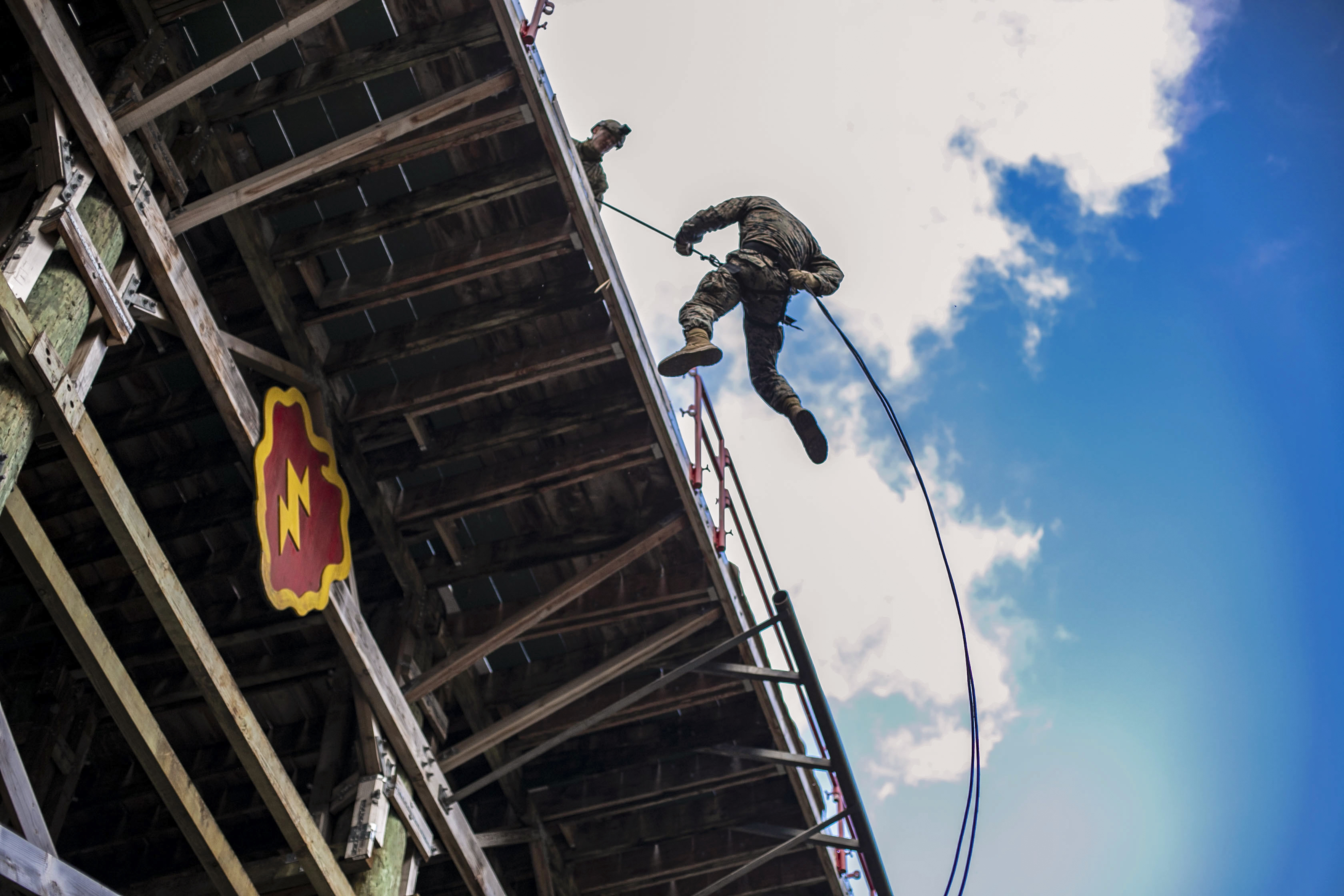
Range Rappel


Marine Corps Sgt. Luke Kuennen rappels during training at East Range Training Complex, Hawaii, Aug. 9, 2020.

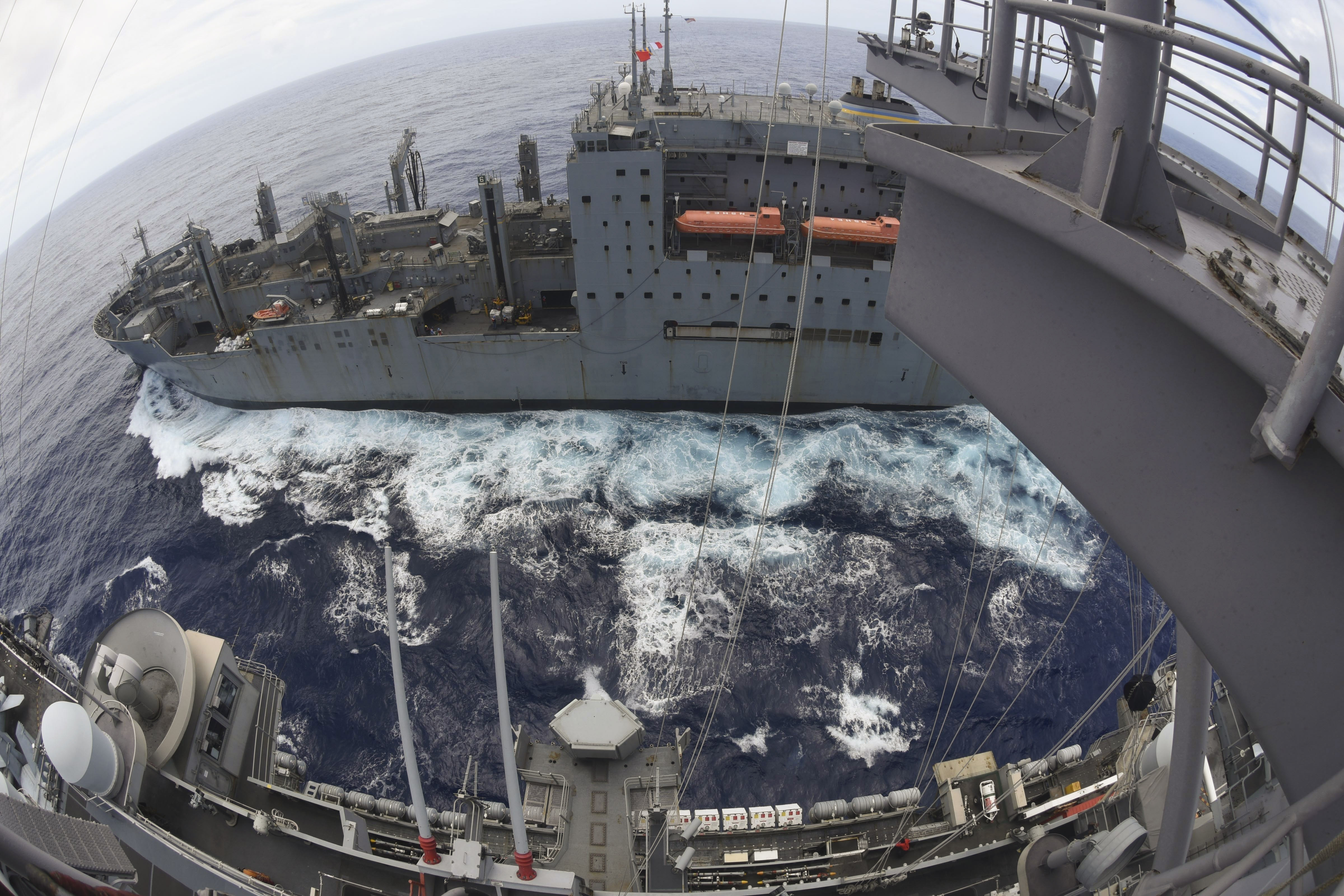
Sea Sail


The USNS Allen Shepherd sails alongside the USS Ronald Reagan during a replenishment in the East China Sea, Aug. 10, 2020.

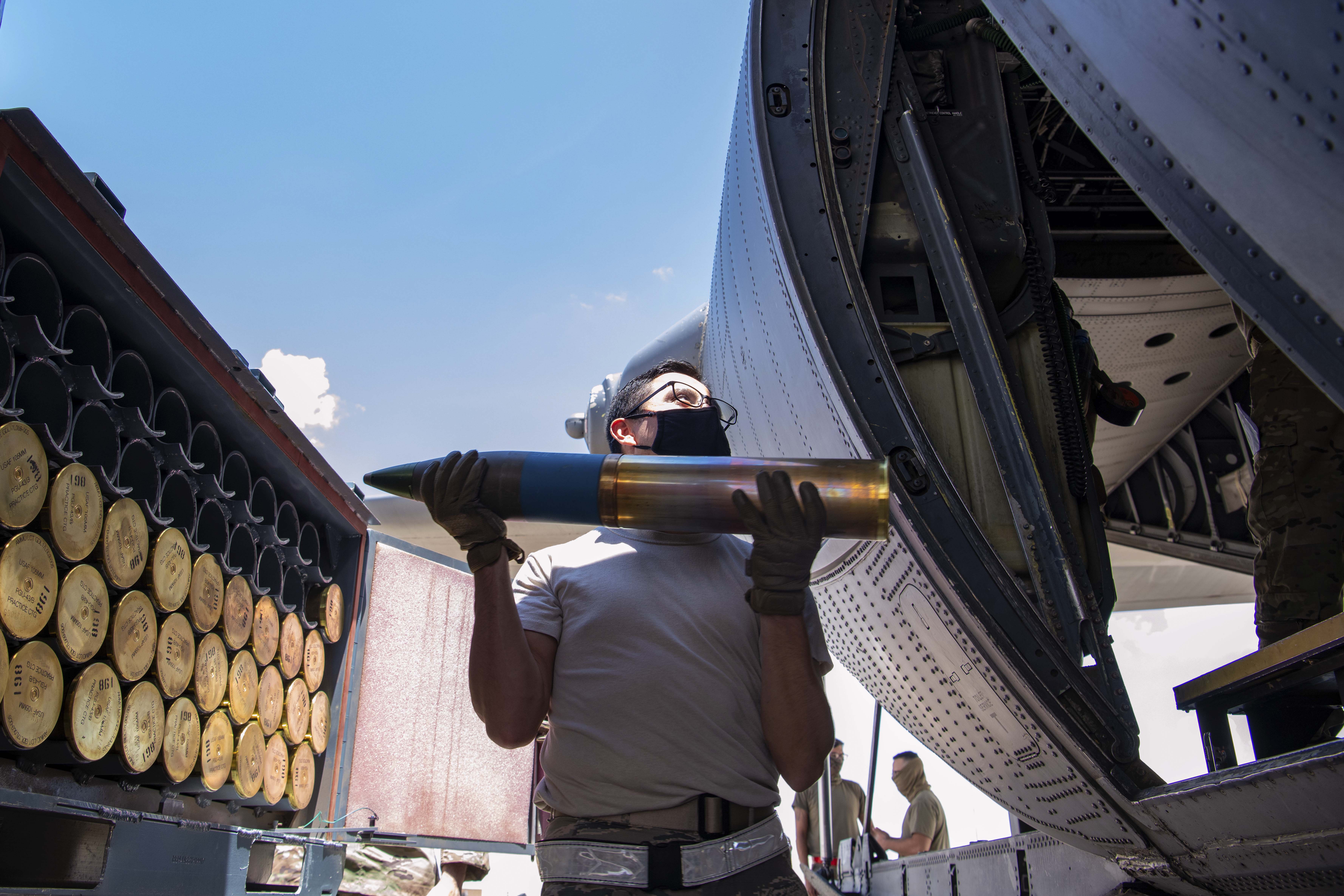
Airman Ammunition


Air Force Staff Sgt. Wellington Parraga hands off ammunition to an aircraft’s crew to load for training at Cannon Air Force Base, N.M., July 22, 2020.

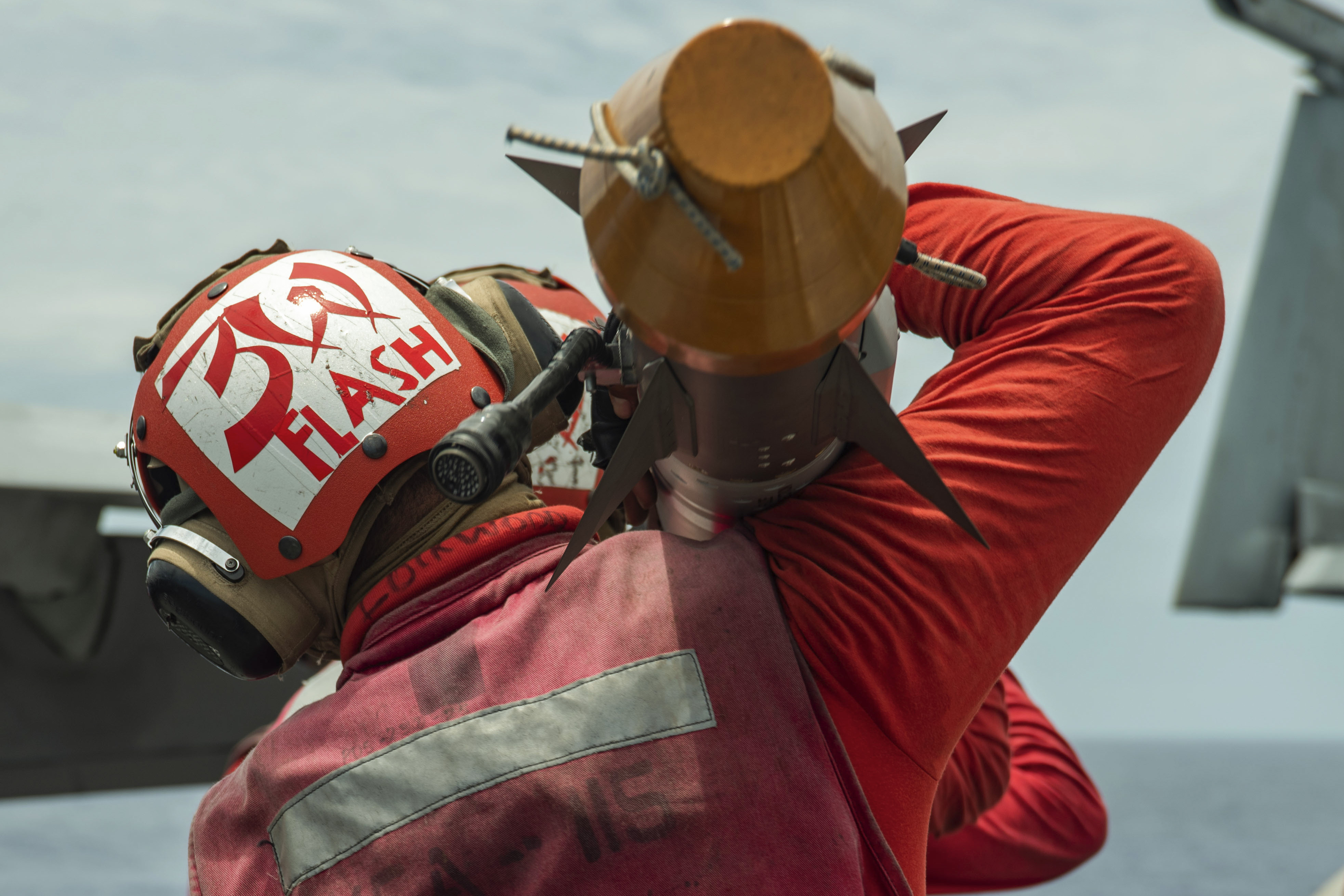
Sailor Squad


Sailors carry a missile on the flight deck of the USS Ronald Reagan in the East China Sea, Aug. 11, 2020.

U.S. Soldiers Arrive in Poland With COVID-19 Protocols in Place

 Aug. 13, 2020 | BY Army Staff Sgt. Scott Longstreet

Soldiers with 2nd Battalion, 12th Cavalry Regiment, 1st Armored Brigade Combat Team, 1st Cavalry Division, are participating in Phase II of Exercise Defender-Europe 20 at Drawsko Pomorskie Training Area, Poland.

The unit, based at Fort Hood, Texas, arrived in Poland July 16.

"We are here executing a deployment readiness exercise," said Army Lt. Col. Ron Sprang, the battalion commander. "We will execute a gunnery skills table ... to improve our lethality as an organization."

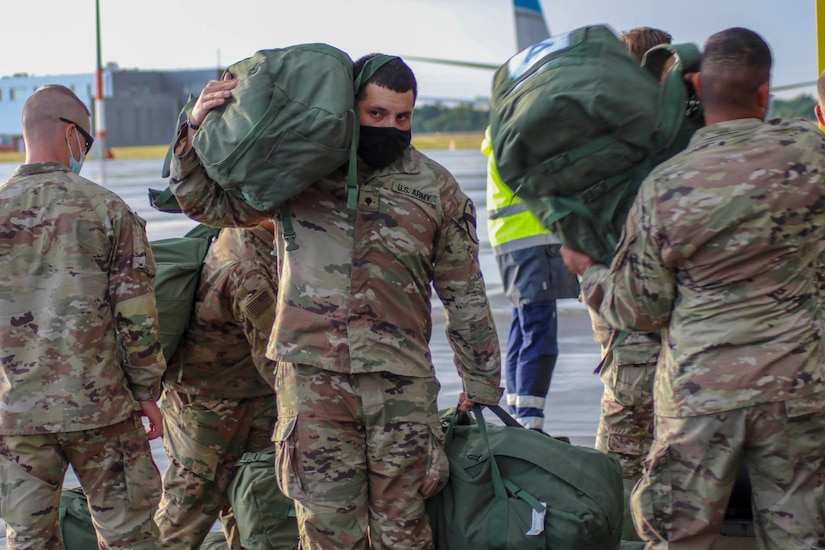
Soldiers wearing face masks retrieve their duffel bags upon arriving at their deployment location.

The "Iron Horse" brigade is scheduled to conduct gunneries and live fire exercises at various lower echelons, up to the company level, to enhance its capabilities. The training will culminate with a combined arms live-fire exercise.

"We are excited to interact with both the Polish military and other American units here supporting Defender 20," said Army Maj. Brandon Kennedy, battalion operations officer.

The training will allow the U.S. forces to integrate with their Polish-NATO Allies.

"Interoperability is key," Sprang said. "We all come from different nations with different equipment and backgrounds. It is critical that we develop skills in order to fight together and build that teamwork and cohesion so we can integrate our systems, our personnel, and be able to communicate effectively so we can fight as a bigger, more powerful team against anyone who will stand against us."

Service members implemented a thorough COVID-19 screening protocol, which included daily screening up to three times through temperature and symptoms checks, along with restriction-of-movement measures. All soldiers will be tested upon arriving at the training area, with periodic checks throughout training.

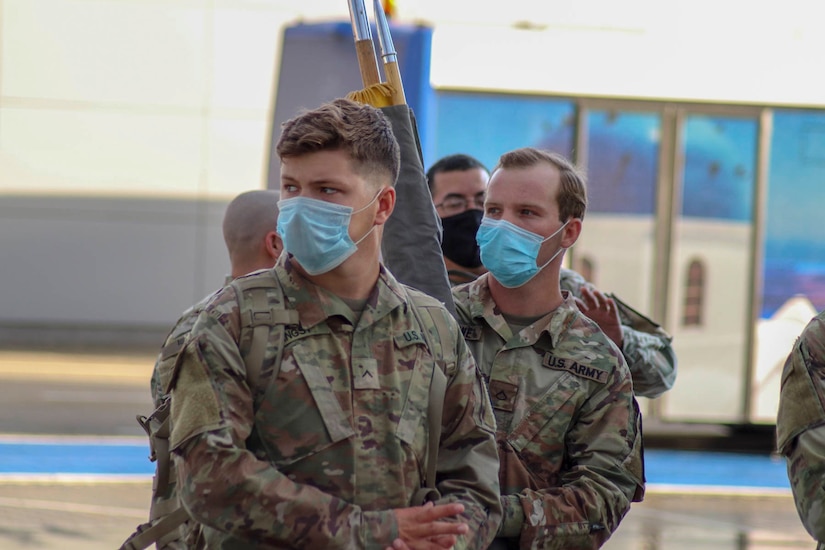
Soldiers wearing face masks arrive at their deployment location.

"We exercised mitigation measures long before we arrived here in Europe," Kennedy said. "We had these measures in place not only for these events upcoming, but to also continue to protect our families and our forces back at Fort Hood."

Defender-Europe 20 is designed as a deployment exercise to build strategic readiness in support of the U.S. National Defense Strategy and NATO deterrence objectives. In response to COVID-19, the exercise was modified in size and scope.

Phase I of the modified Defender-Europe 20 was linked to Exercise Allied Spirit, which took place at Drawsko Pomorskie Training Area, Poland, June 5-19, with about 6,000 U.S. and Polish soldiers. In Phase II of the modified exercise, a U.S.-based combined arms battalion is conducting an Emergency Deployment Readiness Exercise to Europe that began July 14 and ends Aug. 22.

(Army Staff Sgt. Scott Longstreet is assigned to U.S. Army Europe.)

Air Guard Wing Receives DOD's First UV Light Disinfectant System

 Aug. 13, 2020 | BY Air Force Master Sgt. Jessica Roles

Over the last several months, the world changed dramatically due to the COVID-19 pandemic. American families were crushed with the responsibility of wearing face masks, practicing social distancing and keeping social activities to a minimum. While it is becoming easier to manage these new expectations, other preventive measures are being tested and discovered, adding to the health and safety of people around the globe.


The Arkansas Air National Guard's 189th Airlift Wing, in coordination with the wing's innovation team, started the process to implement the Krypton Light Disinfection system. Working with FAR UV Technologies, a Missouri-based disinfectant technology company, the wing plans to install 50 UV lights throughout the campus and eventually innovate ways to use the light sources inside aircraft.

The company was awarded a $1 million contract to initiate the project with the wing. The goal of this partnership is to eventually encourage other units to purchase the same light system through accelerated means, officials said.The 189th Airlift Wing is the first Defense Department unit to use this system.

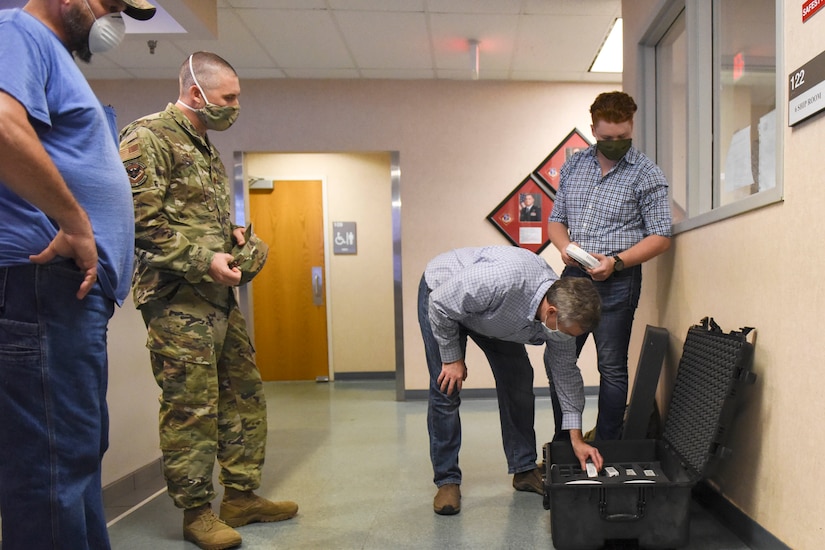
Men wearing face masks prepare to install an ultraviolet light.

"About a month ago, we were running up on a deadline for wings to submit innovation ideas for a special round of government funding called special business innovation research," Air Force Maj. Justin Fitzpatrick, the 189th AW's innovation officer, said. "We weren't planning on going in for that, but the innovation team cold-called the company, and they got back to us."

"We seized the opportunity and used what they already did along with our own work to put this opportunity together," he continued. "We were only able to put this project together so quickly because of our close contacts with the Air National Guard innovation directors and our agile wing innovation structure."

The lights being installed may sound like a process already implemented in some facilities, but a difference in the amount of light used is what allows FAR UV Technologies' product to stand out, wing officials said. According to Far UV Technologies, this technology safely and effectively kills airborne or surface pathogens in occupied locations. This means that while on duty, airmen throughout the wing will have constant, additional protective measures in place to keep them safe and healthy.

"This will add an extra layer of protection in addition to our current risk mitigation strategies," Air Force Lt. Col. (Dr.) Thomas DeGraff III, 189th AW senior flight surgeon and member of the Team DUCIMUS Think Tank group, said. "I see this as increasing exposure time to in-person interactions and decreasing the odds of viral exposure as well as decreasing the risk of infection. We don't have the medical peer-reviewed data to back that up 100 percent, but we do know that it kills pathogens and doesn't cause cancer or cataracts in humans."

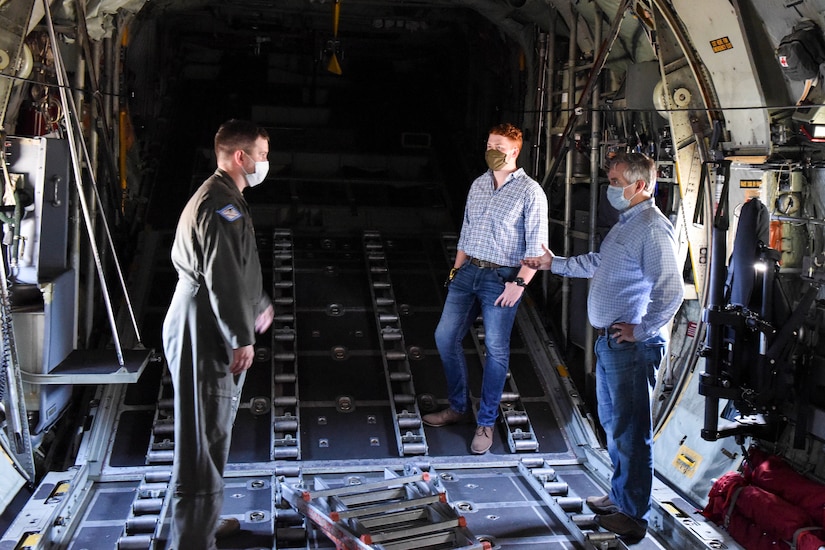
An officer wearing a flight suit talks with two civilians in the cargo bay of a transport aircraft. All are wearing face masks and practicing social distancing.
A man wearing a face mask installs an ultraviolet light on a ceiling.

The krypton light is a measure of ultraviolet light designed to eliminate surface and air pathogens while remaining safe for humans. The light, at 222 nanometers, does not penetrate human and animal skin or eyes, making it safe for everyday use. According to Dr. David Brenner, an independent safety expert from Columbia University Medical Center and subcontractor on the project, the lower exposure range is the key difference between the Krypton system and traditional UV sanitization systems, which can operate at up to 254 nanometers, damaging sensitive cells in the epidermis when used in occupied environments.

"Our advances represent a quantum leap forward in applied science because of our partnerships and represent a giant step for all of DOD," Fitzpatrick said.

(Air Force Master Sgt. Jessica Roles is assigned to the 189th Airlift Wing.)