Tuesday, May 12, 2020

Air Force Implements COVID-19 Screenings at Seattle-Tacoma International Airport


May 12, 2020 | BY Air Force Senior Airman Tryphena Mayhugh

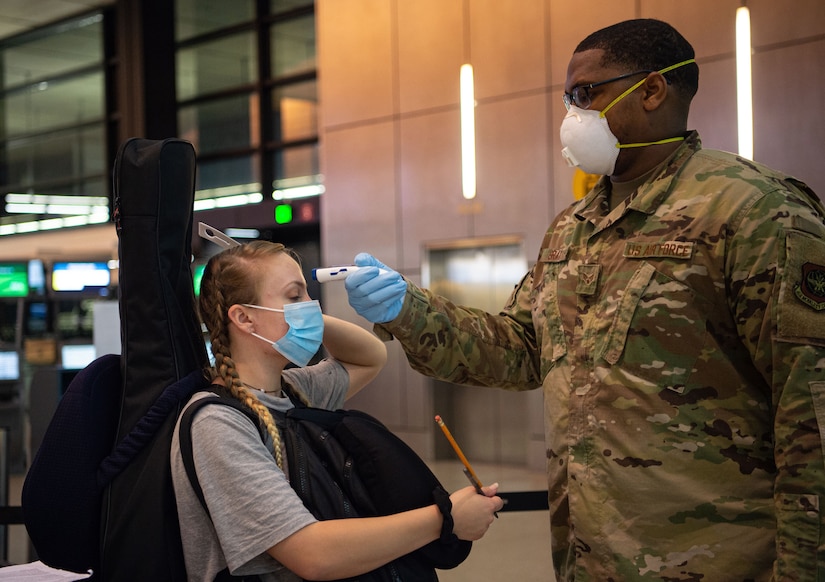
Every Air Force wing, squadron and unit has felt the effects of COVID-19 in one form or another. Airmen assigned to the 62nd Aerial Port Squadron operating out of the Seattle-Tacoma International Airport's Air Mobility Command passenger terminal have implemented  new procedures to ensure the safety of their workers and the passengers who are traveling during the pandemic.

All passengers traveling through any AMC terminal are now required to be medically screened before being allowed to fly. To fulfill the new screening requirements, the 62nd Aerial Port Squadron unit operating out of the airport requested assistance from fellow airmen located at Joint Base Lewis-McChord in Tacoma, Washington.

''For the first time in AMC history, we started conducting enhanced medical screening in partnership with the 62nd Medical Squadron with hopes of preventing the spread of this horrible virus while still enabling the Department of Defense's mission to continue throughout U.S. Indo-Pacific Command,'' said Air Force Master Sgt. Richard House, the 62nd Aerial Port Squadron contracting officer's representative. ''The secretary of defense's stop-movement [order] has dramatically reduced the number of passengers we receive and send, so that has to play a role in reducing the spread.''

Before passengers can check in for their flight, they must fill out a medical questionnaire and have their temperature checked to make sure they are healthy enough to travel. Passengers with a fever of 100.4 F or higher or who have been working at a medical facility, must be cleared by an on-site flight surgeon with the 62nd Medical Squadron before traveling.

''If a passenger is deemed unable to fly, we politely decline their travel, and it's usually a 14-day wait,'' said Air Force Airman 1st Class Nicole Mourik, a passenger service agent with the 62nd Aerial Port Squadron. ''We have had a couple people we had to turn down because they were coughing or sick and the flight surgeon delayed them.''

The number of AMC flights that depart from the airport has remained the same, but the amount of passengers has decreased by 50% to 75%. Despite this drop, the airmen who work there still have quite a large workload, House said.

''Due to ever-changing travel guidance and restrictions intended to reduce the spread of COVID-19, the amount of customer phone calls our passenger service agents are receiving is at an unprecedented level,'' House said. ''Ensuring accurate travel information to our service members and their families requires constant coordination and teamwork between our team and all service components.''

In addition to the screenings, all passengers traveling through the terminal must wear face masks, otherwise they will not be allowed to fly.

''Our team has screened 23 missions consisting of 1,121 passengers with no cases of COVID-19 traced back to our location,'' House said. ''The job they are doing is outstanding. To learn such a novel process and implement it in such a minimal amount of time is to be lauded. Their positive attitude, professionalism and eagerness to help us accomplish our mission at SeaTac can't be more appreciated.''

Anyone who is preparing to fly out of Seattle-Tacoma International Airport and has travel-related questions can call the AMC Passenger Terminal customer service number at (253) 982-3504 or monitor their Facebook page at https://www.facebook.com/SeaTacAmcPassengerTerminal/ to stay current with travel restrictions related to this location.

(Air Force Senior Airman Tryphena Mayhugh is assigned to the 62nd Airlift Wing.)

Army Infectious Disease Doctor Aided Guam's COVID-19 Response


May 12, 2020 | BY Lori Newman , Brooke Army Medical Center

An infectious diseases physician from Brooke Army Medical Center at Joint Base San Antonio-Fort Sam Houston, Texas, recently deployed to Guam in support of the aircraft carrier USS Theodore Roosevelt's response to COVID-19.

Army Maj. (Dr.) Gadiel Alvarado served as the infectious disease expert for the COVID-19 Public Health Task Force from April 12-22. The team, consisting of five Army officers, was there to perform a comprehensive and multidisciplinary review of processes, assess the situation and help with mitigation plans surrounding the COVID-19 outbreak aboard the ship.

The ship arrived in Guam on March 27 for a scheduled port visit. Prior to its arrival, three sailors tested positive for COVID-19. The Navy has since undertaken an aggressive mitigation plan of isolating, quarantining, and treating affected sailors to keep the ship prepared to execute its mission.

"This population of personnel in close quartered and close proximity living on the USS Theodore Roosevelt represented an increased risk population with high likelihood for COVID-19 infection transmission," Alvarado explained.

The 10-day mission consisted of face-to-face interviews, data gathering, on-site evaluations, discussions and recommendations to the Joint Regions Marinas leadership, working closely with Navy Rear Adm. John Menoni, the Joint Regions Marinas commander, and personnel from the Roosevelt, Navy Base Guam and U.S. Naval Hospital Guam to prevent further transmission of the virus.

"The proper public health decision making and management of personnel was critical to preventing death and disease burden from COVID-19 affecting the sailor population and Guam civilian population," Alvarado said.

Alvarado, a native of Puerto Rico, who completed his infectious diseases fellowship at the Brooke Army Medical Center, relied on his previous training and lessons learned during the medical center's initial preparation and response to COVID-19.

"I was heavily involved with the risk identification and testing procedure planning," he said. "One of my main roles was helping with the tent screening process, and I was also on the inpatient call team for COVID patients. I had already gone through the motions at BAMC."

Alvarado credits his training, Brooke Army Medical Center leaders and being part of the COVID-19 planning efforts early on for his success in this mission.

"It was a very efficient and elaborate operation," he said. "We were a very cohesive team. We all had our own specific skills, and we were able to get the job done. It was amazing."

Army Col. Samuel Jang, the Guam Public Health team lead, praised Alvarado for his efforts.

"Major Alvarado shared many nuances and in-depth insights into COVID-19 disease epidemiology and disease transmission," Jang said. "His clinical insights were translated into strategic public health planning and operational decision making. He is a highly competent physician and leader."

Army Lt. Col. Ronal Cole, a public health nurse and task force member, agrees.

"His professionalism is to be commended and emulated," he said. "His ability to function in a diverse team made our long days of interviews, data gathering, evaluations and discussions stress-free. He is to be commended for his contributions in saving the lives of approximately 160,000 civilians and 20,000 military personnel during this time of worldwide distress."

Although the praise of his fellow Public Health Task Force teammates means a great deal to Alvarado, the support from his wife, Maureen and 8-year-old son Aidan was invaluable.

"My wife was very supportive of this mission, but my son was very sad that I was going," Alvarado said. "But he looked at me and said 'daddy I'm very glad they picked you.' When I asked him why, he said 'because I know you can help them.'"

(Lori Newman is assigned to Brooke Army Medical Center.)

Florida National Guard Shines During COVID-19 Response


May 12, 2020 | BY Army Sgt. Leia Tascarini

The Florida Army National Guard's 256th Medical Company Area Support has played an intricate and ever-evolving role in the state's COVID-19 pandemic response.

The units soldiers have collected specimens and conducted quality assurance and quality control, and also have trained other soldiers and civilians to serve as test administrators for community-based testing sites, mobile testing teams and walk-up testing sites in the 50th Regional Support Group area of operations.

''The 256th has proven that they have the technical skills, expertise, and rapid adaptability to execute every mission with the resources it has and at a moment's notice,'' said Army Maj. Jacqueline S. Zuluaga, the 256th MCAS commander. ''Every member of the 256th has demonstrated true professionalism and 100% dedication to this mission.''

The soldiers have provided guidance and served as subject matter experts for other units running mobile testing teams around Florida. They also have served as liaisons among hospital administrative personnel, laboratories, the Health Department, nursing facilities, the Federal Emergency Management Agency, the departments of Health and Human Services and Transportation, local emergency medical services, police departments and other military units.

In support of the fight against COVID-19, the 256th MCAS designed and developed a detailed training program for mobile training teams and mobile testing groups to train nonmedical personnel such as truck drivers, infantry and military intelligence personnel to be part of medical teams. They trained 40 mobile testing team members assigned to the 50th Regional Support Group and several trainers belonging to the 53rd Infantry Brigade Combat Team.

In addition to training personnel and soldiers, the 256th MCAS also helped develop the standard operating procedures for community-based testing sites, mobile testing teams and walk-up test site operations in south Florida.

''The 256th has been one of the Florida Guard's greatest assets during the COVID-19 response,'' said Army Col. Ricardo Roig, the commander of the 50th Regional Support Group. ''Their soldiers' professionalism, knowledge, expertise and commitment to the mission has been exceptional.''

(Army Sgt. Leia Tascarini is assigned to the Florida Army National Guard's 107th Mobile Public Affairs Detachment.)