Tuesday, May 05, 2020

Landstuhl Nurses Answer Call to Combat COVID-19


May 5, 2020 | BY Marcy Sanchez

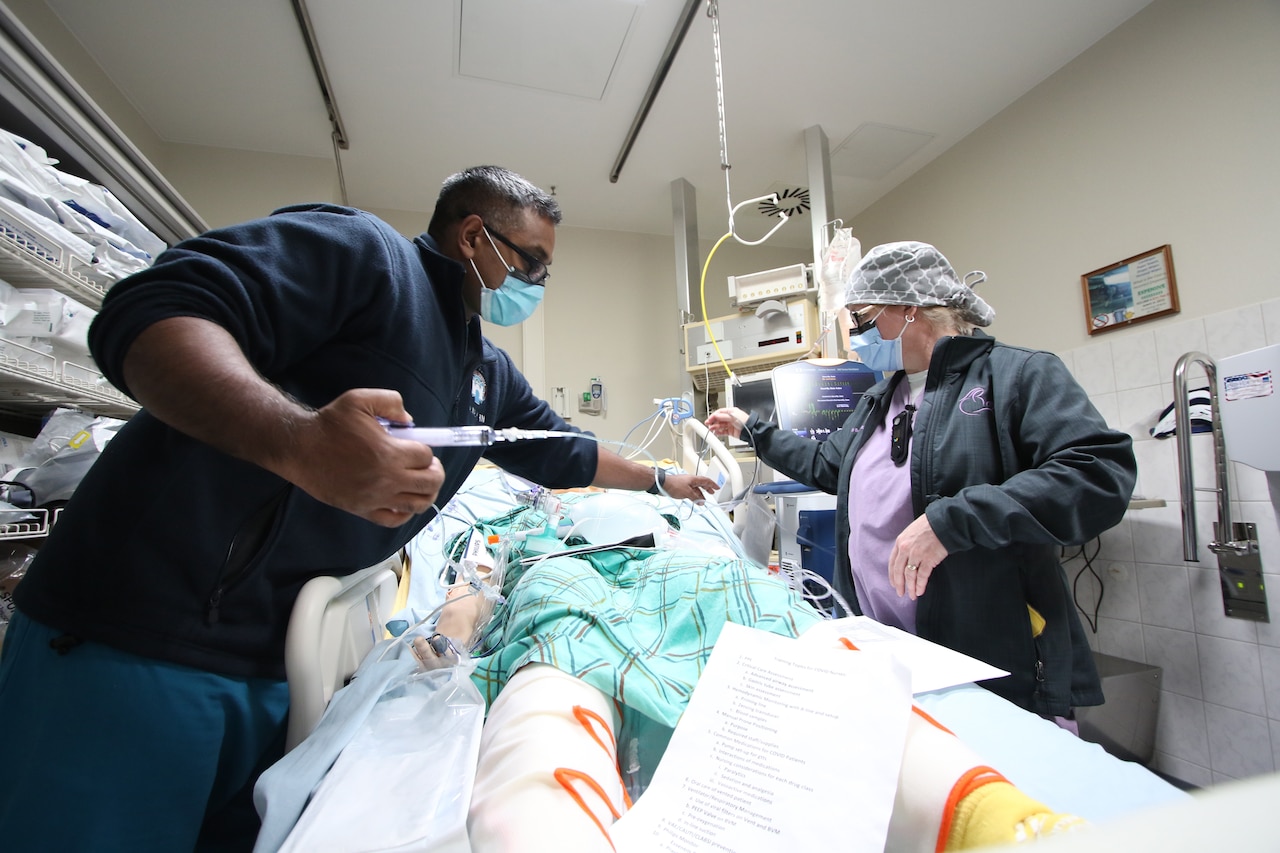
With health care providers everywhere answering the call to prevent the spread of COVID-19, more than 75 nurses at Landstuhl Regional Medical Center in Germany are volunteering to augment the critical care staff to combat the global pandemic if needed.

As part of larger efforts in staff readiness and development, clinical personnel not normally trained in critical care are undergoing training designed to increase staffing capabilities in support of the medical center's COVID-19 operations.

"We're focusing on skills directly related to critically ill COVID-19 patients that are being seen throughout the world right now," said Army Maj. Julie Duffy, a clinical nurse specialist who works in the intensive care unit. "We're working to make sure that [non-ICU nurses] are trained and have the understanding of COVID-19 and what patients are experiencing, and the skills related to it."

Centers for Disease Control and Prevention guidance urges health care facilities to consider mitigation strategies for staffing shortages to continue providing safe patient care and work environments.

The training aims to educate nursing augmentees from different areas of the hospital in critical care medicine using online and hands-on training under supervision. Subjects include training specific to COVID-19 patients such as hemodynamics monitoring, airway management and mechanical ventilation basics, treating adult respiratory distress syndrome, infection control and personnel protective equipment protocols.

Inpatient nurses, as well as nurses from other units, are volunteering to augment the ICU, increasing the capability to care for both COVID-19 and non-COVID-19 critically ill patients.

Duffy said participation in the multidisciplinary efforts toward minimizing the impact of COVID-19 on other medical center operations has benefits beyond supporting critical care units.

"There is a benefit for the nurses as well — the sense of purpose and helping," Duffy said. "I think it's going to be big for a lot of them. We know that there's a nursing shortage nationwide, so to be able to know that we helped in some way with the pandemic, I think that will emotionally help nurses."

Three times a week, cohorts of nurses continue to train with ICU and pulmonary staff members using the latest evidenced-based practices in treating individuals diagnosed with COVID-19. As more staff members are trained, Duffy said, she expects training objectives to evolve.

"Right now, it's really more about familiarization with the equipment and just getting some hands on working with it, then we'll be able to throw it into patient scenarios," she said. "Soon enough, nurses from throughout the facility will be trained so they're able to help [in the ICU] should the time arise."

(Marcy Sanchez is assigned to Landstuhl Regional Medical Center.)

New Jersey Guardsmen, Active-Duty Troops Coordinate State COVID-19 Response


May 5, 2020 | BY Air Force Master Sgt. Matt Hecht

New Jersey Guard soldiers and airmen teamed up with active-duty service members from the Air Force and Coast Guard, as well as civilians from U.S. Northern Command, to establish a joint operations center to coordinate nearly 700 members of the New Jersey National Guard responding to the COVID-19 pandemic across the state.

The JOC provides key leaders in the state with a constant flow of information and updates they require to make decisions.

"We are essentially a liaison office between the Office of Emergency Management and the rest of the New Jersey National Guard," Army Spc. Benjamin Castria, a full-time JOC team member, said. "We also receive requests from the National Guard Bureau down in Washington, D.C., asking for updates on what we're doing to support the COVID-19 response efforts."

According to Castria, the JOC also receives requests from the New Jersey State Police and the New Jersey Department of Health, through the New Jersey Regional Operations and Intelligence Center, the steady-state nerve center that serves as New Jersey's primary focal point for information sharing and intelligence production needed to support law enforcement, counter-terrorism and homeland security missions.

While JOC team members normally operate out of the Homeland Security Center of Excellence in Lawrenceville, New Jersey, they had to get creative with the outbreak of COVID-19. To keep the mission going, the New Jersey National Guard JOC became the first JOC in the country to shift to 100% telework capabilities.

"For the first week, we operated the JOC remotely," Army Master Sgt. Rene Sales, the noncommissioned officer in charge of the JOC, said. "It offered a unique set of challenges, but we made the mission happen, and kept everyone healthy."

Even though staff members have returned, JOC personnel are spread out around the building in accordance with established social distancing protocol.

Logistics experts, active duty liaison officers, medical officers, and intelligence analysts make up some of the JOC workforce.

"The joint effort has definitely been a beneficial and instrumental part of this operation," Army Chief Warrant Officer 2 Timothy Jardinico, the officer in charge of the joint directorate of intelligence and security, said. "We get to see it from different perspectives, from all levels of the organization."

Air Force Master Sgt. Kimberly Kaminski, a security forces airman with the New Jersey Air National Guard’s 108th Wing, has been acting as a liaison between the state's two Wings and the JOC.

"It's a whole different view," Kaminski said. "To do missions like this means a lot to me. Humanitarian missions like this are a big part of why I enlisted. My family was affected by hurricanes Floyd and Irene, and the National Guard came out and helped us, so it feels good to be able to give back."

Air Force Col. Mike Smith, deputy Title 10 commander, who is assigned to U.S. Northern Command, said it was his team's role to support the dual-status commander, Air Force Brig. Gen. Wayne McCaughey, and the deployed forces throughout the state, including Army reserve soldiers with Urban Augmentation Medical Task Force 352-2. McGaughey is the director of the New Jersey Guard's joint staff.

"The Urban Augmentation Medical Task Force soldiers come from all over the country," Smith said. "Wisconsin, Florida, California and many others, coming together for the first time to work together supporting New Jersey."

"The folks that make the most impact are the doctors and nurses, and our active duty and reserve staff that are augmenting hospitals," Coast Guard Cmdr. Shana Donaldson, a member of the U.S. Northern Command Team, said. "We've got Title 10 medical providers all over the state doing just amazing things."

Even though they aren't on the front lines of the COVID-19 response, JOC service members recognize the key role they play.

"What our team does is very important and a big responsibility," Castria said, "What we're doing here has a direct impact on what they're doing in the field. Being able to relay information correctly and accurately and quickly is critical to the mission."

(Air Force Master Sgt. Matt Hecht is assigned to New Jersey Air National Guard.)

i911, helping the Coast Guard save lives


First Coast Guard District command center crews, from Maine to Northern New Jersey, have a new tool to help distressed mariners come home to their families after being out to sea.
The i911 program allows for watchstanders to use a mariner’s cellphone number to assist in finding their location for Coast Guard rescue crews to locate them faster. Once the number is entered, the mariner receives a text message authorizing them to share their location with the U.S. Coast Guard. Once shared, the internal cell phone’s GPS, which uses satellites to pinpoint the mariner’s location, is displayed on a screen for watchstanders to aid in the search for them.

This software is already available to first responder agencies across the country. It was developed by Callyo Inc. and is a free service for all first responders, including the Coast Guard.

“What’s cool about my job is that I get to learn about new technology, and how we can apply it to help the Coast Guard,” said Lt. Anne Newton, Coast Guard Research and Development Center. “The second I saw Callyo’s presentation, I knew this would help command centers tremendously.”

Newton worked in a several command centers before her time at the R&D Center and understands the struggle command center crews face when trying to find someone they know is counting on the Coast Guard to bring them home.

Depending on the cell phone service, i911 can determine locations of distressed mariners from up to 15-20 nautical miles offshore. During the pilot period, more than 38,000 search and rescue cases across the contiguous United States were analyzed, and it was found that 89 percent of all SAR cases took place within 20 nautical miles off shore.

Coast Guard Sector Long Island Sound, located in New Haven, Connecticut, was the first to test the system. It was a success and subsequently all five First Coast Guard District Sector command centers became part of the pilot program.

It’s not a perfect system though, there are some challenges.

The biggest challenge watchstanders at Sector Long Island Sound found was teaching distressed mariners how to turn on their location services. The i911 system will not work without it.

“It’s really cool technology and already helped us on numerous occasions with search and rescue,” said Joshua Olsen, a command duty watchstander for Sector Long Island Sound. “Sometimes, we just need to talk people through how to share their location.”

During the pilot period, the i911 system assisted in bringing several mariners home including three people on an inflatable raft. They were blown out to sea and couldn’t paddle to shore due to high winds and strong sea currents. Armed with only their cell phones, i911 pinpointed their location about 6 miles offshore and rescue crews were able to rescue and bring them home safety.

Chief Petty Officer Andrew Case, a command duty officer at Sector Southeastern New England, located in Woods Hole, Massachusetts, really liked having this tool to use for search and rescue.

“It’s like Rescue 21 for the phone,” said Case. “It greatly decreases the time we spend looking for someone and gets the rescue crews out faster.”

Case also said that doesn’t mean mariners should not have a VHF radio on board. The most reliable and traditional means of communication for mariners to use when in distress is VHF channel 16.

This is just one of many cases where people were brought home safe during the pilot program in the Northeast. This program will hopefully be a game changer in the 2020 recreational boating season.

The pilot program, which ran from May – November 2019, is now authorized for Coast Guard command centers across the entire service and U.S. as of March 20, 2020.