Wednesday, April 22, 2020

DOD Starts Tiered COVID-19 Testing Process to Ensure Safety


April 22, 2020 | BY Jim Garamone , DOD News

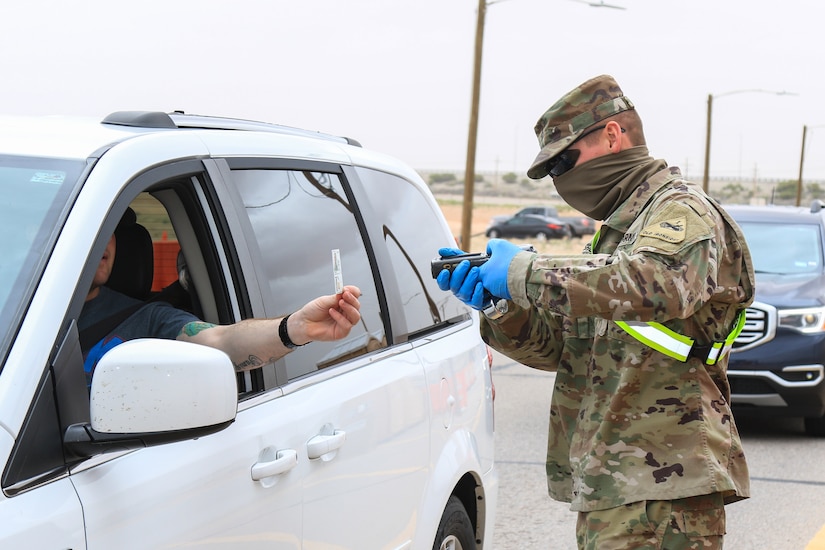
The Defense Department is moving to a tiered COVID-19 testing program to protect service members and ensure they can continue to do the nation's business, the vice chairman of the Joint Chiefs of Staff said.

Air Force Gen. John E. Hyten and Deputy Defense Secretary David L. Norquist described the four-tiered system and all other aspects of DOD's support to civilian agencies against coronavirus during a Pentagon news conference today.

The new system means the department is moving from a diagnostic focus to a diagnostic-plus-screening focus, the general said, noting that DOD now has the means to expand testing to a wider military population. The tiered focus gives priority to the highest-risk forces and will ensure strategic mission assurance, he added.

Tier 1 is testing for those involved in critical national capabilities such as strategic deterrence or nuclear deterrence, Hyten said. Tier 2 will test fielded forces around the world. Tier 3 encompasses forces being forward deployed or those redeploying, and Tier 4 is for all other forces.

Testing will become more frequent as supplies become more available. The military has already started testing those service members in Tier 1, the general said, but he pointed out that testing is not a solution. Service members still must engage in social distancing, wearing masks, washing hands and all other recommendations of medical officials.

The testing is, however, a powerful tool. When used in conjunction with all other preventive measures, it can "improve our overall force availability," Hyten said.

Norquist and Hyten both said the department is adjusting to the new rhythm COVID-19 has enforced on the world. Military and civilian employees continue their missions under the new strictures, including a huge increase in telework. "We now have an estimated 970,000 active duty and civilian personnel teleworking with great success," Norquist said.

For example, the deputy secretary said, the Defense Finance and Accounting Service has 95 percent of its workforce teleworking. "Each month DFAS makes over 5.8 million payments to civilians, active duty, reserve, National Guard and DOD retirees, but because they previously prepared for it and practice extensive telework, they're sustaining regular operations at full capacity," he added.

But some jobs in the military can't be phoned in, and that includes training new recruits, working aboard ships and in cockpits and otherwise working in constrained spaces. The department is working to address those situations, Norquist said.

The department will screen individuals with questionnaires and thermometers to identify people at risk. They will be put in quarantine for 14 to 21 days, depending on the risk tolerance, to identify those who are infected, but are not yet showing it, he said.

"Prior to leaving quarantine, we will conduct a swab test and a temperature check to identify individuals who are infected, but still do not show it. … As the unit then moves to its mission, [we] will keep the group together, but [with] limited outside interaction to prevent introduction of infection from outside."

Again, masks, social distancing, cleaning workspaces and more will continue as the process continues, the deputy secretary emphasized. "These interim measures enable us to reduce the risk," he said. "So we continue to operate until we develop therapeutics and vaccines. And as we learn more about the virus, we will continue to evolve our approach."

DOD Allows Remote Extension of ID Cards


April 22, 2020 | BY JIM GARAMONE , DOD News

Is your military ID card expiring, but with social distancing and various stay-at-home orders in effect, you aren't sure whether you'll be able to renew it?

The Defense Department has changed the process to allow service members and civilians to temporarily extend the life of their cards as the nation battles the COVID-19 pandemic. These extended cards that appear expired on their face can continue to be used for access to benefits, including health care and entry to installations and buildings and to systems and networks.

Matthew P. Donovan, undersecretary of defense for personnel and readiness, and the Joseph D. Kernan, undersecretary of defense for intelligence and security, released the policy changes in memos published April 7 and April 16. The temporary policies are in place through Sept. 30.

The changes allow people to adhere to social distancing practices by updating or renewing their ID cards from their homes with no need to visit an ID card issuing office. Normally, DOD issues between 18,000 and 20,000 ID cards each day at more than 1,600 sites around the world.

Under these new COVID-19 response processes, common access cards, known as CACs, that expire on or after April 16, 2020, and are within 30 days of expiration may have the certificates updated using ID Card Office Online to allow for continued use for logical access through Sept. 30, according to an April 16 Donovan memo. However, officials emphasize that individuals must extend their certificates before the printed expiration date on their CAC.

Individuals must continue to visit an ID card office for first-time CAC issuance, for replacement of a CAC that has already expired, and for CAC PIN resets.

ID card issuance offices will not reissue an ID card simply because of printed changes, the most common being a name change or promotion.

DOD can remotely issue first-time uniformed services IDs — for example, dependent or retiree IDs. DOD also can remotely replace lost or stolen uniformed services dependent and retiree IDs. Remotely-issued uniformed services ID cards will be issued with an expiration date not to exceed one year from the date it's issued. This does not apply to CACs.

Continued use of reserve-component uniformed services ID cards to obtain active duty benefits is authorized for mobilized reservists and their eligible dependents.

For more information go to DOD Response to COVID-19 - DOD ID Cards and Benefits.

Air Force Materiel Command Operations Continue Despite COVID-19


April 22, 2020 | BY Marisa Alia-Novobilski , DOD News

With a focus on high priority, critical operational needs and ensuring airmen's health and safety, the Air Force Materiel Command continues to maintain support to the Air Force across all mission areas in the face of COVID-19.

"Our No. 1 priority is taking care of airmen and their families. They are the foundation of AFMC," Air Force Gen. Arnold W. Bunch Jr., the AFMC commander, said. "I am really proud of what our airmen are doing across the mission. We've never been [in a pandemic] as an Air Force. The team is really leaning in to innovate and get missions done."

With more than 85,000 military and civilian airmen operating at centers and installations across the United States, AFMC manages installation and mission support, discovery and development, test and evaluation, and life-cycle management services and sustainment for every major Air Force weapon system and platform. The command is critical to ensuring Air Force readiness across the mission set.

However, as COVID-19 continues to infiltrate the communities in which AFMC airmen live and operate, prioritizing those items key to near-term readiness is important to ensuring sustained support for the long term while ensuring the right health and safety protections are in place for essential operations.

"We are looking at critical milestones in our missions and balancing them with needs in the field. We are taking smart looks at what we need to execute now while ensuring we sustain our force for the longer term, so as risk goes down, we can ramp back up," Bunch said.

As the command continues to execute both COVID-19-related and everyday missions across the spectrum, the importance of communication and collaboration have emerged as key drivers of success. Recent examples include the success of the Air Mobility Command-led aeromedical mission using the Transport Isolation System and the test community's performance during an F-35 canopy test.

Teams at the Air Force Research Laboratory worked closely with members of Air Mobility Command to provide training to operators for the Transportation Isolation System, recently used to transport three COVID-19 patients from Afghanistan to Ramstein Air Base, Germany, for treatment.

The TIS is an infectious disease containment unit designed to minimize risk to aircrew and medical attendants while still allowing in-flight medical care for patients afflicted by contagions such as COVID-19. Two airmen from the AFRL U.S. School of Aerospace Medicine's Center for Sustainment of Trauma Readiness Skills trained operators on disease and infection prevention and control, personal protective equipment and risk management during patient transport, setting the stage for safe execution of this and future TIS flights.

A recent joint effort between members of the Air Force Test Center, F-35 Lightning II Joint Program Office, Lockheed Martin, Martin Baker, BAE Systems and leadership at the Holloman Air Force Base High Speed Test Track in New Mexico led to the successful test of an F-35 static ejection seat using a canopy transparency from a new manufacturer.

The test's purpose was to demonstrate that the ejection seat could penetrate through the canopy without severely injuring the pilot should the Transparency Removal System, a charge designed to fracture the cockpit canopy acrylic prior to ejection, fail to activate. This was a critical milestone for the F-35 enterprise as it works to qualify a second vendor to ensure sufficient canopies are available to meet the global fleet's demands.

"These unique times require us more than ever to rely on strong communication and collaboration with our partners across the joint enterprise," Bunch said. "Maintaining open and clear lines, and being willing to take calculated risk for high priority missions, is crucial to our ongoing success in both our everyday missions and in the fight against COVID-19."

While the long-term impacts of COVID-19 to the AFMC mission are largely unknown, the command continues to execute its critical Air Force responsibilities in line with health and safety guidance while continuing to support the whole-of-government response to the pandemic.

"We're adjusting to a whole new normal, and I am really proud of what our airmen are doing," Bunch said. "Our installation commanders are making the best decisions for our airmen, and we're making sure to hit high-priority, critical items and as many other items as we can while we sustain our force for the long term."

(Marisa Alia-Novobilski is assigned to Headquarters Air Force Materiel Command.)