Wednesday, April 22, 2020

3,600 Guardsmen Contribute to New York's COVID-19 Fight


April 22, 2020

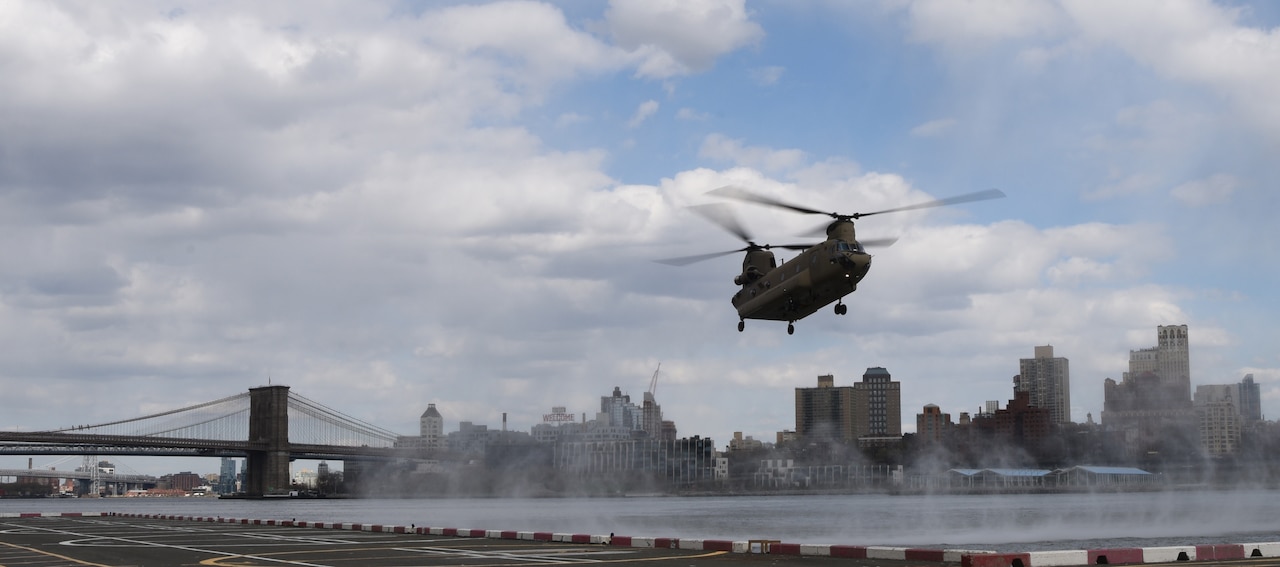
Nearly seven weeks into the COVID-19 pandemic response mission, the New York National Guard had 3,600 troops performing missions ranging from answering public inquiry hotlines to assisting New York City in retrieving the remains of those who have died at home.

Along with 2,993 Army National Guard soldiers and 452 Air National Guard airmen, members of the New York Naval Militia and the New York Guard, the state defense force, also are serving.

The emotionally and physically challenging mission of assisting the New York City medical examiner's office in the dignified recovery of human remains is the toughest mission facing the soldiers and airmen, Army Maj. Gen. Ray Shields, the New York adjutant general, said. There are 255 soldiers and airmen handling this mission.

The medical examiner's office is responsible for the recovery of people who die outside of a hospital. The staff was overwhelmed at the spike in COVID-19-related deaths in the city of 8.5 million people, so city officials turned to the New York National Guard for help, and Guard soldiers and airmen are on duty around the clock to help.

"Your work makes a difference for families at a very critical time of need when their loss is most personal," Shields told members of the detail April 2.

We want to make sure that all our health care professionals have the personal protection equipment needed to do their jobs and keep themselves safe."
Army Staff Sgt. Stephanie Kimball, New York National Guard

The mission started with specially trained airmen of the 107th Attack Wing's fatality search and recovery team. As the demands of the mission grew, additional troops were assigned. Now, soldiers from the 101st Signal Battalion, the 152nd Brigade Engineer Battalion and the 2nd Battalion, 108th Infantry, also are handling this duty.

In addition, New York National Guard soldiers and airmen are supporting 10 drive through COVID-19 test sites run by the state health department. Since the first site opened outside New Rochelle in Westchester County on March 15, 116,126 people have been tested at the sites.

A major mission has been the packaging and delivery of meals. When the mission started, the goal was to provide meals to New Rochelle families whose children would be missing school lunches because of closed schools. Since then, the effort has expanded into a major feeding operation in New York City.

As of April 18, soldiers and airmen in New York City had distributed 1,398,947 meals since the start of the mission. On April 17 alone, 111,792 meals were provided in New York City. The mission has grown so much that additional soldiers deployed from western New York to help.

On April 14, Army 1st Lt. Jessica Reed, a platoon leader in the 2nd Squadron, 101st Cavalry led 25 soldiers from Niagara Falls to New York City to assist in the food distribution mission in the Bronx. The soldiers had been preparing for the mission since March, Reed said.

"Word got out that this was a potential thing," said Reed, a member of the squadron's Bravo Troop. "We had our guys come into armories to fill out paperwork and pack the essential things we knew they might need."

The food distribution mission in Westchester County has provided 68,333 meals, while soldiers in Albany County distributed 1,406 meals to people in quarantine.

Soldiers and airmen are conducting warehouse operations at six locations across New York. They have been moving supplies to troops in the field across the state.

It's not exciting work, but it is important, said Army Staff Sgt. Stephanie Kimball of the New York Guard's 1569th Transportation Company, 369th Sustainment Brigade.


"I feel proud that we can do something in a time of need," Kimball said. "We want to make sure that all our health care professionals have the personal protection equipment needed to do their jobs and keep themselves safe."

Another necessary product being distributed by the New York National Guard is hand sanitizer being packaged by the New York Department of Corrections and Custodial Services. Troops have distributed 35,432 gallons of hand sanitizer in the Hudson Valley since the mission began.

In the state capital of Albany, soldiers and airmen have been putting together COVID-19 testing kits to support the state health department. On April 17,the soldiers produced 8,300 kits, for a total of 191,000 since the mission began.

"The Guard is helping us out with trying to get as many kits out as we can," said Alexis Tripodo, a state employee of the Division of Homeland Security and Emergency Services. "They are helping out tremendously with the speed of the completed kits and making sure it's accurate, making sure every bag is packed correctly. The more people we have, the faster we can get these to the sites and the more people we can test."

In New York City, the New York National Guard continues to support the alternative care facility for COVID-19 patients established at the Jacob K. Javits Convention Center.

Some 2,100 military medical staff members are working at Javits and in New York City hospitals. Soldiers of the Army's 44th Medical Brigade are providing staffing at the center, now operating as the Javits New York Medical Station. Additional medical staff members come from the Army Reserve, the Navy Reserve, the Air Force and the Civilian Medical Reserve Corps. A total of 2,708 people are working at the alternative care facility, and more than 950 patients have received care there.

New York National Guard members continue to manage the Javits site as the unified command post for the multiagency response and are providing other logistical and administrative help.

On Easter Sunday, Air Force Chaplain (Lt. Col.) Jacob Marvel of the New York Air National Guard's 109th Airlift Wing made sure that anyone who wanted to receive communion that day had the chance. While ensuring that social distancing protocols were followed, Marvel conducted an abridged Mass for 140 visitors to his temporary chapel at the convention center.

"My goal was to provide spiritual support for people who needed it or wanted it," Marvel explained. "We are in the midst of Holy Days for several religions, and our spirituality is an important part of how we stay balanced in this crisis."

New York National Guard soldiers are supporting an alternative care facility established at the state's South Beach Psychiatric Center on Staten Island, as well as working at the Javits location.

A unique medical mission has placed pararescue airmen of the 106th Rescue Wing at a New York City hospital to assist medical technicians there as they care for patients on ventilators.

New York National Guard soldiers and airmen have been assisting the state health department in answering calls to its coronavirus hotline since the mission began. Working at a call center in Rotterdam, N.Y., and eventually taking overnight and weekend duty, the National Guard members had fielded 183,169 calls since March 11 by late last week.

That mission was phased out early this week, and the soldiers and airmen are moving on to other duties. But a call center operation on behalf of New York City will continue. Guardsmen working there have handled more than 4,000 calls.

"Everyone is doing great work," Shields told the force in an email. "Know that your support is vital to our fellow citizens and is recognized at the highest level by our elected officials."

(Courtesy of the New York National Guard.)

Department of Defense Announces Winners of the 2020 Secretary of Defense Environmental Awards April 22, 2020


The Department of Defense (DoD) announces the 2020 Secretary of Defense Environmental Awards winners.

The awards recognize installations, teams, and individuals for their accomplishments in innovative and cost-effective environmental management strategies supporting mission readiness.  “Strong environmental programs are vital to the Department’s ability to successfully carry out its mission,” stated Ellen Lord, Under Secretary of Defense for Acquisition and Sustainment.

Each year since 1962, the Secretary of Defense Environmental Awards have honored service members and civilians across the Department of Defense.  The nominees’ achievements include significant strides to conserve our nation’s natural and cultural resources; protect human health; prevent or eliminate pollution at the source; clean up hazardous substances, pollutants or contaminants, and munitions on DoD sites; and incorporate environmental requirements into weapon system acquisition.  DoD also leverages technology to develop innovative solutions to existing and emerging human health and environmental challenges.  A diverse panel of 54 judges from Federal and state agencies, academia, and the private sector evaluated nominations from the DoD Components to help determine the winners.

In 2020, DoD selected the following nine winners from a total of 30 nominees:


  • Natural Resources Conservation, Small Installation:  Fort Custer Training Center, Michigan Army National Guard – partnered with researchers to determine the best fire application techniques to control invasive species, promote native species growth, and support wildlife, thus helping to fill the data gap between prescribed fire management and validated species outcomes.
  • Natural Resources Conservation, Individual/Team:  Conservation-Training Enhancement Team, Camp Ripley, Minnesota Army National Guard – implemented a new forestry management plan for the installation’s 28,000 acres of forests, which defines short-term (10-year) management goals based on natural resources and military training objectives.  The team developed a geographic information system viewer for forestry practices that includes layers for military training, wildlife, threatened and endangered species habitat, sensitive habitats, and past and proposed forest management activities.
  • Environmental Quality, Non-Industrial Installation:  Marine Corps Air Station Miramar, California – decreased hazardous material use and hazardous waste generation to reduce costs for the installation.  Staff reviewed and adjusted hazardous waste disposal contracts in fiscal year (FY) 2018, resulting in an annual savings of $96,000.  The installation’s Qualified Recycling Program also generated more than $240,000 in revenue in FY2018 and FY2019, which Miramar applied to the operating costs of the program and to morale, welfare, and recreation programs for active duty personnel.
  • Environmental Quality, Individual/Team:  Environmental Information Management System Team, U.S. Fleet Forces Command, Virginia – facilitated the management, production, and timely delivery of eight Environmental Impact Statements that included thousands of pages, involved dozens of stakeholders, and adhered to very tight timelines, saving the Navy time and money while generating high-quality documents.  Results enabled the fleet leadership to make informed decisions about environmental impacts for testing and training at sea.
  • Sustainability, Industrial Installation:  Naval Base Kitsap, Washington – reduced the amount of petroleum-based fuel in the installation’s fleet of non-military vehicles by using alternative fuels and electricity.  Personnel used E-85, an ethanol fuel blend, and biodiesel to divert a total of 172,831 and 171,484 gallons from fossil fuels in FY2018 and FY2019, respectively.  The installation’s vehicle inventory is also comprised of 113 electric vehicles, or 11% of the local fleet.
  • Environmental Restoration, Installation:  Camp Edwards, Joint Base Cape Cod, Massachusetts Army National Guard – adopted cutting edge electromagnetic induction sensor technology, known as the “metal mapper,” to reduce the cost of source cleanup, enhance accuracy, and minimize the number of items requiring excavation.  Camp Edwards decreased unexploded ordnance costs by up to 70%, and the installation is the only location worldwide to put the metal mapper technology into operation at an industrial scale.
  • Environmental Restoration, Individual/Team:  Vieques Environmental Restoration Team, Puerto Rico – acted immediately after Hurricane Maria struck Puerto Rico in September 2017 to inspect more than 50 beaches and all roads where munitions might have become exposed during the storm.  Staff also distributed emergency supplies, established satellite telecommunications, helped the community with debris removal, disseminated munitions safety information, and repaired mission-critical roads, fences, safety signs, and infrastructure.
  • Cultural Resources Management, Large Installation:  Naval Air Weapons Station China Lake, California – completed earthquake damage assessment, recovery, and renovation efforts to the curation facility, where over 80% of Navy Region Southwest’s historic artifacts are contained, following the largest earthquakes in the State of California in the last 20 years on July 4 and 5, 2019.
  • Environmental Excellence in Weapon System Acquisition, Large Program:  F-35 Joint Program Office, Wright Patterson Air Force Base, Ohio – monitored the use of cadmium, a human carcinogen, since the early development and production phases of the F-35 aircraft.  The team recently tested and successfully implemented a zinc-nickel plating alternative that will prevent corrosion on aircraft components and completely remove cadmium plating from F-35 aircraft production.


For more information on the 2020 winners, visit: https://www.denix.osd.mil/awards/2020secdef/.  Additional Secretary of Defense Environmental Awards Program information, including past winners, can be found at: www.denix.osd.mil/awards.

Tuesday, April 21, 2020

Joint Press Statement for the 17th Korea-U.S. Integrated Defense Dialogue (KIDD)


April 21, 2020

The Republic of Korea (ROK) Ministry of National Defense (MND) and the United States (U.S.) Department of Defense (DoD) held the 17th Korea-U.S. Integrated Defense Dialogue (KIDD) on April 21, 2020.  Due to travel restrictions as a result of the coronavirus (COVID-19) pandemic, the KIDD was held remotely via secure video teleconferencing.  ROK Deputy Minister for National Defense Policy Chung Sukhwan and U.S. Deputy Assistant Secretary of Defense (DASD) for East Asia Heino Klinck led their respective delegations composed of key ROK and U.S. defense officials.

DASD Klinck applauded the Republic of Korea (ROK)'s proactive leadership in combating COVID-19 as a model of transparency, flexibility, and rapid response for the world. He also expressed gratitude for the ROK’s efforts in support of U.S. forces and their families in the ROK. The two sides also acknowledged effective coordination to contain COVID-19.

Both sides assessed the ongoing joint work to conclude the 11th Special Measures Agreement (SMA), emphasizing the importance of concluding the SMA at a fair and mutually agreeable level that strengthens the ROK-U.S. Alliance and its combined defense posture.

Both delegations reviewed the Conditions-Based Operational Control (OPCON) Transition Plan and concurred on the importance of completing and assessing the strategic documents.  They also discussed impacts and the way ahead on the certification assessment for the full operational capability (FOC) schedule in light of the COVID-19 pandemic and other factors.

Both sides discussed ways to strengthen the Alliance's military readiness and combined defense posture to address the dynamic security changes on the Korean Peninsula and to deepen U.S.-ROK cooperation long into the future.

The two sides also shared assessments on the recent missile launches by North Korea and reaffirmed the importance of continuing close coordination to remain vigilant in the face of North Korean actions.  Furthermore, the two sides committed to cooperate closely on achieving the complete denuclearization of North Korea.  Both sides pledged to work jointly in 2020 to devise measures to strengthen the deterrence posture of the ROK-U.S. Alliance through the Deterrence Strategy Committee (DSC).

The two sides reaffirmed that the KIDD continues to play a critical role in coordinating defense policies between the ROK and the United States.  They also pledged to continue close communication and cooperation to maintain and strengthen the combined readiness posture of the ROK-U.S. Alliance, which serves as the linchpin of peace and stability on the Korean Peninsula and the Northeast Asian region.