Monday, April 13, 2020

Mobility Airmen Conduct First Transport Isolation System Medevac Mission


April 13, 2020

Air Mobility Command aircrew and medical personnel conducted the first operational use of the Transport Isolation System to perform an aeromedical evacuation of three U.S. government contractors who tested positive for the coronavirus from Afghanistan to Ramstein Air Base, Germany.

Upon arrival April 10 at Ramstein, the patients were transferred to Landstuhl Regional Medical Center for treatment.

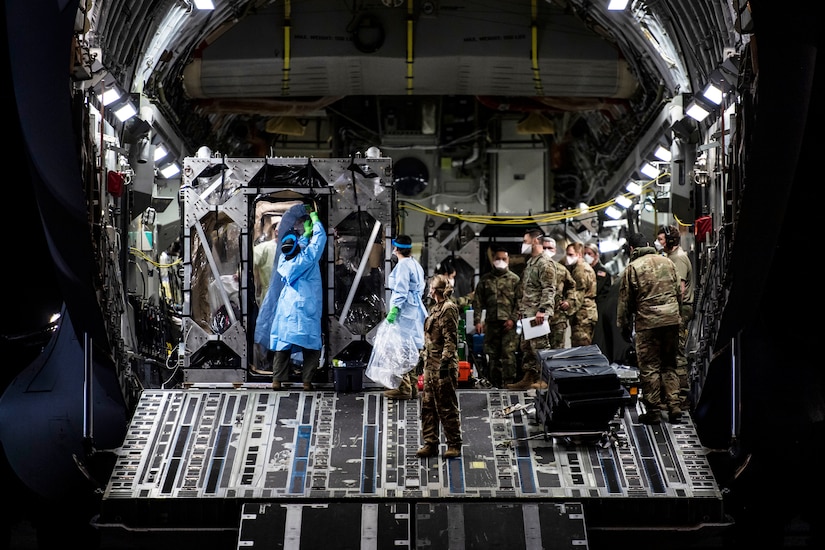
The mission, REACH 725, marked the first operational use of the TIS since its development during the 2014 Ebola outbreak in West Africa, and the first movement of COVID-19 positive patients aboard U.S. Air Force aircraft. The TIS is an infectious disease containment unit designed to minimize risk to aircrew, medical attendants, and the airframe, while allowing medical care to be provided to patients in-flight.

REACH 725 featured a full TIS force package, which includes one C-17 and aircrew carrying two TIS modules and medical support personnel, consisting of aeromedical evacuation specialists, critical care air transport team members, infectious diseases doctors and technicians, and TIS operators.

Upon receipt of a warning order from U.S. Transportation Command on April 8, the 618th Air Operations Center tasked a TIS-trained AMC aircrew and medical team at Ramstein to prepare to execute the mission within 24 hours. Drawn from multiple specialties and units from across the Air Force, these airmen were pre-staged with a C-17 from Joint Base Charleston, South Carolina, and TIS at Ramstein's 86th Airlift Wing in late March in anticipation of joint force, allied and partner requirements in Europe, Africa and the Middle East. Since arriving, these airmen have trained to increase proficiency on the movement of infectious patients via the TIS.

Airmen wearing personal protective gear wait for patient documentation in the cargo bay of a large transport jet.


"Our unique capabilities, paired with our strategic locations across the globe, enable us to rapidly help those in need," said Gen. Jeff Harrigian, commander of U.S. Air Forces in Europe-Air Forces Africa and NATO Allied Air Command. "Along with our allies and partners, we stand united against a shared threat and stand ready to help when called."

Hours before the crew stepped to the C-17, Air Force Brig Gen Jimmy Canlas, 618th Air Operations Center commander, led a teleconference call in which he provided guidance in line with the recently released AMC COVID-19 Patient Movement Plan.

"Through the meticulous effort of AMC's planners over the past few weeks, in coordination with U.S. Transportation Command, we've produced a detailed plan that guides our crews on how to safely and effectively move ill patients to a location where they can receive greater care, all while providing protection for our aircrew, medical personnel and aircraft," Canlas said. "Within hours of completing and releasing this plan to the force, the crew of REACH 725 validated the hard work of these planners by safely transporting three COVID-19 patients nearly 4,000 miles from Afghanistan to Landstuhl."

Developed by AMC planners over the past few weeks, the Patient Movement Plan provides aircrew and support personnel a comprehensive and detailed process by which to transport patients aboard pressurized, military aircraft, including patients afflicted with highly contagious diseases such as COVID-19.


"I'm exceptionally proud of our airmen who executed this historic [aeromedical evacuation] mission," said Air Force Gen. Maryanne Miller, AMC commander. "REACH 725 is a great demonstration of AMC's transition to a warfighting component command, with increased flexibility and speed enabling our mobility airmen to quickly answer any call for help during this global campaign to defeat COVID-19. Delivering hope runs deep in the blood of mobility airmen, and I'm in awe of what they are doing for those in need."

(Courtesy of Air Mobility Command.)

Saturday, April 11, 2020

First DOD Defense Production Act Title 3 COVID-19 Project


April 11, 2020

Statement attributed to Lt. Col. Mike Andrews, Department of Defense spokesman:

First DoD Defense Production Act Title 3 COVID-19 project:

$133 million investment will increase U.S. domestic N95 mask production by over 39 million over the next 90 days

"On the evening of April 10, the Department of Defense received approval from the White House Task Force to execute the first DPA Title 3 project responding to COVID-19.

The $133 million project will use these authorities to increase domestic production capacity of N95 masks to over 39 million in the next 90 days.

The increased production will ensure the U.S. Government gets dedicated long term industrial capacity to meet the needs of the nation.

Additional details, including the names of the companies, will be provided in the coming days when the contract is awarded.

For more information on Defense Production Act Title 3, please visit https://www.businessdefense.gov/DPA-Title-III/Overview/."

Army Deploys Medical Task Forces to Help Hard-Hit Communities


April 11, 2020 | BY Joe Lacdan , Army News Service

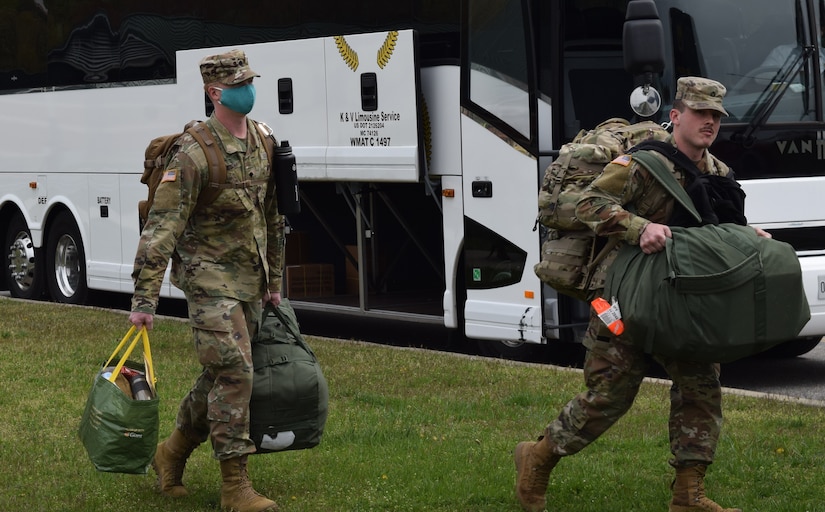
The Army has mobilized eight Urban Augmentation Medical Task Forces to the East Coast to support the coronavirus relief efforts and curb the spread of disease, senior Army leaders said.

Four task forces travelled to New York City, three are deploying to New Jersey, and one is headed to Connecticut, said Army Secretary Ryan D. McCarthy. McCarthy discussed the task forces and other measures the Army is taking to combat the COVID-19 pandemic during a media roundtable Friday at the Pentagon.

Army scientists at the U.S. Army Medical Research and Development Command at Fort Detrick, Maryland, have been working with researchers from across the globe on COVID-19 vaccines. McCarthy said six possible vaccines have shown the most promise; four are being tested on animals, and two on human subjects. Additionally, two soldiers diagnosed with coronavirus were given an antiviral drug used to treat the Ebola virus, and they successfully recovered, McCarthy said.

''They're up and walking around,'' McCarthy said. ''Obviously, that's not that substantial of a sample size, but it shows that it can work.''

McCarthy, who met with USAMRDC Commander  Brig. Gen. Michael Talley, said the research staff has been working relentlessly to find a viable vaccine.

''If you look across all our lines of operation, our labs are working 24 hours a day in the pursuit of vaccine,'' McCarthy said.

To build the Urban Augmentation Medical Task Forces, the Army called up medical professionals from Army Reserve units across the country. The Reserve volunteers were vetted to ensure they were not already engaged in the battle against coronavirus in their own communities, said Army Chief of Staff Gen. James C. McConville.

''We did not want to take medical personnel out of civilian communities where they were actually fighting the virus,'' he said.

Each task force consists of 85 people, and each has the capability of providing the same service as a 250-bed hospital, McConville said.

 ''We went ahead, and we knew that there was going to be a lot of demand for medical professionals,'' McConville said. ''…We put together these 15 Urban Augmentation Medical Task Forces, and they are motivated and ready to go.''

The task forces deployed to Joint Base McGuire-Dix-Lakehurst, New Jersey, before moving on to the hospitals where they will augment staff. Some of the units will support patients receiving treatment at the Javits Convention Center in New York City. Others will augment community hospitals.

Each task force has 14 physicians – including an infectious disease specialist and four respiratory specialists. In addition, each has 16 medics, 13 nurses, five physician assistants, two dentists, four pharmacists, two clinical psychologists, a psychiatrist, two occupational therapy specialists, four dieticians and 18 other supporting staff.

The task forces are designed to perform low-acuity care, officials said, but they can also test for COVID-19.

The remaining seven task forces are on standby and can be ready to travel within 24 hours once a location is identified by Army North and the Federal Emergency Management Agency, McConville said.

About 25,000 National Guard troops have deployed across the United States and its territories in support of the COVID-19 response. Guardsmen have built mobile COVID-19 test sites to relieve some of the burden of screening emergency room patients for coronavirus at treatment facilities in Miami and Chicago, McCarthy said.  He added that the test sites will be able to process thousands of screenings at a faster rate.

''What it does if you go from the screening to the recovery point and the healthcare continuum, it helps create an arm's reach in the screening … instead of overrunning an emergency room with hundreds of people, which then presents the challenge for health care professionals to not getting sick,'' McCarthy said. ''So by going to the (mobile test site), you can have many of these people get diagnosed, they get prescriptions, and they go home as opposed to overwhelming emergency rooms.''

McCarthy said he plans to visit both test sites next week.