By Jim Garamone, DoD News, Defense Media Activity
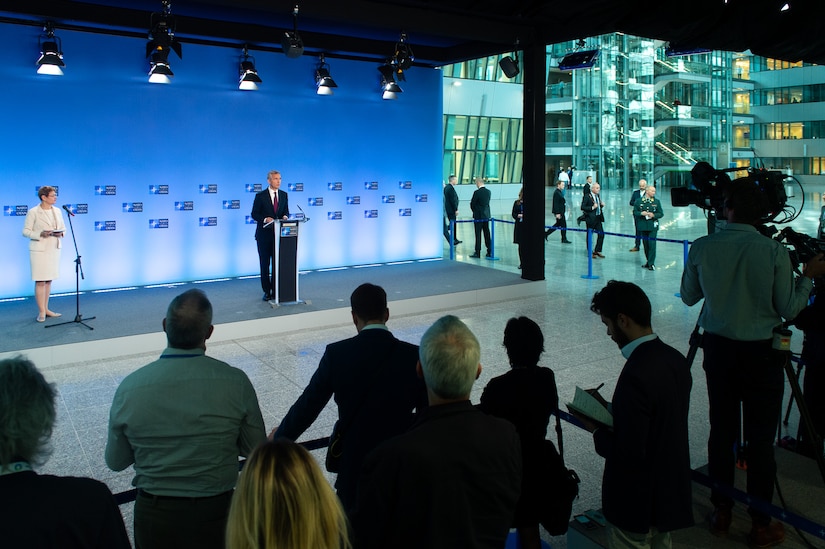
MADRID -- The NATO Military Committee Meeting in Warsaw this
past weekend was so productive because the alliance chiefs of defense were able
to build on the three-year framework put in place, Marine Corps Gen. Joe
Dunford told reporters here today.
The chairman of the Joint Chiefs of Staff said the Military
Committee was able to flesh out the NATO 360-degree approach to security
matters.
Dunford, who came to the position three-years ago, said
there was not the appreciation of the Russian challenge then, that there is
today. “There was also not the appreciation for violent extremism and the risk
of terrorism in everybody’s backyard as there is today,” he said.
Relevant Alliance
In 2015, the alliance began the debate on 360-degree
security. “At that point, all the members of the alliance wanted to know if the
alliance was relevant to the security challenges they confronted,” he said.
In the past three years, alliance heads of state have met
twice – most recently at the Brussels summit in July. The political leaders
affirmed the alliance will meet the 360-degree challenge. The alliance will
defend against the threat posed by Russia and it will address the threats
emanating from North Africa and the Middle East – primarily the risks of mass
migration and acts of terror.
Political leaders also realized that alliance readiness
levels were not where they needed to be, the chairman said. They affirmed that
NATO needed to adapt both its command structure and capabilities in order to be
relevant for the challenges faced today.
Three years ago, the alliance created enhanced forward
presence to assure allies that NATO would act. That effort has matured and
transformed into alliance deterrence, “and we need to project security to the
South to mitigate the effects of violent extremism and terrorist acts,” Dunford
said.
That political framework is in place now. As military
leaders “we don’t have to debate what to do,” the general said.
The military leaders “have a very clear mandate” to adapt
the NATO command structure. They also are working on the 4X30 readiness
initiative that calls for 30 ships, 30 aircraft squadrons, 30 battalions of
ground forces to be ready in 30 days. “So we have to figure how to implement
that,” he said.
“Everyone has a different priority to the challenges we
face, but we have cohesion in that the alliance is expected to address all 29
members security challenges whether that comes from the South or the East,” the
general said. “It’s been the journey that we’ve been on in my three years as
chairman.”
About Deterrence
The alliance is first and foremost about deterrence. Then,
if deterrence fails, it is about collective defense. “That requires a
diplomatic effort and capabilities that can convince an adversary … that the
cost that will be imposed will be much higher than whatever gain they can
achieve,” he said.
An effective deterrent posture is most important when
confronting Russia. Deterrence is across the board. NATO must deter in the
nuclear, conventional and cyber realms. They also must be ready for
capabilities that fall below the threshold of armed conflict that would be by
definition aggressive and provocative acts, Dunford said.
NATO adaptation, measures taken to enhance deterrence, the
European Defense Initiative are “all clearly intended to send a message to
Russia that there is an effective conventional deterrent and a collective
defense of NATO,” he said. “All of the activity that we do – our exercises, our
training, our force posture – is all designed to ensure that our deterrence is
effective.”




 Posts
Posts

